Chindia Alert: You’ll be Living in their World Very Soon
aims to alert you to the threats and opportunities that China and India present. China and India require serious attention; case of ‘hidden dragon and crouching tiger’.
Without this attention, governments, businesses and, indeed, individuals may find themselves at a great disadvantage sooner rather than later.
The POSTs (front webpages) are mainly 'cuttings' from reliable sources, updated continuously.
The PAGEs (see Tabs, above) attempt to make the information more meaningful by putting some structure to the information we have researched and assembled since 2006.
SHANGHAI (Reuters) – Apple Inc’s (AAPL.O) discounts on the iPhone 11 in China and the release of a new low-price SE model have put the company in a better position than rivals to weather a coronavirus-related plunge in global smartphone demand.
While China, which accounts for roughly 15% of Apple’s revenue, appears to be a rare bright spot, investors will be keen to get a picture of global demand when the Cupertino, California-headquartered company reports second-quarter results on Thursday.
The iPhone maker has shut retail stores in the United States and Europe following the COVID-19 outbreak, and China is the only major market where it has been able to reopen all shops.
Consumer spending is expected to be muted as the pandemic has crippled economies and Apple, the world’s second-most valuable tech company, is better armed with the launch of its new price-conscious iPhone model, analysts said.
“Apple is better positioned than most to experience a rapid recovery in a post COVID world,” Evercore analyst Amit Daryanani said in a research note. “We see demand as pushed out, not canceled.”
He added that the launch of the $399 iPhone SE suggested that Apple’s supply chain was getting back on its feet after weeks of shutdown earlier this year.
Analysts expect Apple to report a 6% drop in revenue and an 11% fall in net income in its fiscal second quarter, according to Refinitiv data.
On the other hand, Chinese brands such as Oppo and Vivo who have steadily moved to offer high-end models to challenge iPhones, stand to lose marketshare as bargain hunters choose Apple.
Earlier this month, several online retailers in China slashed prices of the iPhone 11 by as much as 18% – a tactic Apple has used in the past to boost demand. And while initial social media reaction to the new iPhone SE was muted, analysts said they were seeing a pick up in demand.
The cheaper iPhone SE could tempt iPhone owners to opt for a newer device, something they might have otherwise delayed in a weak economy, said Nicole Peng, who tracks the smartphone sector at research firm Canalys.
“People want to avoid uncertainty in a downturn,” she said. “Having a brand like Apple that can showcase quality and make people less worried about breakdowns or after-sales service can bring in buyers.”
CHEAP IS GOOD
Early data suggests that the Chinese smartphone market is recovering rapidly in the aftermath of the virus, and Apple has emerged relatively unscathed.
Sales of iPhones in China jumped 21% last month from a year earlier and more than three fold from February, government data showed, meaning March-quarter sales in the country were likely to have slipped just 1%.
To be sure, a recovery in Chinese demand won’t offset sales lost in the United States and Europe. And the company is yet to launch a smartphone enabled with 5G wireless technology like those offered by Asian rivals, a disadvantage for Apple so far.
But those same expensive 5G models may not sell well in the current climate of frugality, analysts said.
“If there are no massive subsidies (in China), I doubt there will be many smartphone users who will be eager to upgrade to 5G,” said Linda Sui, who tracks the smartphone sector at research firm Strategy Analytics.
Sui expects iPhone shipments in 2020 to be down 2 percentage points at the most, versus double digit declines at Chinese firms.
Apple also has revenue from its services business to fall back on. It has leveraged its large iPhone customer base to boost services revenue from music, apps, gaming and video.
“Apple’s Services segment should remain resilient in today’s work-from-home environment, thereby demonstrating the durability of Apple’s model,” Cowen analyst Krish Sankar said.
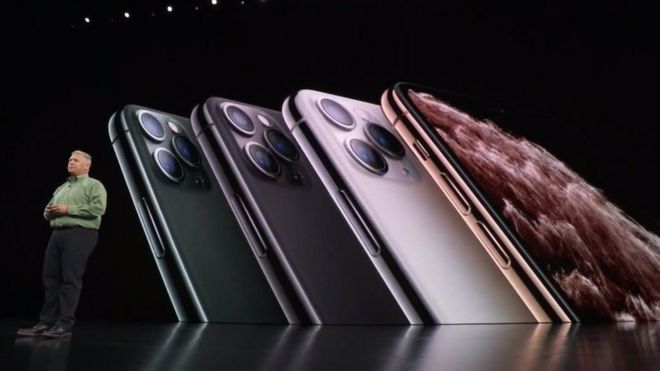
Image copyright APPLEImage caption The iPhone 11 Pro is said to last four hours more than before, while the Pro Max is said to last five hours longer
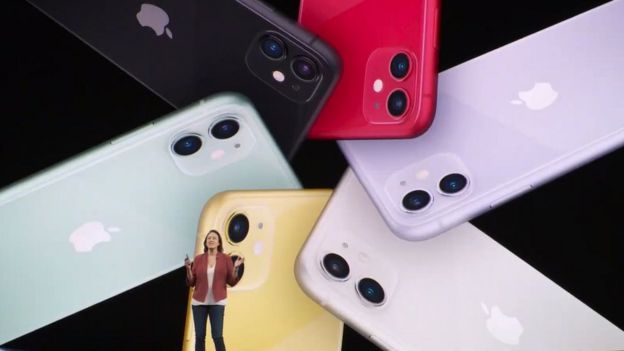
Apple has unveiled its iPhone 11 range of handsets, featuring more cameras and more battery life. But will it be enough to capture one of the world’s only growing smartphone markets?
Samsung has traditionally held dominance in the Indian “premium smartphone” segment, which refers to mobiles that cost 40,000 rupees (£451; $558) or more.
But this year, for the first time ever, Apple surged ahead of the Korean electronics giant in India. It swept up 41.2% of the premium smartphone market in the second quarter of 2019, according to research firm International Data Corporation.
“The Indian smartphone market is a game of changing fortunes,” technology journalist Mala Bhargava told the BBC. “There isn’t a company, no matter how dominant a position it commands, that can afford to sit idle.”
Apple’s latest mobile phones – the iPhone 11, 11 Pro and 11 Pro Max – will be available in India from 27 September.
And the iPhone 11, Ms Bhargava added, is primed to find success in the Indian market.
In recent months, Apple dropped its price for the iPhone 11’s predecessor, the iPhone XR, from 73,900 rupees to 53,900 rupees. The 20,000 rupee price drop was significant enough to make an impact.
“Consumers in India are known to be discount and deal-oriented,” Ms Bhargava said. “Seeing the iPhone as an aspirational product, many snapped up the mobile once prices were slashed.”
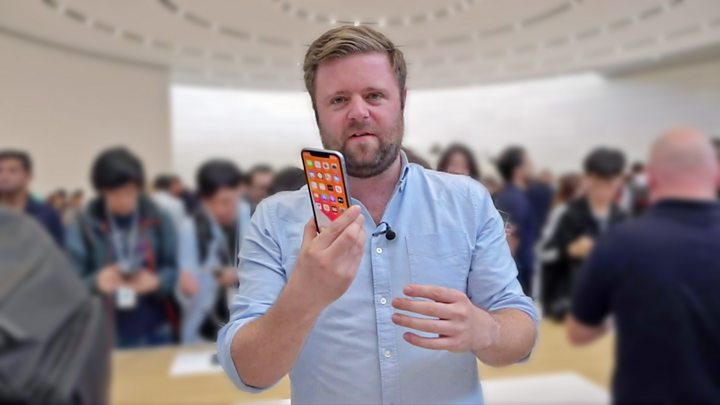
Media caption WATCH: Taking a slowfie with the iPhone 11
This, she said, is also what gave Apple the lead for the first time in India in the smartphone market.
The latest iPhones feature more cameras than before and a processor that has been updated to be faster while consuming less power. There are two Pro models, which the company said would last between four to five hours longer than their XS predecessors.
The entry-level iPhone 11 is the “perfect successor” to the iPhone XR, Ms Bhargava said.
It will start at a price of 64,900 rupees – which is not drastically higher than what the iPhone XR currently sells for.
“The discounted iPhone XR played a big part in bolstering sales in India, so it’s likely that with such a price for the iPhone 11, the company can really extend its market share,” she added.
Image copyright APPLEImage caption The entry-level iPhone 11 is said to last up to one hour longer than the earlier XR
Apple also launched the iPhone 11 Pro and iPhone 11 Pro Max, which at 99,990 rupees and 109,900 rupees a piece, will not be a key attraction as consumers will find that unaffordable.
“But at the same time, this gap could still benefit the company, leaving the field open for older iPhones and for the new iPhone 11 to increase Apple’s share in the country,” Ms Bhargava said.
The company is still selling the iPhone XR, along with the older iPhone 8, which will give consumers more choices and prices to choose from.
“With the sales of smartphones falling in the rest of the world, Apple can’t help but look to consolidate its position in India – it is almost the only market growing at an enthusiastic pace,” she added.
In the second quarter of 2019, 36.9 million handsets were shipped in India – up 9.9% from last year.
In comparison, the premium global smartphone market collapsed 8% in the first quarter this year, with much of the decline pushed by a 20% drop in Apple’s shipments.
“India still has millions of first-time phone buyers,” said Ms Bhargava, “and many of those who have been using budget phones are read to buy something better.”



 CHINDIA ALERT: You'll be living in their world, very soon