Archive for ‘ISRO’

07/09/2019

Chandrayaan-2: Modi proud despite Moon landing setback

Indian Prime Minister Narendra Modi told his country’s space scientists he was proud of a programme that had come so near to putting a probe on the Moon.

Contact with Chandrayaan-2 was lost moments before its Vikram module was due to touch down at the lunar south pole.

The fate of the craft is not yet known, but Mr Modi said there would be further opportunities.

India would have been the fourth nation to make a soft landing on the Moon.

“The best is yet to come in our space programme. India is with you,” said Mr Modi.

The Chandrayaan-2 approached the Moon as normal until an error occurred about 2.1km (1.3 miles) from the surface, officials said.
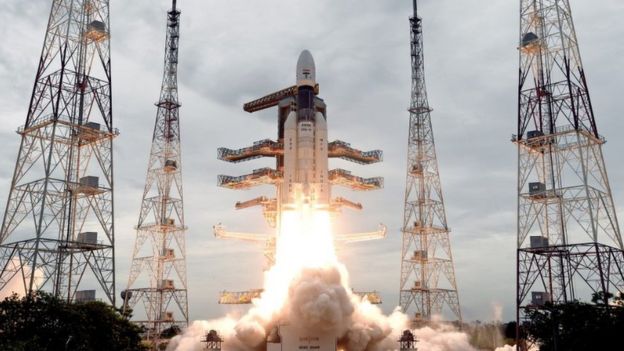
Chandrayaan-2 taking offImage copyright ISRO
Image caption The mission’s lift-off was broadcast live to an audience of hundreds of millions

India’s Space Research Organization (Isro) said it lost contact seconds before the ship was expected to land.

The country’s first Moon mission – Chandrayaan-1, in 2008 – carried out the first and most detailed search for water on the lunar surface using radars.

What happened?

Chandrayaan-2 entered the Moon’s orbit on 20 August and was due to make a controlled descent to the surface early on Saturday, Indian time, over a month after it first took off.

Staff at mission control were glued to the screens at Isro’s Bangalore space centre as the spacecraft made its descent towards the surface.

The control room burst into applause during the so-called rough breaking phase of the descent, with Prime Minister Modi watching the action from behind a glass screen.

Isro chairman Kailasavadivoo Sivan announced to staff that the ship’s initial descent had been “normal,” and that the mission’s data would be analysed.

Mr Sivan had earlier described the final descent as “15 minutes of terror”.

What was this mission all about?

Chandrayaan-2 (Moon vehicle 2) was the most complex mission ever attempted by India’s space agency, Isro. “It is the beginning of a historical journey,” Isro chief K Sivan said after launch in July.

The lander (named Vikram, after the founder of Isro) carried within its belly a 27kg Moon rover with instruments to analyse the lunar soil.

The rover (called Pragyan – wisdom in Sanskrit) had the capacity to travel 500m from the lander in its 14-day life span, and would have sent data and images back to Earth for analysis.

The mission would have focused on the lunar surface, searching for water and minerals and measuring moonquakes, among other things.

Why would it have been significant?

A soft landing on another planetary body – a feat achieved by just three other countries so far – would have been a huge technological achievement for Isro and India’s space ambitions, writes science writer Pallava Bagla.

He adds that it would also have paved the way for future Indian missions to land on Mars, and opened up the possibility of India sending astronauts into space.

For the first time in India’s space history, the interplanetary expedition was led by two women – project director Muthaya Vanitha and mission director Ritu Karidhal.
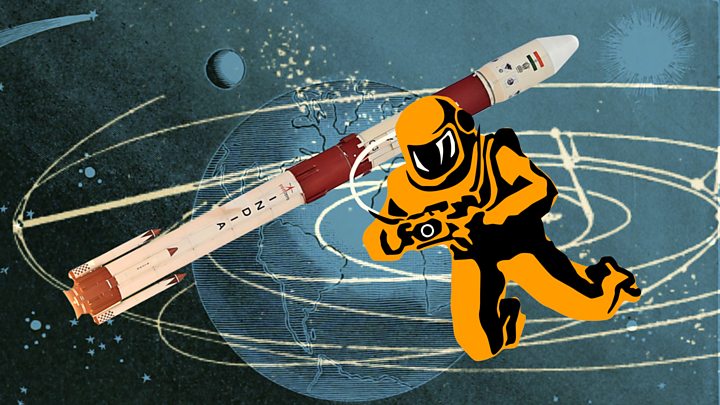
Media caption Is India a space superpower?

It is also a matter of national pride – the satellite’s lift-off in July was broadcast live on TV and Isro’s official social media accounts.

The mission has also made global headlines because it’s so cheap – the budget for Avengers: Endgame, for instance, was more than double at an estimated $356m. But this isn’t the first time Isro has been hailed for its thrift. Its 2014 Mars mission cost $74m, a tenth of the budget for the American Maven orbiter.

Source: The BBC
20/08/2019

Chandrayaan-2: India spacecraft begins orbiting Moon

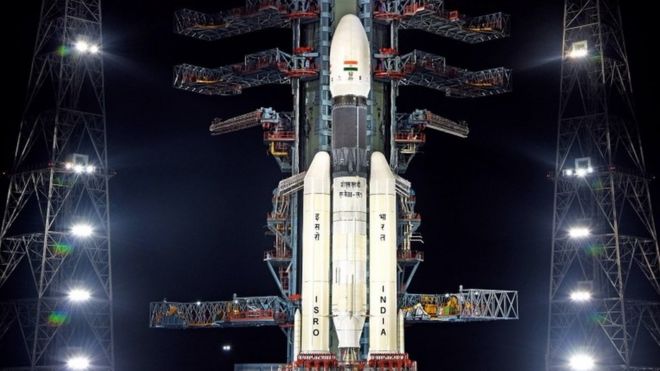
The rocket that will carry the Chandrayaan-2 satelliteImage copyright EPA
Image caption The rocket weighs as much as a fully-loaded jumbo jet

India’s second lunar module has begun orbiting the Moon, nearly a month after blasting off, officials have confirmed.

The manoeuvre to put the module into the lunar orbit was completed at 09:02 local time (04:32 GMT) on Tuesday.

Chandrayaan-2 was launched from the Sriharikota space station on 22 July, a week after the scheduled blast-off was halted due to a technical snag.

India hopes the $145m (£116m) mission will be the first to land on the Moon’s south pole.

Last month’s launch was the beginning of a 384,000km (239,000-mile) journey. Scientists hope the lander will touch down on the Moon on 6 or 7 September as planned.Presentational white space

What is this mission all about?

India’s first lunar mission, Chandrayaan-1, was launched in 2008 but it did not land on the lunar surface. However it carried out the first and most detailed search for water on the Moon using radars.

Chandrayaan-2 (Moon vehicle 2) will try to land near the little-explored south pole of the Moon.

The mission will focus on the lunar surface, searching for water and minerals and measuring moonquakes, among other things.

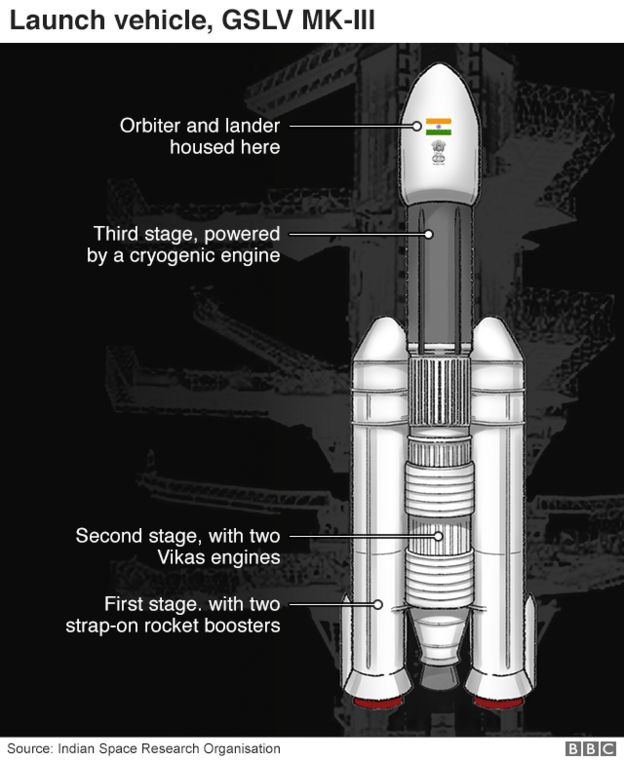
India used its most powerful rocket, the Geosynchronous Satellite Launch Vehicle Mark III (GSLV Mk-III), in this mission. It weighed 640 tonnes (almost 1.5 times the weight of a fully-loaded 747 jumbo jet) and, at 44 metres (144ft), was as high as a 14-storey building.

Graphic showing the launch vehicle with different parts labelled
The spacecraft used in the mission has three distinct parts: an orbiter, a lander and a rover.

The orbiter, which weighs 2,379kg (5,244lb) and has a mission life of a year, will take images of the lunar surface.

The lander (named Vikram, after the founder of Isro) weighs about half as much, and carries within its belly a 27kg Moon rover with instruments to analyse the lunar soil. In its 14-day life, the rover (called Pragyan – wisdom in Sanskrit) can travel up to a half a kilometre from the lander and will send data and images back to Earth for analysis.

Media caption Is India a space superpower?

How long is the journey to the Moon?

The journey of more than six weeks is a lot longer than the four days the Apollo 11 mission 50 years ago took to land humans on the lunar surface for the first time.

In order to save fuel, India’s space agency has chose a circuitous route to take advantage of the Earth’s gravity, which will help slingshot the satellite towards the Moon. India does not have a rocket powerful enough to hurl Chandrayaan-2 on a direct path. In comparison, the Saturn V rocket used by the Apollo programme remains the largest and most powerful rocket ever built.

“There will be 15 terrifying minutes for scientists once the lander is released and is hurled towards the south pole of the Moon,” Isro chief K Sivan said prior to the first launch attempt.

Graphic: How India's Chandrayaan-2 will reach the moon
He explained that those who had been controlling the spacecraft until then would have no role to play in those crucial moments. So, the actual landing would happen only if all the systems performed as they should. Otherwise, the lander could crash into the lunar surface.

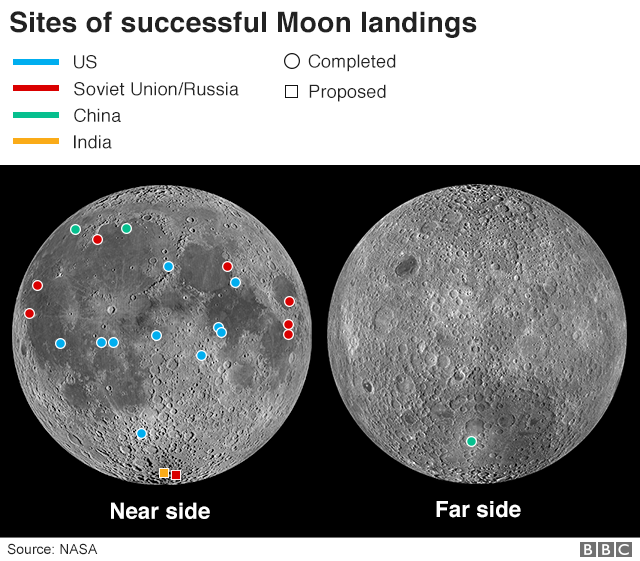
Earlier this year, Israel’s first Moon mission crash-landed while attempting to touch down.

Site of successful moon landings graphic showing where other countries have landed on the moon

Source: The BBC

22/07/2019

Chandrayaan-2: India set to re-attempt Moon mission launch

The rocket that will carry the Chandrayaan-2 satelliteImage copyright EPA
Image caption The rocket weighs as much as a fully-loaded jumbo jet

India is set to re-attempt the launch of its second lunar mission a week after it halted the scheduled blast-off due to a technical snag.

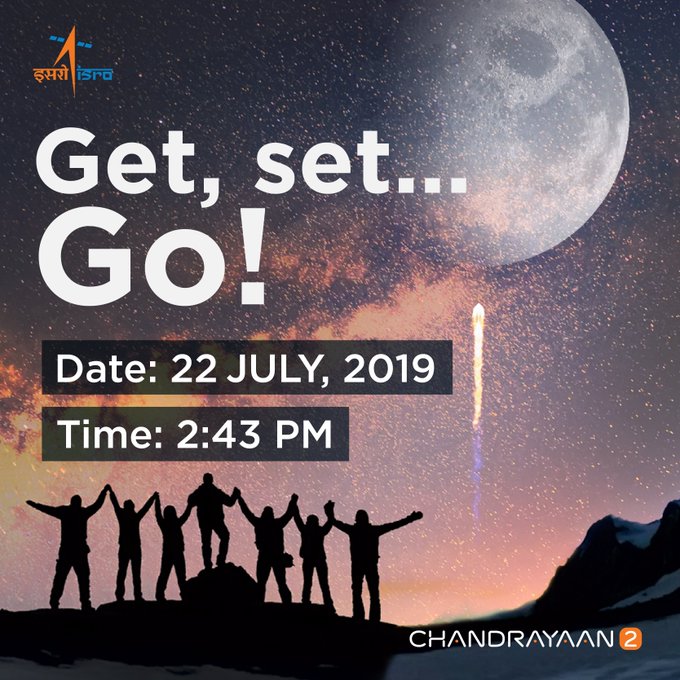
Chandrayaan-2 will be launched at 14:43 local time (09:13 GMT) on Monday, space agency Isro said.

It added the spacecraft was ready “to take a billion dreams to the Moon – now stronger than ever before”.

The space agency hopes the $150m (£120m) mission will be the first to land on the Moon’s south pole.

The countdown on 15 July was stopped 56 minutes before launch after a “technical snag was observed in [the] launch vehicle system”, according to Isro. Indian media have reported that a leak from a helium gas bottle in the cryogenic engine of the rocket was to blame.

The fuel from the rocket was drained and the scientists resolved the glitch.

“It was a simple to fix [but it was] a serious problem that could have resulted in total failure,” says a source at Isro.

Isro thanked people for supporting the mission despite the delay.

What is this mission all about?

India’s first lunar mission in 2008 – Chandrayaan-1 – did not land on the lunar surface, but it carried out the first and most detailed search for water on the Moon using radars.

Chandrayaan-2 (Moon vehicle 2) will try to land near the little-explored south pole of the Moon.

The mission will focus on the lunar surface, searching for water and minerals and measuring moonquakes, among other things.

India is using its most powerful rocket, the Geosynchronous Satellite Launch Vehicle Mark III (GSLV Mk-III), in this mission. It weighs 640 tonnes (almost 1.5 times the weight of a fully-loaded 747 jumbo jet) and at 44 metres (144ft) is as high as a 14-storey building.

Graphic showing the launch vehicle with different parts labelled
The spacecraft weighs 2.379kg (5.244lb) and has three distinct parts: an orbiter, a lander and a rover.

The orbiter, which has a mission life of a year, will take images of the lunar surface, and “sniff” the tenuous atmosphere.

The lander (named Vikram, after the founder of Isro) weighs about half as much, and carries within its belly a 27kg Moon rover with instruments to analyse the lunar soil. In its 14-day life, the rover (called Pragyan – wisdom in Sanskrit) can travel up to a half a kilometre from the lander and will send data and images back to Earth for analysis.

“India can hope to get the first selfies from the lunar surface once the rover gets on its job,” Dr K Sivan, the Isro chief, said before the first launch attempt.

Media caption Is India a space superpower?

How long is the journey to the Moon?

The launch is only the beginning of a 384,000km (239,000-mile) journey – Isro is still hoping the lander will touch down on the Moon on 6 or 7 September as planned, despite the week-long delay of the launch.

The journey of more than six weeks is a lot longer than the four days the Apollo 11 mission 50 years ago took to reach the Moon- and land humans on the lunar surface for the first time.

In order to save fuel, India’s space agency has chosen a circuitous route to take advantage of the Earth’s gravity, which will help slingshot the satellite towards the Moon. India does not have a rocket powerful enough to hurl Chandrayaan-2 on a direct path. In comparison, the Saturn V rocket used by the Apollo programme remains the largest and most powerful rocket ever built.

“There will be 15 terrifying minutes for scientists once the lander is released and is hurled towards the south pole of the Moon,” Dr Sivan said.

Graphic: How India's Chandrayaan-2 will reach the moon
He explained that those who had been controlling the spacecraft until then would have no role to play in those crucial moments. The actual landing, he added, was an autonomous operation dependent on all systems performing as they should. Otherwise, the lander could crash into the lunar surface.

Earlier this year, Israel’s first Moon mission crash-landed while attempting to touch down.

Site of successful moon landings graphic showing where other countries have landed on the moon
Who is on the team?

Nearly 1,000 engineers and scientists have worked on this mission. But for the first time, Isro has chosen women to lead an interplanetary expedition.

Two women are steering India’s journey to the Moon. While programme director Muthaya Vanitha has nurtured Chandrayaan-2 over the years, it will be navigated by Ritu Karidhal.

Source: The BBC

19/12/2018

ISRO launches GSAT-7A satellite that will improve communications for armed forces

The Indian Space Research Organisation (Isro) will launch the country’s newest satellite GSAT-7A, which will give a boost to the defence forces’ communication capabilities, from Andhra Pradesh’s Sriharikota on Wednesday.

INDIA Updated: Dec 19, 2018 16:21 IST

HT Correspondent
Isro,GSAT-7A,satellite
In the third mission in just over a month, the space agency will launch the 2,250 kg operational communication satellite from the second launch pad of Satish Dhawan Space Centre. (AP)

The Indian Space Research Organisation (Isro) on Wednesday launched the country’s newest satellite GSAT-7A, which will give a boost to the defence forces’ communication capabilities, from Andhra Pradesh’s Sriharikota on Wednesday.

In the third mission in just over a month, the space agency launched the 2,250 kg operational communication satellite from the second launch pad of Satish Dhawan Space Centre at 4.10pm on Wednesday.

The satellite was carried by the Geosynchronous Satellite Launch Vehicle-F11 (GSLV-F11), Isro’s 35th communication satellite and the 13th flight of the GSLV rocket to orbit.

The GSLV-Mk II rocket launched the satellite into the temporary orbit after a flight of nearly 20 minutes. The rocket will be taken into the geostationary or circular orbit using the onboard propulsion system and it will take few days after the separation from the launcher to reach its orbital slot.

“GSLV F11 is Isro’s fourth generation launch vehicle with three stages. The four liquid strap-ons and a solid rocket motor at the core form the first stage. The second stage is equipped with high thrust engine using liquid fuel. The Cryogenic Upper Stage forms the third and final stage of the vehicle,” the space agency said on its website.

According to reports, GSAT-7A has been built exclusively for the Indian Air Force (IAF) and the Indian Army and will add to the forces’ communication capabilities.

The satellite will allow IAF to interlink its ground radar stations, airbases and airborne early warning and control (AWACS) aircraft, and reduce the reliance on on-ground control stations for drones, they said. It will also boost the air force’s network-dependent warfare capabilities, enhancing its abilities to operate globally.

Wednesday’s mission will be the space agency’s last mission for this year. This year, Isro launched GSAT-11 on December 5 on a European vehicle from French Guinea’s Kourou, GSAT-29 on November 14 on its GSLV-MkIII vehicle and the ill-fated GSAT-6A on March 29 from Sriharikota.

The launch of Chandrayaan-2 and the PSLV-C44 remote-sensing satellite launch are among the seven missions lined up in 2019.

Law of Unintended Consequences

continuously updated blog about China & India

ChiaHou's Book Reviews

continuously updated blog about China & India

What's wrong with the world; and its economy

continuously updated blog about China & India