Archive for ‘jails’

30/07/2019

China jails award-winning cyber-dissident Huang Qi

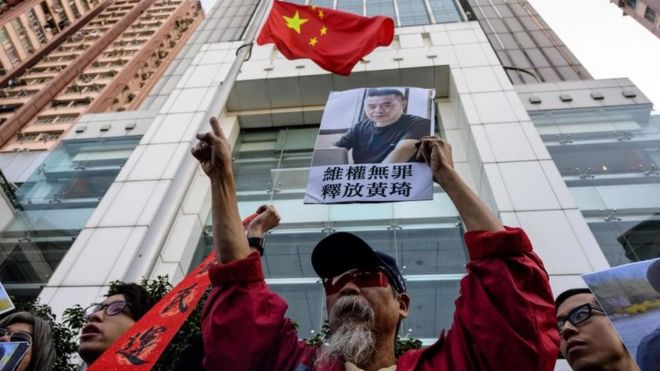
Huang Qi placardImage copyright GETTY IMAGES
Image caption Pro-democracy campaigners in Hong Kong have previously demanded Huang Qi’s release

A Chinese court has sentenced a civil rights activist widely referred to as the country’s “first cyber-dissident” to 12 years in jail.

Huang Qi is the founder of 64 Tianwang, a news website blocked in mainland China that covers alleged human rights abuses and protests.

An official statement said he had been found guilty of intentionally leaking state secrets to foreigners.

Huang has been detained since being arrested nearly three years ago.

He has already served previous prison sentences related to his journalism.

The statement, from Mianyang Intermediate People’s Court, added Mr Huang would be deprived of his political rights for four years and had also been fined 20,000 yuan ($2,900; £2,360).

Huang has kidney and heart disease and high blood pressure. And supporters have voiced concern about the consequences of the 56-year-old remaining imprisoned.

“This decision is equivalent to a death sentence, considering Huang Qi’s health has already deteriorated from a decade spent in harsh confinement,” said Christophe Deloire, the secretary-general of Reporters Without Borders.

The press-freedom campaign group has previously awarded Huang its Cyberfreedom Prize. It has now called on President Xi Jinping to “show mercy” and issue a pardon.

Amnesty International has called the sentence “harsh and unjust”.

“The authorities are using his case to scare other human rights defenders who do similar work exposing abuses, especially those using online platforms,” said the group’s China researcher Patrick Poon.

Repeated arrests

Huang created his website in 1998 to help people search for friends and family who had disappeared. But over time it began covering allegations of corruption, police brutality and other abuses.

In 2003, he became the first person to be put on trial for internet crimes in China, after he allowed articles, written by others, about the brutal crackdown of 1989’s Tiananmen Square pro-democracy protests to be published on the site.

That led to a five-year jail sentence.

He was subsequently sentenced to a further three years in prison, in 2009, after giving advice to the families of children who had died in an earthquake in Sichuan the previous year.

The relatives had wanted to sue the local authorities over claims that school buildings had been shoddily built – a claim the central government denied.

Huang was detained again, in 2014, after 64 Tianwang covered the case of a woman who had tried to set herself on fire in Tiananmen Square to coincide with the start of that year’s National People’s Congress.

Then he was arrested in November 2016 and accused of “inciting subversion of state power”, since when he has been incarcerated.

Since then, several human rights organisations, including Freedom House and the China Human Rights Lawyers Concern Group, have called for his release and raised concerns about reported threats to his 85-year-old mother, who had been campaigning on his behalf.
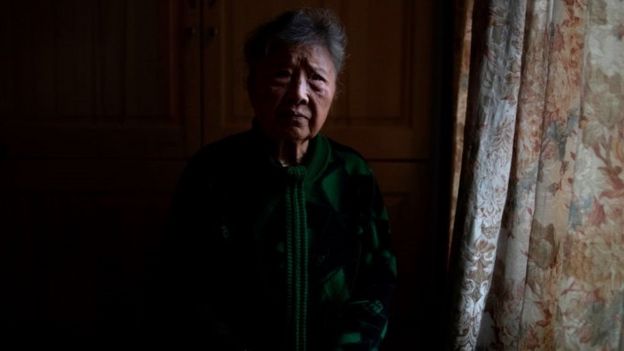
Pu WenqingImage copyright GETTY IMAGES
Image caption Huang’s mother, Pu Wenqing, had travelled to Beijing to plead her son’s case

And in December 2018, a group of the United Nations’ leading human rights experts also pressed for Huang to be set free and be paid compensation.

According to Reporters Without Borders, China currently holds more than 114 journalists in prison.

Source: The BBC

28/01/2019

Wang Quanzhang: China jails leading human rights lawyer

Wang QuanzhangImage copyrightFAMILY
Image captionWang Quanzhang went missing in a 2015 crackdown

China has sentenced prominent human rights lawyer Wang Quanzhang to four and a half years in prison for state subversion.

Wang, 42, had defended political campaigners and victims of land seizures, as well as followers of the banned spiritual Falun Gong movement.

He was one of several lawyers and activists arrested in a 2015 crackdown, and the last to go on trial.

China has intensified its prosecution of rights lawyers in recent years.

Mr Wang was “found guilty of subverting state power, sentenced to four years and six months in prison, and deprived of political rights for five years,” the court in Tianjin said.

The trial had been conducted behind closed doors with journalists and foreign diplomats barred from entering the courthouse.

Reuters news agency reports that Wang fired his state-appointed lawyer during the proceedings.

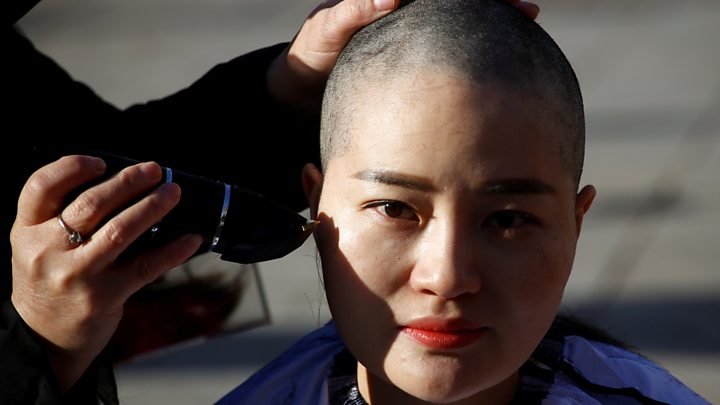
Wang’s wife, Li Wenzu, was also banned from attending and confined to her home in Beijing. A tireless champion of his case, she has shaved her head in protest against his detention and files near-weekly petitions to China’s highest court.

Media captionWang’s wife and her friends shave their heads to protest against his detention

In April, police intercepted Ms Li after she began a 100km (62 mile) march calling for her husband’s release. She was forcibly returned to Beijing and placed under temporary house arrest with her five-year-old son.

After the verdict Ms Li tweeted: “Wang Quanqi is not guilty, the public prosecution law is guilty!”

Presentational grey line

‘A chilling message’

John Sudworth, BBC News, Beijing

Wang Quanzhang had disappeared so completely into a legal black hole, that for much of the past three and half years, his family did not know if he was alive or dead.

He was denied family visits and denied the right to appoint his own lawyer.

Perhaps he’d been seriously injured, those who knew him wondered. Or perhaps, against all the odds, he was somehow managing to hold out – refusing the pressure, and perhaps the torture too, and refusing to confess.

Other lawyers caught up in the same 2015 crackdown, have since been processed, convicted and sentenced.

Whatever the reason for the delay in Mr Wang’s case – his brief one-day trial was finally held behind closed doors over Christmas – he has been found guilty for much the same reason; his attempts to use the letter of the Chinese law to hold the authorities to account in their own Communist Party-run courts.

As the Party has been making clear in recent years, it sees concepts such as constitutionalism and an independent judicial system as dangerous Western ideals.

Mr Wang’s fate is likely intended to reinforce that chilling message.

Presentational grey line

Michael Caster, researcher and author of The People’s Republic of the Disappeared, told the BBC that Wang’s case was “emblematic of Xi Jinping’s assault on the human rights and legal community”.

“The rights defence and broader civil society community in China is rightly outraged. For some time now they have rallied around Wang Quanzhang and his wife Li Wenzu as symbolic of both abuse and resistance under Xi Jinping,” he said after the sentencing.

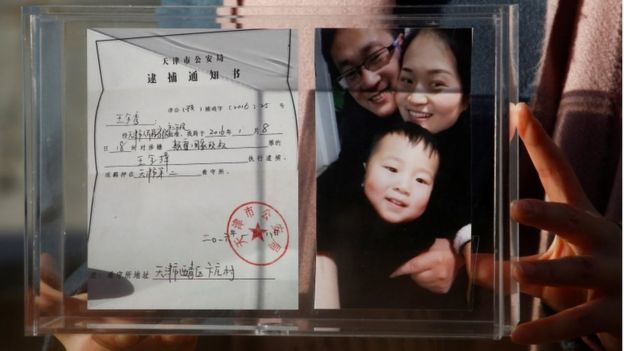
Li Wenzu, the wife of prominent Chinese rights lawyer Wang Quanzhang, holds a box with a family picture and her husband's detention notice, before shaving her head in protest in Beijing, ChinaImage copyrightREUTERS
Image captionLi Wenzu holds a family picture, and her husband’s detention notice

Mr Caster said that “the UN Working Group on Arbitrary Detention has found that Wang’s detention is arbitrary, which means that under international law he should never have faced a trial in the first place, and so obviously should never have faced any length of sentence”.

Rights groups have condemned the trial with Amnesty International calling it a “sham” and the verdict “a gross injustice”.

“It’s outrageous that Wang Quanzhang is being punished for peacefully standing up for human rights in China,” Amnesty China researcher Doriane Lau said in a statement.

China’s crackdown on lawyers, known as the “709” crackdown because it began on 9 July, has been seen by activists as a sign of a growing intolerance of dissent under President Xi Jinping.

More than 200 people were detained in that sweep, with many given jail terms, suspended sentences or house arrest.

Source: The BBC

19/12/2018

Hamid Ansari: ‘Love-struck’ Indian home after Pakistan jail ordeal

Hamid Ansari reunited with his family
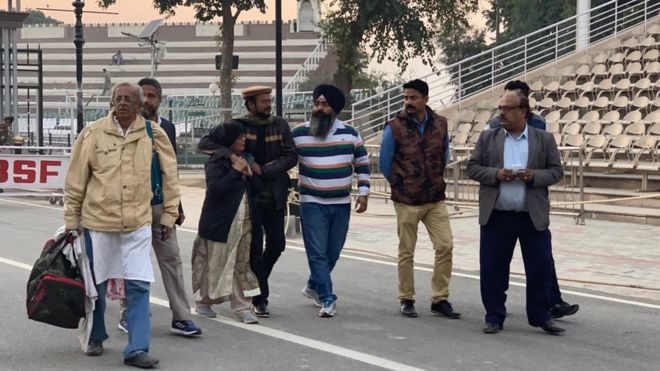
Image captionHamid Ansari reunited with his family at the border on Tuesday

An Indian man held for six years in Pakistan after illegally entering the country has returned to his family.

Hamid Ansari was convicted on charges of spying after he was found with a fake Pakistani identity card.

But his supporters said he had entered the country to pursue “blind and stupid” love with a woman he met online.

It is not clear, however, if he ever met the woman he crossed the border for.

Ansari was greeted at India’s Wagah border by his family, government officials and journalists.

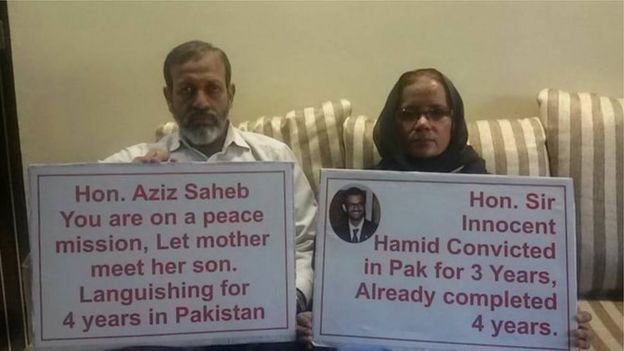
His return ends a years-long ordeal for his family who fought to first track him down, and then secure his release.

Though officially convicted in 2015, Ansari had been in Pakistani custody since 2012.

His jail term officially ended on Sunday, but his release was delayed because legal formalities had not been completed.

India and Pakistan have fought three wars since independence and the partition of India in 1947 and regularly jail each others citizens.

Who is Hamid Ansari?

Hamid Ansari is the youngest son of Fauzia Ansari, the vice-principal of a Mumbai college, and banker Nihal Ansari.

In November 2012, the 33-year-old had just started a new job as a lecturer at an educational institute when he told his parents that he was going to Afghanistan for an interview with an airline company.

But a few days after he landed in the Afghan capital Kabul, Ansari went missing.

हामिद अंसारी के माता पिताImage copyrightFAUZIA ANSARI

His family says that he stopped communicating with them, and his phone number was switched off.

Activist Jatin Desai, who has been at the forefront of efforts to get Ansari released, told BBC Hindi that that the family had then checked his laptop, where they discovered that he had been communicating with several people from Pakistan via email and social media.

They had also realised that he was in the Khyber Pakhtunkhwa province of the country.

So why did he go?

“Blind and stupid love,” according to Mr Desai.

In comments to India’s Mumbai Mirror newspaper, Mr Desai said that he first met Ansari when he had approached him about six months before his disappearance, asking for help with getting a Pakistani visa. He claimed he wanted to marry a woman in Khyber Pakhtunkhwa who he had met online.

“I had a big laugh when he told me that he wanted to marry a woman in a place notorious for honour killings. I told him to stop being stupid and concentrate on his career,” the newspaper quoted him as saying.

But the determined Ansari reportedly reached out to people in Pakistan, who apparently told him he could enter the country through Afghanistan more easily.

He entered through Torkham in Afghanistan after obtaining a fake Pakistani identity card under the name Hamza.

Then, according to documents released later, he was arrested from a hotel in Kohat city, where the girl he had come to find reportedly lived.

How did his release come about?

After his family was unable to trace his whereabouts in Pakistan, they reached out to government officials and activists for help.

Among them was Mr Desai, who has been working for many years to secure the release of both Indian and Pakistani prisoners jailed in each others countries.

A Pakistani journalist – who was later detained for a long period – managed to get in touch with Hamid’s mother in Mumbai and filed a missing person’s petition in court on her behalf.

She played an important role in encouraging a government commission on enforced disappearances to investigate his case.

As a result, security agencies, in early 2016, eventually admitted that Ansari was in their custody and had been jailed.

Hamid Ansari
Image captionAnsari pictured before he went to Pakistan

The Indian Express newspaper quoted official sources as saying that the Pakistan government did not allow any Indian officials to meet Ansari for the entire six years,

His release now is being seen as a “humanitarian gesture” by the new Pakistan government, led by Imran Khan.


The reaction from Pakistan

Ilyas Khan, BBC News, Islamabad

The morning headlines on Pakistani television channels were unanimous: “Indian spy released after completing prison term,” they said. But the reality may not be as stark.

Hamid Ansari was missing for well over three years before it was disclosed that he’d actually been picked up by an intelligence agency and sentenced to three years by a military court for espionage.

Since the military court records remain secret, it is not clear what the actual evidence was. But investigations conducted by the human rights cell of the Supreme Court and hearings held at Peshawar High Court found Mr Ansari’s account of events to be reliable in the light of evidence put before it.

At one point, Mr Ansari’s lawyer even pleaded that he should be charged for illegal entry only and that espionage charges be dropped. But the Peshawar court refused this in the end on grounds that it had no jurisdiction to overturn the ruling of a military court.

Pakistan’s foreign ministry spokesman on Monday still described Ansari as an “Indian spy” but the narrative in India is very different.

However given Mr Ansari trespassed into Pakistan at a time when militancy was at its peak, and the fact that he is an Indian national, the military court actually took a rather lenient view of his case, observers here say.

15/12/2018

China jails boss of 100 billion yuan pyramid scheme for inciting protests

BEIJING (Reuters) – A Chinese court has jailed for 17 years a businessman who ran a 100 billion yuan pyramid scheme and organised a rare street protest in Beijing against police investigations into his activities, state media reported.

Zhang Tianming and nine other staff from his company, Shenzhen-based Shan Xin Hui, were found guilty in a hearing on Friday of running a multi-level marketing company and of disturbing social order.

Shuangpai County People’s Court in central Hunan province handed Zhang a 17-year jail sentence and a 100 million yuan fine after he used social media to organise a public protest involving more than 600 people from his marketing platform, state broadcaster CCTV reported late on Friday.

The investors took to the streets of the capital in July last year, holding banners and shouting slogans, which obstructed and defied police work, the court said.

Zhang’s company had lured investors with promises of high rates of return on projects that were meant to help the poor, but had instead paid out early members purely using funds from new joiners, a court investigation found.

Nearly 6 million people and over 100 billion yuan ($14.48 billion) were involved in the scheme, the court said.

The nine other executives were handed prison sentences ranging from 18 months to 10 years, it said.

Reuters was unable to contact Zhang or the other nine individuals.

Beijing police detained 67 Shan Xin Hui investors for disturbing social order in July last year after they staged a rare protest on the heavily guarded streets of the capital.

Investors told Reuters at the time that they had come to complain that the company had been dealt a huge injustice and that it had genuinely helped a lot of poor people. They said by detaining its leaders, the government had unfairly targeted the company, which they called a charity.

The government has repeatedly vowed to crack down on financial crime and fraud. In 2016, Chinese authorities shut down peer-to-peer lender Ezubao over an online scam that state media said took in some 50 billion yuan from about 900,000 investors.

Law of Unintended Consequences

continuously updated blog about China & India

ChiaHou's Book Reviews

continuously updated blog about China & India

What's wrong with the world; and its economy

continuously updated blog about China & India