Archive for ‘Jean-Claude Juncker’

02/10/2019

France’s Emmanuel Macron to meet Xi Jinping in China next month with focus on climate change and trade, source says

  • The trip comes amid growing resistance from European leaders over what they see as China’s failure to change long-term practices unfair to foreign investors
  • French President’s trip to Beijing follows Chinese leader’s visit to France in March
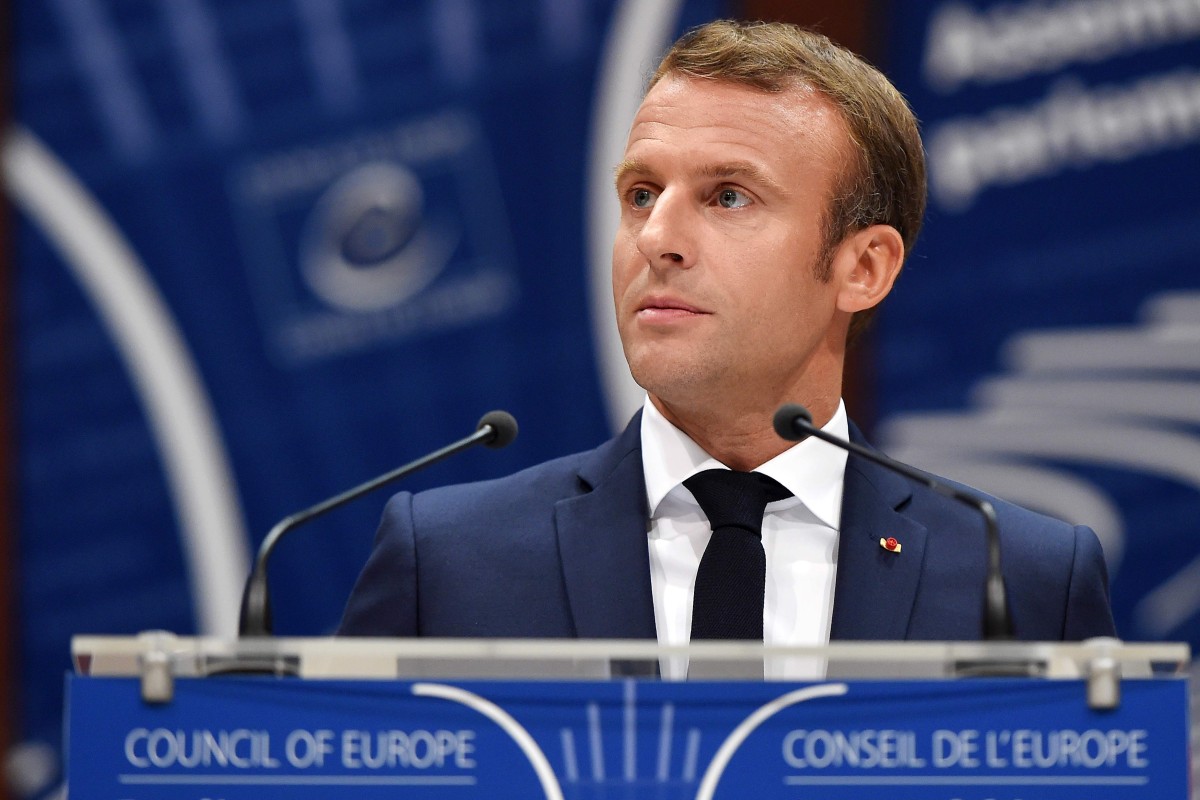
President Emmanuel Macron of France speaks to the Council of Europe parliamentary assembly on Tuesday. Photo: AFP

French President Emmanuel Macron will visit China next month as Europe’s most diplomatically active leader focuses on climate change cooperation and trade promotion with Asia’s leading power, a source briefed on the Elysee Palace’s discussions said.

This will be the second Chinese tour for Macron since he took office in 2017, and it will come amid escalating resistance from European politicians and business communities over what they see as China’s failure to change long-standing practices unfair to foreign investors.

His visit also comes at a time when France – as well as the European Union as a whole – is bracing for Washington’s potential levies of tariffs on European products, and the lack of progress on climate change policies with US President Donald Trump’s administration.

“President Macron will meet President Xi [Jinping], while France strives for better cooperation with China on climate and trade,” the source said. “His itinerary is still in the pipeline, but he is expected to visit Beijing and Shanghai.”

Macron, 41, who is widely seen as emerging as Europe’s most aggressive leader filling the political vacuum left by German Chancellor Angela Merkel’s political twilight, has cast himself as an honest broker between Russia and Ukraine, and between the US and Iran.

He has also been critical of China’s influence in Europe, joining forces with Merkel to push for a tougher EU stance on the world’s second biggest economy.

In March, when Xi claimed a major diplomatic victory by clinching a memorandum of understanding with Italy on the Belt and Road Initiative, Macron declared: “The time of European naivety is ended. For many years we had an uncoordinated approach and China took advantage of our divisions.”

Macron also backed investment screening mechanisms for Chinese business moves in Europe, while endorsing plans to change the EU’s notoriously strict antitrust rules in order to facilitate mergers between large European groups and companies to counter Chinese companies’ global ambitions.

Macron urges Iran and US to show ‘courage of building peace’

The EU is also wary of China’s effort to “divide and rule” the European Union. Greece and Hungary – both recipients of large amounts of Chinese investments – have repeatedly wanted to water down EU’s stance on issues deemed sensitive to Beijing, including the South China Sea and China’s human rights violations.

“It would be good [for Macron] to stress that 17+1 is irritating,” said Joerg Wuttke, president of EU Chamber of Commerce in China, in reference to China’s engagement with a group of EU and non-EU member states in eastern and southeastern Europe.

“After all, the EU has a ‘one China’ policy, [so] EU could expect this position from China too.”

Macron’s domestic call for EU unity has translated into diplomatic appeals, with China being one of the targets.
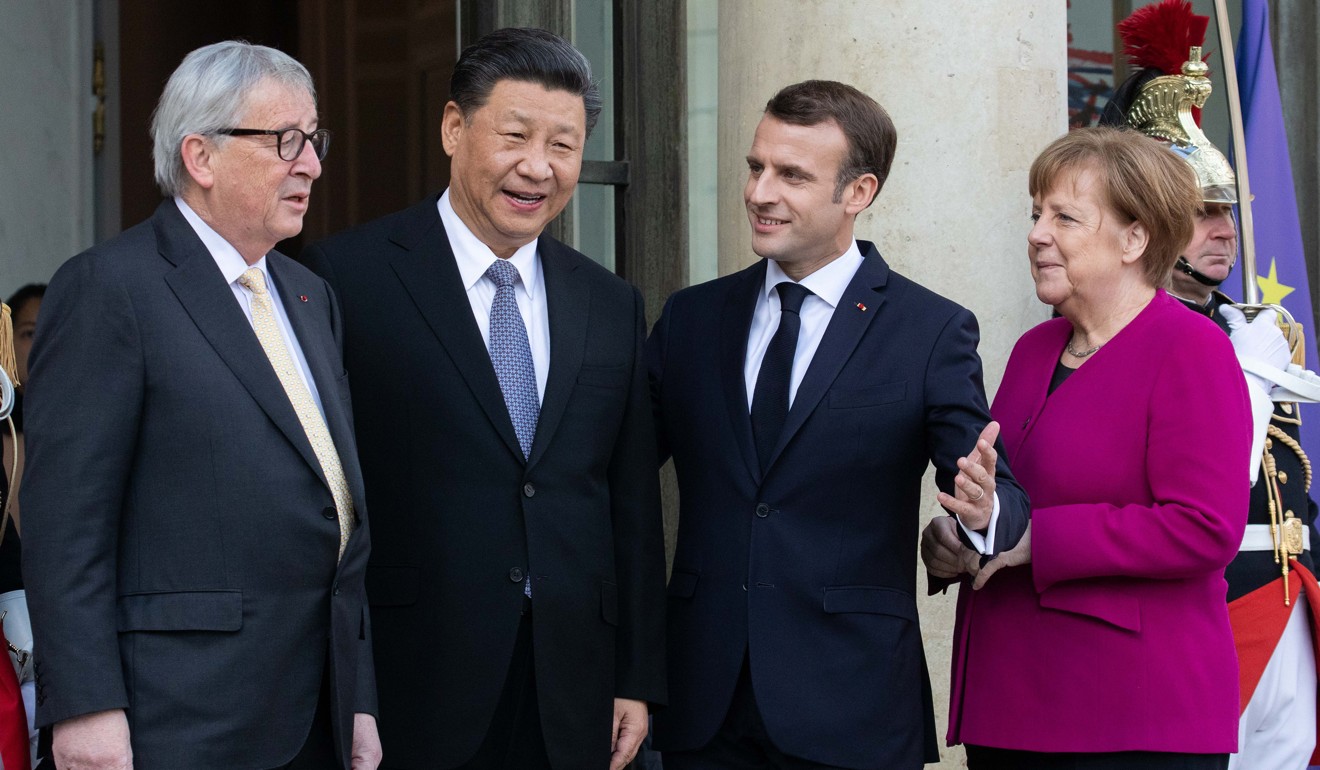
(From left) Jean-Claude Juncker, president of the European Commission; Xi Jinping, China’s leader; Emmanuel Macron, France’s president; and Angela Merkel, Germany's chancellor, ahead of a meeting in Paris on March 26. Photo: Christophe Morin/Bloomberg
(From left) Jean-Claude Juncker, president of the European Commission; Xi Jinping, China’s leader; Emmanuel Macron, France’s president; and Angela Merkel, Germany’s chancellor, ahead of a meeting in Paris on March 26. Photo: Christophe Morin/Bloomberg

When Xi visited France in March, Macron hosted him at the Elysee Palace in the presence of Merkel and European Commission President Jean-Claude Juncker, showcasing European solidarity when it comes to EU-China policies.

In terms of French-Chinese bilateral ties, trade imbalances have persisted after Macron called for a “rebalancing” during his last visit.

France has a 1.4 per cent market share in China, compared with China’s 9 per cent market share in France. China represents France’s largest bilateral trade deficit, totalling €US$29.2 billion (US$31.9 billion) last year, ahead of Germany.

The EU has been calling for reciprocal investment treatment with China, a call that European business leaders in China expect Macron to make.

France bids farewell to late president Jacques Chirac

“We [Europe] need … a solid investment agreement to allow EU business to conduct their affairs in a similar manner as Chinese companies can operate in Europe. The agreement should be finalised in 2020, but not at all cost,” said Wuttke.

“The last thing EU business needs in China is a weak agreement that institutionalises imbalances,” he added.

Part of that involves building “more efficient defensive tools to prevent abusive technology transfers and to address the deep asymmetry in EU-China relations when it comes to access to public procurement markets,” said Mathieu Duchâtel, director of Asia programme at the Paris-based think tank Institut Montaigne.

Duchâtel added that it was also important to convey the message to Beijing that there are areas for cooperation even amid a more defensive China policy from France.
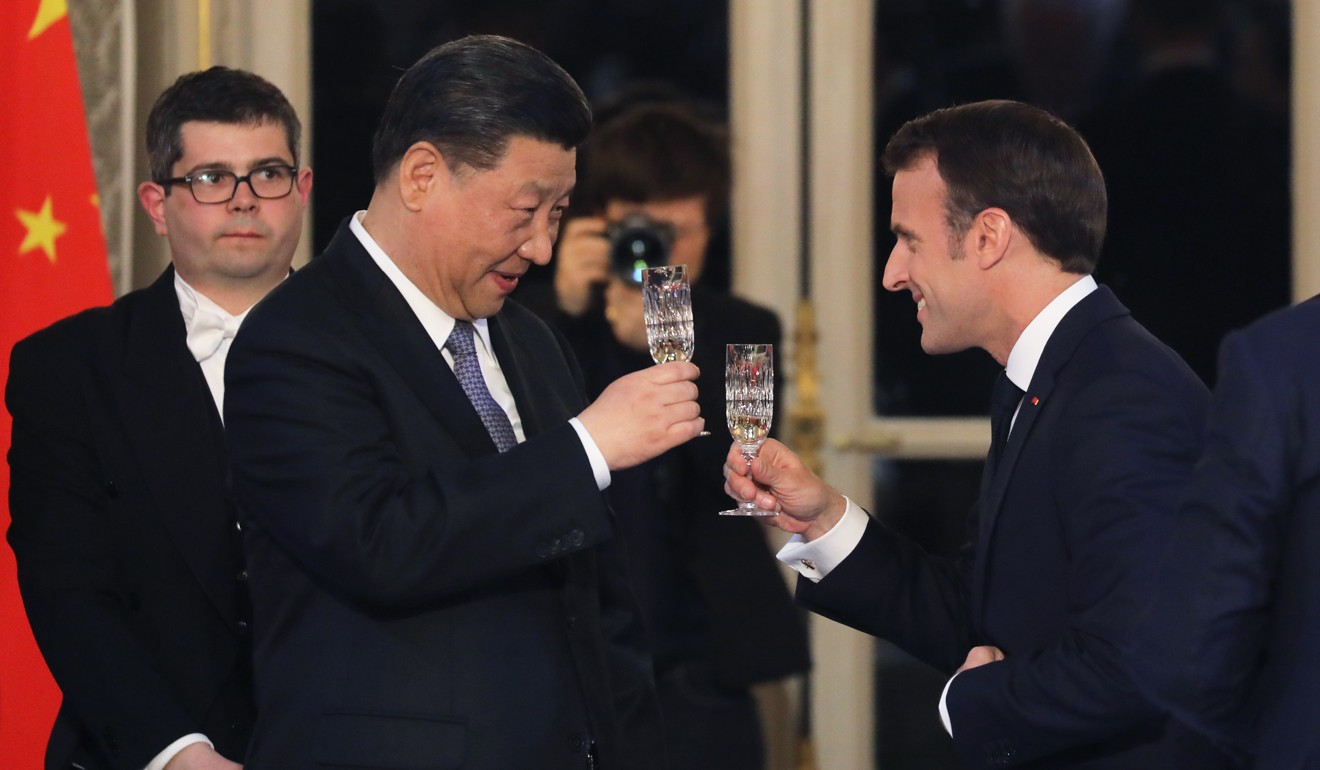
Chinese President Xi Jinping and French leader Emmanuel Macron toast raise a toast during a state dinner in Paris on March 25. Photo: EPA-EFE

One such area is the climate and environment, where China is “an important partner” for France to reach its goal of global carbon neutrality by 2050, he said.

“The energy/environment agenda is a political priority in Paris and one of very few issues on which cooperation with China remains promising and will continue to create business opportunities,” he said.

China is the world’s biggest carbon polluter, producing around 30 per cent of the planet’s man-made carbon dioxide. It remains committed to the 2015 Paris accord on climate change, even after Trump pulled the US out of the deal.

Under the agreement, the long-term temperature goal is to keep the increase in global average temperature to well below 2°C above pre-industrial levels, and to pursue efforts to limit the increase to 1.5°C.

Source: SCMP

21/05/2019

China, EU sign milestone agreements on civil aviation cooperation

BELGIUM-BRUSSELS-CHINA-EU-CIVIL AVIATION-COOPERATION

Representatives from China and the European Union shake hands after signing agreements on civil aviation cooperation in Brussels, Belgium, on May 20, 2019. China and the European Commission on Monday signed two milestone agreements on civil aviation, marking an important step to implement the consensuses reached by leaders from both sides during the China-EU Summit held last month. (Xinhua/European Union)

BRUSSELS, May 20 (Xinhua) — China and the European Commission on Monday signed two milestone agreements on civil aviation, marking an important step to implement the consensuses reached by leaders from both sides during the China-EU Summit held last month.

The two agreements are Agreement on Civil Aviation Safety between China and the European Union (EU) and Agreement between China and the EU on Certain Aspects of Air Services.

Hailing the two aviation agreements as “a first big step”, European Commission President Jean-Claude Juncker said: “In an increasingly unsettled world, Europe’s partnership with China is more important than ever before.”

“The EU firmly believes that nations working together makes the world a stronger, safer and more prosperous place for all,” Juncker said in a statement.

The two agreements “will create jobs, boost growth and bring our continents and peoples closer together. Today’s agreements show the potential of our partnership (with China) and we should continue on this path of cooperation,” he said.

Feng Zhenglin, head of the Civil Aviation Administration of China (CAAC), said the two agreements will further promote cooperation between China and Europe in civil aviation fields while enriching the content of China-EU comprehensive strategic partnership.

“Signing of the first agreement and its airworthiness certification annex is a response to the call for aviation industry development in both China and Europe, and is conducive to the two-way exchanges of civil aviation products developed and manufactured by both sides,” Feng said ahead of the signing ceremony.

“The signing of the second one will remove the contradiction between the bilateral air services agreements signed by China and EU member states and EU law, and will provide legal certainty for the operation of air carriers from both sides,” said Feng.

“The two agreements will for sure bring China-EU civil aviation cooperation to a new stage and a new high,” he added.

“The two agreements … are highly professional and reflect the broadness and depth of the two sides’ cooperation. Both China and the EU stand for multilateralism and want to build an open world. Strengthening cooperation in the field of civil aviation is a strong example of walking the talk,” Ambassador Zhang Ming, head of the Chinese Mission to the EU who also attended the ceremony, said in a statement.

The main objective of the first agreement is to support worldwide trade in aircraft and related products, the EU said in the statement.

“This agreement will remove the unnecessary duplication of evaluation and certification activities for aeronautical products by the civil aviation authorities, and therefore reduce costs for the aviation sector. The agreement will also promote cooperation between the EU and China towards a high level of civil aviation safety and environmental compatibility,” it said.

The second agreement marks China’s recognition of the principle of EU designation, whereby all EU airlines will be able to fly to China from any EU member state with a bilateral air services agreement with China under which unused traffic rights are available, read the statement.

Up until now, only airlines owned and controlled by a given member state or its nationals could fly between that member state and China. The conclusion of a horizontal agreement will thereby bring bilateral air services agreements between China and EU member states into conformity with EU law — a renewed legal certainty which will be beneficial to airlines on both sides, it said.

Source: Xinhua

09/04/2019

Assertive EU to face resistant China at trade-focused summit

BRUSSELS (Reuters) – Chinese Premier Li Keqiang and EU institution leaders meet in Brussels on Tuesday for an annual EU-China summit set to be overshadowed by differences over trade and investment.

After years of offering free access to its markets, the European Union has said it is losing patience with Beijing over the pace of liberalising reforms. It also has growing concerns over state-led Chinese companies’ dominance of some EU markets and acquisitions of strategic industries.

Like the United States, many EU countries want to crack down on industrial subsidies and forced technology transfers, although prefer dialogue to the trade war Washington has triggered.

The European Commission set out a 10-point action plan last month, seeing scope for greater cooperation in fields such as climate change, but demanding greater reciprocity, such as access for EU firms to Chinese public tenders.

“The old narrative is absolutely obsolete,” Commission Vice President Jyrki Katainen told Reuters.

Beijing and Brussels have been wrestling for weeks over the text of a joint declaration to be presented as the fruit of Tuesday’s summit between Li and Commission President Jean-Claude Juncker and European Council chief Donald Tusk.

“China aims to have a feel-good summit, whereas we aim to have a meaningful summit, with a meaningful outcome,” Peter Berz, acting Asia director at the Commission’s trade section, told the European Parliament last week.

EU diplomats said on Monday negotiators had made some progress, but were still short of an agreed text. Talks would continue until the summit, due to start at 1 p.m. (1100 GMT).

China points to a new foreign investment law due to take effect at the start of 2020. It includes provisions to ban forced technology transfers and ensure foreign companies have access to public tenders.

EU officials say the law lacks detail and question how effective it will be in reality in protecting foreign firms.
Li wrote in a German newspaper on Monday that China wanted to work with the European Union on issues including trade and denied Beijing was trying to split the bloc by investing in eastern European states.
Source: Reuters
26/03/2019

EU leaders hold out olive branch to Chinese ‘rival’ with hint they are open to Belt and Road Initiative

  • Angela Merkel says Europe is still keen to participate in infrastructure scheme despite concerns about spread of Chinese influence
  • EU Commission chief Jean-Claude Juncker seeks to reassure Chinese leader Xi Jinping that view of China as ‘strategic rival’ is a compliment
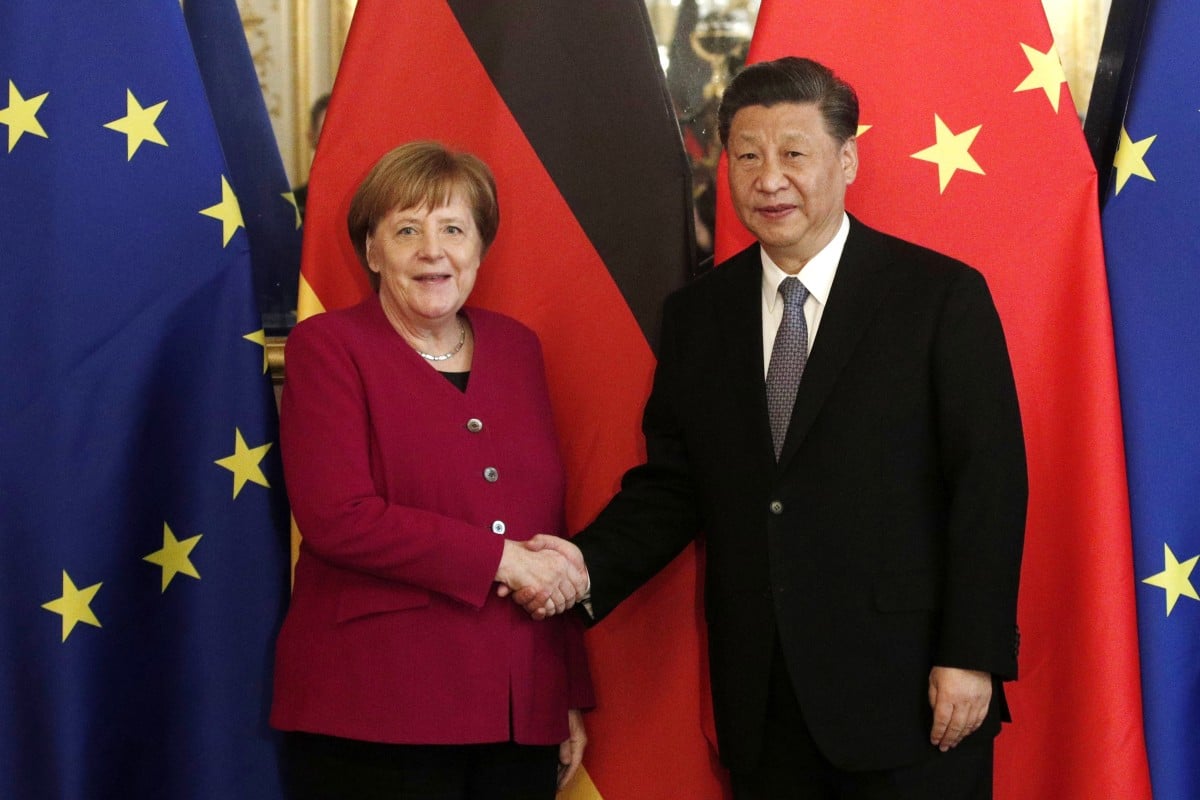
Xi Jinping and Angela Merkel and the Paris meeting. Photo: EPA-EFE

European leaders sought to reassure China over trade and cooperation on Tuesday by suggesting they were still open to joining China’s Belt and Road Initiative.

French President Emmanuel Macron, who is hosting his Chinese counterpart Xi Jinping on the final leg of his European tour, had invited German Chancellor Angela Merkel and European Commission President Jean-Claude Juncker to the meeting in Paris, where the four stressed their support for multilateralism and the pursuit of cooperation between major powers.

The visit took place amid growing European scepticism about China’s influence and follows a decision by Brussels to brand China a “systemic rival” in a policy paper earlier this month.

The scheme has caused increased concern in the West about the extent to which it will help spread Chinese influence, especially since Italy became the first G7 economy to join the project over the weekend.

But Merkel stressed it was an important project that Europeans still wanted to participate in.

She continued: “We, as Europeans, want to play an active part and that must lead to a certain reciprocity and we are still wrangling over that a bit.

“We are seeing the project as a good visualisation of interaction, interrelation and interdependence.”

Xi also said China’s process of opening up its economy to the world had allowed the country to achieve in the space of 40 years what the Europeans had managed over the course of the industrial revolution.

“We will continue to open up,” he said, “and to make the world a better open economy.”

“The Belt and Road Initiative has enriched the world’s multilateral system, we welcome all countries, including France, to join,” Xi said.

The US has also put increasing pressure on European countries to block the Chinese tech giant Huawei, which it sees as a security threat, from playing a role in European communications networks.

Despite her support for Xi’s stance on multilateralism, Merkel was still keen to express support for America’s role in upholding global order.

“The triangle between EU, China and US is very important. Without the US, we will not be able to have multilateralism. Our relations from the European side are obviously very important,” Merkel said.

However, she also noted that the trade war between the US and CHina was “hitting our German economy” and disturbing the balance.

Source: SCMP

Law of Unintended Consequences

continuously updated blog about China & India

ChiaHou's Book Reviews

continuously updated blog about China & India

What's wrong with the world; and its economy

continuously updated blog about China & India