Archive for ‘Latin America’

30/07/2019

Fight against terrorism, extremism in Xinjiang should be supported, respected: Chinese FM

BEIJING, July 29 (Xinhua) — The attempt of some Western countries to tarnish the image of the Xinjiang Uygur Autonomous Region is doomed to fail, and the fight against terrorism and extremism in Xinjiang should be supported and respected, a Chinese foreign ministry spokesperson said Monday.

Recently, ambassadors from 50 countries to the United Nations Office at Geneva (UNOG) have sent a joint letter to the President of the UN Human Rights Council (UNHRC) and the High Commissioner for Human Rights to voice their support for China’s position on issues related to Xinjiang.

The 50 ambassadors, who are from countries including Russia, Pakistan, Saudi Arabia, Algeria and Cuba, have collectively stated for the first time that the counter-terrorism and de-radicalization measures, including the establishment of vocational education and training centers, have effectively safeguarded basic human rights in Xinjiang, spokesperson Hua Chunying told a press briefing.

According to media reports, 24 members of the UNHRC have previously signed a letter criticizing China’s position on relevant issues.

“The 24 members, with a total population of no more than 600 million, are all developed Western countries, none of them being an Islamic or developing country. While of the 50 countries that support China are from Asia, Africa, Latin America and Europe, with a total population of nearly 2 billion, 28 are members of the Organization of the Islamic Cooperation, and their population is more than twice that of the 24 members that criticized China,” Hua said. “So it’s obvious who is right and who is wrong on the matter of Xinjiang,” she added.

Hua said many of the ambassadors who supported China’s Xinjiang policy have visited Xinjiang and witnessed the truth.

As the ambassadors pointed out, those who had visited Xinjiang found what they saw and heard was completely different from what was described in Western media reports, according to Hua.

“The ambassadors also appreciated China’s achievements in human rights, believed that Xinjiang’s establishment of vocational education and training centers, as well as other counter-terrorism and de-radicalization measures, effectively guaranteed basic human rights and urged relevant countries to stop their unfounded accusations against China,” said the spokesperson.

“This fully shows that the international community has its fair judgment on the development of Xinjiang,” said Hua, adding that attempt to smear Xinjiang and put pressure on China in the name of “human rights” will never succeed.

Pointing out that the current problem in Xinjiang is the issue of counter-terrorism and extremism rather than religious and human rights issues, Hua said the counter-terrorism and de-radicalization struggle in Xinjiang deserve support, respect and understanding.

“Faced with severe threats of terrorism and extremism, the Xinjiang Uygur Autonomous Region has taken a series of counter-terrorism and de-radicalization measures according to law, including the establishment of vocational education and training centers,” said Hua, adding that those measures have turned the situation around.

“In almost three years, not a single violent or terrorist incident took place in Xinjiang. The region now enjoys social stability and unity among all ethnic groups. People there are living a happy life with a stronger sense of fulfillment and security. They endorse the government’s policies and measures wholeheartedly,” said the spokesperson.

Noting that many of the 24 countries that denounce China’s Xinjiang policy have been victims of terrorism, Hua said relevant people and officials from these 24 countries are welcome to visit Xinjiang to learn about Xinjiang’s counter-terrorism and de-radicalization experience.

Hua said China is working with all parties to ensure that multilateral human rights mechanisms stick to the purposes and principles of the UN Charter. Human rights issues should be dealt with in an objective, fair and non-selective way. “We need to advance international human rights cause in a sound manner through constructive dialogue and cooperation.”

“We resolutely oppose any country’s act of using the Human Rights Council and other mechanisms to interfere in other countries’ internal affairs and wantonly criticize, smear and pressure others. We urge the relevant countries to correct their mistakes at once, not to politicize the relevant issue or practice double standards, and stop meddling in other countries’ domestic affairs,” she added.

Source: Xinhua
28/07/2019

Latin America trade grows as China and US tussle for influence

  • Chinese Foreign Minister Wang Yi wraps up tour of Brazil and Chile, as Colombian president heads for Beijing
  • Ecuador president tells US Secretary of State Mike Pompeo ‘smaller countries pay when the big ones fight’
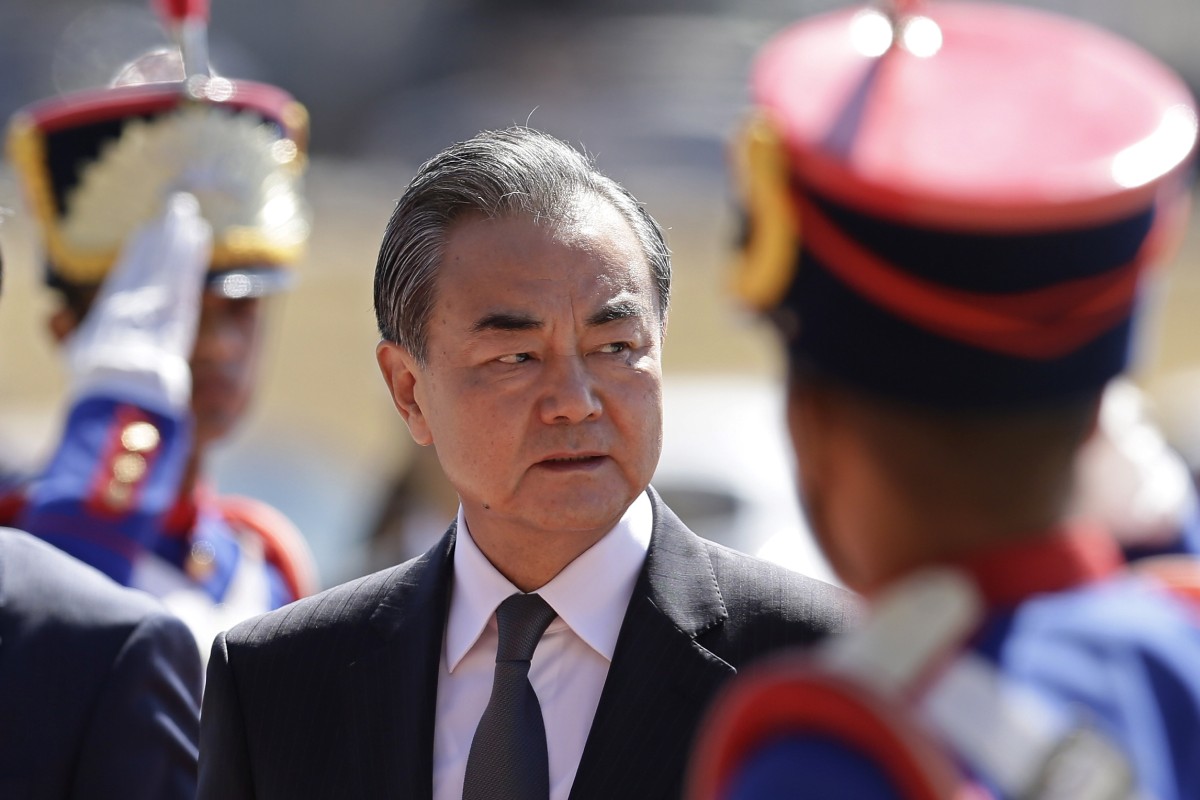
Chinese Foreign Minister Wang Yi is greeted by an honour guard as he arrives at the Itamaraty Palace for a meeting with his Brazilian counterpart Ernesto Araujo on Thursday. Photo: AP
Latin American countries are caught in the middle of a geopolitical tug of war between Beijing and Washington as China boosts its ties in the region in a bid to counterbalance the effects of its trade war with the US.
China’s Foreign Minister Wang Yi wraps up a tour of Latin America on Sunday which began last week in Brazil and ended with an official visit to Chile. He returns to Beijing on the same day Colombia’s President Ivan Duque Marquez arrives for a three-day state visit to China which will include a meeting with Chinese President Xi Jinping.
Wang was in Brazil for the latest summit of foreign ministers from the BRICS countries – an association of emerging countries made up of Brazil, Russia, India, China and South Africa – as well as the third China-Brazil foreign ministers’ comprehensive strategic dialogue with Brazilian Foreign Minister Ernesto Araujo.
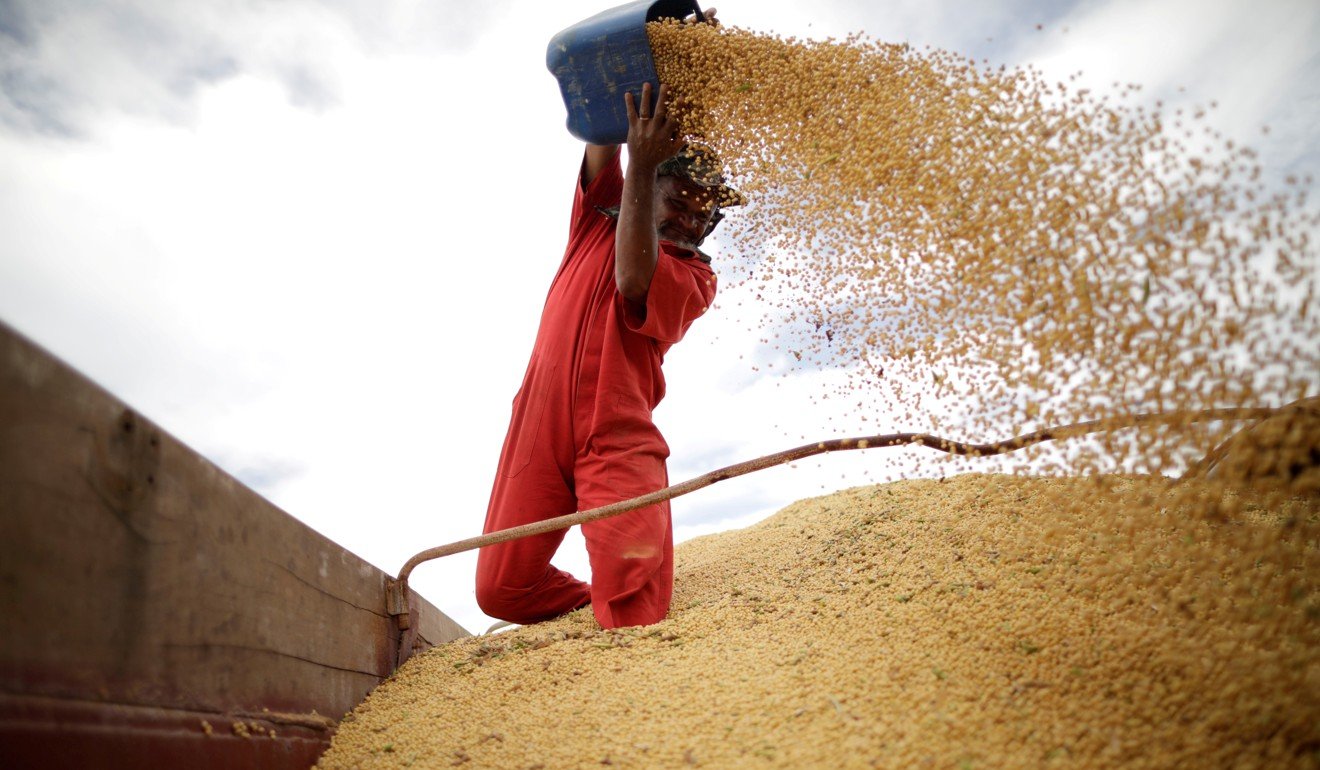
China has overtaken the US as Brazil’s largest trading partner, with Brazilian soybeans – one of the country’s biggest exports – and other agricultural products replacing American imports since the start of the US-China trade war a year ago.
Brazilian soybeans – one of the country’s biggest exports – and other farm products are being sold to China as a result of the trade war. Photo: Reuters

The growing importance of China to Brazil’s economy has created a difficult position for President Jair Bolsonaro, who accused Beijing of trying to buy Brazil during his election campaign, but changed tack on assuming office in January.

In March, Bolsonaro called China his country’s “main partner, politically as well as economically and commercially” and announced plans to travel to Beijing this year, a visit which was confirmed on Tuesday for late October.

China is now Latin America’s second largest trading partner with bilateral trade at US$307.4 billion, growing 18.9 per cent over the previous year, according to China’s ministry of commerce, in a relationship focused on commodity imports, including mining products like copper and energy, as well as soybeans and other agricultural goods.

While the US and China have tentatively agreed to resume talks in Shanghai next week, China and Latin American countries are likely to continue deepening their trade relations as production chains realign as a result of the trade war, according to Gustavo Oliveira, assistant professor of global and international studies at the University of California, Irvine.

“This means Chinese imports of Latin American agricultural and mineral commodities, and Latin American imports of Chinese manufactured products and hi-tech, might contribute to China’s ability to stand its ground against US pressure,” he said.

China in Latin America: partner or predator?
Oliveira said domestic contradictions in most Latin American countries complicated relations with China, as few leaders had the capacity to press or leverage China for much. “Unfortunately, therefore, most in this crop of Latin American leaders are basically placing themselves as junior partners or pawns in the geopolitical tug of war between the US and China.”
US Secretary of State Mike Pompeo put the pressure on Latin American countries over their relationship with China during his four-day tour of the region last weekend, when he visited Argentina, Ecuador, Mexico, and El Salvador.
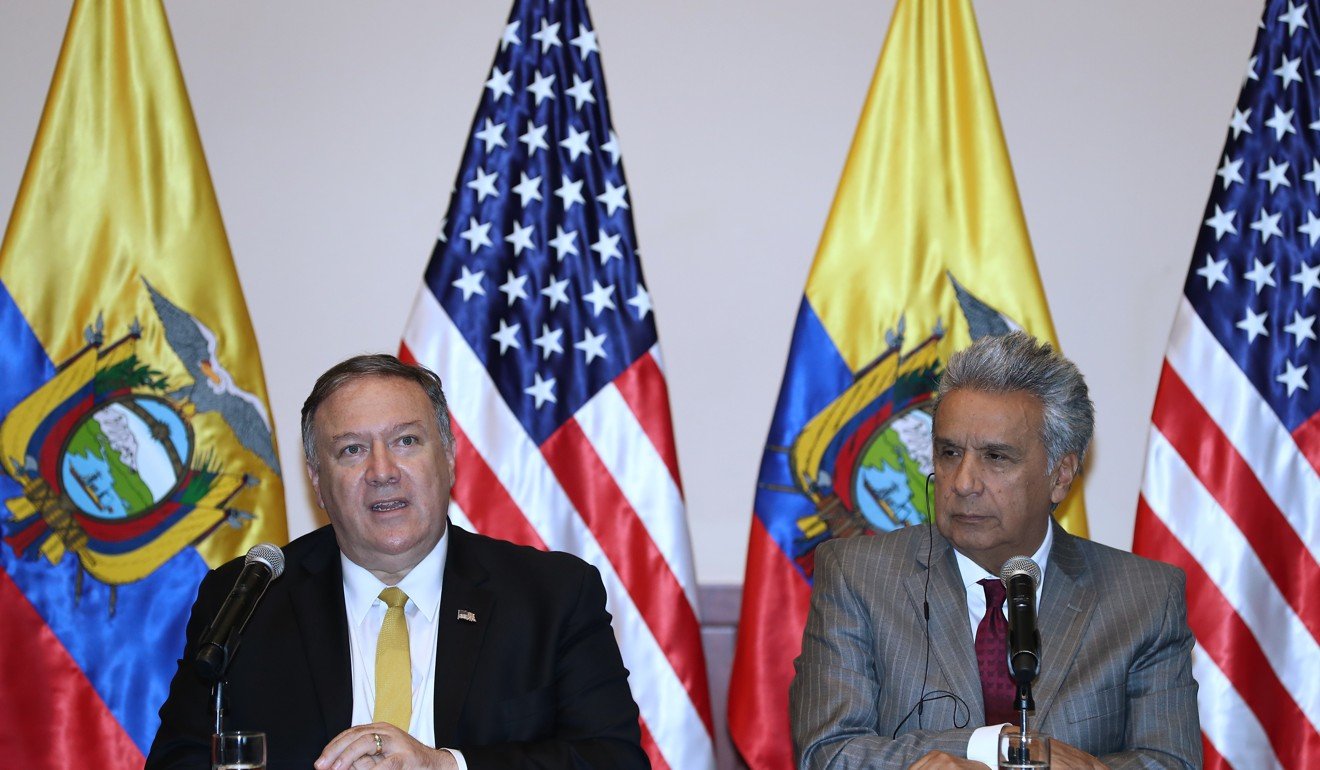
In a joint interview with Pompeo during the visit, Ecuador’s new President Lenin Moreno defended the country’s China ties, and urged Washington and Beijing to resolve their conflicts for the benefit of other nations in the region.
“We hope that the US and China, the greatest powers in the world now, will find agreement easily because, unfortunately, when the big ones are discussing or fighting and have conflicts, the ones that are paying for all of that are the smaller countries,” he said.
“Now, when two elephants fight, the ones who lose are the insects who are of course being crushed by the elephants in the attempt to evade them.”
US Secretary of State Mike Pompeo (left) and Ecuadorian President Lenin Moreno hold a joint press conference during Pompeo’s tour of Latin America on July 20. Photo: EPA-EFE

Pompeo blasted China’s role in the region during a previous tour of South America in April, when he singled out Beijing’s support for President Nicolas Maduro of Venezuela. Maduro is backed by Beijing, Russia and other allies, while the US and many European countries have supported opposition leader Juan Guaido as legitimate president since elections in January.

Speaking from Chile on that tour, Pompeo said Beijing’s calls for non-intervention in Venezuela were “hypocritical” and aimed at protecting Beijing’s investments in the country, as well as debts owed to China by Venezuela.

Pompeo also accused Beijing of “sowing discord” in the region through debt traps. “When China does business in places like Latin America, it often injects corrosive capital into the economic bloodstream, giving life to corruption and eroding good governance,” he said.

Professor Cui Shoujun of Renmin University in Beijing said Washington’s concerns about “debt trap diplomacy” in Latin America reflected concerns that China’s growing involvement in financing infrastructure and development projects would make the region more pro-China.

“China’s interests in Latin America go beyond raw materials extraction,” he said. “The biggest point of tension between the US and China in the region is perhaps that China presents an alternative model for development that is very different from the Western model.”

‘Mr Pompeo, you can stop’: China hits back over Latin America criticism

While the US was drumming up tensions about China across the world, Beijing was not openly retaliating but responding with investment and trade for global partners, said Kevin Gallagher, researcher on China-Latin America ties, and professor at Boston University.

“The US points fingers and makes angry speeches in the region as China cuts investment deals and helps address infrastructure needs,” he said.

“Latin American countries’ governments are rightly keeping their heads down on the broader geopolitical winds, and are getting down to business with their largest trading partner.”

Source: SCMP

27/07/2019

Ambassadors from 50 countries voice support for China’s position on issues related to Xinjiang


GENEVA, July 27 (Xinhua) — Ambassadors from 50 countries to the United Nations Office at Geneva (UNOG) have co-signed a letter to the President of the UN Human Rights Council (HRC) and the High Commissioner for Human Rights to voice their support for China’s position on issues related to its Xinjiang Uygur Autonomous Region.

Earlier on July 12, a number of ambassadors in Geneva sent the joint letter to show their support for China, and as of Friday evening, more ambassadors had joined, the Chinese Mission to the UNOG revealed.

In a statement issued on Friday night, the Chinese mission said that some other countries had also expressed their support in separate letters or press statements.

In the joint letter, the ambassadors commend China for its economic and social progress, effective counter-terrorism and de-radicalization measures, and strong guarantee of human rights.

They appreciate the opportunities provided by China for diplomatic envoys, officials of international organizations, and media professionals to visit Xinjiang, and point to the contrast between Xinjiang in the eyes of those who have visited it and the one portrayed by some western media.

The ambassadors also urge a certain group of countries to stop using uncorroborated information to make unfounded accusations against China.

“I was surprised that some people call these vocational training and education centers concentration or internment camps,” Vadim Pisarevich, deputy permanent representative of Belarus to the UNOG, told Xinhua.

“They’re nothing of the kind. They look like ordinary educational facilities and even I said that they are more than this because they provide life skills training to the students,” Pisarevich said.

They are “very useful institutions for addressing the problems of terrorism, extremism and separatism,” he said.

“Terrorism and extremism are an intractable challenge across the world. In the face of its grave threat, Xinjiang Uygur Autonomous Region responded with a number of lawful steps, including setting up vocational education and training centers, to prevent and combat terrorism and extremism,” the Chinese Mission to the UNOG said in its statement.

“Facts speak louder than words, and justice cannot be overshadowed. The great diversity of countries co-signing the letter — from Asia, Africa, Latin America, and Europe, especially the OIC (Organization of Islamic Cooperation) — makes it clear that the international community has drawn a fair conclusion about Xinjiang’s human rights achievement and counter-terrorism and de-radicalization outcome,” the statement said.

“Those that seek to use human rights as an excuse to slander and pressure China have only themselves to deceive,” it added.

“We oppose any attempt to use human rights issues as a cover for interference in a country’s internal affairs. We urge those who are doing so to change course, refrain from politicization and double standards, and stop interfering in the internal affairs of other countries under the pretext of human rights,” it said.

At a press conference on Friday, China’s Ambassador to the UNOG Chen Xu also rebuked some Western nations for slandering China over Xinjiang, noting that China doesn’t accept these “groundless accusations.”

Jamshed Khamidov, head of Tajikistan’s mission in Geneva, said his government opposes any attempts to use the Human Rights Council for particular political purposes, and efforts should be made to avoid any politicization of the Human Rights Council.

“We know the situation in the Xinjiang region. We know how much the government of China is doing … and what kind of measures were implemented in this region to support its peace, security and development,” he said.

In visits to the vocational training and education centers in Xinjiang’s Urumqi and Kashi, Zenon Mukongo Ngay, head of the Democratic Republic of Congo’s mission in Geneva, said he was impressed with the “level of development” in Xinjiang and how the people in the centers receive education for getting a job.

The Chinese mission also said that together with all parties, China is committed to promoting the healthy development of the international human rights cause by encouraging multilateral human rights institutions to stick to the purpose and principles of the UN Charter, handle human rights issues in an objective, impartial and non-selective manner, and engage in constructive dialogues and cooperation.

Source: Xinhua

29/06/2019

Belt and Road Economic Information Partnership to build info bridge

BEIJING, June 28 (Xinhua) – Set to build an “information bridge” for the Belt and Road Initiative (BRI) construction, attendees of the Belt and Road Economic Information Partnership (BREIP) in Beijing believed it would reduce the “information deficit” between countries.

The partnership, designed to eliminate information asymmetry in implementing the BRI, offers demonstration, guidance and services to participants of the BRI, and create a new platform for international cooperation.

The platform of BRInfo, operated and maintained by China Economic Information Service (CEIS) under Xinhua News Agency, allows BREIP members to share information and conduct cooperation.

Alfred Schipke, IMF Senior Resident Representative for China, said it would be important to strengthen policy frameworks and foster capacity development in China and in partner countries.

“The effective sharing of information will be more and more important. Here, the BREIP could be a key platform,” Schipke said.

New commercial opportunities will surely be created with information from professional institutions and needs of enterprises brought together, so as to promote mutual understanding, said Liu Zhengrong, vice president of Xinhua News Agency.

The BREIP, offering news service and information assurance, has provided a platform of news and economic information for countries and regions to expand cooperation, noted Marat Abulkhatin, first deputy chief editor of TASS Russian News Agency.

Domestic information reports growing significance now in global market, and under the BRInfo mechanism, news agencies can help to further eliminate information asymmetry, said Raphael Juan, director of markets at Brazilian CMA News Agency.

Polish government and enterprises look forward to better understanding different market situations and making better decisions with the economic information shared on the BREIP, said Ryszard Marcin Nizewski, product director with Polish Press Agency.

The BRI has made great contributions to international trade and the international economy, and its achievements have far exceeded expectations. It is believed that the BREIP will also become a multi-faceted cooperation tool, according to Dzmitry Prymshyts, deputy director for Research and Innovation of the Institute of Economics of the National Academy of Sciences of Belarus.

This platform could decrease the “information deficit” between countries while growing into a timely, objective and solid source of information, Prymshyts said.

The BREIP, established in Beijing on Thursday, was initiated by Xinhua News Agency and co-founded by more than 30 institutions including well-known news agencies, information service providers, research institutions, chambers of commerce and associations from more than 20 countries and regions in Asia, Europe, Africa, Latin America and Oceania.

Source: Xinhua

26/04/2019

Interview: Belt and Road helps Latin America to achieve UN 2030 agenda, says ECLAC official

BEIJING, April 26 (Xinhua) — The China-proposed Belt and Road Initiative (BRI) facilitates the compliance with the UN 2030 Agenda for Sustainable Development and the realization of the 17 Sustainable Development Goals in Latin America, said a senior official of a UN body based in Latin America.

Mario Cimoli, deputy executive secretary of the Economic Commission for Latin America and the caribbean (ECLAC), made the remarks in an interview with Xinhua.

Also as chief of the division of production, productivity and management of ECLAC, Cimoli has arrived in Beijing to participate in the second Belt and Road Forum for International Cooperation on April 25-27.

So far, 18 Latin American countries have signed the Memorandum of Understanding on jointly building the Belt and Road cooperation with China.

“The countries in Latin America view China as a fundamental actor,” he said. “The fact that 18 Latin American countries have joined the Belt and Road Initiative means that these countries think that China is necessary and China is also aware of the importance of dialogue. It’s a historical process.”

In his opinion, the BRI makes “greater integration, greater multilateralism and more dialogue” possible and “does good to Latin America.”

He said that both the 2030 Agenda and the BRI seek sustainable development and reduction of inequality and poverty, without contradicting with the proper model of each country.

“Given that the growth rates of Latin America will not be very high for the next few years, a rational process of cooperation such as the Belt and Road will surely help the region and allow each country to seek and improve their model of development and growth,” the ECLAC official said.

The BRI is a much more horizontal dialogue, a platform, in that sense that it is a process that helps and allows a much more positive coexistence despite current global tensions, he said.

In the dialogue with China, Latin America can demonstrate the importance of being an integrated area of trade, policies, and infrastructures in order to trade better with Asia, he said.

Cimoli also affirmed that the incorporation of new technologies in Latin America is a course under discussion, and dialogue with China can accelerate and improve the process.

Cimoli said his one observation of his ongoing China trip is the extensive use of electronic commerce among ordinary people.

He said when he went out to buy something, he found almost everyone use e-payments.

The way in which technologies immerge into the daily life of Chinese citizens is an example and would be a valuable contribution of China to the world and especially to Latin America, Cimoli said.

“The example of China shows the role that a state should play to trigger the technological development. In this dialogue with China, Latin America surely has to learn from the pragmatism of China,” he said.

The ECLAC official mentioned that China invests over 2 percent of its GDP in science and technology, while the average investment of Latin American countries in the field is between 0.4 and 0.5 percent of its GDP, plus, it appears to be swaying instead of stable state policies.

“There is a lot of cooperation to be done, much experience to be shared and much a platform for dialogue like the Belt and Road Initiative could do,” said Cimoli.

Source: Xinhua

16/04/2019

China urges U.S. not to make trouble over China-LatAm ties

BEIJING, April 15 (Xinhua) — China on Monday urged U.S. Secretary of State Mike Pompeo to stop stirring up troubles between China and Latin America.

Pompeo has reportedly made unfriendly remarks on China and China-Latin America relations during a visit to Chile and other Latin American countries.

“It’s utterly irresponsible and unreasonable for U.S. Secretary of State (Mike) Pompeo to recklessly slander China and wilfully stir up troubles over China-Latin America relations. We are strongly opposed to this,” Foreign Ministry Spokesperson Lu Kang told a press briefing.

Cooperation between China and Latin American countries, guided by principles of mutual respect, equality, mutual benefit and win-win outcomes, focuses on common development and has made significant contributions to the economic growth and improvement of people’s well-being in Latin American countries, Lu said.

For a long time, the United States has regarded Latin America as its own “backyard” and has frequently pressured, threatened and even overthrown other regimes, he added. “We believe Latin American countries will make the correct judgment about who is a real friend and who is a fake one, and about who disregards rules and spreads disorder.”

The spokesperson also pointed out that for a long time, a number of U.S. politicians had maligned China, fanning up flames worldwide and driving a wedge between China and other countries.

Calling such actions “disgraceful,” Lu stressed that lies will always be lies and that “Mr. Pompeo should stop making them.”

Source: Xinhua

Law of Unintended Consequences

continuously updated blog about China & India

ChiaHou's Book Reviews

continuously updated blog about China & India

What's wrong with the world; and its economy

continuously updated blog about China & India