Archive for ‘Lawbreakers’

13/02/2020

Why do many India MPs have criminal records?

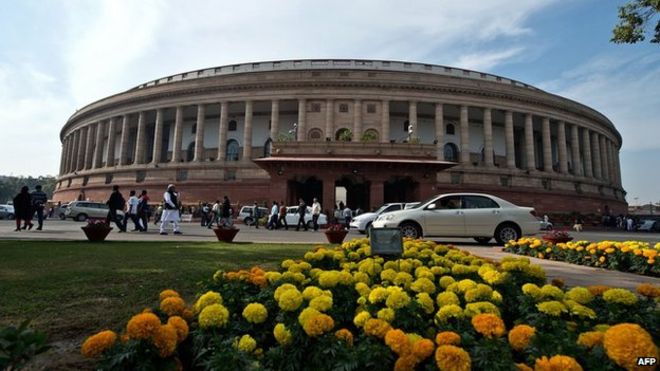
Indian parliamentImage copyright AFP
Image caption A third of the current members of parliament have criminal cases pending against them

“We need to build a consensus on how to prevent individuals with a criminal record from contesting elections.”

A necessary, even obvious fundamental you would think of building the world’s largest democracy.

And when Sonia Gandhi, India’s most powerful politician, uttered those words three years ago, even her main opponent, the leader of the BJP agreed.

Yet since then, things have gone in the opposite direction – with more alleged lawbreakers among India’s lawmakers than ever, a third of the current parliament according to a watchdog called the Association for Democratic Reforms.

By some calculations, politicians with a criminal record are more likely to be elected than those with a clean slate – because, says the ADR, they have more illicit funds with which to buy votes.

And on Tuesday night, India’s cabinet sought to ensure there was even less chance of criminal politicians facing their own laws.

It issued an order overturning a Supreme Court ruling demanding the disqualification of any politician convicted for crimes punishable with more than two years in jail.

This was “to ensure that governance is not adversely impacted“, the government had argued, with no apparent irony intended.

Unusual speed

Arguably, of course, the government is right. Losing tainted local or national politicians – among them many accused murderers, rapists and fraudsters – could upset delicate political alliances and make it even harder to get laws passed.

So often derided for doing nothing, this time round the cabinet acted with unusual speed.

The urgency it appears is the impending conclusion of two cases involving key politicians, due before Prime Minister Manmohan Singh gets back to India from a trip to the US.
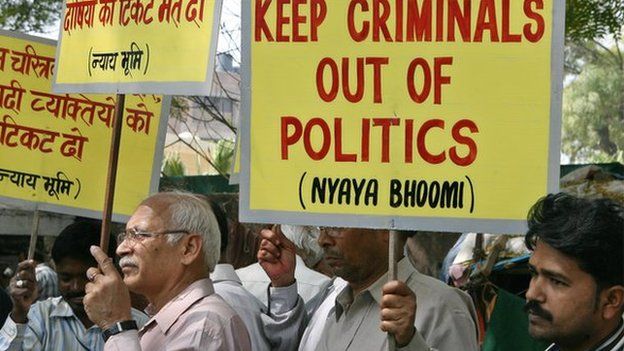
Protest against criminals contesting the parliamentary elections in Delhi on March 14, 2009Image copyright AFP
Image caption There’s been some criticism of criminal politicians

One concerns Lalu Prasad Yadav, a former railways minister and Congress party ally, charged with pocketing millions of dollars in subsidies for non-existent livestock.

Another concerns Congress MP Rashid Masood, already convicted of corruption and due to be sentenced next week. When the BBC asked his office for a comment, his assistant told us “he is unwell”.

“Don’t know whether to laugh or cry” tweeted MP Baijayant Panda in response to the government’s protective move.

He is a rare voice though inside the chamber campaigning against criminals sitting alongside him.

There’s been some other criticism outside, but not much. Indians have become very used to these kinds of shenanigans.

Almost forgotten already are calls in the Verma commission report into the December 16 Delhi gang rape case for all politicians accused of sexual crimes to be barred from office. Instead, six politicians charged with rape remain in office.

The opposition BJP has said it will oppose the cabinet order. But its record is just as murky, with even more accused criminals among its elected members in parliament and state assemblies than the Congress.

And with elections round the corner, none of the parties want to risk real reform right now, whatever they have signed up to in the past.

The world’s largest democracy is not alone in allowing so many questionable people to run it. Fellow Brics member Brazil has similar numbers of alleged criminals running the country.

The difference though is that in Brazil, brazen political abuses have provoked major protest.

But, says Indian MP Baijayant Panda: “This is a phase all democracies have gone through – look at the US.”

Voters will start to demand change, he predicts: “This is the last era of brazenness.”

Source: The BBC

18/05/2019

Lawbreakers to lawmakers? The ‘criminal candidates’ standing in India’s election

NEW DELHI (Reuters) – The Bharatiya Janata Party (BJP) has one unwanted lead in this month’s general election race – according to data from an electoral watchdog it is fielding the most candidates among the major parties who are facing criminal charges. Its main rival, Congress, is just a step behind.

Election laws allow such candidates to run so long as they have not been convicted, on grounds both of fairness and because India’s criminal justice system moves so slowly that trials can take years, or even decades, to be resolved.

Still, the number of such candidates accused of offences ranging from murder to rioting has been rising with each election.

Analysts say political parties turn to them because they often have the deepest pockets in steadily costlier elections, and that some local strongmen are seen as having the best chance of winning.

Nearly one-in-five candidates running for parliament in the current election has an outstanding criminal case against them, inching up from 17% in the previous election and 15% in 2009, according to the Association for Democratic Reforms (ADR), a non-profit organisation that analysed candidates’ declarations.

The data shows that 40% candidates from Prime Minister Narendra Modi’s BJP face criminal charges, including crimes against women and murder, followed by the Congress party at 39%.

Among the smaller parties, the Communist Party of India (Marxist) has an even higher proportion, with 58 percent of its candidates embroiled in criminal cases.

Polls have suggested that the BJP and its allies lead the race to win the mammoth, staggered election that began last month and ends on Sunday. Votes will be counted on Thursday.

“Parties only think about winnability and they know that money power and muscle power of such candidates ensures that win,” said Anil Verma, head of the ADR.

With 240 cases against him, K Surendran of the BJP tops the list of candidates with the most outstanding criminal complaints that include rioting, criminal trespass and attempted murder.

He said most of the cases stem from his involvement in the BJP campaign to oppose the entry of women and girls of menstruating age into the Sabarimala temple in his home state of Kerala.

“I understand that an outsider might feel that I am a grave offender but, in reality, I am completely innocent of these charges,” he said. “It was all politically motivated.”

Dean Kuriakose from the Congress party has 204 criminal cases against him, the second highest, the data showed. Most of the cases were related to a political agitation against the ruling Communist Party in Kerala, which turned violent.

He was not available for comment. But a party spokesman said Kuriakose was innocent. “He was falsely charged by the police under influence from Kerala government,” the spokesman said.

Political analysts say that often people vote for candidates who face criminal charges because they are seen as best placed to deliver results. In some parts of India local strongmen mediate in disputes and dispense justice.

“Powerful people, even if criminals, offer a kind of parallel system of redressal,” said K.C. Suri, a professor of political science at the University of Hyderabad.

A separate ADR survey of more than 250,000 voters last year found 98% felt candidates with criminal backgrounds should not be in parliament, though 35% said they were willing to vote for such a candidate on caste grounds or if the candidate had done “good work” in the past.

Source: Reuters

Law of Unintended Consequences

continuously updated blog about China & India

ChiaHou's Book Reviews

continuously updated blog about China & India

What's wrong with the world; and its economy

continuously updated blog about China & India