Archive for ‘lending’

12/02/2020

Coronavirus cases fall, experts disagree whether peak is near

BEIJING/SINGAPORE (Reuters) – China reported on Wednesday its smallest number of coronavirus cases since January, lending weight to a prediction by its top medical adviser for the outbreak to end by April, but a global infectious diseases expert warned of the spread elsewhere.

Financial markets took heart from the outlook of the Chinese official, epidemiologist Zhong Nanshan, who said on Tuesday the number of new cases was falling in some provinces, and forecast the epidemic would peak this month, even as the death toll in China rose to more than 1,100 people.

World stocks, which had seen rounds of sell-offs over the virus, surged to record highs on hopes of a peak in cases. The Dow industrials, S&P 500 and Nasdaq all hit new highs, and Asian shares nudged higher on Wednesday.

But the World Health Organization (WHO) has warned that the epidemic poses a global threat akin to terrorism and one expert coordinating its response said while the outbreak may be peaking at its epicentre in China, it was likely to spread elsewhere in the world, where it had just begun.

“It has spread to other places where it’s the beginning of the outbreak,” the official, Dale Fisher, head of the Global Outbreak Alert and Response Network coordinated by the WHO, said in an interview in Singapore.

“In Singapore, we are at the beginning of the outbreak.”

Singapore has reported 47 cases and worry about the spread is growing. Its biggest bank, DBS (DBSM.SI), evacuated 300 staff from its head office on Wednesday after a confirmed coronavirus case in the building.

Hundreds of cases have been reported in dozens of other countries and territories around the world, but only two people have died outside mainland China – one in Hong Kong and another in the Philippines.

WHO chief Tedros Adhanom Ghebreyesus said on Tuesday the world had to “wake up and consider this enemy virus as public enemy number one” and the first vaccine was 18 months away.

In China, total infections have hit 44,653, health officials said, including 2,015 new confirmed cases on Tuesday. That was the lowest daily rise in new cases since Jan. 30.

The number of deaths on the mainland rose by 97 to 1,113 by the end of Tuesday.

But doubts have been aired on social media about how reliable the figures are, after the government last week amended guidelines on the classification of cases.

‘STAY HOPEFUL’

The biggest cluster of cases outside China is aboard the Diamond Princess cruise ship quarantined off Japan’s port of Yokohama, with about 3,700 people on board. Japanese officials on Wednesday said 39 more people had tested positive for the virus, taking the total to 175.

One of the new cases was a quarantine officer.

Thailand said it was barring passengers from another cruise ship, MS Westerdam, from disembarking, the latest country to turn it away amid fears of the coronavirus, despite no confirmed infections on board.

“We try to stay hopeful,” American passenger Angela Jones told Reuters in a video recording. “But each day, that becomes a little bit more difficult, when country after country rejects us.”

Echoing the comparison with the fight against terrorism, China’s state news agency Xinhua said late on Tuesday the epidemic was a “battle that has no gunpowder smoke but must be won”.

The epidemic was a big test of China’s governance and capabilities and some officials were still “dropping the ball” in places where it was most severe, it said, adding: “This is a wake-up call.”

The government of Hubei, the central province at the outbreak’s epicentre, dismissed the provincial health commission’s Communist Party boss, state media said on Tuesday, amid mounting public anger over the crisis.

China’s censors had allowed criticism of local officials but have begun cracking down on reporting of the outbreak, issuing reprimands to tech firms that gave free rein to online speech, Chinese journalists said.

The pathogen has been named COVID-19 – CO for corona, VI for virus, D for disease and 19 for the year it emerged. It is suspected to have come from a market that illegally traded wildlife in Hubei’s capital of Wuhan in December.

The city of 11 million people remains under virtual lockdown as part of China’s unprecedented measures to seal infected regions and limit transmission routes.

Travel restrictions that have paralysed the world’s second-biggest economy have left Wuhan and other Chinese cities resembling ghost towns.

Even if the epidemic ends soon, it has taken a toll of China’s economy, with companies laying off workers and needing loans running into billions of dollars to stay afloat. Supply chains for makers of items from cars to smartphones have broken down.

ANZ Bank said China’s first-quarter growth would probably slow to 3.2% to 4.0%, down from a projection of 5.0%.

The likely slowdown in China could shave 0.1 to 0.2 percentage points off both euro zone and British growth this year, credit rating agency S&P Global estimated.

Source: Reuters
06/02/2019

China banks on lending to ease slowdown

  • 5 February 2019
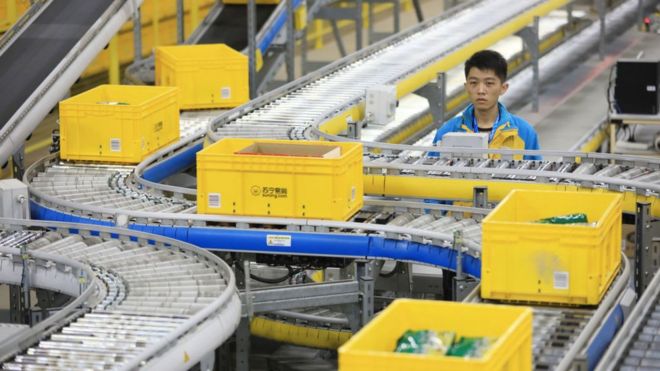
Man next to conveyor belt in Alibaba fulfilment centre.Image copyrightGETTY IMAGES

Build stuff or buy stuff? China has long been a believer in the former to deal with a slowdown in its economy. Now it’s trying to shift the emphasis to the latter.

This year will be a big test of how far it’s come in the transition from state-backed investment to domestic consumption as the main driver of growth.

China’s President Xi Jinping has warned of a “struggle” as his country faces an economic slowdown, the likes of which it hasn’t seen for almost 30 years.

A series of stimulus measures have been unveiled by the government not to boost the economy, but to manage the slowdown.

“China’s goal is not growth, it’s stability,” says economist Andy Xie.

“The option for stimulated growth again, that is not on the table. The debt level is simply too high, not like in 2008.”

‘Less room to manoeuvre’

China’s debt has doubled in the aftermath of the global financial crisis 10 years ago, to around 300% of the size of its economy.

“The level is so high now it’s not easy to move the economy,” Mr Xie says.

Andy Xie
Image captionEconomist Andy Xie says China’s debt levels limit its options

Whether it wants to borrow more to build, or to encourage people to buy, he thinks China’s ruling Communist Party has far less room to manoeuvre.

“It’s not easy to move the needle when the base is so large,” he says.

So what is it doing?

It’s cutting some taxes, to put more money in peoples’ pockets. It’s reduced the reserve rate for banks, so they don’t have to keep as much capital in the safe, and can – in theory – lend more out and boost spending.

And yes, it is splurging cash on big infrastructure projects – railways, bridges, and a vast new city near Beijing.

‘High risk’ firms

Only one of those measures is likely to help Wu Yijian.

Mr Wu is a consumption success story. He is the co-founder of a tech start-up that makes desk top robots, in various sizes, which help China’s children play and learn.

Xiao Bai – or Little White – is powered by voice recognition and artificial intelligence that Mr Wu and his co-founders have spent 20 years developing.

As we stood in his office in Shanghai he called its name. It swivelled towards us and blinked. But private firms like his aren’t the focus of China’s stimulus efforts.

He told me sales “increased” in 2018 “but it’s not as good as we planned”.

Venture capital – private money – helped get them to where they are.

He says they won’t be turning to China’s state-owned banks – almost all of the banks here are state-owned or controlled – for help if things get tough in 2019.

Wu Yijian and Robin Brant on a screen
Image captionWu Yijian depends on venture capital to fund projects like this robot

“Government banks have very low interest rates but that kind of money is not suitable for the company like us.”

He told me that’s because banks “hate” risk and his company is still considered “high risk”.

It’s mostly big, state controlled firms that benefit from those low interest loans. That kind of preferential treatment has long been a central tenet of a Communist government that treated private enterprise as second class.

“Traditional banks, they prefer collateral, like property. But tech companies like us we don’t have properties. The biggest assets are human resources,” Mr Wu told me.

He likes the tax cuts though. He hopes that will mean more parents buying more desk top robots.

President Xi has talked about his “two unwaverings” – an unwavering commitment to state-backed firms and the private sector.

It’s the latter after all that creates by far the most new jobs.

The government has promised new efforts to boost sales of new cars and household goods. One province here has even touted the idea of a longer weekend, so people can shop more.

A good year ahead

Song Junfu is well placed to deal with whatever 2019 throws at him.

His business is paper. Most importantly, paper for the furniture industry. Mr Song’s company makes advanced paper used to imprint patterns on synthetic leather. Which is why he is based in Haining, a city developed by the government to focus on furniture.

“For our business, I would say, it won’t be affected that seriously… partially because of the advanced features of our product, [plus] there’s a big need for the product in China.”

As we stood in front of a long, green, four metre high piece of machinery at his plant he said “we feel confident in the market”.

He also has the support of the Agricultural Bank of China, one of the big four state-owned banks.

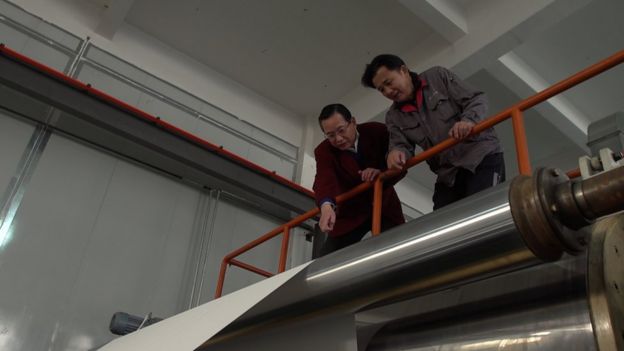
Song Junfu at his paper factory in Haining.Image copyrightGETTY IMAGES
Image captionSong Junfu’s company has benefitted from government support

“The support of the government can be a plus, let’s say, to help the development of the business,” he told me.

“Financially we can get support, to maybe move your project a little faster.”


Global Trade

More from the BBC’s series taking an international perspective on trade:


Mr Song’s company is private, and it’s taken decades of first study, then development and investment to get to where it is now.

It is very far from the often inefficient, behemoth state-owned entities.

But as a manufacturer, he’s more likely to benefit from any direct stimulus measures than the robot makers of Shanghai.

He doesn’t need the help though. Even with a trade war with the US causing huge anxiety for many of China’s manufacturing exporters like him, he thinks he can absorb any hit.

There is a “big, nice margin” on the products they export to the US he told me, so “even if we make 5% or 10% less, for us it’s still good business.”

Source: The BBC

Law of Unintended Consequences

continuously updated blog about China & India

ChiaHou's Book Reviews

continuously updated blog about China & India

What's wrong with the world; and its economy

continuously updated blog about China & India