Chindia Alert: You’ll be Living in their World Very Soon
aims to alert you to the threats and opportunities that China and India present. China and India require serious attention; case of ‘hidden dragon and crouching tiger’.
Without this attention, governments, businesses and, indeed, individuals may find themselves at a great disadvantage sooner rather than later.
The POSTs (front webpages) are mainly 'cuttings' from reliable sources, updated continuously.
The PAGEs (see Tabs, above) attempt to make the information more meaningful by putting some structure to the information we have researched and assembled since 2006.
SYDNEY (Reuters) – The Australian government said on Friday it would meet a week ahead of schedule to decide whether to ease social distancing restrictions, as the numbers of new coronavirus infections dwindle and pressure mounts for business and schools to reopen.
Australia has reported about 6,700 cases of the new coronavirus and 93 deaths, well below the levels reported in the United States and Europe. Growth in new infections has slowed to less 0.5% a day, compared to 25% a month ago.
Prime Minister Scott Morrison said it was imperative to lift social distancing restrictions as early as possible as 1.5 million people were now on unemployment benefits and the government forecast the unemployment rate to top 10% within months.
“We need to restart our economy, we need to restart our society. We can’t keep Australia under the doona,” Morrison said, using an Australian word for quilt.
Morrison’s government has pledged spending of more than 10% of GDP to boost the economy but the central bank still warns the country is heading for its worst contraction since the 1930s.
With less than 20 new coronavirus cases discovered each day, Morrison said state and territory lawmakers would meet on May 8 – a week earlier than expected – to determine whether to lift restrictions.
“Australians deserve an early mark for the work that they have done,” Morrison told reporters in Canberra.
Australia attributes its success in slowing the spread of COVID-19 to social distancing restrictions imposed in April, including the forced closures of pubs, restaurants and limiting the size of indoor and outdoor gatherings.
Morrison said 3.5 million people had downloaded an app on their smartphones designed to help medics trace people potentially exposed to the virus, though the government is hoping for about 40% of the country’s 25.7 million population to sign up to ensure it is effective.
Cabinet will also decide next week how to restart sport across the country, the prime minister said.
The government says any resumption of sport should not compromise the public health, and recommends a staggered start beginning with small groups that play non-contact contact sport outdoors.
The recommendations suggests Australia’s National Rugby League (NRL) competition may not get permission to restart its competition as soon as many in the sports-mad country would like.
BEIJING (Reuters) – China will cut its subsidies on new energy vehicles (NEV) by 10% this year, and will expand government purchases of NEVs, the finance ministry said on Thursday.
China will in principle cut such subsidies by 20% in 2021 and 30% in 2022, the finance ministry said in a statement. However, it will not cut subsidies on qualified new energy commercial vehicles earmarked for public purposes this year.
Under the plan, China would extend subsidies for NEV purchases to 2022, rather than ending them this year, and extend their purchase tax exemption for two years.
China will slightly lift the requirements for the driving range and power efficiency of cars qualified for the subsidies, the statement said, adding authorities will support the sales of cars with swappable batteries, a technology that has been pursued by Chinese electric vehicle makers Nio Inc (NIO.N) and BAIC BluePark (600733.SS).
Only passenger cars cheaper than 300,000 yuan (34,330.23 pounds) will be offered subsidies, it said. The price is higher than starting price of Tesla Inc’s (TSLA.O) China-made Model 3 sedans.
China also said authorities will give priority to purchase new energy vehicles for government use but did not give further details.
The new policy is effective from April 23. NEVs include battery-powered electric, plug-in hybrid and hydrogen fuel-cell vehicles.
China has set an aggressive goal for NEVs to account for a fifth of auto sales by 2025 compared with the current 5%, as it seeks to reduce pollution and cultivate homegrown champions.
Sales of NEVs, however, contracted for a ninth month in a row in March and were down over 50% from a year earlier, according to data from the China Association of Automobile Manufacturers (CAAM).
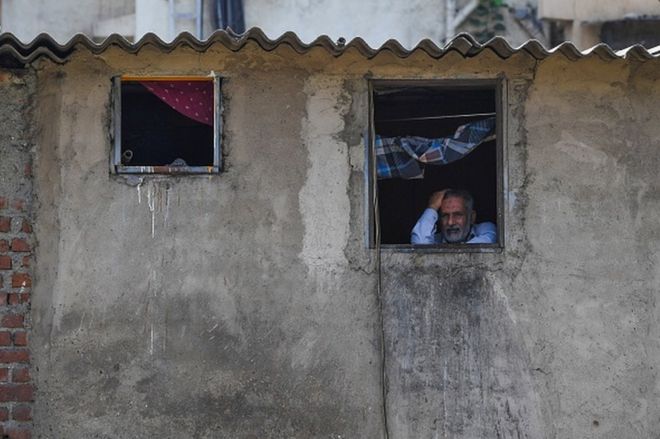
Image copyright GETTY IMAGESImage caption More than a billion people have been staying at home during the lockdown
Will India extend its rigorous 21-day lockdown to slow the spread of coronavirus beyond its end date next week? By all accounts, yes.
On 24 March, India shut its $2.9 trillion economy, closing its businesses and issuing strict stay-at-home orders to more than a billion people. Air, road and rail transport systems were suspended.
Now, more than two months after the first case of Covid-19 was detected in the country, more than 5,000 people have tested positive and some 150 people have died. As testing has ramped up, the true picture is emerging. The virus is beginning to spread through dense communities and new clusters of infection are being reported every day. Lifting the lockdown could easily risk triggering a fresh wave of infections.
A harsh lockdown is certain to slow down the disease. Virologists I spoke to believe India is still at an early stage of the infection. The country still doesn’t have enough data on the transmissibility of the virus or even how many people could have been infected and recovered to develop adequate herd immunity. (It is slowly beginning finger prick blood tests to look at the presence of protective antibodies.)
More than 250 of India’s 700-odd districts have reported the infection. Reports say at least seven states have a third of all infections, and want the lockdown extended. Six states have reported clusters of rapidly growing infections – from the capital Delhi in the north to Maharashtra in the west and Tamil Nadu in the south.
Economic fallout
Not surprisingly, the lockdown is already hurting the economy. Many of the early hotspots are economic growth engines and contribute heavily in revenues to the exchequer. Mumbai, India’s financial capital and Maharashtra’s main city, accounts for more than a third of overall tax collection. The densely populated city has reported more than 500 cases and 45 deaths, and numbers are steadily rising. Authorities say the infection is now spreading through the community. Mumbai has made wearing face masks mandatory.
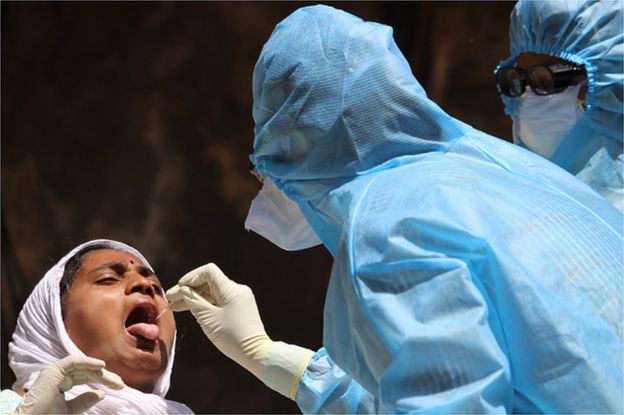
Image copyright GETTY IMAGESImage caption India has ramped up testing during the lockdown
Many of these hotspot clusters are also thriving manufacturing bases. The spread of infection means that they will be under lockdown for a longer period of time.
The services industry, which generates almost half of India’s GDP, is also likely to remain shut for some more time. Construction, which employs a bulk of migrant workers, will remain similarly suspended. The unemployment rate may have already climbed to more than 20% after the lockdown, according to a report by the Center for Monitoring Indian Economy.
For the moment, economists say, the government will have to prioritise farming over everything else to ensure the livelihoods of millions and secure the country’s future food supplies.
Half of India’s labour force work on farms. The lockdown happened at a time when a bumper winter crop had to be harvested and sold, and the rain-fed summer crop had to be sowed. The immediate challenge is to harvest and market the first crop, and secure the second.
Moving trucks to pick up produce and take them to markets, with adequate social distancing and hand washing will be something the government will have to move on quickly.
“The immediate challenge is to ensure that rural India is not hit,” says Rathin Ray, an economist. “Realistically, a complete lockdown cannot be continuously maintained beyond early May. We don’t have a choice but to reopen gradually after that.”
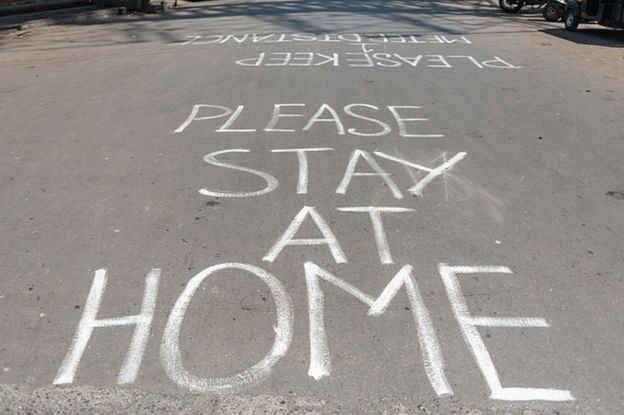
Image copyright GETTY IMAGESImage caption India has been under a lockdown from 24 March
There is little doubt about that. For his part, SK Sarin, who heads a government advisory panel on combating the disease, says the lockdown can be only eased in a “graded manner in areas that are not hotspots” and that the hotspots remained cordoned off.
Like other affected countries, India will have to prepare itself for what Gabriel Leung, an infectious disease epidemiologist and dean of medicine at the University of Hong Kong, describes as several rounds of “suppress and lift” cycles.
During these periods “restrictions are applied and relaxed, applied again and relaxed again, in ways that can keep the pandemic under control but at an acceptable economic and social cost.”
Also, Dr Leung observes, “how best to do that will vary by country, depending on its means, tolerance for disruption and its people’s collective will. In all cases, however, the challenge essentially is a three-way tug of war between combating the disease, protecting the economy and keeping society at an even keel”.
It is now clear that shutdowns need to continue until transmission has slowed down markedly, and testing and health infrastructure has been scaled up to manage the outbreak.
Experts from the southern state of Kerala, a striking outlier that is containing the infection thanks to a transparent government and a robust public health system, say it isn’t time to lift the lockdown yet and have recommended a three-phase relaxation.
For most countries, easing the lockdown is a tricky policy choice. It sparks fears of triggering a fresh wave of infection and presents the inevitable trade-off between lives and livelihoods. French Prime Minister Edouard Phillipe, says relaxing the lockdown in his country is going to be “fearsomely complex”. In a crisis like this, according to his Dutch counterpart Mark Rutte, leaders have to “make 100% of the decisions with 50% of the knowledge, and bear the consequences.”
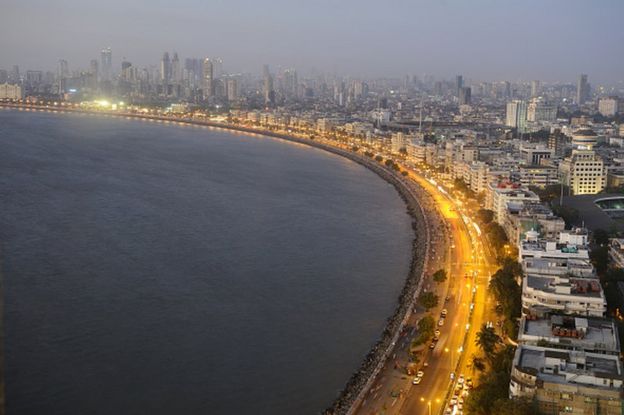
Image copyright GETTY IMAGESImage caption India’s financial capital, Mumbai, is emerging as a hotspot
It is going to be tougher for India with its vast size, densely packed population and enfeebled public health system. Also, no country in the world possibly has so much inter-state migration of casual workers, who are the backbone of the services and construction industries.
How will India manage to return these workers to their work places – factories, farms, building sites, shops – without a substantial easing of public transport at a time when crowded trains and buses can be a vector of transmission and easily neutralise the gains of the lockdown? Even allowing restricted mobility – allowing social distancing, temperature checks and passenger hygiene – would put considerable pressure on the public transport system.
The policy choices are fiendishly tough, and the answers are far from easy. India bungled the lockdown by not anticipating the exodus of millions of migrant workers from cities. The weeks ahead will tell whether the fleeing men, women and children carried the infection to their villages. The country simply cannot afford to make similar mistakes again while trying to relax the lockdown. Nitin Pai of The Takshashila Institution, a think tank, believes states should be left to decide on easing restrictions, and decisions “should be based on threat [of infection], which should be determined by extensive testing”.
This week Prime Minister Narendra Modi said that the “situation in the country is akin to a social emergency”. His government now needs make sure that the looming threat to the nation’s health and economic progress is tackled skilfully.
BEIJING, June 27 (Xinhua) — China and Russia will bring their military relations to a new high under the strategic guidance of leaders of both countries, a spokesperson for the Chinese military said Thursday.
The two sides will enhance their mutual support on their respective core interests, and improve exchange and cooperation mechanisms at all levels and in different fields, Ren Guoqiang, spokesperson of the Ministry of National Defense, said at a press conference.
The two militaries will deepen cooperation in high-level exchanges, practical training, equipment and technology development and counter-terrorism, and promote strategic cooperation, Ren said.
SHANGHAI (Reuters) – Asian shares rose on Tuesday, lifted by gains in China and as auto firms climbed on merger news, but broad uncertainties over trade and economic growth kept investor enthusiasm in check.
European equity markets were expected to open higher. In early European trade, pan-region Euro Stoxx 50 futures were up 0.39% at 3,365, German DAX futures were up 0.39% at 12,112, FTSE futures were up 0.5% at 7,299.5, and France’s CAC 40 futures were up 0.41% at 5,319.
MSCI’s broadest index of Asia-Pacific shares outside Japan rose 0.38%, and U.S. S&P 500 e-mini futures rose 0.22% to 2,837.25, pointing to gains when U.S. markets reopen on Tuesday after a holiday.
Despite the day’s gains, Joanne Goh, Asia equity strategist at DBS in Singapore, said broad market sentiment remained uncertain ahead of a possible meeting between the Chinese and U.S. presidents at the G20 summit next month.
“There’s still a lack of direction in the markets in terms of all the different asset classes,” she said.
“You actually see Chinese bond yields are ticking up, but that shouldn’t be the case because we are expecting stimulus and bond yields should start to come off…there’s quite a lot of uncertainty in the markets right now.”
Chinese blue-chips climbed 0.61% a day after data showed Chinese industrial firms’ profits shrank in April, which could prompt more government stimulus to support the slowing economy.
A planned increase in the weighting of Chinese A-shares in MSCI indexes after the market close later on Tuesday also boosted shares.Seoul’s KOSPI added 0.37%, while Australian shares gained 0.45%. Japan’s Nikkei stock index finished 0.37% higher.
In China’s debt markets, 10-year government bond futures for September delivery, the most-traded contract, rebounded 0.34% on Tuesday having dropped as much as 0.71% the day before, after China’s takeover of a troubled bank sparked concerns of wider financial risks.
“With economic indicators mixed and trade war risks lingering, the bias is still tilted towards loose monetary policy to cushion growth. We think that the rise in longer-term (Chinese) govvie…yields is probably not warranted,” DBS analysts said in a note.
The equity market gains in Asia followed a relatively light session in Europe on Monday, with UK and U.S. financial markets closed for holidays.
European auto shares had rallied after Italian-American carmaker Fiat Chrysler confirmed it had made a “transformative merger” proposal to French peer Renault in a deal that would create the world’s third-biggest carmaker. That sector rally spilled into Asia with Mitsubishi Motors Corp in Japan adding 5.95% and Nissan Motor Co gaining 2.31%.
Shares in Hong Kong-listed Geely Automobile Holdings Ltd jumped 5.47%. Provisional results from EU elections also buoyed markets after pro-union parties kept a firm grip on power in elections to the European Parliament. The pan-European STOXX 600 added 0.22%.
“Although Eurosceptic and anti-establishment parties didn’t win as many seats as expected, their influence has increased significantly. This could have implications for the political colour of key EU positions,” said Rodrigo Catril, senior FX strategist at National Australia Bank.
“The Parliament composition is also likely to have implications on the priority agenda for future EU reform, particularly with respect to things like immigration, fiscal spending and fiscal union,” he added, noting a decrease in bond yields pointed to continued risk aversion.
The yield on benchmark 10-year German Bunds fell to -0.147% on Monday, its lowest since September 2016.
On Tuesday, U.S. yields were also lower. Benchmark 10-year Treasury notes yielded 2.3097%. The two-year yield touched 2.1724%.
Trade worries remain high on investors’ list of concerns. U.S. President Donald Trump said on Monday that Washington was not ready to make a deal with Beijing but he expected one in the future, while at the same time pressing Japanese Prime Minister Shinzo Abe to even out a trade imbalance with the United States.
The dollar was flat against the yen at 109.50, and fell 0.13% against the euro, with the common currency buying $1.1182.
The dollar index, which tracks the greenback against a basket of six major rivals, was 0.17% higher at 97.782.
In commodity markets, oil prices extended gains after rising more than 1% on Monday on tensions in the Middle East and OPEC-led supply cuts, as well as continuing Russian supply disruptions after a contamination problem discovered last month.
Brent crude 0.29% higher at $70.31 per barrel, having earlier dipped below the $70 mark, and U.S. West Texas Intermediate crude added 1.16% to $59.31 per barrel.
Spot gold was down 0.12% at $1,283.30 per ounce.
Bitcoin, which on Monday touched $8,939.18, its highest in more than a year, was down 0.55% at $8,722.61. The cryptocurrency topped $8,000 for the first time since July 2018 on May 13.



 CHINDIA ALERT: You'll be living in their world, very soon