Archive for ‘lunar south pole’

09/09/2019

Chandrayaan 2: What may have gone wrong with India’s Moon mission?

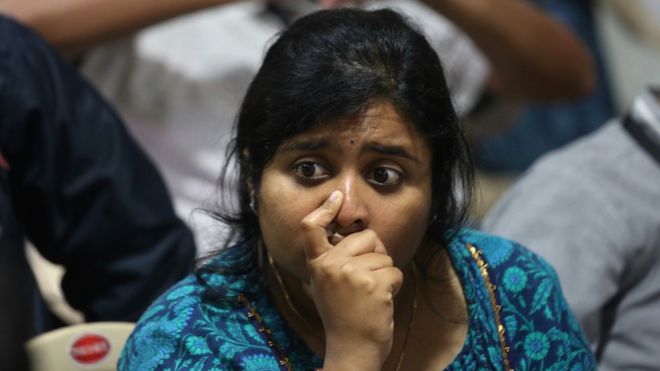
Isro employee reacts after the communication and data were lost from the vikram lander at ground station Indian Space Research Organization (ISRO) Telementry Tracking and Command Network (ISTRAC) Command Centre in Bangalore, India, 07 September 2019.Image copyright EPA
Image caption Indian scientists say contact with the lander was lost seconds before it was scheduled to touch down

India’s space agency, Isro, has not yet released information on how it lost contact with its Moon lander seconds before it was due to touch down on the lunar surface. But former members of the agency tell the BBC what may have gone wrong.

Chandrayaan-2 (Moon vehicle 2) entered the Moon’s orbit on 20 August and was due to land on the lunar surface a little after midnight India local time (1800 GMT) on 7 September – a month after it first shot into space.

But contact was lost moments before the lander (named Vikram, after Isro founder Vikram Sarabhai) was expected to touch down at the lunar south pole.

The orbiter has since spotted the lander on the surface of the Moon – unbroken, but tilted on its side. So far, scientists have not been able to establish contact with it.
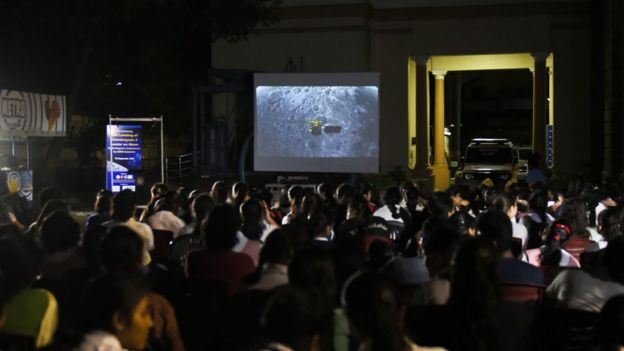
In Kolkata, India, 07 September, 2019, school students watch the live streaming screen of Chandrayaan2 landing on the lunar surface. According to ISRO (Indian Space Research Organisation), Vikram Lander was as planned and normal performance was observed upto an altitude of 2.1kmImage copyright GETTY IMAGES
Image caption The event was watched by millions across India

The lander’s final heart-stopping descent were monitored on screens, complete with readings which reflected the movement of the lander as it headed towards the surface of the Moon.

The screens carrying the readings also appeared on television and various social media accounts as the landing was broadcast live.

When the countdown began, the lander was moving at a velocity of 1,640 metres per second. Scientists say it appeared to be moving as planned during the first two phases of deceleration, known as the rough braking and fine braking operations.

It was during the final stage, known as the “hovering” stage, that the problem occurred.

The problem could well have been with the lander’s central engine, according to Prof Roddam Narasimha, a former member of Isro. He said that his theory was based on the readings on the screen.
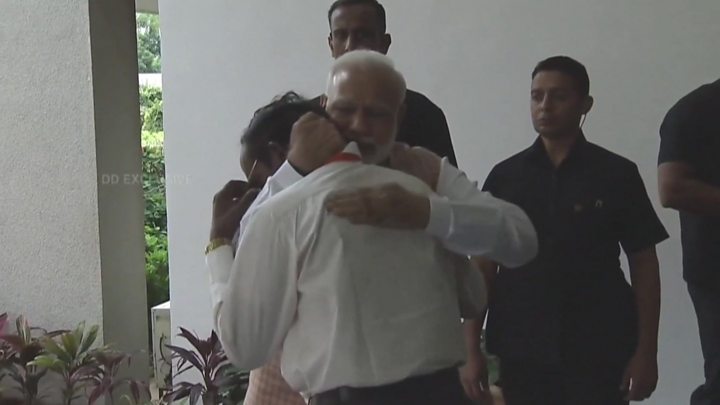
Media caption Modi consoles scientists after India Moon-lander loses contact

“One plausible explanation was that the lander started falling more rapidly,” he told BBC Hindi’s Imran Qureshi. “It’s supposed to come down at a velocity of two metres per second when it hits the Moon’s surface. But the gravity on the moon would have made it fall somewhat more rapidly.”

He believes this could be because the central engine was not “producing the thrust that is required and, therefore, the deceleration was no longer what it was supposed to be”.

And this, in turn, may have led to eventually losing communication with the lander itself.

The head of India’s first Moon mission, Mylswamy Annadurai, also said the anomaly in the velocity profile was an indication that something had malfunctioned in the lander as it hurtled towards the Moon.

“Most likely the orientation [of the lander] could have been disrupted. Once we look at the data we will be able to say for sure what happened, but it is likely that either a sensor or a thruster could have malfunctioned,” he told BBC Tamil.
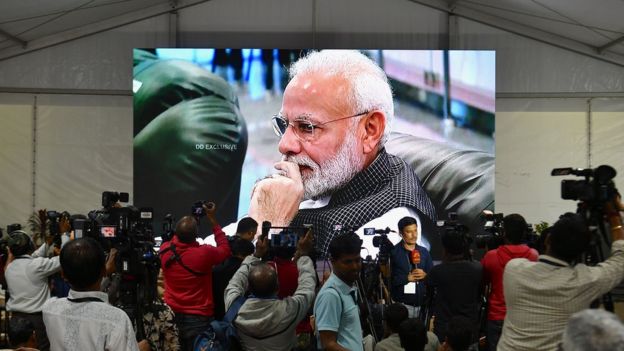
Members of the media cover the development as India's Prime Minister Narendra Modi is seen on a tv screen as he watches the live broadcast of the soft landing of spacecraft Vikram Lander of Chandrayaan-2 on the surface of the Moon at ISRO Telemetry, Tracking and Command Network (ISTRAC) centre in Bangalore early on September 7, 2019.Image copyright GETTY IMAGES
Image caption Prime Minister Narendra Modi also watched the event live

Dr Rajeswari Rajagopalan, the head of the Nuclear and Space Policy Initiative of the Observer Research Foundation (ORF), also said an engine malfunction was the likeliest reason.

“In the absence of data parameters, it is difficult to come to a conclusion, but the readings on the screen did show that something was wrong,” she told BBC Hindi.

“The other possibility is that when you do a landing at a higher speed, you cause a lot of dust to rise that also shakes up the spacecraft because of the gravitational pull. But it’s more likely the malfunctioning of one of the engines.”

Chandrayaan-2 was the most complex mission ever attempted by Isro.

The lander carried within its belly a 27kg Moon rover (called Pragyan, which translates as wisdom in Sanskrit), which included instruments to analyse the lunar soil.

The rover had the capacity to travel 500m from the lander in its 14-day life span, and would have sent data and images back to Earth for analysis.

The mission would have focused on the lunar surface, searching for water and minerals and measuring moonquakes, among other things.

Source: The BBC
07/09/2019

Chandrayaan-2: Modi proud despite Moon landing setback

Indian Prime Minister Narendra Modi told his country’s space scientists he was proud of a programme that had come so near to putting a probe on the Moon.

Contact with Chandrayaan-2 was lost moments before its Vikram module was due to touch down at the lunar south pole.

The fate of the craft is not yet known, but Mr Modi said there would be further opportunities.

India would have been the fourth nation to make a soft landing on the Moon.

“The best is yet to come in our space programme. India is with you,” said Mr Modi.

The Chandrayaan-2 approached the Moon as normal until an error occurred about 2.1km (1.3 miles) from the surface, officials said.

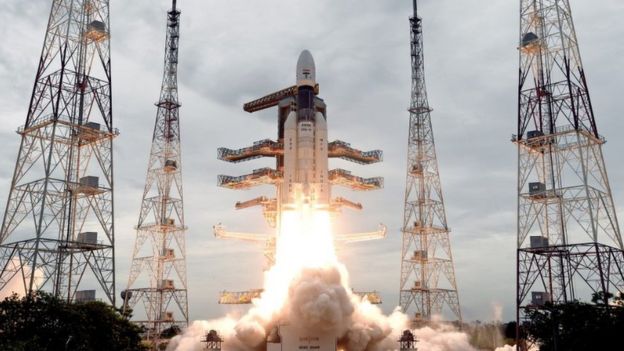
Chandrayaan-2 taking offImage copyright ISRO
Image caption The mission’s lift-off was broadcast live to an audience of hundreds of millions

India’s Space Research Organization (Isro) said it lost contact seconds before the ship was expected to land.

The country’s first Moon mission – Chandrayaan-1, in 2008 – carried out the first and most detailed search for water on the lunar surface using radars.

What happened?

Chandrayaan-2 entered the Moon’s orbit on 20 August and was due to make a controlled descent to the surface early on Saturday, Indian time, over a month after it first took off.

Staff at mission control were glued to the screens at Isro’s Bangalore space centre as the spacecraft made its descent towards the surface.

The control room burst into applause during the so-called rough breaking phase of the descent, with Prime Minister Modi watching the action from behind a glass screen.

Isro chairman Kailasavadivoo Sivan announced to staff that the ship’s initial descent had been “normal,” and that the mission’s data would be analysed.

Mr Sivan had earlier described the final descent as “15 minutes of terror”.

What was this mission all about?

Chandrayaan-2 (Moon vehicle 2) was the most complex mission ever attempted by India’s space agency, Isro. “It is the beginning of a historical journey,” Isro chief K Sivan said after launch in July.

The lander (named Vikram, after the founder of Isro) carried within its belly a 27kg Moon rover with instruments to analyse the lunar soil.

The rover (called Pragyan – wisdom in Sanskrit) had the capacity to travel 500m from the lander in its 14-day life span, and would have sent data and images back to Earth for analysis.

The mission would have focused on the lunar surface, searching for water and minerals and measuring moonquakes, among other things.

Why would it have been significant?

A soft landing on another planetary body – a feat achieved by just three other countries so far – would have been a huge technological achievement for Isro and India’s space ambitions, writes science writer Pallava Bagla.

He adds that it would also have paved the way for future Indian missions to land on Mars, and opened up the possibility of India sending astronauts into space.

For the first time in India’s space history, the interplanetary expedition was led by two women – project director Muthaya Vanitha and mission director Ritu Karidhal.

Media caption Is India a space superpower?

It is also a matter of national pride – the satellite’s lift-off in July was broadcast live on TV and Isro’s official social media accounts.

The mission has also made global headlines because it’s so cheap – the budget for Avengers: Endgame, for instance, was more than double at an estimated $356m. But this isn’t the first time Isro has been hailed for its thrift. Its 2014 Mars mission cost $74m, a tenth of the budget for the American Maven orbiter.

Source: The BBC

Law of Unintended Consequences

continuously updated blog about China & India

ChiaHou's Book Reviews

continuously updated blog about China & India

What's wrong with the world; and its economy

continuously updated blog about China & India