29/05/2020
- Tsai Ing-wen visited exiled Hong Kong bookseller a day after NPC voted in favour of legislation
- Lam Wing-kee said fleeing Hongkongers saw Taiwan as a step towards applying for asylum in the West
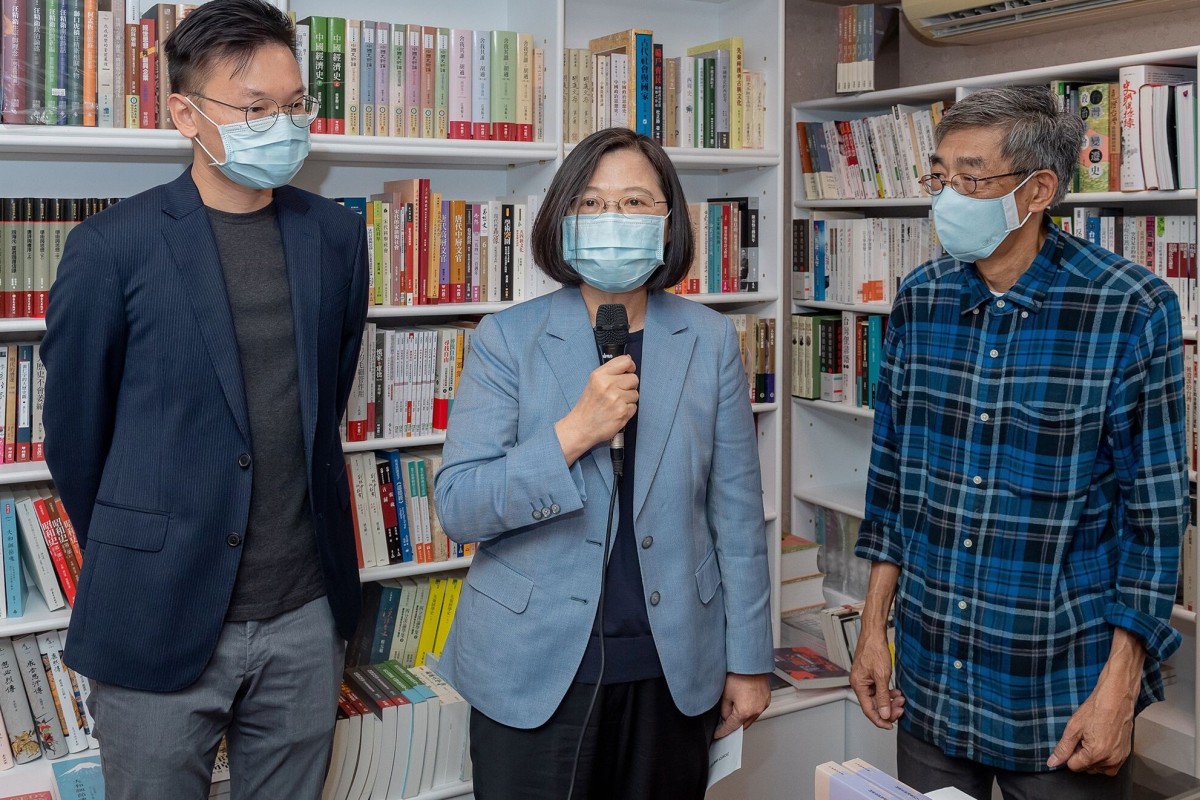
President Tsai Ing-wen (centre) shows her support for Hong Kong bookseller Lam Wing-kee (right) with Lin Fei-fan, deputy secretary general of the ruling Democratic Progressive Party. Photo: Taiwan presidential office/AFP
Taiwan’s President Tsai Ing-wen visited
exiled Hong Kong bookseller Lam Wing-kee
on Friday in a show of support for Hongkongers amid Beijing’s plan to introduce a controversial
national security law.
Her visit came a day after China’s legislature, the National People’s Congress, voted in favour of a resolution to initiate the legal process for a national security law to be imposed on Hong Kong, despite concerns from the United States, the European Union and elsewhere that the move would erode human rights, freedom and autonomy in the city.
Tsai said on behalf of all Taiwanese people, she welcomed Lam to stay in Taiwan where he could bolster the island’s efforts to further freedom and democracy.
Hongkongers who want to flee to Taiwan ‘will go through strict screening’
Lam, one of the five shareholders and staff at Hong Kong’s Causeway Bay Books, fled to Taiwan in April last year after he was detained by Chinese agents for eight months in 2015 for selling books critical of the Chinese leadership.
between October and December that year and it emerged they had been detained on the Chinese mainland.
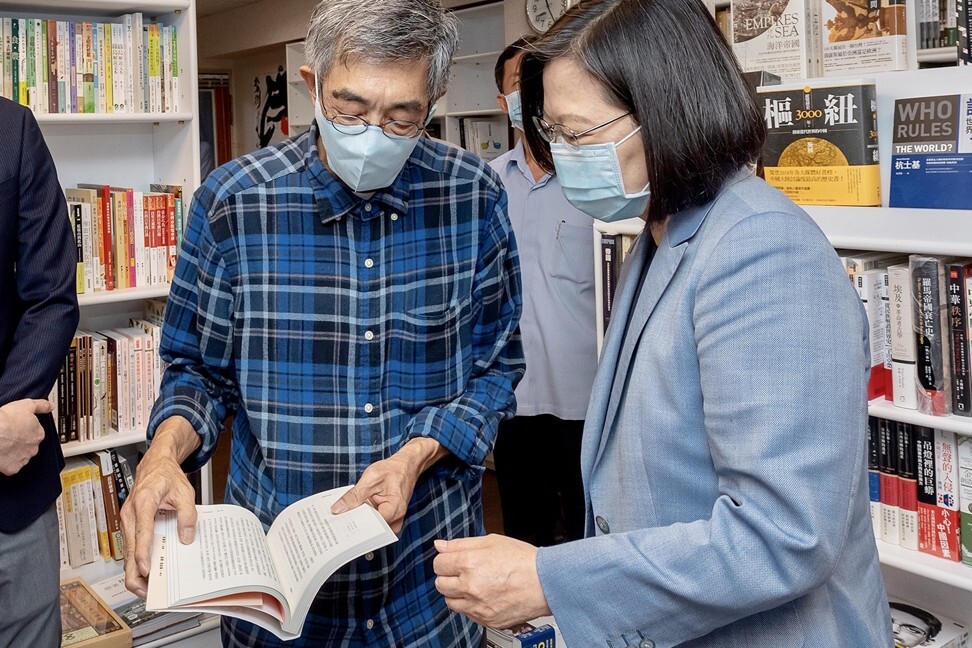
President Tsai Ing-wen looks at a book while visiting Lam Wing-kee on Friday. Photo: Taiwan presidential office/AFP
Lam later said he had been detained and blindfolded by police after crossing the border into mainland China from Hong Kong in October 2015.
The case triggered a huge controversy and raised fears of growing Chinese control in the city.
Seeing Lam as a representative of Hongkongers fleeing to Taiwan to avoid political persecution, Tsai said she wanted to understand what challenges these exiles faced and what help they needed during their stay on the self-ruled island.
“I want to tell Boss Lam [Wing-kee] and our Hong Kong friends that the government here has set up an ad hoc committee to offer help to them very soon,” she said.
On Wednesday, Tsai called for the government to set up an ad hoc committee to work out a “humanitarian help action plan” for Hong Kong people seeking to live in Taiwan or immigrate to the island. It was borne out of concern they would be arrested or prosecuted for taking part in months of anti-government protests triggered last year by the now-shelved extradition bill.
Chen Ming-tong, head of the Mainland Affairs Council, the island’s top mainland policy planner, said on Thursday his council would draft the measures for cabinet’s approval in a week.
Under the plan, the Mainland Affairs Council would issue special measures and coordinate with the island’s authorities on how to help Hongkongers relocate to Taiwan and take care of them.
Bookseller Lam told Tsai what Hongkongers needed most was to have their stay in Taiwan extended.
Lam said that currently, because of the absence of a political asylum law, Hongkongers could only apply to live in Taiwan through study, work, investment, their professional skills or close relatives.
He said fleeing Hongkongers usually came to Taiwan on tourist permits, which at most allowed them to stay for up to six months, giving them not enough time to apply for long-term residence in Taiwan.
“It would be better if they can stay for nine months and preferably one year,” he said.
Lam said some fleeing Hongkongers saw Taiwan as an intermediary base as they hoped to apply for asylum in the West, but it took a long time for Western countries to screen and approve their asylum requests.
Meanwhile, Premier Su Tseng-chang said Article 18 of the Laws and Regulations Regarding Hong Kong and Macau Affairs was good enough to deal with the current crisis in the absence of a political asylum law in Taiwan.
That article states that “necessary help shall be provided to Hong Kong or Macau residents whose safety and liberty are immediately threatened for political reasons”.
Source: SCMP
Posted in action plan, ad hoc committee, applying, asylum, autonomy, Beijing’s, blindfolded, bookseller, challenges, Chinese mainland, concerns, Democracy, Democratic Progressive Party, detained, European Union, exiled, extradition bill, favour, fleeing, Freedom, Government, Hong Kong, Hong Kong and Macau Affairs, Hong Kong Causeway Bay, Hongkongers, Human rights, humanitarian help, imposed, Lam Wing-kee, legislation, Mainland Affairs Council, National People’s Congress, national security law, NPC, Political asylum, political persecution, President, residents, security law, self-ruled island, shadow, supporting, Taiwan, thanks, Tsai Ing-wen, Uncategorized, under, United States, visited, voted, West |
Leave a Comment »
22/05/2020
- The rhetoric towards the self-ruled island has hardened in Premier Li Keqiang’s annual work report
- Beijing regards Taiwan as one of its core national interests and says it ‘resolutely opposes’ any separatist activity
Beijing regards reunification with Taiwan as one of its core interests. Photo: EPA-EFE
Beijing has hardened its rhetoric towards Taiwan, removing references to “peaceful reunification”, in the government’s annual work report.
Observers said the change reflected the stronger stance Beijing would adopt in tackling the Taiwan issue, which it regards as one of its key national interests.
The past six work reports since President Xi Jinping took power in 2013 stressed peaceful reunification and the 1992 consensus – under which both sides tacitly agree there is only one China, but have different interpretations on what this means.
But the latest report from Premier Li Keqiang took a different tone, saying: “We will adhere to the major principles and policies on work related to Taiwan and resolutely oppose and deter any separatist activities seeking ‘Taiwan independence’.”
US to sell US$180 million worth of submarine-launched torpedoes to Taiwan
“We will improve institutional arrangements, policies, and measures to encourage exchanges and cooperation between the two sides of the Taiwan Strait, further cross-strait integrated development, and protect the well-being of our compatriots in Taiwan,” the report said.
“We will encourage them to join us in opposing ‘Taiwan independence’ and promoting China’s reunification.
“With these efforts, we can surely create a beautiful future for the rejuvenation of the Chinese nation,” it said, dropping a clause that described the process as “peaceful”.
The 1992 consensus allows leeway for both parties to negotiate an agreement, but President Tsai Ing-wen has said the island would never accept it as the basis for cross-strait relations.
Taiwan’s Mainland Affairs Council said on Friday that the “one country, two systems” framework, touted by Beijing as a political basis for unification, had harmed cross-strait relations. It called for the two sides to work together to resolve their differences.
Tang Shao-cheng, an international relations specialist at Taiwan’s National Chengchi University, said the change in wording and tone of the Taiwan section of the work report could be seen as a warning to Tsai’s independence-leaning Democratic Progressive Party (DPP).
“Not mentioning ‘peace’ suggests Beijing is considering unification both by peaceful means and by force,” Tang said.
President Xi Jinping and Premier Li Keqiang at the National People’s Congress opening session on Friday. Photo: Kyodo
Derek Grossman, an analyst from US-based think tank Rand Corporation, said Beijing would continue to put pressure on the island using diplomatic, military, economic and psychological means.
“Beijing will continue to send military aircraft near the island … [it] could decide to end the Economic Cooperation Framework Agreement which has remained active in spite of Tsai’s election in 2016; Beijing could steal one or more diplomatic partners from Taipei. I would expect these types of actions to be on the table,” Grossman said.
How would mainland China attack Taiwan? A video outlines one scenario
Sun Yun, director of the China programme at the Stimson Centre think tank in the US, said Beijing faced a dilemma on whether to continue economic integration with Taiwan because that had not had the political effect it wanted.
“The obstacles to unification are not economic, but political. Taiwan is unwilling to pursue unification with an authoritarian mainland. To solve that issue, presumably the mainland could pursue political reform. But in reality, the Chinese Communist Party is unwilling,” she said.
“If the economic and political approach doesn’t work, what’s left is the military approach. But with US intervention, the mainland will not prevail.”
Beijing recently warned Washington it would respond after US Secretary of State
, and demanded that the US stop selling arms to the island.
Joshua Eisenman, a professor from the University of Notre Dame in Indiana, said Beijing was running out of countermeasures, since its actions had only hardened attitudes on the island and enhanced the sense of Taiwanese identity.
“As I see it, all that remains is for the [Chinese Communist Party[ to sit down and talk to the DPP without preconditions and establish a modus vivendi for cross-strait relations,” he said.
Source: SCMP
Posted in "Taiwan independence", activity, annual, ‘resolutely opposes’, “one country, two systems”, Beijing, chinese communist party, chinese government, compatriots, countermeasures, Cross-Strait relations, Democratic Progressive Party (DPP), diplomatic partners, drops, Economic Cooperation Framework Agreement, hardened, independence-leaning, Indiana, Mainland Affairs Council, Mainland China, Mike Pompeo, modus vivendi, national interests, National People’s Congress, peaceful, Premier Li Keqiang, Premier Li Keqiang’s, President Xi Jinping, RAND Corporation, references, reunification, self-ruled island, Separatist, Stimson Centre, Taipei, Taiwan, Taiwan Strait, Uncategorized, University of Notre Dame, US Secretary of State, work report |
Leave a Comment »
11/11/2019
- Mainland social media users come out in strong support for the officer, compounding extensive coverage of vandalism of businesses with ties across the border
Hong Kong’s police force has gained support from online commenters on the mainland. Photo: Nora Tam
As Monday morning’s
police shooting of a protester triggered a wave of shock and outrage in Hong Kong, across the border in mainland China, the response online was just as swift – but in support of the force.
“Support Hong Kong police opening fire! Clean up Hong Kong’s cockroaches!” one popular financial blogger on Weibo, China’s Twitter-like platform, said as he shared footage of the incident.
In the video, an officer grapples with a protester and points his gun towards another approaching protester. The second protester reaches out towards the gun, the officer dodges, steps back and shoots him in the torso.
“It feels great [to watch]! Kill them all, these trash and tumours of society,” a Weibo user replied to the video, with a thumbs-up emoji.
“Hongkong’s loser youth, [police] should totally open fire!! It would be best to shoot them in the head,” another post read.
These comments, and many others like them flooding social media in mainland China, highlight the deep divisions in views on each side of the border as Hong Kong’s political crisis drags into its sixth month.
Despite some initial sympathy, mainland public sentiment towards Hong Kong has hardened since July, amid state propaganda painting the protesters as a separatist movement plotted by “Western black hands”.
In recent weeks, the rancour from the mainland has only appeared to deepen, with photos and videos of protesters vandalising businesses with ties to the mainland spreading online.
Last month, a mainland Chinese banker was assaulted in a confrontation with protesters during his lunch break in Central, drawing the wrath of many mainlanders and renewed online calls for military intervention.
Extensive media coverage of the vandalism and attack, as well as a series of inflammatory commentaries, have further fanned the anger.
On Monday, the social media account of state-run Beijing Daily ran the story of the shooting under the headline: “This morning, a gunshot in Hong Kong, to the applause of citizens!”
“At such a critical moment, the police officer acted so bravely and restrained,” the report said.
“After the police fired the shot and subdued the rioters, some citizens at the scene directly applauded the police. The reaction of the public directly shows that the officer fired not only in a legal and reasonable way, but also in line with the will of the people.”
In the video, a man in a dark blue jumper claps his hands at a nearby traffic light, as police officers pin the protesters to the ground.
The Beijing Daily report did not refer to angry bystanders condemning the officers as “murderers”.
Hong Kong police officer who shot protester receives death threats against children after personal details released online, force says
Hu Xijin, editor-in-chief of nationalist tabloid Global Times, and a regular – and hugely popular – commentator on Hong Kong’s unrest, also weighed in.
“As a media worker, I resolutely support this Hong Kong police officer gunning down the attacking rioters,” he wrote to his 2 million fans on Weibo in a post that included video of the shooting.
Hu accused Hong Kong and Western media of “focusing their coverage on the police shooting and diluting the illegal, criminal and evil deeds of the rioters”.
“Such guiding of public opinion is disgusting,” he wrote.
Hu ended his post with a message to Hong Kong police: “Don’t you be afraid of anything, resolutely defend Hong Kong’s law and order, be strong and be tough. You’re not alone on the front lines. Behind you there are not only the [patriotic] Hong Kong public and the nation, but also the country’s paramilitary police and the People’s Liberation Army Hong Kong garrison, who can enter Hong Kong and offer support in accordance with the Basic Law when needed.”
The post was liked more than 26,000 times in six hours.
Scores of Chinese students flee Hong Kong over fears they will be attacked as anti-mainland sentiment sweeps through protesters in city
Meanwhile, Taiwanese President Tsai Ing-wen called on the Hong Kong government to give a detailed response to the Hong Kong people’s calls for democracy and freedom, which she described as “the only path to return to stability and order”.
“Governments should not fire upon unarmed people, this will only exacerbate the problem,” she wrote on her official Facebook account. “Beijing and the Hong Kong government should respond to the Hong Kong people, not with bullets but with the promise of democracy and freedom.”
Taipei’s Mainland Affairs Council, which oversees the island’s policies on Beijing, called on all sides to give up their arms and aggressive actions to make way for peaceful conversation.
Source: SCMP
Posted in Basic Law, Beijing, Beijing Daily, between, deep, divide, exposes, Facebook, Global Times, Government, Hong Kong, Hong Kong garrison, Mainland Affairs Council, Mainland China, online, People's Liberation Army, Police, President Tsai Ing-wen, shooting, Taipei’s, Taiwan President Tsai Ing-wen, Taiwanese President, Tsai Ing-wen, Uncategorized |
Leave a Comment »
04/11/2019
- Latest measures grant island’s people and enterprises more equal treatment with their mainland counterparts
- Package in March last year was dismissed by Taiwan’s Mainland Affairs Council as an attempt to buy political support
Taipei’s elections in January could influence the tone of cross-strait relations. Photo: EPA-EFE
Beijing announced a series of sweeteners for Taiwanese businesses and individuals on Monday – including participation in its 5G research and allowing Taiwanese to use mainland consular services – only two months before
Taiwan’s critical presidential election.
The latest 26 measures drawn up by 20 government departments, including the State Council’s Taiwan Affairs Office and the National Development and Reform Commission, are designed to attract more Taiwanese to live and work in mainland China, despite worsening cross-strait relations.
But Taiwan’s Mainland Affairs Council criticised the move as an attempt by the Chinese Communist Party to “divide Taiwan internally, and was a further reflection of attempts to try to interfere in and influence Taiwan’s election”.
It follows a similar package of 31 measures unveiled by Beijing in March last year, which included tax incentives, preferential land-use policies for Taiwanese businesses on the mainland and benefits for Taiwanese individuals in studying or living on the mainland.
Taiwan charges pro-Beijing politicians with accepting mainland cash
The latest measures to grant Taiwan-funded enterprises more equal treatment with their mainland counterparts include offering access to research and development in 5G technology, investment in passenger and cargo air services, the establishment of microlending and financing companies and the right to apply for financial guarantees from local government funds.
Taiwanese individuals will also be officially entitled to mainland Chinese consular protection abroad, will be treated the same as their mainland counterparts when buying residential property on the mainland, and will be able to train in Beijing for the 2020 Olympic Games.
Beijing claims sovereignty over self-ruled Taiwan, and has not renounced the use of force to take the democratic island into its fold. Beijing’s ruling Communist Party has stressed its intention to promote “peaceful reunification”, pledging in its communique from the
fourth plenary meeting of the party’s elite last week to “deepen cross-strait integration and development” while opposing Taiwanese independence.
The latest measures from Beijing came ahead of Taiwan’s presidential and legislative elections in January. Relations across the Taiwan Strait have been frozen under the administration of independence-leaning Taiwanese President, ostensibly over her refusal to accept the “1992 consensus”, or the understanding that there is only “one China” – something that Beijing considers a prerequisite for any talks with Taipei.
Taiwan’s Mainland Affairs Council said on Monday that the roll-out of the 26 measures one year later was intended to “cover up” the fact that the 31 measures had not been executed properly, and reflected administrative problems on the mainland amid slowing economic growth.
“Even more than that, it also reflects that during this period Taiwanese people have rejected ‘one country, two systems’ and do not agree with the results of the Communist Party’s united front divisions,” the council said.
“We urge the Communist Party officials to specifically implement protections for Taiwanese businesses and Taiwanese people in their investments and lives.”
Joseph Wu, Taipei’s foreign minister, also responded with a tweet written in simplified Chinese – which is used on the mainland – rather than the traditional Chinese used in Taiwan.
“China’s Taiwan Affairs Office came out with 26 measures and last year there were 31 – it looks like there are so many measures,” he wrote. “But we in Taiwan do not need one country, two systems, so there is really no need to be so polite. Giving your people more freedom is also good!”
Ongoing
anti-government protests in Hong Kong – which is semi-autonomous from Beijing under the one country, two systems model – have highlighted for many Taiwanese voters the threat from Beijing to the island’s sovereignty.
The latest polling by the MAC found that 89 per cent of respondents opposed the one country, two systems framework that Beijing proposed for Taiwan, up from 75 per cent in a similar survey in January.
Edward I-hsin Chen, a political-science professor at Chinese Culture University in Taipei, said the impact of the 26 measures on the election would depend on how they were implemented, but that one country, two systems was clearly not palatable for Taiwanese voters, whether they supported Tsai’s Democratic Progressive Party (DPP) or the mainland-friendly Kuomintang (KMT).
“Taiwan, of course, will not accept one country, two systems, so these policies will need to be more long-term. Mainland officials did not handle the Hong Kong issue very well, so it will be very hard for one country, two systems in Taiwan – blue and green will both reject it,” he said, referring to the party colours for the KMT and DPP. “But it is good for Taiwanese people and businesses to be able to take part in the 5G sector, and there will be more cooperation in the future.”
Lin Chingfa, former chairman of the Beijing-based Association of Taiwan Investment Enterprises, said he believed the new measures were intended to appeal to Taiwanese youth.
“A very important direction for cross-strait cooperation nowadays is to bridge the opportunities available in mainland China for young people who feel deprived from the slow Taiwanese economy. Some of these policies should be especially appealing to them because it shows that the country hopes to make it more convenient for young Taiwan people willing to come,” Lin said.
He said this approach was especially obvious in the measures that were introduced to provide equal treatment for Taiwan people on the mainland – for example the opportunities for Taiwan people to apply for scholarships and the expansion of places for Taiwanese students at universities.
Source: SCMP
Posted in 5G research, 5G technology, anti-government protests, Association of Taiwan Investment Enterprises, Beijing, cargo air services, China’s State Council, chinese communist party, Chinese Culture University, Democratic Progressive Party (DPP), Election, extends, Hong Kong, Mainland Affairs Council, microlending and financing companies, National Development and Reform Commission, National Development and Reform Commission (NDRC), ne country, two systems model, one China, One country, two systems, passenger air services, presidential, sovereignty, State Council Taiwan Affairs Office, Sweeteners, Taipei, Taiwan Affairs Office, Taiwan’s, Taiwanese, Taiwanese President, Uncategorized |
Leave a Comment »




 CHINDIA ALERT: You'll be living in their world, very soon