Chindia Alert: You’ll be Living in their World Very Soon
aims to alert you to the threats and opportunities that China and India present. China and India require serious attention; case of ‘hidden dragon and crouching tiger’.
Without this attention, governments, businesses and, indeed, individuals may find themselves at a great disadvantage sooner rather than later.
The POSTs (front webpages) are mainly 'cuttings' from reliable sources, updated continuously.
The PAGEs (see Tabs, above) attempt to make the information more meaningful by putting some structure to the information we have researched and assembled since 2006.
BEIJING (Reuters) – Shanghai increased airport screening on Saturday as imported coronavirus infections from countries such as Italy and Iran emerge as the biggest source of new cases in China outside Hubei, the province where the outbreak originated.
Mainland China had 99 new confirmed cases on Friday, according to official data. Of the 25 that were outside Hubei, 24 came from outside China.
Shanghai, which had three new cases that originated from abroad on Friday, said it would step up control measures at the border, which had become “the main battlefield”.
At a news conference, Shanghai Customs officials said they city would check all passengers from seriously affected countries for the virus, among other airport measures.
Shanghai already requires passengers flying in from such countries, regardless of nationality, to be quarantined for 14 days. They will now be escorted home in vehicles provided by the government.
Tighter screening has greatly lengthened waiting times at Shanghai’s Pudong International Airport – some passengers say they have had to wait as long as seven hours.
The Shanghai government vowed on Saturday to severely punish passengers who concealed infections.
Beijing police said on Saturday they would work with other departments to prevent imported infections. They said some members of a Chinese family flying in from Italy on March 4 had failed to fill in health declarations accurately, and later tested positive for the virus.
MIGRANT WORKERS
In addition to the growing risk of imported infections, China faces a challenge in trying to get migrant workers back to work by early April.
So far, 78 million migrant workers, or 60% of those who left for the Lunar New Year holiday in January, have returned to work.
Yang Wenzhuang of the National Health Commission (NHC) said that the “risk of contagion from increased population flows and gathering is increasing … We must not relax or lower the bar for virus control”.
But new cases in mainland China continued to decline, with just 99 new cases on Friday, the lowest number the NHC started publishing nationwide figures on Jan. 20, against 143 on Thursday.
Most of these cases, which include infections of Chinese nationals who caught the virus abroad, were in the northwesterly Gansu province, among quarantined passengers who flew into the provincial capital Lanzhou from Iran between March 2 and 5.
For the second day in a row, there were no new infections in Hubei outside the provincial capital Wuhan, where new cases fell to the lowest level since Jan. 25.
The total number of confirmed cases in mainland China so far is 80,651, with 3,070 deaths, up by 28 from Thursday.
Around two thirds of the total number of flights scheduled every day in February were cancelled, placing huge financial pressure on airlines and airports
China’s aviation industry has also been affected by a series of restrictions by other countries and airlines, with British Airways extending its suspension until mid-April
The cancellation of around 10,000 flights a day, or around two thirds of the total number of flights scheduled every day in February, has placed huge financial pressure on airlines and airports. Photo: Kyodo
A one-way air ticket from the coastal economic hub of Shanghai to the inland municipality of Chongqing, a journey of over 1,400km (870 miles), now costs less than a cup of coffee, with Chinese airlines slashing prices in a bid to boost weak domestic demand amid the coronavirus outbreak.
The cancellation of around 10,000 flights a day, or around two thirds of the total number of flights scheduled every day in February, has placed huge financial pressure on airlines and airports.
The Civil Aviation Administration of China said in a notice on Tuesday that flights should resume gradually as part of the country’s efforts to return economic and social life back to normal, but passengers are still reluctant to fly with the deadly outbreak still not fully under control.
The one-way flight from Shanghai to Chongqing is being offered for just 29 yuan (US$4.10) by China’s biggest low-cost carrier, Spring Airlines, as a special offer for its frequent flyer club members, while a tall caffe latte at Starbucks in China costs 32 yuan (US$4.5).
Many Chinese carriers do receive subsidies for operating key domestic routes, so this also skews the economics as well Luya You
A one-way ticket from Shanghai to Harbin, the capital of the northern Heilongjiang province, a distance of over 1,600km (994 miles), costs just 69 yuan (US$9.80).
Shenzhen Airlines, a division of state-owned carrier Air China, is also running special offers to Chongqing, with a one-way ticket for the 1000km (621 miles) journey from Shenzhen costing just 100 yuan (US$14), around 5 per cent of the standard price of 1,940 yuan (US$276).
Chengdu Airlines, a unit of Sichuan Airlines, which counts China Southern Airlines as a shareholder, is also offering cheap one-way flights from Shenzhen to Chengdu, a distance of over 1,300km (808 miles), for just 100 yuan.
“Considering lower average costs of operating in mainland China, carriers could potentially offer deeper discounts while making slim profits or just breaking even,” said Luya You, an aviation analyst with Bank of Communication International. “As outbreak numbers stabilise or even decline, carriers will likely adjust their fares as well, so these low fares will not last if the situation quickly turns for the better.
“Many Chinese carriers do receive subsidies for operating key domestic routes, so this also skews the economics as well. If it is a key route, for example, the carrier may choose to continue operating regardless of fares or loads as the route constitutes a major link in the domestic network infrastructure.”
China’s aviation authority confirmed earlier this month that between January 25 and February 14, which included the Lunar New Year holiday, the average daily passenger traffic in China was just 470,000, representing a 75 per cent drop from the same period last year.
China’s aviation industry has also been affected by a series of restrictions by other countries and airlines, with British Airways last week extending its suspension of flights to China until after the Easter holiday in mid-April following travel advice from the British government.
The novel coronavirus, which causes the disease officially named Covid-19, has infected more than 78,000 people and killed 2,700 in China. In recent days, South Korea, Italy and Iran have all reported a surge in new cases, raising fears over the spread of the coronavirus.
“The flight suspensions will track the outbreaks, but not likely lead them. If there are more outbreaks, expect more flight suspensions,” said Andrew Charlton, managing director of Aviation Advocacy.
SEOUL/BEIJING (Reuters) – South Korea aims to test more than 200,000 members of a church at the centre of a surge in coronavirus cases, as countries stepped up efforts to stop a pandemic of the c that emerged in China and is now spreading in Europe and the Middle East.
More than 80,000 people have been infected in China since the outbreak began, apparently in an illegal wildlife market in the central city of Wuhan late last year.
China’s death toll was 2,663 by the end of Monday, up 71 from the previous day. But the World Health Organization (WHO) has said the epidemic in China peaked between Jan. 23 and Feb. 2 and has been declining since.
RELATED COVERAGE
Britain advises travellers self isolate after north Italy trips
Italy reports coronavirus case in Sicily, first south of Rome
See more stories
However, fast-spreading outbreaks in Iran, Italy and South Korea, and first cases in several Middle East countries, have fed worries of a pandemic, or worldwide spread of the virus.
“We are close to a pandemic, but there is still hope the epidemics in Iran, Italy, South Korea, etc. can be controlled,” said Raina MacIntyre, head of the Biosecurity Programme at the Kirby Institute at the University of New South Wales.
South Korea has the most virus cases outside China and reported its tenth death and 144 new cases, for a total of 977. President Moon Jae-in said the situation was “very grave”.
In Europe, Italy has become a new front line, with 220 cases reported on Monday, up from just three on Friday. The death toll in Italy is seven.
Global stock markets stabilised on Tuesday after a wave of early selling petered out and Wall Street futures managed a solid bounce after a sharp selloff the previous day on fears about the spreading coronavirus.
“If travel restrictions and supply chain disruptions spread, the impact on global growth could be more widespread and longer lasting,” said Jonas Goltermann, senior economist at research consultancy Capital Economics in London.
PUBLIC ANXIETY
About 68% of South Korea’s cases are linked to the Shincheonji Church of Jesus, where the outbreak is believed to have begun with a 61-year-old woman. It is not known how she became infected.
The church said it would provide authorities the names of all its members in South Korea, estimated by media at about 215,000 people. The government would test them all as soon as possible, the prime minister’s office said.
“It is essential to test all of the church members,” it said in a statement. Authorities said they were testing up to 13,000 people a day.
The U.S. and South Korean militaries have said they may cut back joint training due to the virus, in one of the first concrete signs of its fallout on global U.S. military activities.
The disclosure came during a visit to the Pentagon on Monday by South Korean Defence Minister Jeong Kyeong-doo, who said 13 South Korean troops had the virus.
The U.S. military said a woman who tested positive for the virus had visited one of its bases in the hard-hit city of Daegu. It was the first infection connected to U.S. Forces Korea, which has about 28,500 American troops on the peninsula.
The U.S. military urged troops to “use extreme caution” off base, while the U.S. Centers for Disease Control and Prevention said Americans should avoid non-essential travel to South Korea.
IRAN ISOLATION
Outside mainland China, the outbreak has spread to about 29 countries and territories, with a death toll of about three dozen, according to a Reuters tally.
Afghanistan, Bahrain, Iraq, Kuwait and Oman reported their first new coronavirus cases, all in people who had been to Iran where the toll was 14 dead, media said, and 61 infected.
The outbreak threatens to isolate Iran further. The United Arab Emirates, which has 13 virus cases, suspended all flights with Iran for at least a week, state media said.
Iraq extended an entry ban on travellers from China and Iran to those from five other countries over virus fears, its health ministry said.
In Japan, which has reported four deaths and 850 cases mostly linked to a cruise ship, Health Minister Katsunobu Kato said it was too early to talk about cancelling the Tokyo Olympics due to start on July 24.
The United States pledged $2.5 billion to fight the disease, with more than $1 billion going toward developing a vaccine, with other funds earmarked for therapeutics and the stockpiling of personal protective equipment such as masks.
China reported a rise in new cases in Hubei province, the epicentre of the outbreak. But excluding those, China had just nine new infections on Monday, its fewest since Jan. 20.
With the pace of new infections slowing, Beijing said restrictions on travel and movement that have paralysed economic activity should begin to be lifted.
“Low-risk areas … are to restore order in production and life, cancel transport restrictions and help enterprises,” state planner official Ou Xiaoli told a briefing.
State-owned carrier’s chief says it wouldn’t be ‘morally acceptable’ to stop flying to the country, and it will stand with its ‘Chinese brothers and sisters’
Dozens of airlines have cancelled or reduced services to the nation amid the virus outbreak, including two East African rivals
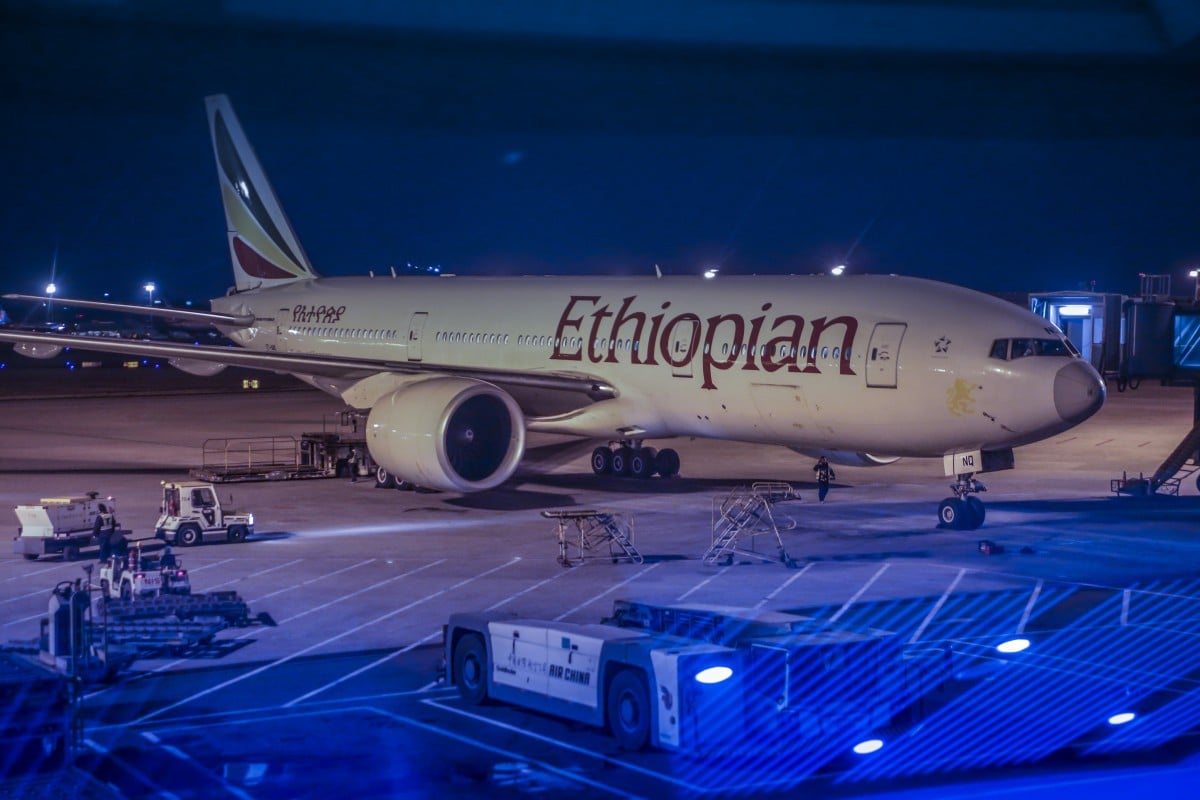
Ethiopian Airlines says it will continue flying to China. The routes are among its most profitable. Photo: Shutterstock
Ethiopian Airlines, Africa’s largest and most profitable carrier, will continue flying to China despite growing pressure for it to suspend services to the country as
Dozens of airlines around the globe have cancelled or reduced their services to cities in the world’s second-largest economy amid fears over the outbreak. Its East African rivals Kenya Airways and RwandAir have both suspended flights to China until the outbreak is contained.
But Ethiopian Airlines chief executive Tewolde GebreMariam said the carrier would not abandon the routes, which are among its most profitable.
Tewolde told media over the weekend that the airline had been flying to China since 1973 and it would not be ethical to suspend flights to the country.
“It will not be morally acceptable to stop flying to China today because they have a temporary problem,” he said, adding that the airline would stand with its “Chinese brothers and sisters”.
His remarks came days after Kenyan President Uhuru Kenyatta put pressure on the Ethiopian government – which wholly owns Ethiopian Airlines – to halt flights to China, citing the need to curb the spread of the virus into the East African region.
Global coronavirus deaths equal Sars, while new infections drop
The airline has bucked a trend that has seen major airlines – from the United States to Europe and Asia – staying away from Chinese airspace as governments around the world move to keep the deadly virus from their borders. The pneumonia-like illness has so far
in mainland China since the outbreak began in Wuhan in December, with cases reported in more than 20 other countries worldwide.
Speaking during a visit to Washington last week, Kenyatta – who is keen to court both China and the US – insisted that Kenya’s decision to suspend flights from Guangzhou to Nairobi was not political.
He said most African countries had weak health systems that would make it harder to handle the outbreak, so preventing its spread – even if through extreme measures such as grounding flights – was the only option.
“Our worry as a country is not that China cannot manage the disease. Our biggest worry is diseases coming into areas with weaker health systems like ours,” Kenyatta said while addressing members of US think tank the Atlantic Council.
Vaccine for new coronavirus unlikely to be ready before outbreak is over, says Sars expert
But Ethiopian Airlines said it would continue flying to Beijing, Shanghai, Guangzhou, Chengdu and Hong Kong and was taking measures to protect staff and passengers. Ethiopia receives about 1,500 visitors from mainland China every day.
According to Tewolde, if the airline halted its Chinese services, China and Africa would be completely disconnected.
“No one in Ethiopian Airlines would like to see this,” he said. “We have to take maximum precautions, but stopping flights is not one of them.”
He added: “Even if we stop flying, people will continue to come to Ethiopia through Singapore, Malaysia, Europe. The transmission of the disease will be dangerously hidden … British Airways stopped flying to China for its economic reasons. But Chinese carriers are flying to the UK.”
Chinese cities keen to get back to work but coronavirus concerns grow as workers return
14 Feb 2020
In a separate statement, the carrier said China was “one of the strongest and one of the oldest markets for Ethiopian Airlines”.
“We have been connecting the great Chinese nation with the entire continent of African for almost half a century and it is our growth strategy,” the airline said, adding that it would continue operating in the five cities in compliance with international aviation and health guidelines.
Aside from seeking to shore up revenues, analysts noted that the airline was under tight state control, and Ethiopia would be reluctant to do anything that might harm its strong bilateral ties with China.
Ethiopia is among the nations on the continent with the highest number of Chinese immigrants. Most of them are workers involved in the construction of infrastructure projects including ports, railways, dams, bridges and malls. Those projects have been financed with billions of dollars in loans from China – Ethiopia is reportedly among the biggest recipients of Chinese lending in Africa.
Last year, China was forced to restructure Ethiopia’s debt after the latter edged closer to defaulting on a loan from Beijing for its standard gauge railway.
Chinese hotel workers arrested in Kenya after caning video prompts demands for action
14 Feb 2020
Ethiopia, Algeria, Angola, Nigeria and Zambia together accounted for nearly 60 per cent of all Chinese workers on the continent at the end of 2017, according to a study by Johns Hopkins University.
Ethiopia is also a major recipient of direct foreign investment from China.
BEIJING/SEOUL (Reuters) – Italy, South Korea and Iran reported sharp rises in coronavirus infections on Monday, triggering concern from the World Health Organization (WHO), but China relaxed some curbs on movement, including in Beijing, as the rate of new infections there eased.
The virus has put Chinese cities into lockdown, disrupted air traffic to the workshop of the world and blocked global supply chains for everything from cars and car parts to smartphones.
The surge of cases outside mainland China triggered steep falls in global share markets and Wall Street stock futures as investors fled to safe havens. Gold soared to a seven-year high, oil tumbled nearly 4% and the Korean won KRW= fell to its lowest level since August.[MKTS/GLOB]
But U.S. Treasury Secretary Steven Mnuchin cautioned against jumping to conclusions about the impact on the global economy or supply chains, saying it was simply too soon to know.
RELATED COVERAGE
Ireland cautions against travel to coronavirus-hit areas of Italy
France blocks passengers on board bus from Italy after one falls ill
The World Health Organization (WHO) said it no longer had a process for declaring a pandemic, but that the coronavirus outbreak remained an international emergency.
“We are specially concerned about the rapid increase in cases in … Iran, Italy and the Republic of Korea,” WHO head Tedros Adhanom Ghebreyesus told a news conference in Sweden via video link from Geneva.
South Korea reported 231 new cases, taking its total to 833. Many are in its fourth-largest city, Daegu, which became more isolated with Asiana Airlines (020560.KS) and Korean Air (003490.KS) suspending flights there until next month.
Iran, which announced its first two cases last Wednesday, said it had confirmed 43 cases and eight deaths. Most of the infections were in the Shi’ite Muslim holy city of Qom.
Elsewhere in the Middle East, Bahrain and Iraq reported their first cases and Kuwait reported three cases involving people who had been in Iran.
Saudi Arabia, Kuwait, Iraq, Turkey, Pakistan and Afghanistan imposed restrictions on travel and immigration from Iran. Afghanistan also reported its first case, officials said.
The WHO has been saying for weeks that it dreads the disease reaching countries with weak health systems.
Europe’s biggest outbreak is in Italy, with some 150 infections – compared with just three before Friday – and a fifth death.
‘SEVERE AND COMPLEX’
Scientists around the world are scrambling to analyze the virus, but a vaccine is probably more than a year away.
“Worryingly, it seems that the virus can pass from person to person without symptoms, making it extremely difficult to track, regardless of what health authorities do,” said Simon Clarke, an expert in cellular microbiology at the University of Reading in Britain.
China postponed the annual meeting of its parliament in Beijing.
But there was a measure of relief for the world’s second-largest economy as more than 20 province-level jurisdictions, including Beijing and Shanghai, reported zero new infections, the best showing since the outbreak began.
President Xi Jinping urged businesses to get back to work, though he said the epidemic was still “severe and complex, and prevention and control work is in the most difficult and critical stage”.
Excluding the central Hubei province, center of the outbreak, mainland China reported 11 new cases, the lowest since the national health authority started publishing nationwide daily figures on Jan. 20.
The coronavirus has infected nearly 77,000 people and killed more than 2,500 in China, most in Hubei.
Overall, China reported 409 new cases on the mainland, down from 648 a day earlier, taking the total number of infections to 77,150 cases as of Feb. 23. The death toll rose by 150 to 2,592.
Outside mainland China, the outbreak has spread to about 29 countries and territories, with a death toll of about two dozen, according to a Reuters tally.
Xi said on Sunday the outbreak would have a relatively big, but short-term, impact on the economy and the government would step up policy adjustments to help cushion the blow.
Mnuchin, speaking to Reuters in the Saudi city of Riyadh, said he did not expect the coronavirus to have a material impact on the Phase 1 U.S.-China trade deal.
“Obviously that could change as the situation develops,” he added.
In northern Italy, authorities sealed off the worst-affected towns and banned public gatherings across a wide area, halting the carnival in Venice, where there were two cases.
Austria briefly suspended train services over the Alps from Italy after two travelers coming from Italy showed symptoms of fever.
Both tested negative for the new coronavirus but Austrian Interior Minister Karl Nehammer said a task force would meet on Monday to discuss whether to introduce border controls.
Japan had 773 cases as of late Sunday, mostly on a cruise ship quarantined near Tokyo. A third passenger, a Japanese man in his 80s, died on Sunday.
In South Korea, authorities reported a seventh death and dozens more cases on Monday. Of the new cases, 115 were linked to a church in the city of Daegu.
Drone footage showed what appeared to be hundreds of people queuing in a neat line outside a Daegu supermarket under the winter sunshine to buy face masks. ( tmsnrt.rs/37WP6lA )
An extended Lunar New Year holiday provides people from the self-ruled island with the opportunity to rethink their careers as the death toll from the deadly infection continues to rise
Online poll finds 63 per cent of Taiwanese unwilling to return to mainland China over health concerns
Many Taiwanese are opting not to return to their jobs in mainland China because of the coronavirus epidemic. Photo: EPA-EFE
Taiwanese account manager Douglas Liu values his life more than his job, which is why he will be staying at home on Monday rather than going back to work in the mainland China city of Suzhou.
Liu returned to his home in Taipei on January 10 for an extended Lunar New Year
holiday – and to vote in the island’s presidential election – and planned to go back to work on February 1. But as the coronavirus epidemic worsened, the 45-year-old changed his plans.
“Last week, my company told me I should resume work on February 24, but after I argued in vain over the risk of returning to Suzhou, I tendered my resignation,” he said. “After all, my life is more important.”
Liu works for a firm that manufactures chest freezers for the mainland Chinese market.
“With more than 80 coronavirus infections in Suzhou and little sign of it subsiding, who knows what could happen to me if I return,” he said.
More than 78,700 people have contracted the virus since it was first detected in Wuhan, the capital of central China’s Hubei province, at the end of last year, and close to 2,500 have lost their lives to it.
As of Saturday, about 98 per cent of the infections and 99 per cent of the fatalities were in mainland China, two figures that have prompted many Taiwanese to rethink their employment plans.
According to a survey conducted last week by online recruitment agency 104 Job Bank, 63 per cent of Taiwanese with jobs on the mainland said they would not be returning to work after the extended Lunar New holiday. Before Wuhan was placed under lockdown on January 23 in a bid to contain the coronavirus outbreak, the figure was just 50 per cent.
“The intensification of the outbreak has created panic and insecurity for Taiwanese who work in mainland China and the lockdown of many cities has further discouraged them from returning to their jobs,” said Jason Chin, a senior vice-president at the recruitment agency.
Wuhan has been on lockdown since January 23. Photo: Reuters
Dozens of cities across China have introduced some form of restriction on the movement of residents, and several remain under total lockdown.
Chin said that the containment efforts had made it impossible for many companies to resume normal operations and provided a catalyst for Taiwanese workers to seek employment elsewhere.
“Taiwanese often to change jobs after the Lunar New Year, so the mainland government’s policy of delaying the resumption of regular business activities has given them more time to look for work outside mainland China,” he said.
Shannon Chiu is another Taiwanese who decided to call time on the mainland because of the coronavirus outbreak.
After two years working for an agricultural technology company in Zhengzhou, the capital of central China’s Henan province, she said she already had concerns about the standards of health care there.
“Being sick in Zhengzhou is a nightmare for Taiwanese because of the poor organisation and registration procedures,” she said.
“You either have to wait hours to see a doctor or go hospital-hopping in the hope of getting an appointment somewhere else.”
Chiu said she was still working in Zhengzhou after the outbreak had been reported in Wuhan – about 500km (310 miles) to the south – but no one in the city was wearing a face mask.
“I was lucky because I came back to Taiwan a week before the lockdown and my company allowed me to continue working from Taipei,” she said.
“Although I no longer enjoy the expatriate benefits, I feel a lot safer here because I don’t think I would survive if I was put in a mainland hospital because of Covid-19.”
BEIJING (Reuters) – China reported a sharp decrease in new deaths and cases of the coronavirus on Saturday but a doubling of infections in South Korea and 10 new cases in Iran added to unease about its rapid spread and global reach.
Mainland China had 397 new confirmed cases of coronavirus infections on Friday, down from 889 a day earlier, but only 31 cases were outside of the virus epicentre of Hubei province, the lowest number since the National Health Commission started compiling nationwide data a month ago.
But infection numbers continued to rise elsewhere, with outbreaks worsening in South Korea, Italy and Lebanon and Iran, prompting a warning from the World Health Organization that the window of opportunity to contain the international spread was closing..
South Korea saw another spike in infections, with 229 new confirmed cases, taking its tally to 433. Officials warned that could rise substantially as more than 1,000 people who attended a church at the centre of the outbreak had shown flu-like symptoms.
Iran, which had no reported cases earlier this week, saw 10 new cases, one of which had died, taking the number to 28 infections and five deaths.
RELATED COVERAGE
South Korea coronavirus cases more than double in a day
Second coronavirus patient dies in Italy – ANSA news agency
Concerns about the virus weighed on U.S. stocks on Friday, driven by an earlier spike in cases in China and data showing stalling U.S. business activity in February. [MKTS/GLOB]
It has spread to some 26 countries and territories outside mainland China, killing 13 people, according to a Reuters tally.
WHO director-general Tedros Adhanom Ghebreyesus on Twitter expressed concern on Saturday about cases with no clear link to China and called on all countries to invest urgently in preparedness. He made an appeal for $675 million to support the most vulnerable countries.
On Friday, he said now was the time to act decisively.
“We still have a chance to contain it,” he said. “If we don’t, if we squander the opportunity, then there will be a serious problem on our hands.”
An outbreak in northern Italy worsened with its first two deaths, among 17 confirmed cases including its first known instance of local transmission.
Japan confirmed 14 new coronavirus cases on Saturday, among those a teacher who had shown symptoms while working at her school.
Japan is facing growing questions about whether it is doing enough to contain its spread, and concern about whether it could scupper this year’s Tokyo Olympics. Organisers on Saturday postponed the start of training for volunteers as a precaution.
The Bank of Japan’s governor on Saturday shrugged off talk that the widening epidemic is triggering an outflow of funds from Asia.
The total number of confirmed cases in mainland China rose to 76,288, with the death toll at 2,345 as of the end of Friday. Hubei reported 106 new deaths, of which 90 were in Wuhan.
But new, albeit isolated findings about the coronavirus could complicate efforts to thwart it, including the Hubei government’s announcement on Saturday that an elderly man took 27 days to show symptoms after infection, almost twice the presumed 14-day incubation period.
That follows Chinese scientists reporting that a woman from Wuhan had travelled 400 miles (675 km) and infected five relatives without showing signs of infection, offering new evidence of asymptomatical spreading.
State television on Saturday showed the arrival in Wuhan of the “blue whale”, the first of seven river cruise ships it is bringing in to house medical workers, tens of thousands of which have been sent to Hubei to contain the virus.
Senior Chinese central bank officials sought to ease global investors’ worries about the potential damage to the world’s second-largest economy from the outbreak, saying interest rates would be guided lower and that the country’s financial system and currency were resilient.
Chen Yulu, a deputy governor of the People’s Bank of China, said policymakers had plenty of tools to support the economy, and were fully confident of winning the war against the epidemic.
“We believe that after this epidemic is over, pent-up demand for consumption and investment will be fully released, and China’s economy will rebound swiftly,” Chen told state television.
China has recently cut several key lending rates, including the benchmark lending rate on Thursday, and has urged banks to extend cheap loans to the worst-hit companies which are struggling to resume production and are running out of cash.
The transport ministry said businesses would resume operations on a larger scale later this month and said more roads, waterways and ports were returning to normal.
Online media and Weibo users posted footage and images on Saturday of some malls reopening, including in the cities of Wuxi, Hangzhou and in Gansu province, with shoppers queuing in near-empty streets outside for mandatory temperature checks as trickles of customers in masks perused luxury goods shops and makeup counters.
Some analysts believe China’s economy could contract in the first quarter from the previous three months due to the combined supply and demand shocks caused by the epidemic and strict government containment measures. On an annual basis, some warn growth could fall by as much as half from 6% in the fourth quarter.
However, transport restrictions remain in many areas and while more firms are reopening, the limited data available suggests manufacturing is still at weak levels, with disruptions starting to spillover into global supply chains.
Samsung Electronics (005930.KS) said on Saturday that one coronavirus case had been confirmed at its mobile device factory complex in Gumi, causing a shutdown of its entire facility.
Finance leaders from the Group of 20 major economies were set to discuss risks to the world economy in Saudi Arabia this weekend.
The WHO’s Tedros on Twitter said 13 priority countries in Africa had been identified for help because of their direct links to China or high travel volume. That would include 30,000 personal protective kits on the way to six countries and 60,000 more for 19 states in the weeks ahead.
The authorities suspect the current outbreak in South Korea originated in Cheongdo, pointing out that a large number of sect followers attended a funeral of the founder’s brother from 31 January to 2 February.
On Friday, a second person who contracted the coronavirus died.
The victim was a woman in her 50s. She died in the south-western city of Busan after being transferred there from a hospital in a nearby country, according to Yonhap news agency.
Reports say she had earlier been a patient at the same mental hospital in Cheongdo as the country’s first victim – an elderly man. Another 15 patients there have also tested positive.
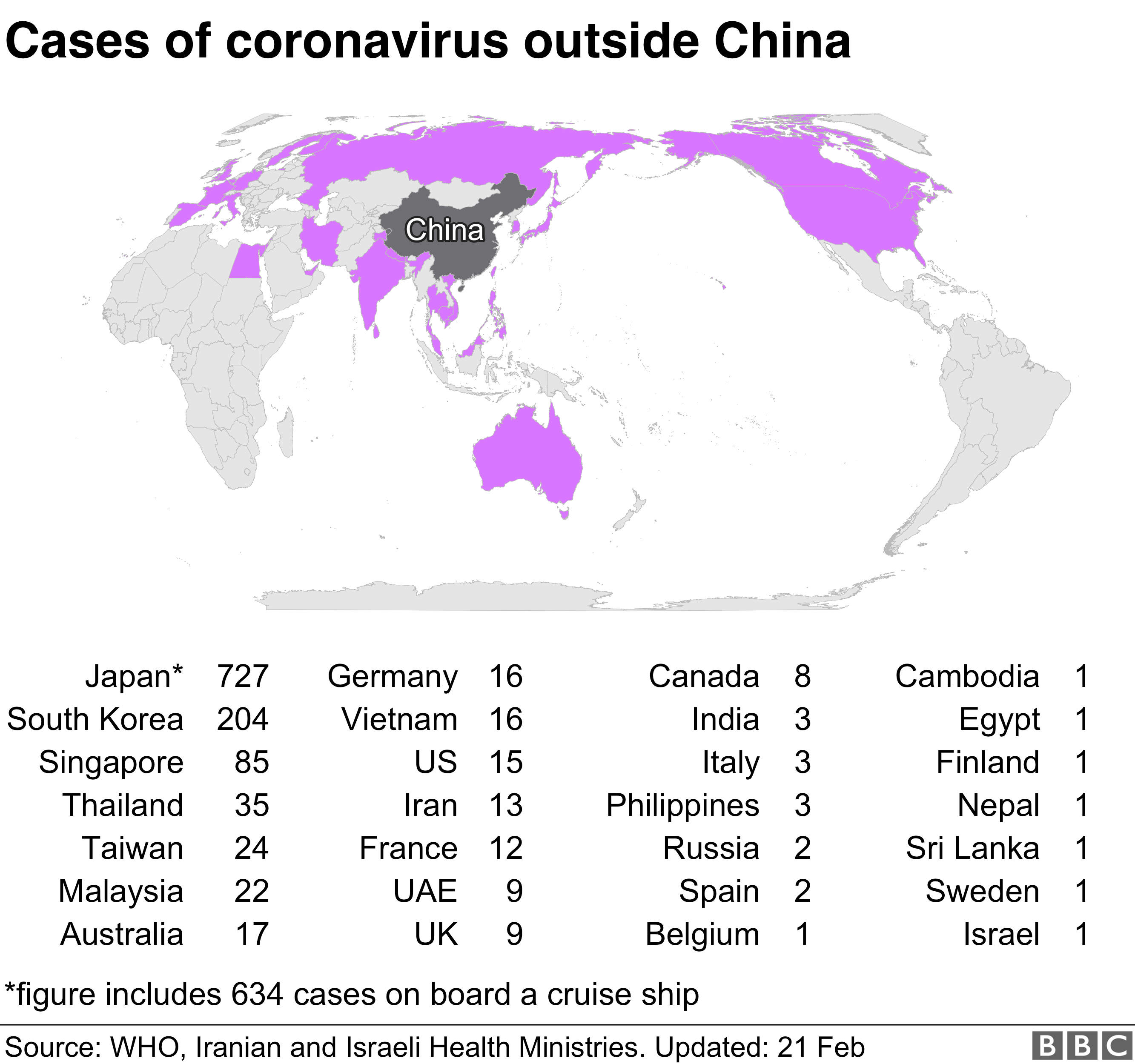
On Thursday, 53 new cases were reported. South Korea now has a total of 204 cases making it the largest cluster outside mainland China and the cruise ship docked off Japan.
The new virus, which originated last year in Hubei province in China, causes a respiratory disease called Covid-19.
What measures are being taken?
From the 100 new cases reported on Friday, 86 were in Daegu, a city 300km (186 miles) south-east of the capital Seoul, and nearly all of those were from a cluster involving the religious sect.
Image copyright AFPImage caption South Korea is trying hard to stop the local spread of the new coronavirus
Reacting to the quickly deteriorating situation, the government promised swift measures to prevent further spread of the virus.
“It is urgent to find people who have contacted infected people and cure patients,” PM Chung said, according to Yonhap.
He said the government was readying resources like sickbeds, medical equipment and health workers and warned the virus was now spreading locally.
“The government has so far focused on curbing infections coming from outside the country. From now on, the government will further prioritise preventing the virus from spreading locally.”
Health Minister Park Neung-hoo said authorities would allow hospitals to isolate respiratory patients from others in an effort to prevent any spread within medical institutions.
He also said that all pneumonia patients in Daegu hospitals would be checked for the virus.
What happened in Daegu?
The city’s biggest cluster appears to be at a branch of a religious sect which calls itself the Shincheonji Church of Jesus, Temple of the Tabernacle of the Testimony.
South Korean health officials believe these infections are linked to a 61-year-old woman who tested positive for the virus earlier this week.
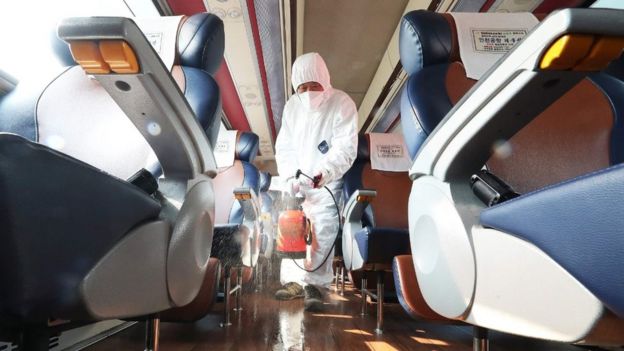
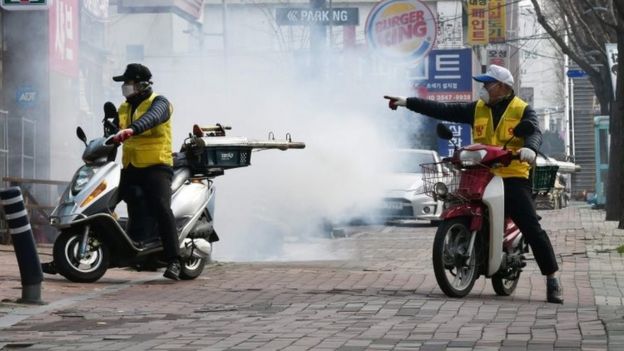
Image copyright AFP/GETTY IMAGESImage caption Workers have been disinfecting the streets of Daegu, South Korea’s fourth-largest city
The Shincheonji, which has been accused of being a cult, said it had now shut down its Daegu branch and that services in other regions would be held online or individually at home.
As of Friday, more than 400 members of the church were showing symptoms of the disease, though tests were still ongoing, the city mayor said.
Can we answer your question on the coronavirus?
Here’s what others have been asking
Once you’ve had coronavirus, will you be immune?
Could the coronavirus become a pandemic?
Is the coronavirus worse than flu or Sars?
Daegu is the country’s fourth-largest city, with a population of 2.5 million people.
Residents are now being asked to remain at home after authorities described the church cluster as “super-spreading event”.
Hand sanitizers and warning signs
By Hyung Eun Kim, BBC Korean Service, Seoul
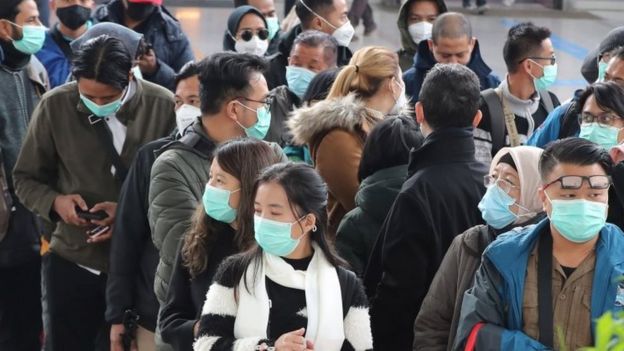
Many people in South Korea are wearing masks on a daily basis.
Hand sanitizers have been placed at public transport stops and building entrances.
Warning government signs are everywhere. They say: “Three ways to prevent further infection: wear a mask at all times; wash your hands properly with soap for more than 30 seconds; and cover yourself when coughing.”
Image copyright EPAImage caption New norm: Mask-wearing crowd in Seoul
Koreans have also developed several apps and websites that tell you how much risk you face where you are. They show where the infected people are within a 10km radius.
“I can’t miss work, what I can do is minimise contact with others and stay at home during the weekend,” Seung-hye Lim, a Seoul resident, told the BBC.
“I do wonder if we reacted too laxly initially or if it really is because of the specific service practices of the Shincheonji sect.”
So-young Sung, a mother of two in Seoul, told the BBC: “It feels like my daily life is collapsing.”
She said she was struggling to find pharmacies that had masks.
She added that checking coronavirus-related alarms from her children’s schools and kindergartens was now a daily routine for her.
What about China and elsewhere?
The latest figures from China put the death toll from the disease at 2,236 people and total infections at more than 75,000.
The virus has now hit the country’s prison system, with more than 500 inmates confirmed infected.
Senior officials have already been sacked for mishandling management of the outbreak.
The virus has also spread around the globe with more than 1,000 cases and several deaths in the rest of Asia, in Europe, the Middle East, the US and Africa.
On Friday, Iran confirmed 13 new cases, saying that two of those infected had died.
Health ministry official Minou Mohrez was quoted by the state-run Iran news agency as saying the coronavirus has spread to several cities, including the capital Tehran.
South Korea is now the worst affected country after mainland China and the more than 600 infections on a cruise ship docked in Japan.
Media caption Coronavirus: Quarantined passengers released from Japan ship
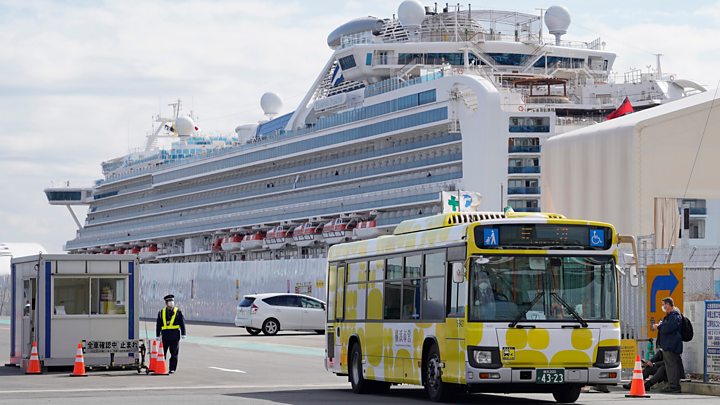
Passengers of the Diamond Princess who have tested negative continue to disembark the ship in Yokohama after more than 14 days quarantined on board.
More than 150 Australian passengers have been evacuated from the ship and have already arrived in Darwin, where they will begin two more weeks of quarantine.
Australian officials said on Friday that six people had reported feeling unwell on arrival in Darwin and were immediately tested.
Two of those people tested positive despite having received negative tests before leaving Japan.
The first batch of people from Hong Kong have also flown back to the city, where they will similarly be quarantined.
(Reuters) – Airlines have been suspending flights to China or modifying service in response to the coronavirus outbreak.
Below are details (in alphabetical order):
AIRLINES THAT HAVE CANCELLED ALL FLIGHTS TO MAINLAND CHINA
** American Airlines – Extends suspension of China and Hong Kong flights through April 24
** Air France – Said on Feb.6 it would suspend flights to and from mainland China for much of March
** Air India – Suspends flights to Shanghai, Hong Kong until June 30
** Air Seoul – The South Korean budget carrier suspended China flights from Jan. 28 until further notice.
** Air Tanzania – Tanzania’s state-owned carrier, which had planned to begin charter flights to China in February, postponed its maiden flights.
** Air Mauritius – Suspended all flights to China and Hong Kong
** Austrian Airlines – until end-February.
** British Airways – Jan. 29-March 31.
** Delta Airlines – Feb. 2-April 30
** Egyptair suspended flights on Feb, 1, but on Feb. 20 said it would resume some flights to and from China starting next week.
** El Al Israel Airlines – Said on Feb. 12 it would suspend its Hong Kong flights until March 20 and reduce its daily flights to Bangkok. It suspended flights to Beijing from Jan. 30 to March 25 following a health ministry directive.
** Iberia Airlines – The Spanish carrier extended its suspension of flights from Madrid to Shanghai, its only route, from Feb. 29 until the end of April.
** JejuAir Co Ltd – Korean airline to suspend all China routes starting March 1
** Kenya Airways – Jan. 31 until further notice.
** KLM – Will extend its ban up to March 28
** Lion Air – All of February.
** LOT – Extends flight suspension until March 28
** Oman and Saudia, Saudi Arabia’s state airline, both suspended flights on Feb. 2 until further notice.
** Qatar Airways – Feb. 1 until further notice.
** Rwandair – Jan. 31 until further notice.
** Scoot, Singapore Airlines’ low-cost carrier – Feb. 8 until further notice.
** United Airlines – Feb. 5-April 23. Service to Hong Kong suspended Feb. 8-April 23.
** Vietjet and Vietnam Airlines – Suspended flights to the mainland as well as Hong Kong and Macau Feb. 1-April 30, in line with its aviation authority’s directive.
AIRLINES THAT HAVE CANCELLED SOME CHINA FLIGHTS/ROUTES OR MODIFIED SERVICE
** Air Canada – Extended the suspension of its flights to Beijing and Shanghai until March 27. It also suspended its Toronto to Hong Kong flights from March 1 to March 27, but its Vancouver to Hong Kong route remains active. [bit.ly/39zgmI0]
** Air China – Said on Feb. 12 it will cancel flights to Athens, Greece, from Feb. 17 to March 18
** Air China – State carrier said on Feb. 9 it will “adjust” flights between China and the United States.
** Air New Zealand – Suspended Auckland-Shanghai service Feb. 9-March 29. Reduced capacity on Shanghai route throughout April and Hong Kong route throughout April and May.
** ANA Holdings – Suspended routes including Shanghai and Hong Kong from Feb. 10 until further notice.
** Cathay Pacific Airways – Plans to cut a third of its capacity over the next two months, including 90% of flights to mainland China. It has encouraged its 27,000 employees to take three weeks of unpaid leave in a bid to preserve cash.
** Emirates and Etihad – The United Arab Emirates, a major international transit hub, suspended flights to and from China, except for Beijing.
** Finnair – Cancelled all flights to mainland China and decreased the number of flights to Hong Kong until March 28.
** Hainan Airlines – Suspended flights between Budapest, Hungary, and Chongqing Feb. 7-March 27.
** Korean Air Lines Co. – The national flag carrier suspended eight routes to China and reduced services on nine Chinese routes between Feb. 7 and 22.
** Philippine Airlines – Cut the number of flights between Manila and China by over half.
** Qantas Airways – Suspended direct flights to China from Feb. 1. The Australian national carrier halted flights from Sydney to Beijing and Sydney to Shanghai between Feb. 9-March 29.
** Royal Air Maroc – The Moroccan airline suspended direct flights to China Jan. 31-Feb. 29. On Jan. 16, it had launched a direct air route with three flights weekly between its Casablanca hub and Beijing.
** Russia – All Russian airlines, with the exception of national airline Aeroflot, stopped flying to China from Jan. 31. Small airline Ikar will also continue flights between Moscow and China. All planes arriving from China will be sent to a separate terminal in the Moscow Sheremetyevo airport. Aeroflot reduced the frequency of flights to Beijing, Shanghai and Guangzhou until Feb. 29.
** Nordic airline SAS – Extended its suspension of flights to Shanghai and Beijing until March 29.
** Singapore Airlines – Suspended or cut capacity on flights to Beijing, Shanghai, Guangzhou, Shenzhen, Chengdu, Xiamen and Chongqing, some of which are flown by regional arm SilkAir.
** UPS – Cancelled 22 flights to China because of the virus and normal manufacturing closures due to the Lunar New Year holiday.
** Virgin Atlantic – Extended its suspension of daily operations to Shanghai until March 28.
** Virgin Australia – Said it will withdraw from the Sydney-Hong Kong route from March 2 because it was “no longer a viable commercial route” due to growing concerns over the virus and civil unrest in Hong Kong.
A government task force has estimated a US$5 billion loss if Chinese students – angered and frustrated by the ban – cannot enrol for university
The tourism sector is also likely to be hit by restrictions on travel from the mainland as Chinese visitors spend about U$8 billion in Australia each year
Some 150,000 Chinese nationals are enrolled at Australian universities, making up around 11 per cent of the student population. Photo: Shutterstock
Abbey Shi knows first hand the anger and frustration felt by Chinese students left stranded by the Australian government’s decision to ban travel from the mainland in response to the coronavirus outbreak.
Shi, general secretary of the Students’ Representative Council at the University of Sydney, is in contact with more than 2,000 Chinese students who went home for the Lunar New Year holiday and now cannot return to Australia with just weeks to go until the start of the new academic year.
“There is a lot of confusion about the ban and anger towards the government,” said Shi, an international student from Shanghai. Currently in Australia, she is sharing information with the stranded students via WeChat.
How to beat the coronavirus? Re-creating it in Singapore, Australia is vital first step
3 Feb 2020
“The education sector in Australia is being commercialised and students are being treated like cash cows,” she said. “Universities don’t care about our affected career path, life, tenancy issues, our pets at home.”
Prime Minister Scott Morrison on Saturday announced that non-citizens – excluding permanent residents and their immediate family members – who arrived from or passed through mainland China within the previous 14 days would be denied entry to Australia as part of efforts to halt the spread of the coronavirus, which was first detected in December in the Chinese city of Wuhan.
Other countries including the United States, Singapore and the Philippines have introduced similar travel restrictions in response to the outbreak, which has sickened more than 19,000 people in at least 26 countries and territories outside mainland China and claimed 425 lives.
The travel ban, which is due to be reviewed on February 15, has upended the plans of numerous Chinese students who were due to begin or return to their studies from late February following the summer break.
Tony Yan, a mathematics undergraduate at Australian National University (ANU), said he had been left out of pocket for several weeks’ rent after being stranded in his home province of Jiangsu, but hoped he could return before classes started on February 24.
“I think the Australian government should have given a few days earlier notice,” Yan said. “I haven’t paid the tuition yet, many others haven’t as well.”
About 150,000 Chinese nationals are enrolled at Australian universities, making up around 11 per cent of the student population – a far greater proportion than in Britain and the United States, which came in at 6 per cent and 2 per cent respectively, in a 2017 report from an Australian think tank.
Coronavirus: Australia evacuates 243 people from China as deaths mount
3 Feb 2020
ANU Vice-Chancellor Brian Schmidt on Saturday described the travel ban as “disappointing”, pledging that the university would be “generous and flexible in supporting our students” through the coming weeks.
Monash University in Melbourne has delayed the start of its academic year, while other universities are exploring options such as online tuition and intensive summer courses.
Australian universities, some of which rely on Chinese students for nearly one-quarter of their revenue, are bracing to take a major financial hit due to the ban.
Phil Honeywood, the head of a government task force initially set up to manage the reputation of Australia’s international education sector in the wake of the country’s bush fires crisis, on Sunday warned the ban could cost universities A$8 billion (US$5.34 billion) if Chinese students could not enrol for the first semester of the year.
Coronavirus: what we know so far about the outbreak spreading in China and abroad
Education minister Dan Tehan on Monday met with peak body Universities Australia to discuss ways to minimise fallout for the sector.
“Australia will remain an attractive study destination for Chinese students, but it may take several years for Chinese student numbers to recover,” said Salvatore Babones, associate professor at the University of Sydney and adjunct scholar at the Centre for Independent Studies. “Students who are already in the middle of a degree are likely to return at the first possible opportunity, even at the cost of missing one semester, but students who have not yet started may make other plans.”
But ANU tertiary education expert Andrew Norton said there remained too many unknowns, including the number of Chinese students stranded abroad, to gauge the impact of the ban.
How the coronavirus spread anti-Chinese racism like a disease through Asia
17 Feb 2020
“This travel ban is a short-term policy to minimise the risk of disease spreading, which would be a more serious problem than a disruption to university timetables,” he said. “One of Australia’s major [education] competitors – the US – has a similar policy, and due to travel restrictions within China and the cancelling of commercial flights to and from China Australia’s competitors are unlikely to be able to take advantage.”
Norton noted that the sector had weathered previous outbreaks such as the 2003 outbreak of severe acute respiratory syndrome (Sars), and “although there were sometimes short-term dips in numbers, none of them have changed the long-term trend towards growth”.
The ban has also sent jitters throughout the tourism industry, which relies on Chinese visitors for a quarter of international spending. Nearly 1.5 million
visited Australia in 2018-19, Australian Bureau of Statistics records show, accounting for about one in eight arrivals.
Nearly 1.5 million Chinese nationals visited Australia in 2018-19, according to Australian Bureau of Statistics records. Photo: SCMP / Alkira Reinfrank
With Chinese tourists spending about A$12 billion (US$8 billion) in Australia each year, according to Tourism Research Australia, every month the travel ban remains in place could amount to billion-dollar losses for the sector.
Tourism Tropical North Queensland on Monday said the outbreak had already cost operators for Cairns and the Great Barrier Reef 25,000 direct bookings worth A$10 million. Chief executive Mark Olsen said the situation constituted a crisis for the industry that called for “unprecedented action” by the government.
David Beirman, senior lecturer in tourism at the University of Technology Sydney, said the ban was especially damaging for the industry as it came on the heels of devastating bush fires that had kept visitors away.
Coronavirus: how Facebook clickbait fuels a perfect storm of fake news
15 Feb 2020
“There is no doubt that the coronavirus outbreak following on so closely to the bush fires will combine to hit international tourism to Australia very hard,” Beirman said. “Later this month the Australian Bureau of Statistics will reveal the December 2019 tourism figures, which are expected to show at best a 25 per cent downturn in international visitor arrivals compared to December 2018. January 2020 is likely to be far worse as the impact of coronavirus will certainly be a factor.”
Others have raised concerns about the impact of the travel restrictions on public attitudes toward Chinese and Chinese-Australians, warning they could stoke latent prejudices.
“This is an overreaction from the Australian government, and in many ways it feels like it is a form of racial targeting,” said Erin Chew, national convenor of the Asian Australian Alliance. “When previous viruses happened such as mad cow disease or the swine flu, Australia didn’t ban non-citizens from Britain and the US. Nor was the blame placed on the people in [those countries].
“Since the coronavirus outbreak it has been coined that this virus is the fault of Chinese people, not just in mainland China, but really all over the world.”









 CHINDIA ALERT: You'll be living in their world, very soon