Archive for ‘Mainland China’

05/08/2019

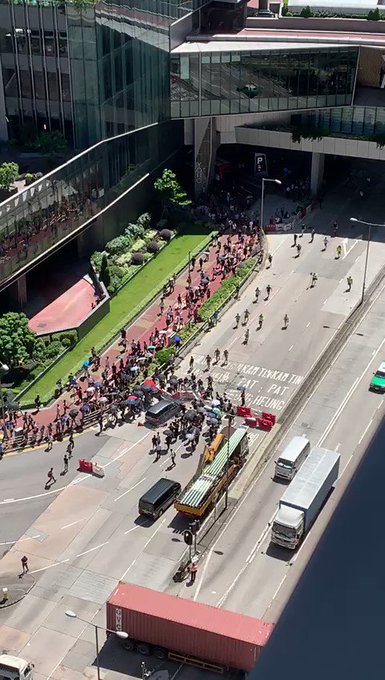
Hong Kong protests: Police and protesters fight running battles

Police in Hong Kong have been fighting running battles with activists in a third consecutive day of protests, after a call for a general strike caused widespread disruption on Monday.

Protesters blocked roads and paralysed train services at peak times on a day of action across the city.

More than 200 flights were cancelled as the protests entered their ninth week.

Hong Kong’s leader, Carrie Lam, has pledged to restore law and order, rejecting calls for her resignation.

Initially the demonstrations, which began on 9 June, focused on a controversial extradition law, which would have allowed the transfer of suspects to mainland China. However, the protests have now become a wider challenge to Beijing’s authority.

Ms Lam warned that Hong Kong was “on the verge of a very dangerous situation”.
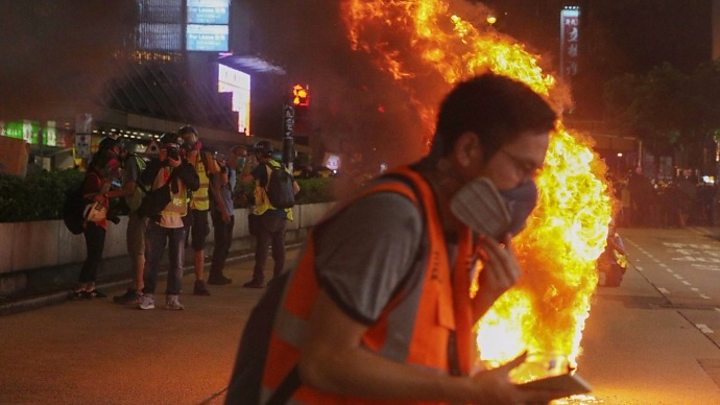
Media caption Protests take place in Hong Kong for the ninth weekend – for and against the authorities

In her first media address in two weeks, Ms Lam said the protesters’ actions had challenged the principle of “one country, two systems” – the extra freedoms granted to Hong Kong when it was returned from British to Chinese rule in 1997.

She also accused activists of using the extradition bill as a cover for their real goals.

“We continue to allow these violent protesters to make use of the [extradition] bill to conceal their ulterior motives,” she said. “Those ulterior motives are going to destroy Hong Kong.”
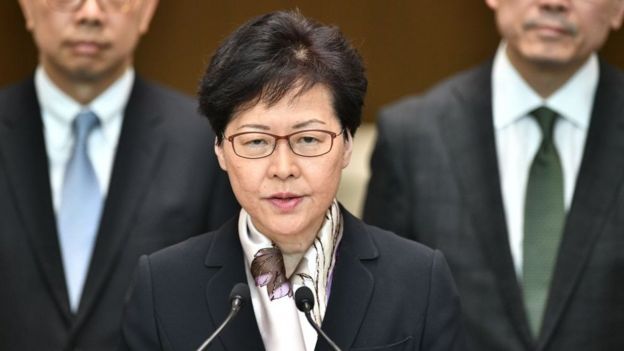
Hong Kong Chief Executive Carrie Lam (C) speaks during a press conference in Hong Kong on August 5, 2019Image copyright GETTY IMAGES

The Chinese foreign ministry said no one should underestimate China’s resolve to safeguard the stability of Hong Kong, Reuters news agency reports.

What happened on Monday?

Police fired tear gas at several locations as protesters rallied into the night, setting fires and besieging police stations. In the North Point district, which has a reputation for pro-Beijing sympathies, men wielding long poles clashed with demonstrators before falling back.

More than 80 people were arrested, in addition to the 420 detained since 9 June. In that time, police said they had used more than 1,000 tear gas canisters and 160 rubber bullets.

Protest leaders had called for a general strike. While many people made it to work, in some areas protesters blocked trains from leaving stations and scuffled with commuters. Several lines of the Mass Transit Railway (MTR) were suspended for a time, and the Cross-Harbour Tunnel was also blocked.

One video circulating on Twitter reportedly showed a car in the district of Yuen Long forcefully hitting a barricade set up by protesters, injuring one person.

It is not clear how many joined the strike, but tens of thousands of protesters were out on the streets. Several shops and businesses were closed, including international fashion retailers like Topshop and Zara.

Hong Kong airport, one of the busiest in the world, said travellers should check its website and seek updates directly from the airlines.

Most of the cancelled flights were with local carriers Cathay Pacific and Hong Kong Airlines.

“The Airport Authority advises passengers… to proceed to the airport only when their seats and flight time have been confirmed,” the airport said in a statement.

What’s behind the Hong Kong protests?

The protests were initially sparked by a controversial bill that would allow China to extradite suspects from Hong Kong to the mainland.

Critics said it would undermine the territory’s judicial independence and could be used to target those who spoke out against the Chinese government.

Although the bill has now been suspended, demonstrators want it fully withdrawn.

Their demands have broadened to include an independent inquiry into alleged police brutality, Ms Lam’s resignation, and the dropping of riot charges linked to the protests.

Last week, more than 40 activists appeared in court charged with rioting. If convicted, they could be jailed for up to 10 years.

The Chinese army has so far stayed out of the dispute, but China’s top policy office in Hong Kong has previously condemned the protests, calling them “horrendous incidents” that have caused “serious damage to the rule of law”.

Unease rose last week when China’s army in Hong Kong posted a video on Chinese social media network Weibo showing soldiers conducting anti-riot drills.
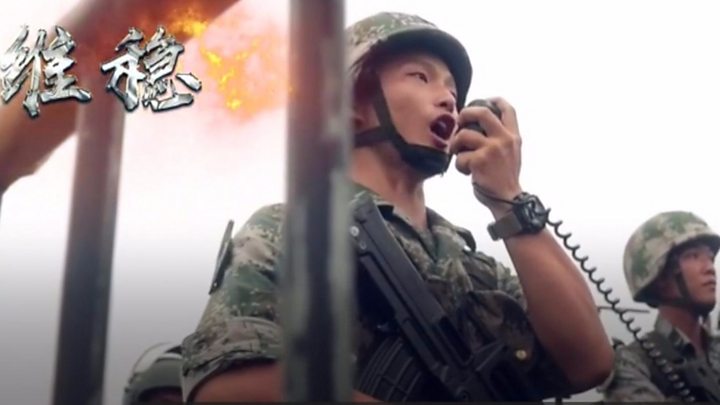
Media caption The video shows a soldier using a loudspeaker to warn protesters
Source: The BBC
25/05/2019

Taiwan begins mass production of home-grown missile corvettes, minelayers

  • Self-ruled island cannot match Beijing’s spending, but innovation can help it succeed in a one-sided military conflict, observers say
  • First of Tuo Jiang-class stealth warships expected to be ready by 2021
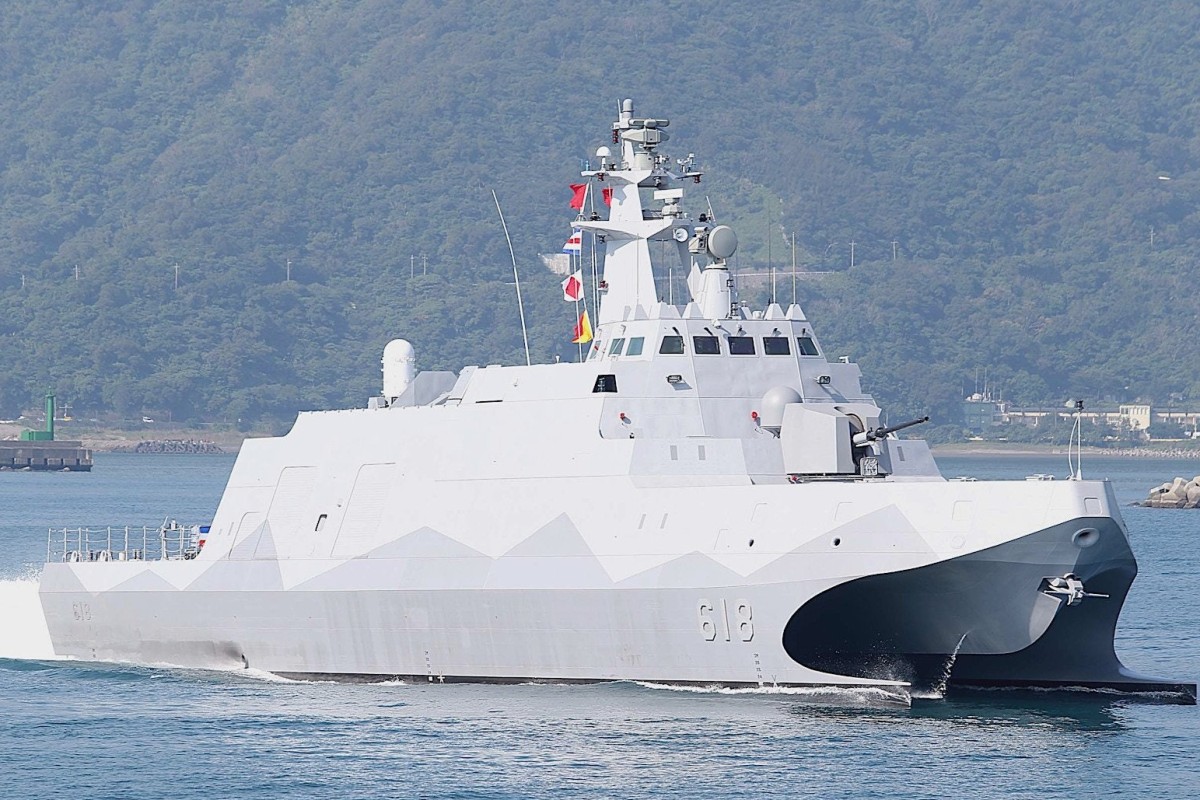
Taiwan began mass production of its Tuo Jiang-class missile corvettes on Friday. Photo: Handout
Taiwan began mass production of its Tuo Jiang-class missile corvettes on Friday.

Taiwan has begun mass production of its home-grown Tuo Jiang-class missile corvettes and high-speed minelayers as it seeks to shore up its naval forces amid rising hostility from Beijing.

Dubbed the “aircraft carrier killer”, the small but powerful corvette, which has a displacement of 680 tonnes and a top speed of 45 knots, is a state-of-the-art stealth warship built by Lung Teh Shipbuilding.

A total of three corvettes will be built under the NT$31.6 billion (US$1 billion) Hsun Hai project, the self-ruled island’s navy said.

The warship is equipped with one of the world’s most technologically advanced computer systems and built partly with high-entropy metal alloys for extra strength and durability, it said. Its stealth technology and low radar cross section makes the ship virtually invisible at sea and even more obscure when operating close to the coastline.
Armed with eight subsonic Hsiung Feng II and eight supersonic Hisung Feng III anti-ship missile launchers, the corvettes are intended to take over many of the missions currently undertaken by larger, less manoeuvrable and more expensive frigates and destroyers, the navy said.
In the event of an actual armed conflict with Beijing, the warships would also boost Taiwan’s ability to counter a much larger and better equipped rival, a concept known as asymmetric warfare.
Taiwan simulates repelling invasion as Beijing threat persists

In a ceremony on Friday at Lung Teh’s shipyard in Suao, Yilan county, to mark the start of mass production, Taiwanese President Tsai Ing-wen said the move was made possible after the navy succeeded in overcoming a number of design and technological issues regarding the warship, an earlier version of which she boarded soon after becoming the island’s leader in 2016.

Together with the construction of the high-speed minelayers, also by Lung Teh, and a home-grown submarine at a separate shipyard in Kaohsiung, Tsai said Taiwan was entering a “new era” of naval strength that would give it the ability to thwart any attempts by the People’s Liberation Army to invade its territory.

“This proves we are able to build our own warships and launch a new era of the naval force,” she said.

Construction of the Tuo Jiang-class corvettes was under way, with the first expected to be ready for delivery to the navy in 2021 and the last by 2025, Tsai said.

The first batch of four minelayers would also be ready by 2021, she said.

Taiwan has sought to counter the rising threat from mainland China by developing more of its own military hardware in recent years. Beijing’s military budget for 2019 is 1.2 trillion yuan, or about 16 times as much as Taiwan’s.

Beijing considers Taiwan a wayward province awaiting reunification, by force if necessary, and suspended all official exchanges with it after Tsai, from the independence-leaning Democratic Progressive Party, was elected president and refused to accept the one-China principle.

Experts doubt China’s ability to launch assault on Taiwan

Over the past three years Tsai has prioritised Taiwan’s military expansion, ordering the Chungshan Institute of Science and Technology – the island’s top weapon research and development agency – to speed up production of weapons like the surface-to-air Skybow-III and supersonic anti-ship Hsiung Feng-III missiles.

Taiwan is also expected next year to begin mass production of its CM-34 Clouded Leopard eight-wheeled armoured vehicles and has set a target to manufacture 284 of them by 2023.

Four prototypes of the vehicles, which passed pre-production tests in October, are expected to take part in the island’s annual Han Kuang war games next week.

Chieh Chung, a national security research fellow at the National Policy Foundation in Taipei, said that because of the huge discrepancies in their military budgets Taiwan could not engage in an arms race with the mainland so had to be more innovative.

“Taiwan has to develop an asymmetric defence strategy,” he said. “Take the Tou Jiang corvettes, for example. Because of their high speed, stealth function, small size and powerful weaponry, they can be deployed anywhere near Taiwan’s coast and called into action very quickly to fend off enemy vessels,” he said.

“The same applies to the high-speed minelayers, which can drop mines very quickly and make it very hard for enemy ships to attack the coast,” he said.

Source: SCMP

11/05/2019

Hong Kong lawmakers fight over extradition law

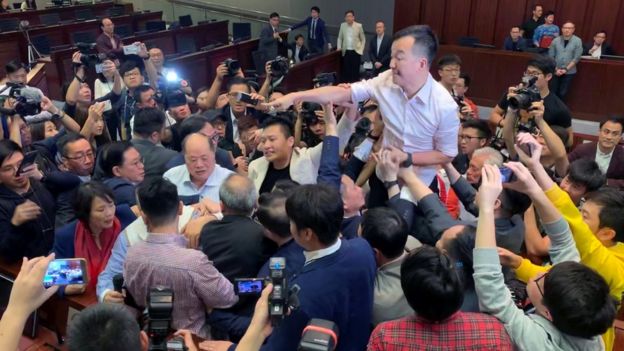
Fighting erupted in Hong Kong’s legislature on Saturday over planned changes to the law allowing suspects to be sent to mainland China for trial.

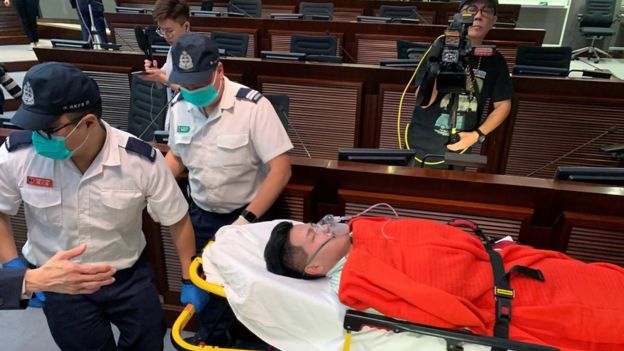
Several lawmakers were injured and one was taken to hospital as politicians clashed in the chamber.

Critics believe the proposed switch to the extradition law would erode Hong Kong’s freedoms.

But authorities say they need to make the change so they can extradite a murder suspect to Taiwan.

One pro-Beijing lawmaker called it “a sad day for Hong Kong”.

Pro-democracy lawmaker James To originally led the session on the controversial extradition bill but earlier this week those supportive of the new law replaced him as chairman.

Tensions boiled over on Saturday, with politicians swearing and jumping over tables amid a crowd of reporters as they fought to control the microphone.

Scuffles broke out in Hong Kong's legislature over proposed changes to extradition lawsImage copyright REUTERS
Image caption Opponents and supporters of the bill clashed in the legislature
Gary Fan stretchered out after clashes between opponents and supporters of Hong Kong's proposed extradition law changesImage copyright REUTERS
Image caption Pro-democracy lawmaker Gary Fan was taken out on a stretcher

Pro-democracy legislator Gary Fan collapsed and was carried out on a stretcher, while one pro-Beijing legislator was later seen with his arm in a sling.

Why change the extradition laws?

Under a policy known as “One Country, Two Systems”, Hong Kong has a separate legal system to mainland China.

Beijing regained control over the former British colony in 1997 on the condition it would allow the territory “a high degree of autonomy, except in foreign and defence affairs” for 50 years.

But Hong Kong’s pro-Beijing leader Carrie Lam earlier this year announced plans to change the law so suspects could be extradited to Taiwan, Macau or mainland China on a case-by-case basis.

Hong Kong's leader Carrie LamImage copyright REUTERS
Image caption Some critics say Carrie Lam has “betrayed” Hong Kong over the law change

Ms Lam has cited the case of a 19-year-old Hong Kong man who allegedly murdered his pregnant girlfriend while on holiday in Taiwan before fleeing home.

While Taiwan has sought his extradition, Hong Kong officials say they cannot help as they do not have an extradition agreement with Taiwan.

Why object to the switch?

The proposed change has generated huge criticism.

Protesters against the law marched on the streets last month in the biggest rally since 2014’s pro-democracy Umbrella Movement demonstrations.

Even the normally conservative business community has objected. The International Chamber of Commerce in Hong Kong said the bill has “gross inadequacies” which could mean people risk “losing freedom, property and even their life”.

And Chris Patten, the last British governor of Hong Kong, told the government-funded broadcaster RTHK last month the proposal was “an assault on Hong Kong’s values, stability and security”.

Source: The BBC

06/05/2019

Mainland, Taiwan youths called on to contribute to national rejuvenation

BEIJING, May 5 (Xinhua) — The Chinese mainland’s Taiwan affairs chief on Sunday called on youths on both sides of the Taiwan Strait to jointly shoulder the historic mission of national rejuvenation and contribute to cross-Strait integrated development.

Liu Jieyi, head of the Taiwan Work Office of the Communist Party of China Central Committee and the Taiwan Affairs Office of the State Council, made the remarks at the opening ceremony of a summit on cross-Strait exchange and cooperation among the youths.

Young people on the two sides of the Strait should value this great time, be responsible and do their share in safeguarding and building the common home of compatriots on the two sides of the Strait, Liu said.

“Attempts by the ‘Taiwan independence’ forces to undermine cross-Strait peace and obstruct national development will never be allowed,” he said.

He also pledged to provide better conditions for youths from Taiwan to carry out exchanges, study, work and start businesses on the mainland.

As Saturday marks the centenary of the May Fourth Movement, Liu called on the youths on both sides of the Strait to pass on the May Fourth spirit, which refers to patriotism, progress, democracy and science, with patriotism at the core.

Source: Xinhua

28/04/2019

Thousands take to Hong Kong streets to protest new extradition laws

HONG KONG (Reuters) – Thousands of people marched on Hong Kong’s parliament on Sunday to demand the scrapping of proposed extradition rules that would allow people to be sent to mainland China for trial – a move which some fear puts the city’s core freedoms at risk.

Opponents of the proposal fear further erosion of rights and legal protections in the free-wheeling financial hub – freedoms which were guaranteed under the city’s handover from British colonial rule to Chinese sovereignty in 1997.

Early estimates suggested several thousand people had joined the march along Hong Kong Island from Causeway Bay to the council in the Admiralty business district.

Veteran Hong Kong activist and former legislator Leung Kwok-hung said the government’s move risked removing Hong Kongers’ “freedom from fear”.

“Hong Kong people and visitors passing by Hong Kong will lose their right not to be extradited into mainland China,” he said. “They would need to face an unjust legal system on the mainland.”

The peaceful marchers chanted demands for Hong Kong’s Executive Carrie Lam to step down, saying she had “betrayed” Hong Kong. Some sported yellow umbrellas – the symbol of the Occupy civil disobedience movement that paralysed parts of Hong Kong for 11 weeks in 2014.
The proposed changes have sparked an unusually broad chorus of concern from international business elites to lawyers and rights’ groups and even some pro-establishment figures.
Chris Patten, the last British governor of Hong Kong who handed the city back to Chinese rule in 1997, on Saturday described the move “as an assault on Hong Kong’s values, stability and security”, government-funded broadcaster RTHK reported.
Chief Executive Lam and other government officials are standing fast by their proposals, saying they are vital to plug long-standing loopholes.
Under the changes, the Hong Kong leader would have the right to order the extradition of wanted offenders to China, Macau and Taiwan as well as other countries not covered by Hong Kong’s existing extradition treaties.
As a safeguard such orders, to be issued case-by-case, could be challenged and appealed through the city’s vaunted legal system.
Government officials have said no-one at risk of the death penalty or torture or facing a political charge could be sent from Hong Kong. Under pressure from local business groups, they earlier exempted nine commercial crimes from the new provisions.
The proposals could be passed into law later in the year, with the city’s pro-democratic camp no longer holding enough seats to block the move.
The government has justified the swift introduction of the changes by saying they are needed so a young Hong Kong man suspected of murdering his girlfriend in Taiwan can be extradited to face charges there.
The government’s assurances are not enough for Lam Wing-kee, a former Hong Kong political bookseller who said in 2016 he was abducted by mainland agents in the city.

Lam left Hong Kong for Taiwan last week, saying he feared being sent back to the mainland under the new laws and his experienced showed he could have no trust in China’s legal system.

A group of 33 followers of Falun Gong, a religious sect banned in China, flew from Taiwan to Hong Kong on Saturday to join the march but were refused entry to Hong Kong, RTHK reported.

Sunday’s march comes amid renewed calls for deeper electoral reforms stalled five years ago after Occupy protests.

Four leaders of the movement were last week sentenced to jail terms ranging from eight to 16 months, part of a group of nine activists found guilty after a near month-long trial.

Source: Reuters

23/04/2019

How China’s ban on plastic waste imports became an ‘earthquake’ that threw recycling efforts into turmoil

  • When recycling businesses gravitated to Malaysia, a black economy went with them
  • Some countries treat China’s ban as an opportunity and have been quick to adapt
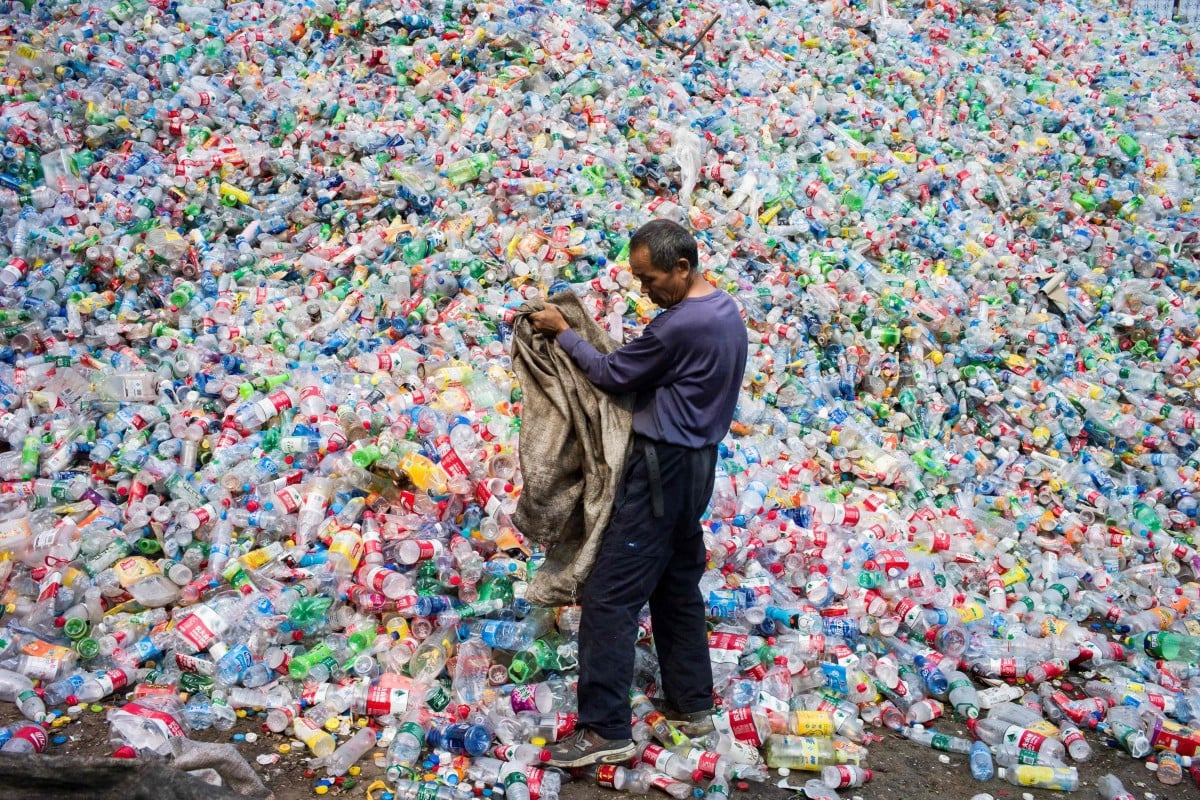
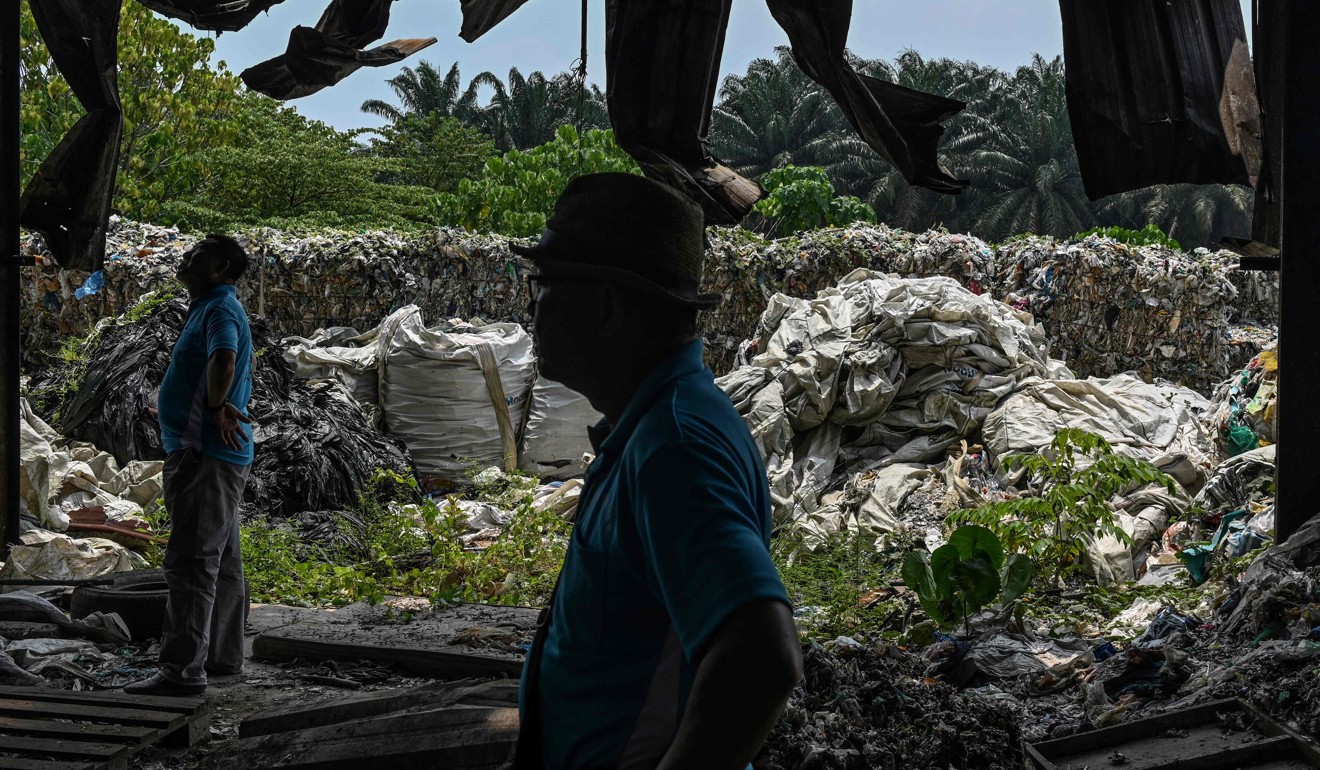
For years, China was the world's leading destination for recyclable rubbish, but a ban on some imports has left nations scrambling to find dumping grounds for growing piles of waste. Photo: AFP
For years, China was the world’s leading destination for recyclable rubbish, but a ban on some imports has left nations scrambling to find dumping grounds for growing piles of waste. Photo: AFP
From grubby packaging that engulfs small Southeast Asian communities to waste that piles up in plants from the US to Australia, China’s ban on accepting the world’s used plastic has thrown recycling efforts into turmoil.
For many years, China took the bulk of scrap plastic from around the world, processing much of it into a higher quality material that could be used by manufacturers.
But, at the start of 2018, it closed its doors to almost all foreign plastic waste, as well as many other recyclables, in an effort to protect its environment and air quality, leaving developed nations struggling to find places to send their waste.
“It was like an earthquake,” Arnaud Brunet, director general of Brussels-based industry group The Bureau of International Recycling, said.
“China was the biggest market for recyclables. It created a major shock in the global market.”
Instead, plastic was redirected in huge quantities to Southeast Asia, where Chinese recyclers have shifted.

With a large Chinese-speaking minority, Malaysia was a top choice for Chinese recyclers looking to relocate, and official data showed plastic imports tripled from 2016 levels to 870,000 tonnes last year.

China to collect applications for scrap metal import licences from next month, trade group says
In the small town of Jenjarom, close to Kuala Lumpur, plastic processing plants appeared in large numbers, pumping out noxious fumes around the clock.

Huge mounds of plastic waste, dumped in the open, piled up as recyclers struggled to cope with the influx of packaging from everyday goods, such as foods and laundry detergents, from as far afield as Germany, the US, and Brazil.

Residents soon noticed the acrid stench over the town – the kind of odour that is usual in processing plastic, but environmental campaigners believed some of the fumes also came from the incineration of plastic waste that was too low quality to recycle.

“People were attacked by toxic fumes, waking them up at night. Many were coughing a lot,” resident Pua Lay Peng said.

“I could not sleep, I could not rest, I always felt fatigued,” the 47-year-old added.

Representatives of an environmentalist NGO inspect an abandoned plastic waste factory in Jenjarom, outside Kuala Lumpur in Malaysia. Photo: AFP

Pua and other community members began investigating and, by mid-2018, had located about 40 processing plants, many of which appeared to be operating without proper permits.

Initial complaints to authorities went nowhere but they kept up pressure, and eventually the government took action. Authorities started closing down illegal factories in Jenjarom, and announced a nationwide temporary freeze on plastic import permits.

Thirty-three factories were closed down, although activists believed many had quietly moved elsewhere in the country. Residents said air quality had improved but some plastic dumps remained.

Chinese recycling expert breeds thousands of flies to turn kitchen waste into cash

In Australia, Europe and the US, many of those collecting plastic and other recyclables were left scrambling to find new places to send it.

They faced higher costs to have it processed by recyclers at home and in some cases resorted to sending it to landfill sites as the scrap piled up so quickly.

“Twelve months on, we are still feeling the effects but we have not moved to the solutions yet,” said Garth Lamb, president of industry body Waste Management and Resource Recovery Association of Australia.

Some have been quicker to adapt to the new environment, such as some local authority-run centres that collect recyclables in Adelaide, South Australia.

The centres used to send nearly everything – ranging from plastic to paper and glass – to China but now 80 per cent is processed by local companies, with most of the rest shipped to India.

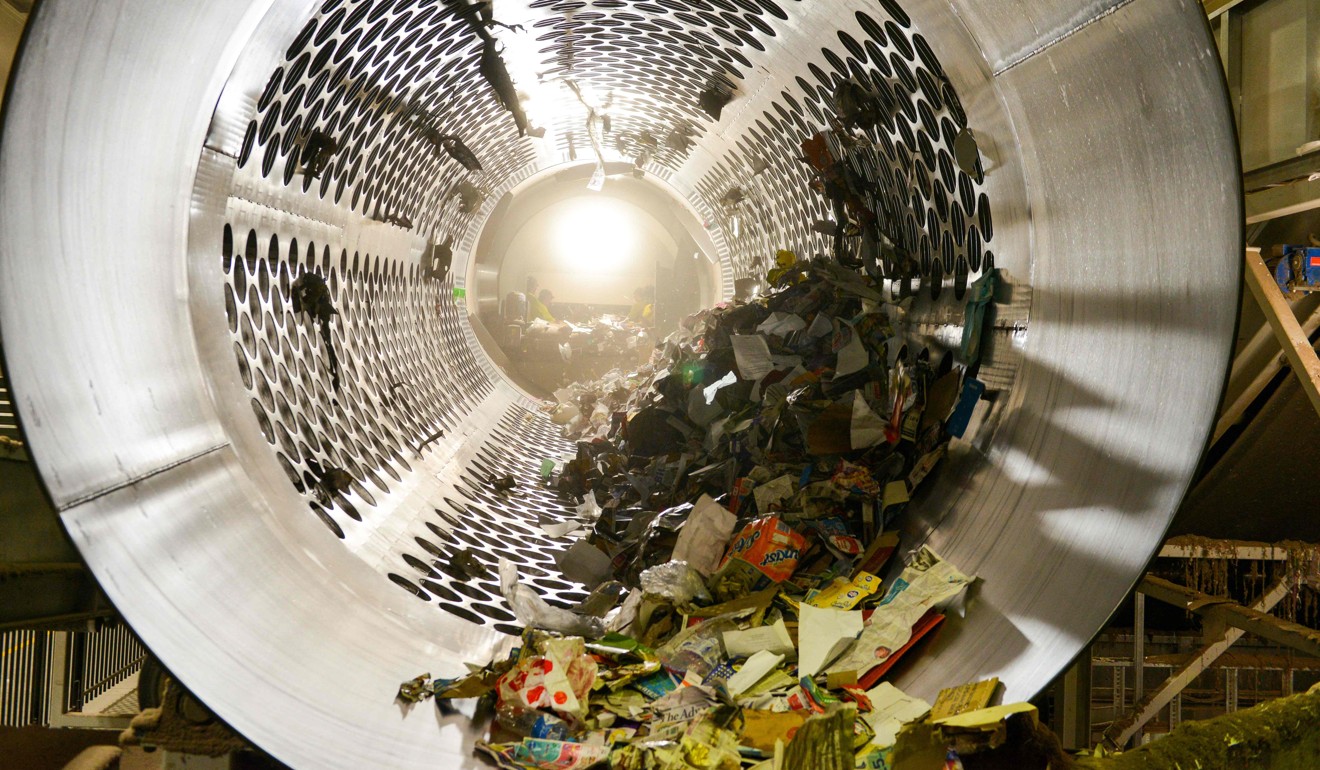
Rubbish is sifted and sorted at Northern Adelaide Waste Management Authority's recycling site at Edinburgh, a northern suburb of the city of Adelaide. Photo: AFP
Rubbish is sifted and sorted at Northern Adelaide Waste Management Authority’s recycling site at Edinburgh, a northern suburb of the city of Adelaide. Photo: AFP

“We moved quickly and looked to domestic markets,” Adam Faulkner, chief executive of the Northern Adelaide Waste Management Authority, said.

“We’ve found that by supporting local manufacturers, we’ve been able to get back to pre-China ban prices.”

In mainland China, imports of plastic waste dropped from 600,000 tonnes per month in 2016 to about 30,000 a month in 2018, according to data cited in a recent report from Greenpeace and environmental NGO Global Alliance for Incinerator Alternatives.

Once bustling centres of recycling were abandoned as firms shifted to Southeast Asia.

How China’s plastic waste ban has left Japan to deal with mountains of trash
On a visit to the southern town of Xingtan last year, Chen Liwen, founder of environmental NGO China Zero Waste Alliance, found the recycling industry had disappeared.
“The plastic recyclers were gone – there were ‘for rent’ signs plastered on factory doors and even recruitment signs calling for experienced recyclers to move to Vietnam,” she said.
Southeast Asian nations affected early by the China ban – as well as Malaysia, Thailand and Vietnam were hit hard – have taken steps to limit plastic imports, but the waste has simply been redirected to other countries without restrictions, such as Indonesia and Turkey, the Greenpeace report said.
With only an estimated nine per cent of plastics ever produced recycled, campaigners said the only long-term solution to the plastic waste crisis was for companies to make less and consumers to use less.
Greenpeace campaigner Kate Lin said: “The only solution to plastic pollution is producing less plastic.”
Source: SCMP
Law of Unintended Consequences

continuously updated blog about China & India

ChiaHou's Book Reviews

continuously updated blog about China & India

What's wrong with the world; and its economy

continuously updated blog about China & India