20/05/2020
- US chip giant GlobalFoundries confirms it has ceased operations at its only Chinese facility, with industry experts saying the poorly-planned project was doomed to fail
- Closure deals blow to China’s plans to move up semiconductor value chain, amid increasingly hostile tech rivalry with the United States
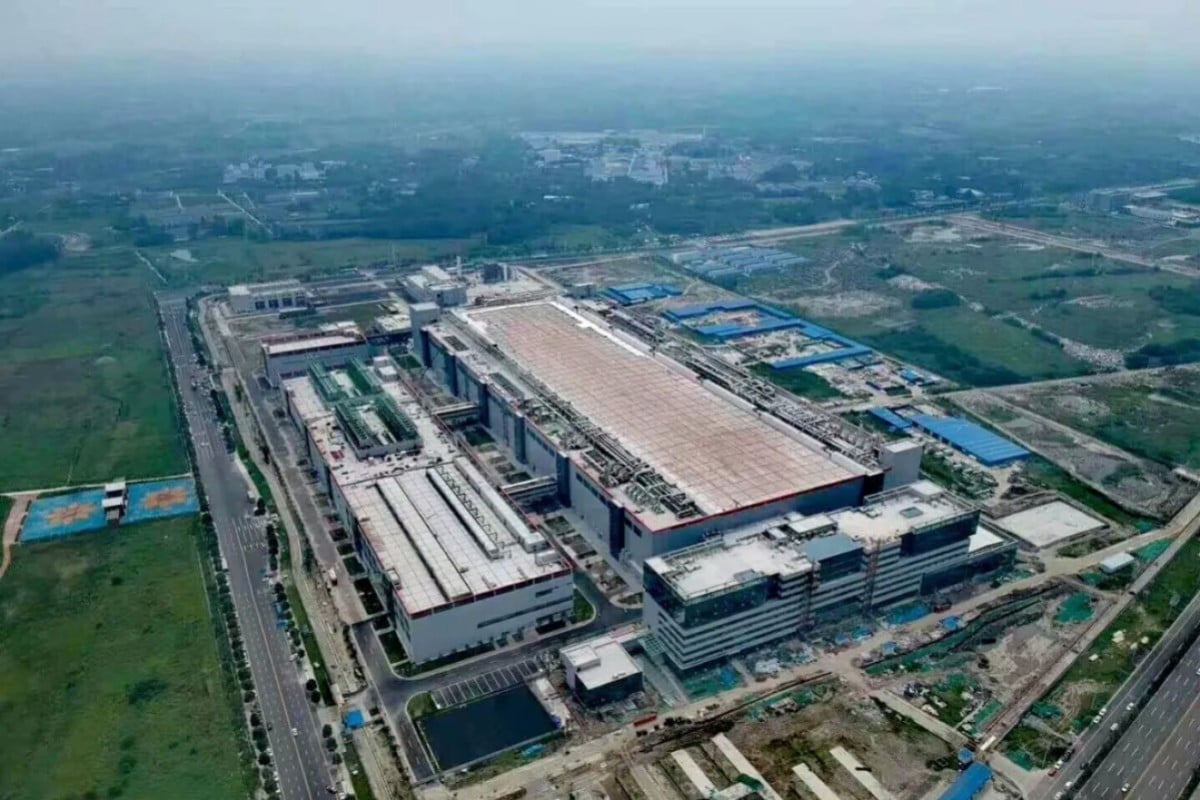
Beijing boasted that the final total investment in the GlobalFoundries plant could be US$10 billion. The plant was intended to produce 300mm wafers, a key material in making chips, but production never started at the 65,000 square metre facility, which was completed mid-2018. Photo: Weibo
US chip giant GlobalFoundries has halted operations at a joint venture factory in China, the company has confirmed, dealing a potential blow to China’s bid to own a bigger slice of the global semiconductor market.
The closure of the firm’s only China facility comes just three years after it announced plans to make chips in the mainland, and comes amid an escalating tech war with the United States.
The winding down, however, has little to do with the fierce superpower rivalry. It comes after two years of speculation as to what was actually happening at the US$100 million facility, which was hailed as “a miracle” by local media when announced to fanfare in 2017, but which never got off the ground.
Nonetheless, the symbolism is rich.
China is struggling in its efforts to boost its domestic chip research and production in a bid to counter US efforts to block it from American technology.
Last week, the US Department of Commerce upped the ante by
banning the sale
of Huawei-designed chips produced outside America if they are made using the US software and technology, adding further pressure to the Chinese telecom giant’s global supply chain.
The GlobalFoundries factory, in a hi-tech park in the southwestern city of Chengdu, was one of China’s major foreign-invested semiconductor projects, for which the local government rolled out the red carpet three years ago.
At the time, Chengdu boasted that the final total investment in the plant could be US$10 billion. The plant was intended to produce 300mm wafers, a key material in making chips, but production never started at the 65,000 square metre facility, which was completed mid-2018.
A spokesperson for California-based GlobalFoundries confirmed that the Chengdu plant had stopped operations and that it had offered staff an “employee optimisation plan”, a commonly-used euphemism for lay-offs.
“The plan is being carried out on the basis of open and transparent communications with the employees and they have been offered various options to choose from based on their personal situations,” a company statement read.
A 2018 annual report from the joint venture, in which GlobalFoundries had a stake of 51 per cent with the rest controlled by an investment vehicle of the Chengdu government, showed that the plant had 320 employees.
A company notice sent to employees dated May 14 and seen by the Post said that after mid-June, the company would only pay 70 per cent of Chengdu’s minimum monthly wage, about 1,246 yuan (US$175.38), while negotiating severance packages with staff.
For some industry analysts who have followed the Chengdu project from its inception, its demise has less to do with the trade war, more to do with poor planning.
There was little detailed research and planning before the project was launched. As far as the Chengdu government is concerned, it lacks a sufficient understanding of GlobalFoundriesGu Wenjun, analyst
“There was little detailed research and planning before the project was launched. As far as the Chengdu government is concerned, it lacks a sufficient understanding of GlobalFoundries, its decision-making mechanism and economic strengths, and it did not get strong support from the central government,” said Gu Wenjun, chief analyst at Shanghai-based semiconductor research firm ICwise.
The idea of establishing a joint venture was first pitched to
Chongqing municipality, a neighbouring city of Chengdu, in 2016. Chongqing signed a memorandum of understanding with GlobalFoundries to set up a plant to manufacture 300mm silicon wafers – components for making integrated circuits – using technology from GlobalFoundries’ Singapore factory.
After the deal to open a Chongqing plant fell through for unclear reasons, Chengdu moved in to cut a deal with GlobalFoundries in late-2016. A 2017 blueprint stated that 3,500 employees could be working at the site, according to Wallace Pai, then GlobalFoundries’ general manager for China.
But production never started. Initially the project was supposed to have two phases: using mainstream technologies to manufacture 300mm wafers from 2018, then transferring to more advanced technologies in late-2019.
However, in October 2018, the two partners decided to “bypass” the phase one manufacturing stage, partly because of China’s increasing demand for more advanced products and GlobalFoundries’ own financial stress. The project has since stalled.
Comparing official announcements from the Chengdu government and GlobalFroundries back in 2017, Gu from ICwise said the two had different focuses, which might explain the plant’s derailment. The government clearly wanted to bring in mainstream, lower-risk technologies to boost the city’s brand, while the company aimed for Chinese capital and government support to invest in more advanced technology, Gu said.
The joint venture will continue after the factory’s demise, with GlobalFoundries still expecting to expand sales in the Chinese market, the company said in its statement. It now has five factories, three in the US and one each in Singapore and Germany.
When The Post contacted the office of the joint venture partner within the Chengdu government, the person answering the phone said they did not know anything about the closure nor future plans, before hanging up without giving their name.
“Our focus in China is on developing and growing our partner ecosystem including creating local technology infrastructure and bringing more intellectual property vendors and electronic design automation partners to better serve the local market,” the company said.
According to the China Semiconductor Industry Association, China’s integrated circuits sales rose 15.8 per cent in 2019 from a year earlier to 756.2 billion yuan (US$106.44 billion), while sales in the global semiconductor market dropped by 12 per cent to US$412 billion.
Last week, Dutch company ASML Holding, a key supplier of chip-making equipment, set up a plant in Wuxi, in Jiangsu province, in a boost to China’s efforts to attract foreign semiconductor investment.
Source: SCMP
Posted in advanced technologies, American, ASML Holding, ‘a miracle’, Beijing’s, blow, Chengdu, China, China Semiconductor Industry Association, chip, Chongqing Municipality, Dutch, euphemism, Factory, foreign, Germany, global, GlobalFoundries, hailed, hostile, Huawei-designed chips, Investment, jiangsu province, lay-offs, mainstream, manufacture, plans, production, semiconductor, semiconductor giant, semiconductor market, shuts, Singapore, symbolism, tech rivalry, technologies, Technology, transferring, Uncategorized, United States, US chip giant, US Department of Commerce, value chain,, Wuxi |
Leave a Comment »
29/03/2020
BEIJING, March 28 (Xinhua) — Clean energy is becoming the mainstream of global energy supply and interconnection is the mainstream of energy allocation, according to the Global Energy Interconnection Development and Cooperation Organization (GEIDCO).
Over the years, China is active in clean energy development and power grid interconnection with neighboring countries, and has achieved significant breakthroughs in UHV grids, smart grids, and clean energy, GEIDCO spokesperson told a press conference via live stream on Friday.
GEIDCO remains committed to promoting the energy interconnection to meet global power demand with clean and green alternatives, making idea dissemination, planning and research, international cooperation and project promotion the focus of its work, said the spokesperson.
The 2020 Global Energy Interconnection & China-Asia Energy and Power Conference is expected to be held in Beijing in November to discuss and strengthen cooperation on sustainable development in the energy industry.
Founded in March 2016, GEIDCO so far had 860 members from 115 countries, covering fields including energy, electricity, information, finance, consultation, science and technology, and environmental protection.
The global energy interconnection is a platform that connects grids around the world to facilitate development, deployment and utilization of clean energy, with ultra-high voltage transmission as the backbone.
Source: Xinhua
Posted in 2020 Global Energy Interconnection & China-Asia Energy and Power Conference, backbone, Beijing, clean energy, Consultation, deployment, development, Electricity, energy, Environmental protection, Finance, GEIDCO, Global Energy Interconnection Development and Cooperation Organization (GEIDCO), global energy supply, information, mainstream, science and technology, ultra-high voltage transmission, Uncategorized, utilization |
Leave a Comment »
08/03/2020
- Matriarchal and matrilineal communities centred around women have existed for centuries in China, India and Indonesia
- But a recent influx of tourism, technology and mainstream patriarchal ideas is rapidly changing their way of life
Khasi women leave their village of Nongtraw in India’s northeastern Meghalaya state to collect herbs from the fields. Photo: AFP
W
hile women’s rights may have become a major topic of discussion around the world in recent years, there are female-centric communities that for centuries have distinguished themselves by carving out their own feminist traditions in places such as
China,
India
and
Indonesia.
But many of these matriarchal and matrilineal societies are now struggling to survive, amid threats posed by the modern world such as mass
tourism,
technology and the infiltration of ideas from mainstream patriarchal society.
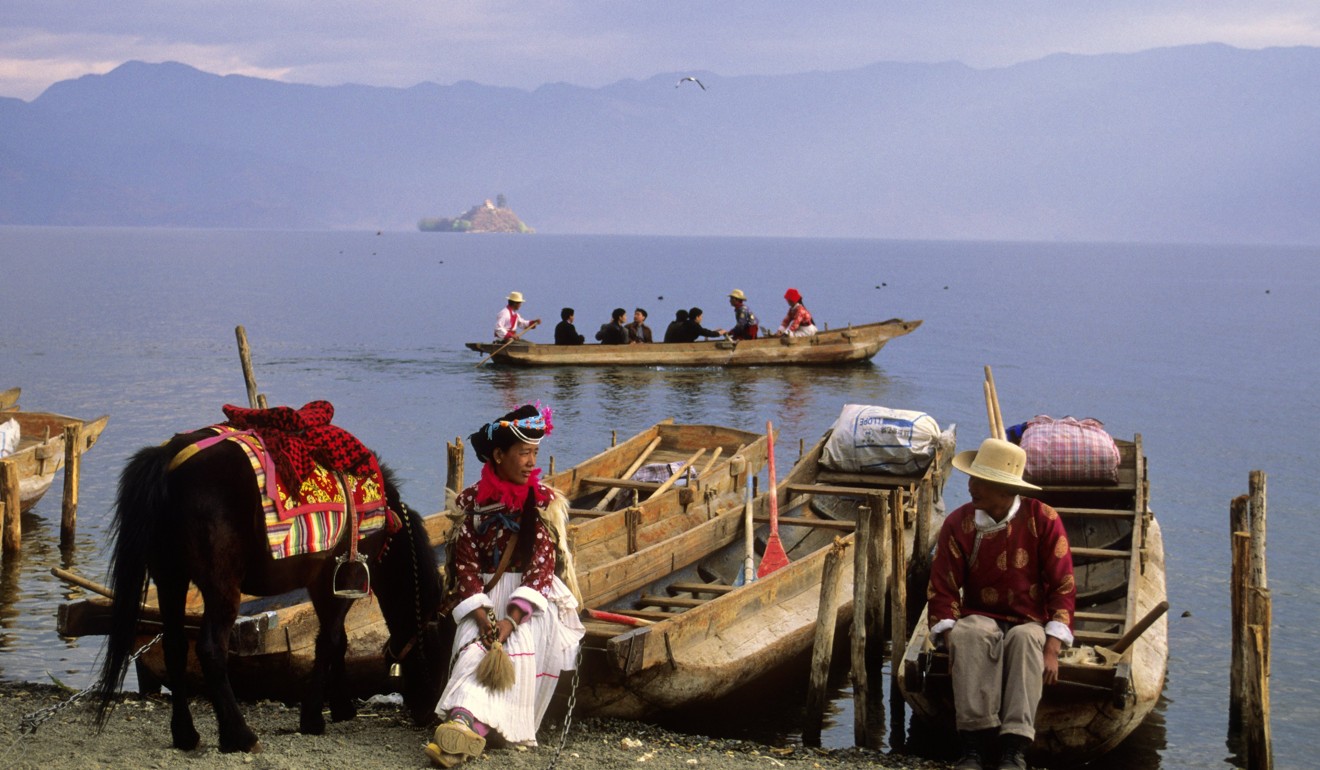
In China, for instance, there is a small Mosuo tribe known as the “kingdom of women”.
“Key to the Mosuo culture is their matrilineal family structure, with a basic building block of only members sharing the same female bloodline making up the family … Any male bloodline is not taken into account,” says Choo Waihong, a former Singaporean corporate lawyer who has researched the community for the past decade.
Lugu Lake in China’s Yunnan province is home to the Mosuo tribe. Photo: hemis.fr
At the top of the hierarchy is the grandmother, who is the head of the household. “Her daughters run the home and look after all the children of the female siblings … The sons and grandsons are expected in their supporting role to shoulder the manual tasks required to maintain the farmstead,” Choo says.
Researchers say that there are about 30,000 to 40,000 Mosuo people – most of whom live in the far eastern foothills of the Himalayas in Yunnan, southwest China. This unique community has come together in a series of villages dotted around a mountain and Lugu Lake, while growing numbers have moved out to work in larger towns and cities elsewhere in the country.
According to Choo, author of the book The Kingdom of Women: Life, Love and Death in China’s Hidden Mountains, the most distinctive facet of this community that sets it apart from mainstream society is the absence of formal marriage arrangements between men and women. Instead, they have “walking marriages”, where the man goes to the woman’s home, spends the night with her and then leaves the following morning.
The Kingdom of Women: China’s ‘lost tribe’ of matriarchs, the Mosuo
15 Mar 2017
The couple can choose to have a temporary or even a permanent arrangement as partners, but they are not bound by marriage ties. If they have children, the baby belongs to the woman’s household. “In fact, the man is not considered part of the matrilineal family and his ties to the baby do not determine the social place of the baby,” the researcher says.
Such a society, where women are not subjected to men and sexual freedom is an intrinsic part of their culture, is so radically different from mainstream patriarchal family structures that the Mosuo tribe has been examined and studied over time. More recently, its unique features have also become an eye-catching selling point for the local tourism industry.
TOURISM INDUSTRY
The Mosuo tribe used to live off the land by farming, herding and hunting. But many families now rely on tourism after the tribe’s culture and Lugu Lake became more popular and widely known.
“Tour buses on fancy freeways and planes arriving at a new airport bring more and more tourists daily to turn the whole area into a busy travel playground,” Choo says. “Every household around the lake is involved one way or another with the hotel, restaurant and tour guide industries.”
While the tourism industry has brought money and better food for most families as well more access to educational opportunities for their children, it is also posing a serious threat to their culture and traditional ways of life.
“The greatest challenge for the tribe is their rapid transition from living a rudimentary subsistence farming way of life right into a burgeoning modern middle-class existence within a short span of 20 or so years,” Choo says.
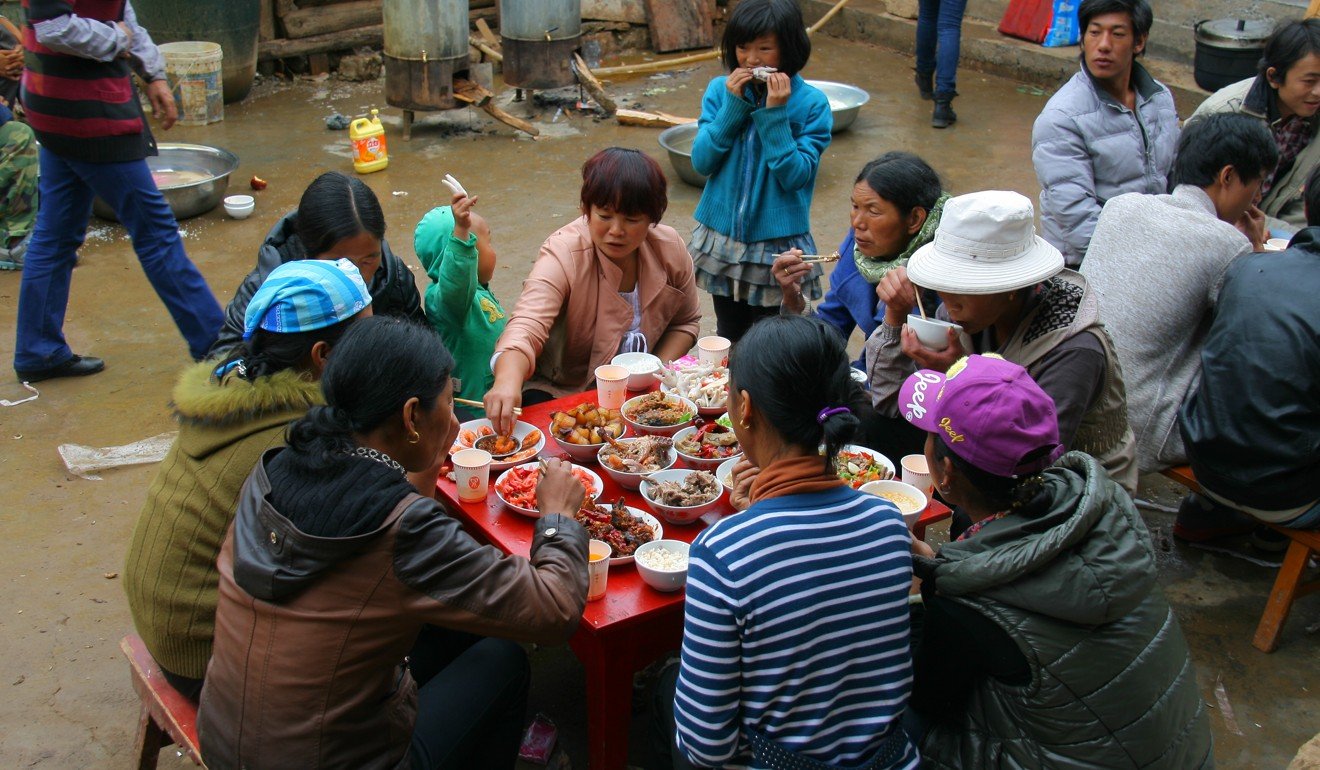
Mosuo people pictured at a wedding ceremony with an all-meat feast in 2013. Photo: Shutterstock
The Mosuo are now being bombarded not only by mainstream traditional Chinese values, but also by new economic values connected to money and the digital economy. “That is a lot to take in for people who had no writing to support their oral language … and only had primary schools for their children not so long ago,” she says.
Older Mosuo are now being pushed to learn Mandarin in order to keep up with the younger generations.
At the same time, the researcher says, “their long-held cultural beliefs and principles are evolving as the young generation gets exposed to the outside world and start to question the old ways of doing things.”
How life is changing for Thailand’s Karen tribe
Walking marriages are not as common, with more youngsters getting married and forming nuclear families. “Large matrilineal families which were the norm are now breaking up into smaller nuclear families. All this dilutes the traditional matrilineal Mosuo family structure,” Choo says.
“The central place of the female in old Mosuo society is slowly being affected, as the male Mosuo are beginning to entertain some patriarchal outlook in the face of outside cultural influences.”
China may have radically reinvented itself in recent decades, but the changes to the Mosuo tribe have been nearly as dramatic. “The world of the Mosuo when I first ventured into their midst 12 years ago is a distant past as I look [today in 2020] at how they have changed,” Choo says.
PATRIARCHY IN DISGUISE
There are dozens of female-centric communities scattered around the world. The Garo and Khasi tribes, which are also traditionally matrilineal societies, can be found mostly in India.
In a Khasi family, the youngest daughter inherits the ancestral property, while in the Garo community, women also inherit property, but don’t necessarily have to be the youngest daughter of the family.
Caroline Marak, former head of the Garo Department at the North Eastern Hill University in India, says that the Garo are female-oriented, but not female-dominated. Women “have no part in the field of administration decision-making”, she wrote in an academic paper.
In recent years, the husbands of Garo women who are property owners have had a greater say over land deals, such as with government. “We are now trying to reclaim our rights from the males,” says Sume Sangma, secretary of the Garo Mothers Union NGO. “Women in the community are self-reliant and we are fighting for their real power.”
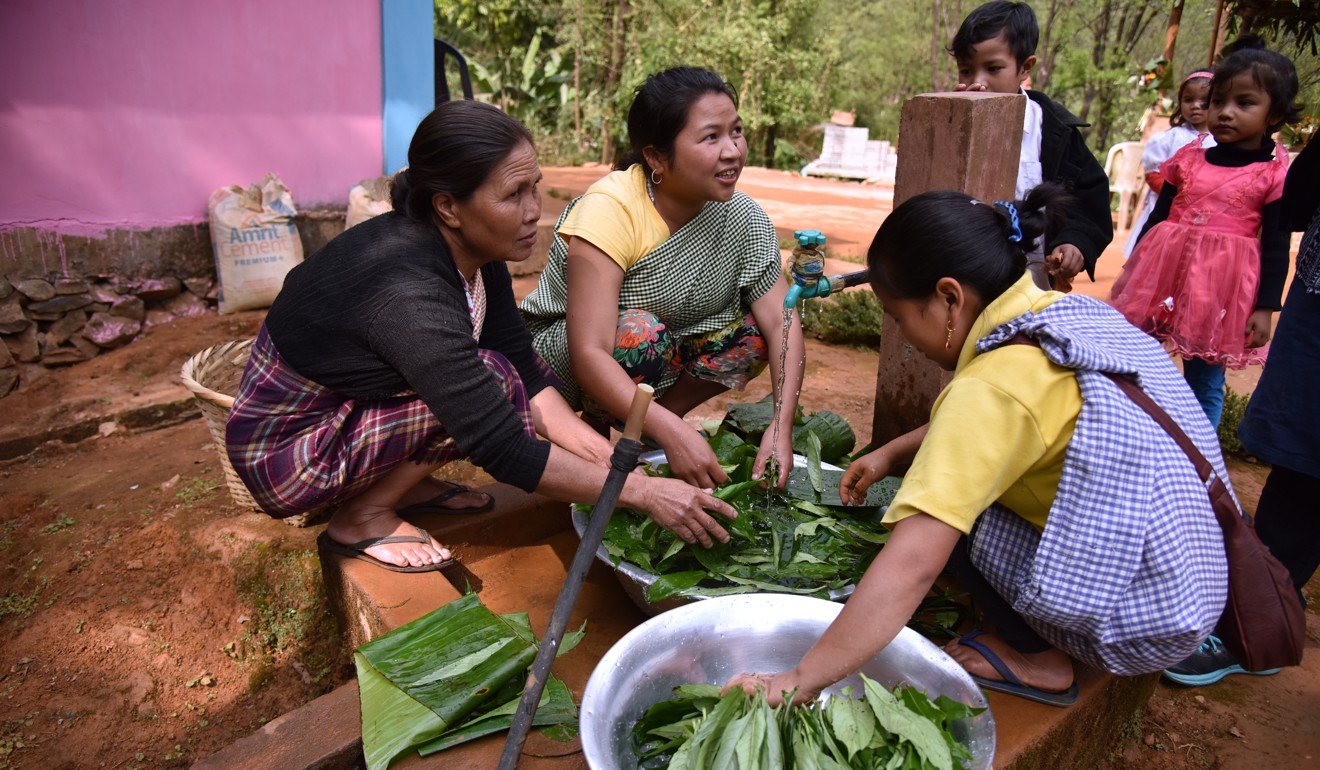
Khasi women wash leaves for cooking in the village of Nongtraw in India’s north-eastern Meghalaya state. Photo: AFP
Tiplut Nongbri, from the Centre for North East Studies and Policy Research at the Jamia Millia Islamia in New Delhi, also says women don’t have much authority in Garo and Khasi societies. “Patriarchy is in disguise in both the communities. The societies are matrilineal only as far as descent, residence and inheritance of property are concerned,” she says. “Women are not allowed to take part in politics.”
RG Lyngdoh, former home minister of Meghalaya – the hilly state in north-eastern India where both communities are based – says inward migration and the presence of Christian missionaries in the state have affected traditional lifestyles. “The old practices of equity between males and females have eroded,” Lyngdoh says.
“This has led to a perception of inadequacy among the males, [creating] discord within the family, which found expression in many negative ways, such as domestic violence and abandonment of wives, which never existed within the Khasi community.”
Gertrude Lamare, a member of the Khasi-Jaintia community now pursuing her PhD in anthropology at the London School of Economics and Political Science, argues that “with families becoming more nuclear, women do have a huge role in the decision-making process”.
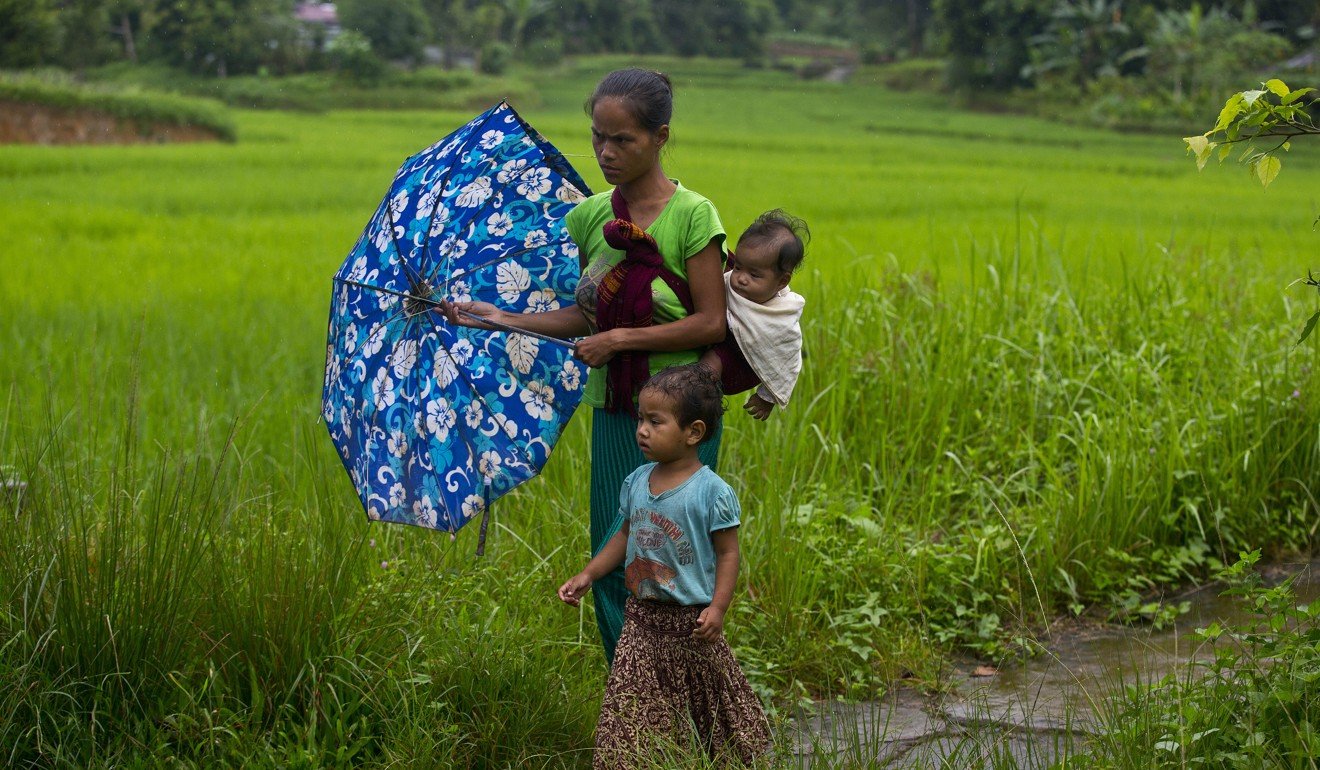
A Khasi woman walks in the rain with children past a paddy field along the Assam-Meghalaya state border in India. Photo: AP
Researchers have estimated that there are 1 million Garo in India and
, and 1.7 million Khasi in the Khasi and Jaintia Hills.
Some of them have become increasingly wary of outsiders preying on their natural resources, which are dwindling, thanks to deforestation and climate change.
Another challenge these communities are facing has to do with the growing trend of mixed marriages. “In recent years, children of a Khasi or Garo mother and non-tribal father [have] not [been] welcomed. The males in the family want their women to marry within the tribal community,” researcher Nongbri says, noting that younger generations are going through an identity crisis.
STILL PROUD
The world’s largest known matrilineal society today is believed to be in Indonesia: the Minangkabau, also known as Minang. Their community of about 8 million is scattered around the world, but most are in Indonesia’s West Sumatra province. While traditionally animist, they were later influenced by Hinduism and Buddhism, and most have since embraced Islam.
But much like the others, their community is also changing.
Nursyirwan Effendi, dean of the Faculty of Social and Political Science at Andalas University, says that many of those who remain in villages and rural areas still hold tight to the tribe’s values.
“Women are central in the distribution of assets, such as rice fields, gardens and [houses], from their ancestors,” he says.
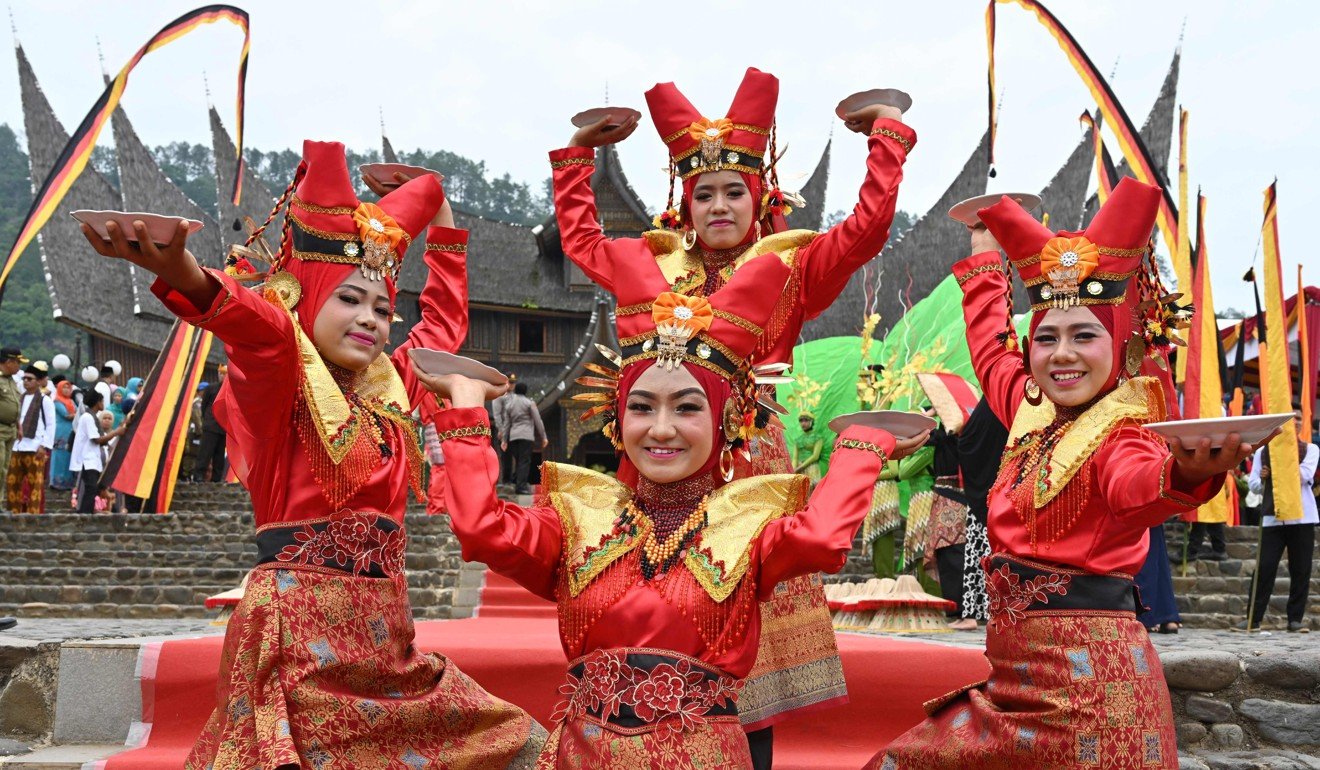
Dancers pose during the 2018 Minangkabau art and culture festival in Batusangkar, West Sumatra. Photo: AFP
Traditionally, Minangkabau women play an essential role in their children’s education and hold inheritance rights, while men are expected to take jobs elsewhere and occupy political and religious positions. When they do get married, the man moves to the woman’s house.
But Nursyirwan, who is of Minangkabau descent, notes that many have left for bigger cities, where they do not closely follow the community’s traditions.
An example of this is Afrianto Sikumbang, a 53-year-old businessman who was born to Minangkabau parents in West Sumatra province but now lives in the capital, Jakarta. Although he married a Minangkabau woman, he says they “don’t really apply” the tribe’s values in their daily life.
Sonya Anggraini, 35, who also works in the capital, has got used to city life, but remains proud of her ancestral roots and hopes that Minangkabau culture will persist for years to come.
“I am a member of my mother’s family, not of my father’s,” she says. ■
Source: SCMP
Posted in Andalas University, ‘Kingdoms of women’, “walking marriages”, Buddhism, capital, Centre for North East Studies and Policy Research, centuries, China, Christian missionaries, Culture, culture and traditional ways of life, DISGUISE, distribution of assets, educational opportunities, Faculty of Social and Political Science, families, farming, female-centric, Food, freeways, gardens, Garo, Garo Mothers Union NGO, grandmother, herding, hierarchy, Himalayas, Hinduism, Household, houses, hunting, India, Indonesia, islam, Jamia Millia Islamia, Karen tribe, Khasi, London School of Economics and Political Science, Lugu Lake, mainstream, Matriarchal, matrilineal communities, Minang, Minangkabau, modernity, money, Mosuo tribe, new airport, New Delhi, North Eastern Hill University, patriarchal, planes, rice fields, serious threat, sexual freedom, societies, Technology, Thailand’s, The Kingdom of Women: Life, Love and Death in China’s Hidden Mountains, threatens, Tourism, tourists, travel playground,, Uncategorized, West Sumatra, Yunnan Province |
Leave a Comment »
18/08/2019
- Adult consumers are fuelling a boom in China’s toy collectibles market
- Men are spending thousands of dollars on figurines to express their identity, boost their street cred, and indulge their inner kid
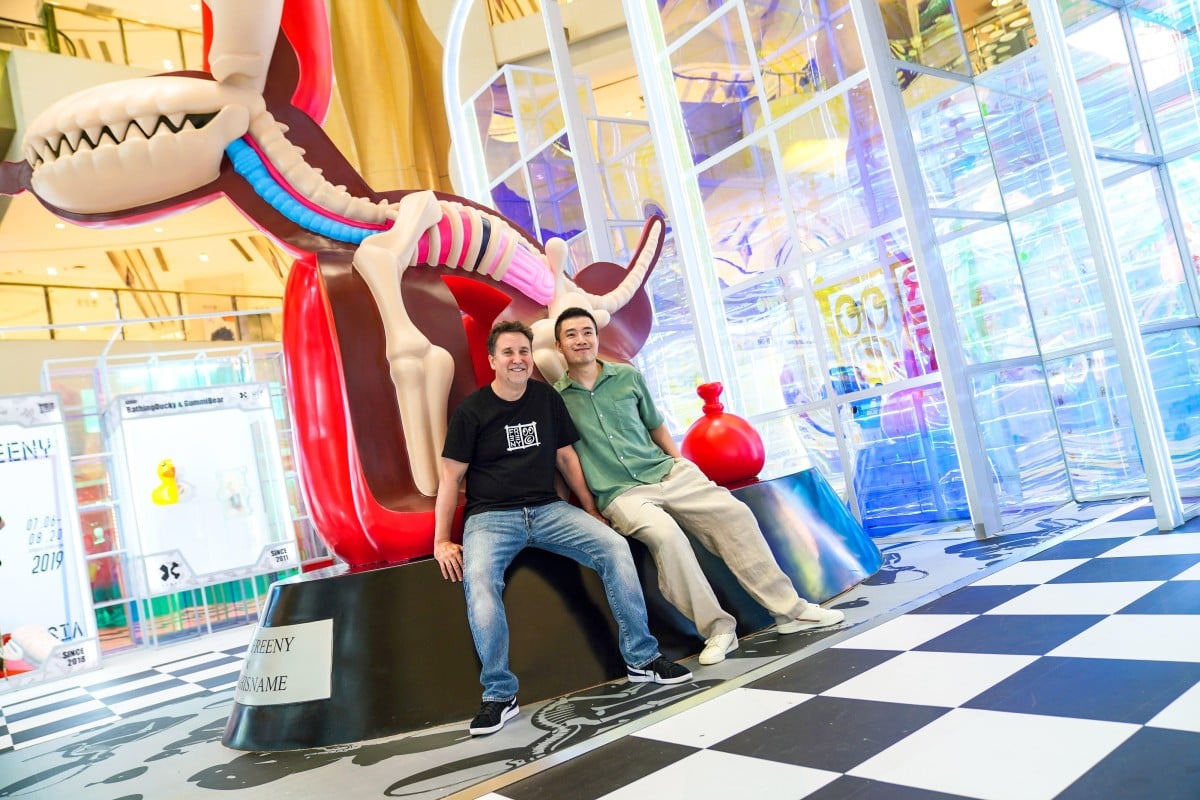
Chinese collector Don Tang with artist Jason Freeny at the Jason Freeny X-Soul Station exhibition in Shanghai. Photo: Don Tang
Don Tang is proud of his toys. So much so that the Shanghai resident, 32, puts them on display both in his home and in the office of the company he runs.
And there are plenty to display. Tang, 32, has some 100 collectibles and the number is growing all the time. Each month he sets aside 2,000 yuan (US$280) to buy the top trending toys, newest releases, or one-of-a-kind items – either from physical stores, online or at toy conventions in China.
But the toys are not connected to his work as the CEO of a firm in the intellectual property sphere. They are simply a hobby, albeit one Tang takes seriously. The crowning jewel of his collection? A 6,000 yuan KAWS action figure bought in Tokyo, Japan.
“When I return home from work each day, I get to see [my toys] and it puts me in a good mood,” says Tang, who realises some people might not get the appeal of his hobby, but says it is an “addictive” pursuit and a way of appreciating designs and craftsmanship. Whether it’s SpongeBob SquarePants, Hello Kitty or Sesame Street, each toy has its own distinct, “lovable, cute, and personalised” identity, he says.
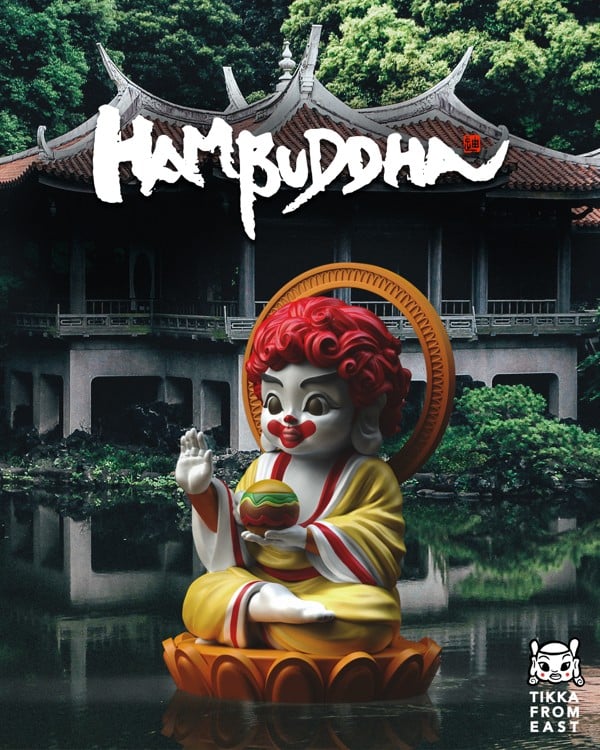
Remind you of someone? Hambuddha is a designer figurine made by Mighty Jaxx of Singapore that is aimed at the adult market. Photo: Mighty Jaxx
“When you look back at the toys that you collected at different times, you realise how your own aesthetic, tastes, and preferences have changed over time,” adds Tang, who would never dream of selling his precious collection.
Tang’s toy story is far from unique. Sales of toys and games in China – which produces 80 per cent of all the world’s toys – soared to 324 billion yuan in 2018, up from 135 billion yuan in 2013, according to market research company Euromonitor. Fuelling these sales is a growing army of toy connoisseurs just like Tang.
Mighty Jaxx, a Singapore-based urban culture company that designs and manufactures collectibles and lifestyle products, is among the many companies benefiting from this surge in demand.
Its Chinese customer base accounts for 25 per cent of its projected revenue of S$10 million (US$7.21 million) for 2019 – and this proportion is expected to hit 40 per cent over the next few years, according to Mighty Jaxx’s founder and CEO, Jackson Aw, 30.
Smearing cannabis on your face: the latest Asian beauty craze
An avid toy collector himself, Aw first mused over the idea of turning his hobby into a viable business back in 2012. He ventured to Shenzhen in China for one month, knocking on factory doors just for a behind-the-scenes glimpse of the toy production process.
Being one of his first times to China, the mammoth scale of the industry came as a major “culture shock” to Aw.
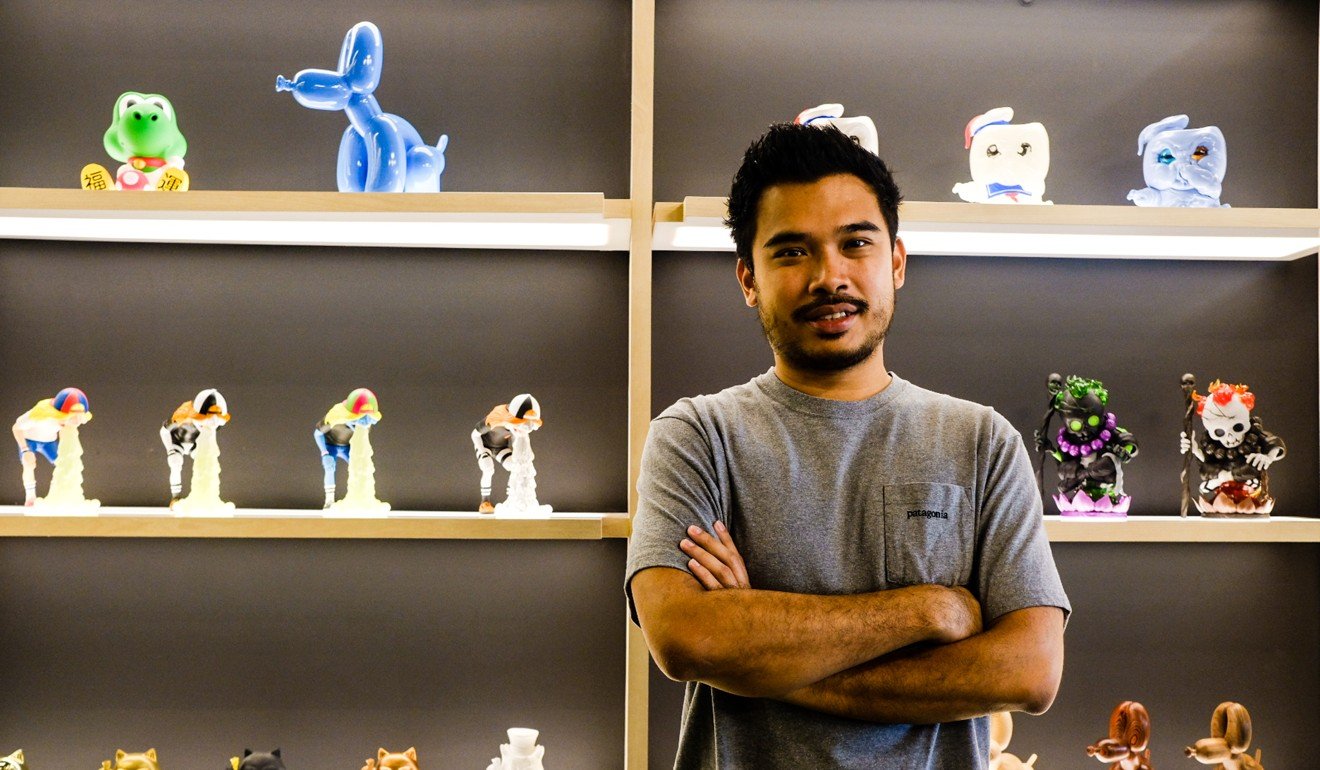
Mighty Jaxx founder and CEO Jackson Aw. Photo: Toh Ee Ming
“I had always thought that it was just one giant machine that spits out parts and that was it. But there were rows and rows of hundreds of people printing, hand painting, assembling and using different skills just to produce one toy,” the Singaporean says.
Describing the visit as his “greatest education”, Aw was inspired to launch Mighty Jaxx from his bedroom with start-up capital of S$20,000 loaned from a bank through his parents.
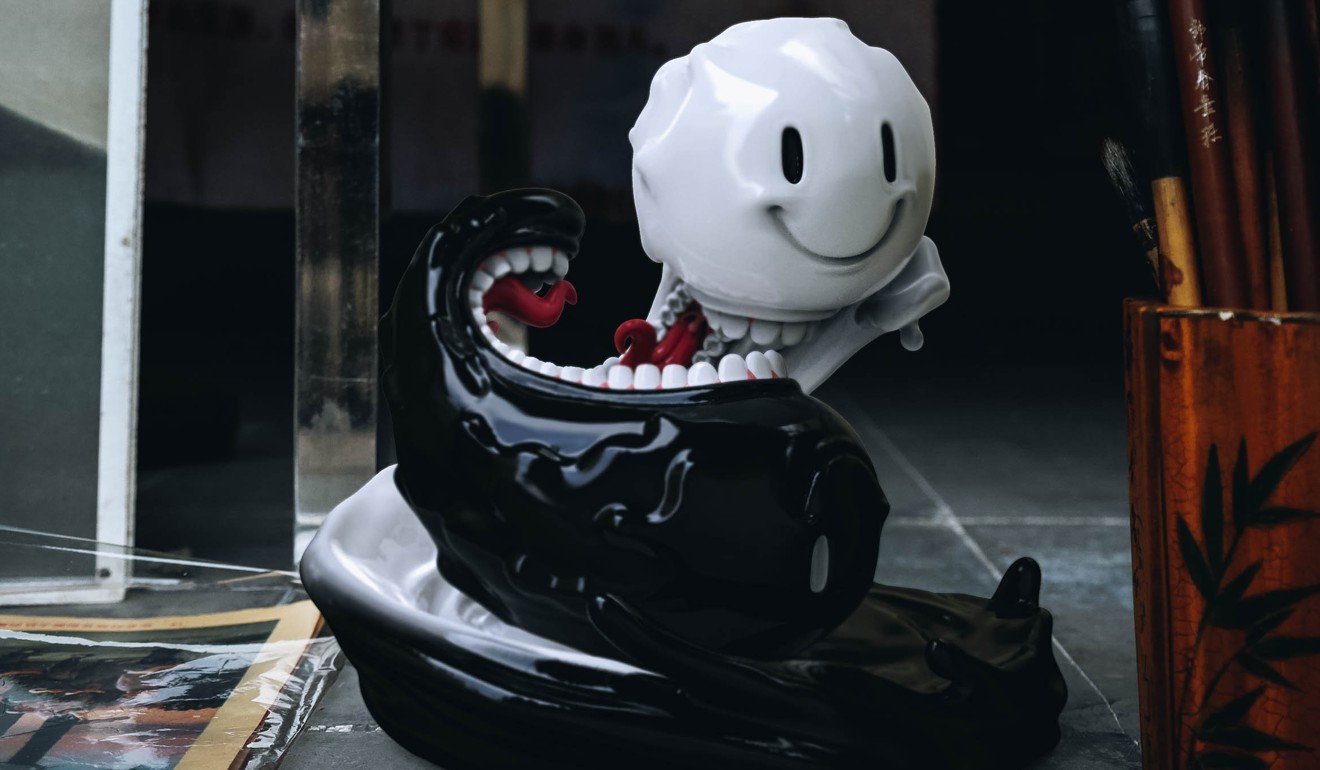
Fast forward to today and his online business has worked with major brands such as Warner Brothers, DC Comics, Cartoon Network, MTV and New Balance, and shipped millions of products to collectors in over 50 countries. It is best known for its XXRAY figures, developed in partnership with artist Jason Freeny, which feature dissected Justice League characters such as Batman, Superman and Wonder Woman.
Hong Kong toy makers hope Asia’s largest toy fair will help boost flagging sales
But in its early days, the China market had intimidated Aw as a “big anomaly” that was still largely closed off. Aw had found it difficult to navigate the cultural norms and familiarise himself with unfamiliar business models.
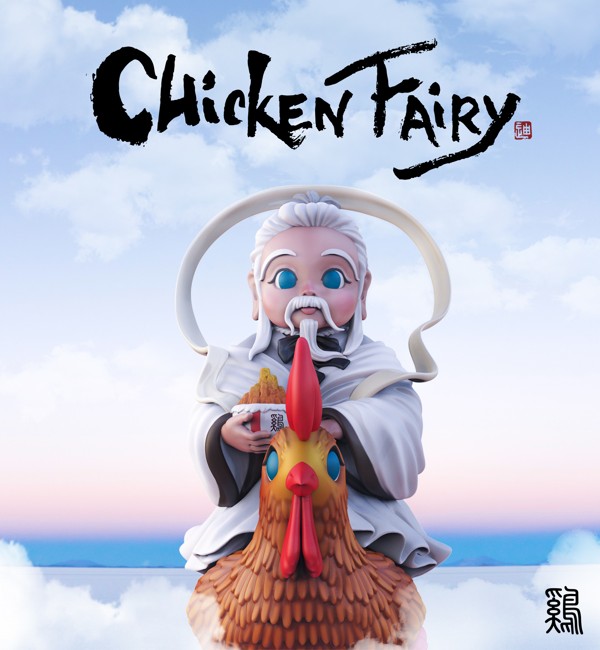
Still, sensing China’s potential, his firm embarked on wide-ranging creative collaborations to tailor its offerings to the Chinese market – from creating yin-and-yang themed toys, celestial chicken fairy deities and the “Hambuddha” (a Buddha holding a pearl-shaped hamburger while on a lotus throne).
It also partnered with Chinese artist Chen Wei (who goes by the alias Cacooca) to develop a new Panda Ink collection, which depicts a panda in the midst of an everyday activity or hobby, such as hiking, playing video games or cuddling with cats.
Mighty Jaxx’s ‘Flow by 18 Uppercut’ has a yin and yang theme with white and black halves. Photo: Mighty Jaxx
It has also collaborated with other big-name artists and celebrities trending among Chinese consumers – such as Los Angeles-based dance crew Kinjaz, who found fame in China appearing on dance shows, and ABS, a leading graffiti crew based in Beijing’s 798 Art District – and has an upcoming collaboration with Taiwanese singer Show Luo.
But it is the comic and toy conventions that provide its biggest fans, typically men in their 20s to 40s who flock in from Beijing, Shanghai and Guangzhou.
Aw says these collectors have a huge appetite to splurge on high-end collectibles, which can range in cost from anywhere between US$10 to US$2,000.
Singapore sex toy sales buzzing thanks to ‘healthy’ branding
To these collectors, price is of little concern as they are looking for “tangible products to buy and show off their personality” and build their street cred among their friends, though they still prefer to stay under-the-radar about their collection to the general public, Aw says.
Today, Mighty Jaxx’s products are manufactured in nearly 20 different factories in Shenzhen and Guangzhou. It set up its first overseas office in Shanghai last year and is planning to open its second one in Suzhou by the end of 2019, according to Aw.
Besides growing Chinese affluence, Aw credits his company’s success to a greater exposure to Western influences and China’s own unique brand of pop culture taking off domestically.
He points to one of China’s biggest blockbusters Monster Hunt, a fantasy martial arts film of how monsters live among humans.
Mighty Jaxx’s celestial chicken fairy deity is aimed at the Hong Kong and mainland China market. Photo: Mighty Jaxx
“Outside China, you wouldn’t know what the hell it’s about. But the Chinese are creating their own unique narrative and developing their own intellectual property … That’s when we know the demand for original creation in different forms is truly there,” Aw says.
Likewise, consumers live in an age of a “mishmash of pop cultures and crossovers” and “subcultures becoming mainstream”, he says.
Citing how the business has teamed up with Team Hero, a China e-sports team comprising professional computer gamers, to roll out new figurines, Aw says: “It doesn’t mean that tattoo artists, skateboarders don’t buy toys … What seems to be separate demographics are converging to become a multibillion-dollar market.”
Aw says the company is planning to expand from its current business model based on direct selling to collectors, to e-commerce distribution channels like Taobao and Tmall by the end of 2019.
He hopes eventually to set up the firm’s first retail store in Shanghai, as he believes the future lies in experiential retail.
“China has been cultivating that openness in recent decades, and we’re still very curious and excited for new things to happen [in this market],” Aw says. ■
Source: SCMP
Posted in ABS, adult male consumers, Batman, Beijing, cannabis, Cartoon Network, celestial chicken fairy deity, Chinese toys boom, collectibles, consumers, crossovers, cuddling with cats, DC Comics, demographics, Euromonitor, everyday activity, figurines, fuelled by, Guangzhou, Hambuddha, hand painting, Hello Kitty, hiking, hobby, Hong Kong, humans, inner kid, Intellectual property, Jason Freeny X-Soul Station exhibition, Justice League characters, Kinjaz, Mainland China, mainstream, market, martial arts film, Mighty Jaxx, mishmash, Monster Hunt, monsters, MTV, New Balance, original creation, Panda Ink, playing video games, pop cultures, Printing, retail store, Sesame Street, sex toy sales, Shanghai, Shenzhen, Singapore, Singaporean, skateboarders, SpongeBob SquarePants, street cred, subcultures, Superman, Taobao, tattoo artists, Team Hero, Tmall, toys, Uncategorized, Warner Brothers, white and black halves, Wonder Woman, XXRAY figures, yin and yang theme |
Leave a Comment »




 CHINDIA ALERT: You'll be living in their world, very soon