Archive for ‘Manila’

31/03/2020

Coronavirus: Philippines awaits Chinese expert team as cases rise to more than 2,000

  • The team is expected to provide technical advice on epidemic prevention and control as well as treatment protocols
  • The Southeast Asian nation on Tuesday recorded its largest daily increase in coronavirus deaths and infections
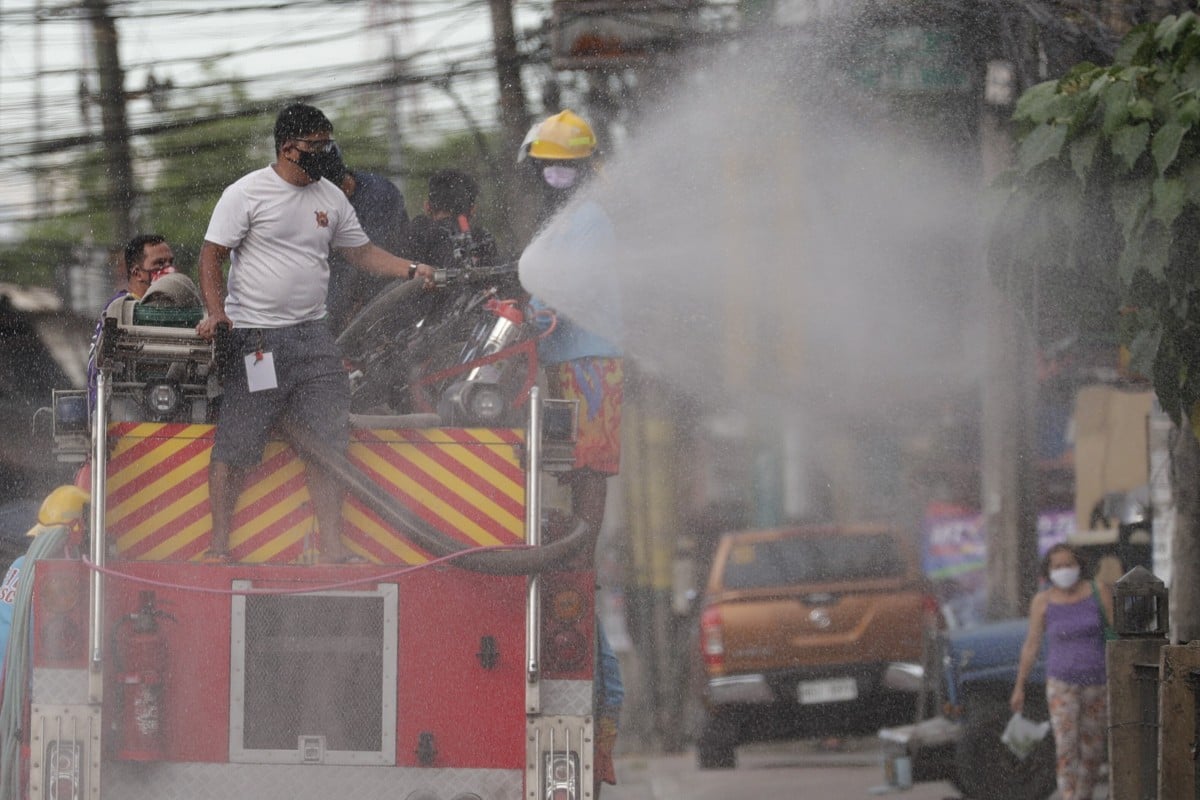
A fireman sprays disinfectant from the back of a fire truck to help curb the spread of the coronavirus during a localised quarantine in Manila. Photo: AP
The Philippines

on Tuesday recorded its largest daily increase in coronavirus deaths and infections, as it awaited the arrival of a Chinese medical team to support its embattled frontline health care workers.
Ten more people died from the Covid-19 disease, bringing the total to 88, while 538 new infections were reported for a total of 2,084.
Among those included in the latest count of positives is former senator Ferdinand “Bongbong” Marcos, whose condition, according to his spokesman Victor Rodriguez, is now “stable” and “improving”.
Health undersecretary Maria Rosario Vergeire said the ministry had opened new labs and run more than 15,000 tests, a five-fold jump from about 3,000 last week. She added that more hospitals were seeking government approval to function as testing centres.
Medical evacuation plane crashes at Manila airport in Philippines, killing eight on board
29 Mar 2020

“We have six more laboratories to conduct tests,” Vergeire said. “We are also conducting contact tracing to find possibly infected persons.”

Philippine hospitals are struggling with a shortage of protective gear, manpower and testing capacity, as are medical facilities around the world. At least 13 doctors have died as of Tuesday and the Philippine Medical Association estimates that over 5 per cent of health workers are currently under quarantine due to Covid-19.
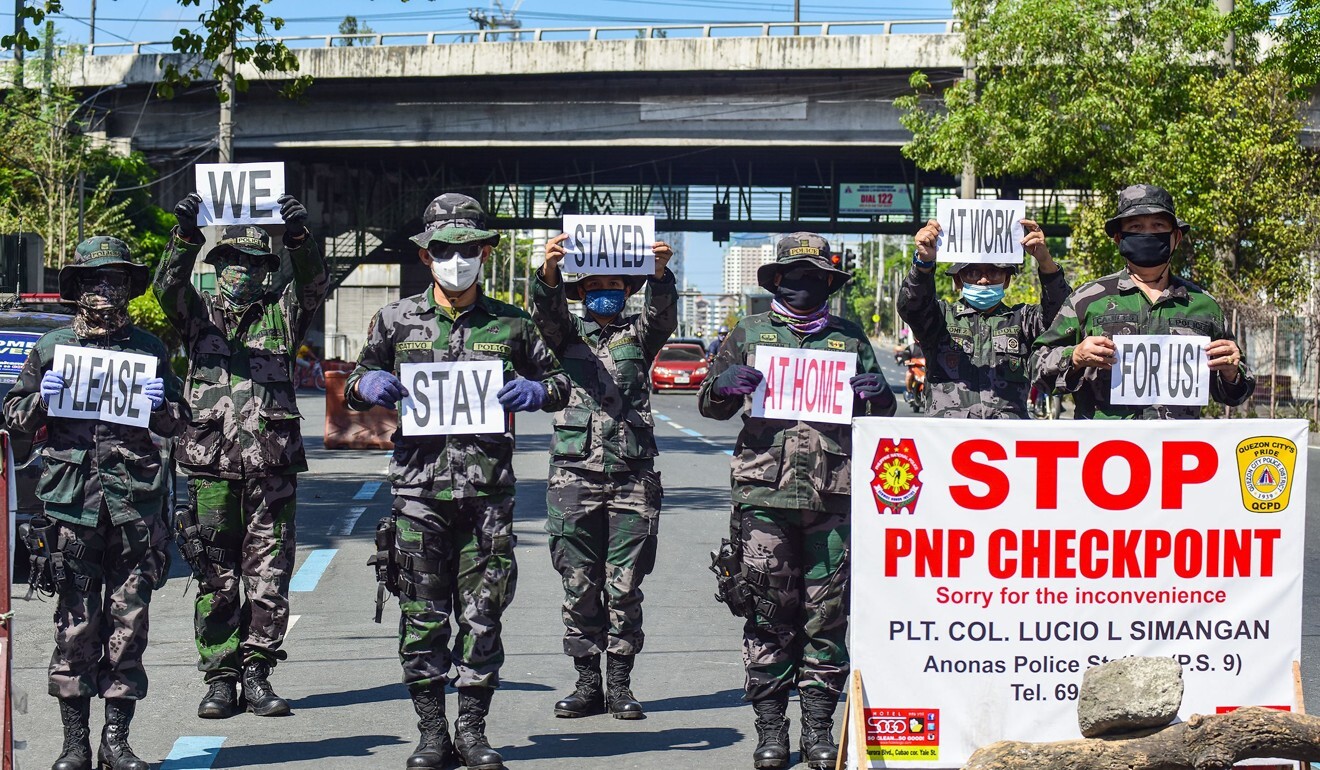
Police personnel in Manila hold up placards reminding people to stay at home. Photo: AFP
The country’s ambassador to China, Chito Sta Romana, confirmed a statement by the Chinese embassy in Manila that Beijing would send an expert team to the Philippines to provide technical advice on epidemic prevention and control as well as treatment protocols.

Sta Romana said the team was made of up of “experienced doctors and public health officials who specialise in infectious diseases”, but could not say when they would arrive.

An infectious disease doctor who spoke on condition of anonymity said the Chinese medical team would only give advice.

Coronavirus: in Philippines, leak shows politicians and relatives received ‘VIP’ testing
25 Mar 2020

“There was an offer to see patients but it was rebuffed because of local laws on practice,” he said, referring to a law that bans foreign doctors from practising medicine in the Southeast Asian nation.

Philippine foreign secretary Teodoro Locsin Jnr on Saturday tweeted that the Department of Health was “blocking their arrival”. His tweet, now deleted, had said “Don’t piss me off. Let them in.”

Health secretary Francisco Duque told local media that Locsin took down his tweet after hearing that the department was preparing hotel accommodation and translators for the expert team.

According to an ethnic Chinese businessman who is a member of a foundation involved in the visit, the team was supposed to have arrived on March 27. It will comprise doctors, nurses and researchers from hospitals and disease prevention agencies in Fujian province who specialise in areas such as infectious diseases, emergency medicine and integrated traditional Chinese and Western medicine.

An estimated 1.2 million ethnic Chinese call the Philippines – which has a population of 107 million people – home, with many tracing their ancestry to Fujian province.

The businessman, who declined to be named, showed This Week in Asia a screenshot of the team’s name list, which included an official from Fujian province’s United Work Front Department, the controversial Communist Party department responsible for promoting its influence around the world.

Coronavirus: US cancels war games with Philippines due to outbreak
Beijing has dispatched teams of medical experts to countries struggling with a surge in Covid-19 cases, including Iran and Italy, and has also donated testing kits and other medical supplies.
The Philippine health department apologised over the weekend for comments made by undersecretary Vergeire that some of the kits donated by China had yielded only “40 per cent accuracy” and could not be used.
The Chinese embassy in Manila had rejected the suggestions, and shared a mobile text message supposedly from Duque to Ambassador Huang Xilian that thanked the Chinese government for the test kits.
Philippine President Rodrigo Duterte addresses the nation during a live broadcast on March 30. Photo: AP
Vergeire also issued a correction to her earlier statement, and said she was referring to “another brand” of test kits from China that a private foundation was going to donate.

Political risk analyst Ramon Casiple, who chairs the Institute for Political and Electoral Reforms, said at this point in the Philippines’ coronavirus fight “any help is welcome”.

He said he did not expect any negative political backlash towards the Chinese experts, even though on social media Filipinos have continued to blame China for failing to contain the outbreak in Hubei province, where cases first emerged.

Coronavirus: Philippines’ Luzon lockdown hits domestic helper agencies in Singapore
20 Mar 2020

The Philippines has locked down its main island of Luzon – where about a third of the population lives, and where 70 per cent of economic activity takes place – for the past two weeks, resulting in supply chain disruptions and millions of poor families losing any source of income.

President Rodrigo Duterte

’s critics have questioned what he has done with emergency powers granted to him that came bundled with a 275 billion peso (US$5.4 billion) emergency fund. A report showed that Duterte, through the Department of Social Welfare and Development, had managed to deliver emergency food aid to only 4,753 of the 18 million targeted families.

On Tuesday, finance secretary Carlos Dominguez said the government was planning a stimulus package to help companies and the poorest households.

“This planned stimulus package is already being crafted and will be responsive to the uncertainties of the situation,” Dominguez said in a statement, without elaborating. “At this point, nobody knows how bad this pandemic will get or how long it will last.”

Senate defence committee chair Panfilo Lacson warned that some people “are eating corn fungus to stave off hunger” and “if the executive does not act with dispatch, we may have a serious social problem to face”.

Communist Party of the Philippines founding chairman Jose Maria Sison agreed with Lacson but added, “it is therefore just for the broad masses of the people to be outraged and demand collective action against Duterte, his servant generals and the Department of Health because of their incompetence, corruption and stupidity.”

However, Senate President Vicente Sotto urged the public to “cut [Duterte] some slack”.

Source: SCMP

21/02/2020

Airlines suspend China flights due to coronavirus outbreak

(Reuters) – Airlines have been suspending flights to China or modifying service in response to the coronavirus outbreak.

Below are details (in alphabetical order):

AIRLINES THAT HAVE CANCELLED ALL FLIGHTS TO MAINLAND CHINA

** American Airlines – Extends suspension of China and Hong Kong flights through April 24

** Air France – Said on Feb.6 it would suspend flights to and from mainland China for much of March

** Air India – Suspends flights to Shanghai, Hong Kong until June 30

** Air Seoul – The South Korean budget carrier suspended China flights from Jan. 28 until further notice.

** Air Tanzania – Tanzania’s state-owned carrier, which had planned to begin charter flights to China in February, postponed its maiden flights.

** Air Mauritius – Suspended all flights to China and Hong Kong

** Austrian Airlines – until end-February.

** British Airways – Jan. 29-March 31.

** Delta Airlines – Feb. 2-April 30

** Egyptair suspended flights on Feb, 1, but on Feb. 20 said it would resume some flights to and from China starting next week.

** El Al Israel Airlines – Said on Feb. 12 it would suspend its Hong Kong flights until March 20 and reduce its daily flights to Bangkok. It suspended flights to Beijing from Jan. 30 to March 25 following a health ministry directive.

** Iberia Airlines – The Spanish carrier extended its suspension of flights from Madrid to Shanghai, its only route, from Feb. 29 until the end of April.

** JejuAir Co Ltd – Korean airline to suspend all China routes starting March 1

** Kenya Airways – Jan. 31 until further notice.

** KLM – Will extend its ban up to March 28

** Lion Air – All of February.

** LOT – Extends flight suspension until March 28

** Oman and Saudia, Saudi Arabia’s state airline, both suspended flights on Feb. 2 until further notice.

** Qatar Airways – Feb. 1 until further notice.

** Rwandair – Jan. 31 until further notice.

** Scoot, Singapore Airlines’ low-cost carrier – Feb. 8 until further notice.

** United Airlines – Feb. 5-April 23. Service to Hong Kong suspended Feb. 8-April 23.

** Vietjet and Vietnam Airlines – Suspended flights to the mainland as well as Hong Kong and Macau Feb. 1-April 30, in line with its aviation authority’s directive.

AIRLINES THAT HAVE CANCELLED SOME CHINA FLIGHTS/ROUTES OR MODIFIED SERVICE

** Air Canada – Extended the suspension of its flights to Beijing and Shanghai until March 27. It also suspended its Toronto to Hong Kong flights from March 1 to March 27, but its Vancouver to Hong Kong route remains active. [bit.ly/39zgmI0]

** Air China – Said on Feb. 12 it will cancel flights to Athens, Greece, from Feb. 17 to March 18

** Air China – State carrier said on Feb. 9 it will “adjust” flights between China and the United States.

** Air New Zealand – Suspended Auckland-Shanghai service Feb. 9-March 29. Reduced capacity on Shanghai route throughout April and Hong Kong route throughout April and May.

** ANA Holdings – Suspended routes including Shanghai and Hong Kong from Feb. 10 until further notice.

** Cathay Pacific Airways – Plans to cut a third of its capacity over the next two months, including 90% of flights to mainland China. It has encouraged its 27,000 employees to take three weeks of unpaid leave in a bid to preserve cash.

** Emirates and Etihad – The United Arab Emirates, a major international transit hub, suspended flights to and from China, except for Beijing.

** Finnair – Cancelled all flights to mainland China and decreased the number of flights to Hong Kong until March 28.

** Hainan Airlines – Suspended flights between Budapest, Hungary, and Chongqing Feb. 7-March 27.

** Korean Air Lines Co. – The national flag carrier suspended eight routes to China and reduced services on nine Chinese routes between Feb. 7 and 22.

** Philippine Airlines – Cut the number of flights between Manila and China by over half.

** Qantas Airways – Suspended direct flights to China from Feb. 1. The Australian national carrier halted flights from Sydney to Beijing and Sydney to Shanghai between Feb. 9-March 29.

** Royal Air Maroc – The Moroccan airline suspended direct flights to China Jan. 31-Feb. 29. On Jan. 16, it had launched a direct air route with three flights weekly between its Casablanca hub and Beijing.

** Russia – All Russian airlines, with the exception of national airline Aeroflot, stopped flying to China from Jan. 31. Small airline Ikar will also continue flights between Moscow and China. All planes arriving from China will be sent to a separate terminal in the Moscow Sheremetyevo airport. Aeroflot reduced the frequency of flights to Beijing, Shanghai and Guangzhou until Feb. 29.

** Nordic airline SAS – Extended its suspension of flights to Shanghai and Beijing until March 29.

** Singapore Airlines – Suspended or cut capacity on flights to Beijing, Shanghai, Guangzhou, Shenzhen, Chengdu, Xiamen and Chongqing, some of which are flown by regional arm SilkAir.

** UPS – Cancelled 22 flights to China because of the virus and normal manufacturing closures due to the Lunar New Year holiday.

** Virgin Atlantic – Extended its suspension of daily operations to Shanghai until March 28.

** Virgin Australia – Said it will withdraw from the Sydney-Hong Kong route from March 2 because it was “no longer a viable commercial route” due to growing concerns over the virus and civil unrest in Hong Kong.

Source: Reuters

18/02/2020

Philippine workers allowed to travel to Hong Kong, Macau amid virus fear

MANILA (Reuters) – The Philippines on Tuesday allowed Filipino workers to travel to Hong Kong and Macau, relaxing the travel ban it imposed on China and its special administrative regions to control the spread of the coronavirus.

The Philippines announced its decision before Hong Kong reported that a Filipina domestic helper became its 61st case of coronavirus in the country.

There are more than 180,000 Filipinos in Hong Kong, many working as helpers, according to the Philippines Labour Ministry.

The Philippines had imposed a travel ban on China and its special administrative regions Hong Kong and Macau. It later included Taiwan in the ban, but lifted it a few days after.

There was no immediate comment from Philippine officials on how the latest development in Hong Kong will affect its decision to relax its travel restriction.

The Philippines also said it would allow foreign spouses or children of Filipinos and holders of diplomatic visas travelling from China, Macau and Hong Kong to enter the country but they will be subjected to a 14-day quarantine.

Initially, only Filipinos and holders of permanent resident visas travelling from these areas were allowed entry.

Recruiters have appealed to the government to exempt Filipino workers from the travel ban because many of them are breadwinners. They could also lose their visas if they failed to report for work on time, the Society of Hong Kong Accredited Recruiters of the Philippines has said.

In 2019, Filipino workers in Hong Kong sent home $801 million in foreign exchange remittances, central bank data showed.

Filipinos leaving for Hong Kong and Macau for study and employment will be required to sign a declaration that they know the risks of going there, health officials said.

The Philippine government also said it will repatriate Filipino crew and passengers from the quarantined cruise ship Diamond Princess who wish to come home.

The cruise ship, owned by Carnival Corp and carrying some 3,700 passengers and crew, has been quarantined in Yokohama since Feb. 3, after a man who disembarked in Hong Kong before it travelled to Japan was diagnosed with the virus.

The Philippine Foreign Ministry said 35 of the 538 Filipinos onboard had tested positive for the coronavirus, including the eight new cases, who are all crew members.

In the Philippines, there have been three confirmed cases of coronavirus, including one death.

Source: Reuters

28/10/2019

Putin accepts Duterte invite, just before Manila-Beijing South China Sea oil talks. Coincidence?

  • The president is set to become the first Russian leader to make a state visit to the Philippines for more than 40 years, according to a former envoy
  • Moscow is aware of China’s entry into the Philippines, and could have its eye on some projects there, while the US is also watching developments
Russian President Vladimir Putin and Philippine President Rodrigo Duterte shake hands during a 2016 meeting in Peru. Photo: EPA
The timing of Moscow’s announcement over the weekend that President Vladimir Putin
has accepted an invitation to visit Manila has raised eyebrows, as it comes on the eve of crucial bilateral talks between the Philippines and China on joint oil exploration in the

South China Sea

.

In a statement immediately welcomed by the Philippine presidential palace, Igor Khovaev, Russia’s ambassador to the Philippines, on Saturday told reporters Putin had accepted Duterte’s invitation “with gratitude”.

No date has been set for the visit, with Khovaev only saying Moscow would “do our best to arrange this meeting as soon as possible”.

A steering committee with representatives from both Manila and Beijing is set to meet this week to discuss the joint oil exploration deal. China has proposed a 60 per cent-40 per cent split in favour of the Philippines, according to Hermogenes Esperon, 

Courting Russia with South China Sea oil is a ‘dangerous gamble’ for Duterte

Neither side has clarified if the split refers to ownership or revenue, and no other details were disclosed.

After an August meeting with Duterte, Chinese President Xi Jinping said the countries could take a “bigger step” in jointly developing oil and gas resources if they could properly handle their sovereignty dispute in the South China Sea.

But defence and security analysts say the Philippine president took a “dangerous gamble” on a visit to Russia last month, when he invited the Russian state oil company Rosneft to explore for oil in Philippine waters – which include parts of the South China Sea claimed by China.

The timing of Moscow’s announcement has not gone unnoticed.

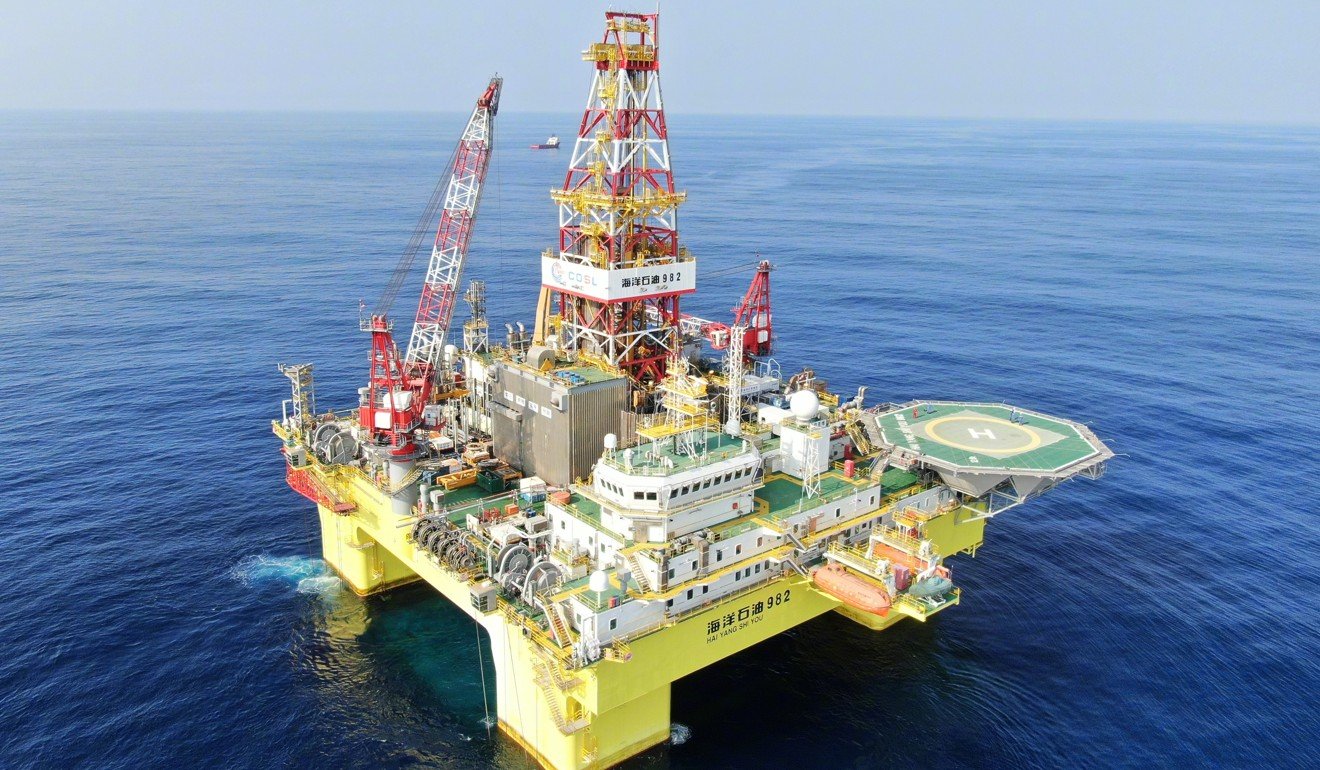
A Chinese deepwater oil rig in the South China Sea. Photo: Weibo

“It’s a welcome and historic development. Some wise guy in the Duterte government thought about timing [the invitation to Putin around the oil talks with Beijing],” said retired Philippine ambassador Lauro Baja, who once served as president of the United Nations Security Council.

Baja told the Post that no Russian president had visited the Philippines during his more than 40 years with the Department of Foreign Affairs.

“The Philippines then was almost a nonentity as far as Russia was concerned, [but] maybe now Russia recognises the strategic importance of the Philippines [in terms of] regional politics,” he said.

Baja said Moscow was aware of China’s entry into the Philippines, and could have its eye on some projects there.

“For all their so-called alliance, China and Russia are fierce competitors for influence and other benefits. And I think Russia has some objectives in mind like selling armaments and [forging] technological agreements,” he said, while cautioning that the situation remained “nebulous”.

New Philippines military chief sees no ‘shooting war’ in South China Sea despite disputes

“It’s a fascinating development but things are still early … For now, this is [just] an invitation extended by Duterte and accepted in principle by Putin.”

The United States will also be monitoring developments in the Philippines, according to Greg Poling, director of the Washington-based Centre for Strategic and International Studies’ Asia Maritime Transparency Initiative.

“Russia is eager to boost its influence in the region, and doubtless doing so with a long-standing US ally is seen as a bonus by Moscow,” he said. “There is nothing that prevents the Philippines from engaging in security cooperation with Russia, but the devil will be in the details.”

Poling added that the US would be concerned if Russia-Philippine cooperation involved acquiring military platforms that were incompatible with the shared platforms and doctrines used by Washington and Manila, as well as the latter’s other major security partners, namely Australia, Japan and South Korea.

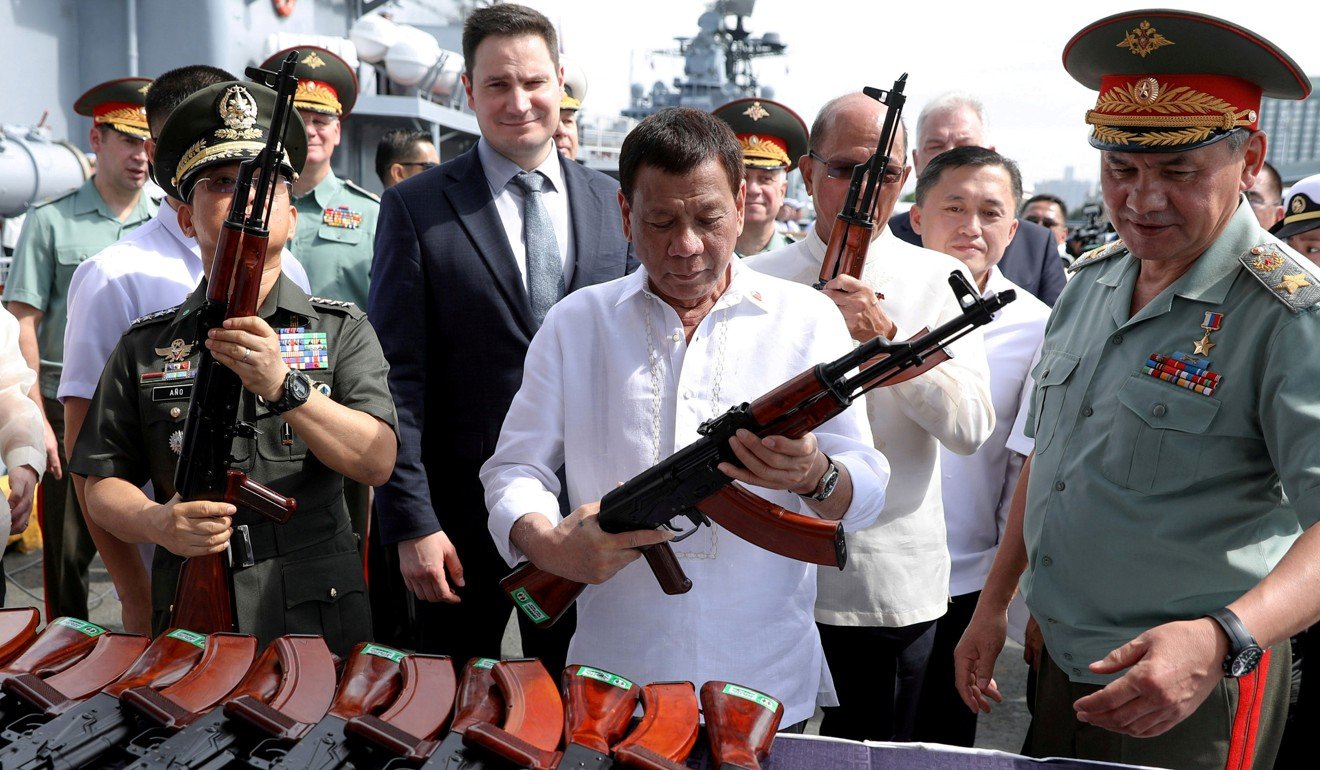
Philippine President Rodrigo Duterte inspects firearms donated by Russia in 2017. Photo: Reuters

“The US will also be concerned if any acquisitions or cooperation with Russia might threaten information security or intelligence cooperation between the US and the Philippines,” he said.

“And finally, any major platforms acquired from Russia would likely require the US to impose sanctions on the Philippines unless a waiver is granted, and the US government has been very stingy about awarding those waivers because they undermine the effectiveness of the sanctions regime.”

Moscow last week offered to help the Philippines produce its own arms for both domestic use and export with the help of Russian technology. Max Montero, an Australia-based Filipino security consultant, viewed that offer as “a swipe at the US”.

“Imagine a US stronghold and long-time ally and former colony becoming a manufacturing hub for Russian arms. And it makes it worse if [the Philippine armed forces] buys them too,” he said.

“Weakening the US alliances in Asia will benefit Russia [as it is] one of the US’ competitors in arms sales and geopolitics.”

Russia offers arms technology to the Philippines with ‘no conditions’ as US ties falter

The Philippines, Montero said, would benefit from such an arrangement since it is “a laggard in defence technology”. However, he pointed out that the country’s armed forces continue to buy weapons from the US and receive American arms as grants, potentially limiting the domestic market for Russian arms.

Navy cooperation has also been on the agenda, as Moscow and Manila discussed signing a new naval pact in March, while warships from each country have visited the other this year. Philippine naval vessels made their first-ever visit to Russia in October, while three Russian ships docked in the Philippines for a goodwill visit in January.

Russia is the top supplier of arms to Southeast Asia, and the No 2 global arms supplier, behind the US. Southeast Asia bought US$6.6 billion of Russian arms between 2010 and 2017, or more than 12 per cent of Russia’s sales, according to the Stockholm International Peace Research Institute, a Swedish think tank that publishes global arms tracking data.

Source: SCMP

13/09/2019

US Marines ‘remind China of America’s military edge’ with Asia-Pacific drills

  • Operations aimed to caution Beijing that US forces can carry out amphibious campaigns far from home
  • Washington has power to intervene directly in territorial disputes between its allies and China
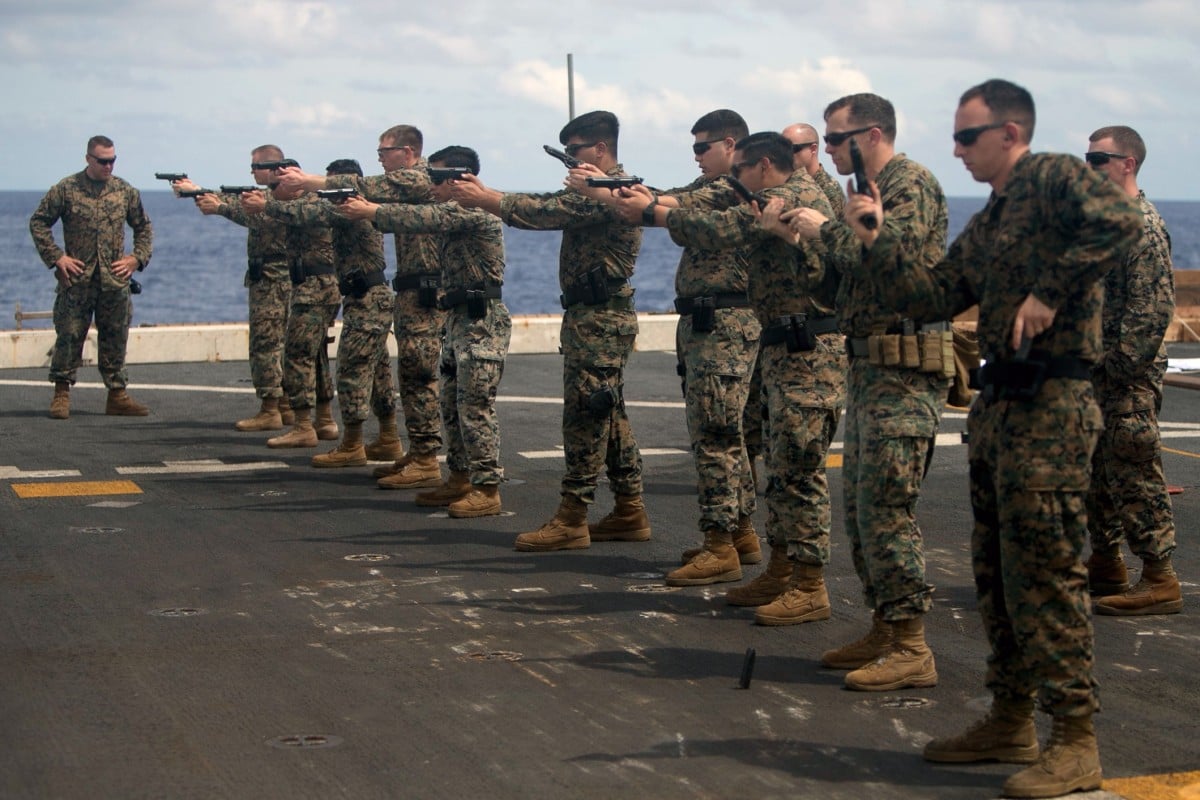
US Marines practise speed reloads on August 9 aboard the USS Green Bay, part of the Wasp Amphibious Ready Group, in the Indo-Pacific region. Photo: Handout

US Marines have conducted airfield- and island-seizure drills in the East and South China seas in what observers say is meant to remind Beijing of US military supremacy in the Asia-Pacific.

The 11-day naval drills were conducted near the Philippines and around the Japanese island of Okinawa by Okinawa-based US marine expeditionary units, the 31st Marine Expeditionary Unit said.

Observers said the operations were meant as a warning to Beijing that the US military could carry out amphibious campaigns far from home if Washington needed to intervene in territorial disputes between China and America’s allies in the region.

The 31st Marine Expeditionary Unit and Amphibious Squadron 11 conducted joint weapons drills from their Wasp Amphibious Ready Group ships from August 9-19, the Okinawa-based marine unit said in a statement.
The activity took place in the Philippine and East China seas and around an American naval base in Japan, it said.

The unit’s Amphibious Reconnaissance Platoon also performed a reconnaissance and surveillance mission through a high-altitude, low-opening parachute jump onto Okinawa.

A tilt-rotor aircraft, which hovers like a helicopter but flies like an aeroplane, afterward sent a landing team from a Wasp ship more than 400km (250 miles) away to establish the arming and refuelling point. The team achieved its objective in just over one hour, the statement said.

“The speed with which the Marines were able to establish the forward arming and refuelling point demonstrates a capability that is critical to conducting expeditionary operations in a contested environment,” the statement quoted Lieutenant Guirong Cai, a FARP officer-in-charge from the Marine Air Traffic Control Mobile Team, as saying.

“Their proficiency in swiftly setting up a refuelling point with 5,500 pounds (2.5 tonnes) of fuel demonstrates the 31st MEU’s ability to rapidly refuel and redeploy our air assets as the mission requires.”

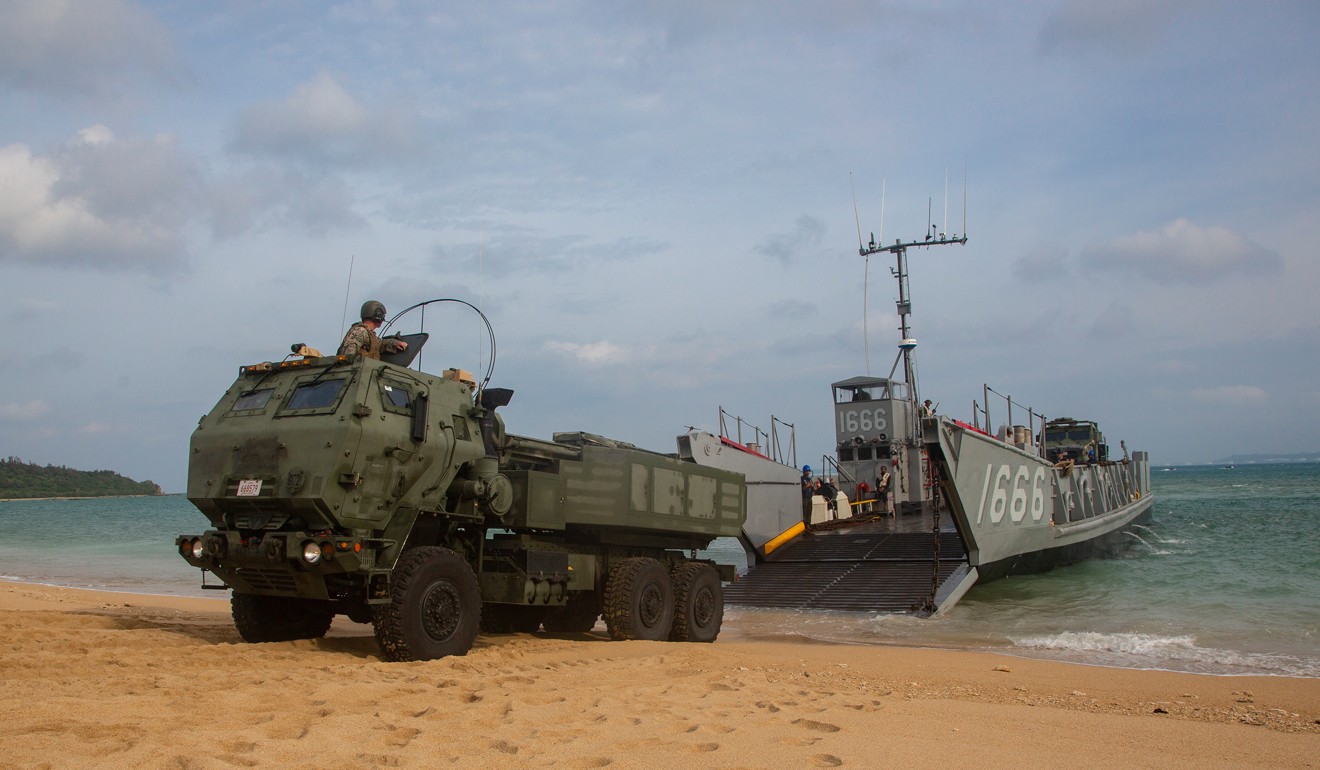
A US landing craft lowers its ramp to unload a high mobility artillery rocket system as part of a simulated amphibious raid at Kin Blue on Okinawa on August 14. Photo: Handout

China has a territory dispute with Japan over Diaoyu Islands, known as the Senkakus in Japan, in the East China Sea, while both Beijing and Manila have put in claims on the Scarborough Shoal – also known in China as Huangyan Dao – in the South China Sea.

Adam Ni, a China specialist at Sydney’s Macquarie University, said the drills near the Philippines and Okinawa showed that such a campaign would encompass a wide area, including the South and East China seas, where the US has joined other countries in the region to conduct freedom of navigation operations since 2015.

Maritime drills between US, Asean coincide with rising tensions

“It is a clear reminder to China of US military supremacy despite the narrowing of gaps in military capability in recent years,” Ni said. “The message is that the US military can still take China-controlled South China Sea features in high-intensity conflict.”

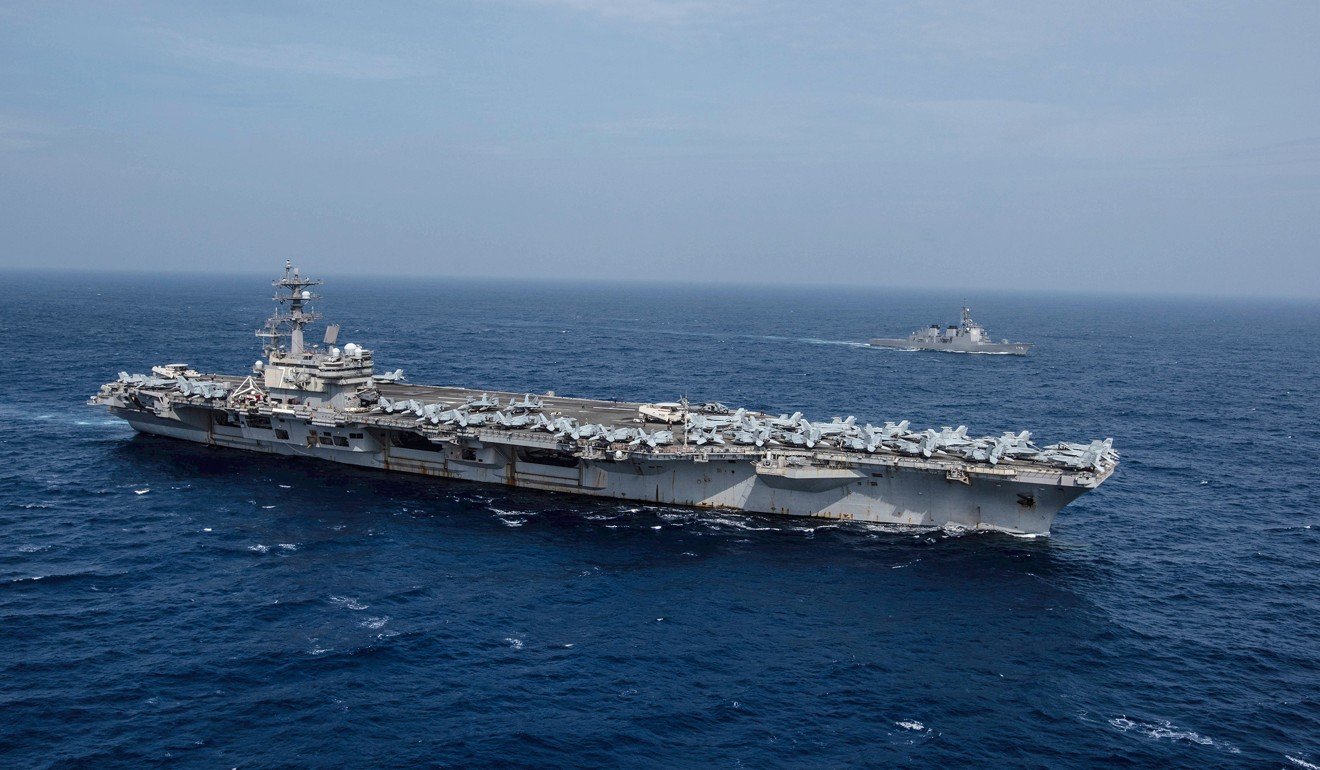
The USS Ronald Reagan aircraft carrier sails alongside a Japan Maritime Self-Defence Force guided-missile destroyer during drills. Photo: Handout

The statement did not say whether the Philippine navy and Japanese maritime self-defence force took part in the drills. But Hong Kong-based military commentator Song Zhongping said the US government would call on its two allies to observe the exercises.

“Whether Washington will intervene in territorial disputes between China and the Philippines as well as China and Japan, the American [military] has used [these drills] to strengthen its island-capture and airfield seizure capabilities in unfamiliar waters and areas,” Song said.

“To show its close relationship with and commitments to Manila and Tokyo, the Americans would invite the two allies to watch the drills. That could also be a good time to sell their amphibious warships and new model aircraft to Japan.”

During the drills, 10 simulated casualties were treated by three medical technicians from the US Air Force’s special operations group and given blood transfusions before being loaded onto a KC-130 transport aircraft for in-flight medical treatment en route to Marine Corps Air Station Futenma on Okinawa, the US Marines said.

Source: SCMP

11/06/2019

Row over China flags sold in Philippine park: Chinese embassy in Manila speaks out

  • Images claiming to show four people selling the flags at Manila’s Luneta Park days before the Philippines’ Independence Day have sparked fury online
  • Under Philippine law, it is illegal for foreign flags to be displayed in public or used in commercials
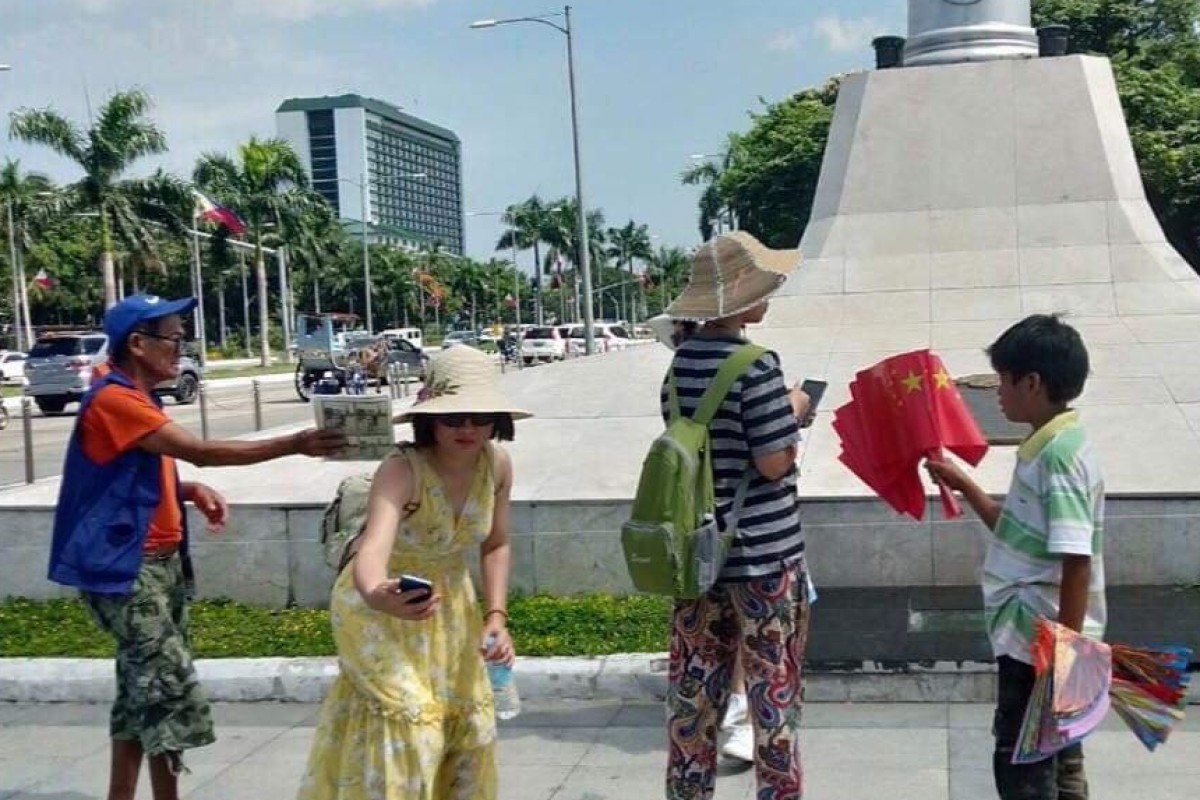
Four people seemingly selling Chinese flags at the Luneta Park in Manila. Photo: Facebook
Staged photographs showing vendors selling Chinese flags in a Philippine park ahead of the country’s Independence Day should be condemned if they were an attempt to undermine bilateral relations, the Chinese embassy has said.
The embassy’s intervention comes after the photos, which purportedly show four people selling the flags at Luneta Park in Manila, sparked fury online at the weekend and reignited a debate about Chinese influence in the country.
Under Philippine law, it is illegal for foreign flags to be displayed in public or used in commercials.
Many social media users in the Philippines reacted negatively to the pictures, hitting out at what they perceived as undue influence from Beijing. In one post typical of the public’s response, Facebook user Martin Masadao criticised Philippine President

Rodrigo Duterte,

writing: “Chinese flags are sold in Luneta! Are we going to be a province of China?”

However, an investigation by the national park authorities has since found the four people in the photograph were paid to pose as if they were selling the flags.

JUST IN: National Parks Development Committee clarifies that there are no vendors selling Chinese flags in Luneta Park,and that the trending photos are fake.Their CCTV caught three Filipinos who allegedly paid the vendors to pose as if selling/buying the Chinese flags. @gmanews pic.twitter.com/KlTpazfeTO— Mav Gonzales (@mavgonzales) June 9, 2019

Taking to Twitter on Tuesday, the Chinese embassy noted that the incident had occurred on China-Philippines Friendship Day.

“We noticed the staged photos of [vendors] selling Chinese flags, which have caught widespread attention,” it said. “If this was done with good intentions to celebrate China-Philippines Friendship Day, you are welcome. However, if it was done to undermine the China-Philippine relationship, we condemn it.”

Manila’s booming logistics property attracts Chinese investment

Manila police on Tuesday said they were searching for suspects “who maliciously ordered the display and selling of Chinese flags in an unauthorised place”.

Anti-China sentiments have been rising in the Philippines over fears the Duterte administration is aligning itself too closely with Beijing.

Duterte: ‘I love China but is it right for a country to claim whole ocean?’
A surge in Chinese migrant workers has also caused resentment domestically. Some Filipinos accuse these workers of taking jobs from locals and adding pressure to the housing market.
On Tuesday, the Philippines announced it would tighten rules for foreign workers. The move follows figures showing that more Chinese workers are entering the country, many of them illegally. Foreign workers will now need a work permit as well as a working visa and a tax number.
Source: SCMP
14/02/2019

Chinese student charged for throwing soybean pudding at Filipino officer

Chinese student Zhang Jiale at a train station in ManilaImage copyrightMANDALUYONG POLICE/FACEBOOK
Image captionPhotos of Ms Zhang at a train station in Manila later went viral

A Chinese student who threw her cup of soybean pudding at a police officer in the Philippines has been charged with assault and disobedience.

Zhang Jiale was at a train station in Manila when she was stopped and told she had to finish her dessert before she could enter the station.

She responded by throwing the treat at the officer, and was later detained.

Ms Zhang could face deportation and eventual blacklisting from the Philippines.

‘I was in a bad mood’

The incident took place on 9 February at the Metro Rail Transit (MRT) in the Philippines’ capital of Manila.

The 23-year-old is currently a fashion design student in the Philippines.

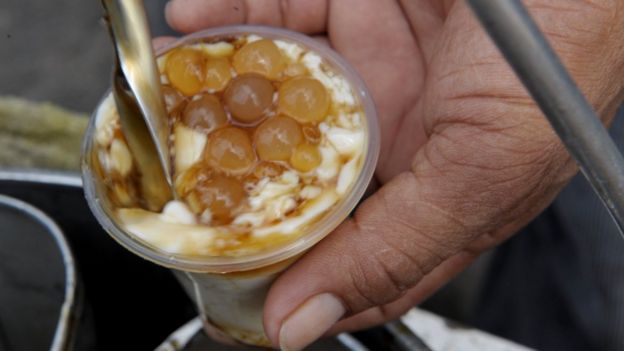
According to local media outlets, she was stopped by police officer William Cristobal from going onto the MRT station in Manila as she was holding a cup of “taho” – a local dessert of soybean pudding.

Street vendor Fermin Pangan sells a sweet soya snack locally known in the Philippines as 'taho' in Manila September 2, 2008Image copyrightJAY DIRECTO
Image captionTaho is a popular sweet dessert in the Philippines

Bottled drinks, water and liquid substances are banned from MRT stations in Manila.

Mr Cristobal told her she would have to finish her dessert or throw it away before she would be allowed to enter the platform.

She instead threw the taho at him and turned around to leave, but was stopped by security personnel, reports news outlet the Inquirer.

Mr Cristobal had a cup of taho thrown at himImage copyrightMANDALUYONG POLICE/FACEBOOK
Image captionMr Cristobal had a cup of taho thrown at him

Ms Zhang was later charged by the Mandaluyong City prosecutor’s office for direct assault, disobedience to an agent of a person in authority and unjust vexation.

The Mandaluyong City Police told the BBC that they were unable to comment on what punishment Ms Zhang would face if found guilty.

She posted bail but was later detained again by the Bureau of Immigration on a separate charge of violating immigration laws. She now remains in detention in Manila.

Zhang at a police stationImage copyrightMANDALUYONG POLICE/FACEBOOK
Image captionMs Zhang was later brought in by Mandaluyong police

“Zhang has already been charged as an undesirable alien for posing as a risk to public interest,” said BI spokesperson Dana Krizia Sandoval in a statement.

“The incident showed her disrespect towards persons of authority which in turn shows her disrespect to the country.”

Ms Sandoval said Zhang may face deportation and eventually be blacklisted from the country altogether, adding that the court case would run “independent” from her immigration case.

“If found deportable, we will wait for the resolution of her court case before implementing the deportation.”

Ms Zhang has since apologised for her behaviour.

“I was in a bad mood and I was not able to control my emotions,” she said in an interview with GMA News. “I really admit the mistake I made.

“I’m really, really sorry. I really ask if it’s possible to have another chance… I really like the Philippines…[and] love Filipinos.”

Source: The BBC

Law of Unintended Consequences

continuously updated blog about China & India

ChiaHou's Book Reviews

continuously updated blog about China & India

What's wrong with the world; and its economy

continuously updated blog about China & India