Archive for ‘manufacturer’

26/04/2020

China’s rolling stock manufacturer donates medical equipment to Germany

GERMANY-BERLIN-CRRC-MEDICAL EQUIPMENT-DONATION

Photo taken with a mobile phone on April 24, 2020 shows a handover ceremony of medical equipment donated by China Railway Rolling Stock Corporation (CRRC) Zhuzhou Locomotive Co. Ltd. in Berlin, Germany. China Railway Rolling Stock Corporation (CRRC), the world’s largest rolling stock manufacturer by production volume, donated a shipment of medical equipment to Germany via the German Red Cross on Friday to help the country fight the coronavirus. Responding to the call from the German government and the Chinese Embassy in Germany, and in accordance with an arrangement between CRRC and CRRC Zhuzhou Locomotive Co. Ltd. (CRRC ZELC), the company donated 1,000 protective suits, 20,000 FFP2 masks and 80,000 surgical masks. (CRRC ZELC/Handout via Xinhua)

BERLIN, April 24 (Xinhua) — China Railway Rolling Stock Corporation (CRRC), the world’s largest rolling stock manufacturer by production volume, donated a shipment of medical equipment to Germany via the German Red Cross on Friday to help the country fight the coronavirus.

Responding to the call from the German government and the Chinese Embassy in Germany, and in accordance with an arrangement between CRRC and CRRC Zhuzhou Locomotive Co. Ltd. (CRRC ZELC), the company donated 1,000 protective suits, 20,000 FFP2 masks and 80,000 surgical masks.

CRRC ZELC said that the donated materials will be distributed to medical staff and volunteers who are fighting the pandemic on the frontlines.

Cheng Jian, general manager of CRRC ZELC Verkehrstechnik GmbH, said that the only way to overcome the crisis is to unite strengths and meet the challenges together.

“We wish to undertake our social responsibility as part of the community. We firmly believe that with joint efforts of the international community, Germany will quickly overcome the crisis, and production and life will return to normal soon,” Cheng said.

According to Jens Quade, president of the Mueggelspree regional branch of the German Red Cross, the risk of new coronavirus infections could be reduced through the generous donation from CRRC ZELC.

“The donated material will be distributed to the Berlin Red Cross, Berlin hospitals and/or medical institutions. We will do our best to provide the necessary assistance to the people who are most in need,” Quade said.

Source: Xinhua

09/12/2019

China Focus: Xinjiang, an emerging investment hotspot

URUMQI, Dec. 8 (Xinhua) — Rich in resources but remote, Xinjiang in China’s far west has become a magnet for investors for its unique position on the Silk Road.

In a workshop of the Amer International Group in Urumqi, capital of Xinjiang Uygur Autonomous Region, workers are busy adjusting and packing laptops.

Recently, Amer sent the first batch of 2,000 laptops it produced for the German company TrekStor to the European market via China-Europe freight trains.

Headquartered in the southern Chinese city of Shenzhen, Amer invested 20 billion yuan (around 2.8 billion U.S. dollars) to build an industrial park in Xinjiang in 2018. So far, the industrial park has produced and exported around 1.5 million mobile phones, according to Wang Wenyin, the founder and chairman of Amer International Group.

“We saw Xinjiang’s geographical advantages, so we established the industrial park and cooperated with our counterparts in South and Central Asia in the fields of smartphones and IT high-end manufacturing,” Wang said.

Amer International Group is among a growing number of enterprises that have been attracted by Xinjiang in recent years, as trains and planes have made Xinjiang better connected than ever before.

As China’s key trade gateway to Central and West Asia, the remote region’s position as the heart of the Belt and Road Initiative is unmistakable. In 2013, China proposed the BRI, which opened up new space for the world economy, spurring trade and economic growth and stimulating investment and creating jobs worldwide.

Urumqi Customs saw the number of China-Europe freight trains skyrocket to 5,743 in the first 10 months this year, up 53.68 percent year on year, outnumbering the total of 2018.

To attract more investors, the local government has gone to great lengths creating a more friendly business environment, such as cutting the time required for starting a business and lowering the entry threshold for products.

Up to now, Xinjiang has had more than 1.8 million market entities including 359,000 enterprises, up 18 percent year on year.

Foreign and domestic business giants including German chemical giant BASF and China’s real estate conglomerates Wanda Group have also invested in the region.

Lai Naixiang, head of Kashgar Oumeisheng Energy Technology, a home appliance manufacturer, moved his business from Shenzhen to Kashgar in southern Xinjiang in 2017.

“We chose to settle in Kashgar because of the great market potential in adjacent Central Asian countries as well as Xinjiang’s lower electricity prices and preferential tax policy,” he said.

Last year, the company exported electric kettles worth more than 16 million yuan to Kyrgyzstan and Tajikistan.

Foreign trade in Xinjiang has seen booming growth. The region recorded around 131.5 billion yuan in imports and exports in the first 10 months of this year, up 28 percent year on year.

In the first 10 months, Kazakhstan topped the list of Xinjiang’s major trade partners, with trade volume between the two growing by 28.2 percent to 60.2 billion yuan.

Xinjiang’s trade with Kyrgyzstan, Australia, Pakistan, Britain, Argentina and Vietnam also showed fast growth, according to the local customs authorities.

“With further Belt and Road construction, Xinjiang will get more impetus in economic and social development. I see great potential in the region,” Wang said.

Source: Xnhua

04/10/2019

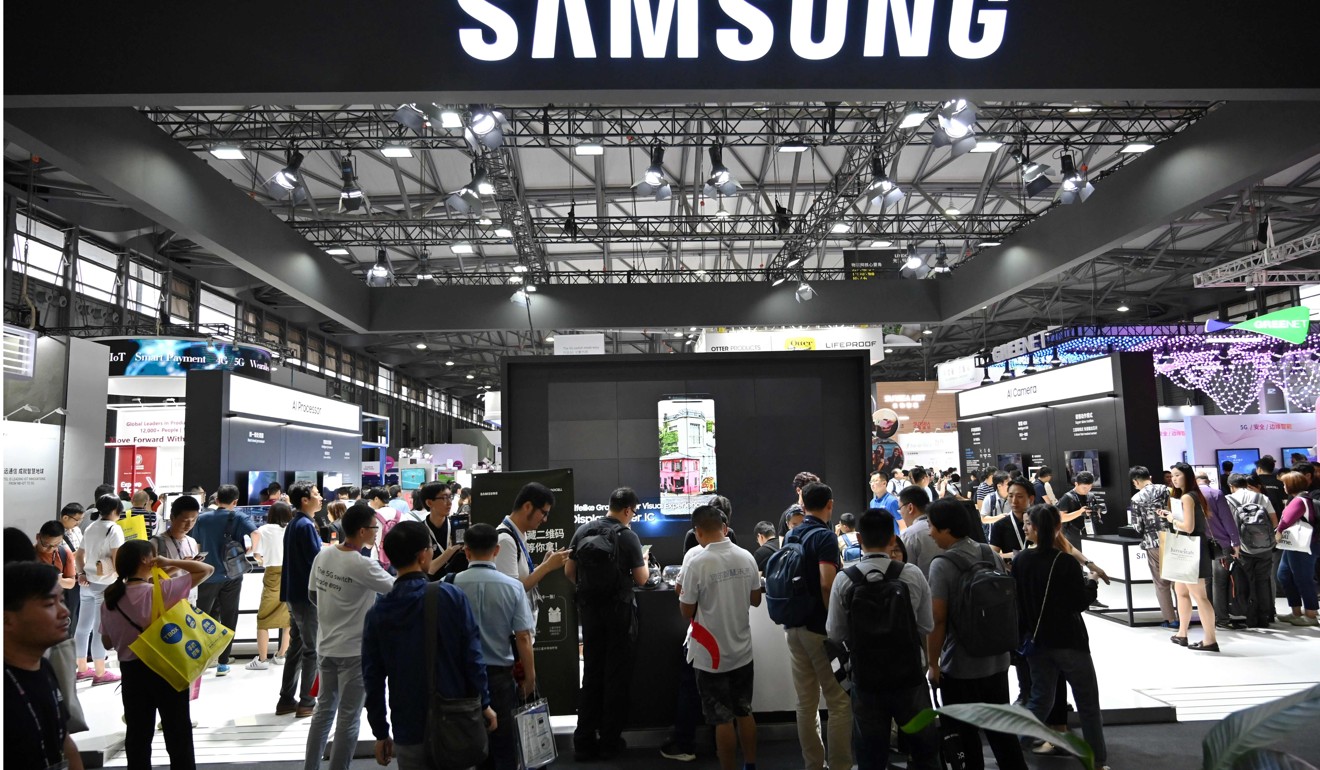
South Korea’s Samsung closes its last smartphone factory in China

  • ‘Difficult decision to cease operations’ at plant in Huizhou taken to ‘enhance efficiency’, company says
  • Firm’s market share in China has dwindled to near insignificance as competitors like Huawei and Xiaomi have taken upper hand
Samsung said operations at its last factory in China ended last month. Photo: Reuters
Samsung Electronics

said on Friday it has ended the production of smartphones in its last factory in China.

Operations at the plant in the south China city of Huizhou, Guangdong province, ended last month, it said in an email.
The company made “the difficult decision to cease operations of Samsung Electronics Huizhou” in order “to enhance efficiency” in its manufacturing, it said.
Samsung’s market share in China has dwindled to near insignificance as competitors like Huawei and Xiaomi have taken the upper hand. It once had 15 per cent of China’s smartphone market.
Samsung once had a 15 per cent share of China’s smartphone market. Photo: AFP
The South Korean giant has moved a large share of its smartphone production to Vietnam and closed a factory in northeastern China’s Tianjin last year.

“The production equipment will be reallocated to other global manufacturing sites depending on our global production strategy based on market needs,” the statement said.

Samsung is the world’s biggest manufacturer of semiconductors and smartphones and a major producer of display screens. But the flagship of South Korea’s largest conglomerate is currently weathering a spell of slack demand for computer chips.

Like other South Korean electronics makers, it also is facing the impact of tightened Japanese controls on exports of hi-tech materials used in semiconductors and displays.

On Wednesday, Sony said it was closing its Beijing smartphone plant and would only make smartphones in Thailand.

But Apple still makes major products in China.

“In China, people buy low-priced smartphones from domestic brands and high-end phones from Apple or Huawei,” Park Sung-soon, an analyst at Cape Investment & Securities, said.

“Samsung has little hope there to revive its share.”

Samsung’s factory in Huizhou was built in 1992, according to the company. South Korean media said it employed 6,000 workers and produced 63 million units in 2017.

Samsung manufactured 394 million handsets around the world in 2107, according to its annual report.

Source: Reuters

12/09/2019

Why is India’s car industry in breakdown mode?

India’s second-biggest manufacturer of commercial vehicles, Ashok Leyland, is suspending production at several units from five to 18 days in September, triggering fears that the slump in the automotive sector shows no sign of letting up. The BBC’s Nitin Srivastava reports.

Ram Mardi is worried he may lose his job. He works for a company that makes spare parts for cars and heavy vehicles in Jamshedpur, an industrial city in eastern India. But he has worked only 14 days in August.

“We had a comfortable life until recently. Now, it’s hard to arrange food or pay for the children’s education,” Mr Mardi says.

The factory he works at temporarily suspended production for half of the month to reduce inventory in the face of shrinking demand.

Industry heavyweights such as Maruti, Tata Motors and Mahindra & Mahindra have all announced production cuts over the past several months.

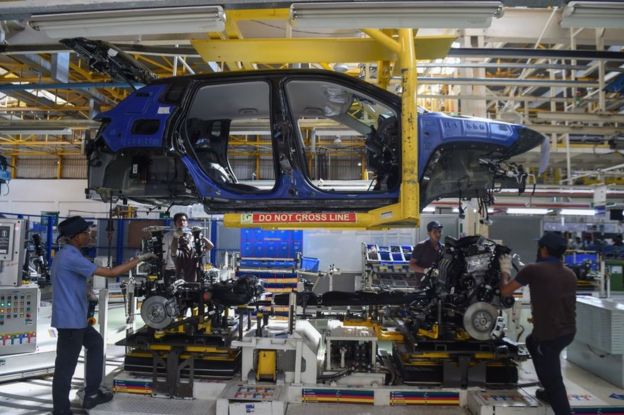
Workers assemble a car at a FCA India Automobiles manufacturing facility in Ranjangaon, some 200km east of Mumbai.Image copyright GETTY IMAGES
Image caption India’s automotive industry employs some 35 million people

India’s economy is facing a slowdown. It grew at 5% in the quarter ending June 2019 – its lowest in five years. This – along with a drop in private investment and a banking crisis that has made it hard to access credit – has weakened consumer demand.

The Indian government is also pushing for a transition to electric vehicles over the next decade, which some experts believe, has contributed to falling vehicle sales.

As the automotive industry declined for the 10th month in a row in August, car sales dropped by 41% – the steepest fall in two decades.

The industry is one of India’s biggest, considering it employs some 35 million people, directly or indirectly, and contributes more than 7% to the country’s GDP.

By some estimates, more than 100,000 workers, many of them contractual, have lost their jobs so far. Now fears are rising that if demand continues to fall, forcing lower production, more jobs could disappear.

Small and medium businesses – thousands of ancillary units that supply to the big manufacturers – have been hit the hardest. And daily wage labourers such as Mr Mardi are the most vulnerable.

And employers are also concerned. “I have never had so much trouble keeping my factory up and running”, says Sameer Singh, who heads a family-owned business in Jamshedpur that makes spare parts for vehicles.

“My employees are jobless for a few weeks and I feel for them. If this continues they may move out, perhaps find another job. But I can’t even look out for a job. My life starts and ends here”.

Mr Singh says it’s also been hard for business owners, companies and consumers to borrow money because banks have tightened credit lines after a spike in bad loans in recent years dented their balance sheets.

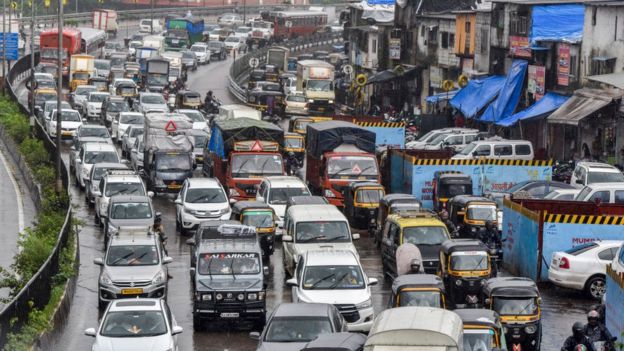
Vehicles on a road in MumbaiImage copyright GETTY IMAGES
Image caption Car sales in India have dropped to their lowest in 20 years

“The fall [in production] is so large and so dramatic that it has affected every single product – two-wheelers, car, commercial vehicles,” says Sanjay Sabherwal, member of the Automotive Component Manufacturers Association of India, an industry body.

Auto executives have been demanding tax cuts and easier access to financing for manufacturers, sellers and consumers. The government recently announced a slew of measures – this includes a delay in increasing the registration fees for new vehicles and asking banks to lower interest rates on loans for cars and two-wheelers.

But, will that be enough? That is hard to say with experts calling this the worst downturn to ever hit India’s automotive industry.

Source: The BBC

Law of Unintended Consequences

continuously updated blog about China & India

ChiaHou's Book Reviews

continuously updated blog about China & India

What's wrong with the world; and its economy

continuously updated blog about China & India