Archive for ‘marathons’

08/03/2020

Why Japan is so keen to go ahead with hosting the Olympic Games, despite coronavirus threat

  • Japan risks massive financial losses and a political blow for Shinzo Abe’s government if the Tokyo Olympics are cancelled or postponed
  • The Olympics were last cancelled in 1940 after Japan invaded China and the outbreak of World War II, but the Zika virus did not stop the 2016 Rio Games
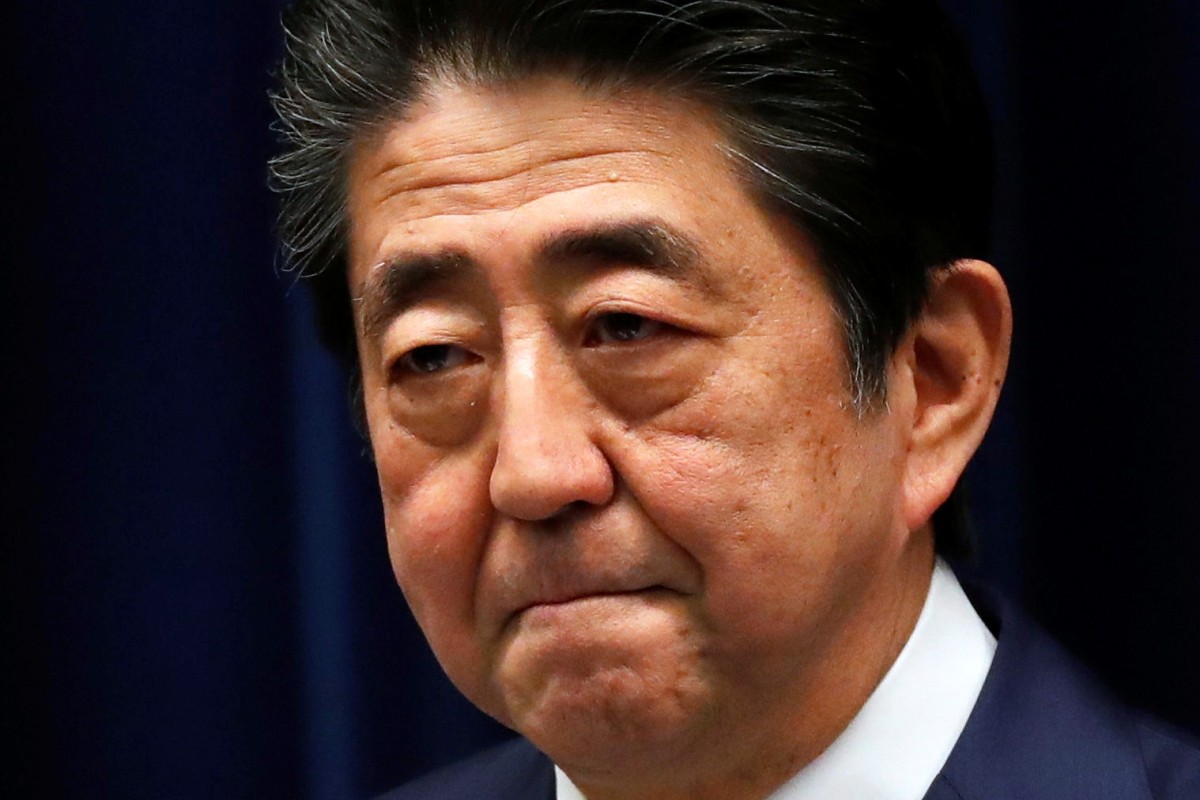
Japan's Prime Minister Shinzo Abe attends a news conference on the coronavirus. An analyst said the cancellation of the Olympic Games would not only be a financial blow, but would also dent the political pride of his government, which wanted to show the world that Japan could host a successful Olympics. Photo: Reuters
Japan’s Prime Minister Shinzo Abe attends a news conference on the coronavirus. An analyst said the cancellation of the Olympic Games would not only be a financial blow, but would also dent the political pride of his government, which wanted to show the world that Japan could host a successful Olympics. Photo: Reuters
Japan

has far more at stake than its athletes picking up medals in the upcoming

Tokyo Olympic Games and Paralympics

, which explains the government’s single-minded commitment to going ahead with the event in the face of the threat posed by the novel coronavirus.
The Japanese government on Wednesday morning reiterated that the Games would go ahead in July as scheduled, with chief cabinet secretary Yoshihide Suga declaring that preparations were continuing despite the spread of the virus worldwide.
The previous day, the International Olympic Committee (IOC) threw its weight behind Tokyo’s position. “We are preparing for a successful Olympic Games, Tokyo 2020,” said IOC head Thomas Bach.
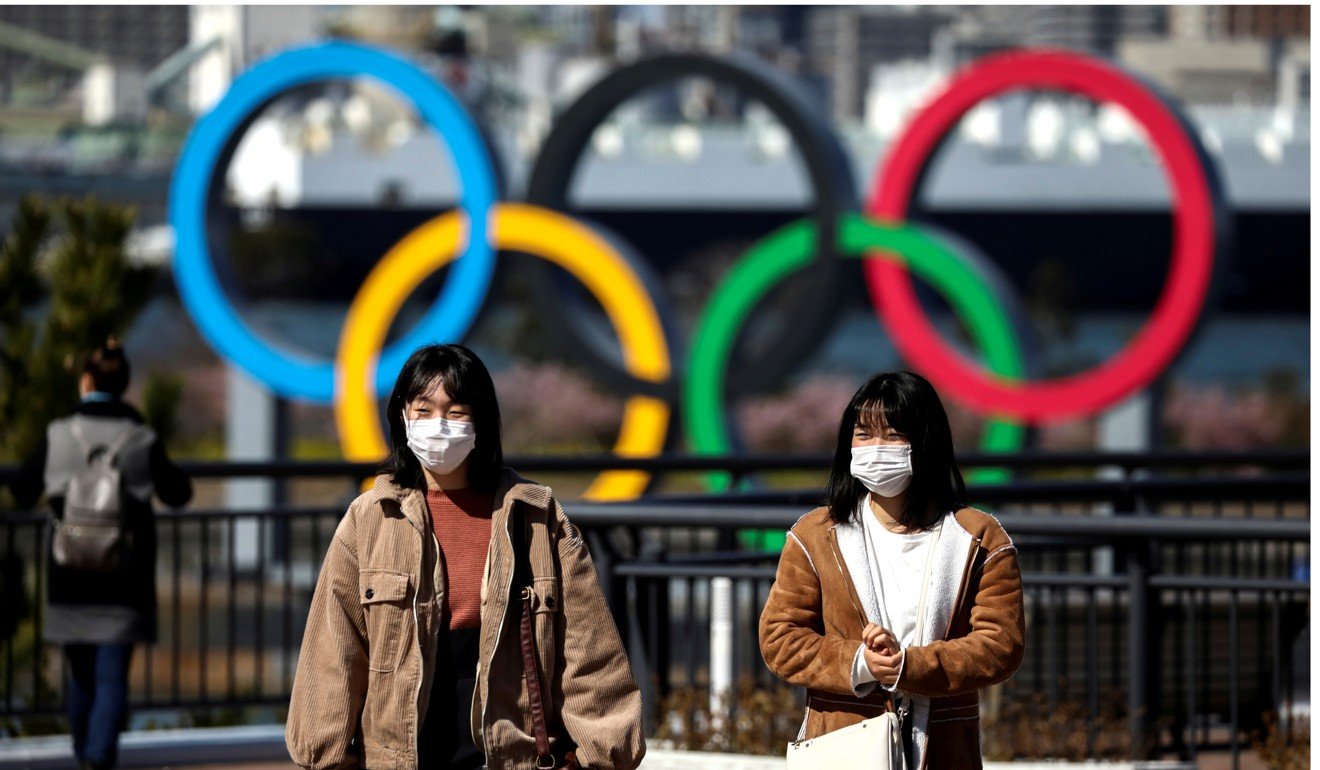
People wearing protective face masks are seen in front of the Olympic rings at the waterfront area at Odaiba Marine Park in Tokyo, Japan. Photo: Reuters
“I would like to encourage all the athletes to continue their preparations … with great confidence and full steam,” he said. “From our side, we will continue to support the athletes and the national Olympic committees.”
Both statements came on the heels of a comment by Seiko Hashimoto, Japan’s minister with responsibility for the Games, who suggested that the contract with the IOC “could be interpreted as allowing for a postponement” until later in the year. On Thursday, Hashimoto acknowledged to the Upper House budget committee that a cancellation or delay of the games would be “unacceptable for the athletes”.

Stephen Nagy, an associate professor of international relations at Tokyo’s International Christian University, said a great deal is at stake for Japan as the last time a modern Olympic Games was cancelled was in 1940 – ironically as a result of Japan’s invasion of China in July 1937, and the outbreak of World War II. Meanwhile, the Rio Games in Brazil went on as planned in 2016 despite the outbreak of the Zika virus.

While the 1940 cancellation has largely been forgotten, it would unquestionably cause serious loss of face to the Abe administration if events did conspire to halt Tokyo 2020, he said.

I think it’s much more about the national political pride of ‘Team Abe’Economist Noriko Hama

Noriko Hama, an economist at Doshisha University in Kyoto believes a number of issues are behind the government’s refusal to contemplate the Games being postponed or cancelled, but one is dominant.

“Yes, it’s about the money that has already been spent on facilities and new infrastructure and the windfall from tens of thousands of foreign tourists, but I think it’s much more about the national political pride of ‘Team Abe’,” she said.

“They wanted to show the world that they could do this, that they would be one of the very few cities to host an Olympics for a second time and that it would be a massive success,” she said. “It’s about chest-thumping.”
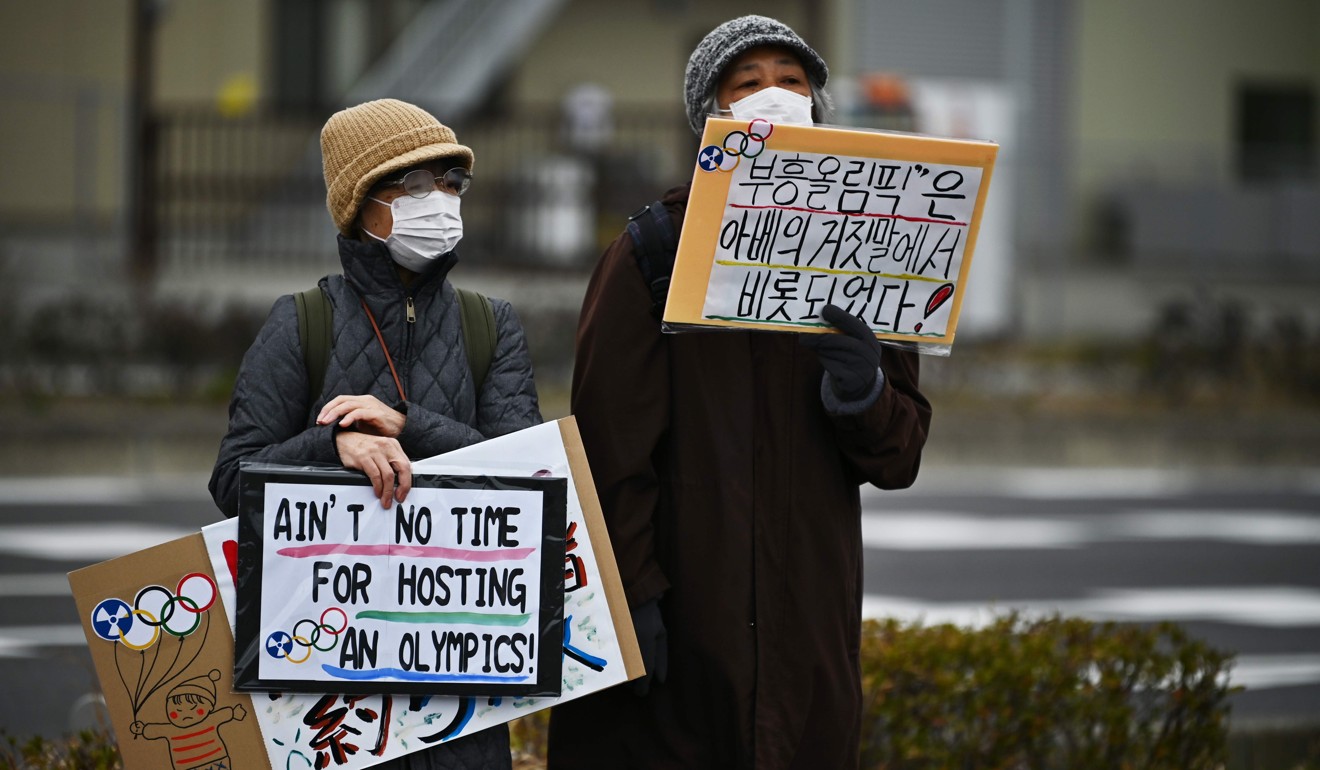
Protesters hold placards during a demonstration against the Olympics, Prime Minister Shinzo Abe and nuclear energy. Photo: AFP
Hama pointed out that many Japanese people had been sceptical about the Games, and for a variety of reasons.

Many are unhappy at the cost, which was previously estimated at 1.06 trillion yen (US$9.81 billion) but organisers confirmed in December had risen to 1.35 trillion yen (US$12.35 billion), plus another 3 billion yen required to move the marathon and walking events from Tokyo to Sapporo, in Hokkaido, to avoid the heat and humidity of the capital.

Others said the Games will cause widespread disruption to the lives of ordinary people and that Tokyo was still not fully prepared for the huge numbers of people that will inevitably flood the city. Some voiced concerns that holding the Games at the peak of a Japanese summer would cause problems for athletes, officials and spectators alike. There have been predictions that the heat is going to cause loss of life.

Only an apocalypse – or government ineptitude – can stop the Olympics

29 Feb 2020

“But there is this strange sort of blind obstinacy that is driving the whole thing forward regardless,” said Hama. “And now the coronavirus has added another layer of very serious concern and I believe the government need to think very carefully what they are going to do.”

Nagy said the Japanese government would be reluctant to postpone the Games as that would “once again tarnish the brand”.

“Seven or eight years ago, Japan was largely seen as a stagnant country that was struggling to shake off the legacy of two decades of economic underperformance, but that changed quite suddenly,” he said.
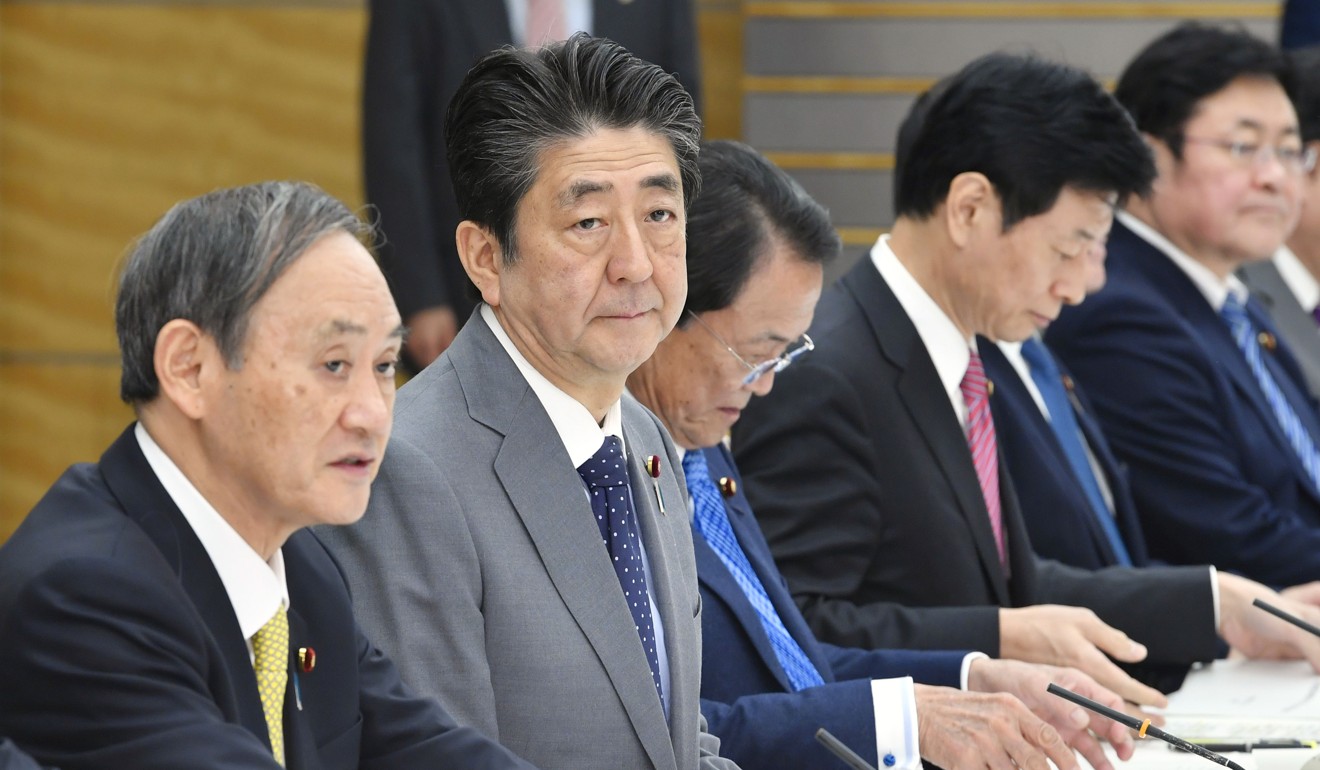
Japan’s chief cabinet secretary Yoshihide Suga and Prime Minister Shinzo Abe attend a meeting with other ministers in Tokyo. Photo: Kyodo
“Now the ‘Japan brand’ is strong and vibrant as they have successfully hosted G-7 conferences and, more importantly, last year’s Rugby World Cup.”
The rugby served to put Japan on the world stage, said Nagy, and everyone went away feeling very positive and it worked exceptionally well as a “dry run” for the Olympics.

Other considerations are the massive amount of money that was spent on preparing for the Games, as well as the political capital that Abe was obliged to use up to win the right to be the host city and then smooth the way in the run-up to the event.

Hong Kong backs IOC’s Olympic pledge despite coronavirus threat

4 Mar 2020

Dick Pound, a senior member of the IOC, said there is a window of two to three months in which organisers must make a decision, meaning there could only be clarity by the end of May. He told Associated Press that if the coronavirus situation worsens, it would probably mean a cancellation.

“You just don’t postpone something on the size and scale of the Olympics. There’s so many moving parts, so many countries and different seasons, and competitive seasons, and television seasons. You can’t just say, ‘We’ll do it in October’,” he said. It was also unlikely that the IOC would move the Games to another city at such short notice.

In the meantime, the local organising committee said it had stepped up its measures to protect runners and spectators for the torch relay, including limiting the number of visitors at venues and monitoring the health of runners.

While the Japanese government remains defiant that the Olympics will go ahead as scheduled, Nagy said both Abe and the IOC were walking a “fine line” on making a final decision.

“There are simply no good choices at this point,” he said. “Policymakers just do not know how long this virus is going to stick around, whether it is going to mutate or anything else. But there will come a point when they absolutely have to make a decision.

Coronavirus fear, paranoia reveal cracks in Japan’s polite facade

3 Mar 2020

“If they wait too long and the outbreak goes on longer than anticipated, then they risk the possibility of a poor public turnout and people getting ill,” he said. “But if they cancel too early and the virus disappears, then they will be accused of being alarmist and of wasting all the effort and money that has already gone into the Games.

“The best they can do, in the circumstances, is to use science and facts and compare this outbreak to previous cycles – and then hope the decision that they do make is the right one.”

Source:SCMP

04/03/2020

Xinhua Headlines: Guitars, roads and red tours: former revolutionary base casts off poverty

Zunyi, a former revolutionary base of the Communist Party of China in southwest China’s Guizhou Province, has cast off poverty.

Thanks to burgeoning industries, improving infrastructure and distinctive cultural tours, more than eight million people in Zunyi are living better lives.

By Xinhua writers Zhong Qun, Wang Li, Li Jingya and Liu Zhiqiang

GUIYANG, March 3 (Xinhua) — Riding on the fast development of industries, improving infrastructure and distinctive cultural tours, a former revolutionary site of the Communist Party of China (CPC) has formally cast off poverty in China’s southwestern mountains.

On Tuesday, the government of Guizhou Province announced that Zheng’an County in the province has shaken off poverty. The county is under the jurisdiction of the city of Zunyi, where the CPC conducted its early revolutionary activities. The announcement means that more than 8 million people in the entire city of Zunyi have officially bid farewell to poverty.

A view of Huamao Village of Fengxiang Township in Zunyi City, southwest China’s Guizhou Province, Feb. 28, 2020. (Xinhua/Tao Liang)

Over the years, Zunyi has taken a variety of measures in answer to China’s campaign to eradicate absolute poverty in 2020.

Major industries such as guitar-making and tea plantations powered Zunyi’s economic growth, while roads, water projects and the revolution-themed tourism also put the city, once mired in grinding poverty, on a fast track toward modernization.

GUITARS STRIKE A CHORD IN REVOLUTIONARY HEARTLAND

When Zheng Chuanjiu decided to build a guitar-making factory in Zunyi’s Zheng’an County in 2013, he was a little nervous.

“There were no raw materials, and transportation was bad,” said Zheng, 42. “But the county had advantages in land and labor and there was government support.”

Zheng, a native of the county, had found success in the guitar industry in Guangzhou, capital of south China’s Guangdong Province. He and his brother established the Guangzhou Shenqu Musical Instruments, a Guangzhou-based guitar-making company, after years of hard work in the southern metropolis.

“The county government of my hometown wanted to develop the guitar-making industry after they found many local migrant workers were working in the industry in Guangzhou,” Zheng said. “They established an industrial park and we were the first to join.”

An employee works at the workshop of Guangzhou Shenqu Musical Instruments, a Guangzhou-based guitar-making company, in Zheng’an County of Zunyi City, southwest China’s Guizhou Province, March 28, 2017. (Xinhua/Tao Liang)

The government put forward a variety of preferential policies in rents, financing and taxes, to support guitar-making companies like Zheng’s and allow the sector to prosper.

Today, Zheng’s company in the county has grown into one with an annual production value of more than 30 million U.S. dollars. One of the country’s top five guitar makers, it employs more than 500 local farmers and more than 100 poverty-stricken residents.

Zheng’s company is part of a bigger picture. The company’s success has led many to jump on the bandwagon. After years of growth, the county is now home to 64 companies specializing in guitar-related fields, churning out about 7 million guitars a year to more than 30 countries and regions across the world and employing more than 15,000 locals.

The guitar industry forms part of the government’s efforts to develop local industries. Thanks to geological advantages, the county also saw the emergence of tea gardens and traditional Chinese medicine plantations. All these sectors drove local economic growth.

A group of children trying tea-picking at Hetaoba Village in Meitan County of Zunyi City, southwest China’s Guizhou Province, April 1, 2018. (Xinhua/Yang Wenbin)

BETTER INFRASTRUCTURE, BETTER LIVES

Given the mountainous landscape in Guizhou, authorities in Zunyi knew the importance of improving infrastructure projects if they wanted to bring the local economy to the next level. So they started building new roads to facilitate transportation.

Last year, Guizhou built 8,116 km of roadways. The Guizhou provincial government spent 29.34 billion yuan (4.2 billion U.S. dollars) building the roadways, including 7,386 km in rural areas, according to the provincial highway bureau. The province also upgraded many old roadways.

The construction site of Tuanjie Grand Bridge of Renhuai-Zunyi Highway, which has resumed construction amid strict prevention measures against the novel coronavirus, in southwest China’s Guizhou Province, Feb. 27, 2020. (Xinhua/Tao Liang)

In the county of Zheng’an, for example, several major highways not only enhanced logistics to bring specialties out of town but also allowed outside investment to flow to the county tucked in the lush green mountains.

“Thanks to improved transportation conditions, our guitars can easily reach many areas in the country and around the world,” said Zheng Chuanjiu.

In Huanglian Village, rural family inns have mushroomed, as more visitors come as more roads were built. Many tourists come to enjoy the countryside scenes during the holidays.

In addition, water projects also began, bringing safe drinking water to local households.

“We used to depend on the weather for water,” said Zunyi resident Zeng Fanyun. “Now we have clean water from the taps.”

For areas deemed inhabitable, authorities moved people out.

Statistics show that Guizhou relocated 1.88 million people from inhospitable areas in 2019.

RED TOURS, GOLDEN OPPORTUNITIES

As many cities in China scramble to modernize and adopt the latest technology to power growth, Zunyi seems to have found a new way to develop itself by looking to the past.

In January 1935, an enlarged meeting of the Political Bureau of the CPC Central Committee took place in Zunyi during the Long March.

The meeting focused on rectifying the left-leaning errors in military and organizational affairs and established the correct leadership of the new Central Committee, as represented by Mao Zedong.

The Zunyi Meeting is regarded as a crucial turning point of the Long March, leading to the ultimate success of the Chinese revolution.

Since then, Zunyi has become a sacred place for generations of CPC members, and the footprints of the Red Army are forever imprinted on the city’s culture and spirit.

Today, local authorities are promoting “red tours” in the locality, aiming to bolster the tourism sector as part of economic growth.

Tourists are seen at the Memorial of Zunyi Meeting in Zunyi, southwest China’s Guizhou Province, Oct. 16, 2018. (Xinhua/Tao Liang)

Yang Zhirong started a family homestay in the county of Tongzi in Zunyi. The homestay is called “The Red Army Road Inn,” because it is close to the command center of a famous battle during the 1930s.

“During the summer holidays, there are barely enough rooms to accommodate all the tourists,” Yang said. “Because the Red Army used to walk near here, the visitors feel they could sense history by staying here.”

Last year, Zunyi received more than 46 million visitors for red tours, generating a revenue of about 35.5 billion yuan, up 24.1 percent year on year, according to official figures.

The red tours also prompted sales of local cultural products, such as handmade soap, wallets and fragrances, all featuring Red Army themes. Forums, hiking and even marathons feature red themes as well in Zunyi.

“Zunyi serves as a good example of the CPC’s ability and responsibility to help people live prosperous lives,” said Zheng Dongsheng, a professor with the Party School of the Guizhou Provincial Committee of the CPC. “Zunyi’s success to cast off poverty highlights the Long March spirit in the modern era.”

Source: Xinhua

Law of Unintended Consequences

continuously updated blog about China & India

ChiaHou's Book Reviews

continuously updated blog about China & India

What's wrong with the world; and its economy

continuously updated blog about China & India