Archive for ‘marks’

30/04/2020

Xinhua Headlines: All counties out of poverty in China’s Yangtze River Delta

– The last nine poverty-stricken county-level regions in east China’s Anhui Province have been removed from the country’s list of impoverished counties.

– This marks that all county-level regions in the Yangtze River Delta, consisting of Shanghai and the provinces of Jiangsu, Zhejiang and Anhui, have been officially lifted out of poverty for the first time in history.

HEFEI, April 29 (Xinhua) — Sitting in front of his smartphone, Zhang Chuanfeng touts dried sweet potatoes to viewers on China’s popular video-sharing app Douyin, also known as TikTok.

“These are made from sweet potatoes I grew myself. They are sweet and have an excellent texture,” said Zhang while livestreaming in Tangjiahui Township of Jinzhai County in east China’s Anhui Province. Tucked away in the boundless Dabie Mountains, the township used to have the biggest poor population in the county.

Aerial photo taken on April 16, 2020 shows residential buildings in Dawan Village of Jinzhai County, east China’s Anhui Province. (Xinhua/Liu Junxi)

Jinzhai County is among the last nine county-level regions in Anhui that have been removed from the country’s list of impoverished counties, according to an announcement issued by the provincial government Wednesday. They are also the last group of county-level regions that bid farewell to poverty in the Yangtze River Delta.

E-COMMERCE

Zhang might seem like a typical e-commerce businessman reaping success in China’s booming livestreaming industry. But his road to success has been a lot bumpier: he suffers from dwarfism.

A little more than 1.4 meters tall, Zhang has a babyface, making him “look like a junior school student,” he said. But the man, 38, is the father of a nine-year-old boy.

For Zhang, life was tough before 2014. “Nobody wanted me because of my ‘disabilities’ when I went out to look for jobs,” he said. “I was turned down again and again.”

Zhang was put on the government’s poverty list in 2014 as China implemented targeted poverty-relief measures. With the help of local officials, he got a bank loan of 10,000 yuan (about 1,400 U.S. dollars) and bought 22 lambs. He tended the animals whole-heartedly and seized every opportunity to learn how to raise them more professionally.

Zhang Chuanfeng feeds his lambs in Zhufan Village of Jinzhai County, east China’s Anhui Province, April 26, 2017. (Xinhua/Zhang Duan)

Within a year, the number of his lambs expanded to hundreds. In 2016, Zhang’s earnings exceeded 100,000 yuan, more than enough for him to cast off poverty.

Riding on this success, Zhang began to seek new opportunities. He rented a shop and started selling products online to embrace an e-commerce strategy the local government introduced in 2017.

More than 100 online shops, including Zhang’s, in the county have helped more than 7,000 poverty-stricken households sell about 73 million yuan worth of local specialties since 2018. Zhang alone earned 500,000 yuan from a sales revenue of 5 million yuan last year.

A villager arranges local specialties for sale at Dawan Village of Jinzhai County, east China’s Anhui Province, April 17, 2020. (Xinhua/Liu Junxi)

WICKERWORK SUCCESS

About 100 km north of Jinzhai lies Funan, a place that used to be vulnerable to constant floods.

Zhang Chaoling, who lives by the Huaihe River in Funan County, had to flee her hometown at a young age due to floods, but has flourished on a willow plantation along the river later.

“The land is largely covered by silt following continual flooding in the past. It is an ideal place to plant willows and make wickerwork,” Zhang said.

Zhang left her hometown for Guangzhou in 1993 and found a job in a garment factory. A few years later, she founded a trading company with her husband in Guangzhou, selling wickerwork products from her hometown to other countries.

Zhang returned to her hometown and set up a wickerwork production base in 2011. Funan is famous for its delicate wickerwork. Skilled craftsmen traditionally use local willow as a raw material to weave products such as baskets, furniture and home decorations.

A villager arranges wickerwork products in Funan County, east China’s Anhui Province, April 15, 2020. (Photo by Zhou Mu/Xinhua)

“The flood is well controlled now. I remember the last huge flood came in 2007,” Zhang said.

Taking advantage of the fertile land along the Huaihe River, she plants over 130 hectares of willow trees and employs hundreds of locals mostly in their 50s and 60s.

“I can process 100 to 150 kg of willow twigs per day, from which I make around 80 yuan,” said Geng Shifen, who peels willow twigs with a clamp next to the plantation.

A total of 130,000 people are engaged in the wickerwork industry in Funan, creating an output of nearly 9 billion yuan in 2019, and helping 15,000 locals shake off poverty, local statistics showed.

POVERTY REDUCTION FEAT

The Anhui provincial government Wednesday announced that its last nine county-level regions including Jinzhai and Funan are removed from the country’s list of impoverished counties.

This marks that all 31 impoverished county-level regions in Anhui have shaken off poverty, echoing China’s efforts to eradicate absolute poverty by the end of 2020.

With the announcement, all county-level regions in the Yangtze River Delta have been officially lifted out of poverty for the first time in history.

A bus runs on a rural road in Jinzhai County, east China’s Anhui Province, April 17, 2020. (Xinhua/Liu Junxi)

Covering a 358,000-square-km expanse, the Yangtze River Delta, consisting of Shanghai and the provinces of Jiangsu, Zhejiang and Anhui, is one of the most populated and economically dynamic areas in China, contributing one-fourth of the country’s GDP.

Anhui had a population of 63.65 million as of 2019, official data showed. The poor population in the province had decreased from 4.84 million in 2014 to 87,000 in 2019, and the poverty headcount ratio had been reduced from 9.1 percent to 0.16 percent during the period, according to the provincial poverty relief office.

A county can be removed from the list if its impoverished population drops to less than 2 percent, according to a national mechanism established in April 2016 to eliminate poverty in affected regions. The ratio can be loosened to 3 percent in the western region.

By the end of 2019, 5.51 million people in China were still living in poverty.

“We will continue our work to prevent people from returning to poverty, and help the remaining poor population shake off poverty by all means,” said Jiang Hong, director of the Anhui provincial poverty relief office.

Source: Xinhua

14/04/2020

Chinese oil survey ship returns to disputed waters off Vietnam amid coronavirus pandemic

  • Vietnamese ships spent months last year shadowing the Haiyang Dizhi 8 as it surveyed the resource-rich waters within Vietnam’s exclusive economic zone
  • Its return follows charges laid by the US that China is ‘exploiting the distraction’ and vulnerability caused by the pandemic
The Haiyang Dizhi 8 at sea. Photo: Weibo
A Chinese ship embroiled in a stand-off with Vietnamese vessels last year
has returned to waters near Vietnam as the United States accused China
of pushing its presence in the South China Sea while other claimants are pre-occupied with the coronavirus.
Vietnamese vessels last year spent months shadowing the Chinese Haiyang Dizhi 8 survey vessel in resource-rich waters that are a potential global flashpoint as the 
US

challenges China’s sweeping maritime claims.

China and Vietnam ‘likely to clash again’ as they build maritime militias
12 Apr 2020
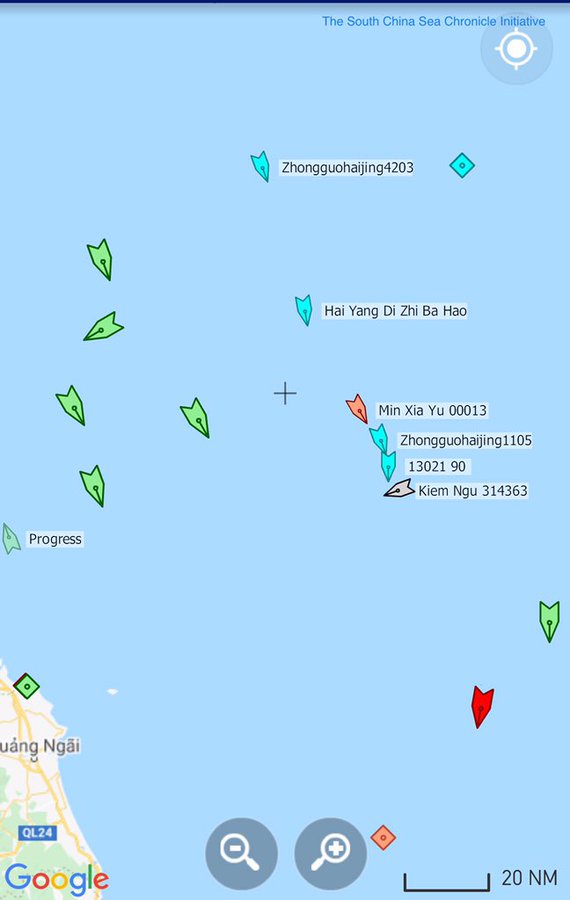
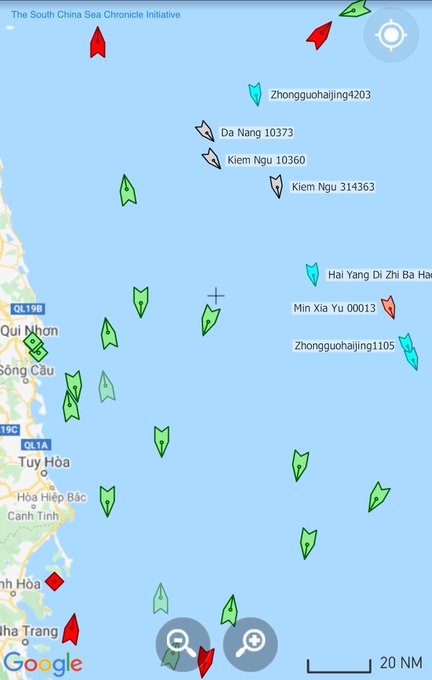
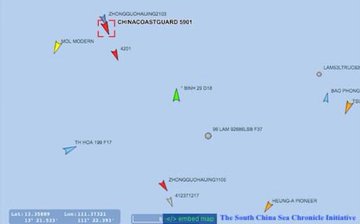
On Tuesday, the ship, which is used for offshore seismic surveys, appeared again 158km off Vietnam’s coast, within its exclusive economic zone (EEZ), flanked by at least one Chinese coastguard vessel, according to data from Marine Traffic, a website that tracks shipping.

At least three Vietnamese vessels were moving with the Chinese ship, according to data issued by the Marine Traffic site.

The presence of the Haiyang Dizhi 8 in Vietnam’s EEZ comes towards the scheduled end of a 15-day nationwide lockdown in Vietnam aimed at curbing the spread of the coronavirus.

It also follows

the sinking of a Vietnamese fishing boat near islands in the disputed waters this month

, an act that drew a protest from Vietnam and accusations that China had violated its sovereignty and threatened the lives of its fishermen.

The US, which last month sent an aircraft carrier to the central Vietnamese port of Da Nang, said it was “seriously concerned” about China’s reported sinking of the vessel.

“We call on the PRC to remain focused on supporting international efforts to combat the global pandemic, and to stop exploiting the distraction or vulnerability of other states to expand its unlawful claims in the South China Sea,” the US State Department said in a statement, referring to China.

Vietnam pulls DreamWorks’ ‘Abominable’ over South China Sea map
The Philippines

, which also has disputed claims in the South China Sea, has raised its concerns too.

On Saturday, the Global Times, published by the official People’s Daily newspaper of China’s ruling Communist Party, said Vietnam had used the fishing boat incident to distract from its “ineptitude” in handling the coronavirus.

Vietnam’s Ministry of Foreign Affairs did not immediately respond to a request for comment.

Helped by a mass quarantine and aggressive contact-tracing, Vietnam has recorded 265 cases of the novel coronavirus and no deaths. Nearly 122,000 coronavirus tests have been carried out in Vietnam.

Coronavirus: what’s behind Vietnam’s containment success?

14 Apr 2020

China and Vietnam have for years been at loggerheads over the potentially energy-rich waters, called the East Sea by Vietnam.

China’s U-shaped “nine-dash line” on its maps marks a vast expanse of the waters that it claims, including large parts of Vietnam’s continental shelf where it has awarded oil concessions. 

Malaysia

and Brunei claim some of the waters that China claims to the south.

During the stand-off last year, at least one Chinese coastguard vessel spent weeks in waters close to an oil rig in a Vietnamese oil block, operated by Russia’s Rosneft, while the Haihyang Dizhi 8 conducted suspected oil exploration surveys in large expanses of Vietnam’s EEZ.
“The deployment of the vessel is Beijing’s move to once again baselessly assert its sovereignty in the South China Sea,” said Ha Hoang Hop, at the Singapore-based ISEAS-Yusof Ishak Institute.
“China is using the coronavirus distraction to increase its assertiveness in the South China Sea, at a time when the US and Europe are struggling to cope with the new coronavirus.”
Source: SCMP
19/03/2020

China’s Wuhan marks no new coronavirus case, success of strict measures

CHINA-HUBEI-ZERO INCREASE-COVID-19 (CN)

People enjoy sunset on a plank road at the Donghu Lake in Wuhan, capital of central China’s Hubei Province, March 18, 2020. No new infections of the novel coronavirus were reported on Wednesday in Wuhan, the epicenter of the epidemic, marking a notable first in the city’s months-long battle with the microscopic foe. (Xinhua/Shen Bohan)

WUHAN, March 19 (Xinhua) — No new infections of the novel coronavirus were reported on Wednesday in Wuhan, the epicenter of the epidemic, marking a notable first in the city’s months-long battle with the deadly virus and sending a message of hope to the world gripped by the pandemic.

The Health Commission of Hubei Province, where Wuhan is the capital, said the virus’ death toll climbed by eight in the province, but the total confirmed cases of the novel coronavirus disease (COVID-19) in Wuhan and Hubei remained at 50,005 and 67,800 on Wednesday.

No increase was observed in the province’s number of suspected cases, which fell to zero on Tuesday, in another indication that large-scale transmissions have been suppressed at the epidemic ground zero after a slew of strict measures.

Previously, the central Chinese province had reported single-digit increases of new infections, all of which were from Wuhan, for a week in a row since last Wednesday. A month ago, the figure was several thousand a day.

The province also saw 795 patients discharged from hospital after recovery on Wednesday, reducing its caseload of hospitalized patients to 6,636, including 1,809 in severe condition and 465 in critical condition.

With no new cases in Wuhan, the Chinese mainland on Wednesday reduced the increase in domestic transmissions to zero, according to the National Health Commission. The country now faces a greater threat of infections imported from overseas, which jumped by 34 on Wednesday.

“The clearing of new infections in Wuhan came earlier than predicted, but it is still too early to let down our guard,” said Zhang Boli, one of the leading experts advising on the epidemic fight in Hubei.

Arduous work still lies ahead as China strengthens its defence against imported cases from abroad, treats thousands of patients still in serious or critical condition and rehabilitates those discharged from hospitals, said Zhang, an academician of the Chinese Academy of Engineering.

“CUNNING VIRUS”

The novel coronavirus was first identified in Wuhan in December as a new pathogen facing mankind. Before its traits were fully understood, the virus had cut a swath of infections among Wuhan’s unsuspecting public, before jumping from the transportation hub to other parts of China via the largest seasonal human migration ahead of the Spring Festival.

The Chinese leadership has described the COVID-19 outbreak as the most difficult to contain since the founding of the People’s Republic of China in 1949 and “a big test” for the country.

Medical experts said the virus is more contagious, though less deadly, than the SARS virus that belongs to the same coronavirus family. Globally, the SARS virus infected 8,422 people and killed 919 between 2002 and 2003.

“We still have insufficient knowledge of the novel coronavirus. What we already know is it’s a very cunning virus with a long incubation period,” said Wang Daowen, a cardiologist at Tongji Hospital in Wuhan.

“We still found the virus from the anus, if not from the lungs, of one patient after he was hospitalized for 50 days,” said Wang, who was among the first medical experts joining the treatment of COVID-19. “Usually, a virus should vanish from one’s body in two weeks.”

TURNING TIDE

China began to see a drop in the number of COVID-19 patients on Feb. 18, after the number of recovered patients surged and new cases declined. By late February, the virus had withdrawn from most territories on the Chinese mainland, with only single-digit daily increases of infections in areas outside Wuhan.

On March 6, the epidemic epicenter Wuhan slashed the daily increase of confirmed cases to below 100, down from a peak of more than 14,000 in early February. Bruce Aylward, who led the China-WHO joint mission on COVID-19, said the outbreak in China had come down “faster than would have been expected.”

On March 11, the daily increase of locally transmitted infections dropped to single digits for the first time on the Chinese mainland. The virus has so far caused a total of 80,928 infections and 3,245 fatalities, defying earlier predictions by foreign researchers of a more extensive national outbreak.

Behind the downward trends were a raft of strong measures taken by the Chinese government, including canceling mass events, closing scenic attractions, suspending long-distance buses and asking hundreds of millions of Chinese to stay indoors to break transmission chain.

On Jan. 23, Wuhan declared unprecedented traffic restrictions, including suspending the city’s public transport and all outbound flights and trains, in an attempt to contain the epidemic within its territory.

The situation in Wuhan and its nearby cities was grim. Officials said more than 3,000 medics in Hubei contracted the virus at the early stage of the outbreak due to limited knowledge of the virus. Many families lost multiple loved ones.

Following reports of overloaded local hospitals, more than 42,000 medical staff, including those from the military, were dispatched to Hubei from across the country. At the peak of the fight, one in 10 intensive care medics in China were working in Wuhan.

Fleets of trucks carrying aid goods and displaying banners of “Wuhan be strong!” rushed to the city from all corners of the country. Under a “pairing-up support” system, each city in Hubei is taken care of by at least one provincial-level region.

To ensure the timely admission of patients, two hospitals with a total of 2,600 beds were built from scratch in Wuhan within a few days, and 16 temporary hospitals were converted from gyms and exhibition centers to add 13,000 beds. Nucleic acid testing (NAT) capacity in Wuhan reached 24,000 people a day. Testing is made free and treatment fees are covered by China’s basic medical insurance.

Huang Juan, 38, witnessed the first few days of chaos and despair at local hospitals before calm and order gradually set in amid the influx of support.

Huang recalled the hospitals were packed with patients — over 100 patients were waiting for the injection but only one nurse was around. Every day, her mother who had a fever on the eve of the Spring Festival in late January waited 10 hours to be injected.

After a week of imploration, Huang finally found a hospital willing to admit her mother. Ten days later, her mother was discharged upon negative NAT results. “She still had symptoms, but there was no choice, as many patients were waiting for beds,” Huang said.

The situation improved when her father, also diagnosed with the disease, was hospitalized on Feb. 19.

“He was discharged after the doctor confirmed his recovery on March 11. It was apparent that the standards for discharge were raised as Wuhan got sufficient beds,” Huang said.

Cui Cui (pseudonym), 57, also testified to the improving situation. The Wuhan resident was transferred to the newly built Huoshenshan (Fire God Mountain) Hospital as her sickness worsened on Feb. 10.

The military-run hospital that treats severe cases impressed her with a calm ambiance. “Doctors and nurses there called me ‘auntie’ instead of ‘patient’ and spent time chatting with me to ease my anxiety,” said Cui, who was discharged after recovering on Feb. 26.

COMMUNITY CONTROL

Outside Hubei, the battle against the epidemic has tested the mobilization capacity of China’s big cities and remote villages alike as they scrambled to prevent sporadic imported cases from evolving into community outbreaks.

Earlier this month, Beijing said about 827,000 people who returned to the capital city after the Spring Festival holiday were placed in two-week home observation. Around 161,000 property management staff and security guards were on duty to enforce the quarantine rules.

Shanghai, a metropolis in eastern China, has demanded its over 13,000 residential communities to guard their gates and take temperatures of residents upon entrance, according to Zeng Qun, deputy head of the Shanghai Civil Affairs Bureau.

Quyi Community was among the first Shanghai neighborhoods to adopt closed-off management. Since late January, it has been disinfecting public areas, introducing contactless deliveries and ensuring residents returning from severely affected regions are placed in quarantine.

“For those who are under self-quarantine at home, health workers will provide door-to-door visits every day, and services from grocery shopping to psychological counseling are offered,” said Huang Ying, an official with Hongkou District where the community is located.

Shanghai, with a population of 24 million, is among China’s most populous cities and a commercial hub. It was once predicted as the most susceptible to a coronavirus outbreak.

Mathematical models estimated that without prevention and control measures, Shanghai’s infection numbers would exceed 100,000. Even with some interventions, the figure could still reach tens of thousands, according to Zhang Wenhong, who heads Shanghai’s medical team to fight the epidemic.

“But now, the infection number is just over 300. This means the measures taken by Shanghai over the past month are effective,” Zhang said, describing the city as an epitome of China’s battle against the epidemic.

NEW BATTLEGROUNDS

China’s economy became a new battleground as the war against the virus wore on, delaying the reopening of plants after the Spring Festival holiday and causing a shortage of workers with the nationwide traffic restrictions in place.

China has about 170 million rural migrant workers employed away from their hometowns, many of whom could not return to work as enterprises across the country began to resume production on Feb. 10.

In response, local governments have arranged chartered flights and trains to take workers directly to the factories while issuing subsidies to tide companies over difficulties. By early March, the southern manufacturing heartland Guangdong Province had seen 91.2 percent of firms resume operation.

Almost every sector of Chinese society has chipped in on the anti-virus fight, from barbers offering medics free haircuts to factories revamping their assembly lines to produce medical masks.

According to the Ministry of Industry and Information Technology, China’s output of protective clothing has surged to 500,000 pieces per day from fewer than 20,000 pieces at the beginning of the outbreak. The daily output of N95-rated medical masks rose from 200,000 to 1.6 million, while that of regular masks reached 100 million.

“China’s economic and social development over the past decade has laid a sound foundation for the fight against the epidemic and enabled the society to mobilize more quickly,” said Tang Bei, an international public health researcher at Shanghai International Studies University.

China’s tech boom also made contributions — tech companies rolled out disinfecting robots, thermal camera-equipped drones and AI-powered temperature measurement equipment, which have been rapidly deployed to reduce the risks of cross-infection.

The outbreak has led to what is being called “the world’s largest work-from-home experiment.” The number of online meetings supported by Tencent Meeting on Feb. 10, when most enterprises started resuming work, was 100 times that of its previous average daily use.

Lu Chuanying, a researcher with Shanghai Institutes for International Studies, said digital technologies have risen to the fore, not only in the country’s anti-virus efforts but also in the recovery of the virus-hit economy.

“Remote consultations, artificial intelligence and big data were used to contain the epidemic, while telecommuting, online education and online vegetable markets have kept our lives in quarantine going,” Lu said.

Source: Xinhua

Law of Unintended Consequences

continuously updated blog about China & India

ChiaHou's Book Reviews

continuously updated blog about China & India

What's wrong with the world; and its economy

continuously updated blog about China & India