Archive for ‘Mars’

27/12/2019

China launches heaviest satellite to test key technologies

CHINA-HAINAN-LONG MARCH-5-LAUNCH (CN)


Long March-5 Y3 blasts off from Wenchang Space Launch Center in south China’s Hainan Province, Dec. 27, 2019. The rocket, coded as Long March-5 Y3, blasted off from the coastal launch center at 8:45 p.m. (Beijing time), carrying the Shijian-20 technological experiment satellite weighing over eight tonnes, the heaviest and most advanced communications satellite of the country. About 2,220 seconds later, the satellite was sent into its planned orbit. (Xinhua/Yang Guanyu)

by Xinhua writers Quan Xiaoshu, Yu Fei

WENCHANG, Hainan, Dec. 27 (Xinhua) — Aboard the third Long March-5 rocket, China’s largest carrier rocket, Shijian-20, a new technology test and verification satellite, successfully entered its orbit Friday night.

The rocket, coded as Long March-5 Y3, blasted off from the Wenchang Space Launch Center in south China’s Hainan Province at 8:45 p.m. (Beijing time).

Shijian-20, weighing more than eight tonnes, is the country’s heaviest and most advanced communications satellite in geosynchronous orbit, according to its maker, the China Academy of Space Technology (CAST) under the China Aerospace Science and Technology Corporation (CASC).

It will carry out orbit experiments for a series of key technologies, the CAST said in a press release.

It will demonstrate in orbit its heat transfer technology based on cryogenic loop heat pipes, an efficient thermal control device for space applications, to lay the foundation for the development of highly sensitive space probes.

The satellite will test the controllable deformation of shape memory polymers, a type of smart material that can switch between temporary shapes, to pave the way for the development of large variable space structures.

It will also carry out satellite-ground communication tests using Q/V bands, which lie between 33-75 GHz, within the extremely high frequency (EHF) area of the radio spectrum. These frequencies are used mainly for satellite communications.

“The major way to improve the satellite communication capacity is to expand the bandwidth of available frequency bands. If we liken the geostationary orbit to an expressway, which is now the most crowded in space, the use of Q/V bands will help to widen the expressway by four to five times,” said Li Feng, chief designer of the satellite with the CAST.

The test is key to the development of the next generation of high throughput satellites capable of delivering 1Tbps bandwidth for ultrafast speeds, he said.

Shijian-20 has the largest solar wings among all China’s satellites, with the total wingspan 10 meters wider than that of a Boeing 737 aircraft.

The solar wings will unfold twice, the first time after the satellite enters its orbit and the second after it flies around the orbit for about a week. The increase of the solar wing area will supply the satellite with abundant power.

The satellite adopts a hybrid propulsion system. Chemical propulsion is powerful but inefficient, and is used in rapid orbit change or satellite attitude adjustment to send it to the planned orbit as soon as possible. Electric propulsion is more precise and efficient but less powerful, which is suitable for long-term delicate adjustments in orbit.

Electric propulsion is also a preferred technology for future deep space exploration. Missions to explore Mars, Jupiter and asteroids are all too far away from Earth to be fulfilled by chemical propulsion alone, as it is impossible to bring the amount of fuel needed.

Shijian-20 will also test the adaptability of the DFH-5 satellite platform, which may serve the needs of high-capacity satellites for high orbit communications, microwave remote sensing, optical remote sensing, space scientific exploration, in-orbit service and other purposes in the next 20 years.

“With the government’s consistent support for the communications satellite industry in the past decades, we have developed the DFH-3 and DFH-4 satellite platforms, making China one of the few countries in the world that can independently develop large communications satellites and provide in-orbit commercial services,” said Hao Yanyan, product assurance manager of Shijian-20 with the CAST.

So far, there are more than 20 communications satellites based on the DFH-4 platforms running stably in orbit.

To meet the pressing needs of economic development, the research and development of the DFH-5 platform started in 2010.

According to the design, the takeoff weight of a satellite based on the DFH-5 platform can reach eight to nine tonnes, and its payload capacity 1,500 to 1,800 kg. The power for the whole satellite is more than 28 kilowatts, while the power for its payload above 18 kilowatts.

“According to these technical indicators, a satellite based on the DFH-5 platform in orbit can provide services equivalent to that of two or three satellites on the DFH-4 platform,” Hao said.

The new technologies verified by Shijian-20 will further promote the development of new satellites, especially the high throughput communications satellite and high resolution remote sensing satellite, which is of great significance to the progress of China’s space technology, Li said.

Source: Xinhua
15/07/2019

Chandrayaan-2: India space launch delayed by technical problem

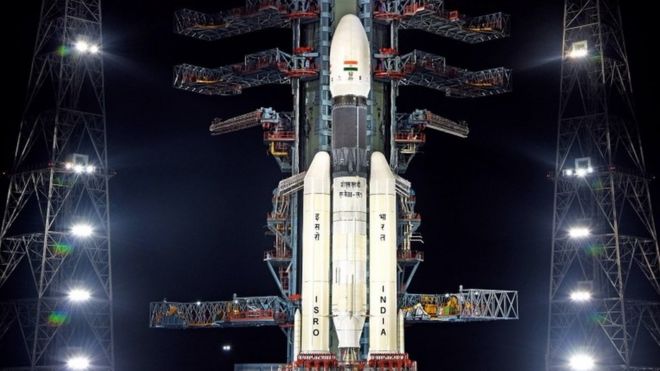
The rocket that will carry the Chandrayaan-2 satelliteImage copyright EPA
Image caption The rocket weighs as much as a fully-loaded jumbo jet

The launch of India’s second lunar mission has been halted less than an hour before the scheduled blast-off, due to a technical problem.

The countdown stopped 56 minutes before the launch after a “technical snag was observed in launch vehicle system,” India’s space agency said.

The satellite had been scheduled for launch at 02:51 local time on Monday (21:21 GMT Sunday) from Sriharikota space station on India’s eastern coast.

A new launch date will follow soon.

What is this mission all about?

India hopes the $150m mission, Chandrayaan-2, will be the first to land on the Moon’s south pole.

It will focus on the lunar surface, searching for water and minerals and measuring moonquakes, among other things.

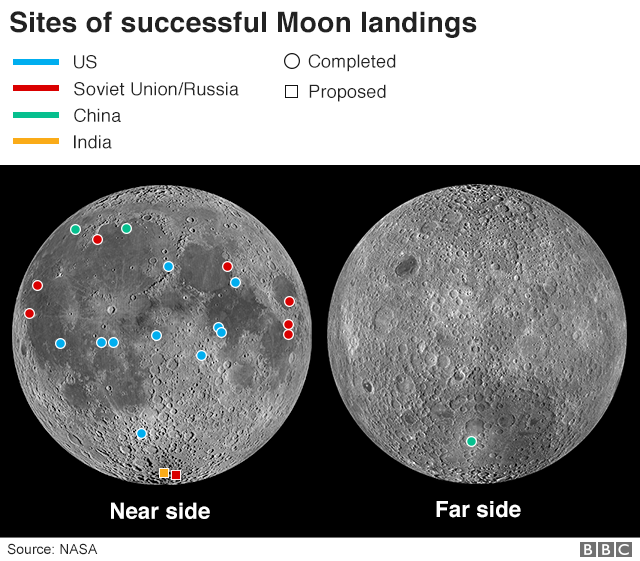
If successful, India will become the fourth country to make a soft landing on the Moon’s surface.

Only the US, China and the former Soviet Union have been able to do so.

India’s Prime Minister, Narendra Modi has championed the country’s space programmes, but critics would like to see poverty at home tackled first.

Presentational white space

The chief of the Indian Space Research Organisation (Isro), K Sivan, said this was “the most complex space mission ever to be undertaken by the agency”.

If the launch had gone to plan, the lander and rover would have been expected to touch down in early September.

India’s space agency is yet to give more details on why the launch was delayed and how it will affect the timeline.

The country’s first lunar mission in 2008 – Chandrayaan-1 – did not land on the lunar surface, but it carried out the first and most detailed search for water on the Moon using radars.

How will it get to the Moon?

Chandrayaan-2 (Moon vehicle 2) will attempt a soft landing near the little-explored south pole of the Moon.

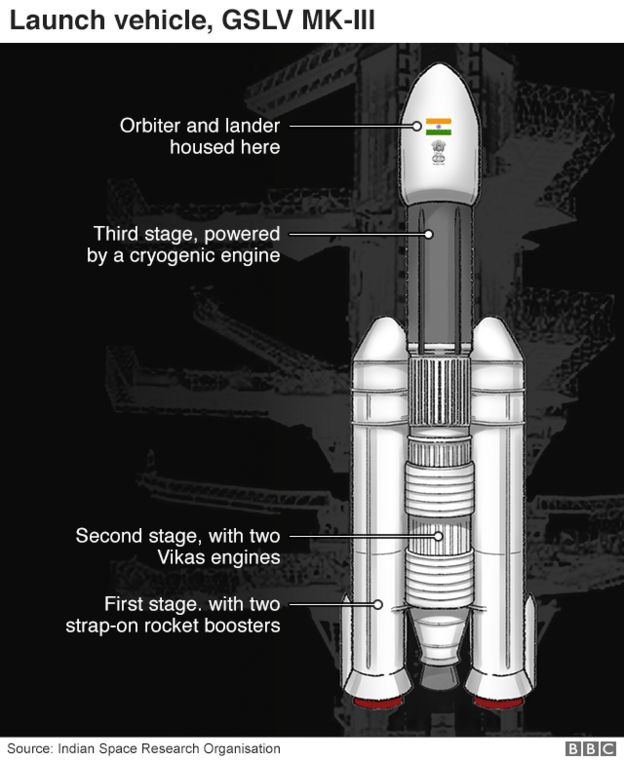
India is using its most powerful rocket, the Geosynchronous Satellite Launch Vehicle Mark III (GSLV Mk-III), in this mission. It weighs 640 tonnes (almost 1.5 times the weight of a fully-loaded 747 jumbo jet) and at 44 metres (144ft) is as high as a 14-storey building.

Graphic showing the launch vehicle with different parts labelled
The spacecraft weighs 2,379kg (5,244lb) and has three distinct parts: an orbiter, a lander and a rover.

The orbiter, which has a mission life of a year, will take images of the lunar surface, and “sniff” the tenuous atmosphere.

The lander (named Vikram, after the founder of Isro) weighs about half as much, and carries within its belly a 27kg Moon rover with instruments to analyse the lunar soil. In its 14-day life, the rover (called Pragyan – wisdom in Sanskrit) can travel up to a half a kilometre from the lander and will send data and images back to Earth for analysis.

“India can hope to get the first selfies from the lunar surface once the rover gets on its job,” Dr Sivan said.

Presentational grey line

A new frontier for India’s space programme

By science writer Pallava Bagla

A soft landing on another planetary body – a feat achieved by just three other countries so far – would be a huge technological achievement for Isro and India’s space ambitions.

It would pave the way for future Indian missions to land on Mars and an asteroid. More importantly, it would open up the possibility of India sending astronauts to the Moon. India hopes to carry out a crewed space flight by 2022.

India also wants to assert itself as a space power to be reckoned with – and national pride is riding high as it aims to hoist its flag on the surface of the Moon.

A successful mission to the Moon would also be a win for India’s ambitious space agency, which has had a string of successes recently.

Media caption Is India a space superpower?

In 2014, it successfully put a satellite into orbit around Mars, becoming only the fourth nation to do so. In 2017, India created history by successfully launching 104 satellites on a single mission, overtaking the previous record of 37 satellites launched by Russia in 2014.

All eyes are on Isro again. Global interest in India’s frugal Moon mission is peaking, according to Simonetta Di Pippo, director of the UN office of Outer Space Affairs.

“The mission’s studies of lunar topography, mineralogy, elemental abundance, the lunar exosphere, and signatures of hydroxyl and water ice will contribute to scientific progress for all of humankind,” she says.

The Indian space community is nervous and Dr Sivan says “there is churning in his stomach”.

“Unknown-unknowns can kill a mission, [although] no stone has been left unturned to understand all the complexities”.

Presentational grey line

How long is the journey to the Moon?

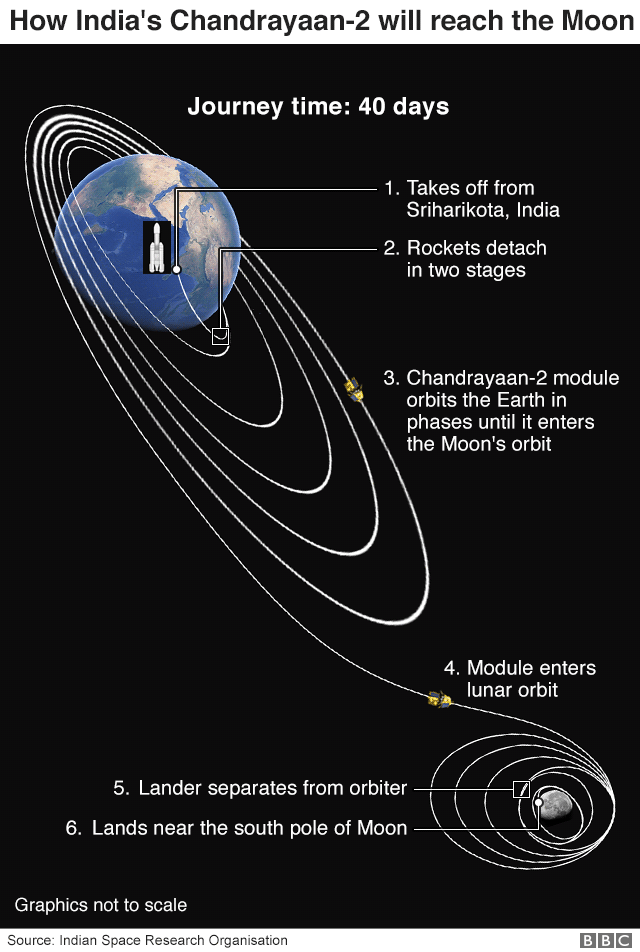
The launch is only the beginning of a 384,000km (239,000-mile) journey – the robotic craft is expected to land on the Moon some 54 days later.

Isro chose a circuitous route to take advantage of the Earth’s gravity, which will help slingshot the satellite towards the Moon. India does not have a rocket powerful enough to hurl Chandrayaan-2 on a direct path.

“There will be 15 terrifying minutes for scientists once the lander is released and is hurled towards the south pole of the Moon,” Dr Sivan says.

Graphic: How India's Chandrayaan-2 will reach the moon
He explains that those who had been controlling the spacecraft until then will have no role to play in those crucial moments. The actual landing, he adds, is an autonomous operation dependent on all systems performing as they should. Otherwise, the lander could crash into the lunar surface.

Earlier this year, Israel’s first Moon mission crash-landed while attempting to touch down.

Site of successful moon landings graphic showing where other countries have landed on the moon

Who is on the team?

Nearly 1,000 engineers and scientists have worked on this mission. But for the first time, Isro has chosen women to lead an interplanetary expedition.

Two women are steering India’s journey to the Moon. While programme director Muthaya Vanitha has nurtured Chandrayaan-2 over the years, it will be navigated by Ritu Karidhal.

“Women power is powering India’s Moon ambitions,” Dr Sivan said, adding that at Isro, “women and men are all equal. Only talent matters – not the gender.”

Source: The BBC

Law of Unintended Consequences

continuously updated blog about China & India

ChiaHou's Book Reviews

continuously updated blog about China & India

What's wrong with the world; and its economy

continuously updated blog about China & India