17/03/2020
NEW DELHI (Reuters) – India plans to take advantage of low prices for oil from Saudi Arabia and the United Arab Emirates to top up its strategic petroleum reserves (SPR), two sources familiar with the matter said on Monday.
Global oil prices have fallen around 40% in March as the impact of the coronavirus pandemic has destroyed demand, while supplies are growing following Moscow’s refusal to back deeper output cuts at a meeting of the Organization of the Petroleum Exporting Countries and its OPEC+ allies.
Leading OPEC producers Saudi Arabia and Abu Dhabi have said they will increase output while cutting prices, giving big consumers the chance to fill up at discounted prices.
“It is an opportune time for us and for them (Abu Dhabi National Oil Company and Saudi Aramco) to finalize the deals and fill the SPRs…If there is any delay, we might fill the SPRs on our own,” said an official familiar with the matter, asking not to be named.
A second source, who also requested anonymity, said the oil ministry has written to the finance ministry to release about 48-to-50 billion rupees ($673.7 million) to buy oil in 8-9 very large crude carriers for filling the storage.
Indian Strategic Petroleum Reserves Ltd (ISPRL) and India’s oil and finance ministry had no immediate comment, while ADNOC and Saudi Aramco declined to comment.
India, the world’s third biggest oil importer and consumer, imports about 80% of its oil needs and has built strategic storage at three locations in southern India to store up to 36.87 million barrels of oil or about 5 million tonnes to protect against supply disruption.
ISPRL, a company charged with building of strategic storage, has signed a memorandum of understanding (MOU) with the UAE’s national oil company ADNOC for the lease of half of its 2.5 million tonnes Padur facility.
Last year it signed an MoU with Saudi Aramco for the lease of a quarter of Padur SPR.
The leases allow the national oil companies to store their oil, some of which will cater for India’s strategic needs, while they can sell the rest to Indian refiners.
Padur has four compartments that hold about 4.6 million barrels each. The ISPRL has received 1 VLCC with Arab Mix to fill one compartment and will get a second VLCC in April, a third source said.
The ISPRL has already leased half of the 1.5 million tonnes capacity in Mangalore storage to ADNOC, which has stored about 5.5 million barrels of Das oil in the cavern, while ISPRL has retained the remainder.
“This is the right time to fill the SPRs before prices start moving up,” a third source said.
India has also filled its 1.03 million tonnes Vizag facility with Basra oil from another OPEC producer Iraq.
While India is primarily taking advantage of low prices as a consumer nation, U.S. President Donald Trump aimed to help U.S. energy producers struggling to cope with the price fall by announcing he would take advantage of low prices to fill up the nation’s emergency reserve.
Source: Reuters
Posted in Abu Dhabi, Abu Dhabi National Oil Company, ADNOC, cheap, India, Indian Strategic Petroleum Reserves Ltd (ISPRL), Memorandum of Understanding (MOU), OPEC, Organization of the Petroleum Exporting Countries (OPEC), plans, Saudi Arabia, strategic, strategic petroleum reserves (SPR), tanks, The United Arab Emirates, top up, U.S. President Donald Trump, Uncategorized, VLCC |
Leave a Comment »
10/02/2020
LUCKNOW (Reuters) – U.S. and European defence firms backed Indian Prime Minister Narendra Modi’s military modernisation drive at a defence exhibition on Friday, despite a lengthy procurement process running into years and limited funds.
Airbus SE (AIR.PA) and U.S.-based Lockheed Martin Corp (LMT.N) and Boeing Co. (BA.N) are eying multi-billion dollar deals under Modi’s aim to upgrade an ageing fleet of aircraft and enhance local arms manufacturing to cut imports.
“I feel encouraged overall,” Anand Stanley, President and managing director of Airbus India and South Asia, told Reuters.
“Every year the government is doing capital allocation. They are spending,” he said.
The military is also looking to buy submarines, warships and battlefield communication systems. But these have made little headway.
Airbus is offering to set up an assembly line in India in partnership with the Tata Group to produce the C295W military transport aircraft as a replacement for Indian Air Force’s Avro fleet.
The 120 billion rupee Avro replacement programme has been in the pipeline for almost a decade.
Airbus on Thursday signed a memorandum of understanding (MoU) with India’s Adani Aerospace and Defence, part of the diversified Adani Group, for aircraft services in India and South Asia.
Boeing, which has pitched its F/A-18 Block III Super Hornet fighter for the India air force and navy and is competing with Lockheed Martin’s F-21, said it plans to push India’s armed forces’ drive for modernisation through a suite of five products – the Super Hornet, KC-46 tanker, P-8I aircraft, AH-64E Apache and CH-47(I) Chinook helicopters.
The company said it wants to build a global defence and aerospace ecosystem “that creates jobs and industrial capacity with Make in India,” said Salil Gupte, president, Boeing India in a statement during the exhibition.
Boeing and Lockheed will be competing with Sweden’s Saab AB (SAABb.ST) with its Gripen fighter and France’s Dassault Aviation SA (AVMD.PA) Rafale and Russian fighter aircraft.
Lockheed Martin, as part of its fighter jet F-21 proposal for the Indian Air Force, signed an MoU with Bharat Electronics Ltd (BAJE.NS) on Friday to explore industrial opportunities around the F-21 fleet, which is essentially building up a spare and supply ecosystem.
The three aerospace giants, with huge displays at the Defence Expo 2020 held in the northern city of Lucknow, displayed miniaturised versions of the latest aircraft and helicopters that they have pitched to India.
Another French defence firm, Dassault (DAST.PA), which recently delivered its first Rafale aircraft to the government in October under a contract to supply 36 units, said it is developing its facility in central India to make the Rafale jets in the subcontinent.
Source: Reuters
Posted in Adani Aerospace and Defence, Adani group, Ageing, AH-64E Apache, air force, Airbus, Airbus India and South Asia, Airbus SE (AIR.PA), Aircraft, aircraft services, arms manufacturing, Assembly line, Avro, battlefield communication systems, Bharat Electronics Ltd (BAJE.NS), Boeing Co (BA.N), Boeing India, C295W military transport aircraft, CH-47(I) Chinook helicopter, Dassault (DAST.PA), Defence, defence exhibition, Defence Expo 2020, drive, F/A-18 Block III Super Hornet fighter, fighter jet F-21, firms, fleet, France’s Dassault Aviation SA (AVMD.PA), global, global defence and aerospace ecosystem, Gripen fighter, India, Indian Air Force, Indian Air Force’s, Indian Prime Minister Narendra Modi’s, KC-46 tanker, line up, Lockheed Marti, Lockheed Martin Corp (LMT.N), Lockheed Martin’s F-21, Lucknow, Memorandum of Understanding (MOU), Military, miniaturised versions, modernisation, MoU, navy, P-8I aircraft, Reuters, Russian fighter aircraft, shopping, South Asia, submarines, Sweden’s Saab AB (SAABb.ST), the Super Hornet, Uncategorized, update, warships |
Leave a Comment »
05/10/2019
Maha Prasad Adhikari, Chief Executive Officer (CEO) of Nepal Investment Board (IBN) speaks during a signing ceremony of the construction of China-Nepal Friendship Industrial Park, in Kathmandu, Nepal, Oct. 3, 2019. Damak Clean Industrial Park, a China-invested company, has signed a Memorandum of Understanding with Nepal Investment Board (IBN) for the China-Nepal Friendship Industrial Park in Nepal’s eastern Jhapa district. (Photo by Sunil Sharma/Xinhua)
KATHMANDU, Oct. 4 (Xinhua) — Damak Clean Industrial Park, a China-invested company, has signed a Memorandum of Understanding with Nepal Investment Board (IBN) for the China-Nepal Friendship Industrial Park in Nepal’s eastern Jhapa district.
Damak Clean Industrial Park President Govinda Thapa and IBN Chief Executive Officer Maha Prasad Adhikari signed the MoU at a function on Thursday evening in Kathmandu.
Lhasa Economic and Technological Development Zone Investment Development Company Limited is investing in the project which aims to develop a complete industrial infrastructure for industries to come in and operate there.
“Industries related to food products, home appliances, transport equipment electrical and communication equipment will be brought inside the park,” Zhou Chengjie, chairman of Lhasa Economic and Technological Development Zone Investment Development Company Limited, said during the signing ceremony.
The location is the hometown of Nepali Prime Minister KP Sharma Oli.
The IBN, a government body focused on promoting large scale investment, approved Foreign Direct Investment (FDI) of 586 million U.S. dollar from the Chinese company in August.
“This investment is for the first phase of the works under which industrial park will be developed in 484.81 hectares of land out of planned development in 1,600 hectares,” Zhou said.
According to him, the project will be developed in four phases and his company has aimed to invest 1 billion U.S. dollar for the entire development. It will be one of the largest FDI to Nepal from China in recent years.
IBN CEO Adhikari said the China-Nepal Friendship Park would be milestone for industrial infrastructure development in Nepal as industrial infrastructure in the Himalayan country has remained poor.
“This will also help Nepal to utilize the economic opportunity offered by the Belt and Road Initiative,” he said.
Source: Xinhua
Posted in Belt and Road Initiative, Belt and Road Initiative (BRI), China-Nepal Friendship Industrial Park, Damak Clean Industrial Park, Foreign Direct Investment (FDI), Kathmandu, KP Sharma Oli, Lhasa Economic and Technological Development Zone Investment Development Company Limited, Memorandum of understanding, Memorandum of Understanding (MOU), Nepal, Nepal Investment Board (IBN), Nepali Prime Minister, Uncategorized |
Leave a Comment »
02/10/2019
- The trip comes amid growing resistance from European leaders over what they see as China’s failure to change long-term practices unfair to foreign investors
- French President’s trip to Beijing follows Chinese leader’s visit to France in March
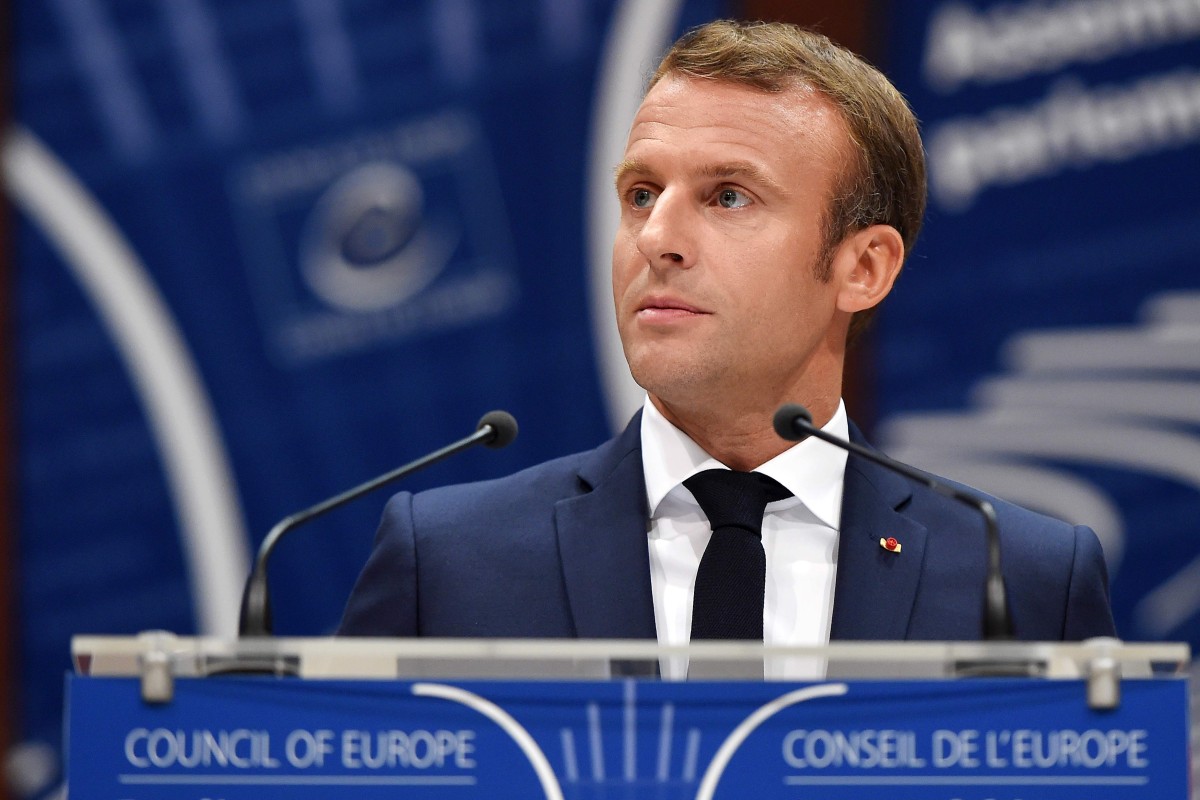
President Emmanuel Macron of France speaks to the Council of Europe parliamentary assembly on Tuesday. Photo: AFP
French President Emmanuel Macron will visit China next month as Europe’s most diplomatically active leader focuses on climate change cooperation and trade promotion with Asia’s leading power, a source briefed on the Elysee Palace’s discussions said.
This will be the second Chinese tour for Macron since he took office in 2017, and it will come amid escalating resistance from European politicians and business communities over what they see as China’s failure to change long-standing practices unfair to foreign investors.
His visit also comes at a time when France – as well as the European Union as a whole – is bracing for Washington’s potential levies of tariffs on European products, and the lack of progress on climate change policies with US President Donald Trump’s administration.
“President Macron will meet President Xi [Jinping], while France strives for better cooperation with China on climate and trade,” the source said. “His itinerary is still in the pipeline, but he is expected to visit Beijing and Shanghai.”
Macron, 41, who is widely seen as emerging as Europe’s most aggressive leader filling the political vacuum left by German Chancellor Angela Merkel’s political twilight, has cast himself as an honest broker between Russia and Ukraine, and between the US and Iran.
He has also been critical of China’s influence in Europe, joining forces with Merkel to push for a tougher EU stance on the world’s second biggest economy.
In March, when Xi claimed a major diplomatic victory by clinching a memorandum of understanding with Italy on the Belt and Road Initiative, Macron declared: “The time of European naivety is ended. For many years we had an uncoordinated approach and China took advantage of our divisions.”
Macron also backed investment screening mechanisms for Chinese business moves in Europe, while endorsing plans to change the EU’s notoriously strict antitrust rules in order to facilitate mergers between large European groups and companies to counter Chinese companies’ global ambitions.
Macron urges Iran and US to show ‘courage of building peace’
The EU is also wary of China’s effort to “divide and rule” the European Union. Greece and Hungary – both recipients of large amounts of Chinese investments – have repeatedly wanted to water down EU’s stance on issues deemed sensitive to Beijing, including the South China Sea and China’s human rights violations.
“It would be good [for Macron] to stress that 17+1 is irritating,” said Joerg Wuttke, president of EU Chamber of Commerce in China, in reference to China’s engagement with a group of EU and non-EU member states in eastern and southeastern Europe.
“After all, the EU has a ‘one China’ policy, [so] EU could expect this position from China too.”
Macron’s domestic call for EU unity has translated into diplomatic appeals, with China being one of the targets.
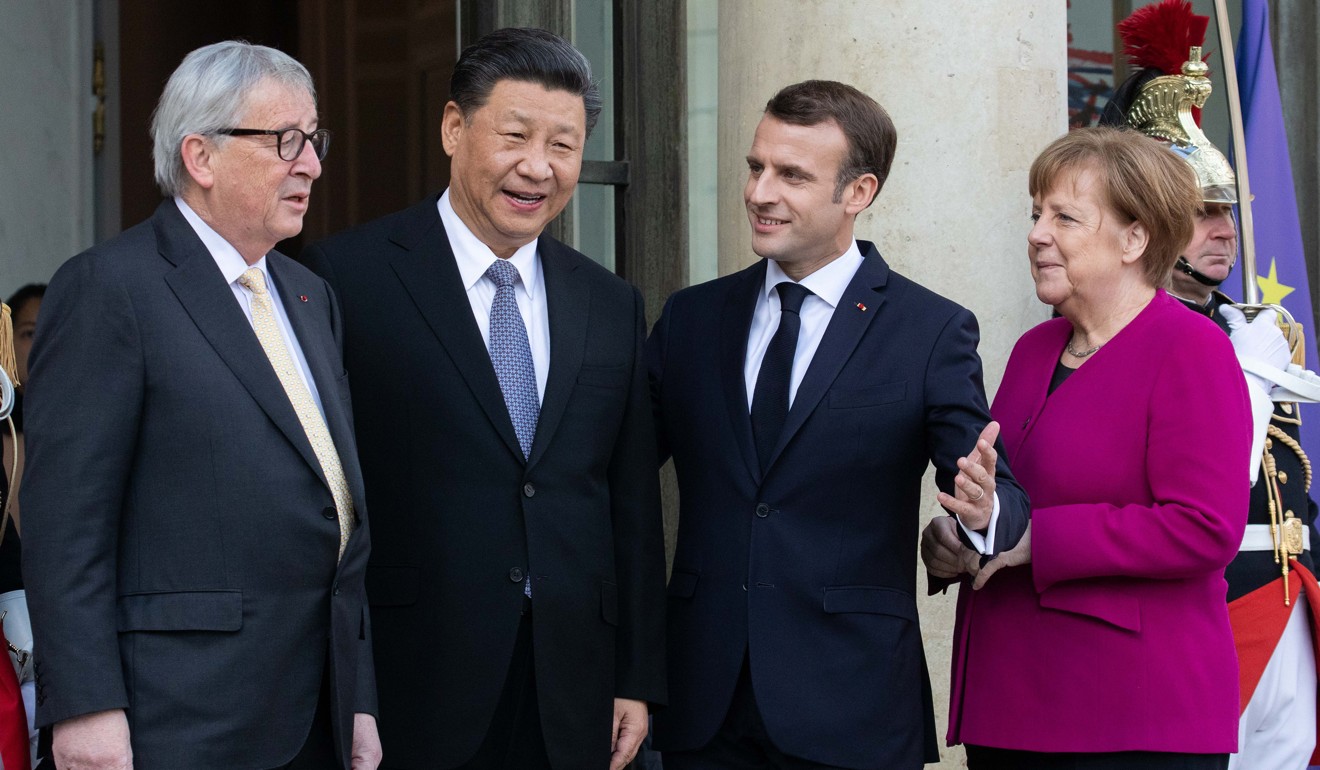
(From left) Jean-Claude Juncker, president of the European Commission; Xi Jinping, China’s leader; Emmanuel Macron, France’s president; and Angela Merkel, Germany’s chancellor, ahead of a meeting in Paris on March 26. Photo: Christophe Morin/Bloomberg
When Xi visited France in March, Macron hosted him at the Elysee Palace in the presence of Merkel and European Commission President Jean-Claude Juncker, showcasing European solidarity when it comes to EU-China policies.
In terms of French-Chinese bilateral ties, trade imbalances have persisted after Macron called for a “rebalancing” during his last visit.
France has a 1.4 per cent market share in China, compared with China’s 9 per cent market share in France. China represents France’s largest bilateral trade deficit, totalling €US$29.2 billion (US$31.9 billion) last year, ahead of Germany.
The EU has been calling for reciprocal investment treatment with China, a call that European business leaders in China expect Macron to make.
France bids farewell to late president Jacques Chirac
“We [Europe] need … a solid investment agreement to allow EU business to conduct their affairs in a similar manner as Chinese companies can operate in Europe. The agreement should be finalised in 2020, but not at all cost,” said Wuttke.
“The last thing EU business needs in China is a weak agreement that institutionalises imbalances,” he added.
Part of that involves building “more efficient defensive tools to prevent abusive technology transfers and to address the deep asymmetry in EU-China relations when it comes to access to public procurement markets,” said Mathieu Duchâtel, director of Asia programme at the Paris-based think tank Institut Montaigne.
Duchâtel added that it was also important to convey the message to Beijing that there are areas for cooperation even amid a more defensive China policy from France.
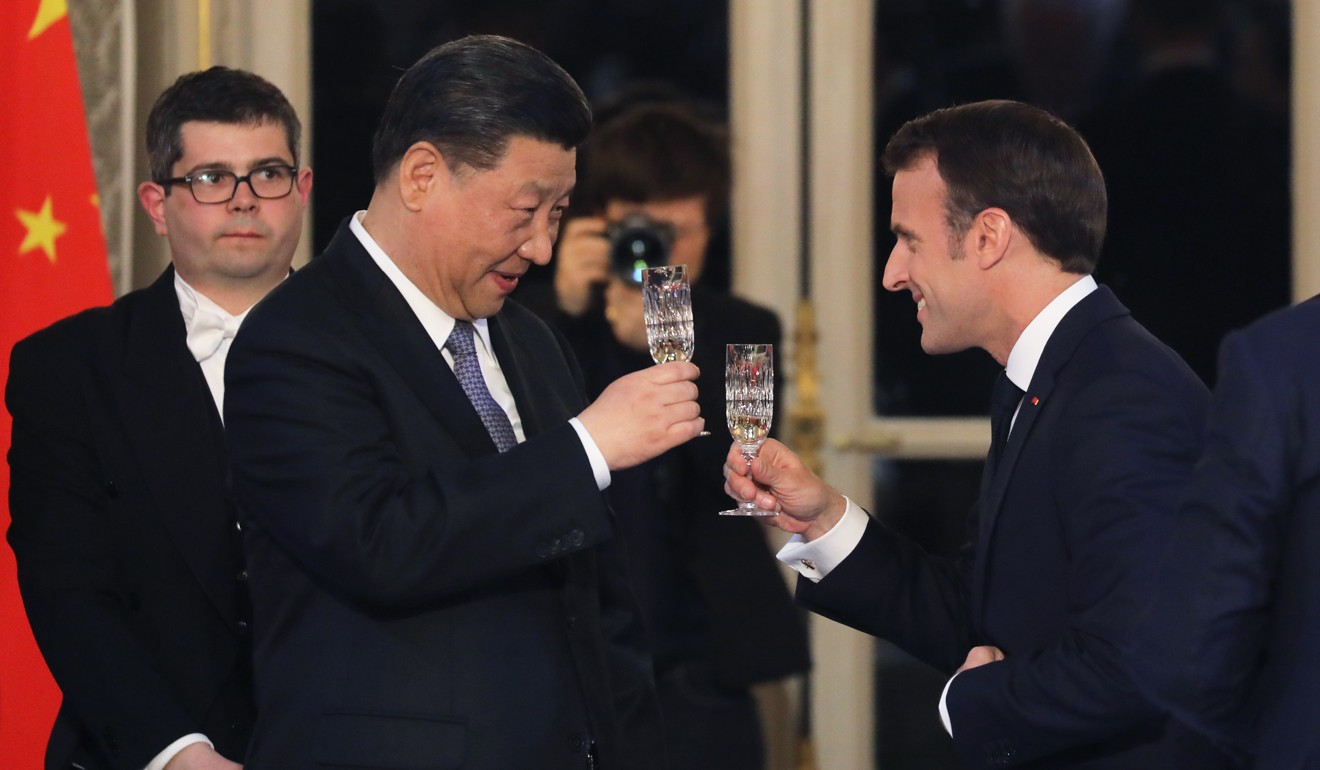
Chinese President Xi Jinping and French leader Emmanuel Macron toast raise a toast during a state dinner in Paris on March 25. Photo: EPA-EFE
One such area is the climate and environment, where China is “an important partner” for France to reach its goal of global carbon neutrality by 2050, he said.
“The energy/environment agenda is a political priority in Paris and one of very few issues on which cooperation with China remains promising and will continue to create business opportunities,” he said.
China is the world’s biggest carbon polluter, producing around 30 per cent of the planet’s man-made carbon dioxide. It remains committed to the 2015 Paris accord on climate change, even after Trump pulled the US out of the deal.
Under the agreement, the long-term temperature goal is to keep the increase in global average temperature to well below 2°C above pre-industrial levels, and to pursue efforts to limit the increase to 1.5°C.
Source: SCMP
Posted in Angela Merkel, Beijing, Belt and Road Initiative, Belt and Road Initiative (BRI), building peace, Carbon dioxide, carbon polluter, China alert, climate change, Council of Europe, courage, deep asymmetry, divide and rule, energy/environment agenda, EU, EU Chamber of Commerce in China, European Commission, European Commission President, European Union, focus, France, German Chancellor, Greece, human rights violations, Hungary, imbalances, institutionalises, INVESTMENTS, iran, Italy, Jacques Chirac, Jean-Claude Juncker, meet, Memorandum of understanding, Memorandum of Understanding (MOU), month, one-China policy, Paris, Planet, political twilight, recipients, South China Sea, technology transfers, Trade, Uncategorized, US, US President Donald Trump, Xi JinPing |
Leave a Comment »
08/09/2019
Serbian President Aleksandar Vucic(4th R) meets with Zhang Youxia(3rd L), a member of the Political Bureau of the Communist Party of China (CPC) Central Committee and vice chairman of the Central Military Commission in Belgrade, Serbia on Sept. 6, 2019. (Photo by Li Xiaowei/Xinhua)
BELGRADE, Sept. 7 (Xinhua) — Serbia hopes to enhance mutually beneficial cooperation with China in various fields, including military, to advance bilateral relations to new levels, Serbian President Aleksandar Vucic has said.
Vucic made the remarks on Friday when meeting with visiting vice chairman of China’s Central Military Commission, Zhang Youxia.
Vucic said that history has proved that China is Serbia’s most reliable friend. The Serbian government, people and military support the “one-China” policy as well as China’s stance and proposition in many other issues concerning China’s core interests.
Vucic added that the Belt and Road Initiative has brought many opportunities to the development of Serbia. He said he hopes that the two sides will continue to deepen mutually beneficial cooperation in various fields, including military, to advance bilateral relations to new levels.
Zhang, who is also a member of the Political Bureau of the Communist Party of China Central Committee, said that the traditional friendship between China and Serbia is profound.
He said that China is ready to work with Serbia to consolidate the all-weather friendship between the two countries, promote the quality of their bilateral relations and accelerate the growth of their ties.
Zhang also called for the militaries of the two countries to implement consensus reached between the heads of state of China and Serbia, deepen strategic mutual trust and enhance exchanges and cooperation in bids to promote their links to new height.
During his visit, Zhang also met with Serbian Defense Minister Aleksandar Vulin, and witnessed the signing of a memorandum of understanding on the establishment of a Chinese medicine center in the Serbian Military Medical Academy.
Source: Xinhua
Posted in advance, Aleksandar Vucic, Aleksandar Vulin, Belt and Road Initiative, Belt and Road Initiative (BRI), Central Military Commission, Central Military Commission (CMC), China alert, Chinese medicine center, establishment, levels, member of the Political Bureau of the Communist Party of China Central Committee, Memorandum of understanding, Memorandum of Understanding (MOU), Military, pledges, Serbian Defense Minister, Serbian Military Medical Academy, Serbian president, ties, Uncategorized |
Leave a Comment »
26/04/2019
BEIJING, April 26 (Xinhua) — The China-proposed Belt and Road Initiative (BRI) facilitates the compliance with the UN 2030 Agenda for Sustainable Development and the realization of the 17 Sustainable Development Goals in Latin America, said a senior official of a UN body based in Latin America.
Mario Cimoli, deputy executive secretary of the Economic Commission for Latin America and the caribbean (ECLAC), made the remarks in an interview with Xinhua.
Also as chief of the division of production, productivity and management of ECLAC, Cimoli has arrived in Beijing to participate in the second Belt and Road Forum for International Cooperation on April 25-27.
So far, 18 Latin American countries have signed the Memorandum of Understanding on jointly building the Belt and Road cooperation with China.
“The countries in Latin America view China as a fundamental actor,” he said. “The fact that 18 Latin American countries have joined the Belt and Road Initiative means that these countries think that China is necessary and China is also aware of the importance of dialogue. It’s a historical process.”
In his opinion, the BRI makes “greater integration, greater multilateralism and more dialogue” possible and “does good to Latin America.”
He said that both the 2030 Agenda and the BRI seek sustainable development and reduction of inequality and poverty, without contradicting with the proper model of each country.
“Given that the growth rates of Latin America will not be very high for the next few years, a rational process of cooperation such as the Belt and Road will surely help the region and allow each country to seek and improve their model of development and growth,” the ECLAC official said.
The BRI is a much more horizontal dialogue, a platform, in that sense that it is a process that helps and allows a much more positive coexistence despite current global tensions, he said.
In the dialogue with China, Latin America can demonstrate the importance of being an integrated area of trade, policies, and infrastructures in order to trade better with Asia, he said.
Cimoli also affirmed that the incorporation of new technologies in Latin America is a course under discussion, and dialogue with China can accelerate and improve the process.
Cimoli said his one observation of his ongoing China trip is the extensive use of electronic commerce among ordinary people.
He said when he went out to buy something, he found almost everyone use e-payments.
The way in which technologies immerge into the daily life of Chinese citizens is an example and would be a valuable contribution of China to the world and especially to Latin America, Cimoli said.
“The example of China shows the role that a state should play to trigger the technological development. In this dialogue with China, Latin America surely has to learn from the pragmatism of China,” he said.
The ECLAC official mentioned that China invests over 2 percent of its GDP in science and technology, while the average investment of Latin American countries in the field is between 0.4 and 0.5 percent of its GDP, plus, it appears to be swaying instead of stable state policies.
“There is a lot of cooperation to be done, much experience to be shared and much a platform for dialogue like the Belt and Road Initiative could do,” said Cimoli.
Source: Xinhua
Posted in Belt and Road (B&R), Belt and Road Initiative (BRI), chief of the division of production, productivity and management of ECLAC, China alert, deputy executive secretary, ECLAC official, Economic Commission for Latin America and the caribbean (ECLAC), horizontal dialogue, infrastructures, Latin America, Mario Cimoli, Memorandum of Understanding (MOU), policies, Sustainable development, Trade, UN 2030 agenda, Uncategorized |
Leave a Comment »
09/04/2019
BEIJING, April 8 (Xinhua) — Chinese ambassador to Barbados Yan Xiusheng has called for efforts to promote China-Barbados cooperation to a new stage.
In the article, carried by Monday’s People’s Daily, Yan said the two countries signed a Memorandum of Understanding (MOU) on jointly advancing the Belt and Road Initiative (BRI) in February, making Barbados the first new partner to join the BRI in 2019.
“The friendly and cooperative relations between the two countries have deepened in recent years, showing a good trend of upgrading quality and accelerating speed,” Yan said.
Political mutual trust between the two sides has been strengthened, pragmatic cooperation has been steadily advancing and people-to-people and cultural exchanges have seen many highlights, he explained.
As an important partner of China in the Caribbean, Barbados attaches great importance to international cooperation within the framework of the BRI, the article read.
The signing of the MOU between the two countries has brought new opportunities for further development of bilateral relations and practical cooperation in various fields, Yan noted.
Under the framework of the BRI and guided by the principle of consultation, collaboration and benefit for all, both sides will give full play to their comparative advantages and tap into their potential for cooperation in the fields including shipping, aviation, infrastructure and modern agriculture, he said.
Efforts will be made to achieve high-quality Belt and Road cooperation and push China-Barbados friendship and cooperation into a new stage, said the article.
Source: Xinhua
Posted in Barbados, Belt and Road Initiative (BRI), Caribbean, China alert, China-Barbados cooperation, Chinese ambassador to Barbados, Memorandum of Understanding (MOU), People's Daily, Uncategorized, Yan Xiusheng |
Leave a Comment »




 CHINDIA ALERT: You'll be living in their world, very soon