Archive for ‘Merger’

19/11/2019

Tata Steel to cut 3,000 jobs in ‘severe’ market

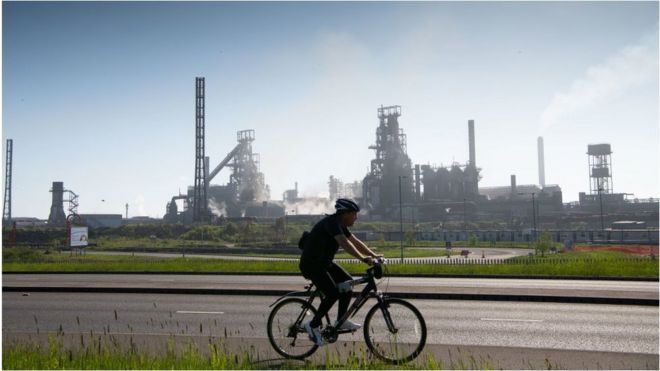
Port TalbotImage copyright GETTY IMAGES
Image caption Port Talbot employs just under half of Tata’s 8,385 UK workforce

Tata Steel plans to cut as many as 3,000 jobs across its European business in another bid to come to terms with a “severe” international steel market.

The company wants to focus on higher-value products, it said, adding there would be no plant closures.

About two thirds of the job cuts will be office-based, it added.

The announcement comes after a merger with German rival Thyssenkrupp was blocked during the summer. Bosses had hoped the deal could reduce costs.

“Today we are highlighting important proposals towards building a financially strong and sustainable European business,” said Henrik Adam, chief executive of Tata Steel in Europe.

“We plan to change how we work together to enable better cooperation and faster decision-making. This will help us become self-sustaining and cash positive in the face of unprecedented severe market conditions, enabling us to lead the way towards a carbon-neutral future.”

The business employs about 20,000 people and is owned by India’s Tata.

Port Talbot steelworks employs just under half of Tata’s 8,385-strong workforce in the UK.

Wales’ economy minister Ken Skates said: “I am seeking an urgent conversation with Tata to establish what this means for workers in Wales and how we can support those affected by this announcement.”

Last week, Chinese firm Jingye agreed to invest £1.2bn in British Steel as it signed a deal to rescue the UK steelmaker.

It also said it would seek to “preserve thousands of jobs in a key foundation industry for the UK” but did not put a number on how many would be saved.

British Steel employs about 4,000 people in Scunthorpe and Teesside.

It has been kept running by the government via the Official Receiver since May when the company went into liquidation.

Source: The BBC

26/10/2019

Merger of China’s shipbuilding giants gets the green light

  • After nearly 10 years of planning, the country’s two shipbuilders will be reunited with a combined revenue of US$141.5 billion
China’s two shipbuilding giants have built hundreds of military vessels over the past few years as the country’s navy seeks to modernise rapidly. Photo: Xinhua

China on Friday announced the merger of the country’s two largest state-owned shipbuilding giants, a step Beijing has been preparing for nearly a decade to strengthen the competitiveness of its shipbuilding industry.

The intention to merge the Shanghai-based China State Shipbuilding Corp (CSSC) and the China Shipbuilding Industry Co (CSIC), based in Dalian, Northern Liaoning province, was announced in a statement on the website of the state-owned Assets Supervision and Administration Commission of the State Council, China’s cabinet.

The merger would enable China to establish a shipbuilding giant with a combined revenue up to 1 trillion yuan (US$141.5 billion), capable of building vessels ranging from warships, like aircraft carriers, to civilian ships such as container ships and oil tankers, said a source familiar with the merger plan.

“This merger has been in the making since Hu Wenming, a former party leader of the state-owned aviation industry, was assigned to CSSC as party secretary in 2010,” the source said, requesting anonymity because of the sensitivity of the issue.

“The merger plan was put on the drawing board at a time when the world shipping industry had entered a golden period in 2009, and the business of CSSC and CSIC was at its peak, but [China’s] analysis indicated a decline was on the horizon, as has actually happened in recent years.”
Chinese shipbuilder touts warships in push to expand arms sales in region

CSIC and CSSC were part of the same group until 1999 when they were split into two separate entities. Since then, China has overtaken South Korea and Japan to become the world’s largest builder of merchant ships, a rise spurred by the boom in world trade and the country’s accession to the World Trade Organisation in 2001.

CSSC manages shipbuilding business in the east and south of China, while CSIC oversees activities in the northern and western parts of the country. Both are also primary contractors for PLA naval ships.

Commercial shipbuilding was the major source of revenue for both enterprises, given they were generally less technologically challenging and of lower cost to build, the source said.

“Developing and building warships for the PLA needs more manpower and more advanced technologies because naval ships, which are built for sea battles, take longer to build and require cutting-edge technologies, hence the higher costs,” the source said.

China tests new warships in live-fire drills near Vietnam
CSSC and CSIC have built hundreds of military vessels over the past few years as the Chinese navy seeks to modernise rapidly. These have included aircraft carriers, Type 055 destroyers, Type 075 amphibious assault ships and Type 094A nuclear submarines.
But, the source said, the two giants’ naval warship building mission would be cut back next year, as Beijing expected greater financial pressure as a result of slower economic growth. The merger would allow the two companies to pool their resources and enhance their competitiveness, especially in the development of mega vessels.
But the source said the two giants’ naval warships building missions would be cut back beginning next year as Beijing foresees greater financial pressure as a result of slower economic growth. The merger will allow the two companies to pool their resources and enhance their competitiveness, especially in areas of mega vessels.
“The merger is also part of China’s long-term maritime energy development plan to meet President Xi Jinping’s sustainable and clean energy goal, because China needs more giant vessels to help ship oil and gas from other countries,” the source said.
Source: SCMP
Law of Unintended Consequences

continuously updated blog about China & India

ChiaHou's Book Reviews

continuously updated blog about China & India

What's wrong with the world; and its economy

continuously updated blog about China & India