29/11/2019
BEIJING, Nov. 28 (Xinhua) — A spokesperson for China’s Ministry of National Defense on Thursday slammed U.S. warships and military aircraft’s willful and repeated trespassing into the adjacent waters and airspace of China’s islands and reefs in the South China Sea.
The trespassing hurts regional peace and stability, harms China’s sovereignty and security, and endangers the lives of frontline officers and soldiers of both sides, spokesman Ren Guoqiang said at a press conference, calling it “a highly dangerous provocation.”
“We demand that the United States immediately stop such infringement upon China’s interests,” Ren said, adding that the Chinese military is always on high alert and will take all necessary measures to resolutely safeguard national sovereignty, security and development interests.
Source: Xinhua
Posted in Beijing, China alert, Military aircraft, Ministry of National Defense, slams, South China Sea, trespassing, U.S., Uncategorized, warships |
Leave a Comment »
17/10/2019
- Fly-past will begin with helicopters and feature the country’s new generation warplanes
- A People’s Liberation Army Air Force officer will lead the squadron in a KJ-2000 and become the first serving commander to fly in a National Day parade
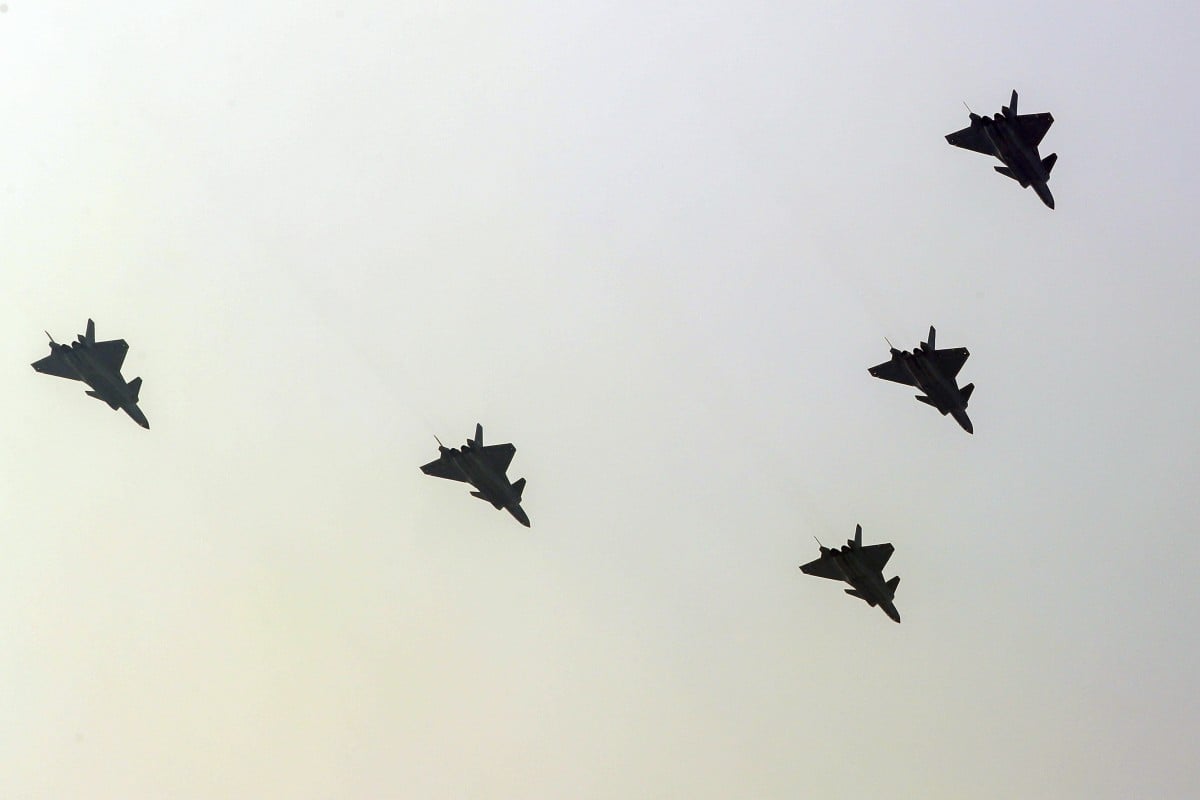
J-20 stealth fighter jets will be featured in Tuesday’s National Day parade in Beijing. Photo: AP
China will assemble the biggest squadron of its most advanced military aircraft for the National Day parade in the capital next week.
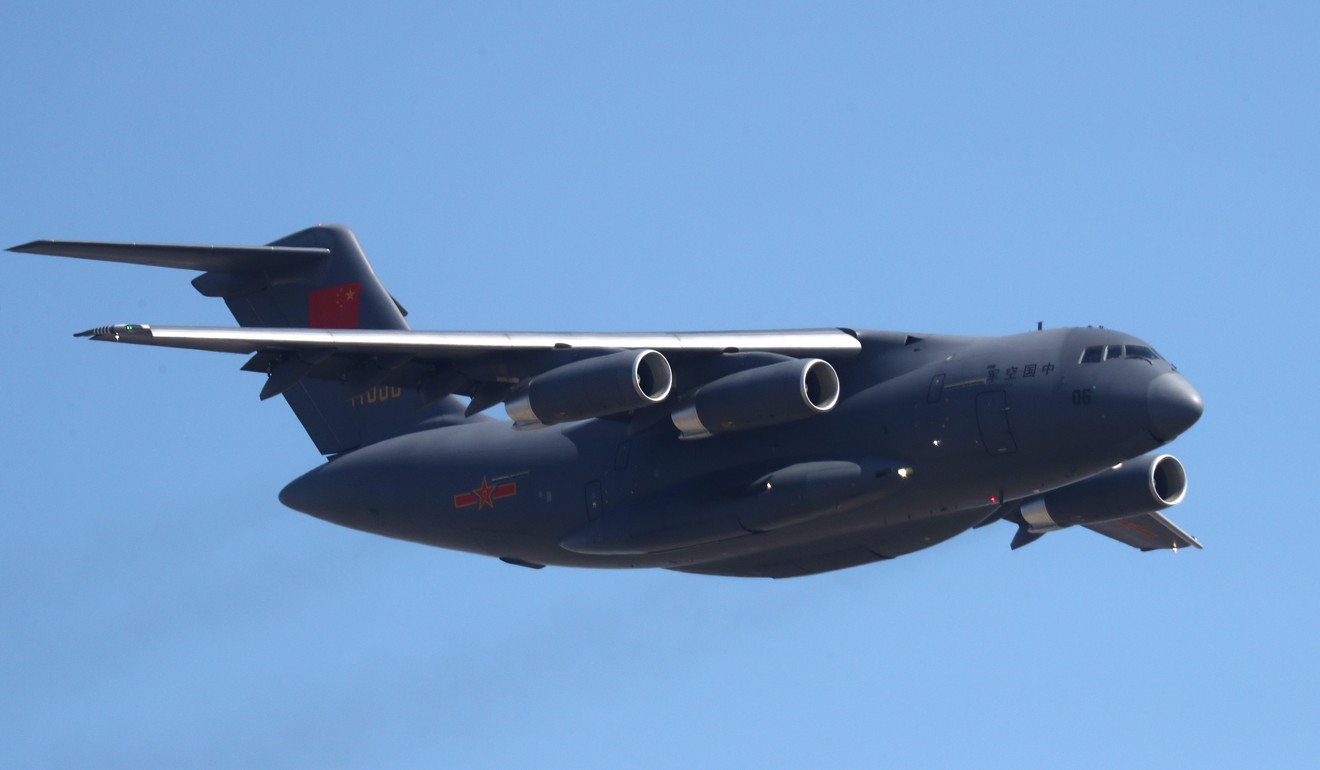
Three types of the new generation “20” series warplanes – five J-20 stealth fighter jets, three Y-20 transport planes and six Z-20 helicopters – will join airborne squadrons in the parade, according to a fly-past schedule obtained by the South China Morning Post.
“This year will be the biggest parade to have so many ‘20’ series advanced aircraft flying together,” a military insider said, referring to aircraft developed since 2000.
The J-20 is the country’s first stealth fighter; the Y-20 is China’s first heavy airlifter; and the Z-20 is a medium-lift utility helicopter comparable to the American Black Hawk.
The appearance of all three types of warplanes indicates that each one has entered production.
The H-20 subsonic stealth bomber, China’s answer to the US Air Force’s B-21 Raider, is also part of the “20” series will not make an appearance because it might need at least five more years of development.
The military insider involved in preparations for the parade, said People’s Liberation Army Air Force Commander Ding Laihang would lead the squadron in a KJ-2000 early warning aircraft.
Chinese fighter jets seen in skies over Beijing as preparations for National Day parade step up
“Ding will fly the KJ-2000 over Tiananmen Square for inspection by President Xi Jinping,” the source said, adding that Ding would be the first serving commander to fly in a National Day parade.
“The arrangement is similar to 2015 when [then] Russian Air Force commander Viktor Bondarev flew a Tu-160 strategic bomber over Moscow’s Red Square to mark the 70th anniversary of the end of the second world war.”
The KJ-2000 is the most advanced active early warning aircraft in the PLA Air Force, but it is based on the Russian Ilyushin aircraft.
The Y-20 transport aircraft will be among the new generation of planes taking part in the parade. Photo: Dickson Lee
According to the schedule, 167 aircraft will take part in the fly-past, starting with a helicopter carrying a national flag.
Eight Z-10 attack and 12 Z-19 reconnaissance helicopters will follow in formation, creating the number 70 in the sky to mark the 70th anniversary of the founding of the People’s Republic.
A source close to the navy said Z-8 multi-role and Z-19 reconnaissance helicopters be among the aircraft deployed to the Type 075 amphibious helicopter dock launched on Wednesday.
China says National Day military parade ‘won’t disappoint’ in scale or advanced weapons
A total of 44 fighter jets representing five key battle warplanes – the J-20, the J-16 fighter-bomber, the J-15 carrier-based fighter jet, the J-11 and the J-10 – will participate in the event.
But the J-8 fighter jet was not on the schedule, confirming that the first interceptor built in China has been formally retired.
Various H-6 series bombers will also make an appearance, including the H-6K and H-6N strategic bombers, as well as HU-6 refuelling plane based on the H-6 platform.
H-6K long-range bombers have been sent to the Taiwan Strait as part of “encirclement” patrols close to the self-ruled island in recent years.
Meanwhile the modified H-6N strategic bomber is designed to be armed with the Changjian-10 land-attack subsonic cruise missile, which has an operational range of more than 1,500km (932 miles).
Macau-based military observer Antony Wong Dong said that by adding more functions, the H-6 series of bombers was showing the world China had modified its combat capacity.
Wong also said the appearance of three types of training planes – the JL-8, JL-9 and JL-10 – was notable.
“It indicates that the Chinese air force had build up a systematic and comprehensive training system to train more pilots,” he said.
Source: SCMP
Posted in 70th anniversary, 70th anniversary of the founding of the People's Republic of China (PRC), advanced, American Black Hawk, B-21 Raider, Beijing, biggest squadron, Changjian-10, China’s, early warning aircraft, Fly-past, fly-past schedule, H-20 subsonic stealth bomber, H-6N strategic bomber, helicopters, Ilyushin aircraft, J-20 stealth fighter jets, KJ-2000, Mass show, Military aircraft, Moscow, National Day, National Day parade, People’s Liberation Army Air Force, PLA Air Force, President Xi Jinping, Red Square, Russian, Russian Air Force, second world war, south china morning post, strategic bombers, Tiananmen Square, Tu-160, Uncategorized, US Air Force, Y-20 transport planes, Z-20 helicopters |
Leave a Comment »
28/08/2019
- Military insiders say the aircraft appears to have beaten the FC-31 in the race to become the PLA Navy’s fighter of the future
- A military source close said it would be almost impossible to develop both aircraft over the next few years given the risk of an economic downturn
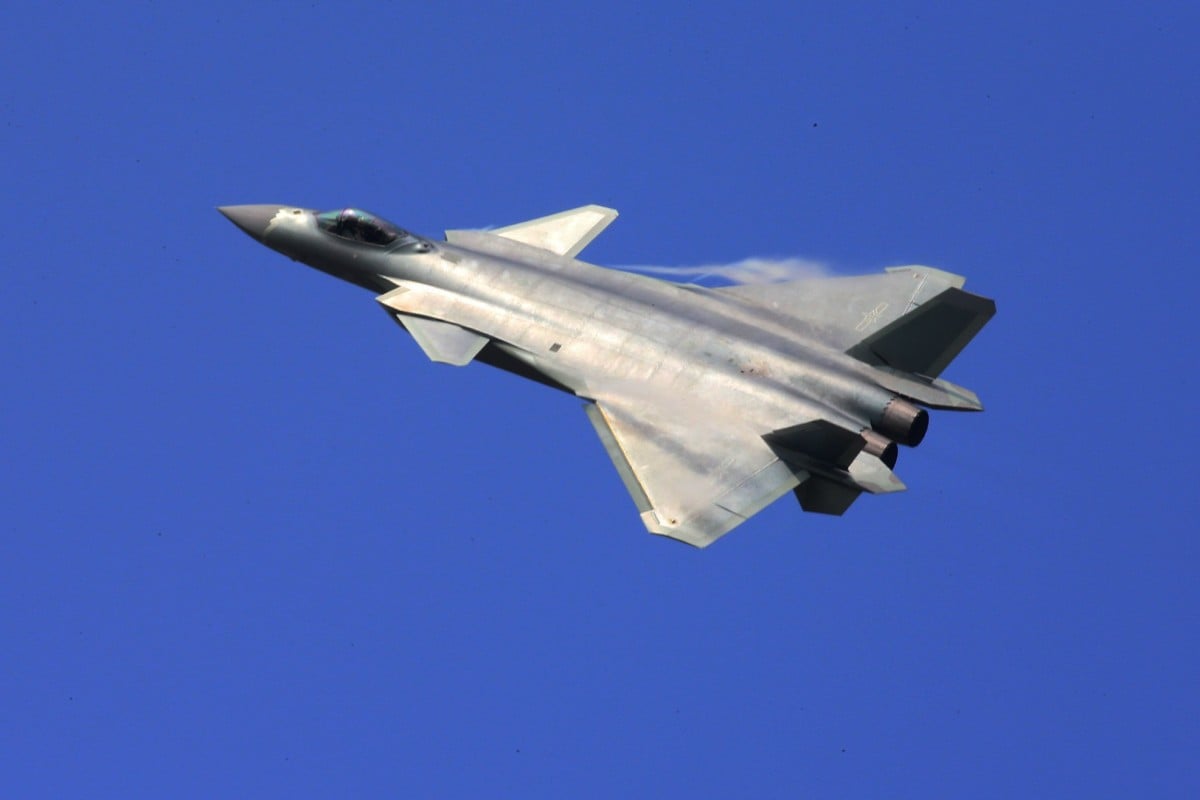
The J-20 stealth fighter is likely to be modified to serve on China’s next generation aircraft carriers. Photo: Xinhua
China’s military is likely to pick the country’s first active stealth fighter, the J-20, for its next generation aircraft carriers, according to military sources and a recent report on state media.
The J-20, made by the Chengdu Aerospace Corporation (CAC), appears to have a won a head-to-head contest with the FC-31, a fighter made by another company which is still undergoing testing.
A military insider told the South China Morning Post that the Central Military Commission, the People’s Liberation Army’s top decision-making body, now favoured adapting the J-20 for its new carriers.
“The Chengdu Aerospace Corporation will announce some new products, which will include a new version of their J-20. You can guess what type it will be,” the military insider, who requested anonymity because of the sensitivity of the subject, said.
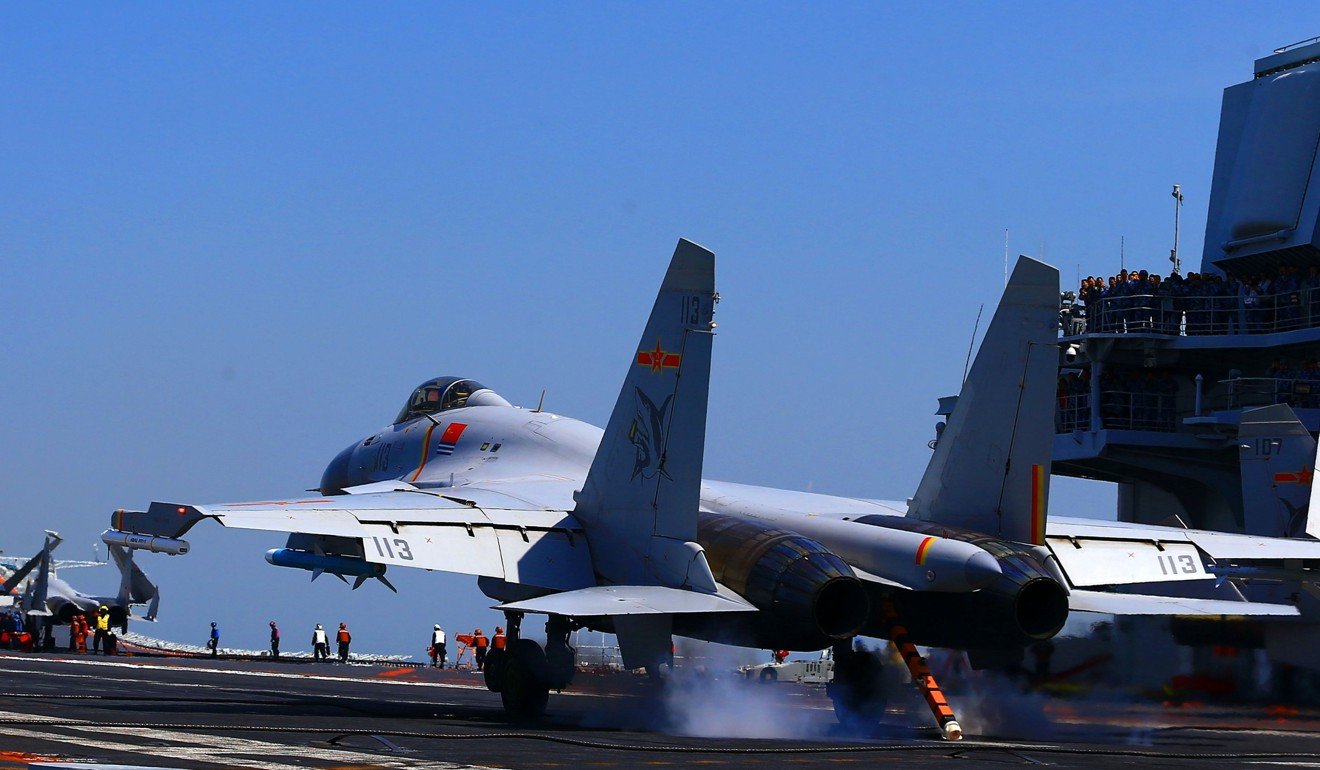
The FC-31 was independently developed by CAC’s sister company Shenyang Aircraft Corporation (SAC), which also produced the J-15 – the jets currently in use on the country’s only active aircraft carrier, the Liaoning.
Both aerospace firms are subsidiaries of the state-owned giant Aviation Industry Corporation of China, which specialises in designing and developing military aircraft, and were set up to ensure benign competition between manufacturers.
However, the SAC has faced criticism from some military leaders and experts for being too conservative and failing to innovate because of its bureaucratic structure.
A recent programme aired by the state broadcaster China Central Television also suggests the J-20 will be chosen.
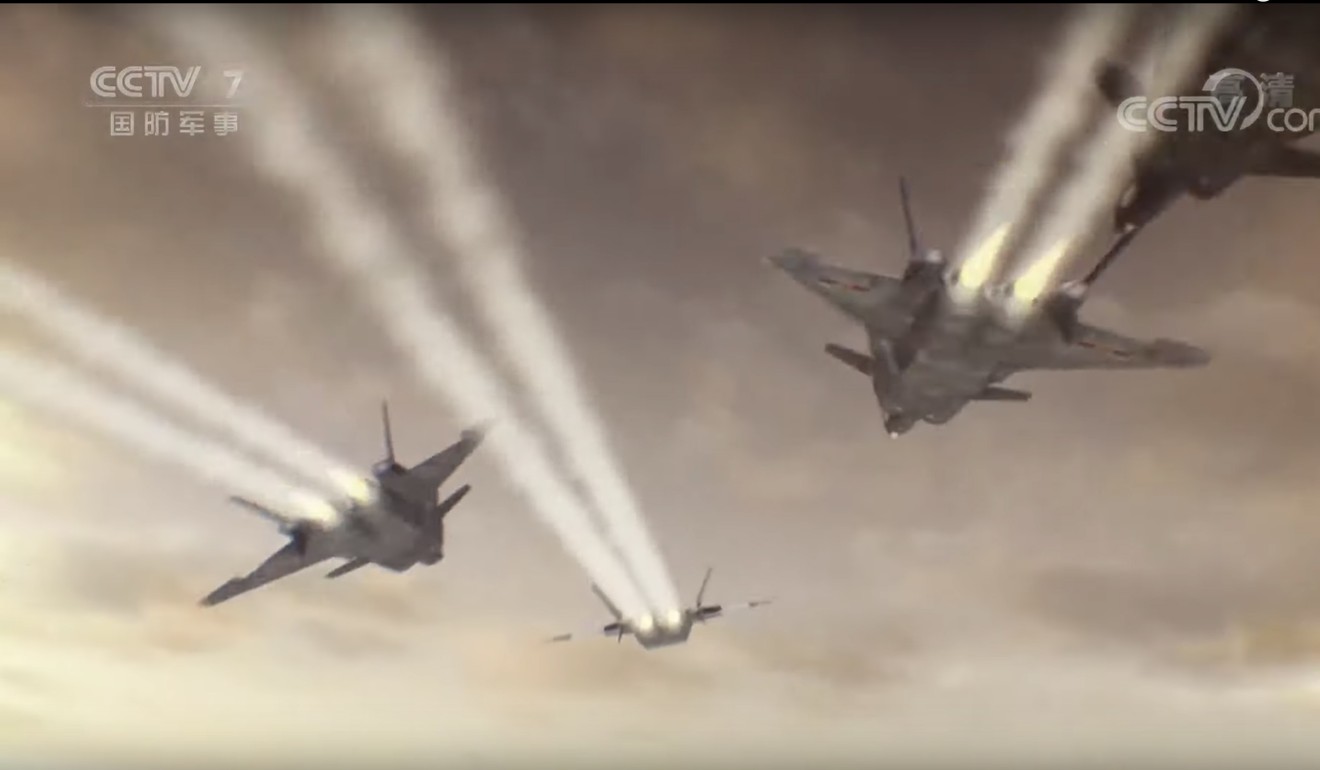
An episode of Military Documentary shown on August 16 reported how the PLA Navy was selecting candidates for pilot training and illustrated the feature with a mock-up of jets that looked like J-20s taking off from a carrier.
Ground-based J-20s – also known as Powerful Dragons – entered service with the PLA Air Force in 2017.
as China stepped up its efforts to counter the deployment of American F-22s and F-35s in the Asia-Pacific region.
A J-15 fighter lands on the Liaoning. Photo: AFP
If the selection of the J-20 is confirmed it will mark the end of a lengthy debate between its supporters and advocates of the FC-31 as to which would make a better carrier-based fighter.
Those who favoured the J-20 said it was more advanced and reliable than the FC-31, but its supporters said it was more light and nimble.
“Both the J-20 and FC-31 have their advantages. The size of the J-20 is similar to the J-15 since both are powerful heavy fighters,” Song Zhongping, a military commentator for Hong Kong-based Phoenix Television, said.
Song said the lighter FC-31 could be developed into a medium-sized carrier fighter that would complement the J-20 in future.
But another military source close to the PLA Navy said it would be almost impossible to develop both aircraft over the next few years given the risk of an economic downturn as the trade war with the US continues to escalate.
A video simulation broadcast on state television earlier this month showed fighters that resembled the J-20 taking off from a carrier. Photo: CCTV
The source said China’s next generation aircraft carriers would be with equipped electromagnetic catapults similar to those used on the US Navy’s Ford-class supercarriers.
These enable the use of heavier fighters because they are more powerful than the older diesel systems used on older carriers.
“The key problem of the J-20 is not weight, but length. If it wants to be a carrier-based fighter jet, it needs to be made shorter.”
Military insiders have previously said that CAC engineers are working to produce a shorter version of the J-20 that will work with the new launch system.
At present both the J-20 and F-31 still rely on Russian engines. The WS-15 engine that has been purpose built for the J-20 has undergone hundreds of hours of testing b
ut has yet to meet reliability targets while the F-31 prototype does not have a purpose-built engine.
China’s navy plans to build at least four carrier battle groups by 2030, three of which will be active at any given time.
Military analysts say China will need at least a decade to develop its new generation carrier-based fighters, so the J-15 will remain in service for at least a decade, if not two.
The J-15 made its maiden flight in 2009 and has been in service since 2012. They are the only fighters based on the Liaoning and will be used by its sister ship the Type 001A when it enters service, probably later this year.
Source: SCMP
Posted in aircraft carriers, Aviation Industry Corporation of China, benign competition, CAC engineers, carrier battle groups, carrier-based fighter, carriers, Central Military Commission, Central Military Commission (CMC), Chengdu Aerospace Corporation, Chengdu Aerospace Corporation (CAC), China Central Television, China Central Television (CCTV), China’s navy, electromagnetic catapults, Ford-class supercarriers, J-20 stealth jets, Liaoning, manufacturers, Military aircraft, Military Documentary, mock-up, new launch system, next generation, People’s Liberation Army, People’s Liberation Army (PLA), Phoenix Television, pick, pilot training, PLA Air Force, pla navy, Powerful Dragons, Russian engines, selecting candidates, Shenyang Aircraft Corporation (SAC), south china morning post, State broadcaster, state broadcaster CCTV, Uncategorized, US Navy |
Leave a Comment »
14/08/2019
- Scientists’ large-scale conversion of agricultural waste into fuel offers savings up to 60 per cent, they say
- Discovery could slash military costs and bring civilian applications of hypersonic flight technology closer
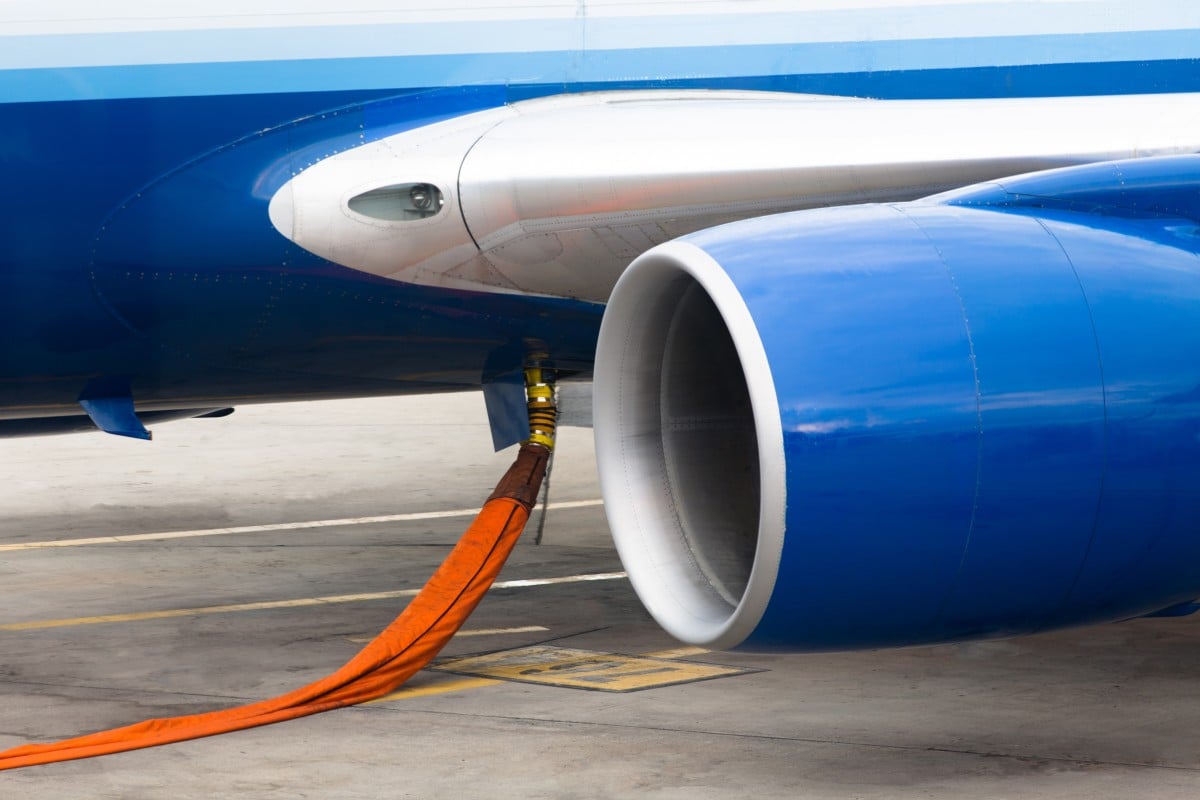
Super-fuel for military aircraft costs nearly 10 times as much as ordinary jet fuel for commercial planes. Photo: Shutterstock
Chinese scientists say they have developed a technology to convert bio-waste into fuel for missiles and hypersonic planes, reducing fuel costs by as much as 60 per cent.
The existing JP-10 super-fuel for military aircraft has numerous advantages including high energy density, good thermal stability and low freezing point, but it costs more than US$7,000 per tonne – nearly 10 times as much as ordinary jet fuel for commercial aircraft.
It is used mainly in cruise missiles and ramjet or scramjet engines on new-generation aircraft travelling at hypersonic speed, or five times faster than sound.
Scientists from the Dalian Institute of Chemical Physics, at the Chinese Academy of Sciences in the northeastern province of Liaoning, predicted using the new technology in the near future could reduce the cost to as low as US$2,547 per tonne.
The secret, according to their paper, published in the latest issue of German chemistry journal Angewandte Chemie, lies in cheap bio-waste.
Using agricultural and forestry residues including bran, chaff and mill dust, Professor Zhang Tao, Li Ning and colleagues discovered new chemical processes that can turn the waste to JP-10 fuel on a large scale with unprecedented efficiency.
At present, the super-fuel comes from coal tar or naphtha, and the synthesis is extremely costly and unfriendly to the environment.
The bio-JP-10 fuel can be produced by two different methods, one involving six steps of chemical reactions and the other only four, according to the paper.
China’s plan to make jet fuel from restaurant leftovers
Combining these methods with the latest technology in biomass conversion, the researchers said, the super-fuel can be mass-produced at a price equivalent to that of some of the bio-jet fuels already in commercial use, thanks to government subsidies provided for their environmental benefits.
“We believe that the future commercialisation of bio-JP-10 fuel is very promising, especially taking policy support and exemption from CO2 emission tax into consideration,” the authors wrote in the paper.
Liu Huoxing, professor at the school of energy and power engineering at Beijing University of Aeronautics and Astronautics, said civilian applications of hypersonic flight technology faced many challenges that remained to be solved, with the problem of high fuel prices being one of the headaches.
“No airline will buy a plane if the fuel costs too much, however fast it can fly,” he said.
Liu, who conducts research on engine technology for
hypersonic vehicles but was not involved in the Dalian study, said the reduction of production costs for jet fuel was usually incremental and it was quite rare to see a significant drop.
“This can be an important development,” he said of the Dalian findings.
China is developing various models of hypersonic speed aircraft for military and civilian use. Some are aimed at flying distances such as Shanghai to Los Angeles in a couple of hours.
Posted in agricultural waste, Angewandte Chemie, Beijing University of Aeronautics and Astronautics, bio-waste, biomass conversion, bran, chaff, cheap, China alert, Chinese Academy of Sciences, civilian applications, coal tar, commercialisation, costly, cruise missiles, Dalian Institute of Chemical Physics, Dalian study, Environment, faster than sound, forestry residues, hours, hypersonic flight technology, Hypersonic speed, jet fuel, JP-10 super-fuel, Liaoning, Los Angeles, mass-produce, Military aircraft, mill dust, missiles, naphtha, ramjet engines, restaurant leftovers, school of energy and power engineering, scramjet engines, Shanghai, super-fuel, synthesis, Uncategorized, unfriendly |
Leave a Comment »



 CHINDIA ALERT: You'll be living in their world, very soon