Chindia Alert: You’ll be Living in their World Very Soon
aims to alert you to the threats and opportunities that China and India present. China and India require serious attention; case of ‘hidden dragon and crouching tiger’.
Without this attention, governments, businesses and, indeed, individuals may find themselves at a great disadvantage sooner rather than later.
The POSTs (front webpages) are mainly 'cuttings' from reliable sources, updated continuously.
The PAGEs (see Tabs, above) attempt to make the information more meaningful by putting some structure to the information we have researched and assembled since 2006.
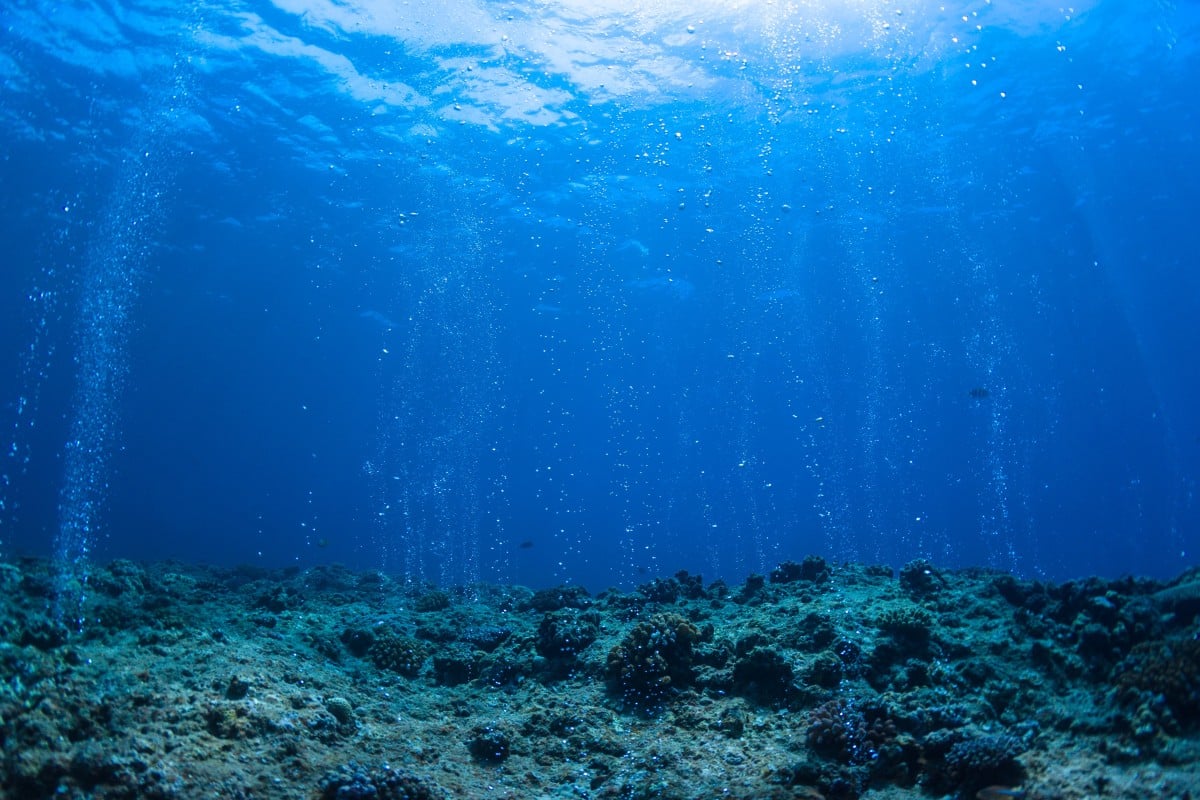
International rules on seabed mining set for approval in 2020, with China most likely to lead the race, UN body says
Governments, research institutions and commercial entities have already signed contracts for the exploration phase to extract minerals from the seabed, with China holding the most. Photo: Shutterstock
China is in pole position for the global race to start deep sea mining operations to extract valuable minerals used in smartphones and electric car batteries from the seabed.
The head of the International Seabed Authority (ISA) said China was likely to become the first country in the world to start mining seabed minerals if the international rules for exploitation were approved next year.
The ISA has already signed 30 contracts with governments, research institutions and commercial entities for exploration phase, with China holding the most, five contracts.
The body, which was established to manage the seabed resources by the United Nations Convention on the Law of the Sea (UNCLOS), is aiming to adopt seabed mineral exploitation rules by July 2020.
As China leads the hunt for deep-sea minerals, environmental concerns surface
“I do believe that China could easily be among the first (to start exploitation),” said Michael Lodge, ISA general secretary, who visited China last week.
“The demand for minerals is enormous and increasing, there is no doubt about the market.”
There is also interest from European countries including Belgium, Britain, Germany and Poland, as well as from the Middle East.
The quest to exploit seabed minerals – such as polymetallic nodules containing nickel, copper, cobalt and manganese – is driven by demand for smartphones and electric car batteries, and the need to diversify supply.
However, no one has yet shown that deep sea mining can be cost effective and some non-governmental organisations have questioned whether it would be possible to reach a deal on exploitation rules next year.
“I think, it’s pretty good. I think the current draft is largely complete,” Lodge said, when asked about prospects of adopting the rules by next July.
One of the issues yet to be agreed is proportionate financial payments to the Jamaica-based ISA for subsea mineral exploitation outside national waters.
“We are looking at ad valorem royalty that would be based on the value of the ore at a point of extraction … The middle range is 4 per cent to 6 per cent ad valorem royalty, potentially increasing over time,” Lodge said.
New iPhone models to use recycled rare earths, Apple says
If the rules are approved, it could take about two to three years to obtain permits to start deep sea mining under the current draft, Lodge said.
Canadian Nautilus Minerals had tried to mine underwater mounds for copper and gold in the national waters off Papua New Guinea, but ran out of money and had to file for creditor protection earlier this year.
This has not deterred others, such as Global Sea Mineral Resources (GSR), a unit of Belgian group DEME, and Canada’s DeepGreen, to continue technology tests and research.
In July, Greenpeace called for an immediate moratorium on deep sea mining to learn more about its potential impact on deep sea ecosystems, but the ISA has rejected such a proposal.
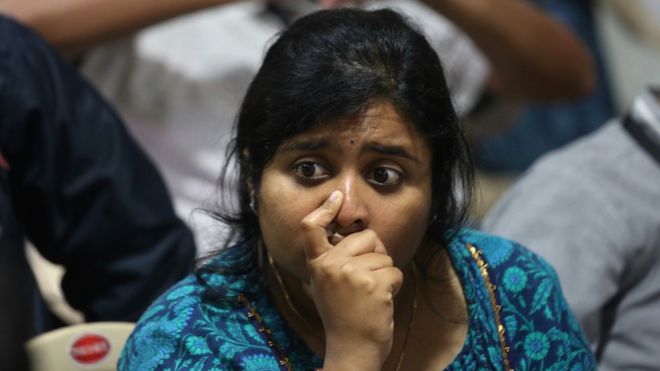
Image copyright EPAImage caption Indian scientists say contact with the lander was lost seconds before it was scheduled to touch down
India’s space agency, Isro, has not yet released information on how it lost contact with its Moon lander seconds before it was due to touch down on the lunar surface. But former members of the agency tell the BBC what may have gone wrong.
Chandrayaan-2 (Moon vehicle 2) entered the Moon’s orbit on 20 August and was due to land on the lunar surface a little after midnight India local time (1800 GMT) on 7 September – a month after it first shot into space.
But contact was lost moments before the lander (named Vikram, after Isro founder Vikram Sarabhai) was expected to touch down at the lunar south pole.
The orbiter has since spotted the lander on the surface of the Moon – unbroken, but tilted on its side. So far, scientists have not been able to establish contact with it.
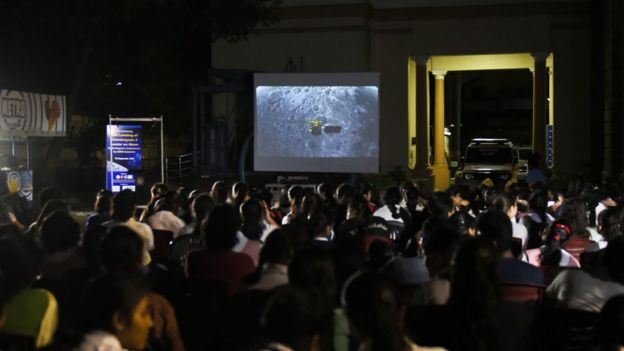
Image copyright GETTY IMAGESImage caption The event was watched by millions across India
The lander’s final heart-stopping descent were monitored on screens, complete with readings which reflected the movement of the lander as it headed towards the surface of the Moon.
The screens carrying the readings also appeared on television and various social media accounts as the landing was broadcast live.
When the countdown began, the lander was moving at a velocity of 1,640 metres per second. Scientists say it appeared to be moving as planned during the first two phases of deceleration, known as the rough braking and fine braking operations.
It was during the final stage, known as the “hovering” stage, that the problem occurred.
The problem could well have been with the lander’s central engine, according to Prof Roddam Narasimha, a former member of Isro. He said that his theory was based on the readings on the screen.
Media caption Modi consoles scientists after India Moon-lander loses contact
“One plausible explanation was that the lander started falling more rapidly,” he told BBC Hindi’s Imran Qureshi. “It’s supposed to come down at a velocity of two metres per second when it hits the Moon’s surface. But the gravity on the moon would have made it fall somewhat more rapidly.”
He believes this could be because the central engine was not “producing the thrust that is required and, therefore, the deceleration was no longer what it was supposed to be”.
And this, in turn, may have led to eventually losing communication with the lander itself.
The head of India’s first Moon mission, Mylswamy Annadurai, also said the anomaly in the velocity profile was an indication that something had malfunctioned in the lander as it hurtled towards the Moon.
“Most likely the orientation [of the lander] could have been disrupted. Once we look at the data we will be able to say for sure what happened, but it is likely that either a sensor or a thruster could have malfunctioned,” he told BBC Tamil.
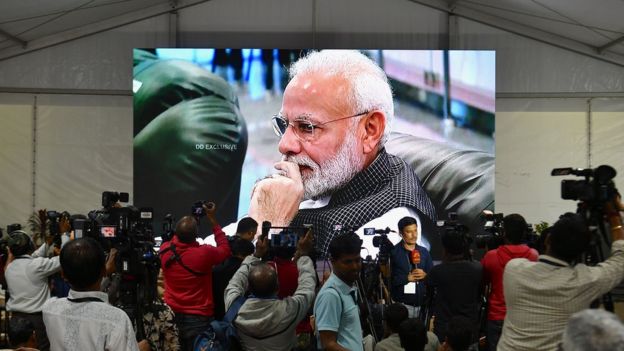
Image copyright GETTY IMAGESImage caption Prime Minister Narendra Modi also watched the event live
Dr Rajeswari Rajagopalan, the head of the Nuclear and Space Policy Initiative of the Observer Research Foundation (ORF), also said an engine malfunction was the likeliest reason.
“In the absence of data parameters, it is difficult to come to a conclusion, but the readings on the screen did show that something was wrong,” she told BBC Hindi.
“The other possibility is that when you do a landing at a higher speed, you cause a lot of dust to rise that also shakes up the spacecraft because of the gravitational pull. But it’s more likely the malfunctioning of one of the engines.”
Chandrayaan-2 was the most complex mission ever attempted by Isro.
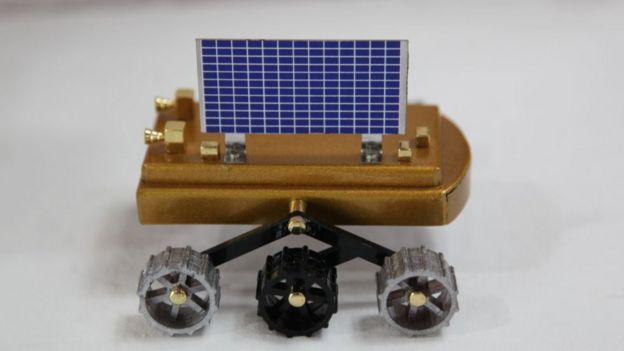
The lander carried within its belly a 27kg Moon rover (called Pragyan, which translates as wisdom in Sanskrit), which included instruments to analyse the lunar soil.
The rover had the capacity to travel 500m from the lander in its 14-day life span, and would have sent data and images back to Earth for analysis.
The mission would have focused on the lunar surface, searching for water and minerals and measuring moonquakes, among other things.
Image copyrigh tGETTY IMAGESImage caption Chandrayaan-2 is a three-in-one mission comprising an orbiter, a lander and a six-wheeled rover
India’s second Moon mission will see the country’s space agency attempt to land a rover on the lunar surface on 7 September. Science writer Pallava Bagla explains how it will reach the Moon and why it is significant.
Why is this mission unique?
Costing $150 million, Chandrayaan-2 will carry forward the achievements of its predecessor Chandrayaan-1 which was launched in 2008 and discovered the presence of water molecules on the parched lunar surface.
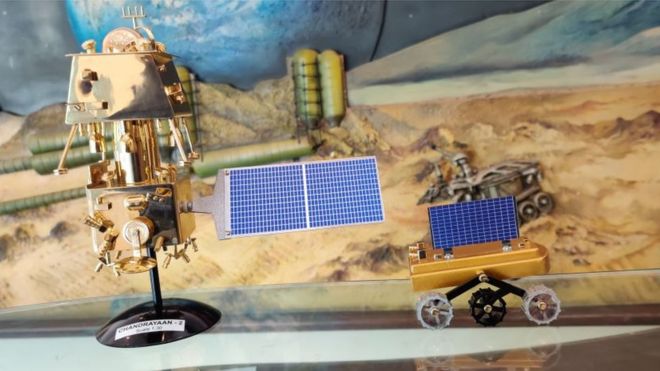
Chandrayaan-2 is a three-in-one mission comprising an orbiter, a lander named Vikram and a six-wheeled rover named Pragyaan.
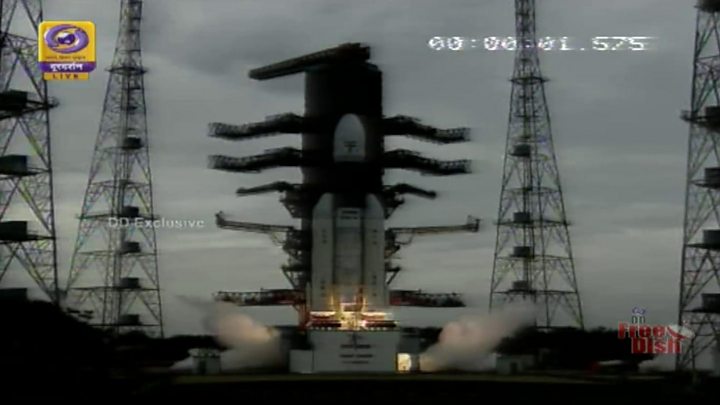
It was launched on 22 July, a week after its scheduled blast-off, which was halted due to a technical snag.
It entered the Moon’s orbit nearly a month later in a tricky operation, completing a series of manoeuvres before its lander was cut loose on 2 September.
Media caption The successful launch of India’s Moon mission
Now, on 7 September, a little after midnight India local time (1800 GMT), the lander which contains the rover will be sent hurtling down to the lunar surface where it is expected to make a landing near the South Pole of the Moon.
The last 15 minutes of the mission, when the Vikram lander will attempt to autonomously guide itself down to the lunar surface with no support from ground control, has been described as “15 minutes of terror” by the head of the Indian Space Research Organisation (Isro), Dr K Sivan.
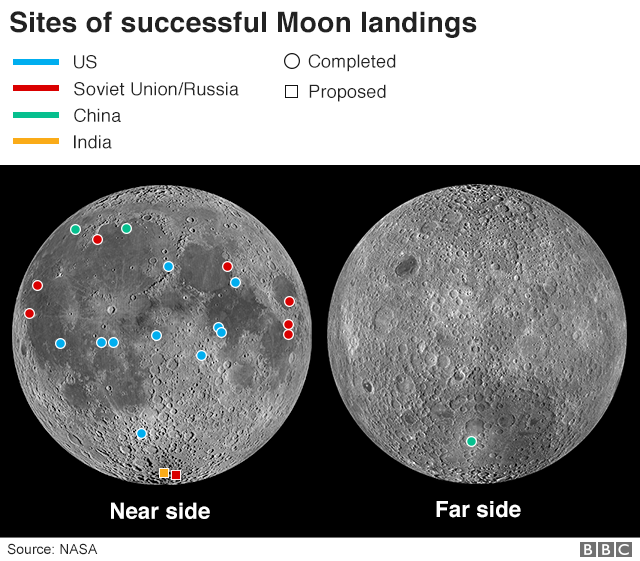
If India does succeed in touching down with the Vikram lander intact, it will become the fourth country to do so after the US, Russia and China.
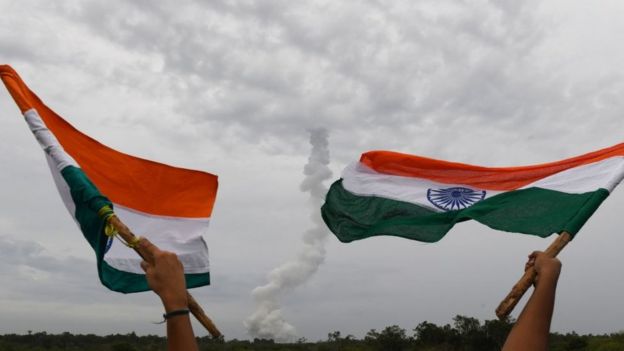
More importantly for Indians, it will mean the nation’s flag will reach the Moon intact.
How will it land on the Moon?
The Moon may be Earth’s closest neighbour, but landing on it is a very tricky operation.
It has no atmosphere worthy of the name, which means parachutes cannot be used to slow the lander’s descent to the surface. The only option therefore is to go in for what is called a “powered descent”.
This means that the velocity of the lander is steadily reduced with its own rocket engines.
The lander will be moving horizontally across the surface of the Moon as it descends. The rocket engines must bring that horizontal movement to a stop whilst at the same time controlling the rate of descent to near zero just before the moment of touchdown.
This is known as a “soft landing”.
Before the final approach, both the orbiter and lander would have surveyed the Moon to find a “sweet spot” with no craters and boulders where it can land.
If the lander does not function properly it could crash land on the Moon surface, like its predecessor Chandrayaan-1 – though this was an intentional crash landing as in 2008 India had not yet mastered how to perform a soft landing.
Media caption Is India a space superpower?
Either way, once the landing happens and the lunar dust that may have been kicked up settles, the ramp opens up and the rover is very gently wheeled out.
The rover will then “Moon walk” at the princely speed of one centimetre per minute. It can travel a maximum of 500m (1,640ft) from the lander.
Both the lander and rover are powered with solar batteries and carry three instruments apiece.
What will the lander do?
The lander will, among other things, measure Moon quakes in its vicinity and do a thermal profile of the lunar “soil”. Meanwhile, the rover will further analyse the lunar soil.
The rear wheels of the rover are imprinted with the national emblem – the Ashoka Chakra – and the Isro logo, which means a permanent mark of India’s visit will be left on the surface of the Moon.
But the extreme temperatures on the Moon’s surface are a real challenge to the mission.
Image copyright GETTY IMAGESImage caption The rover will “Moon walk” at a speed of one centimetre per minute
When the Sun shines, the lunar temperature can cross 100C and when it sets the temperature can drop to -170C.
As their batteries must be recharged with sunlight, the nominal life of both the rover and lander is expected to be one lunar day, since Isro is not sure if they can survive the ultra-cold temperatures of the long cold lunar night which lasts 14 days.
Both will send back photos of each other so the first Indian “selfies” from the lunar surface are expected soon after they land.
Why is the South Pole of the Moon significant?
The South Pole of the Moon is still a largely unexplored area, and India is targeting a spot that no other landing craft has reached so far. The mission will attempt to soft land its rover and lander in a high plain between two craters – Manzinus C and Simpelius N – at a latitude of about 70° south.
Most earlier missions including the Apollo manned missions targeted the equatorial region of the Moon.
Isro says the lunar South Pole is especially interesting because the surface area that remains in shadow here is much larger than that of the Moon’s North Pole. This means that there is a possibility of water in areas that are permanently shadowed.
In addition, the South Pole region has craters that are cold traps and contain a fossil record of the early Solar System.
This unexplored region is also especially important because in the near future, possibly by 2024, the US space agency Nasa aims to place boots back on the Moon through its Artemis Mission, and wants to target landing near the South Pole.
India’s mission will therefore give the Americans much needed data of this unchartered territory.
Why will the orbiter circle the Moon for a year?
The Chandrayaan-2 orbiter is expected to circle the Moon for a further year.
During that time, it will map lunar minerals, take high resolution photos and search for water on the lunar surface in the most detailed fashion till date by any lunar craft, using an infra-red imager and radars.
Image copyright GETTY IMAGESImage caption The imprints of India’s national emblem and the Isro logo will be left on the Moon by the rover
The high resolution camera will help make a digital terrain map of the moon
It will also analyse the thin lunar atmosphere.
There is also the possibility that the orbiter may last longer than a year, as Isro says it has made suitable savings in fuel. But once its fuel runs out, the orbiter will become a long-lasting Indian-made lunar satellite.
India hopes the $145m (£116m) mission will be the first to land on the Moon’s south pole.
Last month’s launch was the beginning of a 384,000km (239,000-mile) journey. Scientists hope the lander will touch down on the Moon on 6 or 7 September as planned.
India’s first lunar mission, Chandrayaan-1, was launched in 2008 but it did not land on the lunar surface. However it carried out the first and most detailed search for water on the Moon using radars.
Chandrayaan-2 (Moon vehicle 2) will try to land near the little-explored south pole of the Moon.
The mission will focus on the lunar surface, searching for water and minerals and measuring moonquakes, among other things.
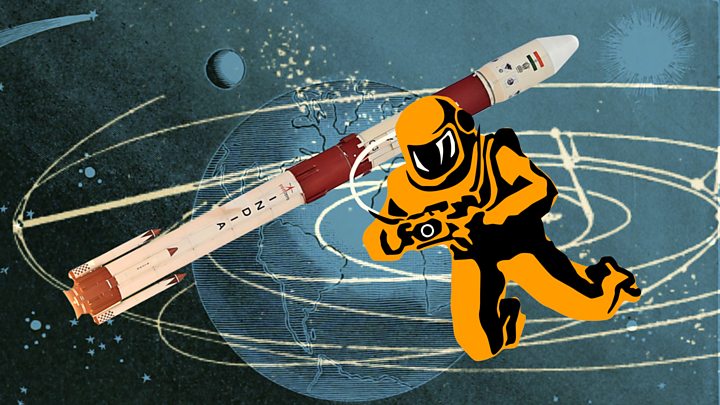
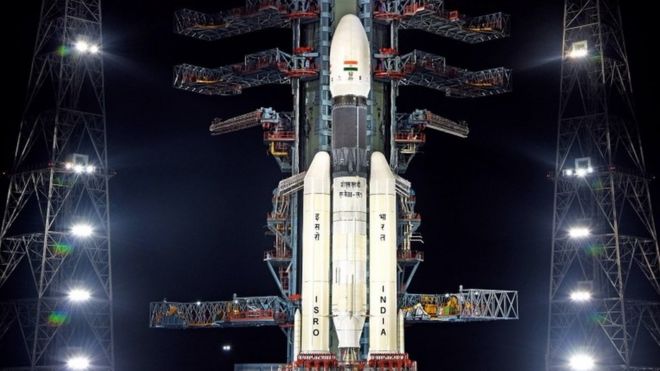
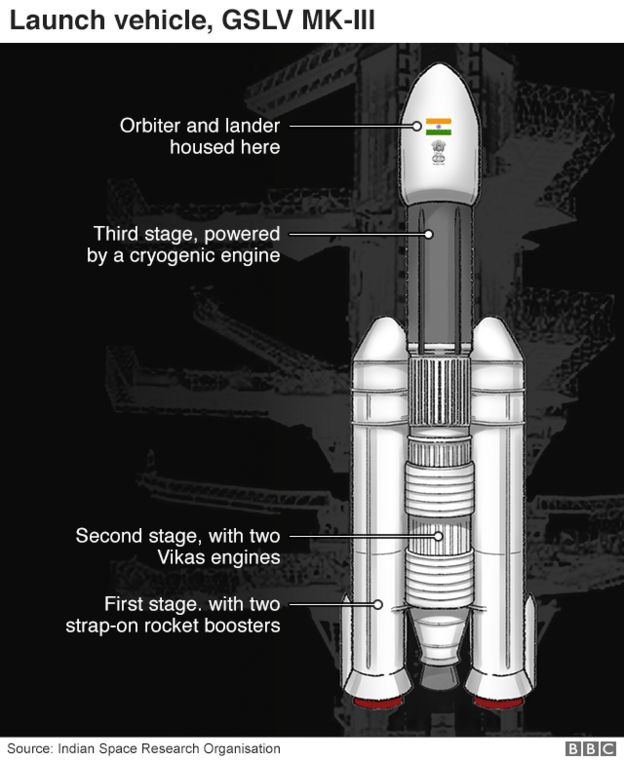
India used its most powerful rocket, the Geosynchronous Satellite Launch Vehicle Mark III (GSLV Mk-III), in this mission. It weighed 640 tonnes (almost 1.5 times the weight of a fully-loaded 747 jumbo jet) and, at 44 metres (144ft), was as high as a 14-storey building.
The spacecraft used in the mission has three distinct parts: an orbiter, a lander and a rover.
The orbiter, which weighs 2,379kg (5,244lb) and has a mission life of a year, will take images of the lunar surface.
The lander (named Vikram, after the founder of Isro) weighs about half as much, and carries within its belly a 27kg Moon rover with instruments to analyse the lunar soil. In its 14-day life, the rover (called Pragyan – wisdom in Sanskrit) can travel up to a half a kilometre from the lander and will send data and images back to Earth for analysis.
Media caption Is India a space superpower?
How long is the journey to the Moon?
The journey of more than six weeks is a lot longer than the four days the Apollo 11 mission 50 years ago took to land humans on the lunar surface for the first time.
In order to save fuel, India’s space agency has chose a circuitous route to take advantage of the Earth’s gravity, which will help slingshot the satellite towards the Moon. India does not have a rocket powerful enough to hurl Chandrayaan-2 on a direct path. In comparison, the Saturn V rocket used by the Apollo programme remains the largest and most powerful rocket ever built.
“There will be 15 terrifying minutes for scientists once the lander is released and is hurled towards the south pole of the Moon,” Isro chief K Sivan said prior to the first launch attempt.
He explained that those who had been controlling the spacecraft until then would have no role to play in those crucial moments. So, the actual landing would happen only if all the systems performed as they should. Otherwise, the lander could crash into the lunar surface.






 CHINDIA ALERT: You'll be living in their world, very soon