Chindia Alert: You’ll be Living in their World Very Soon
aims to alert you to the threats and opportunities that China and India present. China and India require serious attention; case of ‘hidden dragon and crouching tiger’.
Without this attention, governments, businesses and, indeed, individuals may find themselves at a great disadvantage sooner rather than later.
The POSTs (front webpages) are mainly 'cuttings' from reliable sources, updated continuously.
The PAGEs (see Tabs, above) attempt to make the information more meaningful by putting some structure to the information we have researched and assembled since 2006.
Rahul Ganghi at a rally in Sriganganagar, Rajastan, on Tuesday. (Congress/Twitter)
Congress president Rahul Gandhi on Tuesday said the promise of minimum income guarantee is his party’s “surgical strike on poverty” that will ensure there is no poor in the country after 2019. Gandhi said the Congress’s promise of minimum income guarantee is “an explosion”.
“It will set off a bomb…This is the Congress’s surgical strike on poverty. They (the BJP) tried to eliminate the poor. We will eliminate poverty,” said Gandhi at a public rally in Rajasthan’s Ganganagar.
‘Surgical strike on poverty’: Rahul Gandhi counters BJP on minimum income promise
A day after the Bharatiya Janata Party tried to discredit the Congress’ promise of a minimum income guarantee scheme in case it comes to power, Congress President Rahul Gandhi countered the BJP’s criticism.
Gandhi hit out at the Narendra Modi government in his speech alleging that the current regime has brought back people who were uplifted from the below poverty line by the Congress-led UPA rule. “The fact that 25 crore people are living in poverty in the 21st century India is a shame,” Gandhi said.
The Congress president said nowhere such a scheme has ever been implemented. “There should not be a single poor person in the country,” he said addressing the Congress’s Jan Sankalp Rally at Suratgarh in Ganganagar district.
On Monday, Gandhi promised that his party would, if it comes to power, guarantee an income of at least Rs 12,000 a month for 20 per cent of India’s poorest families by giving them Rs 6,000 a month. He said the minimum income guarantee scheme, named NYAY (standing for Nyuntam Aay Yojana) meaning justice, would cover 5 crore families or 25 crore people, who constitute the poorest 20 per cent of Indian households.
The scheme, if implemented, is expected to cost Rs 3.6 lakh crore, around 2 per cent of India’s GDP. Gandhi has insisted that it is fiscally prudent.
At his Rajasthan rally, Gandhi said Prime Minister Narendra Modi has tried to “create two Indias” in the last five years giving all the benefits of the government to select few rich people while insisting that if voted to power, the Congress will eradicate poverty completely.
“If Narendra Modi can give money to the rich, the Congress will give money to the poor,” said Gandhi, who also took a swipe at the prime minister’s chowkidar campaign. The Congress president said PM Modi is a chowkidar but “serves rich people like Anil Ambani instead of the poor”.
The BJP has rejected the minimum income guarantee promise of Gandhi with Union Finance Minister Arun Jaitley calling it a “bluff announcement” in his blog. Jaitley also said that the total promised by the Congress (Rs 72,000 a year) is just around two-thirds of what the NDA gives the poor.
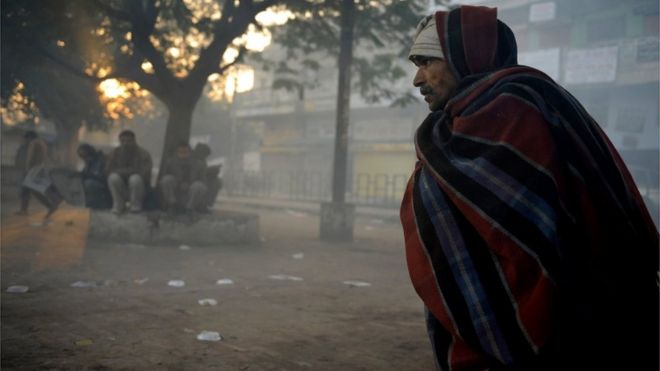
Image copyrightAFPImage captionMillions of Indians remain vulnerable to income shocks
India’s opposition Congress Party has promised to guarantee a minimum income for the country’s poor if it wins the upcoming summer elections.
So will this scheme be a game-changer and bolster the fortunes of the Congress party? (There are rumours that the BJP is primed to announce a similar scheme soon) Or does it risk becoming a handout, fuelled by populism, mired in confusion and blighted by misallocation?
The details of the minimum income plan will be only revealed in the party manifesto, which is due soon.
The Congress’s scheme essentially promises a basic income support for India’s poorest households after fixing an income eligibility threshold. It is also likely to be progressive in nature: if the household is entitled to, say 50,000 rupees ($700; £534) a year, and it already earns 30,000 rupees, it will receive 20,000 rupees as income support. So the poorer the family, the more income support it will get.
Abhijit Vinayak Banerjee, a professor of economics at MIT, told me that there is “a lot of sympathy for the minimum income guarantee in purely ethical terms”. But, he says, there will be a lot of challenges in implementing it in a vast and complex country like India.
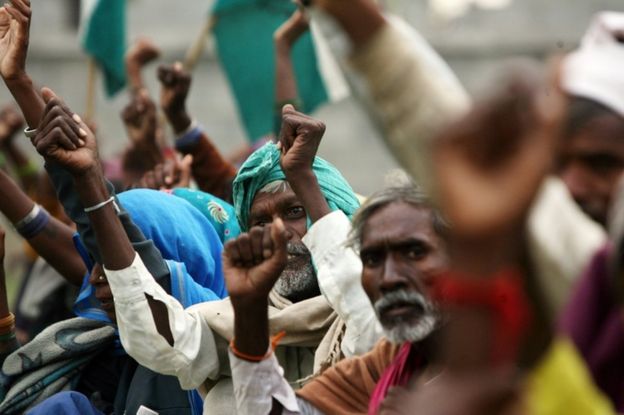
Image copyrightAFPImage captionThe gap between the rich and poor has widened in India
For one, what happens to India’s massive rural employment guarantee programme? The Mahatma Gandhi National Rural Employment Guarantee Scheme (MNREGA) also promises a minimum income to every rural household by providing at least 100 days of guaranteed wage employment in a financial year. Will the new scheme also count income from the rural programme? What happens if someone stops going for rural work?
“Our research suggests this is where the poor often lose out and the less poor make hay, partly – but probably not mostly – because of corruption, but also because the less poor are better at figuring out how to make claims,” says Prof Banerjee.
Then there’s the problem of what economists call the “moral hazard” – undue risks that people could take if they don’t have to bear the consequences of it.
‘Lack of incentive’
Welfare schemes, many economists believe, can end up trapping people in poverty. One criticism of guaranteed income support is that it reduces the incentive to work – generations of families stay on welfare in the US because there’s no incentive to come out of it.
Economist Vivek Dehejia wonders whether something similar could happen with this scheme. “If you fix a household income eligibility threshold of 10,000 rupees a month to be eligible for income support, what incentive do you have rise above it,” he says.
There are also questions about where India will find the money to support such a scheme – we are talking about hundreds of millions of eligible families who will have to be paid.
India already has more than 900 federally funded schemes – like cheap food, fertiliser subsidies, rural jobs guarantee, crop insurance, student scholarships – accounting for about 5% of the GDP by budgetary allocation. Many of these schemes are marred by leakage, wastage, exclusion of the eligible, and even fraud.
Economists wonder whether the vast amount of money required for the new income scheme will come from pruning subsidies and existing welfare schemes, which are always politically difficult.
“A lot thinking and working has gone into the income scheme,” Praveen Chakravarty, head of the data analytics department of the Congress party, told me. “It is fiscally doable without drastic reduction of existing welfare schemes”.
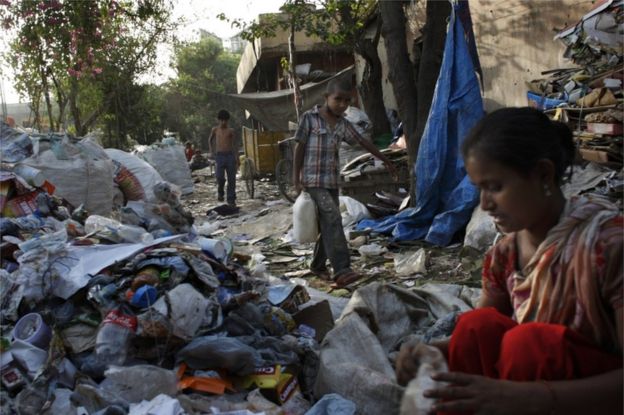
Image copyrightAFPImage captionGuaranteed basic income is intended to pull more people out of poverty
So the plan is to apparently find money for it through expenditure reduction (trimming wasteful government expenditure?) and “new revenue streams” (new taxes?). Both are going to be daunting tasks.
Vivek Dehejia says the scheme would make financial sense if it subsumes other welfare schemes and subsidies. Otherwise, he says, it will “become another handout, and will not help fix India’s poorly sorted out welfare architecture”.
Clearly, the scheme, inspired in part by the Brazil’s Bolsa Familia or Family Grant to lift people out of poverty will also reignite the debate over cash transfers to the poorest, who, some believe, often do not have enough fiscal knowledge and information to handle money. However. the Indian scheme will be unique because Bolsa Familia is a conditional transfer of money
Test for the state
Supporters of cash transfers say they reduce poverty, give the poor the choice to spend as they think best, targets better, and acts as a buffer against shocks. It also improves financial inclusion, and by helping the poor to consume more, boosts the GDP. Other economists, most notably Nobel laureate Amartya Sen, believe that people in a market driven economy will spend more on private education and healthcare if the state gives them a minimum income.
Any which way, handing out guaranteed income in a vast and complex country in India will remain a formidable challenge, irrespective of the government in the power. It will be a test for the Indian state.



 CHINDIA ALERT: You'll be living in their world, very soon