10/04/2020
BEIJING (Reuters) – China will promote the sales of export products in domestic markets, as foreign trade faces unprecedented challenges due to the coronavirus pandemic, an assistant commerce minister said on Friday.
As the coronavirus spreads to almost all of China’s trading partners, the world’s second-largest economy is set to reach a grim milestone for full year growth, with the pace of expansion likely to be the slowest since the Cultural Revolution ended in 1976. And, the export sector is facing millions of job losses and factory shutdowns.
“Due to the rapid spread of the epidemic in the world, foreign demand has slumped and the biggest difficulty facing foreign trade companies is the plunge in orders,” said Ren Hongbin, the assistant minister at the Ministry of Commerce.
He said firms across the board have had their orders cancelled or delayed, and new orders are “very hard to sign”.
“The uncertainty about the pandemic has become the biggest uncertainty for foreign trade development.”
Forecasters expect China’s 2020 growth could be nearer the 2.0% mark – the slowest in over 40 years – due to the sweeping impact of the pandemic both at home and overseas. The economy grew 6.1% last year.
China’s overseas shipments fell 17.2% in January-February from the same period a year earlier, marking the steepest fall since February 2019. Imports sank 4% from a year earlier.
Among the government measures to support the sector, China is accelerating efforts to build online trade fairs and guiding exporters to work with e-commerce retailers for sales in domestic markets and coordinating with its trading partners to stabilise supply chains, said Ren.
The Canton Fair, China’s oldest and biggest trade fair due to take place online, will feature live-streaming services for participants, Li Xingqian, another commerce ministry official, told the same briefing. The fair was originally scheduled to begin on April 15, but was postponed due to the coronavirus outbreak.
China is willing to boost trade relations with other countries, including the United States, under the new circumstances, said Ren, adding that Beijing hopes to work together with Washington to promote bilateral trade.
Both countries have been engaged in a near two-year long trade war with tit-for-tat tariffs on each other’s goods, before negotiators called a truce with an interim trade deal in January.
Source: Reuters
Posted in 0, 1, 10, 11, 12, 13, 14, 15, 16, 17, 18, 19, 1976, 2, 20, 21, 22, 23, 24, 25, 26, 27, 28, 29, 3, 30, 31, 4, 5, 6, 7, 8, 9, April, batters, Beijing, bilateral trade, cancelled, Canton Fair, challenges, China, China’s, Commerce minister, companies, coronavirus, coronavirus outbreak, Coronavirus pandemic, Cultural Revolution, delayed, domestic markets, domestically, encourages, epidemic, export goods, export products, export sector, Factory, February, foreign demand, foreign trade, global, imports, interim trade deal, January, job losses, live-streaming services, milestone, millions, Ministry of Commerce, Negotiators, oldest and biggest trade fair, online, orders, overseas shipments, pandemic, plunge, promote, Sales, shutdowns, slumped, spreads, tit-for-tat tariffs, Trade, trade war, trading partners, Uncategorized, uncertainty, United States, unprecedented, Virus, Washington, World, world’s second-largest economy |
Leave a Comment »
09/04/2020
BEIJING, April 9 (Xinhua) — The third China International Import Expo (CIIE) plans to double the size of its medicine and medical equipment section from that of last year’s event, and nearly 60 Fortune 500 companies and industry giants have signed up for the section, an official said Thursday.
Over 80 percent of the planned area for this section has been booked, Gao Feng, spokesperson of the Ministry of Commerce, told a press briefing.
The section will display items such as drugs, medical equipment, elderly care, health food and medical services. A few companies will present epidemic control products including extracorporeal membrane oxygenation machines, invasive and non-invasive ventilators, thermometers and protective face masks, said Gao.
More than 1,000 exhibitors worldwide have signed up for the third CIIE scheduled to be held in Shanghai from Nov. 5 to 10, occupying 60 percent of the exhibit space.
Source: Xinhua
Posted in China International Import Expo (CIIE), companies, drugs, Elderly care, epidemic control products, exhibitors, extracorporeal membrane oxygenation machines, health food, medical equipment, medical services, medicine and medical equipment, Ministry of Commerce, Nov, protective face masks, Shanghai, thermometers, third CIIE, Uncategorized, ventilators, worldwide |
Leave a Comment »
24/02/2020
BEIJING, Feb. 24 (Xinhua) — With the positive trend of containing the outbreak of novel coronavirus illness (COVID-19), China is meticulously expanding business operations with a precise approach that attaches different priorities to regions in light of their health risks.
A total of 11 newly confirmed cases of COVID-19 were reported Sunday outside Hubei Province, the center of the outbreak, while 24 provincial-level regions didn’t report newly confirmed cases, according to the National Health Commission Monday.
As more provincial-level regions have been reporting no newly confirmed cases for longer streaks, more local governments are starting to lower their emergency response to fast-track the restoration of economic and social order.
While high-risk regions still need to be fully committed to epidemic prevention and control, regions with relatively low risks are encouraged to focus on forestalling cases brought in from elsewhere and comprehensively restoring the order of production and life, said a meeting Sunday.
Coastal province Fujian has divided the 88 cities and counties into four groups, ranging from regions with over ten infections to regions with none, and adopted differentiated measures to better fight the outbreak and mitigate the impact on the economy.
Changting County in Fujian, for instance, which has no confirmed cases of infection, has seen most of the key enterprises resume production.
The country has pledged efforts such as arranging customized trains for migrant workers, smoothing the traffic, enhancing credit support and alleviating social security burden on employers to bring enterprises back on track.
Shanghai Municipality has rolled out 28 policies to provide targeted fiscal support, tax and fee cuts, as well as epidemic-prevention supplies for local enterprises, ferrying them through rough patches.
Foreign companies will also benefit from the supportive policies and be treated on the same footing as other types of enterprises, said Xu Wei, spokesperson for the Shanghai municipal government.
The operation resumption rate of 51,000 foreign-funded enterprises in Shanghai is nearly 70 percent, while that of the regional headquarters of 217 multinational companies is as high as 93 percent.
Wyeth Nutrition, a Sino-U.S. joint venture with its headquarter in Shanghai, is operating at its capacity to supply infant formula in China.
“The local commerce department has built a green channel for us, ensuring smooth operation of our supply chains and product delivery in the Yangtze River Delta,” said Cao Jingheng, vice president of the company.
Foreign firms and firms are high on the agenda of Chinese government agencies when formulating preferential policies.
The Ministry of Commerce has promised to strengthen services and guarantees to foreign-funded enterprises while the General Administration of Customs vowed efforts to optimize the port business environment and promote reciprocal market opening up.
Now with the country gradually heading back to work, many are confident that the potential economic blow brought by the national production halt is expected to be only a short-term, one-off hit against China’s solid economic foundation.
The epidemic might disturb economic activities in the first quarter of this year, but the economy is likely to steady shortly after the epidemic is contained, as the unleashing of pent-up demands will make up for previous weak economic performance, said Pan Gongsheng, vice governor of the People’s Bank of China, the central bank.
International Monetary Fund Managing Director Kristalina Georgieva said Saturday that she expects China’s economy to “return to normal in the second quarter” of 2020.
“As a result, the impact on the world economy would be relatively minor and short-lived,” Georgieva said.
Source: Xinhua
Posted in Beijing, Central bank, corporate China, COVID-19, epidemic, Fujian, gears up, hubei province, International Monetary Fund, Ministry of Commerce, National Health Commission, operation restoration, People's Bank of China, Shanghai Municipality, Uncategorized, Wyeth Nutrition |
Leave a Comment »
23/02/2020
BEIJING, Feb. 22 (Xinhua) — Supply of daily necessities has been stable in China, including the epidemic-hit Hubei Province, despite the ongoing novel coronavirus outbreak that heavily impacted daily life and factory activities, an official with the Ministry of Commerce said Saturday.
With more Chinese returning to work, more than 95 percent of the chain supermarkets and about 90 percent of the large fast-food chains have opened to customers, Wang Bin with the commerce ministry told a press conference.
Meanwhile, around 80 percent of the chain convenience stores and 80 percent of the large wholesale farm produce markets nationwide have resumed operation, along with many farmers’ markets and grocery stores.
In China’s 50 key wholesale farm produce markets, vegetable transaction volume on Friday jumped 26.4 percent from the beginning of the month, he said.
In contrast, other retailers are getting back to service at a slower pace. For instance, only 50 percent of the department stores and shopping malls have so far opened for business, according to Wang.
For Hubei, especially the provincial capital Wuhan where the epidemic first broke out with the largest number of infections, Wang said while the epidemic did cause some difficulties, the local market is generally stable with stocks of grain, meat and vegetables on the rise.
Local authorities in Wuhan have ordered online purchase, group buying and direct delivery services to provide daily necessities to residents kept indoors by the epidemic.
Up to 80 percent of communities in the city’s central districts are covered by group buying services from shops and supermarkets, he said.
To ensure food price stability in the epidemic-hit Hubei, Wang said the commerce ministry has ordered 150 key food producers, including state-owned food group COFCO and major pork producer Shuanghui, to provide over 600,000 tonnes of food to the region.
For the next stage, Wang said the authorities will work on product circulation, farm product sales and further resumption of wholesale markets to both help farmers sell their produce while ensuring daily supplies for residents amid the epidemic.
Source: Xinhua
Posted in chain convenience stores, chain supermarkets, Daily necessity, department stores, epidemic, farmers' markets, fast-food chains, grocery stores, hubei province, infections, Ministry of Commerce, retailers, stable, supplies, Uncategorized, vegetable transaction volume, wholesale farm produce markets, Wuhan |
Leave a Comment »
21/02/2020
- China Passenger Car Association said sales fell to just 4,909 units in the first 16 days of February, from 59,930 in the first quarter of 2019
- The growth rate for China’s imports and exports is expected to decline sharply in the January-February period
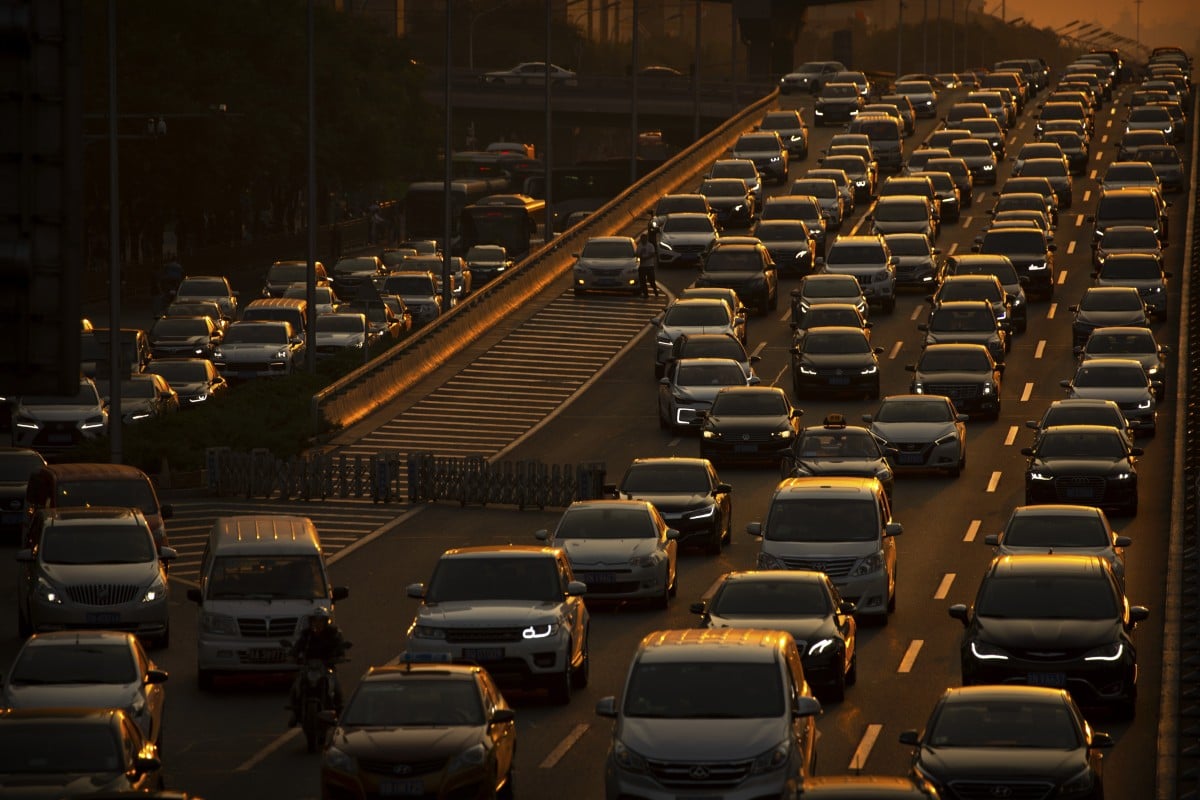
Commuters make their way along an expressway during rush hour in Beijing. Photo: AP
A 92 per cent drop in car sales in China in the first half of February provided the first real indicator of the economic impact of the coronavirus epidemic, with officials also warning of a sharp decline in Chinese exports and imports for the first two months of the year.
The China Passenger Car Association (CPCA) on Friday said that sales dropped to just 4,909 units in the first 16 days of the month, down from 59,930 vehicles in the same period a year earlier.
“Very few dealerships opened in the first weeks of February and they have had very little customer traffic,” said the CPCA.
China’s car market is likely to see sales slide more than 10 per cent in the first half of the year due to the outbreak, and around 5 per cent for the whole year, provided the virus is effectively contained before April, the country’s top industry body, the China Association of Automobile Manufacturers (CAAM), said last week.
Chinatowns around the world feel effects of coronavirus fears
The sector was already under pressure from the cooling economy, with car sales falling 3 per cent in 2018 in the first sales contraction since the 1990s, and 8.2 per cent in 2019, CAAM said.
“We must firmly believe that China’s auto market still has great development space and potential, and the automobile consumption demand is still strong,” Wang Bin, vice-director of the commerce market operation department at the commerce ministry, said on Thursday.
To stabilise the market, in which more than 25 million vehicles were sold last year, China’s commerce ministry said it will introduce more measures to
boost consumption.
Li Xingqian, head of foreign trade at the Ministry of Commerce, said the growth rate for China’s exports and imports would decline sharply in the January-February period due to a collapse in logistics and the delayed
start of work following the extended Lunar New Year holiday, which was aimed at controlling the coronavirus outbreak.
“The impact of the epidemic on the first quarter is here objectively, should not be underestimated, but [growth] is still within the tolerable range,” he said on Friday. “As the
prevention and control [measures] achieve new staged results, foreign trade will inevitably resume its growth. China’s
foreign trade development is expected to remain within a reasonable range throughout the year.”
China cancelled the release of its January trade data, with the General Customs Administration of China saying it will combine January and February’s data in an effort to remove
seasonal volatility from the Lunar New Year period. Statistics will be released in early March.
Trade is traditionally volatile over the first two months of the year in China. Shipments are heavily affected by the Lunar New Year break, with this volatility to be exacerbated by the coronavirus outbreak, which causes the disease officially known as Covid-19.
Zong Changqing, head of the commerce ministry’s foreign investment department, also conceded the virus could hit inward investment over the entire first quarter of 2020. Zong claimed the impact would only be temporary, and that China remained an attractive environment for foreign investment.
Foreign direct investment (FDI) in China in 2019 rose 5.8 per cent from a year earlier to 941.5 billion yuan (US$134 billion), according to the commerce ministry. FDI in China also saw a steady year-on-year increase of 4 per cent last month, compared with a growth of 4.8 per cent registered in January 2019.
The impacts of the outbreak on foreign investment have begun to show, and are expected to become greater in February and March. Zong Changqing
“The impacts of the outbreak on foreign investment have begun to show, and are expected to become greater in February and March,” Zong said.
He confirmed that the ministry asked local authorities in Shandong province to push all 32 South Korean-owned car parts companies to restart production by the end of last week to keep the global supply chain stable.
He also said that over 80 per cent of key foreign-owned enterprises in Shanghai, Shandong and Hunan province had reopened, with most regions expected to restore production by the end of February, provided the spread of the virus is contained.
However, a survey by the American Chamber of Commerce in Shanghai, released earlier this week, found that in the vast majority of cases, factories that have reopened are running at a fraction of their production capacity.
Source: SCMP
Posted in car sales collapse, China Association of Automobile Manufacturers (CAAM), China Passenger Car Association, China Passenger Car Association (CPCA), Chinatowns, coronavirus epidemic, exports and imports, Foreign Direct Investment (FDI), foreign trade development, General Customs Administration of China, global supply chain, Hunan Province, lunar new year, Ministry of Commerce, prevention and control [measures], seasonal volatility, shandong province, Shanghai, sharp trade decline, South Korean-owned car parts companies, Uncategorized |
Leave a Comment »
20/02/2020
- Eyeing large profits, Indian manufacturers are scrambling to meet the demand from countries such as China and Malaysia
- But this new focus on exports means the domestic market is being underserved, and substandard masks are hitting shelves
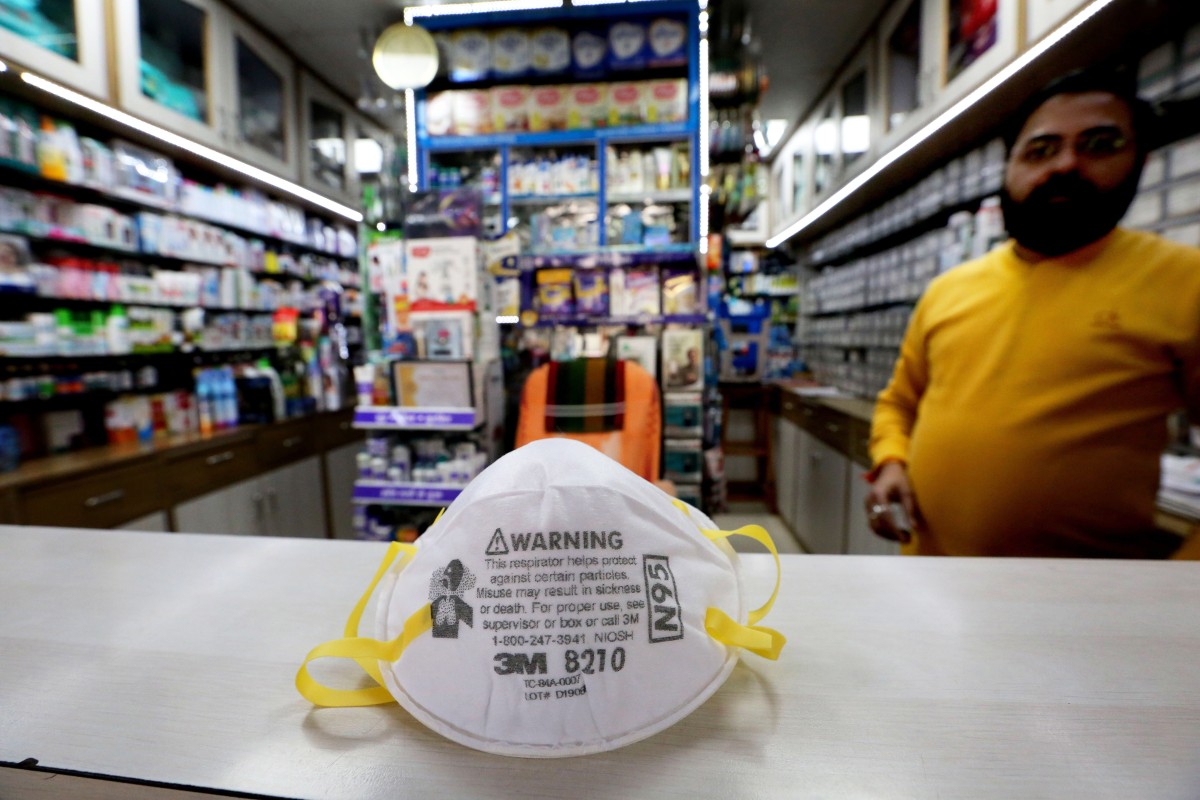
A vendor shows an N95 face mask at medical store in Bhopal, India. Photo: EPA
manufacturers and distributors of surgical face masks are currently in overdrive to meet a surge in global demand for protective gear amid the coronavirus outbreak.
With an eye on enormous profits, these suppliers have turned their focus to exports,
– causing a chronic local shortage of masks due to the relatively lower margins in the domestic market.
Indian manufacturers produce 240 million disposable masks every year, primarily for domestic use, as per the estimates of the Association of Indian Medical Device Industry.
There are no large-scale manufacturers of surgical masks in the country; the landscape is dominated by more than a dozen medium-sized companies with a production capacity of between 20,000 and 100,000 masks a day.
China, Asean foreign ministers begin emergency meeting on coronavirus in Vientiane
The production cost of a mask is estimated to be 1 rupee (less than 2 US cents), and masks were sold for 2-4 rupees at retail outlets a month ago. As of this week, the price of a surgical mask has skyrocketed to 15 rupees.
In some regions where there is a shortfall, retail stores are reportedly demanding as much as 50 rupees. Some experts, meanwhile, say exporting masks to coronavirus-threatened Asian countries where masks are in high demand could fetch firms up to US$15 per mask.
China has so far imported over 1.2 billion masks to meet soaring demand, according to the Ministry of Commerce.
Manoj Rajawat – director of Orthosut Biomedical and Engineering Company, which distributed about 500,000 masks every month before the surge in demand – estimates that nearly 90 per cent of masks manufactured in India in recent weeks have been exported to countries such as China,
Malaysia and
Singapore.
“The value of the exported masks could [easily be more than 50] times what it was before the virus outbreak in China,” Rajawat said.
More than 75,000 people have been infected with the coronavirus, the vast majority of them on mainland China, and more than 2,000 patients have died with more than 16,000 staging a full recovery. This includes India’s three cases of infection, which were discovered in Kerala and have since been cured.
To allay fears of a domestic shortage, the Indian government briefly banned exports of masks and protective gear earlier this month, when the country’s first case of coronavirus infection was confirmed. A week later, however, the ban was partially lifted for two- and three-ply masks as the demand for such protective equipment kept rising overseas.
Multiple Indian ministries are closely monitoring the situation, but are reluctant to comment on specific issues beyond releasing official notifications.
Coronavirus: Anxious Asian countries want China flight ban, says new poll
“Indian manufacturers have exponentially increased their production of masks. With the government lifting the restrictions on exports, [these firms] are also catering to international demand, somewhat focusing more on exports as it seems more beneficial,” said Vivek Tiwari, chief executive of Medikabazaar, a business-to-business online platform for medical supplies and equipment.
However, experts and observers such as Prasad Danave, president of the Retail and Dispensing Chemist Association, say Indian manufacturers are not equipped to deal with the sudden demand for such large quantities.
“I talked to one of the manufacturers and his capacity to produce disposable masks is 20,000 pieces per day. Suddenly, two purchasers approached him asking for 2 million masks and 5 million masks respectively. It is impossible to cater to such a need immediately,” Danave said.
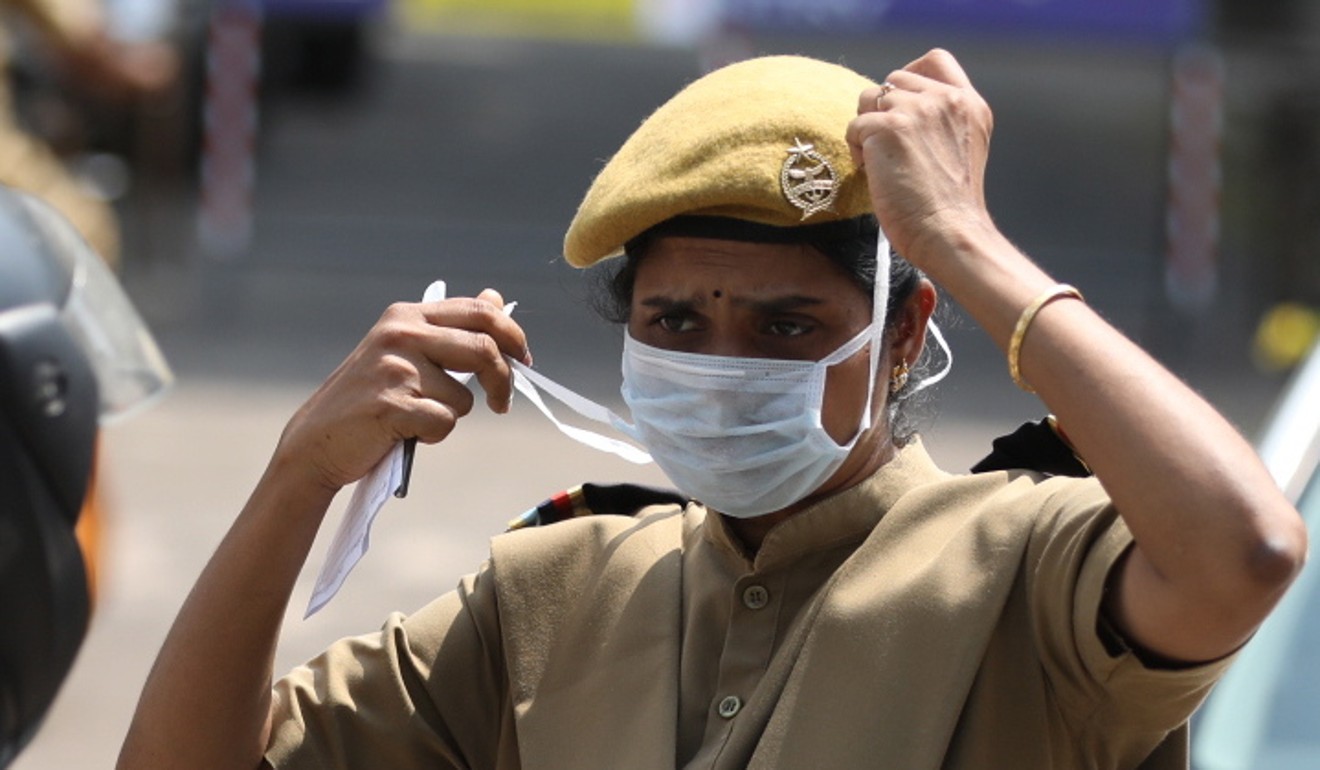
A police officer in Kochi, India wears a face mask amid fears of the coronavirus outbreak. Photo: EPA
The N95 respirator, an industrial-purpose face mask, is in huge demand as people seek to protect themselves from the coronavirus. Alcohol-based hand sanitisers are also flying off shelves, while there are also concerns of panic buying and shopkeepers hyping up demand for their products to capitalise on the situation.
Abhay Pandey is the national president of the All Food and Drug Licence Holder Foundation, an industry organisation which represents about 7,000 pharmaceutical suppliers across India. He said vendors are distributing substandard face masks to domestic consumers due to a shortage of production time given the increased demand, as well as the lack of a credible mechanism to ensure standards.
Coronavirus: Japan scientist stands by ‘chaotic’ criticism of cruise ship quarantine
“There’s a micro-filter which is usually fitted between two layers in the three-ply face masks used by doctors during surgical procedures. Now, the suppliers are preparing substandard face masks without this filter for the Indian market, and for exports they’re sending the good quality ones,” Pandey said.
Mask makers in China, the world’s largest producer of face masks, are currently operating at 76 per cent capacity, National Development and Reform Commission official Cong Liang said at a press conference in Beijing on Tuesday.
This means they are producing about 15.2 million masks daily but demand is estimated to be between 50 and 60 million units, according to Chinese media reports citing mainland mask manufacturers.
Source: SCMP
Posted in Alcohol-based hand sanitisers, All Food and Drug Licence Holder Foundation, ASEAN, Asian demand, Association of Indian Medical Device Industry, Bhopal, China, coronavirus outbreak, Cruise Ship, foreign ministers, India’s, Japan, Makers, Malaysia, Medikabazaar, meet, Ministry of Commerce, National Development and Reform Commission, Orthosut Biomedical and Engineering Company, Police officer, quarantine, scientist, Singapore, surgical mask, Uncategorized |
Leave a Comment »
09/12/2019
Attendants from China and Japan exchange documents of cooperation projects at the 13th China-Japan Comprehensive Forum on Energy Saving and Environmental Protection in Tokyo, Japan, Dec. 8, 2019. Officials, entrepreneurs, experts and scholars from China and Japan discussed cooperation and inked agreements on 26 cooperation projects at the 13th China-Japan Comprehensive Forum on Energy Saving and Environmental Protection here on Sunday. (Xinhua/Du Xiaoyi)
TOKYO, Dec. 8 (Xinhua) — Officials, entrepreneurs, experts and scholars from China and Japan discussed cooperation and inked agreements on 26 cooperation projects at the 13th China-Japan Comprehensive Forum on Energy Saving and Environmental Protection here on Sunday.
Some 800 people attended the forum co-organized by the National Development and Reform Commission, Ministry of Commerce, Chinese embassy in Japan, and Japan’s Ministry of Economy, Trade and Industry, and the Japan-China Economic Association.
Deputy Director of the National Development and Reform Commission Zhang Yong briefed the attendants about China’s achievements in recent years in energy saving, emission reduction and development of environment-friendly industries.
Noting that this year marks the 70th anniversary of the founding of the People’s Republic of China, Zhang said China will continue to open up to the outside world at a higher level and improve the quality of the ecological environment at a new historical starting point.
He urged Japanese enterprises and institutions to take an active part in China’s energy conservation and environmental protection and work together to promote green and sustainable development.
China and Japan should strengthen policy communication and coordination, deepen bilateral practical cooperation, jointly explore the international market and boost people-to-people exchanges and cooperation, so as to deepen cooperation in energy conservation and environmental protection, he added.
Attendants held discussions on energy saving, circular economy, development of intelligent vehicle and new energy vehicle, clean coal technology and coal-fired power generation, as well as China-Japan long-term trade.
The two sides inked 26 cooperation projects in various areas, including energy saving, circular economy, pollution prevention and control, hydrogen energy and green technology innovation.
The China-Japan Comprehensive Forum on Energy Saving and Environmental Protection, first held in 2006, has seen agreement achieved on a total of nearly 400 cooperation projects and provides a good platform for enterprises, research organizations and local governments of the two countries to enhance cooperation.
Source: Xinhua
Posted in 13th China-Japan Comprehensive Forum on Energy Saving and Environmental Protection, China alert, Chinese embassy, cooperation, deals, energy saving, Environmental protection, Japan, Japan-China Economic Association, Ministry of Commerce, Ministry of Economy, Trade and Industry, National Development and Reform Commission, sign, Tokyo, Uncategorized |
Leave a Comment »
05/09/2019
The fourth China-Arab States Expo is opened in Yinchuan, capital of northwest China’s Ningxia Hui Autonomous Region, Sept. 5, 2019. (Xinhua/Feng Kaihua)
YINCHUAN, Sept. 5 (Xinhua) — The fourth China-Arab States Expo opened Thursday in Yinchuan, capital of northwest China’s Ningxia Hui Autonomous Region.
The four-day event will feature trade fairs and forums on infrastructure, Internet plus healthcare, high technology, modern agriculture, logistics, tourism, digital economy and industrial cooperation.
Sponsored by the Ministry of Commerce, China Council for the Promotion of International Trade and Ningxia regional government, this year’s event attracts around 12,600 participants from 2,900 regional organizations, commerce chambers, associations and enterprises in 89 countries, according to the organizer of the expo.
Source: Xinhua
Posted in Associations, China Council for the Promotion of International Trade, China-Arab States Expo, China’s Ministry of Commerce, Chinese Ministry of Commerce, commerce chambers, countries, digital economy, enterprises, forums, healthcare, high technology, industrial cooperation, Infrastructure, Internet, logistics, Ministry of Commerce, Ministry of Commerce (MOC)., modern agriculture, Ningxia Hui Autonomous Region, Ningxia regional government, organizer, participants, regional organizations, Tourism, trade fairs, Uncategorized, Yinchuan |
Leave a Comment »
14/03/2019
NANNING, March 13 (Xinhua) — Total volume of trade between China and the Association of Southeast Asian Nations (ASEAN) countries hit a record high of 587.87 billion U.S. dollars in 2018, up 14.1 percent year on year, an official with the Ministry of Commerce said Wednesday.
China-ASEAN trade maintained a strong upward momentum last year, with two-way investments amounting to 205.71 billion U.S. dollars, said Yang Weiqun, deputy head of the Department of Asian Affairs, Ministry of Commerce.
The mutual investment stock has grown 22 times since 2004, Yang added when attending a senior officials meeting for the 16th China-ASEAN Expo, which is scheduled to be held from Sept. 20 to 23 in Nanning, capital of south China’s Guangxi Zhuang Autonomous Region.
The theme of this year’s expo is “Building the Belt & Road, Realizing Our Vision for A Community of Shared Future,” with Indonesia as the Country of Honor.
Yang said China hopes to take this chance to strengthen communication and cooperation with ASEAN countries.
Gustanto, Consul General of the Consulate General of the Republic of Indonesia in Guangzhou, said the expo has made positive contributions to bilateral trade between Indonesia and China.
As the Country of Honor, Indonesia plans to bring more exhibitors and deepen bilateral economic and trade cooperation, he said.
Initiated in 2004, the expo is an important platform to promote trade and relations between China and the ASEAN.
Source: Xinhua
Posted in Belt & Road, bilateral trade, China alert, China-ASEAN, consul general, Consulate General, Country of Honor, deputy head of the Department of Asian Affairs, Guangxi Zhuang Autonomous Region, Gustanto, Indonesia, Ministry of Commerce, Nanning, Republic of Indonesia, Uncategorized, Yang Weiqun |
Leave a Comment »
26/02/2019
BEIJING, Feb. 26 (Xinhua) — China’s service trade rose 11.5 percent year-on-year and hit a record high in 2018, the Ministry of Commerce said Tuesday.
Imports and exports of services totaled 5.24 trillion yuan (about 782.1 billion U.S. dollars) last year, ranking the world’s second largest for five years in a row, the Ministry of Commerce said on its website after a national meeting on service trade.
As the country continued to transition its economy, the service sector prospered and contributed to nearly 60 percent of GDP growth.
The country will move to expand service exports, boost service consumption and push poverty reduction through development of the household service industry, according to the ministry.
The country will also work to promote high-quality development of the service trade and commercial service sector, and expand the overseas service market with a focus on countries along the Belt and Road, Xian Guoyi, a ministry official, said at Tuesday’s meeting.
Source: Xinhua
Posted in Belt and Road Initiative, China alert, gdp growth, Imports and exports, Ministry of Commerce, ministry official,, record high, service trade, Uncategorized, Xian Guoyi, yuan |
Leave a Comment »





 CHINDIA ALERT: You'll be living in their world, very soon