Chindia Alert: You’ll be Living in their World Very Soon
aims to alert you to the threats and opportunities that China and India present. China and India require serious attention; case of ‘hidden dragon and crouching tiger’.
Without this attention, governments, businesses and, indeed, individuals may find themselves at a great disadvantage sooner rather than later.
The POSTs (front webpages) are mainly 'cuttings' from reliable sources, updated continuously.
The PAGEs (see Tabs, above) attempt to make the information more meaningful by putting some structure to the information we have researched and assembled since 2006.
WINDHOEK, May 1 (Xinhua) — China’s poverty eradication policy and deliberate attempts to improve the lives of the rural population is a model for Namibia and Africa in general to follow in dealing with inequality in society, experts have said.
University of Namibia social and political analyst Ndumbah Kwamwayah said China has laid a strong foundation in dealing with poverty and emancipating its people since the days of Mao Zedong.
“Chinese literature especially the life journey of Chairman Mao is a good benchmark for developing countries that want to find ways of creating equal societies. If you check here in Namibia inequality and rural poverty are there despite our economy being agro-based.
“We need to take a cue from countries like China who have created better societies through improving agriculture production and mechanization through investing heavily in local people,” he said.
According to Kamwayah, China continues to value its agro-based economy as well as investment in rural development.
“China through its leaders in the past and present has come up with strong policies of decentralizing key services and also curbing rural urban drift through developing villages. Chinese literature also strongly captures the aspect of local development.
“In Namibia there are many regions including the Kunene, Zambezi and Kavango which are heavily affected by poverty. These need deliberate policies to be improved,” he said.
Political analyst from University of Namibia, Hoze Riruako said poverty eradication remains one of the biggest challenges confronting Namibia in contemporary times.
“What is more important is not to reproduce the Chinese way of doing things but to pick certain traits that can dent poverty and rural development from them,” he said.
SHANGHAI (Reuters) – Apple Inc’s (AAPL.O) discounts on the iPhone 11 in China and the release of a new low-price SE model have put the company in a better position than rivals to weather a coronavirus-related plunge in global smartphone demand.
While China, which accounts for roughly 15% of Apple’s revenue, appears to be a rare bright spot, investors will be keen to get a picture of global demand when the Cupertino, California-headquartered company reports second-quarter results on Thursday.
The iPhone maker has shut retail stores in the United States and Europe following the COVID-19 outbreak, and China is the only major market where it has been able to reopen all shops.
Consumer spending is expected to be muted as the pandemic has crippled economies and Apple, the world’s second-most valuable tech company, is better armed with the launch of its new price-conscious iPhone model, analysts said.
“Apple is better positioned than most to experience a rapid recovery in a post COVID world,” Evercore analyst Amit Daryanani said in a research note. “We see demand as pushed out, not canceled.”
He added that the launch of the $399 iPhone SE suggested that Apple’s supply chain was getting back on its feet after weeks of shutdown earlier this year.
Analysts expect Apple to report a 6% drop in revenue and an 11% fall in net income in its fiscal second quarter, according to Refinitiv data.
On the other hand, Chinese brands such as Oppo and Vivo who have steadily moved to offer high-end models to challenge iPhones, stand to lose marketshare as bargain hunters choose Apple.
Earlier this month, several online retailers in China slashed prices of the iPhone 11 by as much as 18% – a tactic Apple has used in the past to boost demand. And while initial social media reaction to the new iPhone SE was muted, analysts said they were seeing a pick up in demand.
The cheaper iPhone SE could tempt iPhone owners to opt for a newer device, something they might have otherwise delayed in a weak economy, said Nicole Peng, who tracks the smartphone sector at research firm Canalys.
“People want to avoid uncertainty in a downturn,” she said. “Having a brand like Apple that can showcase quality and make people less worried about breakdowns or after-sales service can bring in buyers.”
CHEAP IS GOOD
Early data suggests that the Chinese smartphone market is recovering rapidly in the aftermath of the virus, and Apple has emerged relatively unscathed.
Sales of iPhones in China jumped 21% last month from a year earlier and more than three fold from February, government data showed, meaning March-quarter sales in the country were likely to have slipped just 1%.
To be sure, a recovery in Chinese demand won’t offset sales lost in the United States and Europe. And the company is yet to launch a smartphone enabled with 5G wireless technology like those offered by Asian rivals, a disadvantage for Apple so far.
But those same expensive 5G models may not sell well in the current climate of frugality, analysts said.
“If there are no massive subsidies (in China), I doubt there will be many smartphone users who will be eager to upgrade to 5G,” said Linda Sui, who tracks the smartphone sector at research firm Strategy Analytics.
Sui expects iPhone shipments in 2020 to be down 2 percentage points at the most, versus double digit declines at Chinese firms.
Apple also has revenue from its services business to fall back on. It has leveraged its large iPhone customer base to boost services revenue from music, apps, gaming and video.
“Apple’s Services segment should remain resilient in today’s work-from-home environment, thereby demonstrating the durability of Apple’s model,” Cowen analyst Krish Sankar said.
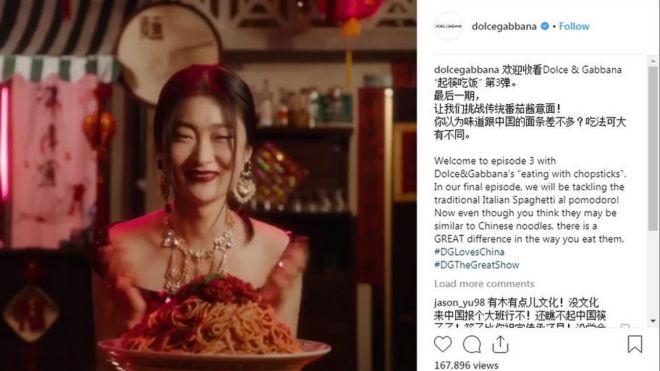
Image copyrightDOLCE AND GABBANA/INSTAGRAMImage captionThe ad was supposed to show that ‘#DGLovesChina’
The Chinese model featured in a Dolce & Gabbana ad campaign accused of racism has said the controversy almost ruined her career.
Three videos, released in November, showed Zuo Ye struggling to eat Italian food including cannoli and pizza with chopsticks.
Widely seen as offensive it led to a severe backlash in China with several retailers pulling the brand’s products.
Ms Zuo said she felt “guilty and ashamed” but asked for understanding.
Following her statement on Chinese social media network Weibo, the debate has flared up again with some people saying they hope that she can continue her career as a model and that they understand her hands were tied working with D&G.
‘It nearly killed my career’
In a long post on Monday, Ms Zuo said that usually working for an international brand like D&G would be an exciting career step but that in this case “it nearly killed off my modelling career”.
She explains she understands that “it’s about representing the national image of China and Chinese culture” and that she “therefore feels even more guilty and ashamed”.
She also vowed to “improve my behaviour” in the future.
Image copyrightGETTY IMAGESImage captionConsumers called for a boycott of D&G products in China
According to her statement, she knew the shoot was about trying Italian delicacies but that she felt very awkward when she was asked to eat food like pizza and pasta with chopsticks.
The director told her to show first shock and disbelief, then roll her eyes, and eventually delight and satisfaction at the presumed tastiness of said Italian dishes, she said.
The model explains that she didn’t see the final clip before it was released.
She also writes she didn’t receive any support during the backlash, even when she, her family and agent were all targeted in widespread attacks on social media.
Support and condemnation
Since Ms Zuo’s post, opinion has been divided on Chinese social media.
While some see her as a victim of the Italian brand and sympathise with her experience, others remain critical saying she only had herself to blame.
Others again point out the problem with the powerlessness of models in the industry as a whole where they are often made to do things they might not necessarily want to do.
Image copyrightDOLCE AND GABBANAImage captionDomenico Dolce and Stefano Gabbana asked for forgiveness
In November last year, D&G released the videos on social media ahead of a fashion show in Shanghai.
The entire campaign was accused of trivialising Chinese culture and promoting unflattering stereotypes.
“Chinese consumers are not naïve; they will spot insincerity and tokenism a mile off, and respond accordingly,” Dr Julie Bilby of the department of media and communication at RMIT University in Melbourne told the BBC.
The controversy escalated further when screenshots were circulated showing designer Stefano Gabbana allegedly insulting China in an Instagram chat.
D&G insisted the account had been hacked and apologised publicly for the controversial ad campaign.
The Italian luxury company was forced to cancel the fashion show in Shanghai and their products were removed from several Chinese online retailers.
Consumers in China also called for a boycott of the brand.




 CHINDIA ALERT: You'll be living in their world, very soon