Archive for ‘motherland’

25/05/2019

Across China: “Sino-British Street” seeks rejuvenation

SHENZHEN, May 25 (Xinhua) — A southern Chinese trade hub boasting special links with Hong Kong is hoping the enhanced efforts to build the g will revitalize its tourism industry and local economy.

Chung Ying Street, or “Sino-British Street,” straddles the Hong Kong Special Administrative Region and the mainland city of Shenzhen and has been a special zone where local residents from both sides are allowed to cross the border freely.

It was once a boomtown popular among mainland visitors, who entered with a special permit to snatch duty-free goods from Hong Kong, but fell into decline after travel to Hong Kong was made easier for mainlanders.

The street derived from a small village, which was divided by the “Sino-British” borderline after Hong Kong became a British colony in the 19th century.

Sha Jintao, a 73-year-old resident, remembers how the street became a boomtown as China opened up and tightened links between the mainland and Hong Kong.

“When I was a child, there were only a few farmers and fishermen living on the mainland side of the street, while the Hong Kong side bustled with shops and businesses,” Sha said.

But as Shenzhen rose as a forefront of China’s reform and opening up starting in the late 1970s, the street became the center of changes. New shops and factories propped up with the inflow of Hong Kong investments, and the fancy commodities from its Hong Kong stores wooed in large numbers of mainland tourists.

Historical records show the number of tourists flocking into the 250-meter-long street peaked at 100,000 a day in the 1980s. As many as 89 jewelry stores opened in its heyday and sold 5 tonnes of gold jewelry in half a year.

SURVIVAL CRISIS

The heyday was however short-lived. After Hong Kong returned to the motherland in 1997, the street began to lose its appeal, as shopping in Hong Kong was made much easier for mainland tourists. Its daily visitors dropped below 10,000 after 2003, when mainlanders were allowed to independently travel to Hong Kong.

Many stores closed due to a loss of customers, and some survived by selling fake jewelry, winning the street much notoriety, recalled Sha, who then headed the local neighborhood committee.

Sha said the ephemeral boom was limited to the era when most Chinese had limited access to the outside world, so as the country opened its door wider, the street’s function as a “window” faced an inevitable doom.

“Now with a smartphone, a consumer could easily buy goods from across the globe,” he said, referring to China’s cross-border e-commerce boom. “So if is just for the purpose of shopping, why take the trouble of traveling to the Chung Ying Street?”

The street is now more of a cultural site, dotted with relics and museums displaying its history, but locals are hopeful that the ongoing construction of the Guangdong-Hong Kong-Macao Greater Bay Area will usher in another golden era for their neighborhood.

China has planned to turn the greater bay area, which encompasses Hong Kong, Macao and nine cities in Guangdong Province, into the world’s largest bay area in terms of GDP by 2030.

Earlier this month, the city government of Shenzhen said it will upgrade its ports with Hong Kong to boost the greater bay area development. The Shatoujiao Subdistrict, where the Chung Ying Street is located, was reserved for a new cooperation zone featuring tourism and consumption.

Optimism is running high in the community. New industries like artificial intelligence (AI), health and high-end shipping service have taken root in Yantian District, which administers Shatoujiao, and Sha is buzzing around to connect business people from Hong Kong and Shenzhen.

“Shatoujiao and its Chung Ying Street have boasted the one-of-the-kind advantage in Shenzhen-Hong Kong cooperation. We’ll work hard to turn the blueprint of the greater bay area into a reality here,” said Chen Qing, party secretary of Yantian.

Source: Xinhua
27/02/2019

Beijing says it can ease power and water shortages on Taiwans’s Quemoy, Matsu islands

  • Different social systems should not be ‘a barrier to unification or an excuse for separation’, according to mainland’s cross-strait affairs office
  • After Quemoy began importing water from Fujian in August, preliminary research has been done to supply water to Matsu chain and electricity to both

News

Beijing says it can ease power and water shortages on Taiwan’s islands

27 Feb 2019

Taiwan-controlled Quemoy Island – which is just 2km from Xiamen – began importing water from the mainland in August. Photo: Weibo

Beijing says it is prepared to supply electricity and water to islands controlled by Taipei in the Taiwan Strait despite escalating tensions between the two sides.

An Fengshan, spokesman for the Taiwan Affairs Office in Beijing, also said their different social systems should not be “an excuse” to separate the country, and any deal between the mainland and Taipei should be struck in the interests of a “peaceful unification” agenda.

Speaking at a monthly press briefing on Wednesday, An said the mainland could supply power and water to meet the needs of residents on Quemoy, also known as Kinmen, and the Matsu island group. Controlled by Taipei, the islands are located off the mainland’s southeastern Fujian coast – Quemoy is just 2km from Xiamen – and have been on the front line of cross-strait tensions since 1949.

Taiwan’s cold war island begins to thaw

“The people of the Quemoy and Matsu islands have long hoped that the mainland could help to resolve the difficulties they face with power and water shortages, and they have made numerous appeals for gas and bridge connections [with the mainland],” An said.

“Our attitude is very clear – that in regards to these demands, the mainland will make every effort to provide opportunities and conditions to help them achieve bigger and better development.”

An said Fujian province authorities had completed preliminary research and planning to supply electricity to the Quemoy and Matsu islands, as well as water to the Matsu chain. Plans to supply gas and build bridges were expected in the future, he said, without elaborating.

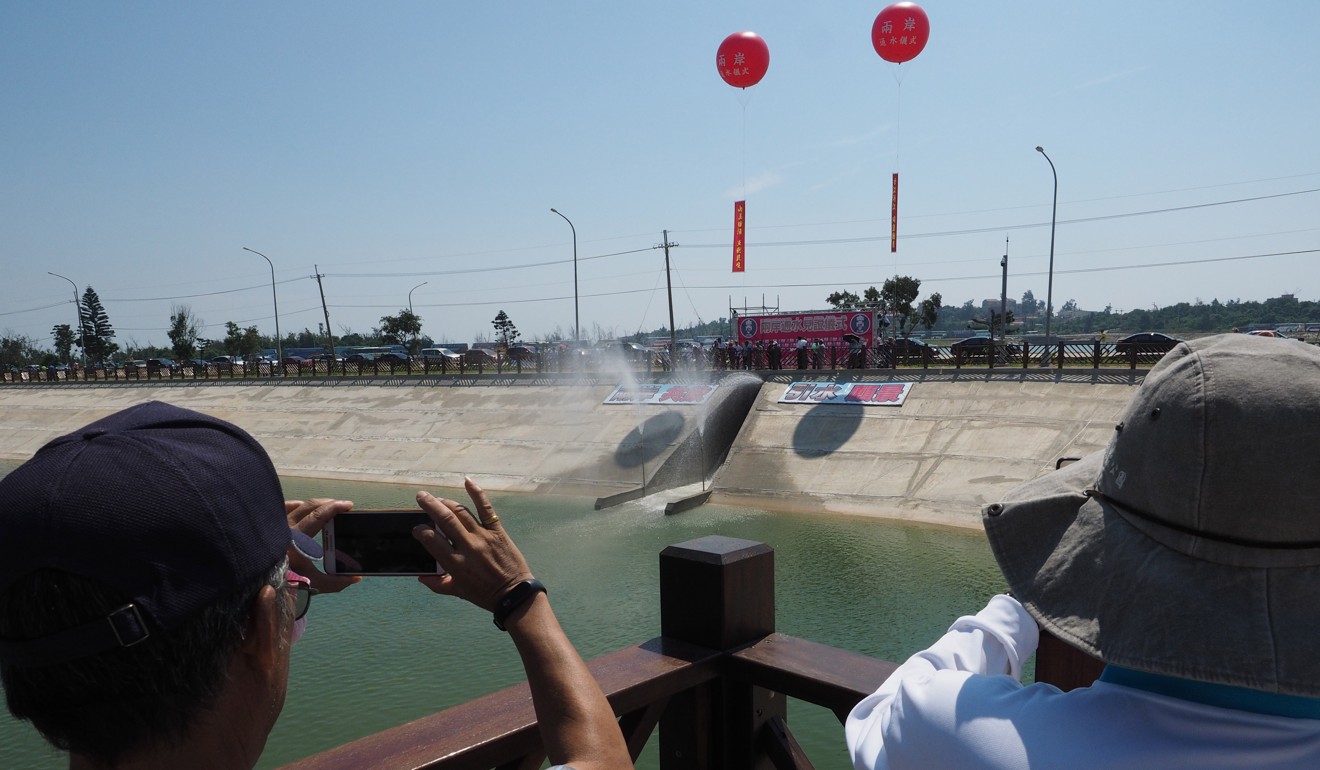
Water is released into the Tianbu Reservoir on Quemoy island in August when the mainland supply began. Photo: EPA-EFE

Quemoy began importing water from Fujian to ease its water shortage in August, three years after it signed a 30-year agreement with the mainland province to supply water via an undersea pipeline.

But Taiwan’s Mainland Affairs Council, which handles cross-strait ties, asked the Quemoy county government to downplay a ceremony marking the start of the supply
because of moves by Beijing to suppress Taipei.

Beijing sees Taiwan as a breakaway province subject to eventual reunification, by force if necessary. Relations across the strait soured after Tsai Ing-wen, of the independence-leaning Democratic Progressive Party, became president in 2016 and refused to accept the one-China principles.

Since then, mainland China has stepped up pressure on Taiwan, suspending official communications with the Tsai government, poaching its diplomatic allies and staging war games near the self-ruled island, which is edging closer to Washington.

In an interview with CNN last week, Tsai said she would seek re-election next year and there would be no peace deal with the mainland unless Beijing ruled out using force against Taiwan.

On Wednesday, An said the different social systems across the strait should not be a barrier to unification, which President Xi Jinping sees as part of his Chinese dream of national rejuvenation but has been rejected by Tsai.

“Peaceful unification and ‘one country, two systems’ are the basic policies for us to resolve the Taiwan issues, and the best way to realise the motherland’s unification,” An said.

He was referring to a speech by Xi in January calling for Beijing and Taipei to start talks on “one country, two systems” in Taiwan – first proposed by late paramount leader Deng Xiaoping in the 1980s – as the path to bring the island back into the China fold.

“The differences in the systems should not be a barrier to unification or an excuse for separation,” An said.

China protests against US ‘provocation’ after two American warships pass through Taiwan Straits.
Asked about Beijing-friendly Kuomintang chairman Wu Den-yih’s recent remarks that Taipei would sign a peace deal with the mainland if his party won the election in 2020, An said the two sides could explore a deal “as long as it benefits and safeguards the peace of the Taiwan Strait, increases the peaceful development of relations and pushes the peaceful unification process of the motherland”.

Source: SCMP

17/12/2018

Macao holds int’l parade to mark 19th anniversary of return to motherland

CHINA-MACAO-PARADE (CN)

Performers attend the Macao International Parade, which is held to celebrate the 19th anniversary of Macao’s return to the motherland, in Macao, south China, Dec. 16, 2018. (Xinhua/Cheong Kam Ka)

MACAO, Dec. 16 (Xinhua) — The government of China’s Macao Special Administrative Region (SAR) held an international parade Sunday afternoon to mark the 19th anniversary of Macao’s return to the motherland.

The parade attracted more than 70 groups from the Chinese mainland, the Macao SAR and the Hong Kong SAR, as well as those from foreign countries including Japan, Brazil, Spain, Italy, Portugal, France, Mozambique, Malaysia, among others.

The parade featured performances such as folk dances, acrobatics, stilt walking, Chinese martial arts and puppet shows.

The parade started from the renowned Ruins of St. Paul’s and ended at Sai Van Lake Square, where the groups took to the stage one by one.

The parade, one of the major cultural events in Macao since 2011, was organized by Macao’s Cultural Affairs Bureau and the Macao Government Tourism Office.

Law of Unintended Consequences

continuously updated blog about China & India

ChiaHou's Book Reviews

continuously updated blog about China & India

What's wrong with the world; and its economy

continuously updated blog about China & India