Chindia Alert: You’ll be Living in their World Very Soon
aims to alert you to the threats and opportunities that China and India present. China and India require serious attention; case of ‘hidden dragon and crouching tiger’.
Without this attention, governments, businesses and, indeed, individuals may find themselves at a great disadvantage sooner rather than later.
The POSTs (front webpages) are mainly 'cuttings' from reliable sources, updated continuously.
The PAGEs (see Tabs, above) attempt to make the information more meaningful by putting some structure to the information we have researched and assembled since 2006.
Students attend a class at a primary school in Dahua Yao Autonomous County, south China’s Guangxi Zhuang Autonomous Region, May 29, 2020. Guangxi, one of the major battlefields in China’s poverty alleviation campaign, has been making painstaking efforts to improve education for poverty-stricken children, as schooling is believed to be the best way to empower the youngsters to lift their families out of poverty. The region has taken various measures in this regard, including granting students stipends, improving school facilities and nutritional conditions of rural students, and helping more students from rural and impoverished areas have access to higher education. As many households from inhospitable areas have moved into relocation sites built for poverty alleviation in the county seats, relocated children can study in schools in and near resettlements, instead of trekking hours back and forth in mountains for schooling. The faculty is a key to education. The regional government has called in capable teachers to help schools in rural areas, and has been committed to guaranteeing payment to teachers and filling vacancies of teachers in rural areas through special programs. Reducing poverty must begin with reducing ignorance. Therefore, giving rural children a good education is an important task in poverty relief, and also a crucial means to stop poverty being passed on through generations.
Chinese President Xi Jinping, also general secretary of the Communist Party of China Central Committee and chairman of the Central Military Commission, checks the ecological protection work of the Fenhe River in Taiyuan, capital city of north China’s Shanxi Province, May 12, 2020. (Xinhua/Li Xueren)
BEIJING, May 13 (Xinhua) — Chinese President Xi Jinping attaches great importance to ecological conservation and environmental protection. He has spoken of the issue on many occasions. The following are some highlights of his quotes.
— Lucid waters and lush mountains are invaluable assets.
— Ecological conservation and environmental protection are contemporary causes that will benefit many generations to come.
— A sound ecological environment is the basic foundation for the sustainable development of humanity and society.
— We should adhere to the integrated protection and restoration of mountains, rivers, forests, farmlands, lakes and grasslands, and coordinate efforts to strengthen ecological and environmental protection in river basins with efforts to promote an energy revolution, green production and lifestyle, and economic transformation and development.
— A good ecological environment is the fairest public product and the most accessible welfare for the people.
— The quality of the eco-environment is the key to building a moderately prosperous society in all respects.
— Economic development should not be achieved at the cost of the ecology. The ecological environment itself is the economy. Protecting the environment is developing productivity.
— We shall protect ecosystems as preciously as we protect our eyes, and cherish them as dearly as we cherish our lives.
— The history of civilizations shows that the rise or fall of a civilization is closely tied to the quality of the ecological environment.
Chinese surveyors hike toward a higher spot after setting out from a base camp at an altitude of 5,200 meters in southwest China’s Tibet Autonomous Region on May 7, 2020. The Chinese measurement team of over 30 surveyors Thursday arrived at a base camp at an altitude of 6,500 meters, as they endeavor to accomplish a mission to remeasure the height of the world’s highest mountain. (Photo by Lhagba/Xinhua)
MOUNT QOMOLANGMA BASE CAMP, May 7 (Xinhua) — A team of over 30 Chinese surveyors Thursday arrived at a base camp at an altitude of 6,500 meters, as they endeavor to accomplish a mission to remeasure the height of the world’s highest mountain.
The team arrived at the advance camp at around 5 p.m. safe and sound, after they set out from their base camp at an altitude of 5,200 meters, located in Tingri County of Tibet Autonomous Region in southwest China, on Wednesday.
The team will take a rest and continue to debug height measuring equipment at the base camp for at least one day before moving on.
They arrived at a transition camp at a height of 5,800 meters at around 6 p.m. Wednesday and spent the night there. They began climbing at around 11 a.m., passed nearby the East Rongbuk glacier and arrived at the advance camp after six hours’ walk.
The advance camp sits on a slope next to the end of the glacier, and is the last camp before the snow line and the ice and snow road. After about an hour’s walk up from the camp, the surveyor will arrive at the shoe-changing point, where climbers need to wear crampons to continue climbing on the icy road.
Known as the “devil camp,” many professional mountain guides who have reached the peak of Mount Qomolangma many times also suffer from altitude sickness here due to its geographical location surrounded by mountains and poor air circulation.
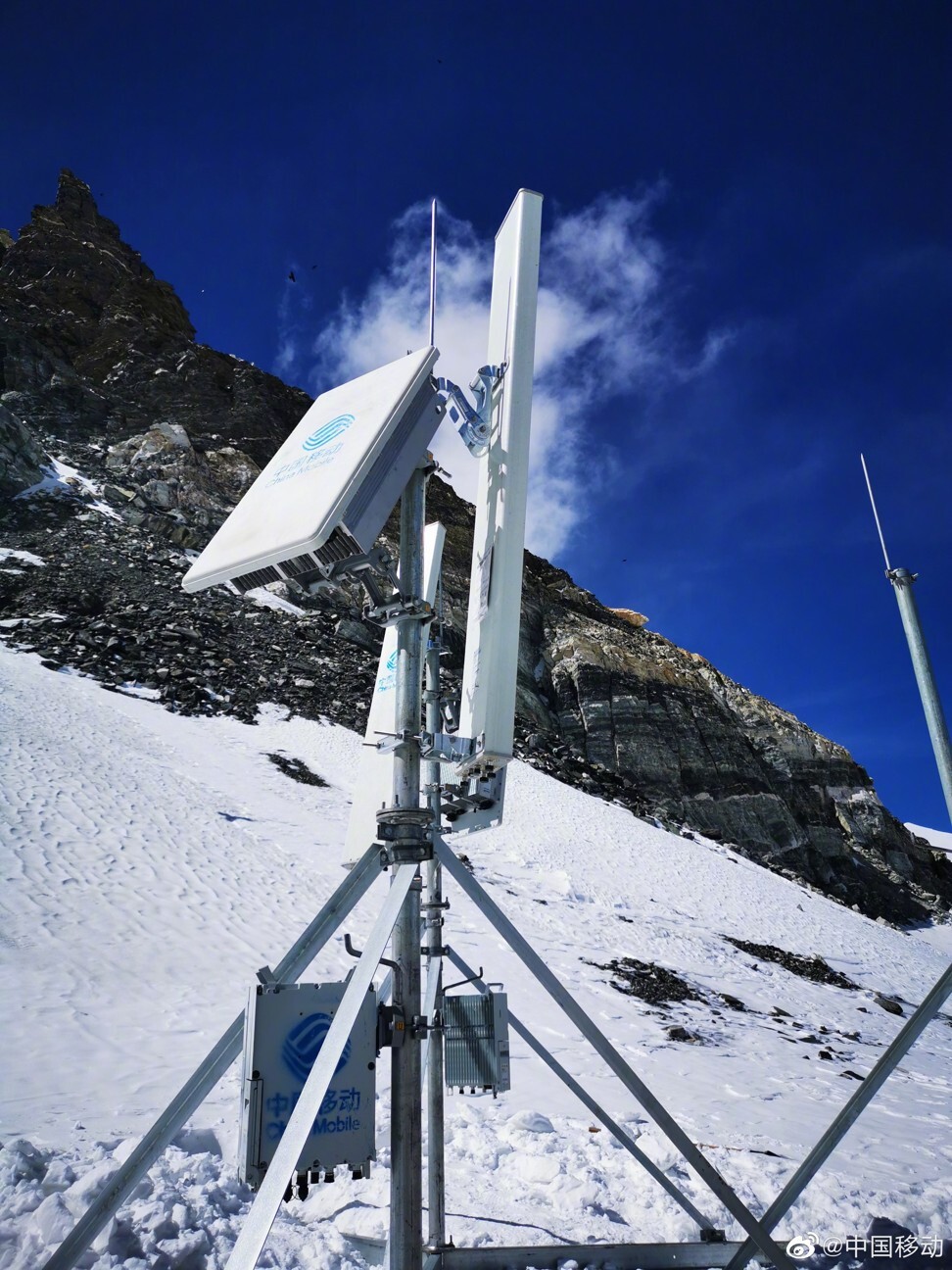
This marks the latest mobile network upgrade on Mount Everest, where Chinese carriers had previously installed 2G, 3G and 4G equipment
China Mobile plans to deploy Huawei 5G gear at an altitude of 6,500 metres, providing network coverage to the mountain’s summit
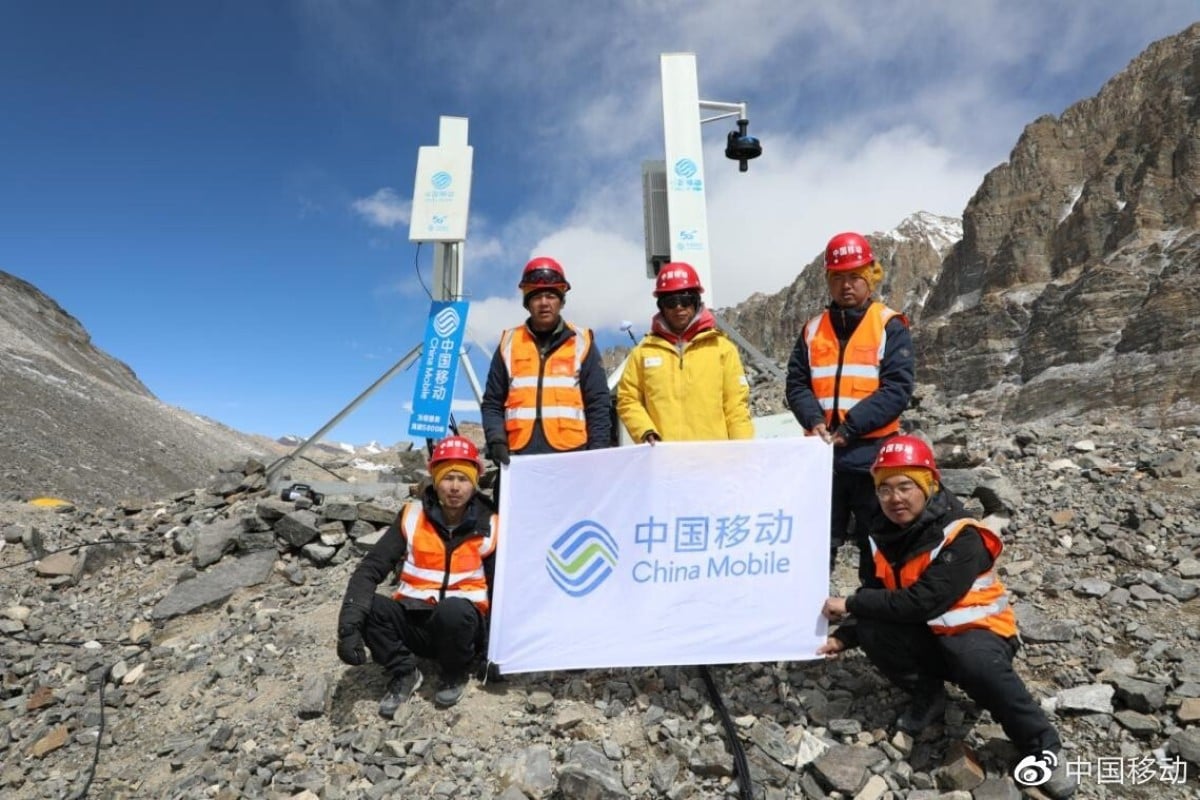
A team from China Mobile shows off the initial 5G base stations, supplied by Huawei Technologies, that the telecoms carrier deployed on Mount Everest this April. Photo: Weibo
Huawei Technologies has teamed up with wireless network operators China Mobile, China Unicom and China Telecom to roll out advanced 5G infrastructure on
The deployment of 5G base stations on the famous Himalayan mountain, with an elevation of 8,848 metres, has extended the reach of the next-generation mobile technology, which has been held up as “the connective tissue” for the Internet of Things, autonomous cars, smart cities and other new applications – providing the backbone for the industrial internet. The new 5G infrastructure roll-outs were announced by Huawei in a post on Chinese microblogging site Weibo on Monday and confirmed by its spokeswoman on Tuesday.
China Mobile, the world’s largest wireless network operator, said its 5G project on Mount Everest marked “not only another extreme challenge in a human life exclusion zone, but also laid a solid foundation for the later development of 5G smart tourism and 5G communications for scientific research”, according to the company’s post on Weibo on Monday.
The Hong Kong and New York-listed carrier set up three 5G base stations – radio access gear that connects mobile devices to the broader telecommunications network – on April 19 in two camps at altitudes of 5,300 metres and 5,800 metres, which provide online download speed of about 1 gigabit per second.
China Mobile plans to install two more 5G base stations, supplied by telecommunications gear maker Huawei Technologies, on Mount Everest before April 25. Photo: Weibo
Installation of two more base stations are expected to be completed by China Mobile before April 25 in another camp at an altitude of 6,500 metres, providing 5G network coverage to the summit of Mount Everest. The international border between China and Nepal is 1,414 kilometres in length and runs across that summit.
More than 150 China Mobile employees are taking part on the construction and maintenance of the new 5G base stations as well as upgrading existing infrastructure on the surrounding areas, according to the company. It said 25 kms of new optical cables have also been laid out to support this project.
China Telecom confirmed its Mount Everest project on Tuesday in a statement, which said its 5G base stations were installed on April 13 at an altitude of 5,145 metres. It partnered with state-run China Central Television to broadcast a 24-hour live-streamed programme on April 14 from Mount Everest, which had an audience of more than six million people.
China Mobile did not immediately respond to a request for comment. China Unicom did not immediately reply to a separate request for comment.
Mobile network operators in China launched initial commercial 5G services last year. The country has already deployed more than 160,000 5G base stations, covering more than 50 cities, according to a report published last month by the GSMA, the trade body which represents mobile operators worldwide.
While initial commercial 5G mobile services were launched in countries like South Korea, the US, and Australia, the scale of China’s market is likely to dwarf the combined size of those economies, negating any first-mover advantage.
The steady annual deployment of new 5G base stations is critical to meet future demand in the world’s second largest economy and biggest smartphone market. China is expected to have 600 million 5G mobile users by 2025, which would make up 40 per cent of total global 5G subscribers, according to the GSMA.
Chinese State Councilor and Foreign Minister Wang Yi meets with Vietnamese Deputy Prime Minister and Minister for Foreign Affairs Pham Binh Minh in Vientiane, Laos, Feb. 19, 2020. (Photo by Kaikeo Saiyasane/Xinhua)
VIENTIANE, Feb. 19 (Xinhua) — Chinese State Councilor and Foreign Minister Wang Yi met here Wednesday with Vietnamese Deputy Prime Minister and Minister for Foreign Affairs Pham Binh Minh, with both sides pledging to further promote bilateral ties and jointly advance Lancang-Mekong cooperation.
Wang is in Vientiane, capital of Laos, for the Special ASEAN-China Foreign Ministers’ Meeting on Coronavirus Disease and the fifth Lancang-Mekong Cooperation Foreign Ministers’ Meeting.
During the meeting with Pham Binh Minh, Wang said that under the strong leadership of the Communist Party of China Central Committee with Xi Jinping at the core, the whole party and the whole country are rallying together to counter the COVID-19 epidemic.
Thanks to the arduous efforts, China’s measures to prevent and control the epidemic have been achieving visible progress, he noted.
It is necessary for China and the Association of Southeast Asian Nations (ASEAN), linked by mountains, rivers and waters and sharing weal and woe, to timely share information and work together to tackle the epidemic so as to safeguard people’s health of China and ASEAN countries, Wang said.
Vietnam, as the ASEAN chair, has made active response to China’s proposal to hold the Special ASEAN-China Foreign Ministers’ Meeting on Coronavirus Disease, Wang said, noting that it testifies to the fine tradition of their shared spirit of “good neighbor, good friend, good comrade and good partner” as well as supporting and helping each other, he said.
Wang expressed belief that the Special ASEAN-China Foreign Ministers’ Meeting on Coronavirus Disease to be held Thursday will achieve success, thus sending out an explicit message that China and ASEAN countries will overcome difficulties with concerted efforts.
This year marks the 70th anniversary of the establishment of the diplomatic relations between China and Vietnam, Wang said, noting that the China-Vietnam comprehensive strategic cooperative partnership has entered into a critical phase of inheriting the past and ushering in the future.
He called on the two sides to carry forward the friendly cause initiated by past generations of leaders of both sides, implement the important consensus reached by leaders of the two countries, maintain high-level strategic communication and advance exchanges and cooperation across the board and at sub-national levels.
He also said that the two countries should properly manage and control differences, steadily promote practical cooperation in various fields and well uphold the common strategic interests of the two socialist countries.
China attaches great importance to the Lancang-Mekong cooperation, Wang said, adding that China stands ready to work together with the Vietnamese side to actively develop greater synergy between the Lancang-Mekong cooperation and the construction of the “new land-sea corridor” so as to give a boost to the economic development of the Mekong River areas.
Pham Binh Minh, for his part, said Vietnam speaks highly of the efforts China has made in the fight against the COVID-19 epidemic, believing that the Chinese government and the Chinese people will tide over the difficulties and win the fight.
Minh told Wang that those in Vietnam affected by the virus have almost recovered.
He said his country is willing to work together with China to ensure that the Special ASEAN-China Foreign Ministers’ Meeting on Coronavirus Disease will be held successfully here on Thursday.
Noting that the development of bilateral relations has maintained good momentum for the time being, Minh hoped that the two sides will boost strategic coordination, jointly hold activities to celebrate the 70th anniversary of the establishment of the diplomatic ties between the two countries and promote the cooperation in all fields so as to make greater achievements.
He said Vietnam is willing to strengthen mutual political trust with China, properly handle maritime issues and encourage the cooperation between localities of the two countries, especially in the border areas.
Minh also said his country is willing to strengthen coordination and cooperation with China within the framework of multilateralism.
Vietnam applauds the achievements made in Lancang-Mekong cooperation and is ready to join hands with China to advance the mechanism, he added.
Li Keqiang tells senior officials to step up efforts to channel water from Yangtze River to arid regions
Impact of pollution and rising population has prompted increased efforts to improve efficiency and supply
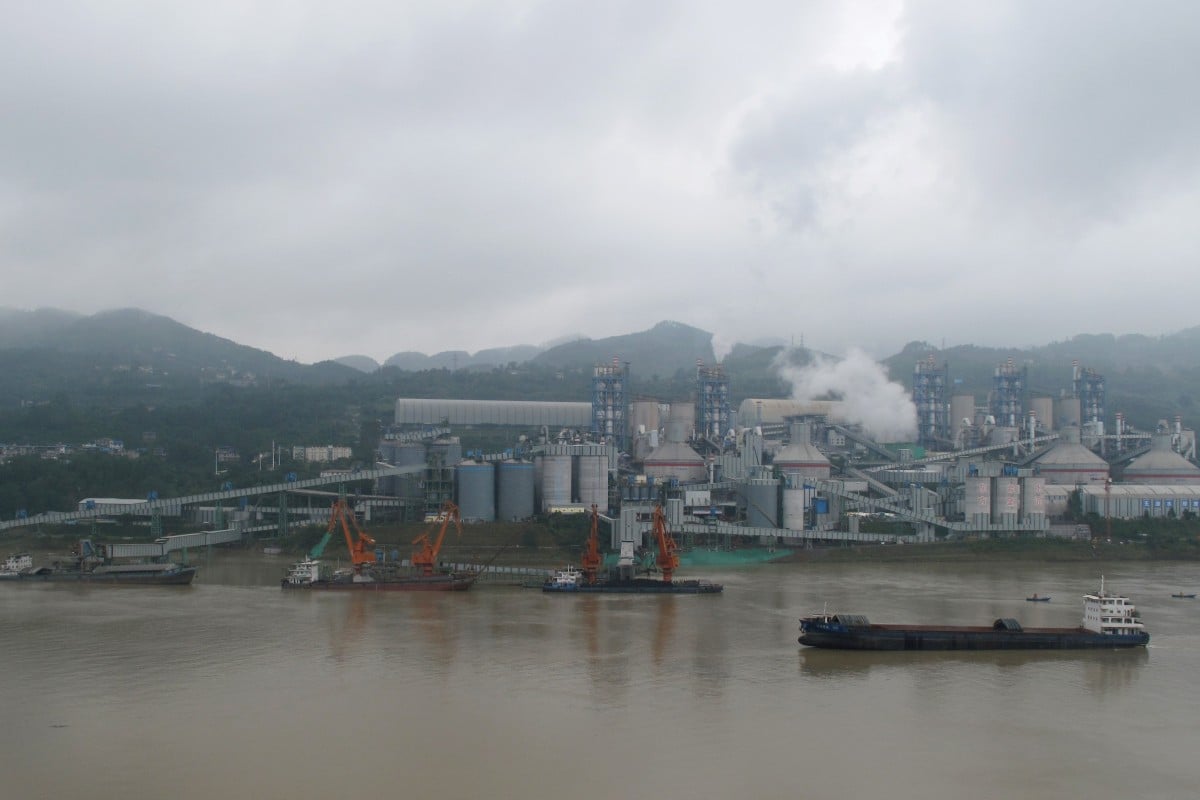
A cement plant on the banks of the Yangtze in Chongqing. The authorities are now trying to stop further development along the river. Photo: Reuters
China needs to divert more water to its arid northern regions and invest more in water infrastructure as shortages get worse because of pollution, overexploitation and rising population levels, Premier Li Keqiang has said.
China’s per capita water supplies are around a quarter of the global average. With demand still rising, the government has sought to make more of scarce supplies by rehabilitating contaminated sources and improving efficiency.
Water remained one of China’s major growth bottlenecks, and persistent droughts this year underlined the need to build new infrastructure, Li told a meeting of senior Communist Party officials on Monday. An account of the meeting was published by China’s official government website.
Local government bonds should be “tilted” in the direction of water infrastructure, he said, and innovative financing tools were also needed.
He also called for research into new pricing policies to encourage conservation.
Li said China’s water supply problems had been improved considerably as a result of the South-North Water Diversion Project, a plan to divert billions of cubic metres of water to the north by building channels connecting the Yangtze and Yellow rivers.
World ‘woefully unprepared’ for climate change’s effects on drinking water supplies drawn from mountains
He said opening up more channels to deliver water to regions north of the Yangtze River Delta would support economic and social development and optimise China’s national development strategy, according to a summary of the meeting on the government website.
China is in the middle of a wide-reaching programme to clean up the Yangtze River, its biggest waterway, and put an end to major development along its banks.
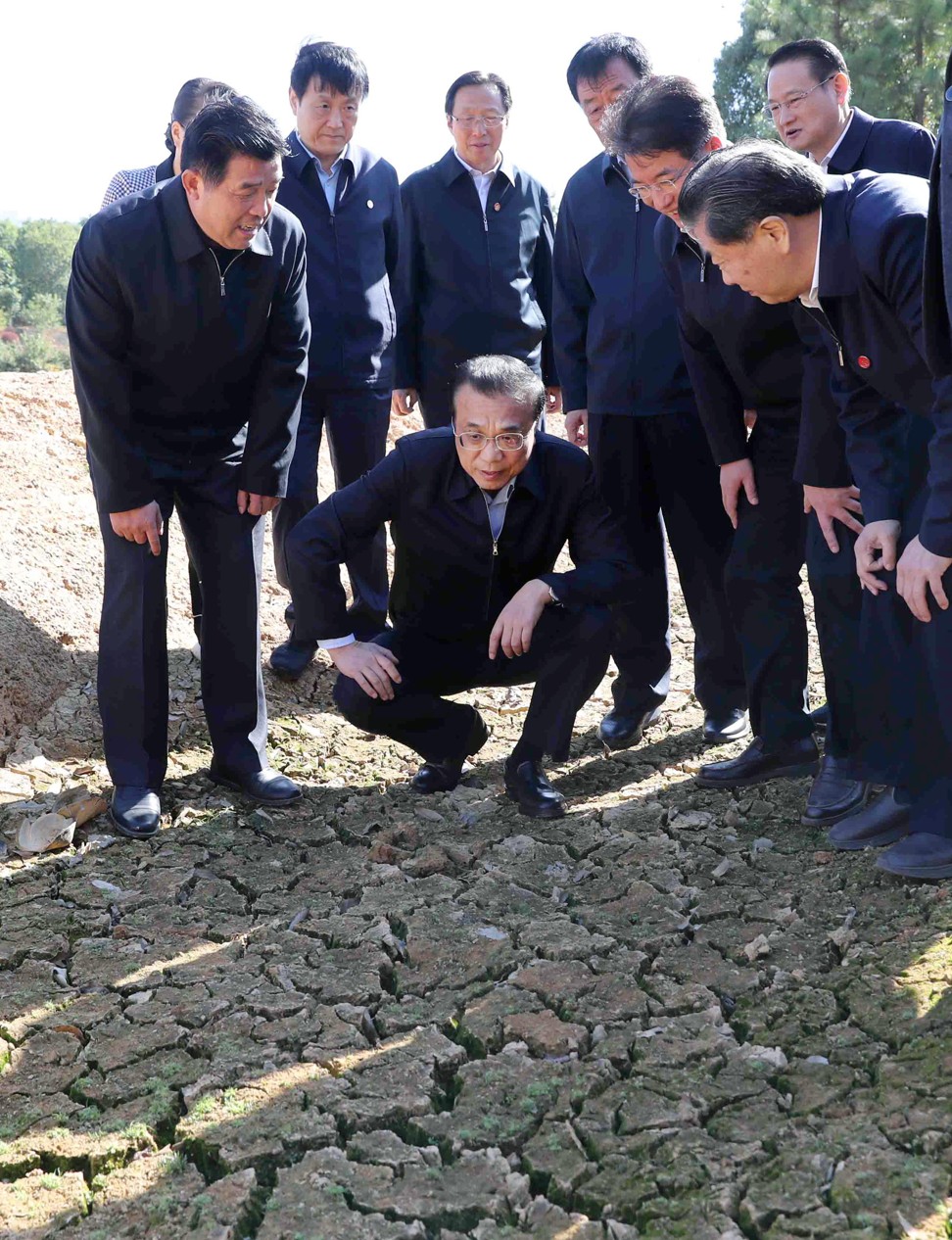
Chinese Premier Li Keqiang inspects an empty reservoir during a visit to Jiangxi province last week. Photo: Xinhua
Local governments have been under pressure to dismantle dams, relocate factories and even ban fishing and farming in ecologically fragile regions.
But experts say the ongoing campaign to divert the course of the Yangtze to other regions is still causing long-term damage to the river’s environmental health.
Many cities that had polluted their own water sources had drawn replacement supplies from the Yangtze, exceeding the river’s environmental capacity, said Ma Jun, founder of the Institute of Public and Environmental Affairs, which monitors water pollution.
Beijing already relied on diversion channels from the Yangtze to supply 70 per cent of its water, but had done little to improve conservation or reduce per capita consumption, which was higher than many Western countries, he said.
“[Diversion] has caused so much suffering and needs so many dams to keep up supply, and that has impacted biodiversity,” he said.
Artists perform during an event marking the conclusion of an activity that took journalists to retrace the route of the Long March, in Huining, northwest China’s Gansu Province, Aug. 18, 2019. The activity, held from June 11 to Aug. 18, was aimed at paying tribute to the revolutionary martyrs and passing on the traditions of revolution. The Long March was a military maneuver carried out by the Chinese Workers’ and Peasants’ Red Army from 1934 to 1936. During this period, they left their bases and marched through rivers, mountains and arid grassland to break the siege of Kuomintang forces and continue to fight Japanese aggressors. Many marched as far as 12,500 km. (Xinhua/Luo Xiaoguang)
BEIJING, March 5 (Xinhua) — Despite increasing downward pressure on its economy, China is assuring the world of its firm resolution in the pursuit of green development with concrete and self-motivated efforts.
For China, green development is a critical element of modernizing its economy. The country sticks to a new development vision that features innovative, coordinated, green and open development for the benefit of all.
It is not at the request of others, but on the country’s own initiative.
With a large population, China is facing increasing resource constraints, severe environmental pollution and a deteriorating ecosystem. People are becoming increasingly aware of environmental problems.
The country’s leadership has made it clear that China must win the battle to ensure blue skies and clean water and soil.
The battle will not be won easily.
Facing a complicated and challenging domestic and international environment of a kind rarely seen in many years, China has two options: lowering standards of environmental protection in launching new projects to stimulate growth; finding fundamental solutions to address pollution and build an ecological civilization that will benefit generations to come.
China’s choice and actions reassure those who may doubt its seriousness about green development.
When China says it “puts ecological protection first,” it is not just lip service.
This year, China will cut the energy consumption per unit of GDP by around 3 percent. Sulfur dioxide and nitrogen oxide emissions will be cut by 3 percent, and there will be a continuous decline in PM2.5 density in key areas.
The central government will allocate 25 billion yuan (3.73 billion U.S. dollars) to prevent and control air pollution, an increase of 25 percent year on year, an evidence of the advantage of China’s governance system which can “concentrate resources to accomplish major undertakings.”
China will also strengthen green and environmental protection industries, and press ahead to conserve and restore the ecosystems of mountains, rivers, lakes, forests, farmland, and grassland.
Simple, moderate, green, and low-carbon ways of life are increasingly popular in China. It has become common sense among the public that “lucid waters and lush mountains are invaluable assets themselves.”
As a matter of fact, the country’s yearning for green growth, instead of dragging down the economy, will be a boon to the economy, for China and the rest of the world.
Chinese and foreign investors are embracing a new wave of opportunities in the market for environment-related products and services, such as thermal power and steel industry upgrading, the development of sewer networks and treatment facilities and the construction of eco-friendly buildings.
China is one of the first countries to sign the Paris Agreement on climate change. China has pledged to halt the rise in carbon dioxide emissions by around 2030.
Among the essence of traditional Chinese thinking is the concept that man and nature form a community of life. Only by observing the laws of nature can mankind avoid costly blunders in its exploitation.
China has embarked on this bumpy but promising road. Marching toward an era of green development, there will be no turning back.







 CHINDIA ALERT: You'll be living in their world, very soon