Chindia Alert: You’ll be Living in their World Very Soon
aims to alert you to the threats and opportunities that China and India present. China and India require serious attention; case of ‘hidden dragon and crouching tiger’.
Without this attention, governments, businesses and, indeed, individuals may find themselves at a great disadvantage sooner rather than later.
The POSTs (front webpages) are mainly 'cuttings' from reliable sources, updated continuously.
The PAGEs (see Tabs, above) attempt to make the information more meaningful by putting some structure to the information we have researched and assembled since 2006.
Pakistan Prime Minister Imran Khan on Tuesday said if there is any evidence of involvement of any Pakistani national in Pulwama terror attack, his government will act against the culprits. (AP)
Pakistan Prime Minister Imran Khan has denied his country’s role behind the Pulwama terror attack, the worst in Jammu and Kashmir in decades. He claimed that India does not have any evidence to prove Pakistan’s role in terror attacks in Kashmir.
“You (India) have blamed the Pakistan government without any evidence…If you have any evidence, we will act,” Imran Khan said.
He said, “It is in our interest that nobody from our soil spreads violence. I want to tell Indian government that we will take action if evidence is found against anyone from Pakistan.”
“What has Pakistan to gain from this? Why will Pakistan do this at a stage when it is moving towards stability,” said Imran Khan adding that “this is a Naya Pakistan with a new mindset.”
Calling for a dialogue with India, he said, “If you thinks you will attack us and we will not think of retaliating…We will retaliate. We all know starting a war is in the hands of humans, where it will lead us only God knows. This issue should be solved through dialogue.”
Imran Khan’s reaction comes days after at least 40 CRPF jawans were killed in a terror attack in Jammu and Kashmir. Pakistan-backed terror outfit Jaish-e-Mohammad claimed responsibility for the attack.
Earlier, Pakistan sought an urgent intervention of UN Secretary-General in defusing tensions with India and help facilitate dialogue between the two countries.
Following the terror attack, India launched a diplomatic offensive against Pakistan with the ministry of external affairs reaching out to more than two dozen countries including P5 – the US, the UK, France, Russia and China, which has repeatedly blocked India’s bid to get Jaish-e-Mohammad chief Masood Azhar declared as global terrorist by the United Nations.
China has used veto to shield Masood Azhar. Pakistan has also denied its support to the terror group. On Monday, in a joint statement Imran Khan and Saudi Arabia’s prince Mohammed bin Sultan “underlined the need for avoiding politicisation of UN listing regime.” This is being viewed as a snub to India’s renewed efforts to isolate Pakistan over its continued support to terror outfits and corner Masood Azhar’s JeM.
India withdrew the most favoured nation (MFN) status accorded to Pakistan in 1996. The MFN status had not been revoked even during the 1999 Kargil War and in the aftermath of 2008 Mumbai terror attack that killed more than 160 people.
NEW DELHI (Reuters) – A hotel that caught fire in the Indian capital on Tuesday, killing 17 people, passed safety checks 14 months ago, but an investigation has revealed breaches of regulations, such as faulty alarms, prompting a mass reinspection of other hotels.
Poorly enforced regulations lead to thousands of deaths in fires across India every year and officials in New Delhi say an overstretched fire service is hampering safety efforts.
The Hotel Arpit Palace passed a fire safety check in December 2017, but a copy of the initial police investigation seen by Reuters showed several breaches of fire regulations, including a lack of signs to guide guests to exits and fire alarms that did not work.
Delhi’s fire service, which is responsible for safety inspections as well as fighting fires, is now reviewing certificates issued to more than 1,500 hotels in one of India’s tourist hubs, a senior fire official told Reuters.
But stretched resources mean the re-inspection process could take months.
“Fire officers have to do a lot of work,” said Vipin Kental, Delhi’s chief fire officer. “We have to be inspectors and fight fires. We do not have the manpower.”
The city has around 1,700 firefighters, he said, which is less than an eighth of the number in New York, a city with less than half of Delhi’s population.
PREVENTABLE TRAGEDY
The fire is believed to have begun on the hotel’s first floor, spreading quickly through wood-panelled corridors, police say. Among the dead were members of a wedding party from Kerala and a two Buddhist pilgrims from Myanmar.
“From the outside, the building looked intact, but inside everything was completely charred,” a police officer told Reuters.
Two of the 17 died after jumping out of windows in desperation after failing to find emergency exits, added the officer, who declined to be named as he is not authorised to talk to the media.
“Fire preparedness is a matter of shockingly low priority in most parts of the country,” said an editorial in the Indian Express, one of the country’s leading newspapers.
A 2018 study by India’s home ministry that found the country had just 2,000 of more than 8,500 fire stations it needs.
More than 17,000 people died in fires in 2015, according to data from the ministry, the last year for which figures are available, one of the largest causes of accidental death in India.
Fire safety is an issue for shanty towns and some of the country’s most expensive real estate.
A day after the Arpit Palace disaster, more than 250 makeshift homes were destroyed in a slum in Paschim Puri, a poor area of New Delhi, though no one was killed.
In 2017, 14 people were killed during a birthday party at a high-end bar in India’s financial capital Mumbai.
In several upscale neighbourhoods in Delhi, police shut hundreds of shops and restaurants last year for trading on floors meant for residential use, though many continue to operate illegally, residents say.
By the boarded-up Arpit Palace in the Karol Bagh area of New Delhi, wires from adjacent hotels still trail across the street, though staff there told Reuters they were complying with fire regulations.
Adding to the safety problems, poorly paid staff in the hotel and restaurant industries are often unable to help guests when fires break out, Kental said.
“They are not trained. They don’t know what to do in the event of a fire,” he said.
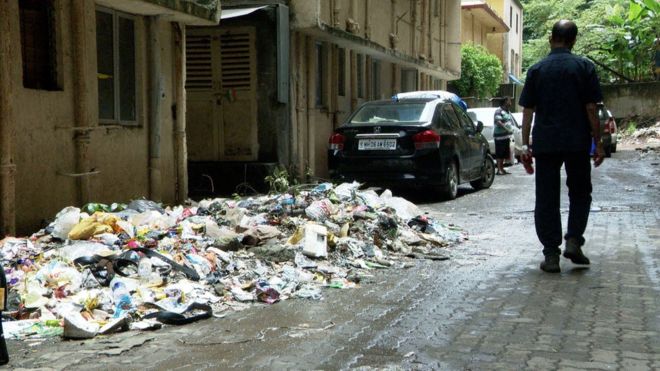
Image captionPiles of garbage are a common sight in Mahul
Tens of thousands of people are fighting to leave Mahul, a heavily industrialised neighbourhood in the western Indian city of Mumbai, saying the toxic pollution there is adversely impacting their health. BBC Marathi’s Mayuresh Konnur and Janhavee Moole report on the residents’ battle to be relocated.
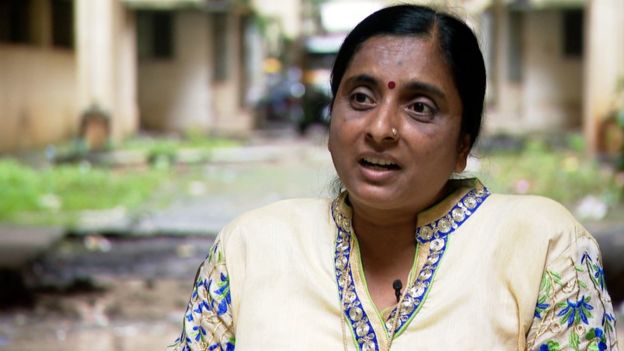
Anita Dhole, 38, was forced to move to a “transit camp” set up by the civic authorities in Mahul in May 2017 after the illegal slum she was living in was demolished. Since then, she says, she has been suffering.
“I have breathing trouble and high blood pressure, and the pollution has also affected my eyesight,” she says.
Hers was one of more than 5,000 families – estimated to be between 30,000 and 50,000 people – that lost their homes in the demolition drive and were offered temporary housing in Mahul. They were told they would be given homes in another Mumbai suburb later but, residents say, Mahul is not fit for living, even for a short time.
Image captionMs Dhole has been living here since May 2017
A former fishing village, it’s now close to oil and petroleum refineries, chemical factories and fertiliser plants.
A report in 2013 by the King Edward Memorial Hospital said that around 67% of people living in Mahul complained of breathlessness several times a month and around 84% of them complained of eye-irritation. In 2015, India’s environment court National Green Tribunal said there was “a perceptible threat to [the] health of residents” in Mahul because of the “prevailing air quality in the area”.
But local municipal authorities say three different surveys by the Maharashtra Pollution Control Board show “that the pollution levels in Mahul are not different from other areas of Mumbai”.
Yet residents blame breathing issues, asthma, skin diseases, tuberculosis and blood pressure-related problems on poor local conditions.
Ms Dhole says her parents fell so sick in Mahul that they soon left for their village.
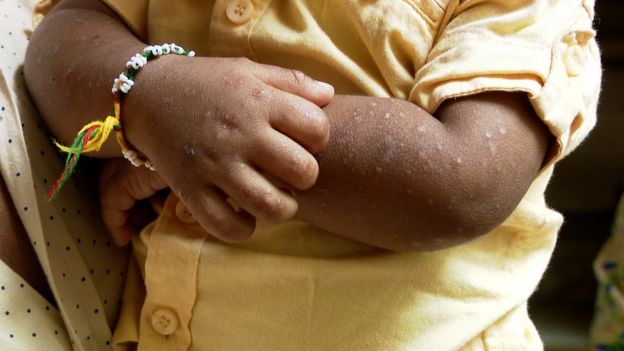
Image captionSkin infections are common among residents
Shamdas Salve, who also moved to Mahul last year, says his two-year-old son has had a persistent skin infection for the past five months.
“He doesn’t sleep the whole night and keeps scratching. I’ve consulted several skin specialists and changed his medication but he has had no relief. He cries and keeps scratching. He now has marks on his face too.”
His words are echoed by many of his neighbours – 10-year-old Sahil suffers from TB and so does 17-month-old Anshul Tusambad; Maya Goswami, 55, struggles with asthma; and 18-year-old Kavita Subramanyan has low BP and breathing problems.
Besides pollution, residents say they have no access to clean water and sewage facilities and that electricity supply is far from regular. There are also no hospitals or schools nearby. The area is poorly connected with other parts of the city and, as a result, many women have been forced to quit their jobs and stay home.
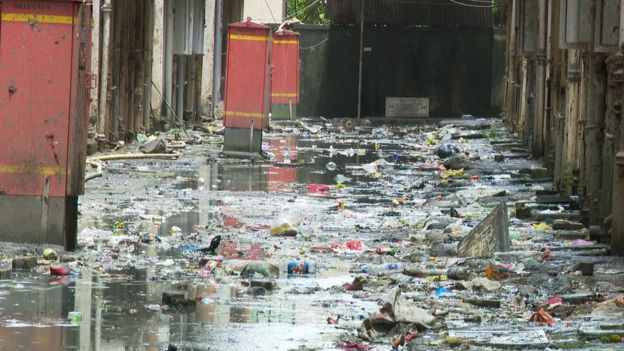
Image captionOverflowing sewage in Mahul’s transit camp
The transit camp where Ms Dhole lives is actually a block of apartments that goes by the official name of Eversmile layout.
It has dozens of buildings and each is home to 300 congested one-room apartments. The complex is filthy – sewage pipes are broken, gutters are overflowing; electric wires are dangling everywhere; the air is stuffy, mosquitoes abound and rats scurry past us as we walk around the neighbourhood.
Most of these low-cost homes are meant for families who have been relocated because of demolition of unauthorised slums.
Every year, tens of thousands migrate from rural India to Mumbai in search of livelihood and most end up living in illegal shanty towns that often encroach on roads or other city infrastructure.
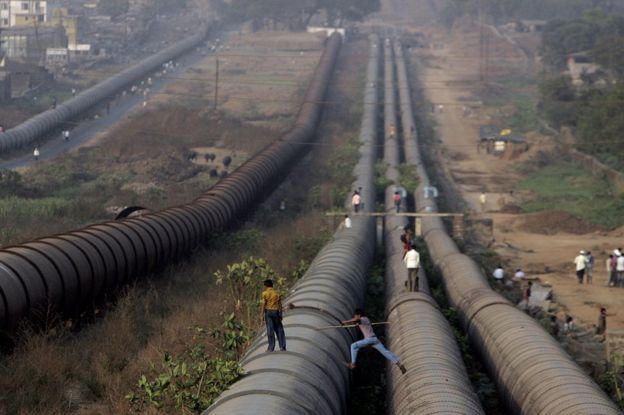
Image copyrightGETTY IMAGESImage captionThousands were relocated to build the Tansa water pipeline
Most of those who were relocated to Mahul, including Ms Dhole, used to live in a slum along the Tansa pipeline – the 160km (99 miles) long water pipeline that runs through Mumbai, carrying water from Lake Tansa. It’s a major source of water for the city.
Just over half of the pipeline is overground and, over the years, unauthorised houses came up alongside it and, in some places, on top of it.
In 2006, a petition was filed in the high court in Mumbai asking the court to order the government to relocate those living in the slums to “ensure that the water, which is used by the citizens of Mumbai, is safe, and that these pipelines do not become a target for persons to attack the citizens of Mumbai”.
Read more stories about pollution and the environment:
In 2009, the court ruled that there must be a 10-metre gap between the pipeline and the nearest home, which meant that thousands of families had to move out. Their homes were subsequently demolished and they were told to relocate to Mahul.
Many initially refused because of the pollution, but were forced to move as the demolitions continued.
In August, the court said the civic authorities could not force people to move to Mahul and that they must find alternative housing for them or pay rent for those families that did move out.
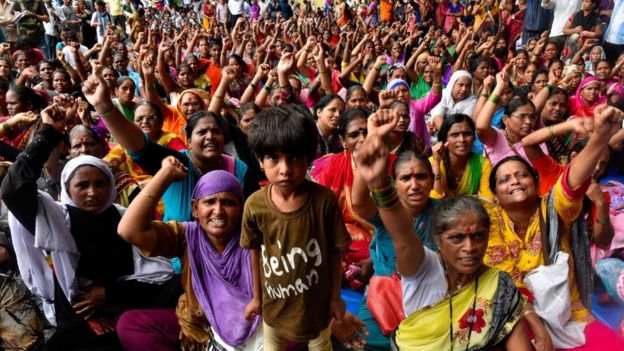
Image copyrightGETTY IMAGESImage captionResidents have been protesting for months to be moved elsewhere
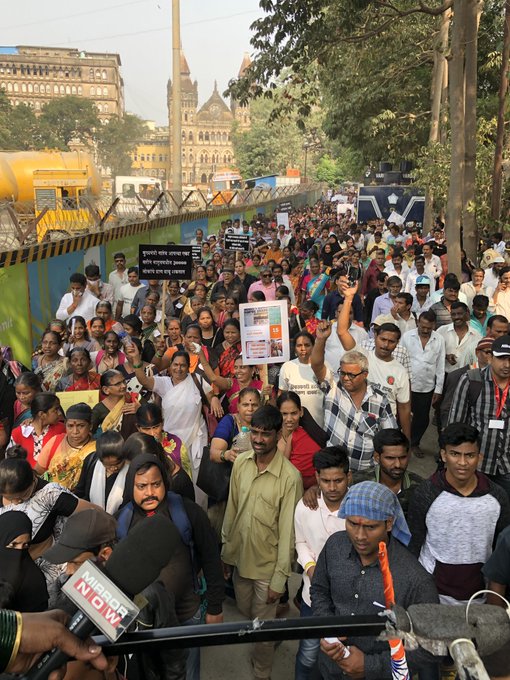
The protests have intensified in the past two months with many residents of Mahul’s transit camp demonstrating at the site where their homes once stood.
They have also launched a campaign on social media with the hashtag and Twitter handle MumbaisToxicHell – demanding that they are relocated again, this time to a safer and healthier environment.
Residents of Mahul protesting on the streets yet again demanding relocation from the Maha state government. Now even IIT Bombay’s report says the area is not fit to stay. What are you now waiting for? #mumbaistoxichell#wakeupgovt#residentspleadforbetterlife#mirrornow
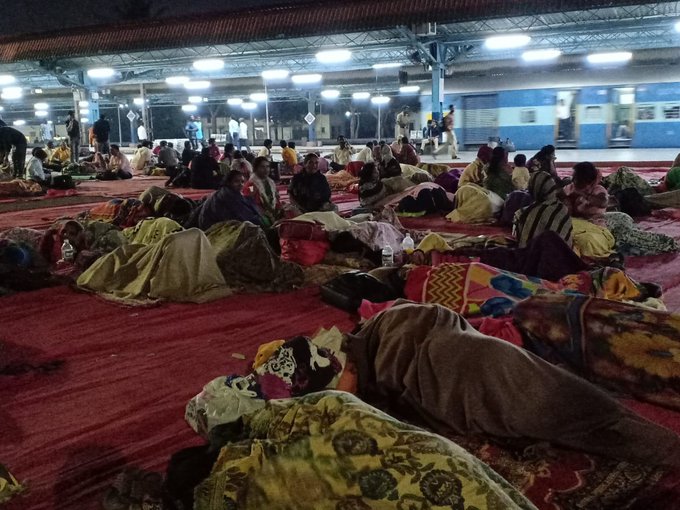
Residents of Mahul are compelled to sleep under the sky to save their lives from toxic atmosphere of Mahul. They are camping outside their homes since 50 days to save their lives.#MumbaisToxicHell








 CHINDIA ALERT: You'll be living in their world, very soon