Archive for ‘Muslim-majority’

14/02/2020

European diplomats check India’s loosening of Kashmir clampdown

SRINAGAR/NEW DELHI, India (Reuters) – More than two dozen diplomats are visiting Indian-administered Kashmir, New Delhi said on Wednesday, as the country tries to reassure foreign allies following several months of unrest in the contested territory.

The group includes European diplomats, some of whom declined a previous invitation from New Delhi to visit the region. A proposed vote in the European Union parliament next month could chastise India for its actions in Kashmir.

The Muslim-majority Himalayan region is claimed by India and arch-rival Pakistan and has been in turmoil since New Delhi stripped it of special status and clamped down on communication and freedom of movement in August.

India has since eased those restrictions, and restored limited internet connectivity last month, ending one of the world’s longest such shutdowns in a democracy.

But many political leaders, including three former chief ministers of Jammu & Kashmir state, are still in detention without charge six months after the crackdown, and foreign journalists have so far been denied permission to visit the region.

Representatives from countries including Germany, Canada, France, New Zealand, Mexico, Italy, Afghanistan and Austria are on a two-day visit to “witness for themselves the progressive normalisation of the situation,” India’s foreign ministry said in a statement on Wednesday.

Representatives from several countries, including Germany’s ambassador Walter Lindner, were pictured on a traditional wooden shikara boat on Dal Lake, in Kashmir’s main city of Srinagar.

“We are interacting with the traders, businesswomen and entrepreneurs in Srinagar about the status of business and tourism,” Afghanistan’s envoy Tahir Qadiry said in a tweet on Wednesday.

Sources familiar with the itinerary said the trip will also include meetings with the Indian army and government officials, as well as journalists and civil society groups selected by the security services.

Last month fifteen foreign envoys visited Kashmir – a trip participants characterised as tightly-choreographed with no room for independent meetings.

“Things looked calm, but we only had a very short time out the window of the car to assess the situation,” said a diplomat who attended the previous trip.

“They told the truth, but not necessarily the whole truth,” he added of his meetings with delegates.

Source: Reuters
19/10/2019

After parliamentary win, India’s BJP set to sweep state elections-poll

NEW DELHI/MUMBAI (Reuters) – India’s ruling Bharatiya Janata Party (BJP) is set to sweep two state polls next week, the first since Prime Minister Narendra Modi’s landslide win in a parliamentary election in May, a leading pollster said.

The BJP is set to comfortably win elections in the western state of Maharashtra and the northern state of Haryana, leaving the main opposition Congress party trailing, according to a survey by polling agency CVoter released on Friday.

CVoter estimates that a BJP-led alliance in Maharashtra will pick up 194 of the 288 seats on offer. In Haryana, the party is predicted to win 83 of the state’s 90 seats, leaving just three for Congress.

Voting in the elections will be held on Monday with the results expected to be announced on Thursday.

Several Congress party officials conceded they had all but given up hope of posing a serious challenge to Modi and the BJP.

In particular, the resignation of Congress chief Rahul Gandhi in July, after weeks of drama following the loss to the BJP in the general election, has sown internal confusion, triggering infighting and exits, two party officials in New Delhi said.

“It’s going to be a rout, and it will deflate morale even further,” one of the officials said, referring to the state elections. “It’s like a slow-moving disaster.”

They requested anonymity because they are not authorised to speak to the media.

Pranav Jha, the secretary in charge of Congress’s communication department, said the party was undergoing a period of “cleansing and churning” and remained committed to taking on the BJP.

“The people of India…can see through the diversionary drama of the ruling party, and realise that jobs, economy and issues of farmers can only be put on track by the Congress party,” Jha told Reuters.

Modi, analysts say, has moved decisively, including withdrawing special rights for Muslim-majority Jammu and Kashmir state, and consolidating the BJP’s hold over India’s Hindu-majority electorate.

INFIGHTING, INDIFFERENCE

In Maharashtra, one of India’s most industrialised states which includes Mumbai, two Congress officials said the top leadership’s relative indifference and infighting had hurt their already weak campaign.

Congress’s state wing had asked for Gandhi, his mother and current party chief Sonia Gandhi, and his charismatic sister Priyanka Gandhi Vadra to join the campaign, one of the two officials said.

But only Rahul Gandhi came and spoke at a handful of rallies.

“Senior leaders from BJP have covered every district. They have been visiting Maharashtra for the last two months to build momentum,” said one Congress official, who is contesting the upcoming poll.

“There wasn’t any concrete effort from Congress leaders in New Delhi to give energy to our cadre,” he said.

The list of recent resignations from the party include Ashok Tanwar, Congress’s former chief in Haryana who quit earlier this month and is now campaigning against his old party.

“The state of affairs in the Congress party is so dire that the decision makers can’t win an election themselves, while the soldiers on ground who stay in touch with the masses are neglected,” Tanwar wrote in his resignation letter.

The situation has even riled Congress allies. Two leaders from the Nationalist Congress Party, which is in alliance with the Congress in Maharashtra, said their partner was slack.

“It looks like Congress is not very serious about the state elections,” one of the leaders said. “Congress is not in the picture. Congress leaders are not attacking the ruling party the way we expected.”

In New Delhi, Congress officials said there was a sense of inertia at the party headquarters, without any understanding of who will become president after Sonia Gandhi, who is only holding charge temporarily.

“Without a clear leadership, nothing is going to change,” one of the officials said, “If it continues like this, the party will fade away.”

Source:Reuters

19/08/2019

Schools deserted in Indian Kashmir as parents fear more unrest

SRINAGAR, India (Reuters) – Schools reopened in Indian Kashmir’s main city on Monday but most classrooms were empty as parents kept their children home, fearing unrest over the government’s decision two weeks ago to revoke the region’s autonomy.

Some 190 primary schools were set open in Srinagar as a sign of normalcy returning to Muslim majority Jammu and Kashmir as authorities ease a clampdown aimed at preventing mass protests.

Parents said their children would stay home until cellular networks are restored and they can be in contact with them.

“How can we risk the lives of our children?” said Gulzar Ahmad, a father of two who are enrolled in a school in the city’s Batamallo district where protests have occurred.

“Troops have arrested minor children in the last two weeks and several children were injured in clashes,” he said. “Our children are safe inside their homes. If they go to school who can guarantee their safety?”

Authorities were not immediately available for comment, but have previously denied reports of mass arrests.

Protests began after the Aug. 5 decision by Prime Minister Narendra Modi’s government to withdraw Kashmir’s special status and integrate it fully into India, with equal rights for all Indians to buy property there and compete for government jobs.

Critics said the decision will alienate many Kashmiris and add fuel to a 30-year armed revolt in the Himalayan territory that Pakistan also lays claim to.

On the weekend, residents of Srinagar – the hotbed of the separatist revolt – threw stones and clashed with police. Dozens of people were injured, two senior officials and witnesses said.

Reuters journalists visited two dozen schools in Srinagar on Monday. Some schools were lightly staffed and classrooms deserted. Gates at other schools were locked.

Only one student showed up at Presentation Convent Higher Secondary School, which has an enrolment of 1,000 pupils, and went home, said a school official.

A handful of teachers but no students turned up at the barricaded Burn Hall school in one of the city’s high security zones.

“How can students come to classes in such a volatile situation? The government is turning these little children into cannon fodder,” a teacher said, adding that schools should stay closed until the situation is normal.

CROSS BORDER FIRING

New Delhi’s decision on Kashmir has heightened tensions with its neighbour and rival nuclear power, Pakistan, and triggered cross-border exchanges of fire.

In the latest incident, two civilians were killed in Pakistan-controlled Kashmir by Indian soldiers firing across the disputed border, Pakistan’s foreign ministry said, adding that it had summoned India’s deputy commissioner in Islamabad to protest.

“The ceasefire violations by India are a threat to regional peace and security and may lead to a strategic miscalculation,” the foreign ministry said.

There was no immediate comment from India which has previously accused Pakistan of trying to whip up tensions to draw global attention.

More than 50,000 people have died in the revolt that erupted against Indian rule in Kashmir in 1989. India blames Pakistan for giving material support to the militants and helping them cross into its part of the mountainous region.

Pakistan denies the allegation and says it only gives moral and diplomatic support to the Kashmiri people in their struggle for self determination.

Source: Reuters
22/02/2019

Pulwama attack: India government must protect Kashmiris – top court

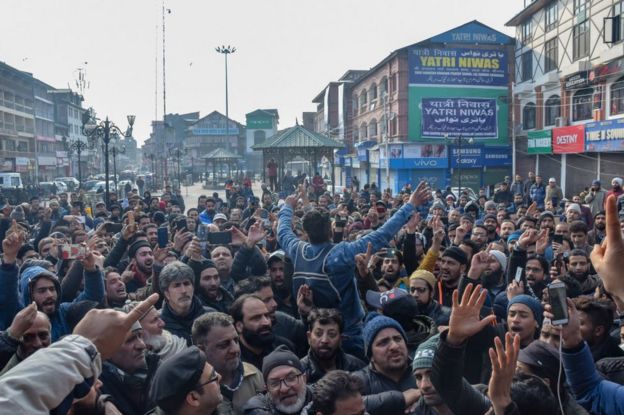
Protests against attacks on Kashmiris in Srinagar on 20 FebruaryImage copyrightGETTY IMAGES
Image captionProtests have been held in Indian-administered Kashmir over attacks on Kashmiris in other parts of India

India’s top court has ordered the government to protect Kashmiri people from attacks in apparent retaliation for last week’s deadly bombing in Indian-administered Kashmir.

There have been several reports of Kashmiri students and businessmen being harassed or beaten up in recent days.

The Supreme Court has also sought a response from the states where these alleged incidents happened.

The attack has sparked anger and anti-Pakistan protests across India.

The suicide bombing of an Indian security convoy in Pulwama on 14 February was claimed by a Pakistan-based militant group and has led to a war of words between nuclear-armed India and Pakistan.

But in some cases the anger has been directed against Kashmiri people living in other parts of India. The attack, which killed more than 40 Indian paramilitary police, was the deadliest against Indian forces in Kashmir in decades.

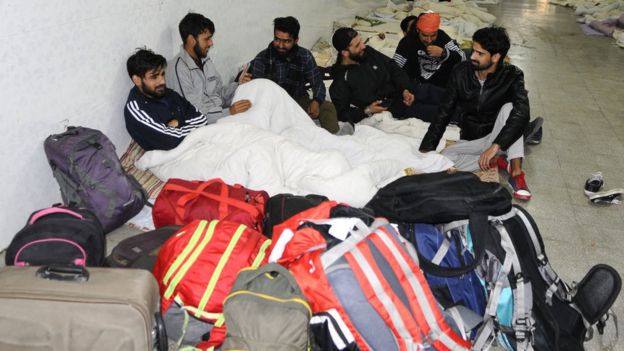
Hundreds of Kashmiri students, traders and businessmen have returned to Kashmir from various Indian cities out of fear that they could face harassment or attack.

Many Indians have expressed sympathy towards the Kashmiri students on social media, with some offering shelter in their own homes.

India has long had a volatile relationship with Muslim-majority Kashmir, where there has been an armed insurgency against Indian rule since the late 1980s.

The region has been a flashpoint between India and Pakistan since independence. Both countries claim all of Kashmir but control only parts of it. They have fought two wars and a limited conflict over the territory.

Kashmiri students from Dehradun, Ambala, Banur and Mohali leaving for Kashmir in Mohali, India.Image copyrightGETTY IMAGES
Image captionKashmiri students living in Dehradun and other cities have returned home since the attack

What did the court say?

The court’s decision singled out the federal government as well as governments in 10 states which are home to a sizeable Kashmiri population.

It asked authorities to widely publicise the details of officials who Kashmiris can contact if they face threats or violence.

The order was in response to a petition seeking protection for Kashmiris living across India. Tehseen Poonawala, one of the petitioners, told the BBC that he was moved to act because he was “disturbed” after reading reports of Kashmiris being attacked.

“It’s not about Kashmiris. It’s about human beings. We cannot be a country that responds with mob violence,” he said.

What happened to Kashmiri students?

In the days following the attack, isolated incidents of students from Kashmir being beaten up or evicted from their accommodation in northern Indian states were reported in local media. Kashmiri Muslims were warned to stay vigilant and India’s Central Reserve Police Force (CRPF) offered help to those in need, but also warned of false reports.

Twenty Kashmiri girls in the northern city of Dehradun were forced to lock themselves in their hostel after protesters gathered outside to demand their eviction, according to the Times of India.

Two other colleges in the city issued public statements saying they would not admit Kashmiri students in the next academic year.

“We did so to provide protection to the [Kashmiri] students,” the college principal, Aslam Siddidqu, told the BBC, adding that he had faced pressure from right-wing groups.

Federal education minister Prakash Javadekar has denied that “incidents” have taken place involving Kashmiri students.

But a police official in Dehradun told the BBC that 22 students had been arrested for protesting and demanding that Kashmiri students be expelled from colleges in the city.

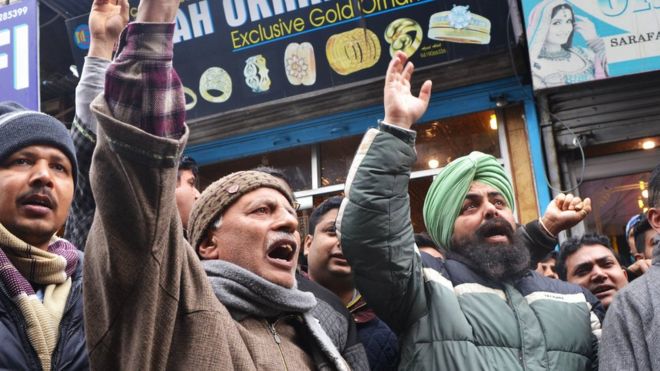
Kashmiri traders are seen shouting slogans during the protest. Traders in Lal Chowk and adjoining markets closed their shops as a mark of protest against attacks on Kashmiris elsewhere in India.Image copyrightGETTY IMAGES
Image captionMarkets and businesses were closed to protest against violence

What’s the bigger picture?

The attack has raised tensions between India and Pakistan, which have fought two wars and a limited conflict in the region and are both nuclear powers.

India has accused Pakistani intelligence services of having a hand in the attack, which was claimed by militant group Jaish-e-Mohammad.

Pakistan denies this and has warned that it will retaliate if India takes military action. In his first comments addressing the attack, Prime Minister Imran Khan said India should “stop blaming Pakistan without any proof or evidence” and urged Indian authorities to share any “actionable intelligence”.

India has moved to impose trade restrictions on Pakistan. It has also said it will build dams to reduce the flow of water to Pakistan from three rivers in India. Similar plans were announced in 2016, after a deadly militant attack on an Indian base in Kashmir.

The tensions between the neighbours may also have an impact on cricket, a national obsession in both India and Pakistan. Amid outrage over the attack, there have been calls for India to boycott its much anticipated match against Pakistan at the World Cup in June.

Indian cricket administrators say no decision has yet been made.

Source: The BBC

Law of Unintended Consequences

continuously updated blog about China & India

ChiaHou's Book Reviews

continuously updated blog about China & India

What's wrong with the world; and its economy

continuously updated blog about China & India