Archive for ‘NASDAQ’

12/02/2020

Coronavirus cases fall, experts disagree whether peak is near

BEIJING/SINGAPORE (Reuters) – China reported on Wednesday its smallest number of coronavirus cases since January, lending weight to a prediction by its top medical adviser for the outbreak to end by April, but a global infectious diseases expert warned of the spread elsewhere.

Financial markets took heart from the outlook of the Chinese official, epidemiologist Zhong Nanshan, who said on Tuesday the number of new cases was falling in some provinces, and forecast the epidemic would peak this month, even as the death toll in China rose to more than 1,100 people.

World stocks, which had seen rounds of sell-offs over the virus, surged to record highs on hopes of a peak in cases. The Dow industrials, S&P 500 and Nasdaq all hit new highs, and Asian shares nudged higher on Wednesday.

But the World Health Organization (WHO) has warned that the epidemic poses a global threat akin to terrorism and one expert coordinating its response said while the outbreak may be peaking at its epicentre in China, it was likely to spread elsewhere in the world, where it had just begun.

“It has spread to other places where it’s the beginning of the outbreak,” the official, Dale Fisher, head of the Global Outbreak Alert and Response Network coordinated by the WHO, said in an interview in Singapore.

“In Singapore, we are at the beginning of the outbreak.”

Singapore has reported 47 cases and worry about the spread is growing. Its biggest bank, DBS (DBSM.SI), evacuated 300 staff from its head office on Wednesday after a confirmed coronavirus case in the building.

Hundreds of cases have been reported in dozens of other countries and territories around the world, but only two people have died outside mainland China – one in Hong Kong and another in the Philippines.

WHO chief Tedros Adhanom Ghebreyesus said on Tuesday the world had to “wake up and consider this enemy virus as public enemy number one” and the first vaccine was 18 months away.

In China, total infections have hit 44,653, health officials said, including 2,015 new confirmed cases on Tuesday. That was the lowest daily rise in new cases since Jan. 30.

The number of deaths on the mainland rose by 97 to 1,113 by the end of Tuesday.

But doubts have been aired on social media about how reliable the figures are, after the government last week amended guidelines on the classification of cases.

‘STAY HOPEFUL’

The biggest cluster of cases outside China is aboard the Diamond Princess cruise ship quarantined off Japan’s port of Yokohama, with about 3,700 people on board. Japanese officials on Wednesday said 39 more people had tested positive for the virus, taking the total to 175.

One of the new cases was a quarantine officer.

Thailand said it was barring passengers from another cruise ship, MS Westerdam, from disembarking, the latest country to turn it away amid fears of the coronavirus, despite no confirmed infections on board.

“We try to stay hopeful,” American passenger Angela Jones told Reuters in a video recording. “But each day, that becomes a little bit more difficult, when country after country rejects us.”

Echoing the comparison with the fight against terrorism, China’s state news agency Xinhua said late on Tuesday the epidemic was a “battle that has no gunpowder smoke but must be won”.

The epidemic was a big test of China’s governance and capabilities and some officials were still “dropping the ball” in places where it was most severe, it said, adding: “This is a wake-up call.”

The government of Hubei, the central province at the outbreak’s epicentre, dismissed the provincial health commission’s Communist Party boss, state media said on Tuesday, amid mounting public anger over the crisis.

China’s censors had allowed criticism of local officials but have begun cracking down on reporting of the outbreak, issuing reprimands to tech firms that gave free rein to online speech, Chinese journalists said.

The pathogen has been named COVID-19 – CO for corona, VI for virus, D for disease and 19 for the year it emerged. It is suspected to have come from a market that illegally traded wildlife in Hubei’s capital of Wuhan in December.

The city of 11 million people remains under virtual lockdown as part of China’s unprecedented measures to seal infected regions and limit transmission routes.

Travel restrictions that have paralysed the world’s second-biggest economy have left Wuhan and other Chinese cities resembling ghost towns.

Even if the epidemic ends soon, it has taken a toll of China’s economy, with companies laying off workers and needing loans running into billions of dollars to stay afloat. Supply chains for makers of items from cars to smartphones have broken down.

ANZ Bank said China’s first-quarter growth would probably slow to 3.2% to 4.0%, down from a projection of 5.0%.

The likely slowdown in China could shave 0.1 to 0.2 percentage points off both euro zone and British growth this year, credit rating agency S&P Global estimated.

Source: Reuters
26/02/2019

Trump: US and China ‘very very close’ on deal

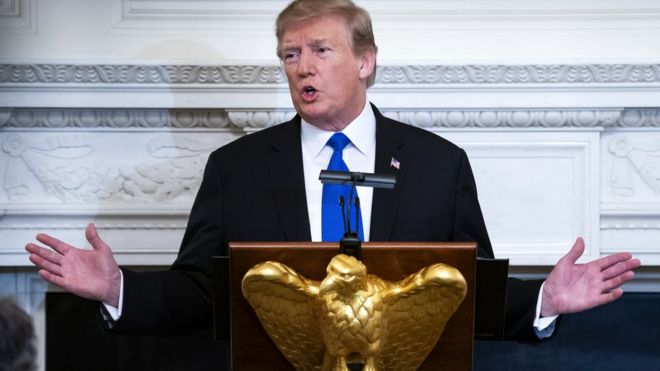
US President Donald Trump addresses US governors at the White HouseImage copyrightAFP

President Donald Trump has said that the US and China are “very very close” to signing a trade agreement, potentially ending the long-running feud between the two countries.

Mr Trump told US governors on Monday that both nations “are going to have a signing summit”.

“Hopefully, we can get that completed. But we’re getting very, very close,” he said.

It follows a decision to delay imposing further trade tariffs on Chinese goods.

At the weekend, Mr Trump said both sides had made “substantial progress” in trade talks following a summit in Washington last week.

The rise in import duties on Chinese goods from 10% to 25% was due to come into effect on 1 March.

Instead, Mr Trump said the US is now planning a summit with Chinese Premier Xi Jinping at the US President’s Mar-a-Lago resort in Florida.

US shares rose on the decision to delay tariffs, with the Dow Jones Industrial Average closing 0.23% higher at 26,091.9.

The S&P 500 and the Nasdaq also finished trading in positive territory.

As he prepared to meet North Korean leader Kim Jong-un in Vietnam, Mr Trump also tweeted that a China trade deal was in “advanced stages”.

Mr Trump’s decision to delay tariff increases on $200bn (£153bn) worth of Chinese goods was seen as a sign that the two sides were moving ahead in settling their damaging trade war.

Last week, Mr Trump noted progress in the latest round of negotiations in Washington, including an agreement on currency manipulation, though no details were disclosed.

Sources told CNBC on Friday that China had committed to buying up to $1.2 trillion in US goods, but there had been no progress on the intellectual property issues.

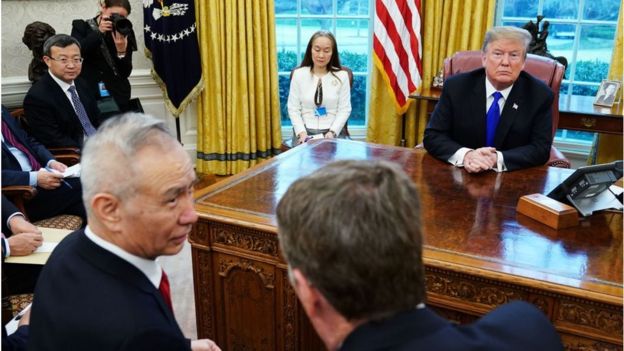
Donald Trump and China's Vice Premier Liu He in the Oval OfficeImage copyrightAFP
Image captionPresident Trump met China’s Vice Premier Liu He on Friday

Gregory Daco, chief US economist at Oxford Economics, said: “We had anticipated such a delay and believe a handshake agreement in which China will promise to import more agricultural products, work towards a stable currency and reinforce intellectual property rights protection will be achieved in the coming weeks.

“However, we don’t foresee a significant rollback of existing tariffs, and see underlying tensions regarding China’s strategic ambitions, its industrial policy, technological transfers and ‘verification and enforcement’ mechanisms remaining in place.”

What has happened in the trade war so far?

Mr Trump initiated the trade war over complaints of unfair Chinese trading practices.

That included accusing China of stealing intellectual property from American firms, forcing them to transfer technology to China.

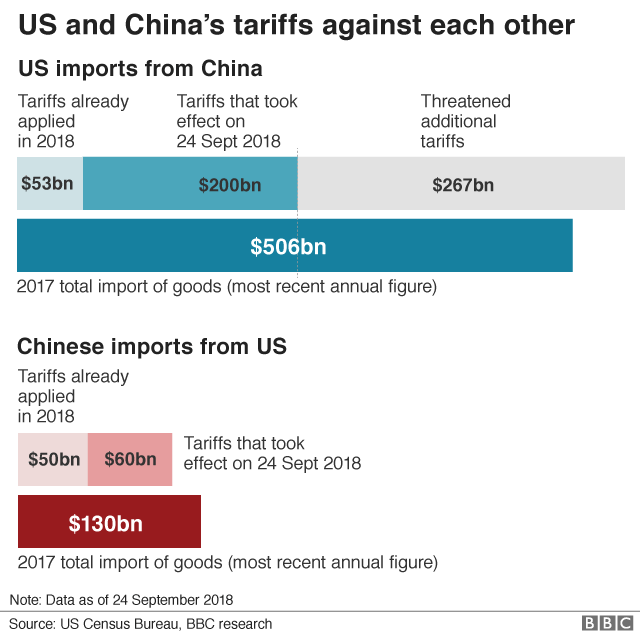
The US has imposed tariffs on $250bn worth of Chinese goods, and China has retaliated by imposing duties on $110bn of US products.

Mr Trump has also threatened further tariffs on an additional $267bn worth of Chinese products – which would see virtually all of Chinese imports into the US become subject to duties.

US and China's tariffs against each other

The trade dispute has unnerved financial markets, risks raising costs for American companies and is adding pressure to a Chinese economy that is already showing signs of strain.

It has also stoked fears about the impact on the global economy.

Last year, the International Monetary Fund warned the trade war between the US and China risked making the world a “poorer and more dangerous place”.

Source: The BBC

12/02/2019

Chinese shares jump on 1st trading day of Year of Pig

#CHINA-STOCKS (CN)

Investors are seen at a stock exchange in Hangzhou, east China’s Zhejiang Province, Feb. 11, 2019, the first trading day of the Year of the Pig. China’s major stock indices ended notably higher Monday as investors greeted the Year of the Pig in China’s lunar calendar with bullish sentiment. The benchmark Shanghai Composite Index closed 1.36 percent higher at 2,653.9 points while the Shenzhen Component Index surged by 3.06 percent to close at 7,919.05 points. (Xinhua/Long Wei)

BEIJING, Feb. 11 (Xinhua) — China’s major stock indices ended notably higher Monday as investors greeted the Year of the Pig in China’s lunar calendar with bullish sentiment.

The benchmark Shanghai Composite Index closed 1.36 percent higher at 2,653.9 points while the Shenzhen Component Index surged by 3.06 percent to close at 7,919.05 points.

Companies in the agricultural sector were among the biggest winners, with Jiangxi Zhengbang Technology, a Shenzhen-listed agro-processing firm, jumping by the daily limit of 10 percent.

Liquor makers saw a strong performance, with the share price of top liquor brand Kweichow Moutai jumping 4.71 percent, bringing the company’s market capitalization to over 911 billion yuan (135 billion U.S. dollars).

Beijing Jingxi Culture & Tourism Co., Ltd, an investor of Chinese sci-fi blockbuster “The Wandering Earth”, surged by the daily limit after the film claimed the winner of the Chinese box office during the week-long Spring Festival holiday.

The film had earned over 1.94 billion yuan (about 288 million U.S. dollars) since its release on Tuesday as of 7:00 p.m. Sunday, according to Maoyan, a professional box office tracker.

The ChiNext Index, China’s NASDAQ-style board of growth enterprises, gained 3.53 percent to close at 1,316.1 points.

Source: Xinhua

Law of Unintended Consequences

continuously updated blog about China & India

ChiaHou's Book Reviews

continuously updated blog about China & India

What's wrong with the world; and its economy

continuously updated blog about China & India