

- As China expands its military might a retired naval officer points out that size is not everything in modern warfare
- ‘It is the people who use these weapons that count’

“In China, [our military planes] would not have taken off [for training] if the cloud was lower than 400 metres above ground,” he explained.
“Such conditions are dangerous [for military aircraft to take off] but they were able to carry on training despite the weather.”
After a fourth sea trial, China’s Type 001A aircraft carrier may go into service within months
As China expands its military might with new aircraft carriers, advanced fighter jets and other world-class weaponry, questions have been raised about whether the People’s Liberation Army can compete with other advanced forces.
Wang, now a naval armament expert, pointed out that size was only one determining factor in modern warfare, and hardware could only answer part of the question as China raced to catch up with leading powers like the US and its top allies, including Japan“It is the people who use these weapons that count, and that essentially boils down to our level of training.

“Some people hold the view that our military planes are more advanced than others. But if we look at the level of training of our forces … We are not at the same level [as others] yet.”
Antony Wong Dong, a military expert based in Macau who has spent years studying the PLA, agreed with Wang’s assessment.
Although the PLA – which has not fought a major war since the Korean war – has made great strides in improving training for its rank and file in past decades, Wong said there was much room for improvement to raise its “preparedness”.
That was in fact the message from President Xi Jinping in December in a speech reminding the top brass that strengthening training and preparation for war would be the top priorities for the PLA in 2019.
Chinese President Xi Jinping gives army its first order of 2019: be ready for battle
Naha, in Japan’s Okinawa prefecture, is home to the 9th Air Wing, which was set up three years ago with 40 F-15 fighter jets. It was a time of growing assertiveness by China in the East China Sea, including over the contested Diaoyu Islands, which are administered by Tokyo but also claimed by Beijing and Taipei.
According to the Joint Staff of the Japanese defence ministry, in the 2017 fiscal year, which started on April 1, there were 500 scrambles by Japan’s Air Self-Defence Force to intercept Chinese military aircraft flying over the region, compared with 851 scrambles in 2016.
But in the first three quarters of the 2018 fiscal year, the number of scrambles reached 476, as Xi pushed the PLA to conduct more training, including exercises further from home.
And, as China starts testing its first home-made aircraft carrier, Tokyo announced in December that it would convert its helicopter carrier, the destroyer Izumo, into an aircraft carrier capable of launching American F-35B fighter jets.
Against such a background, Wang said China needed to reflect deeply on its overall military strength in addition to investing in cutting-edge weaponry.
This was the reason for his heavy heart at Naha Airport, as he watched the extent of Japanese military training.
“On that day it was not just the F-15s taking off [at Naha], but also Ospreys and Sikorsky Seahawks, and the training went on non-stop the whole day,” Wang said.
“It immediately came to my mind that we should not look down upon the Japanese forces. We must bear in mind that the level of training reflects your level of combat preparedness.
“Our fleet of warships and military planes far outnumber the Japanese forces, even by the number of more advanced generations of fighter jets … but in real combat, the size of the battlefield is limited, whether it is at sea or in the sky.
“You cannot deploy everything you have. And when both sides deploy the same resources into the battlefield, we must not be blindly [optimistic] about our chance of winning.”
The rapid development of new hardware could also pose challenges for training Chinese troops, especially in helping them master the skills necessary to use and understand the new weapons.
“We are still exploring. It is not that we are slack. [These new weapons] are just too advanced,” Wang said.
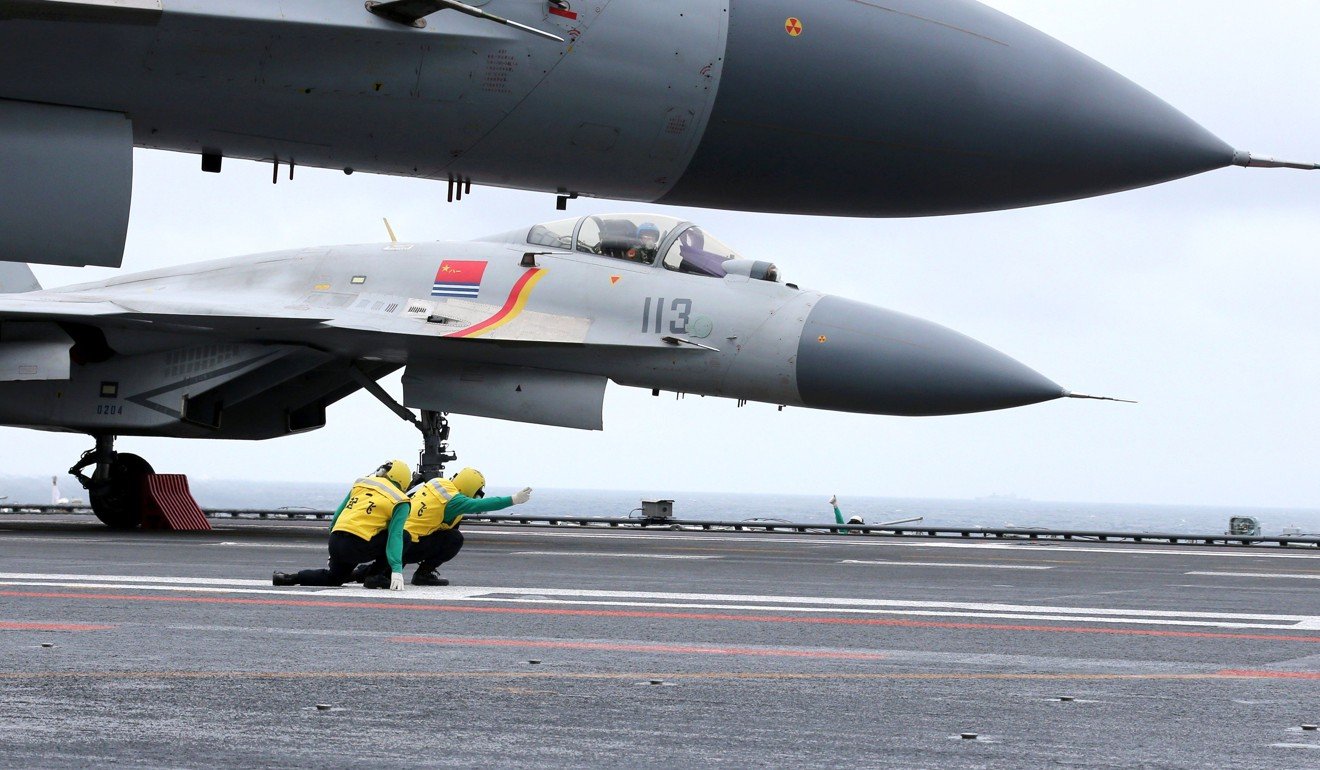
“Like [the stealth fighter jet] J-20… or [carrier-based fighter jet] J-15, we initially didn’t know how to make the best use of them in different circumstances.
“We only recently mastered how to take off and land [J-15s] at night. It is not certain if we are ready to undertake evening flight missions of these aircraft when they are loaded with heavy missiles,” he said.
Military expert Wong said the PLA had yet to resolve many issues, including pairing up its J-15 fighter jets and its aircraft carriers.
“To what extent can PLA troops and these weapons work seamlessly in executing tactics?” Wong said.
“From what we saw on the news, [I would say that] there are still gaps in the quality and quantity of weapons that [our carrier-based aircraft] can actually carry.”
Source: SCMP


 CHINDIA ALERT: You'll be living in their world, very soon
