Archive for ‘New Silk Road’

01/10/2019

China anniversary: How the country became the world’s ‘economic miracle’

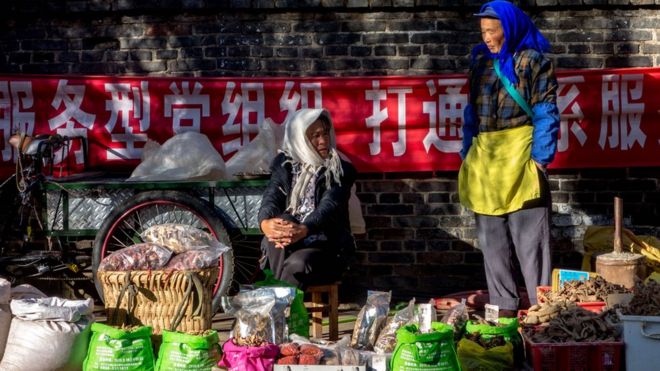
Local women sell produce in the market. Zhongyi market, located at the southern gate of Dayan ancient city, in Lijian, Yunnan Province in ChinaImage copyrightGETTY IMAGES

It took China less than 70 years to emerge from isolation and become one of the world’s greatest economic powers.

As the country celebrates the anniversary of the founding of the People’s Republic of China, we look back on how its transformation spread unprecedented wealth – and deepened inequality – across the Asian giant.

“When the Communist Party came into control of China it was very, very poor,” says DBS chief China economist Chris Leung.

“There were no trading partners, no diplomatic relationships, they were relying on self-sufficiency.”

Over the past 40 years, China has introduced a series of landmark market reforms to open up trade routes and investment flows, ultimately pulling hundreds of millions of people out of poverty.
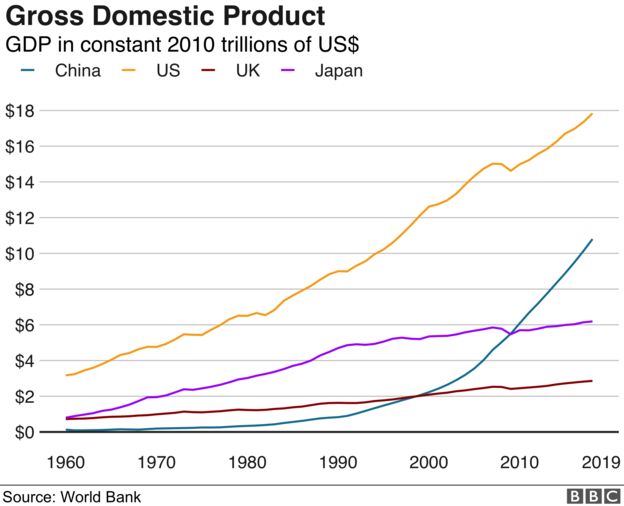
Chart showing gross domestic product of US, China, Japan and the UK

The 1950s had seen one of the biggest human disasters of the 20th Century. The Great Leap Forward was Mao Zedong’s attempt to rapidly industrialise China’s peasant economy, but it failed and 10-40 million people died between 1959-1961 – the most costly famine in human history.

This was followed by the economic disruption of the Cultural Revolution in the 1960s, a campaign which Mao launched to rid the Communist party of his rivals, but which ended up destroying much of the country’s social fabric.

‘Workshop of the world’

Yet after Mao’s death in 1976, reforms spearheaded by Deng Xiaoping began to reshape the economy. Peasants were granted rights to farm their own plots, improving living standards and easing food shortages.

The door was opened to foreign investment as the US and China re-established diplomatic ties in 1979. Eager to take advantage of cheap labour and low rent costs, money poured in.

“From the end of the 1970s onwards we’ve seen what is easily the most impressive economic miracle of any economy in history,” says David Mann, global chief economist at Standard Chartered Bank.

Through the 1990s, China began to clock rapid growth rates and joining the World Trade Organization in 2001 gave it another jolt. Trade barriers and tariffs with other countries were lowered and soon Chinese goods were everywhere.

“It became the workshop of the world,” Mr Mann says.
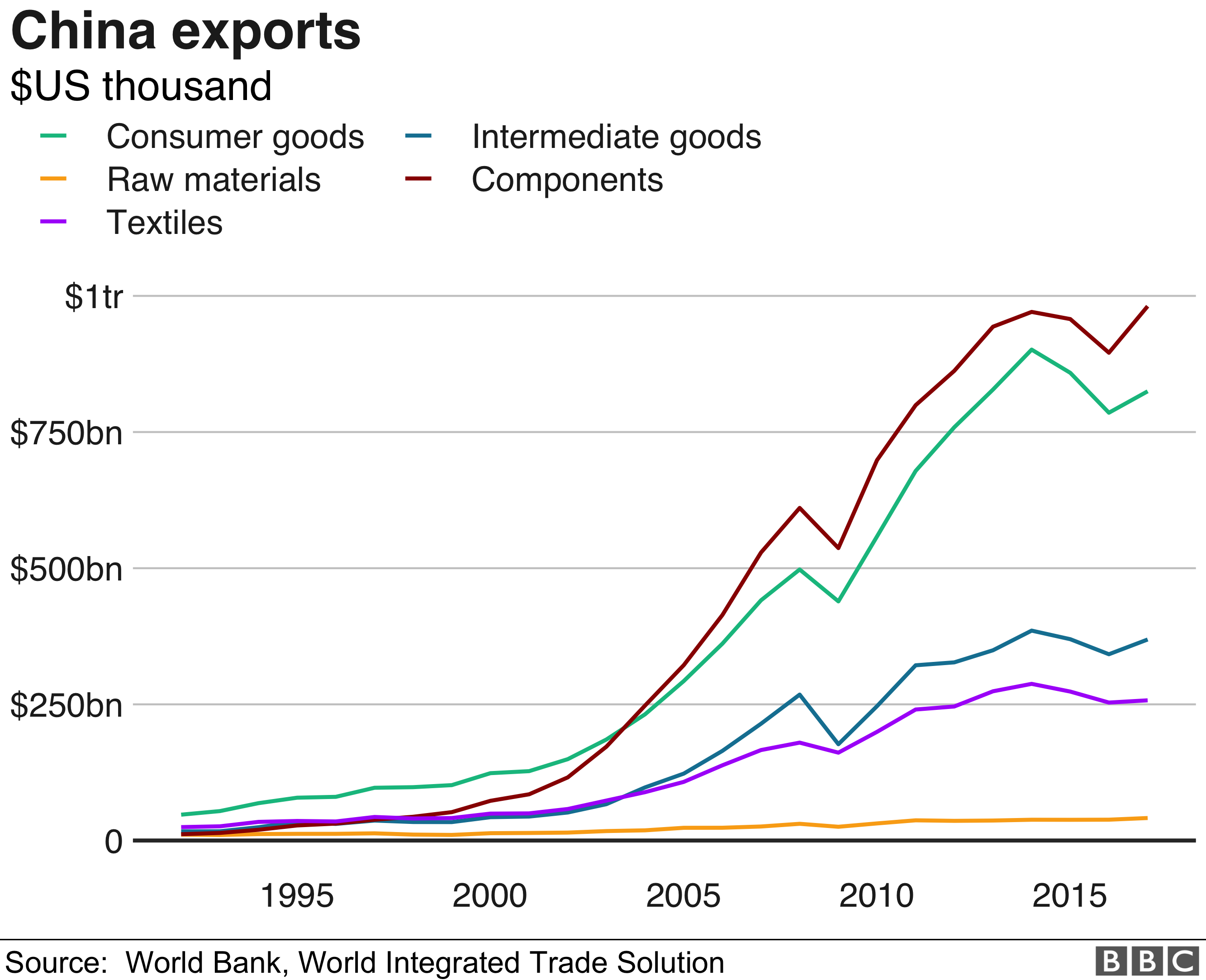
Chart showing China exports

Take these figures from the London School of Economics: in 1978, exports were $10bn (£8.1bn), less than 1% of world trade.

By 1985, they hit $25bn and a little under two decades later exports valued $4.3trn, making China the world’s largest trading nation in goods.

Poverty rates tumble

The economic reforms improved the fortunes of hundreds of millions of Chinese people.

The World Bank says more than 850 million people been lifted out of poverty, and the country is on track to eliminate absolute poverty by 2020.

At the same time, education rates have surged. Standard Chartered projects that by 2030, around 27% of China’s workforce will have a university education – that’s about the same as Germany today.
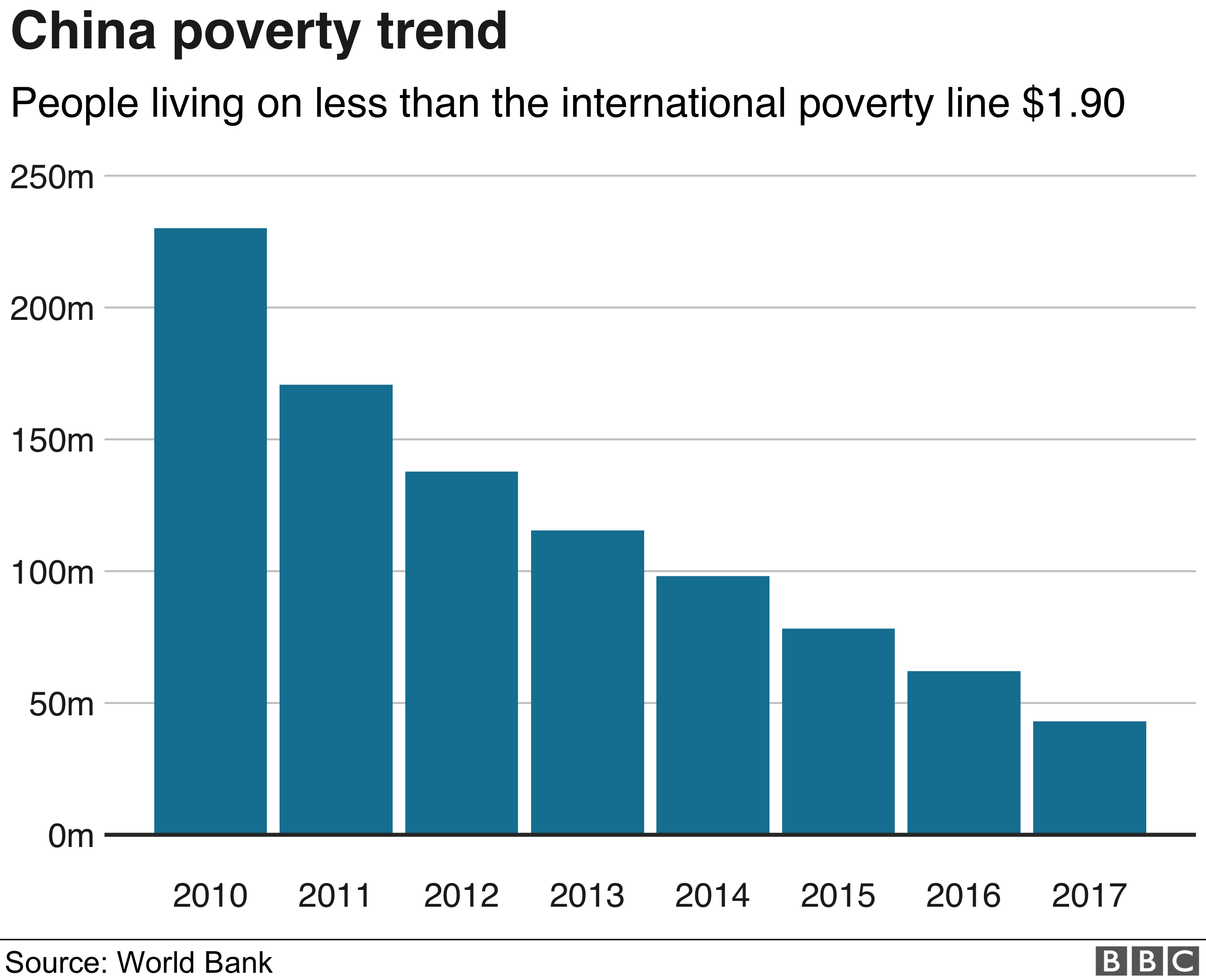
China poverty rates

Rising inequality

Still, the fruits of economic success haven’t spread evenly across China’s population of 1.3 billion people.

Examples of extreme wealth and a rising middle class exist alongside poor rural communities, and a low skilled, ageing workforce. Inequality has deepened, largely along rural and urban divides.

“The entire economy is not advanced, there’s huge divergences between the different parts,” Mr Mann says.

The World Bank says China’s income per person is still that of a developing country, and less than one quarter of the average of advanced economies.

China’s average annual income is nearly $10,000, according to DBS, compared to around $62,000 in the US.
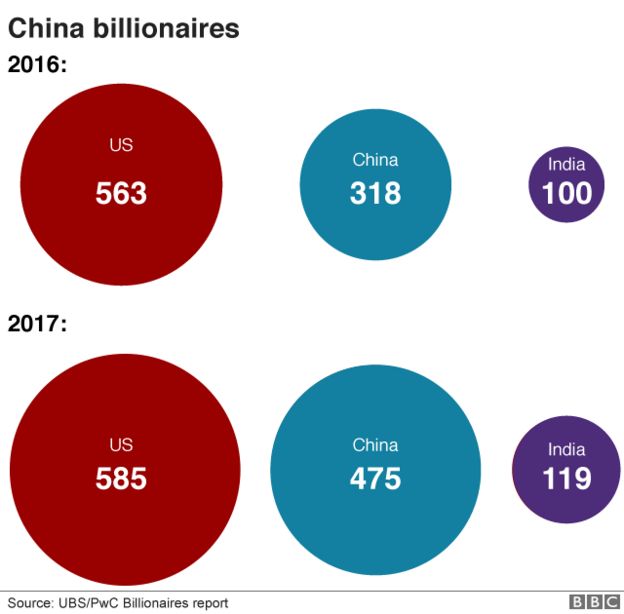
Billionaires in China, the US and India

Slower growth

Now, China is shifting to an era of slower growth.

For years it has pushed to wean its dependence off exports and toward consumption-led growth. New challenges have emerged including softer global demand for its goods and a long-running trade war with the US. The pressures of demographic shifts and an ageing population also cloud the country’s economic outlook.

Still, even if the rate of growth in China eases to between 5% and 6%, the country will still be the most powerful engine of world economic growth.

“At that pace China will still be 35% of global growth, which is the biggest single contributor of any country, three times more important to global growth than the US,” Mr Mann says.

The next economic frontier

China is also carving out a new front in global economic development. The country’s next chapter in nation-building is unfolding through a wave of funding in the massive global infrastructure project, the Belt and Road Initiative.
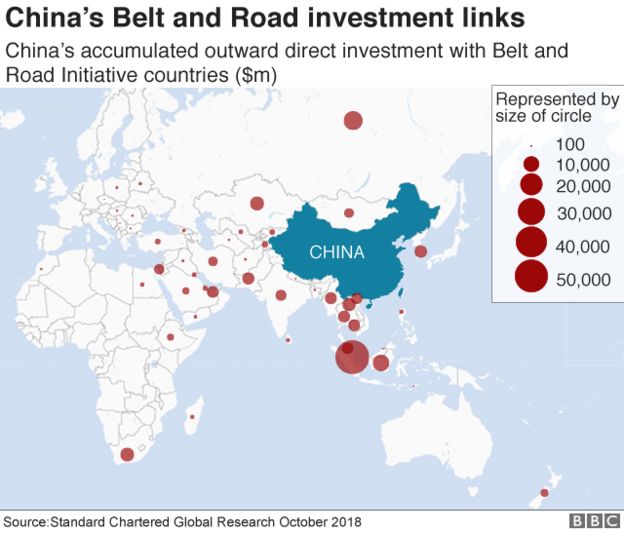
Map showing Chinese investment as part of the Belt and Road initiative

The so-called new Silk Road aims to connect almost half the world’s populations and one-fifth of global GDP, setting up trade and investment links that stretch across the world.

Source: The BBC
21/03/2019

Italy takes a shine to China’s New Silk Road

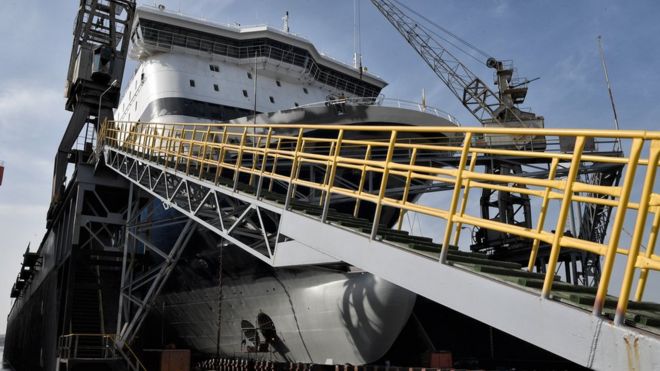
A large ship in dry dock is worked on in this photo from late 2018Image copyrightGETTY IMAGES
Image captionChina has bought up a majority stake in the Greek port of Piraeus – and Italy might be next

China’s president lands in Rome on Thursday, where he is expected to sign a landmark infrastructure deal that has raised eyebrows and suspicions among Italy’s Western allies.

Xi Jinping’s project is a New Silk Road which, just like the ancient trade route, aims to link China to Europe.

The upside for Italy is a potential flood of investment and greater access to Chinese markets and raw materials.

But amid China’s growing influence and questions over its intentions, Italy’s Western allies in the European Union and United States have concerns.

By land and by sea

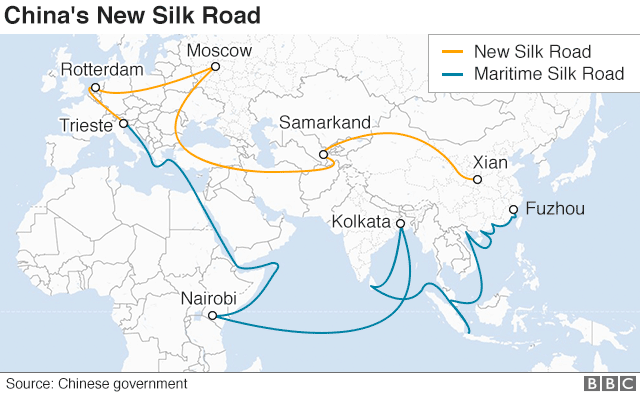
The New Silk Road has another name – the Belt and Road Initiative (BRI) – and it involves a wave of Chinese funding for major infrastructure projects around the world, in a bid to speed Chinese goods to markets further afield.

It has already funded trains, roads, and ports, with Chinese construction firms given lucrative contracts to connect ports and cities – funded by loans from Chinese banks.

The levels of debt owed by African nations to China have raised concerns in the West – but roads and railways have been built that would not exist otherwise:

Italy, however, will be the first top-tier global power – a member of the G7 – to take the money offered by China.

It is one of the world’s top 10 largest economies – yet Rome finds itself in a curious situation.

A map shows the overland and sea routes from China to Europe - the overland routes stretches from Xian in China's east, to Samarkand, Moscow, and Rotterdam; the sea route from Fuzhou port to Kolkata in India and Nairobi in Africa before reaching Italy

The collapse of the Genoa bridge in August killed dozens of people and made Italy’s crumbling infrastructure a major political issue for the first time in decades.

And Italy’s economy is far from booming.

The country slipped into recession at the end of 2018, and its national debt levels are among the highest in the eurozone. Italy’s populist government came to power in June 2018 with high-spending plans but had to peg them back after a stand-off with the EU.

It is in this context that China’s deal is being offered – funding that could rejuvenate Italy’s grand old port cities along the Maritime Silk Road.

Italian Prime Minister Giuseppe Conte has mentioned the cities of Trieste and Genoa as likely candidates.

“The way we see it, it is an opportunity for our companies to take the opportunity of China’s growing importance in the world,” said Italy’s undersecretary of state for trade and investment, Michele Geraci.

“We feel that amongst our European partners, Italy has been left out. We have wasted a little bit of time,” he told the BBC.

So what’s in it for China?

Italy’s move is “largely symbolic”, according to Peter Frankopan, professor of Global History at Oxford University and a writer on The Silk Roads.

But even Rome admitting the BRI is worth exploring “has a value for Beijing”, he said.

“It adds gloss to the existing scheme and also shows that China has an important global role.”

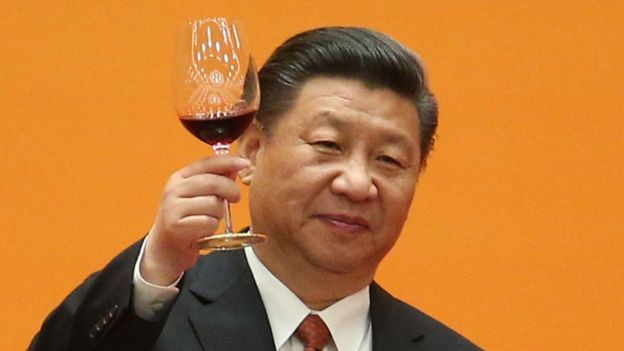
President Xi Jinping raises a glass of wine from a podium, set against a yellow background, in this photoImage copyrightGETTY IMAGES
Image captionPresident Xi Jinping has made the BRI a flagship policy

“The seemingly innocuous move comes at a sensitive time for Europe and the European Union, where there is suddenly a great deal of trepidation not only about China, but about working out how Europe or the EU should adapt and react to a changing world,” Prof Frankopan told the BBC.

“But there is more at stake here too,” he added. “If investment does not come from China to build ports, refineries, railway lines and so on, then where will it come from?”

Ahead of his arrival, President Xi declared that the friendship between the two nations was “rooted in a rich historical legacy”.

“Made in Italy has become synonymous with high quality products. Italian fashion and furnishings fully meet the taste of Chinese consumers; pizza and tiramisu are liked by young Chinese people,” he wrote in an article published by Corriere della Sera.

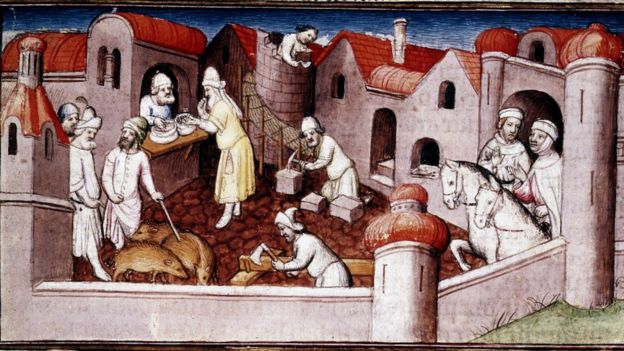
Scene from Marco Polo's Book of Marvels, early 15th century, showing merchants entering a walled town, mason and carpenter at work, a shopkeeper serving a customer, and men driving swineImage copyrightOXFORD SCIENCE ARCHIVE/GETTY IMAG
Image captionExplorer Marco Polo’s travels along the Silk Road were immortalised in the “Book of Marvels”

That “made in Italy” label carries a reputation for quality worldwide, and is legally protected for products items processed “mainly” in Italy.

In recent years, Chinese factories based in Italy using Chinese labour have been challenging that mark of quality.

Better connections for cheap raw materials from China – and the return of finished products from Italy – could exaggerate that practice.

“Predatory” investment

The non-binding deal being signed by the two countries on Thursday comes amid questions over whether Chinese firm Huawei should be permitted to build essential communications networks – after the United States expressed concern they could help Beijing spy on the West.

That is not part of the current negotiations in Italy.

But a little over a week before the deal was due to be signed, the European Commission released a joint statement on “China’s growing economic power and political influence” and the need to “review” relations.

As President Xi tours Rome, EU leaders in Brussels will be considering 10 points for relations with China.

While they include deepening engagement, they also involve plans to “address the distortive effects of foreign state ownership” as well as “security risks posed by foreign investment in critical assets, technologies and infrastructure”.

In March, US National Security Council spokesman Garrett Marquis pointed out that Italy was a major economy and did not need to “lend legitimacy to China’s vanity infrastructure project”.

Members of Italy’s ruling right-wing League party have their owns concerns about national security

Interior Minister Matteo Salvini warned that he did not want to see foreign businesses “colonising” Italy.

“Before allowing someone to invest in the ports of Trieste or Genoa, I would think about it not once but a hundred times,” Salvini warned.

Setting the scene

Italian officials are keen to point out that the deal being signed is not an international treaty, and is non-binding.

“There are no specific projects,” Mr Geraci said. “It is more of an accord that sets the scene.”

Other European nations already accept Chinese investment through something called the Asian Infrastructure Investment Bank, he said – something the UK was the first to sign up to.

Media captionWhat China’s One Belt, One Road really means

“And then one by one, France, Germany, Italy and everyone else also followed suit,” Mr Geraci said.

Similarly, he believes Italy’s neighbours will soon follow it into the Belt and Road initiative.

“I do believe that this time Italy is actually leading Europe – which I understand may be a surprise to most,” he added.

Source: The BBC

Law of Unintended Consequences

continuously updated blog about China & India

ChiaHou's Book Reviews

continuously updated blog about China & India

What's wrong with the world; and its economy

continuously updated blog about China & India