Archive for ‘next generation’

28/08/2019

China’s navy ‘set to pick J-20 stealth jets for its next generation carriers’

  • Military insiders say the aircraft appears to have beaten the FC-31 in the race to become the PLA Navy’s fighter of the future
  • A military source close said it would be almost impossible to develop both aircraft over the next few years given the risk of an economic downturn
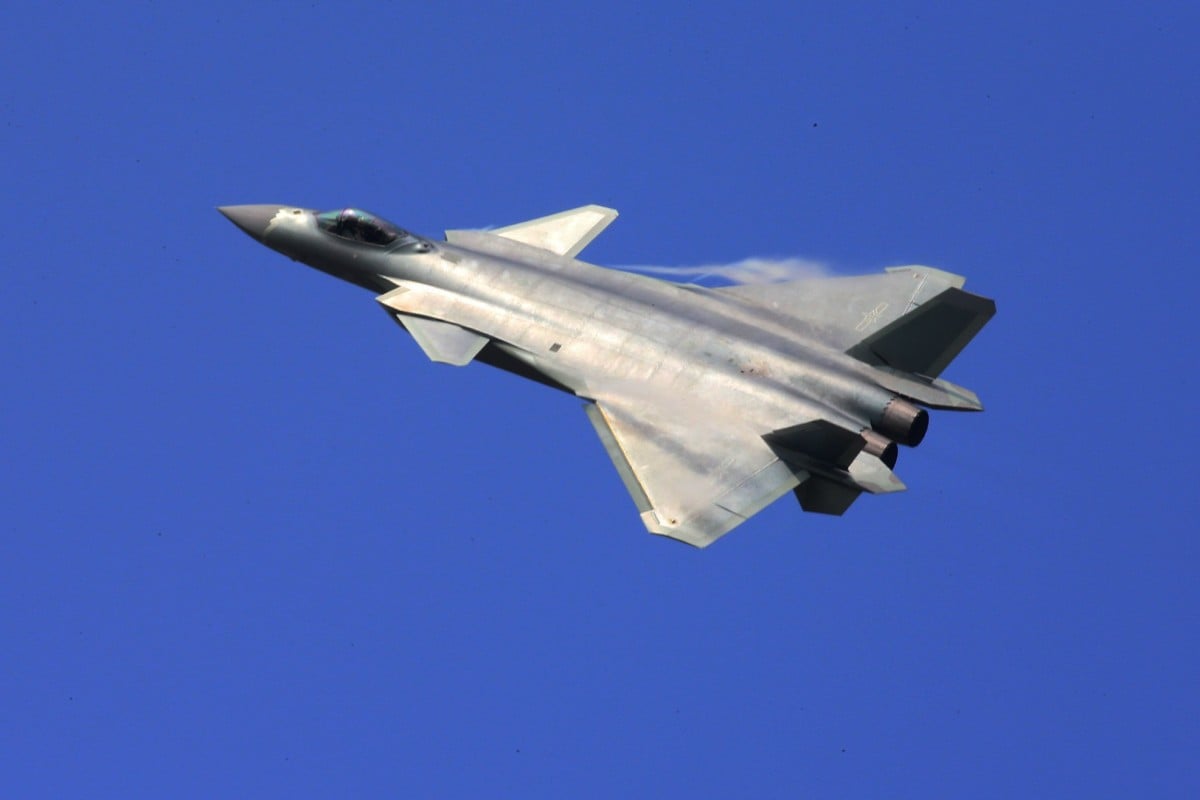
The J-20 stealth fighter is likely to be modified to serve on China’s next generation aircraft carriers. Photo: Xinhua

China’s military is likely to pick the country’s first active stealth fighter, the J-20, for its next generation aircraft carriers, according to military sources and a recent report on state media.

The J-20, made by the Chengdu Aerospace Corporation (CAC),  appears to have a won a head-to-head contest with the FC-31, a fighter made by another company which is still undergoing testing.

A military insider told the South China Morning Post that the Central Military Commission, the People’s Liberation Army’s top decision-making body, now favoured adapting the J-20 for its new carriers.

“The Chengdu Aerospace Corporation will announce some new products, which will include a new version of their J-20. You can guess what type it will be,” the military insider, who requested anonymity because of the sensitivity of the subject, said.

The FC-31 was independently developed by CAC’s sister company Shenyang Aircraft Corporation (SAC), which also produced the J-15 – the jets currently in use on the country’s only active aircraft carrier, the Liaoning.

Both aerospace firms are subsidiaries of the state-owned giant Aviation Industry Corporation of China, which specialises in designing and developing military aircraft, and were set up to ensure benign competition between manufacturers.

However, the SAC has faced criticism from some military leaders and experts for being too conservative and failing to innovate because of its bureaucratic structure.

A recent programme aired by the state broadcaster China Central Television also suggests the J-20 will be chosen.

An episode of Military Documentary shown on August 16 reported how the PLA Navy was selecting candidates for pilot training and illustrated the feature with a mock-up of jets that looked like J-20s taking off from a carrier.

Ground-based J-20s – also known as Powerful Dragons – entered service with the PLA Air Force in 2017. 

Mass production of the stealth fighters began late last year

as China stepped up its efforts to counter the deployment of American F-22s and F-35s in the Asia-Pacific region.

A J-15 fighter lands on the Liaoning. Photo: AFP

If the selection of the J-20 is confirmed it will mark the end of a lengthy debate between its supporters and advocates of the FC-31 as to which would make a better carrier-based fighter.

Those who favoured the J-20 said it was more advanced and reliable than the FC-31, but its supporters said it was more light and nimble.

“Both the J-20 and FC-31 have their advantages. The size of the J-20 is similar to the J-15 since both are powerful heavy fighters,” Song Zhongping, a military commentator for Hong Kong-based Phoenix Television, said.

Song said the lighter FC-31 could be developed into a medium-sized carrier fighter that would complement the J-20 in future.

But another military source close to the PLA Navy said it would be almost impossible to develop both aircraft over the next few years given the risk of an economic downturn as the trade war with the US continues to escalate.
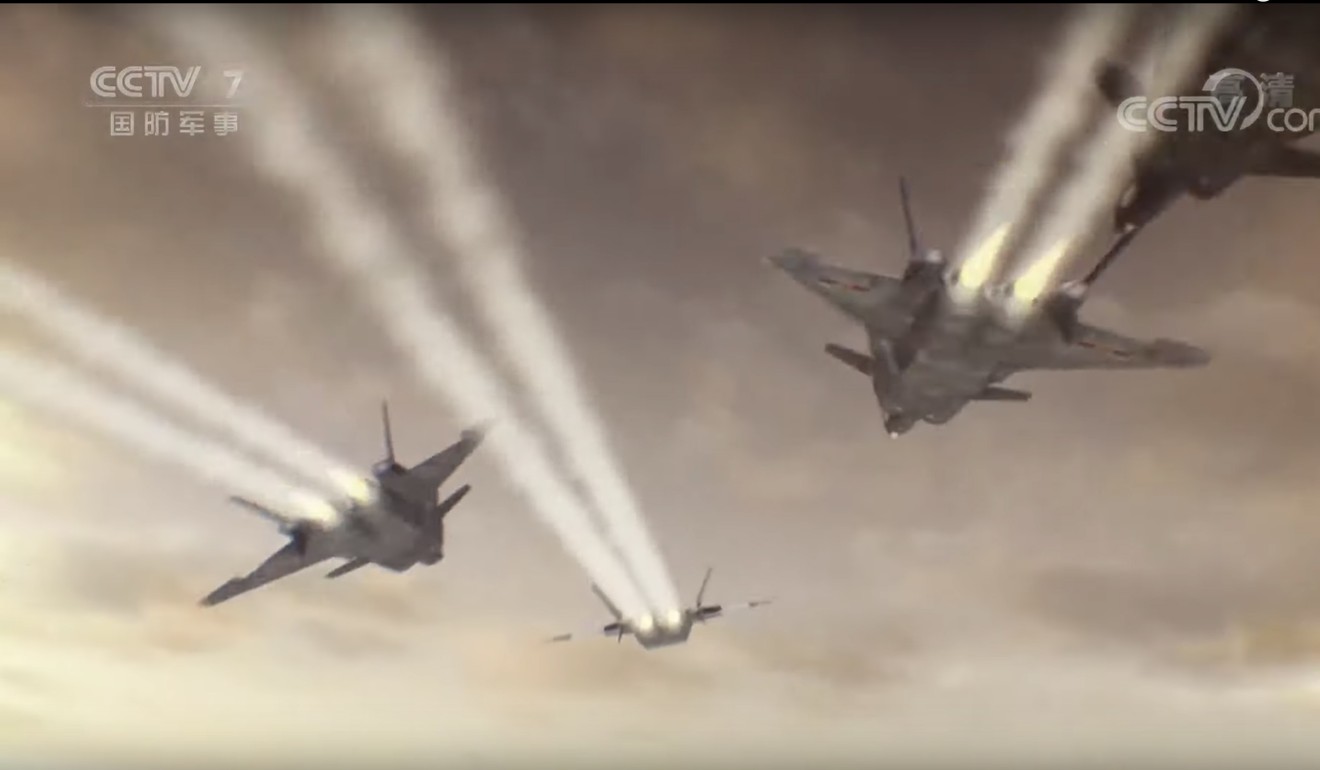
A video simulation broadcast on state television earlier this month showed fighters that resembled the J-20 taking off from a carrier. Photo: CCTV

The source said China’s next generation aircraft carriers would be with equipped electromagnetic catapults similar to those used on the US Navy’s Ford-class supercarriers.

These enable the use of heavier fighters because they are more powerful than the older diesel systems used on older carriers.

“The key problem of the J-20 is not weight, but length. If it wants to be a carrier-based fighter jet, it needs to be made shorter.”

Military insiders have previously said that CAC engineers are working to produce a shorter version of the J-20 that will work with the new launch system.

At present both the J-20 and F-31 still rely on Russian engines. The WS-15 engine that has been purpose built for the J-20 has undergone hundreds of hours of testing but has yet to meet reliability targets while the F-31 prototype does not have a purpose-built engine.
China’s navy plans to build at least four carrier battle groups by 2030, three of which will be active at any given time.
Military analysts say China will need at least a decade to develop its new generation carrier-based fighters, so the J-15 will remain in service for at least a decade, if not two.
The J-15 made its maiden flight in 2009 and has been in service since 2012. They are the only fighters based on the Liaoning and will be used by its sister ship the Type 001A when it enters service, probably later this year.
Source: SCMP
08/02/2019

Feature: Returning to organic farming: next generation of Chinese farmers

BEIJING, Feb. 7 (Xinhua) — Wang Xin, 33, is a landscape designer by profession and farmer in practice. The strawberries coming from his organic plantation in the southern outskirts of Beijing are believed by his clients to be “the best of China.”

Every day in Beijing, when men and women of his age are sucked in heavy traffic and endless meetings, Wang lives a life in the countryside, far from the maddening crowd.

He rises with the sun, works all day in the field or goes to farmers’ market to sell fresh produce. At the end of the day, he goes to bed with sore muscles and falls into a deep sleep.

He does not take the time to consider whether it is hard work, preferring to get on with the job. “It has become a lifestyle. This is the life I chose to live.”

In a country where food is so central to the culture, many well-educated city dwellers like Wang have returned to the countryside to dedicate themselves to fresher, healthier food.

RESEARCH FARMERS

Every Tuesday, Saturday and Sunday, Wang brings freshly-picked strawberries to the organic farmers’ market in Beijing. The fruits are grown naturally in nutrient-rich soil, without use of fertilizers, pesticides, growth hormones or chemicals.

“I don’t plan to be filthy rich, or I wouldn’t have gone for organic farming,” Wang said. With his firm athletic build and healthy tan, it is hard to imagine him the designer who used to spend days and nights in front of a computer screen.

Majoring in landscape botany, Wang has always been a plant lover. When he was 25, he realized his sedentary life made him put on weight, and he could no longer stand being an office drone. He quit his job, rented two plantation sheds in the suburbs and started his career from scratch.

On Tuesday, Wang presented this winter’s first batch of fruit he planted in September. But work had begun in July, when he prepared all-natural organic matter to enrich the soil.

The formula has been perfected through years of research in collaboration with Beijing University of Agriculture, to simulate the formation of the fertile dark forest soil in Northeast China, known for its high crop productivity.

Logically, the true foundation of organic farming lies in soil content: if the soil is right – as a living organism with a complex organic structure – the outcome is safe and tasty food farmed without the need for fertilizing chemicals, according to Wang.

But quality produce is not the only objective. Wang hopes to build a production model that rehabilitates the soil itself – in regular plantations, the soil can degrade within a matter of years after being over-exploited.

Wang’s work on the farm has not always been a smooth ride. But after a rough start he believes he has learned valuable lessons. He has gone back to the university and visited his colleagues in Tochigi Prefecture, Japan, to study the most modern organic farming techniques.

“For the organic farming to become truly sustainable, to revitalize the soil is key. I am certain that in three to four years, the soil that I have been reviving will keep getting healthier and healthier,” he said.

Wang is not alone.

In Araxan, a semi-arid region located in northwest China’s Inner Mongolia Autonomous Region, Ma Yanwei has spent years reinvigorating saline soil by applying water-saving methods to cultivate fruit and crops suitable for local conditions.

Sweet melon is the best-selling produce on Ma’s farm. The sweetness of the melons comes from many years of study, experiment and hard work in the desert. Ma aims to find an ideal organic farming methodology to maximize the utilization of scarce water resources and mend the soil. “As long as the soil improves, it is natural to harvest healthy produce,” Ma said.

In the last six years, he has seen more and more young people returning to the countryside to take on farming. In 2017 Ma set up a network for these new farmers to communicate, exchange experience and help each other. “So we could avoid longer detours and mistakes previously made by others,” he said.

AN IDYLLIC FARM REBUILT

For 18 years, Zhang Zhimin, a former foreign trade expert, has been building an idyllic farm in the far southwestern end of Beijing to produce food and preserve biodiversity.

Zhang speaks several languages, so was designated to work in food imports and exports when China opened its market to the world outside. She believes that “agriculture is the art of man and nature working together.”

On her bio-farm, the nature rules over man. Instead of eliminating weeds and pests, the wholesome biosphere works on its own to render seasonal harvests.

“Agriculture is the management of life, and life should be nourished by life itself,” she said. On her farm Heaven’s Blessings, trees, bushes, grass, insects, birds and cattle coexist in harmony. It is more like a habitat than a farm. In early summer she chops tender leaves and branches of weed under peach trees to feed the cattle and make room for the gramineous crops to thrive. In early autumn, she let cows roam free to finish the weeding.

In Wang’s vegetable shed, the natural ecosystem works for the harvest to be healthy while no intervention from the outside is necessary.

“I have observed that the grass that coexists with the crops functions as a regulating factor of the microclimate by keeping the soil humid,” Wang said.

Also, a native breed of spiders that leaves webs among the vegetables, feeds on the whiteflies that are usually hard to detect due to their miniscule size, preventing the need for harmful insecticides.

Wang has also gone back to ancient Chinese agricultural traditions to find inspiration to better coordinate human actions with nature, after learning the latest farming models in Japan, Germany and Israel.

At a “Farmers’ Assembly” held in China Agricultural University (CAU) last month, Professor Meng Fanqiao with CAU’s College of Resources and Environmental Sciences said organic/ecological farming is an important measure to improve the quality and safety of agricultural products.

“Organic/ecological farming is of vital significance for economic development as well as environmental protection in rural areas, for which it should play an imperative role in China’s rural revitalization and the building of an ‘ecological civilization,'” Meng said.

“The green development of the countryside is a strategy that goes hand-in-hand with the food supply security and the income level improvement,” said Jin Shuqin with the Ministry of Agriculture’s Research Center for Rural Economy. “To revivify ecology constitutes a crucial aspect of overall rural revitalization.”

“It is our hope to promote healthy eating to become a mainstream choice, as well as the organic way to produce healthy foods,” said Ma Xiaochao, project officer with Know Your Food, a self-publishing community focused on food sustainability.

Source: Xinhua

Law of Unintended Consequences

continuously updated blog about China & India

ChiaHou's Book Reviews

continuously updated blog about China & India

What's wrong with the world; and its economy

continuously updated blog about China & India