07/09/2019
- He is expected to join a trilateral dialogue with his counterparts from Pakistan and Afghanistan, and observers say he may try to mediate in Kashmir dispute
- Trip also includes a stop in Nepal that could pave way for a visit by Xi Jinping
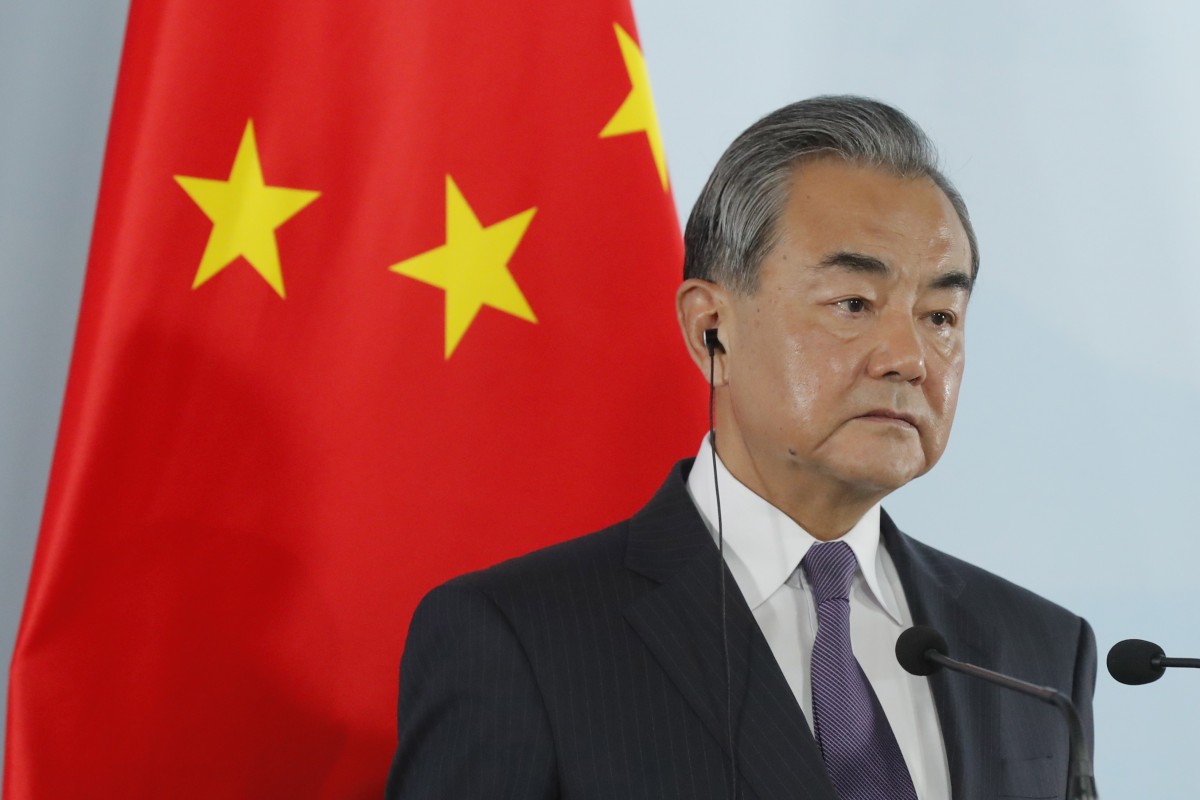
Chinese Foreign Minister Wang Yi may try to act as a negotiator in the Kashmir dispute. Photo: EPA-EFE
Chinese Foreign Minister Wang Yi began a four-day trip to Pakistan and Nepal on Saturday, amid escalating tensions between Islamabad and New Delhi over
.
Wang was expected to join a trilateral dialogue with the foreign ministers of Pakistan and Afghanistan in Islamabad, foreign ministry spokesman Geng Shuang said on Friday. He will also travel to Nepal.
Beijing has criticised India’s decision last month to strip the Jammu and Kashmir autonomous state of its special status and break it into two federally controlled territories, calling it “unacceptable”.
China also formally backed Pakistan’s request for the United Nations Security Council to hold “closed consultations” on the revocation of the state’s autonomy.
Meanwhile, observers say the Chinese foreign minister could attempt to act as a negotiator in the complex border dispute.
“Wang might try to play a role to mediate between the two sides to resolve the crisis,” said Wang Dehua, head of the Institute for South and Central Asia Studies at the Shanghai Municipal Centre for International Studies. “This has been China’s long-held position on the issue.”
Pang Zhongying, an international relations researcher at Ocean University of China in Qingdao, agreed.
“[Indian Prime Minister] Narendra Modi has visited China a couple of times and it is likely [Chinese President] Xi Jinping will visit India soon,” he said. “If Xi is to visit India later this year, China may try to contain its differing views with India on Kashmir.”
Modi has proposed an informal summit with Xi later this year that may be held in the religious hub of Varanasi, Modi’s parliamentary constituency. New Delhi said in May that Indian officials were working with the Chinese side to finalise the details, but Beijing has yet to confirm Xi’s visit.
India dismisses Beijing’s concerns over Kashmir because ‘it won’t have any impact on China’
Wang Yi was also due to visit India later this month for border talks, but the trip had to be postponed at the request of New Delhi because of scheduling problems, Hindustan Times reported, citing China’s foreign ministry.
The row over Kashmir has escalated in the past month. Pakistani Prime Minister Imran Khan said on Friday that Islamabad would make the fullest possible response to New Delhi’s actions in disputed Kashmir and that the global community would be responsible for any “catastrophic” aftermath.
Since Modi withdrew special rights for Indian-administered Kashmir on August 5, India has flooded the Kashmir valley with troops, restricted the movements of residents and cut off communication.
Both India and Pakistan claim the whole of Kashmir, which was partitioned between the two following the end of British rule in 1948, and they have subsequently fought wars over the territory.
China has its own territorial dispute with India over the part of Kashmir it controls. In early August, Chinese foreign ministry spokeswoman Hua Chunying
and said it was not binding. Beijing later appeared to soften its rhetoric, with Hua calling for a solution through dialogue and negotiation, without criticising either side.
The Chinese foreign minister will also visit Nepal, where he is expected to meet his counterpart, the president and prime minister. The trip could pave the way for an expected visit by Xi to Nepal.
Source: SCMP
Posted in 1948, Afghanistan, autonomy, British rule, China alert, Chinese foreign minister Wang Yi, complex border dispute, Hindustan Times, Imran Khan, India alert, Indian Prime Minister Narendra Modi, Institute for South and Central Asia Studies, Islamabad, Jammu and Kashmir, Kashmir, negotiator, Nepal, New Delhi, observers, Ocean University of China, Pakistan, Pakistani Prime Minister, Qingdao, Shanghai Municipal Centre for International Studies, tensions, troops, Uncategorized, United Nations Security Council, United Nations Security Council (UNSC), visits, Xi JinPing |
Leave a Comment »
17/08/2019
- Chinese government advisers say Beijing has not reached direct intervention point but that could change if the violence continues
- Military action would trigger international backlash, observers say, as US expresses concern over reported paramilitary movements and ‘erosion of Hong Kong’s autonomy’
Footage of trucks from the paramilitary People’s Armed Police in Shenzhen has circulated online. Photo: Handout
The unrest in Hong Kong does not yet warrant direct intervention by Beijing despite hardening public sentiment and calls for tougher action in mainland China, according to Chinese government advisers.
Shi Yinhong, an international relations expert at Renmin University and an adviser to the State Council – China’s cabinet – said China would risk damaging its ties with the United States and other major foreign powers, upsetting its own development and losing Hong Kong’s special status if it took the matter directly into its hands.
“I don’t think we need to use troops. Hong Kong police will gradually escalate their action and they haven’t exhausted their means,” Shi said, expressing a view shared by other mainland government advisers and academics.
But he warned that if the violence and chaos continued, it “won’t be too far away from reaching that point”.
A US State Department spokeswoman said the United States was “deeply concerned” about reports of paramilitary movements along the Hong Kong border and reiterated a US call for all sides to refrain from violence.
She said it was important for the Hong Kong government to respect “freedoms of speech and peaceful assembly” and for Beijing to adhere to its commitments to allow a high degree of autonomy for Hong Kong.
She said the protests reflected “broad and legitimate concerns about the erosion of Hong Kong’s autonomy”.
brought the city’s air traffic to a halt and triggered
a huge backlash on the mainland
, where the public feel they have been wrongly targeted by the increasingly violent protesters. Many demanded the central government take action to end the chaos.
The tension deepened after US President Donald Trump, citing intelligence sources,
to the border with Hong Kong. Trump described the situation in the city as “tricky” and called on all sides to remain “calm and safe”.
Footage of trucks from the paramilitary People’s Armed Police rolling into Shenzhen began circulating online on Saturday.
Beijing ‘unlikely to intervene’ in Hong Kong as pressure mounts on police
But Shi and others said direct intervention would be too costly to China and would only be used when all other methods had been exhausted.
“As the trade war with the US goes on, Hong Kong’s importance to our financial system is getting bigger,” Shi said. “If Beijing intervenes with too much assertiveness, the US might revoke the preferential status of Hong Kong.”
He was referring to the US’ 1992 Hong Kong Policy Act which gives the city a special status. In June, American lawmakers introduced a bipartisan bill requiring the US government to examine Hong Kong’s autonomy annually to decide whether to extend the arrangement.
Losing that status could cripple the operations of many businesses based in Hong Kong, said Shen Dingli, a Shanghai-based international affairs expert.
A satellite image appears to show a close-up of Chinese military vehicles at Shenzhen Bay Sports Centre in Shenzhen. Photo: Maxar Technologies
Wang Yong, another specialist on international political economy with Peking University, agreed.
“There would be a lot of opposition from interest groups in the US. Hong Kong is the bridgehead for many multinational corporations and investors from Wall Street to get into the Chinese market,” said Wang, who also teaches at an academy affiliated with China’s Ministry of Foreign Affairs.
“Hong Kong and the Chinese government will need to handle this with extra care, so as not to give any ammunition to hawks in the United States.
“If Hong Kong is not handled properly, it could add tensions to the bilateral ties and ruin any prospect of a trade deal.”
China rejects requests for US warships to visit Hong Kong amid protests Pang Zhongying, an international relations specialist at Ocean University of China in Qingdao, said direct intervention could also damage China’s ties with other countries.
“The whole world is watching. Beijing has exercised restraint for two months and still hasn’t taken any clear action because this is not an easy choice,” said Pang, who is also a member of the Beijing-based Pangoal Institution, a think tank that advises several ministerial offices.
While some observers said Beijing was under political pressure to end the protests in Hong Kong before October 1 – the 70th anniversary of the founding of the People’s Republic, Shi said the central government would not lose patience so easily.
“National Day [on October 1] is an important time, but the Chinese government is not naive to believe there has to be peace under all heaven then,” he said.
“It’s only a bit more than a month from now, we can almost say for sure the trade war will still be on by then and a major turning point in Hong Kong is not likely to happen. But the celebration must go on.”
Source: SCMP
Posted in 70th anniversary, American, autonomy, backlash, Beijing, bipartisan bill, celebration, China alert, China's cabinet, China-US trade war, China’s State Council, concern, direct intervention, financial system, foreign powers, Hong Kong, international, lawmakers, Mainland China, military action, Ministry of Foreign Affairs, Ministry of Foreign Affairs (MFA), National Day, Ocean University of China, Pangoal Institution, paramilitary, peace under all heaven, People's Armed Police, People’s Republic, preferential status, Qingdao, quell, Renmin University, Risks, Risks still too big, send in troops, Shenzhen, Shenzhen Bay Sports Centre, trade war, trigger, Uncategorized, United States, unrest, US, US President Donald Trump, US warships, US’ 1992 Hong Kong Policy Act |
Leave a Comment »




 CHINDIA ALERT: You'll be living in their world, very soon