01/10/2019
- 70th anniversary of the founding of the People’s Republic of China marked by its biggest ever military parade and huge civilian parade
- Xi says no force can stop China ‘marching forward’ and vows to protect the long-term stability of Hong Kong
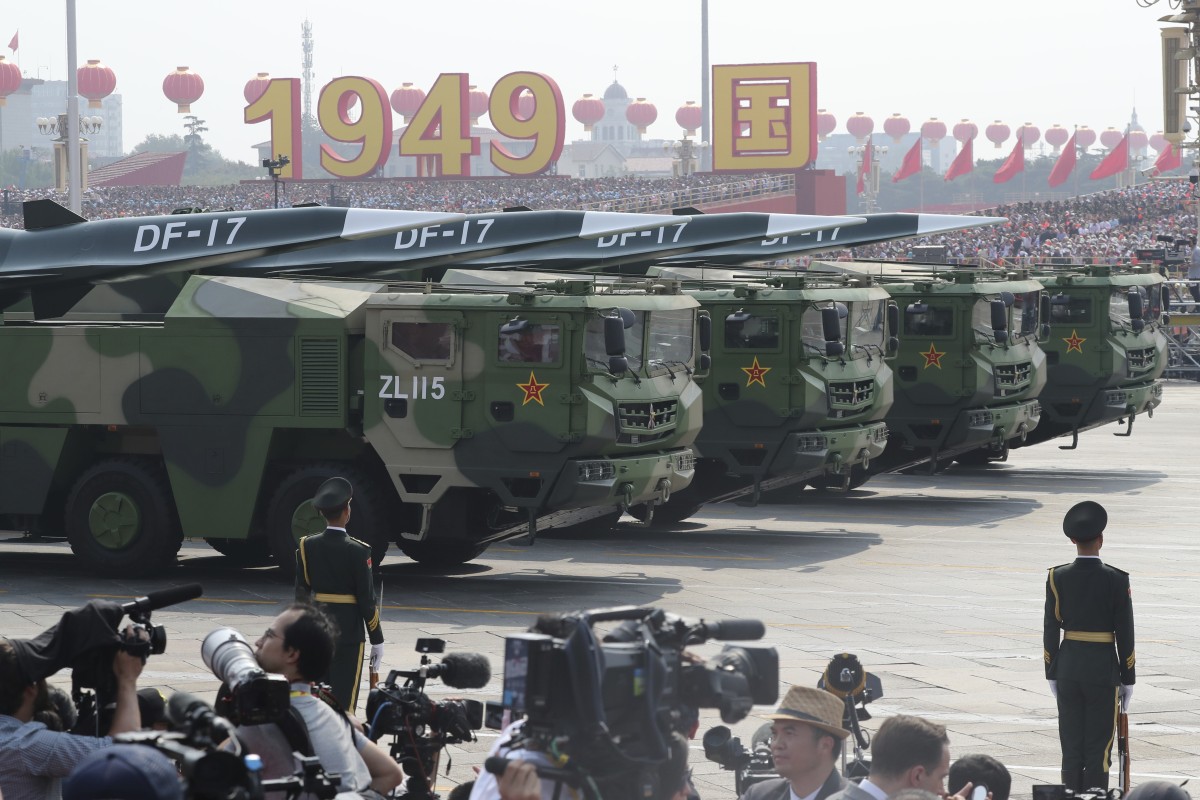
Military vehicles carry DF-17 missiles capable of reaching the US mainland during the parade to mark 70 years of the People’s Republic. Photo: AP
China staged a massive military parade in Beijing on Tuesday to mark the
70th anniversary of the founding of the People’s Republic, with much of the smog-shrouded capital city under a security lockdown.
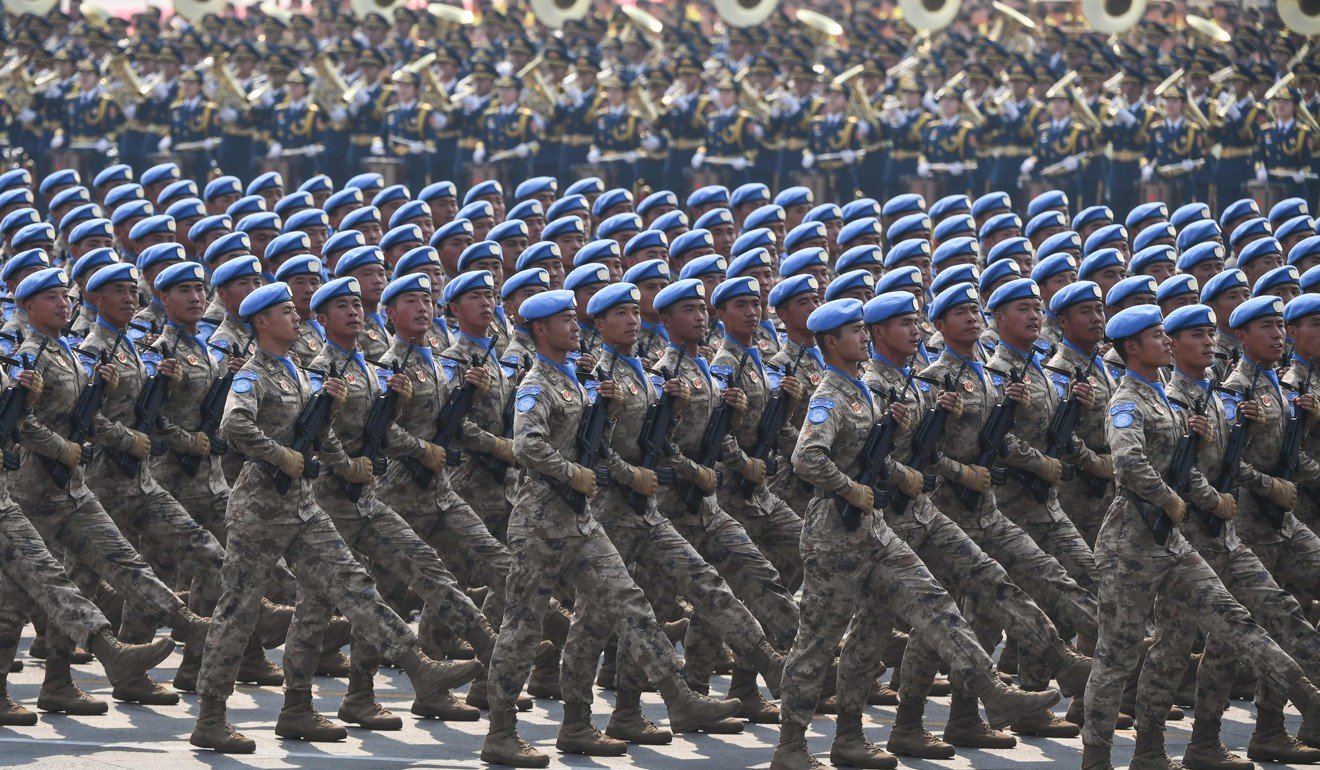
President Xi Jinping inspected over 15,000 troops, more than 160 aircraft and 580 weapon systems in a show of the country’s growing military might and his drive to modernise the People’s Liberation Army.
He also delivered a bullish eight-minute speech hailing the accomplishments of seven decades of Communist rule and pledging to achieve his vision of a “Chinese dream” of national rejuvenation and global prominence.
Here are some of the key takeaways from a day of celebration in Beijing:
Xi presided over the ceremony in Tiananmen Square flanked by his predecessors Jiang Zemin and Hu Jintao, along with other retired and present party elders.
The rare appearance of Jiang and Hu – on the rostrum of the Gate of Heavenly Peace, where the country’s founding father Mao Zedong declared Communist rule on October 1, 1949 – was clearly aimed at projecting unity and solidarity in the face of daunting domestic and international challenges.
China’s National Day parade, as it happened
Hu had been absent from the funeral of former premier Li Peng in late July, although the ailing Jiang attended.
Former vice-president Zeng Qinghong and Song Ping, the oldest party elder in attendance, also appeared on the rostrum.
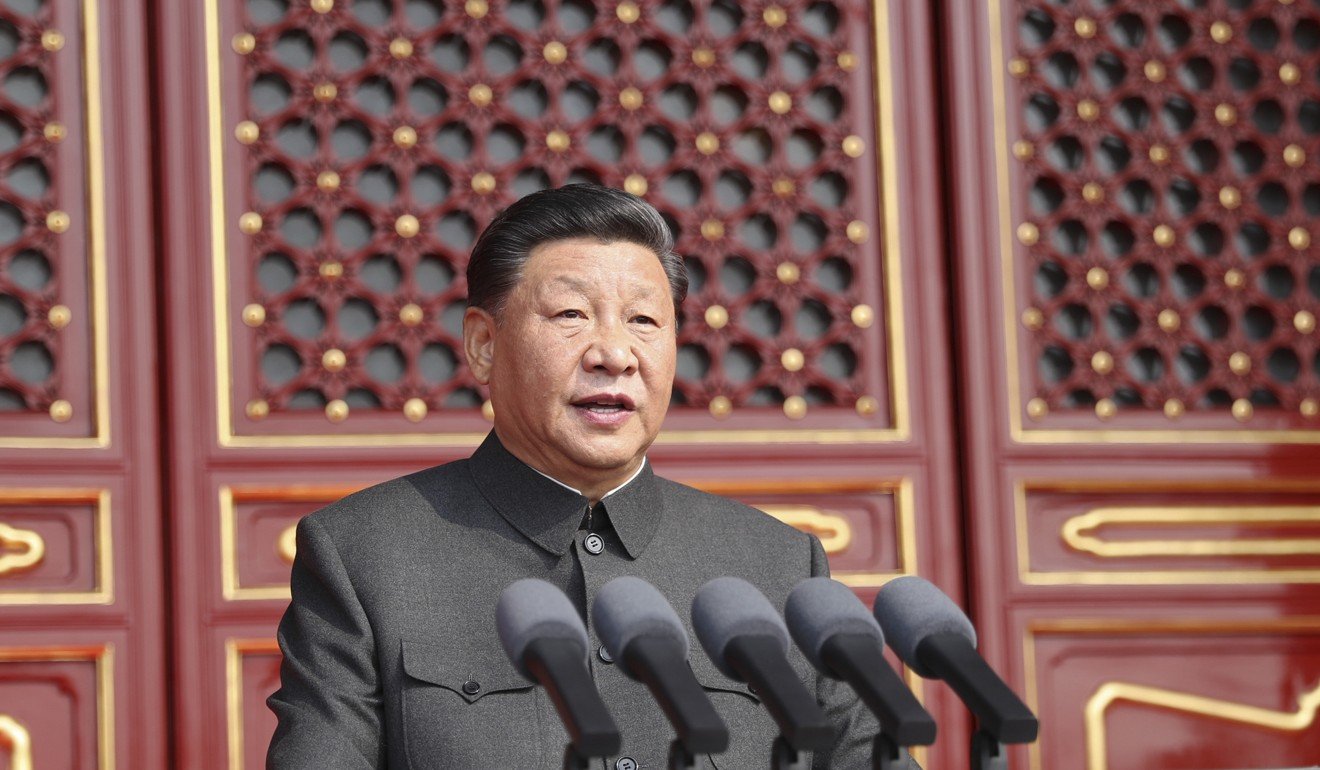
President Xi Jinping speaks in Tiananmen Square during Tuesday’s celebrations. Photo: Xinhua
But notably, while former premier Wen Jiabao was present, his predecessor Zhu Rongji was not.
‘No force can shake China’
Dressed in a Mao suit, Xi’s nationally televised speech invoked China’s “century of humiliation” and praised the achievements of its people, saying there was no force that could stop it forging ahead.
“No force can shake the status of our great motherland, and no force can stop the Chinese people and the Chinese nation from marching forward,” he said.
Chinese troops take part in the Republic’s largest ever military parade. Photo: AFP
“The People’s Liberation Army [PLA] will serve its purpose in safeguarding the sovereignty, security and development interests of the country, and world peace,” he said, at a time when Beijing has expanded its military footprint globally, including with its
first overseas military base in Djibouti.
Xi called on the Communist Party and the country to unite and continue to fight for the realisation of what he called the “Chinese dream” – the nation’s rejuvenation.
One country, two systems
Amid escalating unrest in Hong Kong, which has plunged the city into a deepening crisis and threatened to overshadow the National Day celebrations, Xi vowed that the central government would uphold “one country, two systems”.
He said the central government would protect the long-term stability of Hong Kong and Macau, and stressed the goal of “peaceful reunification” with the self-ruling Taiwan, repeating a message frequently used by his predecessors, including Deng Xiaoping, Jiang and Hu.
The theme of one country, two systems later appeared in a National Day parade for the first time, with placards forming the words: “Hong Kong’s tomorrow will be better.”
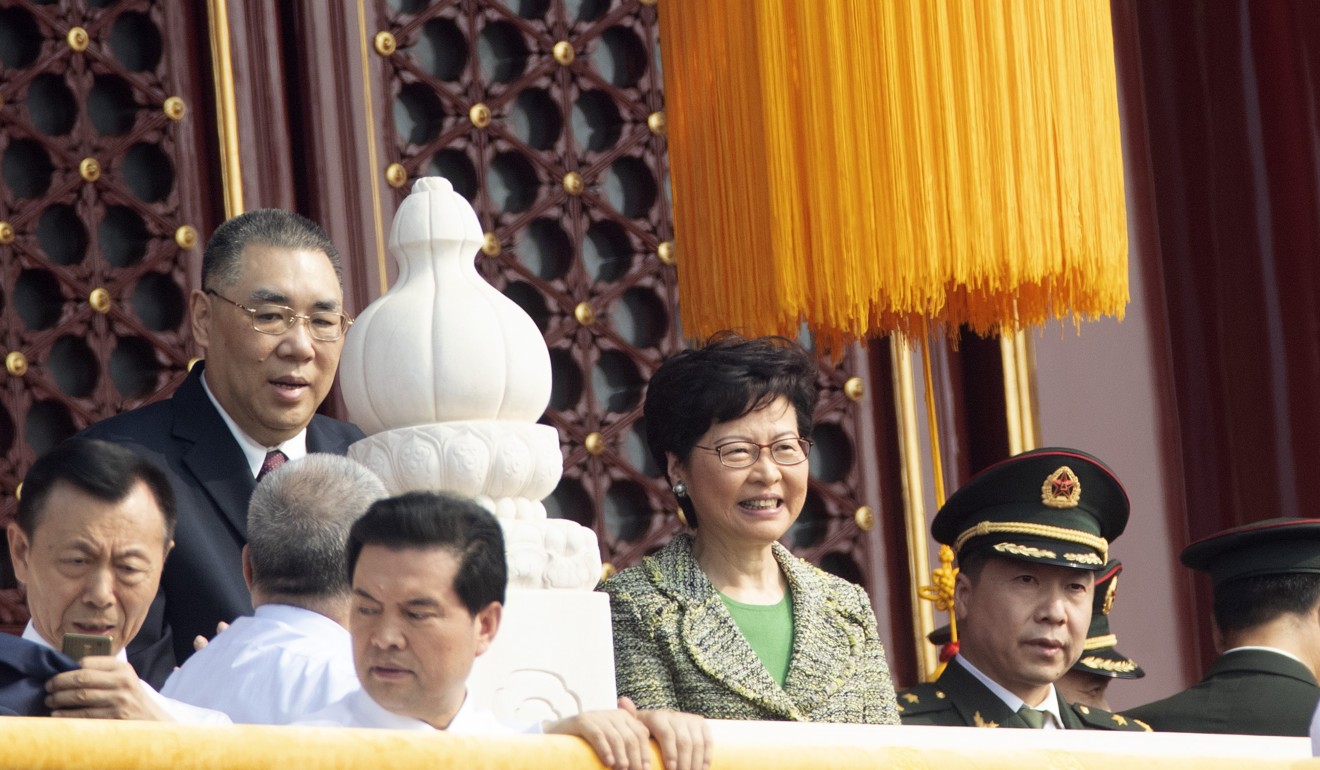
Hong Kong Chief Executive Cheng Yuet-ngor attended the ceremony, as did 10 Hong Kong police officers involved in suppressing
anti-government protests in the city.
Showing off new weapons
China’s advancement in military weaponry was on full display, with almost half of the items featured being shown to the public for the first time.
Hong Kong leader Carrie Lam was among the guests in Beijing on Tuesday. Photo: AP
The morning’s celebrations included an 80-minute military parade – the biggest since the founding of the People’s Republic – in an apparent effort to showcase the prowess of the PLA, the world’s biggest military with 2 million personnel.
Among the weapons shown were DF series missiles, including the DF-17, a nuclear-capable glider that has the capacity to strike the US mainland, and the DF-41, which has a range of up to 15,000km, making it the world’s longest-range military missile.
Signalling Xi’s status
A 100,000-strong civilian parade featuring huge portraits of Xi and predecessors including Mao, Deng, Jiang and Hu wrapped up the morning celebration.
The procession was divided into three parts, representing three eras of the People’s Republic: the Mao era, Deng’s reform and opening up, and Xi’s era, which seeks global prominence on a par with that of the United States.
Xi appeared keen to project his supreme status in the party, reinforced since he abolished the constitutional term limit a year ago, allowing him potentially to remain leader for life.
He waved at his own portrait, unveiled alongside a sign reading “Carry out Xi Jinping Thought on Socialism with Chinese Characteristics for a New Era”.
Source: SCMP
Posted in "one country, two systems", 70th anniversary, Aircraft, Beijing, Carrie Lam Cheng Yuet-ngor, Carry out Xi Jinping Thought on Socialism with Chinese Characteristics for a New Era, celebrates, Central government, century of humiliation, civilian parade, Communist rule, Country, development interests, DF-17 missiles, Djibouti, escalating unrest, founding father, founding of the People’s Republic of China, Gate of Heavenly Peace, global prominence, Hong Kong, Hong Kong Chief Executive, Hu Jintao, inspected, leader for life, Li Peng, long-term stability, Macau, Mao suit, Mao Zedong, marching forward, Military advances, military footprint globally, military parade, Military vehicles, National Day, National Day celebrations, national rejuvenation, October 1 1949, overseas military base, peaceful reunification, People's Liberation Army (PLA), People’s Liberation Army, People’s Liberation Army (PLA), president jiang zemin, President Xi Jinping, security, Song Ping, sovereignty, supreme status, Taiwan, The Chinese Dream, themes, Tiananmen Square, troops, Uncategorized, US mainland, weapon systems, Wen Jiabao, world peace, Xi JinPing, Zeng Qinghong, Zhu Rongji |
Leave a Comment »
22/08/2019
- State media says presence is part of preparations for major drill, but analyst calls it a ‘psychological warfare tactic’
- Fears that the armed presence was a show of power to Hong Kong
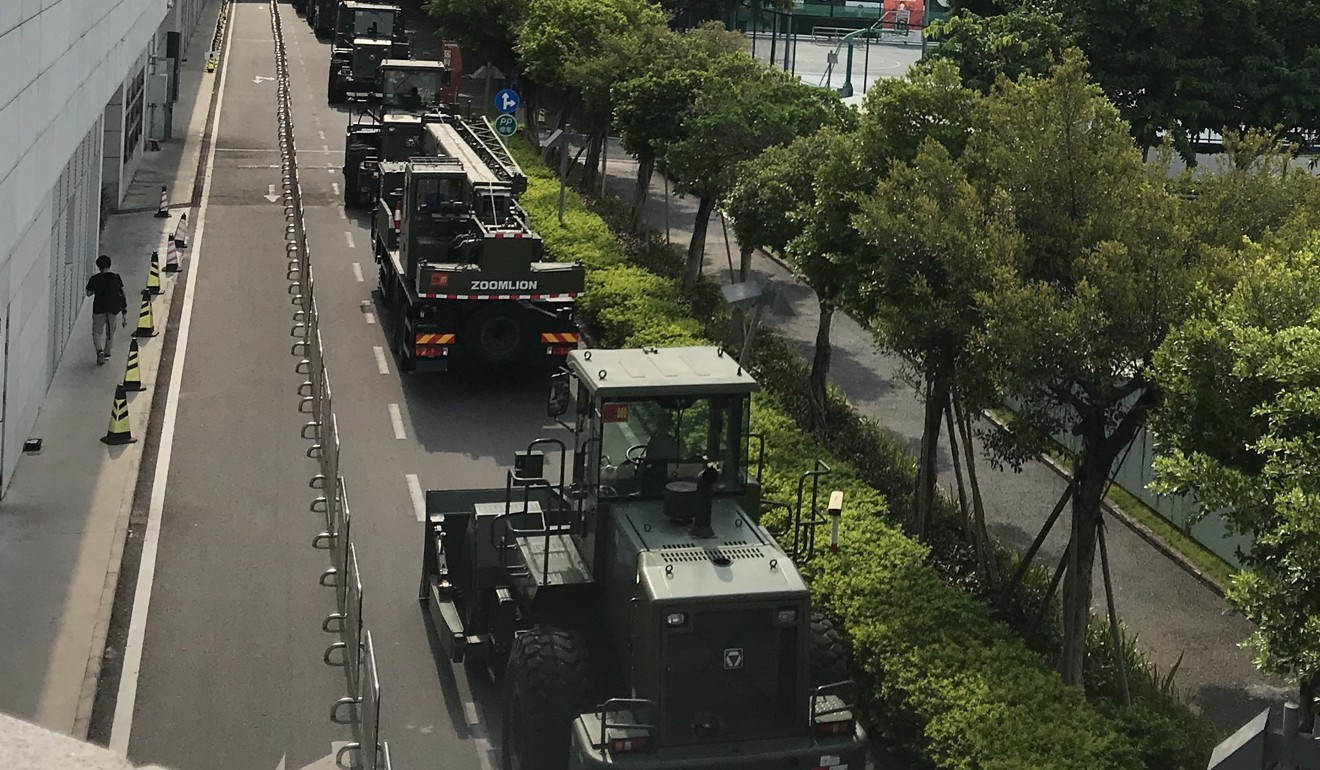
Dozens of trucks line a street next to the entrance of the Shenzhen Bay Sports Centre in Shenzhen on Monday. Photo: SCMP
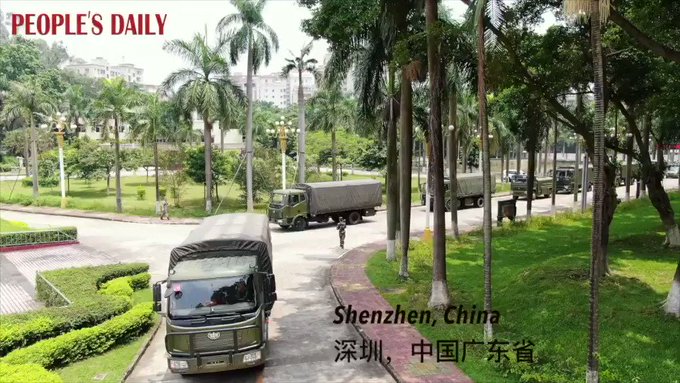
A convoy of armed police trucks has been stationed at a sports centre in a mainland Chinese city bordering Hong Kong, adding to speculation online that Beijing could be preparing to intervene directly in the protests roiling the special administrative region.
But a Beijing-based military expert said the movements were part of regular exercises and not cause for concern.
Footage of the trucks rolling into Shenzhen in the southern province of Guangdong began circulating online on Saturday.
On Monday, Communist Party mouthpiece People’s Daily and Global Times posted videos of the convoy in the city, saying the police were there to prepare for large-scale drills.
Dozens of the trucks as well as excavators lined a pavement next to the entrance of the Shenzhen Bay Sports Centre in Nanshan district on Monday, across the harbour from Hong Kong.
Personnel in camouflage uniforms stood at the entrances of the sports centre, but did not block access to civilians.
Asked whether they were in Shenzhen for a drill and what time they had arrived, the personnel shook their heads and said nothing.
Also on Monday, the Hong Kong and Macau Affairs Office released a stern statement, calling attacks on police “signs of terrorism”.
Online, internet users speculated that the armed presence was a show of power to Hong Kong.
Excavators are among the heavy equipment stationed near the entrance of the Shenzhen Bay Sports Centre on Monday. Photo: SCMP
“They are just waiting for an order before they’ll drive to Hong Kong to calm the riots. We hope the armed forces can enter Hong Kong and beat the hell out of these idiotic youth,” one commenter said on Weibo, China’s Twitter-like social media platform.
Beijing-based military specialist Zhou Chenming said that the armed police were taking part in regular drills and that people should not feel nervous.
“The central government has repeatedly stated it will only interfere if there are large-scale riots and the Hong Kong government has applied voluntarily for support,” Zhou said.
Hong Kong policeman filmed aiming gun at protesters hailed as a hero by Chinese state media
“If the situation does not reach that point, then this is only a deterrence measure, to deter these [small group of people] from stepping over the line.”
Dixon Sing Ming, a political-science professor at the Hong Kong University of Science and Technology, said the move was a “psychological warfare tactic”.
“The drill is part and parcel of a well-coordinated attempt by Beijing to pressure the protesters and the general public to give up their five demands, including the one for universal suffrage immediately,” Sing said.
Hong Kong has been engulfed in protests since early June, at first to oppose the now-shelved extradition bill that would have allowed Hong Kong to send suspects to other jurisdictions, including mainland China.
Chinese police mass 12,000 anti-riot officers in Shenzhen for drill
But protesters now have five demands, including a complete withdrawal of the extradition bill and an independent investigation into the police’s use of force in handling the protests.
As the confrontations have escalated, public opinion in the mainland has grown steadily tougher, with many calling for more stern measures to restore order.
On August 6, 12,000 police officers gathered in Shenzhen for a drill, which included anti-riot measures similar to those seen on the streets of Hong Kong.
Although the police said the drill was part of security preparations for the 70th anniversary of the People’s Republic on October 1, internet users saw it as a show of power and warning to Hong Kong.
Source: SCMP
Posted in 70th anniversary, anti-riot officers, armed police, Beijing, camouflage uniforms, Central government, Chinese armed police, excavators, Global Times, guangdong province, harbour, Hong Kong, Hong Kong and Macau Affairs Office, Hong Kong University of Science and Technology, large-scale drills, mainland Chinese city, Nanshan district, October 1 1949, People’s Daily, People’s Republic, Police, protests, psychological warfare tactic, regular drills, Shenzhen, Shenzhen Bay Sports Centre, signs of terrorism, Special administrative region, truck convoy, Uncategorized, videos, Weibo |
Leave a Comment »
07/03/2019
BEIJING (Reuters) – China’s ruling Communist Party is ramping up calls for political loyalty in a year of sensitive anniversaries, warning against “erroneous thoughts” as officials fall over themselves to pledge allegiance to President Xi Jinping and his philosophy.
This year is marked by some delicate milestones: 30 years since the bloody crackdown on pro-democracy demonstrators in and around Tiananmen Square; 60 years since the Dalai Lama fled from Tibet into exile; and finally, on Oct. 1, 70 years since the founding of Communist China.
Born of turmoil and revolution, the Communist Party came to power in 1949 on the back of decades of civil war in which millions died, and has always been on high alert for “luan”, or “chaos”, and valued stability above all else.
“This year is the 70th anniversary of the founding of new China,” Xi told legislators from Inner Mongolia on Tuesday, the opening day of the annual meeting of parliament. “Maintaining sustained, healthy economic development and social stability is a mission that is extremely arduous.”
Xi has tightened the party’s grip on almost every facet of government and life since assuming power in late 2012.
Last year parliament amended the country’s constitution to remove term limits and allow him to stay in office for the rest of his life, should he so wish, though it is unclear if that will happen and Xi has not mentioned it in public.
Later in the year the party will likely hold a plenum of its top leadership focused on what China calls “party building”, diplomats and sources with ties to China’s leadership say, a concept that refers to furthering party control and ensuring its instructions are followed to the letter.
In late January the party again stressed loyalty in new rules on “strengthening party political building”, telling members they should not fake loyalty or be “low-level red”, in a lengthy document carried by state media.
“Be on high alert to all kinds of erroneous thoughts, vague understandings, and bad phenomena in ideological areas,” it warned. “Keep your eyes open, see things early and move on them fast.”
LOYALTY FIRST
On March 1, Xi spoke at the Central Party School, which trains rising officials, mentioning the word “loyalty” at least seven times, according to official accounts in state media.
Xi noted that whether an official is loyal to the party is a key gauge of whether they have ideals and convictions. “Loyalty always comes first,” he said.
Duncan Innes-Ker, regional director for Asia at the Economist Intelligence Unit, said China was concerned about resistance at lower levels to following party orders, the slowing economy and also about demands for political reforms as people get steadily richer.
“The desire for control is not something particular to any time period,” he said. “It is a fundamental tenet of autocratic governments that they are constantly paranoid about being overthrown.”
Xi looms large over this year’s session of China’s largely rubber stamp parliament, known as the National People’s Congress, which has always been stacked with people chosen for their absolute fealty to the party.
Government ministers who spoke to reporters on the sidelines of parliament’s opening session on Tuesday peppered their comments with references to Xi – 16 times in all.
Customs minister Ni Yuefeng said that Xi himself “pays great attention to not allowing foreign garbage into the country”, a reference to China’s ban on solid waste imports, part of the country’s war on pollution.
“Ideology comes first this year,” said one Western diplomat who is attending the parliamentary sessions as an observer. “It’s all about the 70th anniversary.”
ROOTING OUT DISLOYALTY
The party has increasingly been making rooting out disloyalty and wavering from the party line a disciplinary offence to be enforced by its anti-corruption watchdog, whose role had ostensibly been to go after criminal acts such as bribery and lesser bureaucratic transgressions.
The graft buster said last month it would “uncover political deviation” in its political inspections this year of provincial governments and ministries.
Top graft buster Zhao Leji, in a January speech to the corruption watchdog, a full transcript of which the party released late February, used the word “loyalty” eight times.
“Set an example with your loyalty to the party,” Zhao said.
China has persistently denied its war on corruption is about political manoeuvring or Xi taking down his enemies. Xi told an audience in Seattle in 2015 that the anti-graft fight was no “House of Cards”-style power play, in a reference to the Netflix U.S. political drama.
The deeper fear for the party is some sort of unrest or a domestic or even international event fomenting a crisis that could end its rule.
Xi told officials in January they need to be on high alert for “black swan” events..
That same month the top law-enforcement official said China’s police must focus on withstanding “colour revolutions”, or popular uprisings, and treat the defence of China’s political system as central to their work.
The party has meanwhile shown no interest in political reform, and has been doubling down on the merits of the Communist Party, including this month rolling out English-language propaganda videos on state media-run Twitter accounts to laud “Chinese democracy”. Twitter remains blocked in China.
The official state news agency Xinhua said in an English-language commentary on Sunday that China was determined to stick to its political model and rejected Western-style democracy.
“The country began to learn about democracy a century ago, but soon found Western politics did not work here. Decades of turmoil and civil war followed,” it said.
Source: Reuters
Posted in anniversaries, anti-corruption watchdog, “luan” or “chaos”, black swan, bloody crackdown, Central Party School, China alert, chinese communist party, civil war, Communist Party, Customs minister, Dalai Lama, Defence, delicate milestones, diplomats, disciplinary offence, disloyalty, Duncan Innes-Ker, Economist Intelligence Unit, edge allegiance, English-language propaganda, erroneous thoughts, fake loyalty, founding of Communist Chin, founding of Communist China, graft buster, House of Cards, Ideology, Inner Mongolia, leadership, Ni Yuefeng, October 1 1949, Party building, philosophy, political loyalty, political reform, President Xi, President Xi Jinping, pro-democracy demonstrators, regional director for Asia, rubber stamp parliament, ruling communist party, sensitive year, Tiananmen Square, Tibet, turmoil and civil war, turmoil and revolution, Twitter, Uncategorized, warnings, Western-style democracy, Xinhua, Zhao Leji |
Leave a Comment »
01/03/2019
- Next month’s nautical spectacle will allow country to show off its most advanced warships to an international audience
- More than a dozen foreign navies are expected to join in, including the United States
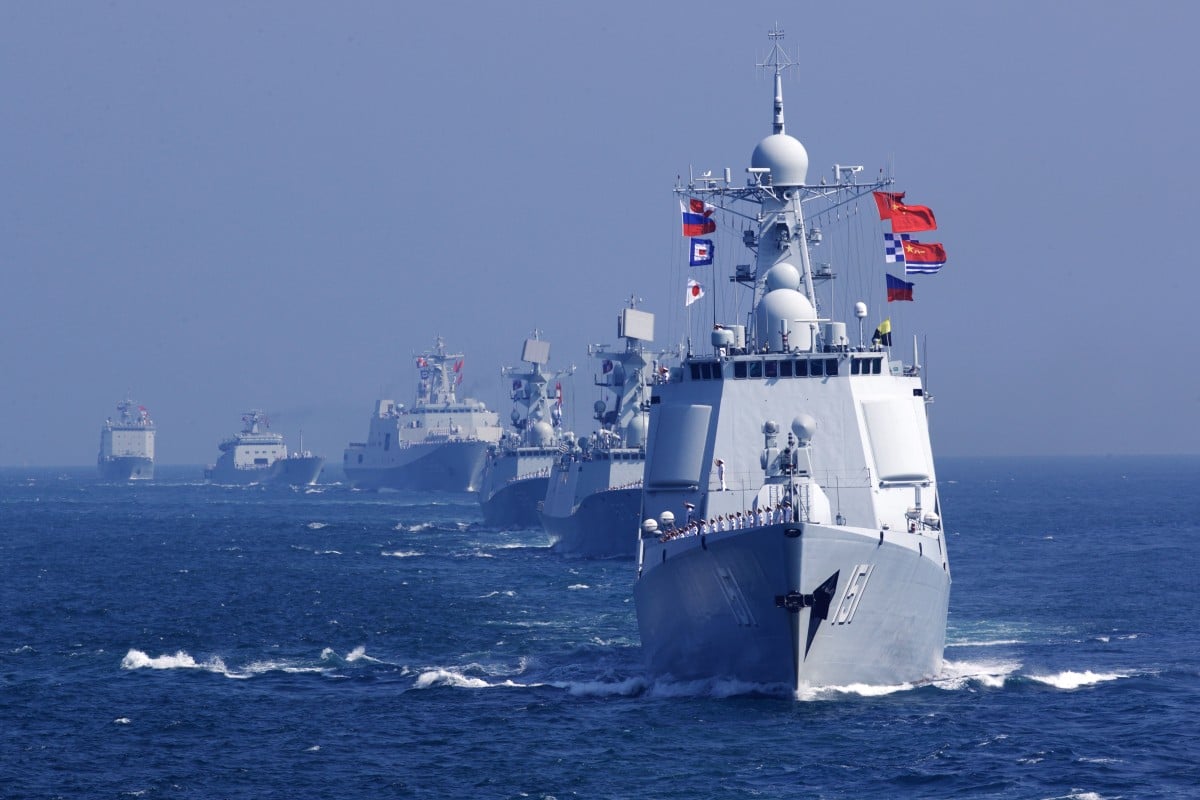
Chinese warships pictured at the end of joint exercise with the Russian navy in 2016. Photo: Xinhua
China will hold a naval parade next month to mark the 70th anniversary of the founding of the People’s Liberation Army Navy and will invite more than a dozen of foreign navies to participate.
The parade will take place on April 23 in the Yellow Sea off the coast of Qingdao in Shandong province, Ren Zhiqiang, a spokesman for the Ministry of National Defence, said on Thursday.
Ren did not provide further details of the parade but military analysts said the exercise would give the navy the opportunity to display its rapidly growing strength and show how that has increased in the past 12 months.
‘No-go zone’ in Yellow Sea for Chinese aircraft carrier sea trials
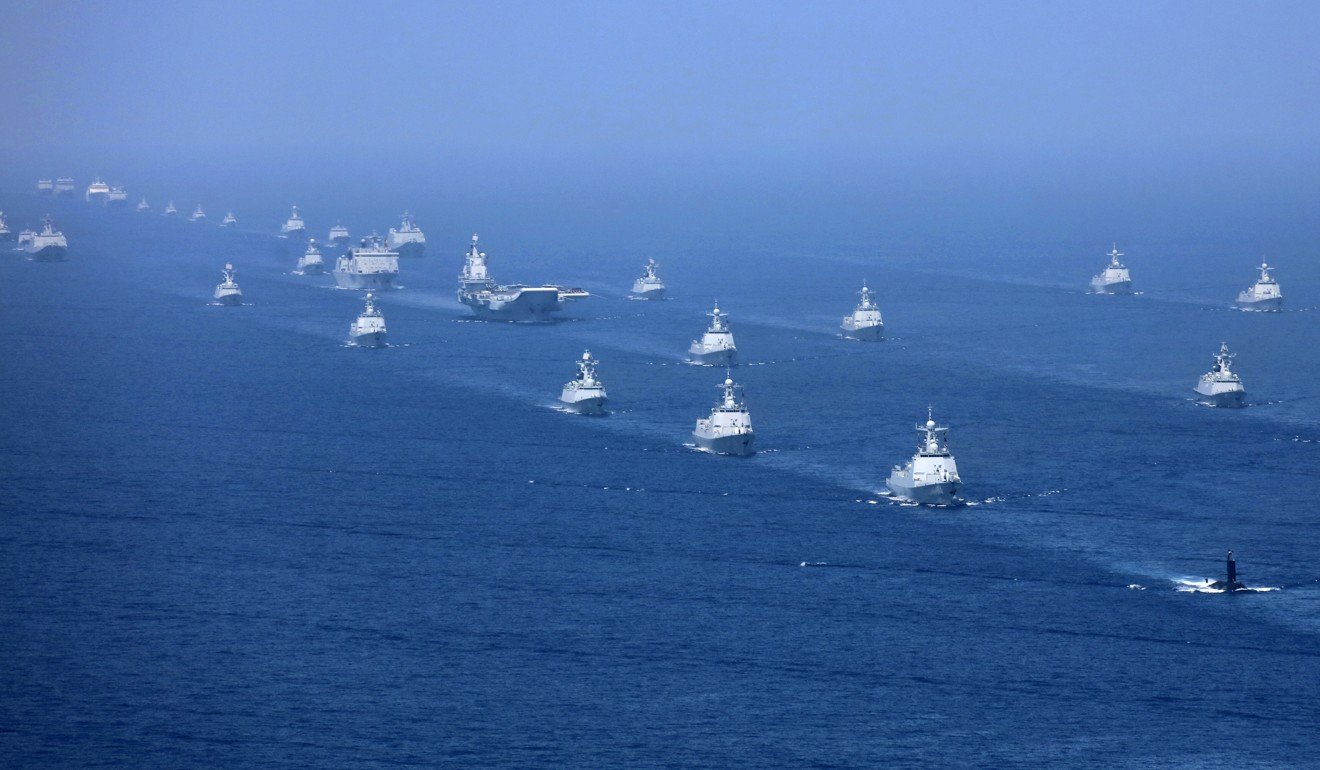
In April last year a naval review in the South China Sea featured a total of 48 vessels and 76 planes, including China’s first aircraft carrier, the Liaoning, its Type 094A and 095 nuclear submarines, 052D guided missile destroyers and J-15 fighter jets.
The experts expect that next month’s event will provide a showcase for several new and more powerful vessels including its home-grown aircraft carrier Type 001A, the Type 055 – Asia’s most powerful destroyer – and several nuclear submarines.
“The fact that China is holding the naval parade just one year after the South China Sea review shows the great importance [the leadership] attaches to the development of China’s maritime interests, the navy and its expansion,” navy expert Li Jie said.
Chinese President Xi Jinping joined the crew on the deck of the cruiser Changsha following last year’s naval review. Photo: Xinhua
Share:
China also held a major naval parade in 2009 to mark the navy’s 60th anniversary.
It was smaller in scale than the upcoming extravaganza with 25 PLA vessels and 31 fighter jets taking part.
Fourteen foreign navies sent ships to the 2009 parade, including the USS Fitzgerald from America and the guided-missile cruiser Varyag from Russia. France, Australia, South Korea, India and Pakistan also joined in the event.
More foreign countries are expected to join the party this year as the PLA has become more active internationally and China has sold more warships to foreign navies.
China’s new veterans’ law to be reviewed at National People’s Congress next week
“The parade is more like a birthday party for the PLA Navy and the participation of foreign navies is a matter of diplomatic courtesy with few military implications,” said Yue Gang, a former PLA colonel.
Yue said the US and its allies would attend despite the rising tensions between the two sides.
Since 2015 the US and Chinese navies have engaged in a series of confrontations in the South China Sea as China strengthens its military presence in the region and the US has sought to challenge Beijing’s claims to the waters by conducting what it describes as “freedom of navigation” operations.
“I don’t expect they will send any of the warships that have taken part in such operations [to the parade],” Yue said.
China has greatly expanded its naval capabilities in recent years. Photo: AP
Share:
It has been reported that the Japanese Maritime Self-Defence Force has expressed an interest in joining the parade and the Philippines – which has a rival claim to the South China Sea – is planning to send a vessel to the event for the first time.
Li said militaries such as the US and Japan would not want to miss the chance to observe the PLA Navy closely.
“In addition, greater transparency [through the parade] will also help reassure smaller regional partners such as the Philippines that China is a friendly power despite its growing military strength,” he said.
China held its first naval parade in 1957 and April’s display will be the sixth such event.
Sailors also took part in the parade through Tiananmen Square to mark the foundation of the People’s Republic on October 1 1949.
Source: SCMP
Posted in Australia, birthday parade, China alert, Chinese President Xi Jinping, France, guided-missile cruiser Varyag, India alert, Japan, Japanese Maritime Self-Defence Force, Liaoning, Ministry of National Defence, nautical spectacle, naval parade, navy, nuclear submarines, October 1 1949, Pakistan, People's Liberation Army Navy, People’s Republic, PLA colonel, Qingdao, Ren Zhiqiang, Russia, sea power, shandong province, South China Sea, South Korea, Tiananmen Square, Uncategorized, United States, US, USS Fitzgerald, warships, Yellow Sea, Yue Gang |
Leave a Comment »






 CHINDIA ALERT: You'll be living in their world, very soon