Archive for ‘onion’

05/10/2019

India’s onion crisis: Why rising prices make politicians cry

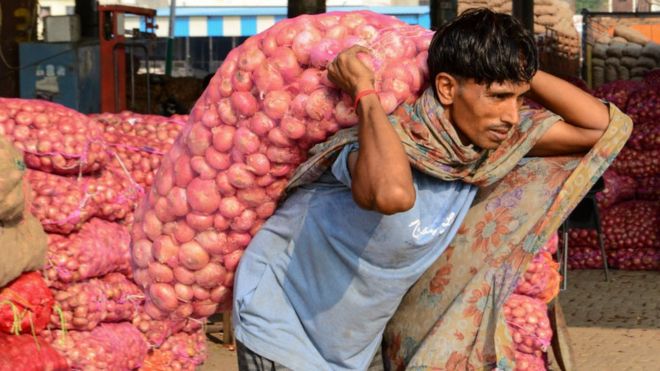
A labourer carries a sack of onions at a wholesale vegetable market on the outskirts of Amritsar on September 19, 2019.Image copyright GETTY IMAGES
Image caption The onion is India’s most “political” vegetable

Onion prices have yet again dominated the headlines in India over the past week. BBC Marathi’s Janhavee Moole explains what makes this sweet and pungent vegetable so political.

The onion – ubiquitous in Indian cooking – is widely seen as the poor man’s vegetable.

But it also has the power to tempt thieves, destroy livelihoods and – with its fluctuating price a measure of inflation – end the careers of some of India’s most powerful politicians.

With that in mind, it’s perhaps unsurprising those politicians might be feeling a little concerned this week.

So, what exactly is happening with India’s onions?

In short: its price has skyrocketed.

Onion prices had been on the rise in India since August, when 25 rupees ($0.35; £0.29) would have got you a kilo. At the start of October, that price was 80 rupees ($1.13; £0.91).

Fearing a backlash, the Bharatiya Janata Party (BJP)-led government banned onion exports, hoping it would bring down the domestic price. And it did.
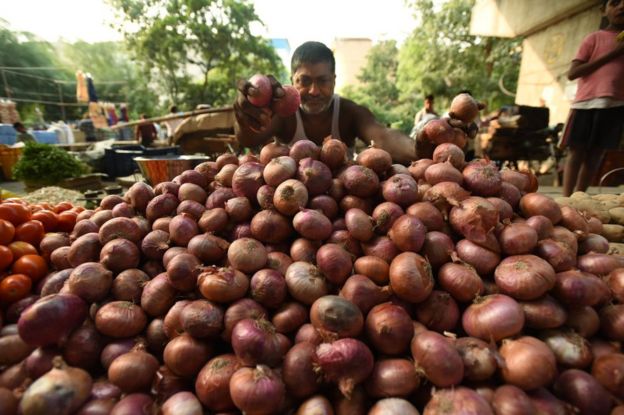
Vegetable vendors sell onions by the road, at Sector 25 on September 24, 2019 in Noida, India.Image copyright GETTY IMAGES
Image caption Onion prices peaked by the end of September

A kilo was selling for less than 30 rupees on Thursday at Lasalgaon, Asia’s largest onion wholesale market, located in the western state of Maharashtra.

However, not everyone is happy.

While high prices had angered consumers in a sluggish Indian economy, the fall in prices sparked protests by exporters and farmers in Maharashtra, where state elections are due in weeks.

And it is not just at home where hackles have been raised: the export ban has also strained trade relations between India and its neighbour, Bangladesh, which is among the top importers of the vegetable.

But why does the onion matter so much?

The onion is a staple vegetable for the poor, indispensable to many Indian cuisines and recipes, from spicy curries to tangy relishes.

“In Maharashtra, if there are no vegetables or you can’t afford to buy vegetables, people eat ‘kanda bhakari’ [onion with bread],” explains food historian Dr Mohseena Mukadam.

True, onions are not widely used in certain parts of the country, such as the south and the east – and some religious communities don’t eat them at all.

But they are especially popular in the more populous northern states which – notably – send a higher number of MPs to India’s parliament.

“Consumers in northern India wield more power over the federal government. So although consumers in other parts of India don’t complain as much about higher prices, if those in northern India do, the government feels the pressure,” says Milind Murugkar, a policy researcher.
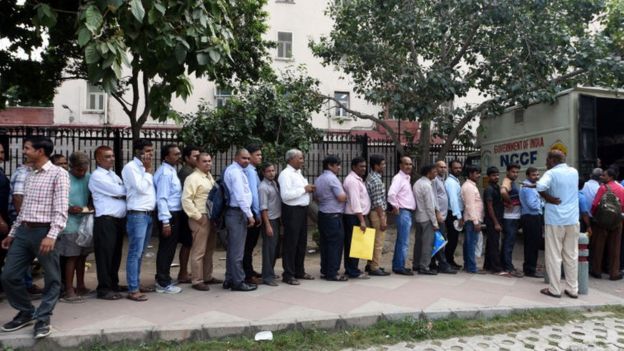
People stand in a queue to buy onions sold at Rs. 22 per kg by the Government of India, outside Krishi Bhawan on September 24, 2019 in New Delhi, India.Image copyright GETTY IMAGES
Image caption Onions are so ubiquitous that the government has been selling them at subsided rates

A drop in prices also affects the income of onion farmers, mainly in Maharashtra, Karnataka in the south and Gujarat in the west.

“Farmers see the onion as a cash crop that grows in the short term, and grows well in dry areas with less water,” says Dipti Raut, a journalist, who has been on the “onion beat” for years.

“It’s like an ATM machine that guarantees income to farmers and sometimes, their household budget depends on the onion produce,” she said.

Onions have even attracted robbers: when prices skyrocketed in 2013, thieves tried to steal a truck loaded with onions, but were caught by the police.

Why do politicians care about the onion?

Put simply, because the price moving too far one way or another is likely to anger a large block of voters, be they everyday households, or the country’s farmers.
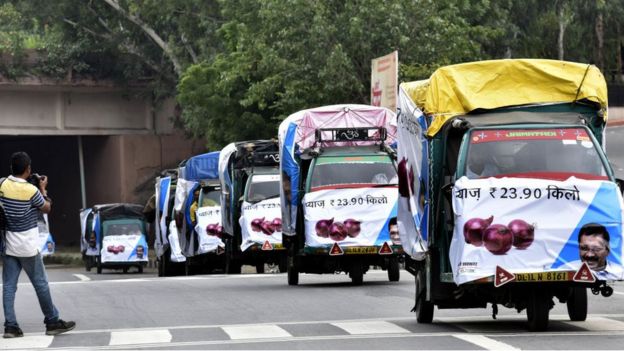
Control rate onion vans seen after flagged off by Chief Minister of Delhi Arvind Kejriwal, at Delhi secretariat, on September 28, 2019 in New Delhi, India.Image copyright GETTY IMAGES
Image caption The Delhi government transported 70 vans full of subsidised onions

Onions are so crucial they have even featured in election campaigns. The Delhi state government bought and sold them at subsidised rates in September when prices were at their peak: chief minister Arvind Kejriwal, it should be noted, is up for re-election next year.

Meanwhile, Indira Gandhi swept to power in 1980 on slogans that used soaring onion prices as a metaphor for the economic failures of the previous government.

But why did onion prices rise this year?

A drop in supply, due to heavy rains and flooding destroying the crop in large parts of India, and damaging some 35% of the onions stocks in storage, according to Nanasaheb Patil, director of the National Agricultural Co-operative Marketing Federation.

He said the flooding had also delayed the next round of produce, which was due in September.
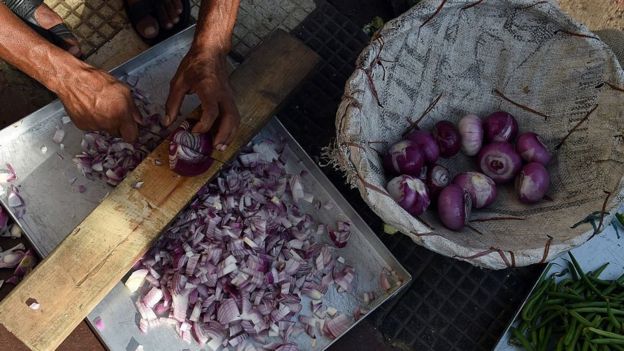
An Indian restaurant worker cuts onions for curries in New Delhi on September 11, 2015.Image copyright GETTY IMAGES

“This has become a fairly regular phenomenon in recent decades,” Mr Murugkar said. “Onion prices swing heavily with a small drop or increase in production.”

In fact, the shortage – and subsequent rise in prices – happens almost every year around this time, according to Ms Raut.

“It’s a vicious cycle and the trader lobby and middlemen benefit from even the slightest price fluctuations,” she added.

What’s the solution?

Ms Raut says more grass-root planning and better storage facilities and food processing services will ease the problem – and making a variety of cash crops and vegetables available across the country would also ease the pressure on onions.

“The government is quick to act when onion prices rise. Why don’t they act as swiftly when prices fall?” asked Vikas Darekar, an onion farmer in Maharashtra. He said the government should buy onions from farmers at a “fair price”.

Mr Murugkar, however, feels that the government should never interfere in “onion matters”.

“If you are interested in raising purchasing power of the people, they should not curtail exports. Do we have such a ban on software exports? It’s really absurd. A government which has won such a huge majority should be able to withstand the pressures from a few consumers.”

Source: The BBC

28/12/2018

Collapse in India’s onion prices could leave Modi smarting in election

HIVARGAON/MUJAHIDPUR, India (Reuters) – A spike in the price of onions has led to the ouster of governments in Indian elections in the past. Now, prices of the staple have collapsed, and many impoverished farmers are saying they will make Prime Minister Narendra Modi pay in next year’s general election.

Steep drops in recent weeks in the prices of onions and potatoes, both staple foods for India’s 1.3 billion people, have badly hit the rural economy in large states.

In interviews with dozens of farmers last week, Reuters reporters found resentment welling against Modi’s Hindu nationalist Bharatiya Janata Party (BJP) for not helping support incomes in the countryside, where a majority of the population lives.

“Whatever they do in the coming months, I will vote against the BJP. I won’t repeat the 2014 mistake,” said Madhukar Nagare, an onion grower from Nashik in Maharashtra state, referring to his backing the BJP at the last general election.

In the 1998 state elections, a sharp spike in onion prices led to the fall of the BJP government in the capital New Delhi.

In the 1980 general election, sky-high onion prices helped former Prime Minister Indira Gandhi dislodge a coalition government that had included politicians who later formed the BJP.

In recent weeks, loss-stricken farmers have staged protests, blocked highways and dumped onions on the road after prices plunged to as low as one rupee (1.4 U.S. cents) per kg for a crop that costs about 8 rupees a kg to produce.

But because of large cuts taken by middlemen, consumers have not benefited from the low prices.

In Maharashtra, the top onion producing state, farm prices have fallen 83 percent, dragged down by surplus supplies from the previous season’s crop and lower export orders from the Middle East and Southeast Asia.

And in India’s most populous state of Uttar Pradesh, which was crucial in Modi’s election win in 2014, there is a similar problem with low potato prices.

Maharashtra and Uttar Pradesh are both dominated by rural voters and together send 128 lawmakers to the 545-member lower house of parliament. It means that big losses in these two states could either see Modi lose the next election which is due by May or his party be forced to form a coalition government. Farmers say shortcomings in a government crop support programme, and weak overseas demand have combined to produce the current glut of onions. And as prices have plunged, fertiliser and crop nutrient costs have risen, thanks in part to a weak rupee.

Perhaps most important of all, the BJP came into office in 2014 determined to shift away from subsidies. That may have been fine when crop prices were relatively high but as they crashed it has exposed the party in farm areas.

The prime minister’s office did not respond to a request for comment on this story.

NOT “GOOD DAYS”

Many farmers blame Modi for not fixing a price protection programme which barely covers 7 percent of India’s 263 million farmers, leaving most growers at the mercy of middlemen.

They also criticize him for not setting up more food processing and cold storage facilities, which would allow them to store their crops without having to sell immediately after the harvest.

“Expecting good days, as promised by Modi, we voted for the BJP, but now we are going through the worst phase,” onion farmer Madhav Pawase said, pointing to his rotting crop stocked in a temporary shed in Hivargaon village, about 230 km (140 miles) northeast of Mumbai, India’s financial hub.

“I’ve spent more than 80,000 rupees to produce 15 tonnes of onions from my two acres of land, but I won’t recover more than 3,000 rupees at the current market price,” he said.

Some farmers have decided to let onions rot in the field, saying that harvesting and transporting the produce to wholesale markets would only add to their losses.

A farmer sits on a tractor trolley after auctioning his onions at Lasalgaon market in Nashik in the western state of Maharashtra, India, December 19, 2018. REUTERS/Rajendra Jadhav

The BJP was defeated by the opposition Congress party in three major states in local elections this month because of rural anger, and Modi’s government is under pressure to come up with measures to placate farmers.

Congress wrote off farmers’ loans in the three states which it won and has demanded the federal government do the same across the country.

Although the BJP has so far not commented on the issue of farm loan waivers, Rajiv Kumar, the head of government think-tank NITI Aayog, has said that writing off debt is not the solution for the problems of the farm sector.

Syed Zafar Islam, a spokesman for the BJP, said the government had initiated a number of steps to help farmers get remunerative prices, including a project to electronically provide farmers with real-time market prices and help them directly sell to buyers, eliminating middlemen.

“It’s an ongoing process and the results will not just start reflecting in four years,” he said.

In a sign that the Modi administration is beginning to take the crisis seriously, the government on Friday doubled export incentives for onion farmers to 10 percent.

The move will result in better prices for onions in the domestic market, the government said in a statement.

POTATO PRICES

In Mujahidpur village of Uttar Pradesh, India’s biggest potato growing state, farmers lamented that prices have dropped by 86 percent to 2,500 rupees a tonne.

“I lost my entire investment of 100,000 rupees to grow potatoes on one hectare,” said Gopi Chand, 55, sitting next to bright yellow mustard fields.

He said he and some other farmers in the area had dumped potatoes in favour of growing mustard.

Farmers in the two states also complained of rising operating costs.

Prices of crop nutrient diammonium phosphate, popularly called DAP, have gone up by 400 rupees to 1,450 rupees for a bag of 50 kg, said Babloo Singh in Mujahidpur village. DAP rates have gone up because of higher overseas prices and India’s weaker currency.

“Higher input costs and record low potato prices have left us in deep debt,” said Singh. “The situation would have been different had there been more cold storage facilities and food processing plants in our state.”

The crash in vegetable prices hasn’t helped consumers either thanks to the chain of middlemen.

In Lasalgaon, the country’s largest onion trading hub, most farmers are selling their produce at 2 rupees a kg. But consumers in Mumbai are still shelling out 20 rupees. Between Lasalgaon and Mumbai, a distance of 220 km (135 miles), traders say onions pass through at least four layers of middlemen, adding a hefty margin at every stage.

Law of Unintended Consequences

continuously updated blog about China & India

ChiaHou's Book Reviews

continuously updated blog about China & India

What's wrong with the world; and its economy

continuously updated blog about China & India