28/04/2020
SHANGHAI (Reuters) – Apple Inc’s (AAPL.O) discounts on the iPhone 11 in China and the release of a new low-price SE model have put the company in a better position than rivals to weather a coronavirus-related plunge in global smartphone demand.
While China, which accounts for roughly 15% of Apple’s revenue, appears to be a rare bright spot, investors will be keen to get a picture of global demand when the Cupertino, California-headquartered company reports second-quarter results on Thursday.
The iPhone maker has shut retail stores in the United States and Europe following the COVID-19 outbreak, and China is the only major market where it has been able to reopen all shops.
Consumer spending is expected to be muted as the pandemic has crippled economies and Apple, the world’s second-most valuable tech company, is better armed with the launch of its new price-conscious iPhone model, analysts said.
“Apple is better positioned than most to experience a rapid recovery in a post COVID world,” Evercore analyst Amit Daryanani said in a research note. “We see demand as pushed out, not canceled.”
He added that the launch of the $399 iPhone SE suggested that Apple’s supply chain was getting back on its feet after weeks of shutdown earlier this year.
Analysts expect Apple to report a 6% drop in revenue and an 11% fall in net income in its fiscal second quarter, according to Refinitiv data.
On the other hand, Chinese brands such as Oppo and Vivo who have steadily moved to offer high-end models to challenge iPhones, stand to lose marketshare as bargain hunters choose Apple.
Earlier this month, several online retailers in China slashed prices of the iPhone 11 by as much as 18% – a tactic Apple has used in the past to boost demand. And while initial social media reaction to the new iPhone SE was muted, analysts said they were seeing a pick up in demand.
The cheaper iPhone SE could tempt iPhone owners to opt for a newer device, something they might have otherwise delayed in a weak economy, said Nicole Peng, who tracks the smartphone sector at research firm Canalys.
“People want to avoid uncertainty in a downturn,” she said. “Having a brand like Apple that can showcase quality and make people less worried about breakdowns or after-sales service can bring in buyers.”
CHEAP IS GOOD
Early data suggests that the Chinese smartphone market is recovering rapidly in the aftermath of the virus, and Apple has emerged relatively unscathed.
Sales of iPhones in China jumped 21% last month from a year earlier and more than three fold from February, government data showed, meaning March-quarter sales in the country were likely to have slipped just 1%.
To be sure, a recovery in Chinese demand won’t offset sales lost in the United States and Europe. And the company is yet to launch a smartphone enabled with 5G wireless technology like those offered by Asian rivals, a disadvantage for Apple so far.
But those same expensive 5G models may not sell well in the current climate of frugality, analysts said.
“If there are no massive subsidies (in China), I doubt there will be many smartphone users who will be eager to upgrade to 5G,” said Linda Sui, who tracks the smartphone sector at research firm Strategy Analytics.
Sui expects iPhone shipments in 2020 to be down 2 percentage points at the most, versus double digit declines at Chinese firms.
Apple also has revenue from its services business to fall back on. It has leveraged its large iPhone customer base to boost services revenue from music, apps, gaming and video.
“Apple’s Services segment should remain resilient in today’s work-from-home environment, thereby demonstrating the durability of Apple’s model,” Cowen analyst Krish Sankar said.
Source: Reuters
Posted in 5G models, 5G wireless technology, accounts, after, analyst, analysts, appears, Apple, Apple Inc’s (AAPL.O), apples, are bright spot, armed, Asian, avoid, back on its feet, better, blow, brand, breakdowns, Buyers, California-headquartered, canceled, cheaper, China, Chinese brands, climate, Company, Consumer spending, coronavirus-related, COVID, COVID-19 outbreak, crippled, Cupertino, current, demand, discounts, downturn, drop, earlier, economies, Europe, Evercore, expected, experience, fall, February, fiscal, fold, following, from, frugality, fter-sales service, global, Government, income, investors, IPhone, iPhone 11, iPhone SE, just, last month, launch, low-price, Major, maker, March, market, marketshare, model, muted, net, new, online retailers, only, Oppo, pandemic, plunge, position, Post, price-conscious, prices, put, quality, quarter, rapid, reaction, recovery, Refinitiv data, release, reopen, reports, research note, results, retail stores, Revenue, rivals, roughly, Sales, SE model, second-quarter, Shanghai, shops, showcase, shut, shutdown, slashed, slipped, smartphone, social media, Strategy Analytics, suggested, Supply chain, tactic, this year, Three, Thursday, to cushion, Uncategorized, uncertainty, United States, Virus, Vivo, weak economy, weather, weeks, World, world’s second-most valuable tech company, worried, year |
Leave a Comment »
12/03/2020
- China is now making more than 100 million masks a day, up from 20 million before the coronavirus outbreak, and may start to export more to other countries
- Mask shortages elsewhere once more raise the debate about an over-reliance on China, with critics pointing to a lack of US industrial policy
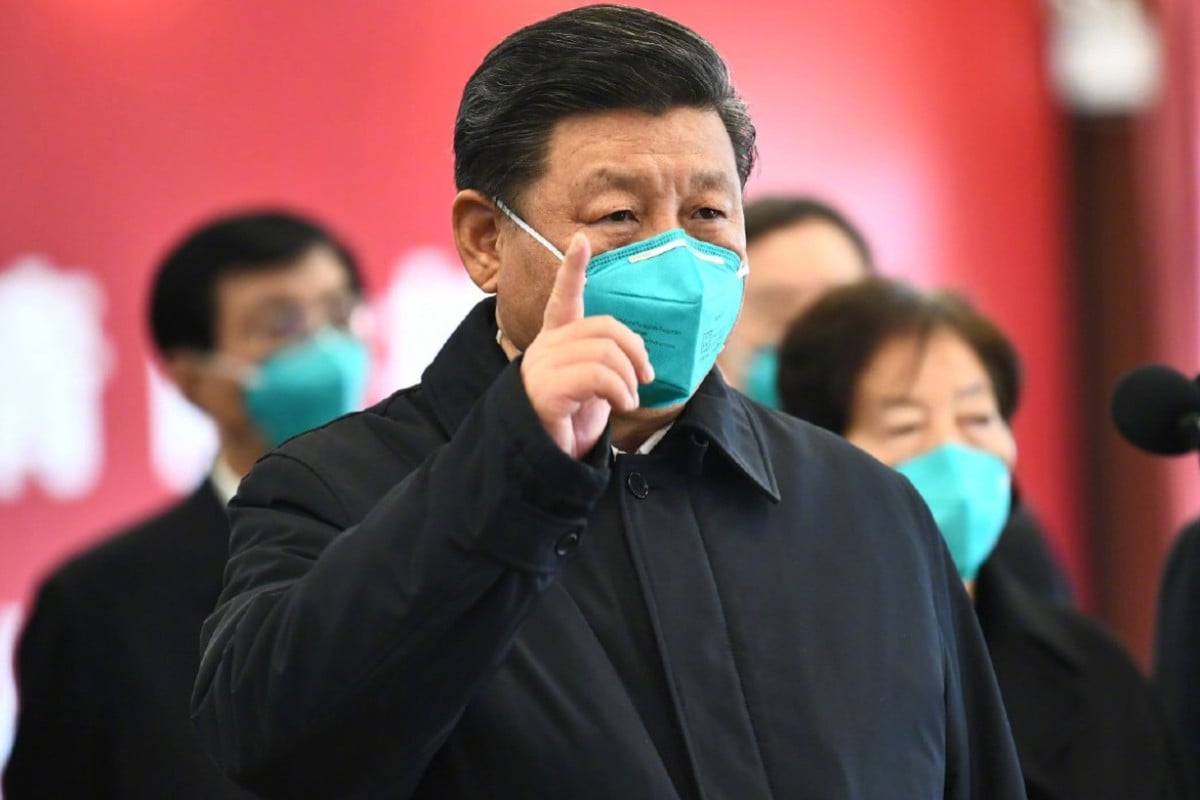
China was producing 116 million masks per day of February 29, including a mix of disposable and high-end masks like the American-designed N95 model worn by President Xi Jinping on his trip on Tuesday to Wuhan. Photo: Xinhua
The Liu family factory has been making diapers and baby products in the Chinese city of Quanzhou for over 10 years, but in February, for the first time, it started making face masks, as demand soared spectacularly due to the coronavirus outbreak.
The business – which employs 100 people in the Southeastern Fujian province – has added two production lines to make up to 200,000
masks a day.
And while the decision was primarily commercial, “encouragement” from the Chinese government – in the form of subsidies, lower taxes, interest-free loans, fast-track approvals for expansion and help alleviating labour shortages – made the decision an obvious one, said Mr Liu who preferred only to give his family name.
“The government is advocating an expansion in production,” Liu said. “With faster approvals, producers need to prioritise the government’s needs over exports.”
WHO declares coronavirus crisis a pandemic
The factory is one of thousands of refitted pop-ups around China making masks and other protective equipment for the first time, part of a massive industrial drive to respond to the spread of the coronavirus.
Before the outbreak, China already made about half the world’s supply of masks, at a rate of 20 million units a day. That rose to 116 million as of February 29, according to China’s state planning agency, a mix of disposable and high-end masks like the American-designed N95 model worn by President Xi Jinping on his trip on Tuesday to Wuhan, the epicentre of the outbreak.
This exponential jump is the result of a wartime-like shift in industrial policy, with Beijing directing its powerful state-owned enterprises to lead the nationwide mask-making effort, and the country’s sprawling manufacturing engine following their lead.
For me, this is the big advantage of China, the speed Thomas Schmitz
“For me, this is the big advantage of China, the speed,” said Thomas Schmitz, president of the China branch of Austrian engineering giant Andritz, which has seen a big uptick in demand for its wet wipe-making machines in recent weeks, also due to the virus. “When you need to run, people know how to run, and this is something which has been lost in other countries since their industrial heydays.”
Chinese oil and gas major Sinopec upped production of mask raw materials such as polypropylene and polyvinyl chloride in January. This week, it set up two production lines in Beijing to produce melt-blown non-woven fabric, intended to make four tonnes of the fabric each day, which can then be used to produce 1.2 million N95 respirators or six million surgical masks a day.
The maker of China’s new J-20 stealth fighter jet, Chengdu Aircraft Industry Group, repurposed part of its factory to design a mask production line, according to local media reports. The Sichuan Daily said 258 of the company’s engineers spent three days fast-tracking development of an assembly line with more than 1,200 components.
Coronavirus: From mysterious origins to a global threat
More than 2,500 companies in China have reportedly started making masks, among them 700 technology companies including iPhone assembler Foxconn and smartphone makers Xiaomi and Oppo, in an extraordinary mobilisation of resources.
The result resembles “the war effort” in the middle of the last century in the United States and western Europe, but arguably no other nation could undergo such a transformation so quickly today.
It is a reminder of what can happen in a centrally-planned economy with a strong manufacturing base, but also brings into sharp focus some of the geopolitical issues which have characterised China’s at-times difficult relationship with the rest of the world, particularly the European Union and US, over the past couple of years.
China’s dominance in manufacturing has become all the more evident as the rest of the world scrambles to shore up their own dwindling medical supplies, leading many to wonder why the world is so dependent on it for vital supplies.
The lesson for Washington is not that we need to emulate the Chinese economic model, but rather that we need to better steward the industrial base in key sectors Rush Doshi
The Italian government, which is dealing with the highest number of coronavirus cases and deaths after China, is to take shipment of 1,000 ventilators, 2 million masks, 100,000 respirators, 200,000 protective suits and 50,000 testing kits from China.
Italian foreign minister Luigi Di Maio said after a phone call with Chinese counterpart Wang Yi, they had agreed the
export deal in the same week that European neighbours France and Germany banned masks from being exported because of low domestic supplies.
The Italy export deal showed that “China is emerging as a global public goods provider as the US proves unable and unwilling to lead,” said Rush Doshi, the director of the China Strategy Initiative at the Washington-based Brookings Institute think tank.
“China’s ability to produce what is needed to fight coronavirus is not simply a product of its economic model – it’s also a product of its industrial capacity,” Doshi said. “The US once had this capacity too, but it has lost important parts of it. The lesson for Washington is not that we need to emulate the Chinese economic model, but rather that we need to better steward the industrial base in key sectors.”
The frustration is felt acutely by Michael Einhorn, president of medical equipment distributor Dealmed-Park Surgical in New York, who has been trying to source stock from China for weeks, “but cannot get straight answers” from vendors.
Unaware that Wuhan was still under heavy
economic lockdown, Einhorn said he placed an order with a private seller in China’s virus-stricken city last week, but that the goods had not been shipped.
“Everyone is running out here, people are panicking in hospitals and we want to be able to help our most important customers,” Einhorn said. “We are dealing with hospitals that do not have products, how in the United States of America in 2020 did this happen?”
With the number of confirmed coronavirus cases in China falling daily, it is not inconceivable that the sort of export deal struck with Italian leaders becomes commonplace, although for now, it deal can be chalked up as a significant public relations coup for Beijing.
The World Medical Association is unable to specify how many masks are required to supply frontline medical staff in virus-hit areas, but said that “this crisis should be a wake up call for politicians and societies to make the necessary investment in emergency preparedness and to look into the vulnerability of our supply chains”.
Australian-listed manufacturer Eagle Health announced on Friday that it had installed production lines at its Xiamen factory in southern China to make 300 million masks a year and said it had already received orders from China and would be securing further larger orders internationally.
The group, which normally makes products including amino acids, protein supplements and lozenges in China, said it would prioritise meeting the large domestic demand, but was aware of an impending global shortage.
Eagle Health has already commenced production of its first order of 3.2 million medical masks for the Yiling Hospital Management Group in China, a process which will take 10 days. It has other smaller orders from Chinese government agencies and expects to receive more orders outside China.
The decision to make more masks came from increased demand. These are opportunities. The global demand for high quality masks will be significant Xu Gang
“The decision to make more masks came from increased demand. These are opportunities,” said chief executive Xu Gang. “The global demand for high quality masks will be significant. Imagine when the schools open. The situation will take some time to peak.”
Last week, the Australian Dental Association said supplies of masks at many practices were expected to run out within four weeks. The Australian government has since arranged a supply of 54 million masks for both the dental and medical industries.
At the same time, the US only has 1 per cent of the 3.5 billion masks it would need to counter a serious outbreak, Bloomberg reported.
While China has no quota on the volume of masks that had to be hived off for local consumption, the government has said domestic demand needs to be prioritised.
Businesses are free to export but overseas demand has yet to explode like it has in China, said Fujian factory owner Liu.
Wendy Min, sales director of Pluscare, a manufacturer based near the virus’ epicentre in Hubei province, said her company is making 200,000 masks per day, much of which are sold to the government, with exports still restricted by partial lockdown of workers and cargo transport.
“We previously exported to Europe, South America and other parts of Asia,” Min said. “But at the moment we can’t export. We are trying to discuss this with the government, but we cannot wait any more – we have to export soon.”
Min said that while she was receiving countless cold calls up until last week from people in China looking for masks, these have stopped, perhaps unsurprising given the abundance in supplies becoming available.
An influx of Chinese-made masks, though, is likely to be welcomed in other virus-stricken parts of the world.
Self-quarantine of all international travellers to Beijing as China fights import of coronavirus
Miguel Luiz Gricheno, CEO of Brazilian mask manufacturer Destra, said that his company is making 30,000 masks a day, but cannot meet local demand due to a lack of supplies, including the non-woven fabric from which masks are made.
“In disposable masks, most Brazilian companies are paralysed due to the lack of raw materials,” Gricheno said. “With the arrival of the coronavirus in Brazil, the demand has increased a lot but the main raw material comes from abroad.”
However, a short-term supply fix will not answer underlying questions about how so many countries found themselves in such dire straits, meaning the geopolitical fallout of the coronavirus will be extensive.
Decades of weak industrial policy helped elect US President Donald Trump, who said he would bring manufacturing jobs back to America at China’s expense. While he has waged a bruising two-year trade war with China in response, the current situation shows just how difficult it will be to change the global manufacturing processes, which are so heavily controlled by China.
One of the great flaws of globalisation is that everyone wanted things cheaper, but did you compromise your health care infrastructure in the process? Stephen Roach
“In the guise of trying to improve efficiency and create value for price-sensitive consumers, we’ve created a global production network that is very difficult to unwind,” said Stephen Roach, a professor of economics at Yale University and a veteran China watcher. “One of the great flaws of globalisation is that everyone wanted things cheaper, but did you compromise your health care infrastructure in the process.
Reuters reported that Trump is considering invoking the emergency provisions of the Defence Production Act, which would allow the government to instruct companies to alter production to help address the domestic shortage of medical supplies like masks. If a company is producing 20 per cent N95 masks and 80 per cent standard masks, the White House could order them to rejig the ratio, an unnamed official said.
The New York Times reported on Wednesday that the White House is preparing an executive order that would allow the government to buy medical supplies from overseas in the hope that it will incentivise companies to make them within the US.
But these changes still do not give Trump the sort of sweeping powers enjoyed by Chinese counterpart Xi.
“When you have a pluralistic, democratic situation that Trump is overseeing, it becomes more unwieldy” to take the steps necessary to address a crisis situation, said Harry Broadman, chair of the emerging markets practise at the Berkeley Research Group and a senior US government official in the 1980s and 1990s.
“That is why I think Trump looks at Xi with envy, because he doesn’t have to deal with a disparity of views or democratic interests,” Broadman said. “I think Trump is at heart a bilateral guy, as you saw with the phase one [US-China] trade deal and the state-to-state purchases. That is why he likes dealing with [Russian President Vladimir] Putin and Xi, because each of them can move mountains. I think Trump is very envious of that ability.”
Source: SCMP
Posted in 100 million masks, American-designed N95 model, Andritz, Asia, Australian Dental Association, Australian government, Austrian engineering giant, Beijing, Bloomberg, Brazil, Brazilian companies, Brookings Institute, can move mountains, Chengdu Aircraft Industry Group, China Strategy Initiative, China’s, coronavirus, coronavirus cases, coronavirus outbreak, countries, cranks, Dealmed-Park Surgical, deaths, Defence Production Act, Destra, Eagle Health, Europe, European neighbours, European Union, exponential jump, export, Fears, Foxconn, France, Fujian, gear, Germany, industrial policy, international travellers, iPhone assembler, Italian foreign minister, Italian government, J-20 stealth fighter jets, Juggernaut, mask-making, mobilisation, New York, Oppo, over reliance, paralysed, Pluscare, President Xi Jinping, protective suits, Putin, Quanzhou, raw materials, resources, respirators, Reuters, russian president vladimir putin, self-quarantine, Sichuan Daily, Sinopec, smartphone makers, South America, sparking, testing kits, The New York Times, Trump, Uncategorized, United States of America, US, US industrial policy, US President Donald Trump, ventilators, Wang Yi, wartime-like shift, Washington, White House, World Medical Association, world’s workshop, Wuhan, Xi, Xiamen, Xiaomi, Yiling Hospital Management Group |
Leave a Comment »
26/03/2019
SHANGHAI (Reuters) – Smartphone retailers in China say it’s a tough sell of late with consumers reluctant to upgrade, put off by chill economic winds.
Even so domestic brands led by Huawei have made big strides, wooing consumers with top-notch hardware and innovative features as they move upmarket in the $500-$800 price range. The result: a loss of share in a key segment for Apple Inc and fresh price cuts for iPhones by Chinese retailers.
“Of those people who are upgrading, there are many switching from Apple to Chinese brands but very few switching from Chinese brands to Apple,” said Jiang Ning, who manages a Xiaomi store in the northern province of Shandong.
Huawei Technologies Co Ltd, Xiaomi Corp, Oppo and Vivo once sought to grab share in the world’s biggest smartphone market with value-for-money devices, but consumer demand for better phones has prompted strategic rethinks.
“People are more attached to their phone than ever and have higher expectations for the function and experience it offers. The response has been constant upgrading of hardware specs,” Alen Wu, global vice president at Oppo, told Reuters.
He Fan, CEO of Huishoubao which buys and resells used phones, said he has seen a consumer shift to Huawei from Apple, driven by the Chinese love of selfies and emphasis on camera quality. Huawei has had a tie-up with German camera maker Leica since 2016.
“Huawei’s cameras have become noticeably better than Apple’s in that they suit the tastes of Chinese consumers more,” he said.
Compared to dual-cameras common in most smartphones, Huawei’s P20 Pro device boasts three rear-facing cameras, with the additional one improving zoom capabilities.
It is one of several new devices in its P20 and Mate 20 lines, which helped Huawei’s share of the $500-$800 segment in China surge to 26.6 percent last year from 8.8 percent, data from research firm Counterpoint shows.
Apple, by contrast, saw its share of the segment tumble to 54.6 percent from 81.2 percent, also hurt by its decision to move even further upmarket with the iPhone X series.
“Most Chinese smartphone buyers are not ready to shell out beyond $1,000 for a phone,” said Neil Shah, research director at Counterpoint. “This left a gap in the below-$800 segment, which Chinese vendors grabbed with both hands.”
Shipments of phones priced above $600 in China grew 10 percent in 2018, data from research firm Canalys shows. By contrast, the overall market shrunk 14 percent, marking a second year of contraction.
OVERSEAS GAINS
The weaker cachet for Apple in China was underscored this month when several major retailers simultaneously cut iPhone prices for a second time this year.
A 64GB iPhone 8 sold at Suning.com Co Ltd now costs 3,899 yuan ($580), roughly 25 percent less than it did in December. That’s also lower than its $599 price tag in the United States, where iPhones typically cost less to buy than in China. Most iPhone models through to the iPhone 8 series have seen prices in China cut, albeit not equally.
In earnings too, it seems to be a tale of divergent fortunes. Apple’s October-December revenue from the Greater China region fell by about a quarter from a year earlier. Greater China currently accounts for 15.6 percent of its overall revenue.
Huawei, the world’s No. 2 smartphone maker, has estimated revenue for 2018 rose 21 percent, which analysts attribute in large part to robust smartphone sales.
More broadly, fewer sales for Apple means fewer customers for its App Store and media streaming services. The shift to higher-end phones by Chinese brands has also meant greater inroads in overseas markets.
Huawei’s shipments in Europe jumped 55 percent in the latest quarter and it now has 23.6 percent market share, according to Canalys. That’s not far behind Samsung Electronics and Apple which saw small declines in shipments.
OPPO, VIVO
If Huawei is taking the lion’s share of turf that Apple once had in China, Oppo and Vivo – brands owned by electronics hardware conglomerate BBK – are the newest threats.
Apple launches TV, credit card and game service
In June, Vivo launched the Nex which starts from 3,898 yuan ($610) and in July, Oppo launched the Find X, priced at 4,999 yuan ($755).
The models mark the first time the brands have priced a phone above $600, a sharp departure from their roots selling $300-$500 models to young consumers in second-tier cities.
The devices came with features unavailable in the iPhone, including under-the-glass fingerprint sensors and “notchless” displays, both of which increase the size of usable screen.
Xiaomi too is going upmarket, announcing in January it would split off its low-budget Redmi range of phones into a sub-brand. In doing so, it is taking a leaf out of Huawei’s book which has for years sold cheaper devices under the Honor brand, helping differentiate its products.
Redmi will target international markets and e-commerce sales, while the flagship Xiaomi brand will target China and offline retail markets, company founder Lei Jun told reporters.
Last month, Xiaomi unveiled the Mi 9, its latest flagship device with a price tag of 2,999 yuan ($450). But the company also said it might be the last time a Xiaomi flagship phone would be priced under 3,000 yuan.
“Xiaomi’s flagship series phones were once always set at 1,999 yuan,” said Lei. “This was a contributing factor to our rise, but it also became an obstacle to our growth,” he said.
Source: Reuters
Posted in Apple, China alert, home market, Huawei, Oppo, seize turf, smartphone vendor, Uncategorized, Vivo, Xiaomi Corp. |
Leave a Comment »



 CHINDIA ALERT: You'll be living in their world, very soon