Archive for ‘outer space’

28/09/2019

China’s National Day parade to showcase advances in nuclear deterrence

  • Military experts say PLA modernisation brought about during Xi Jinping’s presidency will be the main focus of October 1 celebration in Beijing
  • It’s necessary for China to ‘show some of its muscle’ amid the trade dispute with the US, observer says
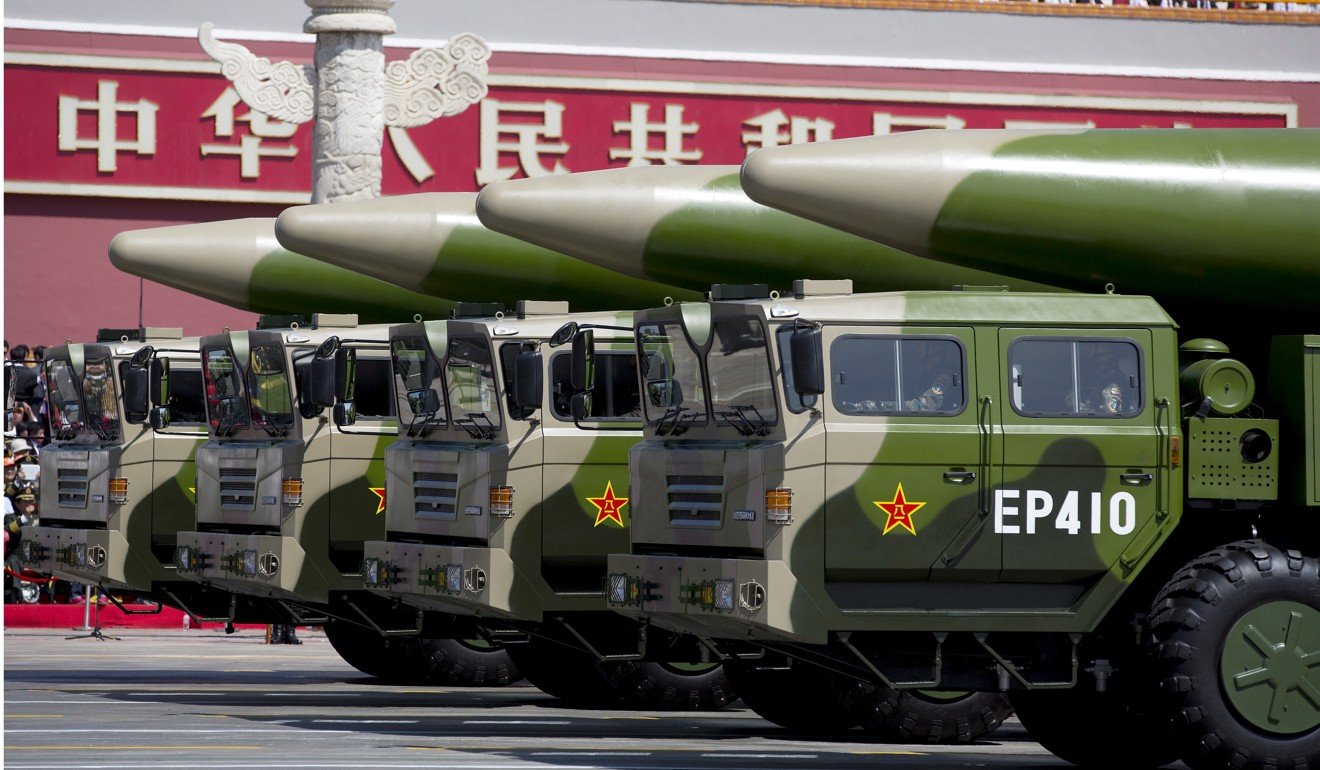
China’s land-based DF-41 intercontinental ballistic missile will be among the military hardware on show on October 1. Photo: Reuters

China plans to show off its most advanced active weapon systems at the upcoming National Day parade, which will be the biggest of the 14 such events it has held over the past seven decades.

The parade, to be held on October 1 to mark the 70th anniversary of the founding of the People’s Republic, will highlight the military modernisation – particularly in nuclear deterrence – that has taken place since President Xi Jinping came to power in late 2012, according to military experts.

The People’s Liberation Army (PLA) offered a glimpse of those weapons during rehearsals for the parade in downtown Beijing from September 14.

As part of the celebrations, Xi, who also chairs the Central Military Commission, will inspect 48 squads on the ground and more than a dozen airborne squadrons, according to a military insider involved in support services for the parade.
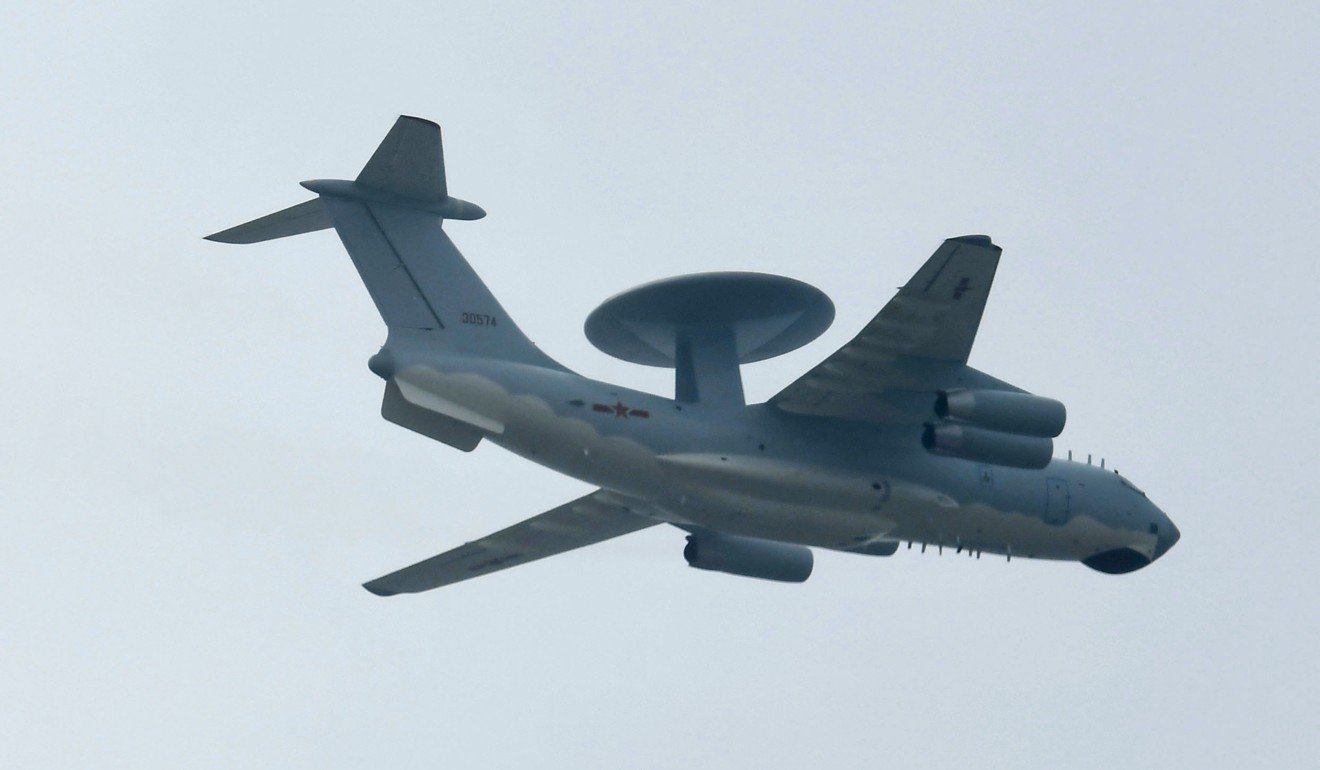
More than a dozen airborne squadrons will take part in the National Day parade. Photo: Kyodo

The squadrons will include the air force’s first stealth fighter, the J-20; the main active warplanes such as the J-10 and J-11B; and armed helicopters like the Z-20. However, the J-8 fighter jet would not appear this year, the source said, confirming that the first interceptor built in China has been formally retired.

“The ground march will be led by several hero forces from the five theatre commands, which is different from previous squads selected from the ground forces, air force and navy,” said the insider, who requested anonymity because of the sensitivity of the matter.

“The main goal of this year’s parade is to promote the military modernisation of the PLA under President Xi’s leadership over the past seven years, with the military overhaul being one of the key achievements.”

Thirty-three of the 48 squads would be “weapon squads”, while the 13 others would be made up of infantry troops from the five theatre commands, the source said.

National Day fireworks in Hong Kong cancelled over safety fears

As part of the PLA’s sweeping military reforms, the army’s previous seven military commands were reshaped into five theatre commands, while the four former general headquarters were dissolved and replaced by 15 small functional departments.

In September 2015, Xi announced the PLA would shed 300,000 troops, cutting its size to 2 million, a move aimed at turning the PLA into a more nimble and combat-ready fighting force on a par with international standards.

Xi also split the former Second Artillery Corps into the Rocket Force and the Strategic Support Force, with the latter backing up the military’s electronic warfare units in cyberspace and outer space.

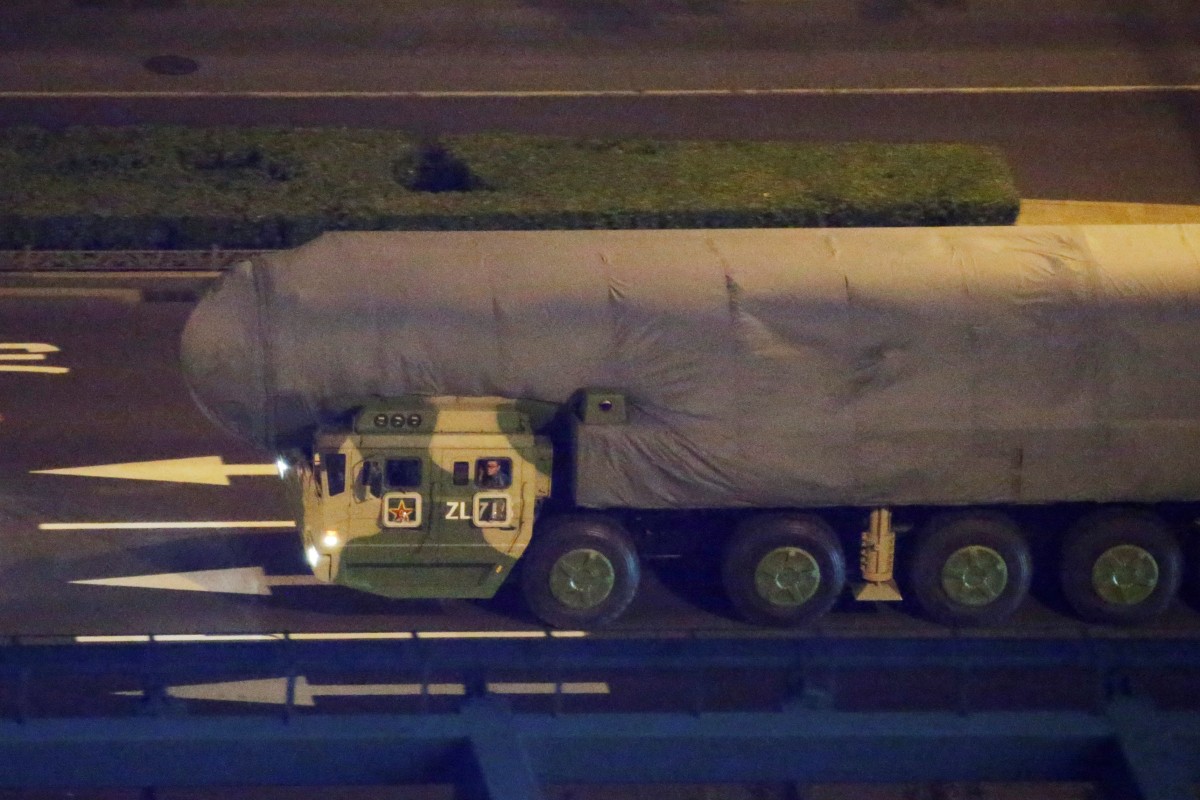
Among the 33 weapon squads, the highlights are expected to be the PLA’s strategic nuclear missiles such as the Rocket Force’s land-based DF-41 intercontinental ballistic missile (ICBM), the DF-21D anti-ship ballistic missile, the DF-17 hypersonic missile and the sea-launched JL-2, or Big Wave-2.

Adam Ni, a researcher at Macquarie University in Australia, said that showing off different types of missiles on land and sea indicated that the PLA was improving its nuclear deterrence capabilities by perfecting a three-pronged military force structure, or the so-called nuclear triad.
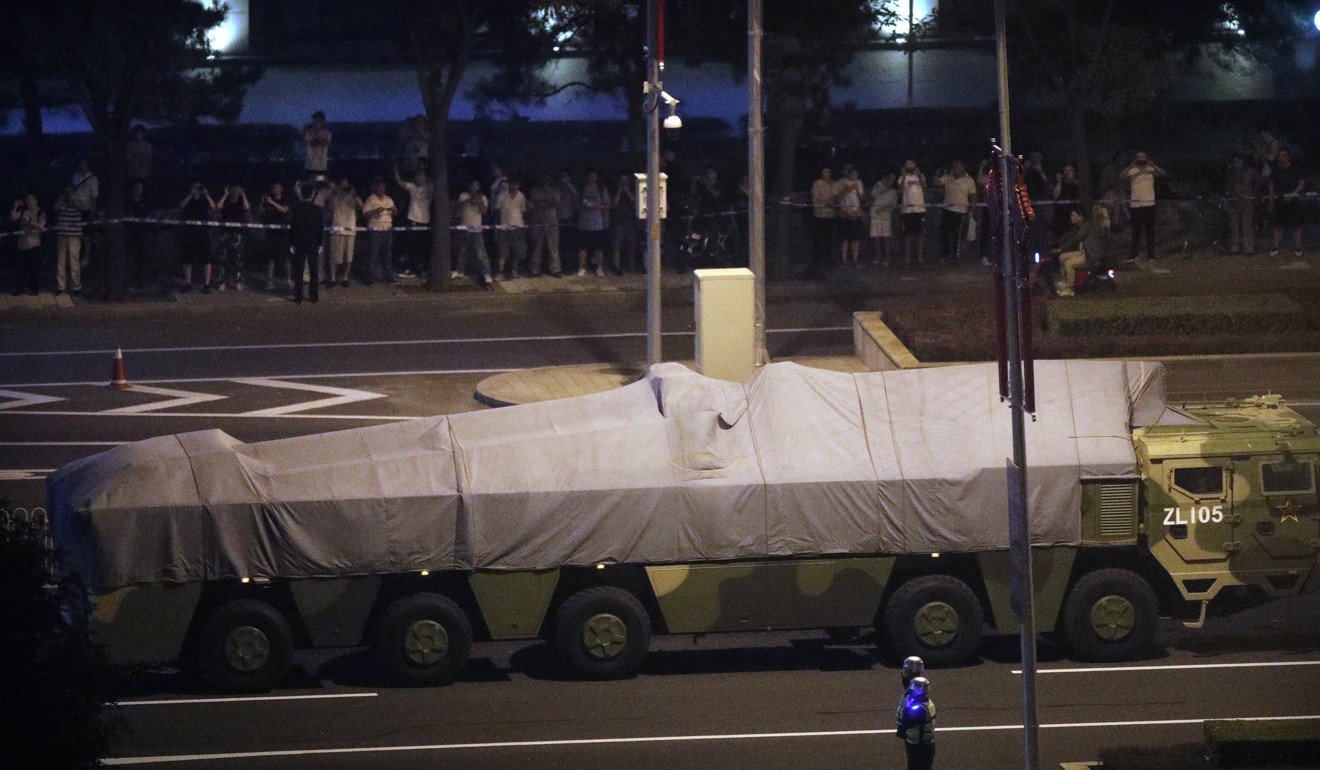
The DF-17 hypersonic ballistic missile will be one of the highlights of the parade. Photo: AP

The DF-41 is capable of carrying multiple warheads and many decoys, making it harder to detect than silo-based systems and better able to survive a first strike.

Ni said the DF-41 was China’s next-generation cutting-edge weapon.

“It’s actually an advanced ICBM and has a range to hit practically anywhere in the world, including the continental United States,” Ni said.

“The DF-41 is the ultimate symbol of the destructive potential of Chinese armed forces, just as nuclear weapons are similar symbols of the US and Russia.”

The JL-2 – which has a shorter range of 7,000km (4,350 miles) and can be launched by the PLA Navy’s Type 094 submarines – is unable to hit anywhere on the American continent when launched from submarines in the South China Sea and coastal areas of China.

China tests new warships in live-fire drills near Vietnam

However, China is developing the JL-3, which has a range of about 9,000km; the upgraded version of the JL-2, with a flight test conducted in June, though it is still less than the 12,000km range of the American Trident II.

“China is stepping up its military modernisation, which includes a number of aspects; the land-based aspect is introducing more mobile and survivable missile systems,” Ni said.

“The game change will happen when China is able to hit the whole US continent with its missile submarines in Chinese coastal waters.”

In military terms, survivable refers to the ability to remain mission capable after a single engagement.

The DF-17 is a land-to-land short-range strategic missile capable of delivering both nuclear and conventional payloads. The US intelligence community has estimated that it will reach initial operational capability by 2020. But if the missile is displayed in the parade, that means it is active already.

China conducted two tests of the DF-17 in November 2017, with the first launched from the Jiuquan Space Launch Centre in Inner Mongolia.
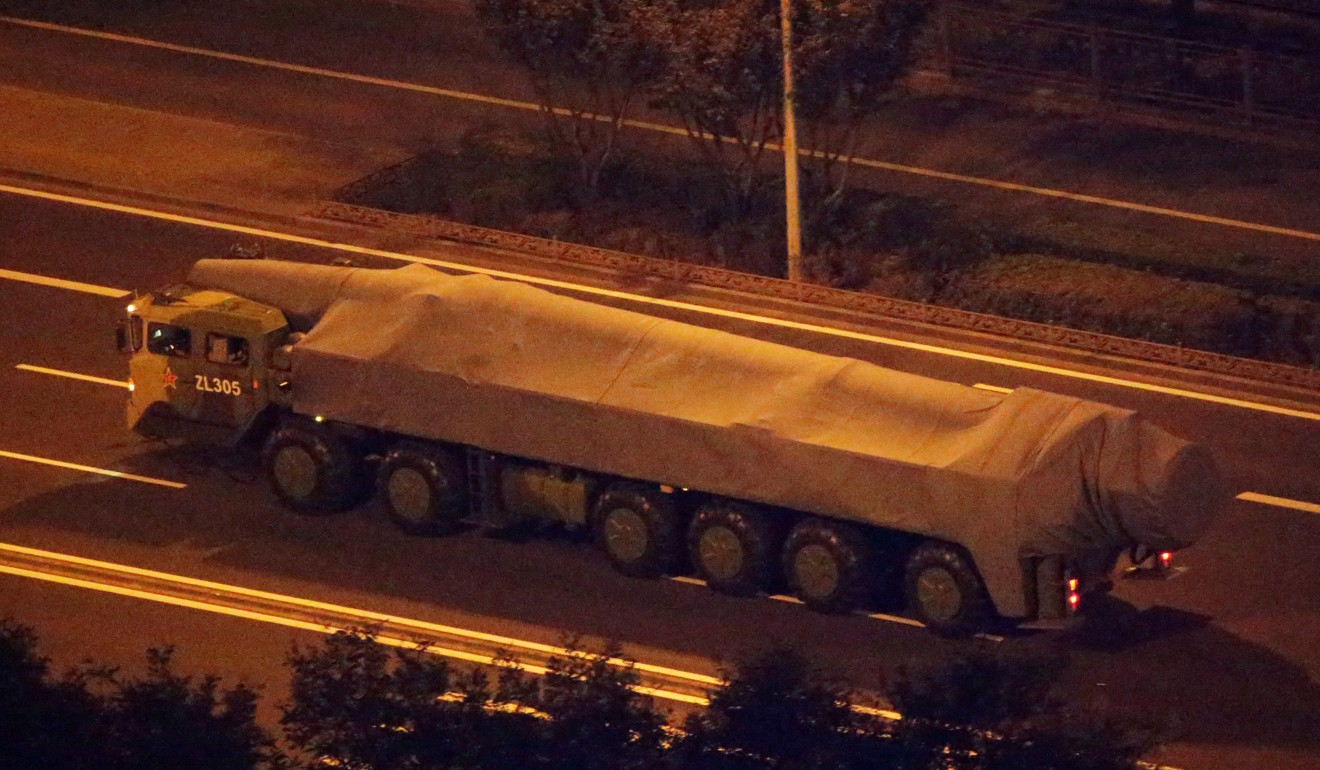
An insider said the main goal of this year’s parade is to promote the military modernisation of the PLA. Photo: Reuters

Hong Kong-based military commentator Song Zhongping said the nuclear weapons that would go on show in the parade would all be strategic missiles designed to improve China’s deterrent capabilities.

The show comes after the PLA delivered a national defence white paper in July stressing its goal to “maintain national strategic security by deterring other countries from using or threatening to use nuclear weapons against China”.

Unlike in the past, this year’s report stated that the US and China were now competing superpowers, and that the PLA’s growing forces were developing to the point that they could challenge the US.

Zhou Chenming, a Beijing-based military observer, said it was also necessary for the PLA to “show some of its muscle” amid the ongoing trade dispute between Beijing and Washington.

“To prevent misunderstanding, most of the weapons are just strategic equipment, not tactical arms, because Beijing still doesn’t want to irritate Washington,” he said.

About 280,000 people were involved in the rehearsals for the parade and related support services, according to Xinhua.

Source: SCMP
22/09/2019

China’s National Day parade to showcase advances in nuclear deterrence

  • Military experts say PLA modernisation brought about during Xi Jinping’s presidency will be the main focus of October 1 celebration in Beijing
  • It’s necessary for China to ‘show some of its muscle’ amid the trade dispute with the US, observer says
China’s land-based DF-41 intercontinental ballistic missile will be among the military hardware on show on October 1. Photo: Reuters

China plans to show off its most advanced active weapon systems at the upcoming National Day parade, which will be the biggest of the 14 such events it has held over the past seven decades.

The parade, to be held on October 1 to mark the 70th anniversary of the founding of the People’s Republic, will highlight the military modernisation – particularly in nuclear deterrence – that has taken place since President Xi Jinping came to power in late 2012, according to military experts.

The People’s Liberation Army (PLA) offered a glimpse of those weapons during rehearsals for the parade in downtown Beijing from September 14.

As part of the celebrations, Xi, who also chairs the Central Military Commission, will inspect 48 squads on the ground and more than a dozen airborne squadrons, according to a military insider involved in support services for the parade.

More than a dozen airborne squadrons will take part in the National Day parade. Photo: Kyodo

The squadrons will include the air force’s first stealth fighter, the J-20; the main active warplanes such as the J-10 and J-11B; and armed helicopters like the Z-20. However, the J-8 fighter jet would not appear this year, the source said, confirming that the first interceptor built in China has been formally retired.

“The ground march will be led by several hero forces from the five theatre commands, which is different from previous squads selected from the ground forces, air force and navy,” said the insider, who requested anonymity because of the sensitivity of the matter.

“The main goal of this year’s parade is to promote the military modernisation of the PLA under President Xi’s leadership over the past seven years, with the military overhaul being one of the key achievements.”

Thirty-three of the 48 squads would be “weapon squads”, while the 13 others would be made up of infantry troops from the five theatre commands, the source said.

National Day fireworks in Hong Kong cancelled over safety fears

As part of the PLA’s sweeping military reforms, the army’s previous seven military commands were reshaped into five theatre commands, while the four former general headquarters were dissolved and replaced by 15 small functional departments.

In September 2015, Xi announced the PLA would shed 300,000 troops, cutting its size to 2 million, a move aimed at turning the PLA into a more nimble and combat-ready fighting force on a par with international standards.

Xi also split the former Second Artillery Corps into the Rocket Force and the Strategic Support Force, with the latter backing up the military’s electronic warfare units in cyberspace and outer space.

Among the 33 weapon squads, the highlights are expected to be the PLA’s strategic nuclear missiles such as the Rocket Force’s land-based DF-41 intercontinental ballistic missile (ICBM), the DF-21D anti-ship ballistic missile, the DF-17 hypersonic missile and the sea-launched JL-2, or Big Wave-2.

Adam Ni, a researcher at Macquarie University in Australia, said that showing off different types of missiles on land and sea indicated that the PLA was improving its nuclear deterrence capabilities by perfecting a three-pronged military force structure, or the so-called nuclear triad.

The DF-17 hypersonic ballistic missile will be one of the highlights of the parade. Photo: AP

The DF-41 is capable of carrying multiple warheads and many decoys, making it harder to detect than silo-based systems and better able to survive a first strike.

Ni said the DF-41 was China’s next-generation cutting-edge weapon.

“It’s actually an advanced ICBM and has a range to hit practically anywhere in the world, including the continental United States,” Ni said.

“The DF-41 is the ultimate symbol of the destructive potential of Chinese armed forces, just as nuclear weapons are similar symbols of the US and Russia.”

The JL-2 – which has a shorter range of 7,000km (4,350 miles) and can be launched by the PLA Navy’s Type 094 submarines – is unable to hit anywhere on the American continent when launched from submarines in the South China Sea and coastal areas of China.

China tests new warships in live-fire drills near Vietnam
However, China is developing the JL-3, which has a range of about 9,000km; the upgraded version of the JL-2, with a flight test conducted in June, though it is still less than the 12,000km range of the American Trident II.
“China is stepping up its military modernisation, which includes a number of aspects; the land-based aspect is introducing more mobile and survivable missile systems,” Ni said.
“The game change will happen when China is able to hit the whole US continent with its missile submarines in Chinese coastal waters.”
In military terms, survivable refers to the ability to remain mission capable after a single engagement.
The DF-17 is a land-to-land short-range strategic missile capable of delivering both nuclear and conventional payloads. The US intelligence community has estimated that it will reach initial operational capability by 2020. But if the missile is displayed in the parade, that means it is active already.
China conducted two tests of the DF-17 in November 2017, with the first launched from the Jiuquan Space Launch Centre in Inner Mongolia.
An insider said the main goal of this year’s parade is to promote the military modernisation of the PLA. Photo: Reuters

Hong Kong-based military commentator Song Zhongping said the nuclear weapons that would go on show in the parade would all be strategic missiles designed to improve China’s deterrent capabilities.

The show comes after the PLA delivered a national defence white paper in July stressing its goal to “maintain national strategic security by deterring other countries from using or threatening to use nuclear weapons against China”.

Unlike in the past, this year’s report stated that the US and China were now competing superpowers, and that the PLA’s growing forces were developing to the point that they could challenge the US.

Zhou Chenming, a Beijing-based military observer, said it was also necessary for the PLA to “show some of its muscle” amid the ongoing trade dispute between Beijing and Washington.

“To prevent misunderstanding, most of the weapons are just strategic equipment, not tactical arms, because Beijing still doesn’t want to irritate Washington,” he said.

About 280,000 people were involved in the rehearsals for the parade and related support services, according to Xinhua.

Source: SCMP

17/06/2019

Are China and US racing towards inevitable military confrontation in outer space?

  • Beijing is still behind in terms of its space-based military capabilities, but the gap is closing fast, experts say
  • US law now prohibits Nasa from communicating with China’s space agency
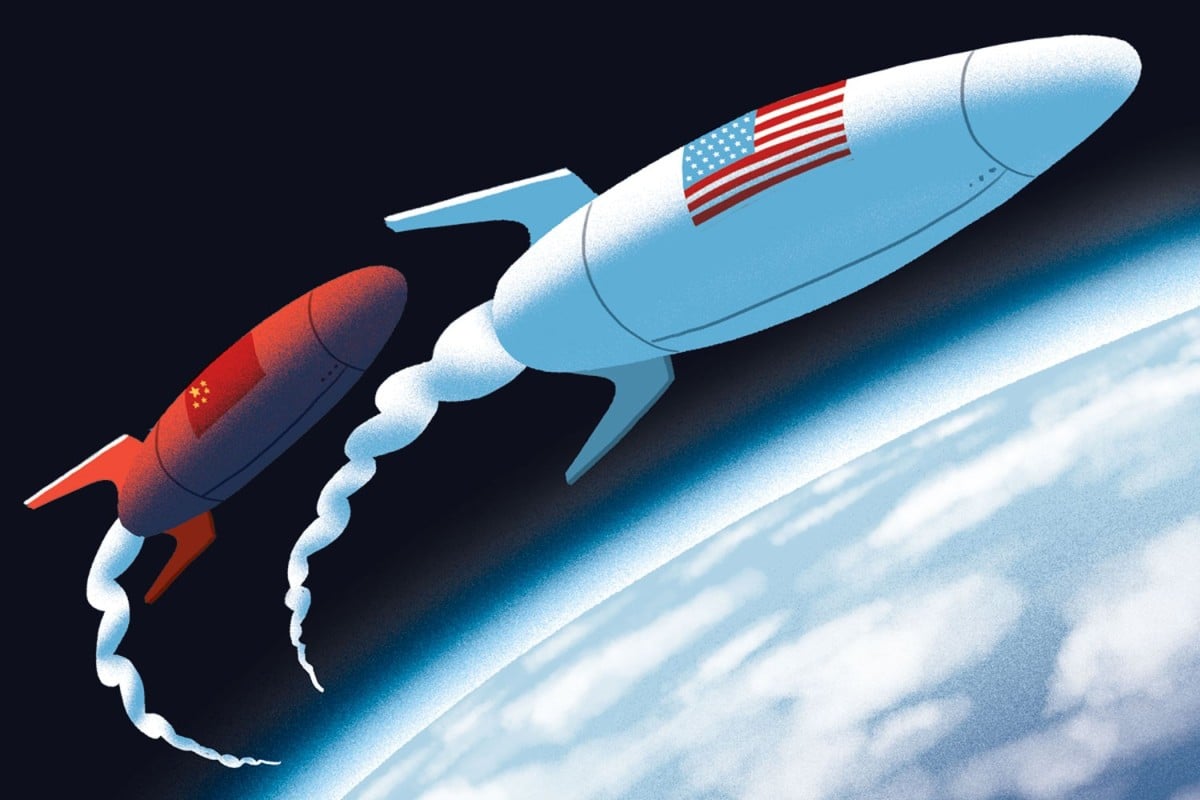
Illustration: Kaliz Lee

This story is part of an ongoing series on US-China relations produced jointly by the South China Morning Post and POLITICO, with reporting from Asia and the United States.

A top Chinese general has a warning for any US leaders planning an arms race in space: be prepared to lose.

Outspending a rival power into economic exhaustion might have helped the US win the cold war, said Qiao Liang, a major general in the Chinese air force who co-wrote the book Unrestricted Warfare: China’s Master Plan to Destroy America. But he said it would not work against a wealthy manufacturing powerhouse like China.

“China is not the Soviet Union,” Qiao said in an interview with the South China Morning Post, a news partner of POLITICO. “If the United States thinks it can also drag China into an arms race and take down China as it did with the Soviets … in the end, probably it would not be China who is down on the ground.”
Qiao’s words come as both Washington and Beijing are pouring money and resources into an increasingly militarised space race that some security specialists and former US officials fear is heightening the risk of war. The aggressive manoeuvres include US President Donald Trump’s proposal for a stand-alone 
Space Force

– which Qiao dismissed as “an unwise move” – and efforts by both countries to develop laser and cyber weapons that could take out each other’s satellites.

The rivalry is plainly on the minds of leaders at the Pentagon, which cites “space” 86 times in a new threat assessment of China’s military. It also warns that the People’s Liberation Army (PLA) is working on “enabling long-range precision strikes” and developing directed-energy weapons for use in orbit.
Sea launch rockets China to forefront of global space race

Trump, Vice-President Mike Pence and a slew of US military leaders have cited China’s military space programmes as a key rationale for proposing the Space Force, which would gather nearly all the defence department’s space-related programmes into a new military branch – similar to the one China created four years ago. Congress is considering the administration’s plan, although some defence hawks are sceptical.

Pence has also expressed alarm at China’s success in

landing uncrewed probes on the moon

, a place US astronauts last visited in 1972.

“Last December, China became the first nation to land on the far side of the moon and revealed their ambition to seize the lunar strategic high ground and become the world’s pre-eminent spacefaring nation,” Pence said at a meeting of the National Space Council in March.

China and the US are pouring money into an increasingly militarised space race that some observers fear is heightening the risk of war. Photo: Shutterstock

Even more worrying, neither country seems interested in placing the issue on the diplomatic agenda to lower the tensions, some security advocates say. That is in contrast to the decades of space cooperation that have existed between the US and Russia.

“One of my biggest concerns is that for all the talk about how horrible an armed conflict with China would be for everyone, all the current US policies and actions seem to be preparing for armed conflict instead of avoiding it,” said Brian Weeden, director of programme planning at the Secure World Foundation, which advocates for using space in a peaceful and sustainable way.

“There is not a lot of dialogue between the US and China,” he said.

But other space experts say China is a greater threat to the United States than most people realise – and even an “imminent threat”, according to independent analyst Namrata Goswami.

“If anything, it [the threat from China] is underappreciated and underplayed in the US,” she said. “I suspect that is because the US military might not want to call attention to its own vulnerabilities regarding its space assets.”

Chang’e 4 lunar probe sends first photo of far side of the moon

Qiao said China was not seeking a space war but was preparing to counter any nation, including the US, that sought to pose a threat to its national security.

China’s economic prowess left it well positioned to prevail in an expensive contest with the US, he said.

“When the United States and the Soviet Union engaged in the cold war and the arms race, the United States was the largest manufacturing country, and the Soviet Union was not even the second,” he said. “But today it is China who is the world’s top manufacturer.”

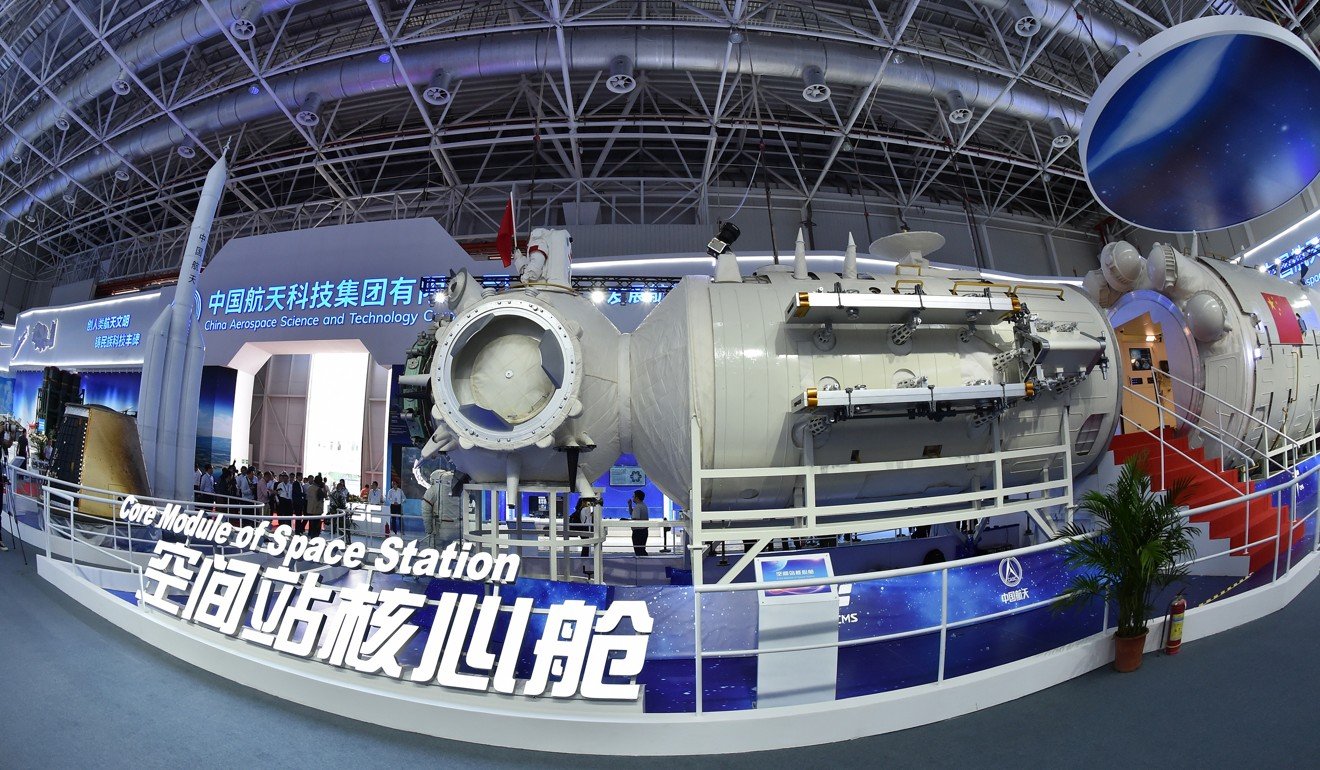
A full-size model of the core module of China’s space station goes on show at Airshow China in November. Photo: Xinhua

Recent reports from US spy agencies and think tanks indicate that China’s efforts are advancing quickly. Those include estimates that China will soon be able to field high-powered lasers designed to attack objects in low-Earth orbit – and evidence that its weapons can already attack targets much further from the Earth than the United States can.

China’s reliance on space assets is also expanding: it has more than 120 intelligence, surveillance and reconnaissance satellites of its own – second only to the United States.

About half of them are owned and operated by the military and could be used to track and target US forces around the world, the report warns.

Will China’s new laser satellite be ‘Death Star’ for submarines?

The threat getting the most attention is the danger China’s orbiting weapons might pose to the satellites the United States relies on for communications, navigation and surveillance – for both military operations and economic well-being.

China is heavily investing in so-called counterspace technology, including the development of at least three antisatellite missile systems, according to an April report from the Centre for Strategic and International Studies. It is also developing satellites that can make physical contact with other satellites in orbit, the report said.

While that technology can be used for repairs in orbit, it can also be used to disable a satellite or tear off a solar array to impact a satellite’s power source.

China is developing satellites that can make physical contact with other satellites in orbit. Photo: Xinhua

The Pentagon’s “China Military Power” report found that China is also pursuing new jamming and “directed energy” weapons that can interfere with satellites. In a conflict, that technology would probably be used to “blind and deafen the enemy”, the report said.

China also reorganised the PLA in 2015 to create a Strategic Support Force, a military branch dedicated entirely to space, electronic and cyberwarfare. The new branch was designed to bring space assets from across the military under one organisation, similar to the goal of the US Space Force.

The space-centric branch, which reports directly to the Central Military Commission, is focused primarily on satellite launches and intelligence, navigation and communication operations, but also conducts research and development on new counterspace capabilities, according to the US Defence Intelligence Agency report published in February.

China ‘has overtaken Russia’ as a maritime power

Chinese military units are also training with missiles that could damage or destroy satellites, the agency also reported in February, adding that China will probably have a ground-based laser that can blind optical sensors on satellites in low-Earth orbit by 2020.

Unlike the United States or Russia, China is also believed to have the capacity to use missiles to attack satellites in the more distant geosynchronous orbit, or 35,000km (22,000 miles) above Earth.

If any country were to launch a physical strike in geosynchronous orbit (GEO), the debris field would make the area, which is today used for critical missions like early missile warning and weather observations, unusable.

“We have much more to lose in GEO than any other country,” said Kaitlyn Johnson, an associate fellow who specialises in space security at the Centre for Strategic and International Studies. “We wouldn’t want to have a first strike capability.”

Chinese military units are training with missiles that could destroy satellites. Photo: Reuters

Military experts also worry that China could try to seize areas of the moon that contain strategic resources including ice that could be used for rocket fuel or life support.

But they say it is much more likely China will want to use dominance in space to influence conflicts on Earth. For instance, being able to threaten the military’s GPS or communications satellites might deter the US from getting involved in a conflict in the South China Sea, Weeden said.

The US Space Force is intended to close some of those gaps by grouping space assets together to build expertise and giving the new service autonomy over its budget requests. One of the biggest goals of the new branch is to speed up space acquisitions, allowing new technology to be fielded faster, and to develop a space “doctrine” that would oversee how the US fights conflicts when space platforms are at stake.

China adds new satellite to rival US global positioning system

The Chinese government insists that it is merely responding to aggressive US moves to dominate space militarily. Qiao called it “bullying and hegemonic” for the United States to insist that other countries cannot follow suit.

“The US space troops have long existed,” he said. “They just did not become an independent force … moreover, the US possessed anti-satellite capabilities as early as the 1970s and 1980s. China only developed anti-satellite capabilities at the end of the 1990s and even in the first decade of this century.”

China had little choice but to enhance its capabilities, he said.

“China’s purpose to develop space capabilities, firstly, is we do not want to be blackmailed by others,” Qiao said in the interview. “Second, we hope to use space peacefully. But if others want to oppress us by occupying the heights of space and opening up a ‘fourth battlefield’, China will certainly not accept it.”

Qiao Liang, a major general in the Chinese air force, says it is “bullying and hegemonic” for the United States to insist other countries cannot develop a space force. Photo: Handout

Still, China remained far from surpassing US dominance, he said. “We cannot overtake the US in the next decade or two, but we will narrow the gap in a comprehensive way. And it is possible we may take the lead in some individual areas.”

Weeden agreed.

“China is developing many of the same space capabilities the US did decades ago, while the US is focused on sustaining its capabilities and making them more resilient,” he said.

“On the whole, the US is still far more capable than China is but the relative advantage is narrowing.”

What is space junk and why is it a problem?

The two nations have some diplomatic channels through which they could cooperate in space, including the United Nations’ Committee on the Peaceful Uses of Outer Space, of which both are members. In 2015, the Obama administration established a dialogue with China on space safety, which is quietly continuing under Trump, although Weeden said the meetings were mostly high-level talks.

But the Wolf Amendment, which was first passed in a Congressional appropriations bill in 2011, forbids the US government from working with China and prohibits any bilateral cooperation between the China National Space Administration and the US National Aeronautics and Space Administration on national security grounds. And there is virtually no collaboration between the militaries of the two nations today.

To open the door for conversations that could ease tensions and avoid miscommunication, the US and China must “crawl before we walk”, Audrey Schaffer, the director of space strategy and plans at the defence department, said at a March event on US-China space relations hosted by the Secure World Foundation.

Some potential first steps include the two countries sharing information like their national defence strategies, providing launch notifications of space vehicles or opening routine, secure communications channels between diplomats. Each step would help build trust and transparency, Schaffer said, pointing to the strong relationship between the US and Russia in space as evidence that it could be done.

“Even then when the relationship was just as strained, if not more so, we did manage to work bilaterally and multilaterally with the Soviets to really create mechanisms that would help reduce the risks of conflict and enhance stability,” Schaffer said.

Source: SCMP

31/12/2018

Xinhua Headlines: China, EU on path of expanding cooperation in outer space

Source: Xinhua| 2018-12-30 14:58:41|Editor: Yamei
Xinhua Headlines: China, EU on path of expanding cooperation in outer space

People visit the booth of China Aerospace Science and Technology Corporation during the 69th International Astronautical Congress in Bremen, Germany on Oct. 1, 2018. (Xinhua/Lian Zhen)

by Xinhua writer Zhang Yirong

BERLIN, Dec. 30 (Xinhua) — China’s Chang’e-4 lunar probe was launched earlier this month, and it is expected to make the first-ever soft landing on the far side of the moon.

During the mission, China has cooperated with four other countries, three of which are from Europe, an epitome of the increasing space cooperation between China and the European Union (EU) in recent years.

CHANG’E-4 TO THE MOON

The Chang’e-4 mission will be a key step in revealing the mysterious far side of the moon, most of which remains unknown.

Germany’s scientific payload is a “Lunar Lander Neutron and Dosimetry” instrument, developed by Kiel University, which aims to measure radiation on the moon, mainly for future manned missions there, also the water content beneath the landing unit, said Robert Wimmer-Schweingruber, who is leading the research team.

Karl Bergquist, the European Space Agency’s (ESA) administrator for the International Relations Department, called the Chang’e-4 mission scientifically and technologically “very impressive,” because “no one has ever done it, this mission will therefore advance our knowledge of the moon.”

He also called the lunar mission “the first step towards future explorations farther afield.”

Stressing the difficulties of landing on the far side due to spacecraft controlling and signal relay, Wimmer-Schweingruber said that “the satellite is already in place. We’re orbiting the moon right now. It has worked well.”

Earlier, China has already launched a relay satellite “Queqiao,” tasked with transmitting signals between Chang’e-4 and ground control.

Scientific tasks for Chang’e-4 also include low-frequency radio astronomical observation, surveying the terrain and landforms, as well as detecting the mineral composition and shallow lunar surface structure, according to the China National Space Administration (CNSA).

COOPERATION OPPORTUNITIES

Wimmer-Schweingruber said he’s been working with his Chinese counterparts for nearly two decades, and praised China for its increasing cooperation with international partners.

Apart from Chang’e-4, China has offered and promised multiple opportunities for space cooperation with the EU and beyond recently.

At the International Astronautical Congress held this October in the German city of Bremen, Zhang Kejian, deputy minister of the Ministry of Industry and Information Technology of China, stressed China’s willingness to cooperate with other countries within the space program.

Zhang, who is also the head of the CNSA, noted that Chang’e-6, China’s second sample return lunar mission, will provide 10 kg of payloads on the orbiter and lander for international partners.

China also announced in Vienna this May that all member states of the United Nations (UN) are welcome to cooperate with China to jointly utilize its future China Space Station (CSS).

“The CSS belongs not only to China, but also to the world,” said Shi Zhongjun, China’s ambassador to the UN and other international organizations in Vienna.

The CSS, expected to be launched by 2019 and operational by 2022, will be the world’s first space station that is developed by a developing country and open for cooperation with all UN member states.

Jan Woerner, director general of the ESA, told Xinhua that the ESA welcomes more cooperation with China’s space program, and several European astronauts are now learning Chinese in preparation.

China and the EU signed an agreement in 2015 concerning cooperation in a manned space program, stipulating that the period from 2015 to 2017 was the stage of technological exchanges, and the two sides taking part in each other’s astronaut training programs.

Matthias Maurer, an ESA astronaut of German nationality, told Xinhua that he had studied Chinese for over six years.

After participating in a sea survival training program in waters off the coast of Yantai in east China’s Shandong Province, organized by the Astronaut Center of China in 2017, Maurer hopes to work with astronauts from China and other countries at the CSS.

WIN-WIN RESULTS

China’s achievements and openness in outer space explorations have been welcomed worldwide and are believed to produce win-win results.

China’s opening its CSS will reinforce international cooperation for the peaceful use of outer space, said Simonetta Di Pippo, director of the UN Office for Outer Space Affairs.

“China is currently the first contributor to our activities in terms of voluntary contributions. This is quite important. It’s a sign of the strong interest of China in collaborating with us, opening up to the entire world the possibility of utilizing your facilities,” said Di Pippo, who hoped to see more cooperation projects in the future.

Maurer viewed the cooperation between China and the EU as win-win. He said China has a lot of advantages such as its own rockets, capsules and a space station.

Europe, on the other hand, has abundant experience in long-duration missions in space “which can be brought into our cooperation to make it develop more efficiently,” Maurer said.

Wimmer-Schweingruber spoke highly of China’s openness, saying “to compensate the weakness of one country with the strength of another, that’s how we work scientifically.”

After collaborating on satellites that monitor earthquakes and their effects, “we now hope to collaborate more intensively on their new space station, that could offer us important flight opportunities for our astronauts, but also for the development of experiments and innovative technologies,” said Piero Benvenuti, commissioner of the Italian Space Agency.

Woerner said the ESA is also discussing using the Chinese manned spacecraft Shenzhou to send European astronauts into space in the future. “Although it is not on the agenda, it’s a possibility,” he said.

“We have worked with the Chinese side for over 25 years. For us Europeans, the exploration of the universe as well as major space science missions are domains in which we collaborate with all space powers: the United States, Russia, China and Japan,” Bergquist said.

“What’s important is to advance our knowledge, and if we can do it together, it’s preferable for everyone,” Bergquist added.

Law of Unintended Consequences

continuously updated blog about China & India

ChiaHou's Book Reviews

continuously updated blog about China & India

What's wrong with the world; and its economy

continuously updated blog about China & India