Chindia Alert: You’ll be Living in their World Very Soon
aims to alert you to the threats and opportunities that China and India present. China and India require serious attention; case of ‘hidden dragon and crouching tiger’.
Without this attention, governments, businesses and, indeed, individuals may find themselves at a great disadvantage sooner rather than later.
The POSTs (front webpages) are mainly 'cuttings' from reliable sources, updated continuously.
The PAGEs (see Tabs, above) attempt to make the information more meaningful by putting some structure to the information we have researched and assembled since 2006.
AirAsia X sells a quiet zone where children under 10 are not allowed, and Singapore-based Scoot has an ‘exclusive and silent’ section on its Boeing 787 Dreamliners barring kids under 12
Japan Airlines’ move, however, appears to be new and the first example of an airline showing where a child will be sitting on a map
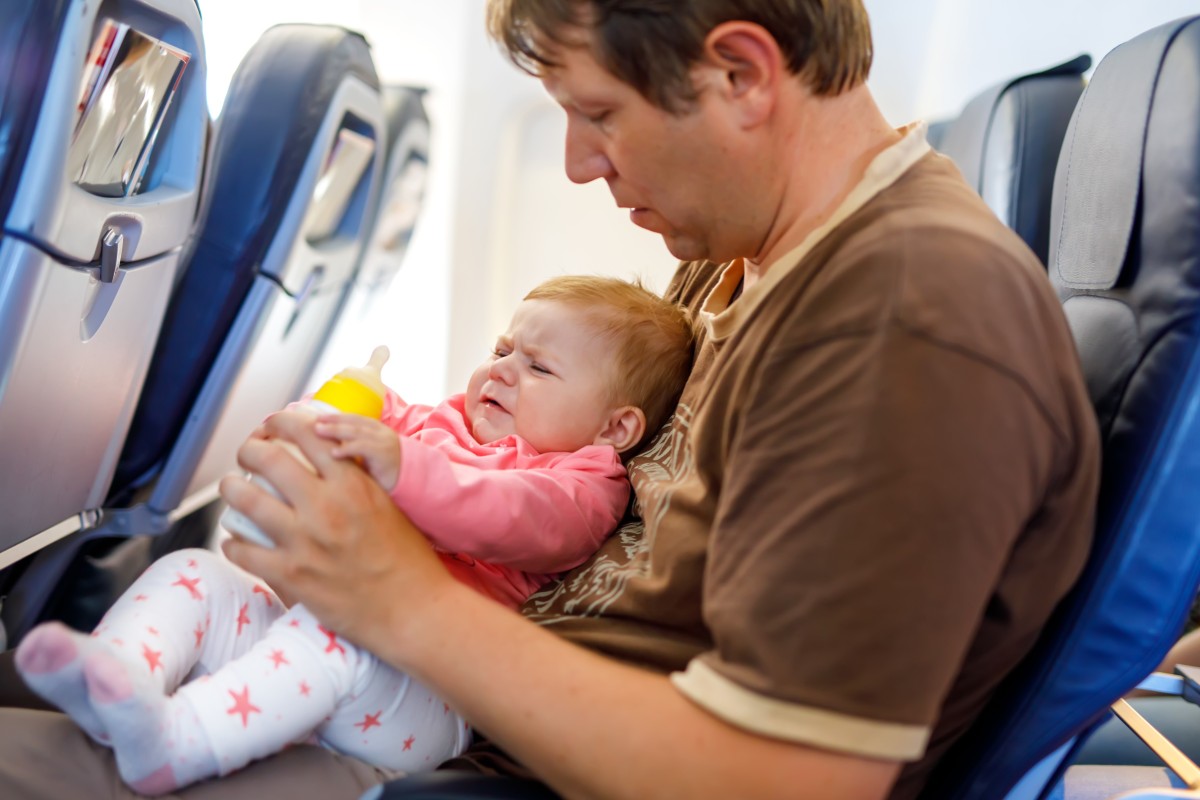
A father holds his daughter during a flight. Photo: Handout
Some travellers would prefer to avoid sitting near a baby when they fly. Now, Japan Airlines has introduced a baby map to help.
The airline notes on its website that when passengers who travel with young children – those between the age of eight days and two years – choose on the site where they want to sit, a “child icon” will be displayed on those spots on the seat selection screen.
“This lets other passengers know a child may be sitting there,” the website says on its “baby travel support service” section.
The feature came to light when traveller Rahat Ahmed took an image of the baby map and thanked the airline on Twitter. “This really ought to be mandatory across the board,” he wrote.
Rahat Ahmed@dequinix
Thank you, @JAL_Official_jp for warnings me about where babies plan to scream and yell during a 13 hour trip. This really ought to be mandatory across the board.
Please take note, @qatarairways: I had 3 screaming babies next to me on my JFK-DOH flight two weeks ago.
It’s unclear when the carrier introduced the feature. Japan Airlines has not responded to questions about the origin of the child icon or which flights it is used on. It is listed under domestic flights on the website, along with information about child seats, strollers, changing tables and blanket rentals.
The airline also warns that the icon will not be shown if seats are booked as part of a tour, using award tickets or by some method other than the airline’s website.
It remains to be seen whether any other airlines offer the same type of guidance: “It’s a new one for us, that’s for sure,” says Natalie Arney, spokeswoman for the online travel agency Alternative Airlines. “To have that when you’re booking just, like, blows you away, really.”
Her site offers a list of airlines that boast child-free zones, all of which are in Asia. They include the budget carriers AirAsia X, which sells a quiet zone where children under 10 are not allowed to sit, and Scoot, which advertises a “ScootinSilence” zone on its Boeing 787 Dreamliners. The Singapore-based carrier promises an “exclusive and silent cabin (no kids under 12 allowed here)” in the section.
This lets other passengers know a child may be sitting there … This really ought to be mandatory Rahat Ahmed
“It’s just being able to have somewhere quiet where you can sleep or where you can get on with your work and stay away from children,” Arney says.
Tracy Stewart, content editor of TripAdvisor’s family travel site Family Vacation Critic, said in an email that Japan Airlines’ move was new and the first example he’d seen of an airline showing where a child would be sitting on a map. He said quiet zones were not likely to become a global trend.
“You’ll likely never see something similar in the US for fear of backlash,” he said.
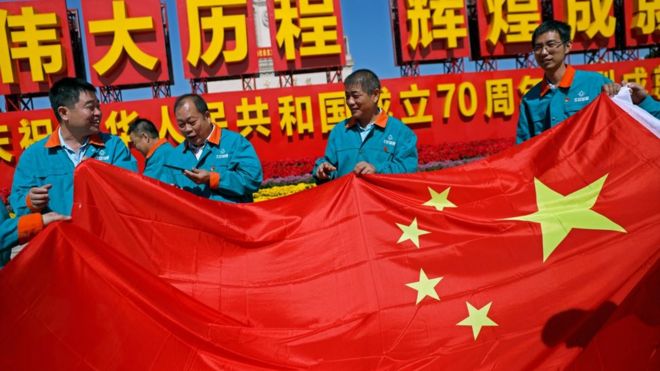
Image copyright EPAImage caption China is getting dressed up for its big birthday party
One week from now, the People’s Republic of China will mark its 70th anniversary with celebrations on a scale not seen in China in decades.
Beijing is pulling out all stops and 1 October will be flush with fireworks, fanfare and a huge military parade.
To ensure it goes smoothly, authorities have been ramping up security in the capital – and online – for weeks.
But with yet more protests expected in Hong Kong, the territory might just rain on China’s parade.
What is it all about?
The birth of modern China was declared on 1 October 1949, after the communists under Mao Zedong won the civil war that followed World War Two.
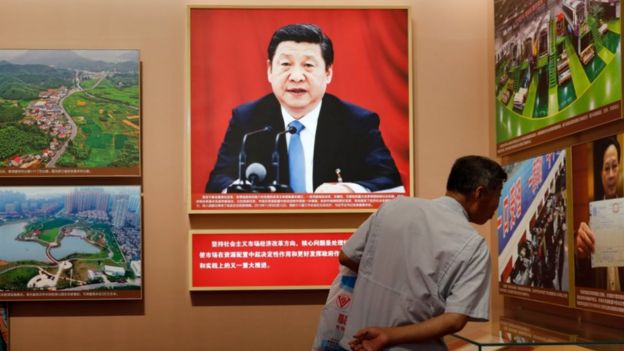
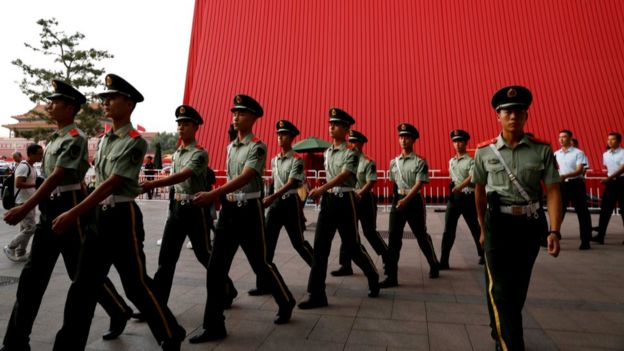
Image copyright EPAImage caption Exhibitions are highlighting the achievements of the Communist Party
The date is marked every year, but celebrations for this 70th anniversary are expected to eclipse previous events.
It’s the first big anniversary since China has emerged as a global power. While 10 years ago China was a superpower in the making, it is now the world’s second largest economy, almost eye-to-eye with the United States.
What to expect?
The main celebrations will take place in the capital, Beijing, where there will be a grand military parade with “advanced weapons” on display, followed by a “mass pageant”.
President Xi Jinping – considered the most powerful Chinese leader since Mao – will address the Chinese people. His speech is expected to celebrate China’s rapid growth and which will be closely watched for any indication of the country’s direction in the coming years.
The president will also hand out honours for contributions to the country and in the evening there will be a grand gala and fireworks show.
All official Chinese celebrations are carefully choreographed and the success of this one is particularly important to the government.
The Dos and Don’ts
The parade – open to invited guests only – will take place around Tiananmen Square in central Beijing. The surrounding area will be practically under lockdown, and in fact has been so several times already.
During rehearsals leading up to the big day, hotels near Tiananmen Square told guests that for several hours each day, no-one would be able to leave the hotel or return to it should they be out, leading to much travel chaos and rebookings.
Many shops and restaurants in the centre are also closed or have shortened hours and some subway stations are temporarily shut.
Image copyright EPAImage caption Security is tight ensure the party goes to plan
Trains to Beijing are running numerous safety checks on their passengers and vehicles going into the city are also being tightly watched.
On the big day itself, areas around Tiananmen Square will be blocked and guarded. Local residents will need to identify themselves if they want to pass.
To ensure the sun will shine brightly on the celebration in notoriously polluted Beijing, several coal plants and construction sites in and around the city have been ordered to stop work for the duration.
There’s also a ban on any low-flying aerial vehicles in place. That means anything from light aircraft to drones, balloons and even racing pigeons.
Censorship galore
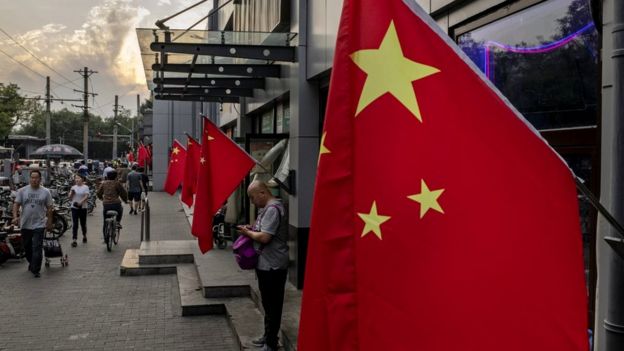
Across much of the city centre, there are national flags set up at every door. Voluntary inspectors are monitoring the streets and locals have told the BBC they’re being questioned after having even brief conversations with foreigners
One person said she was asked by an inspector: “Who were those foreigners? Why were they here?”
The tight control naturally extends online as well. Popular social media platform Weibo said it was deleting content that “distorts” or “insults” the country’s history ahead of the anniversary.
Image copyright GETTY IMAGESImage caption Every house and every shop is sporting a national flag
Chinese journalists are always expected to toe the party line anyway, but starting in October they will have to pass an extra test to prove they are versed particularly in Xi Jinping’s teachings, officially called Xi Jinping Thought on Socialism with Chinese Characteristics, which has been written into the constitution.
Whether or not they pass the exam will then determine whether they’ll be accredited as journalists.
“The fundamental point with this ‘training’ and indoctrination process isn’t so much about the content,” David Bandurski of China Media Watch told the BBC.
“It is about reinforcing the message and understanding among journalists that they work, first and foremost, for the Chinese Communist Party, and serve its agenda.”
So not only will the events be choreographed – the domestic coverage of them will also be tightly guarded.
What about Hong Kong?
Despite Beijing’s determination to let its achievements shine on 1 October, there’s a good chance Hong Kong will pull focus.
Anti-Beijing protests always take place in Hong Kong on China’s National Day, but this time, the activists know that the world is watching.
Anti-government protests have rocked the city for months and the situation shows no sign of dying down.
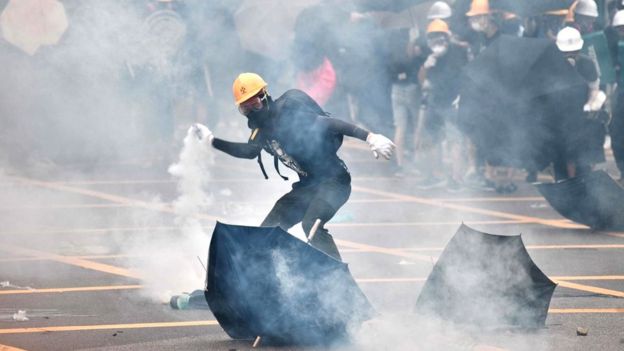
Clashes between police and activists have been becoming increasingly violent, with police using tear gas and activists storming parliament.
Image copyright AFPImage caption The protests have often escalated into violent clashes
That means two things for 1 October: official celebrations in the territory are being toned down to avoid clashes – the annual fireworks display has been cancelled – while at the same time, activists are planning to step up their protests.
On Sunday 29 September, a “Global Anti Totalitarianism March” is scheduled to take place at various locations around the world in support of Hong Kong.
On 1 October itself, a march in central Hong Kong is planned with everyone asked to wear black.
If the past weeks’ demonstrations are anything to go by, the smiles and celebrations in Beijing will be competing for media space with pictures of tear gas and angry young protesters in Hong Kong.
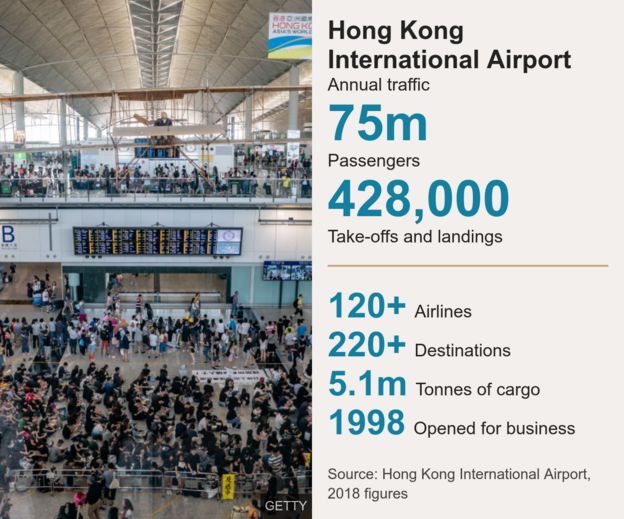
HONG KONG, Aug. 14 (Xinhua) — The Hong Kong International Airport started to resume operation on Wednesday after chaos and flight cancellations caused by protesters.
Passengers are now able to conduct check-in procedures after tickets or purchase vouchers are checked by airport staff. A demonstration area has been marked out at the arrival hall.
Airport Authority Hong Kong said earlier Wednesday that it has obtained an interim injunction to restrain persons from unlawfully and willfully obstructing or interfering with the proper use of the airport.
The authority emphasized that persons are also restrained from attending or participating in any demonstration or protest or public order event in the airport other than in the area designated by the airport authority.
The interim injunction expressly provides that nothing in the interim injunction shall be construed as authorizing any demonstration, protest or public order event contrary to the Public Order Ordinance.
Many of the passengers, who have their flights delayed or changed, are still waiting at the airport for confirmation of their departure time.
“It was totally chaos last night and those people in black were everywhere. We were very scared,” said Maria, a passenger from the Philippines. “I just hope we can fly on time today.”
“I’m very angry. Some of the protesters said they were sorry but I think they were just having fun here, obstructing us,” said Pia from Germany. “I can’t believe this could be happening in the 21st century.”
“I only wish I can leave Hong Kong safely and go back home,” she said.
As one of the busiest in the world, the Hong Kong International Airport handled an average of 200,000 travelers each day in 2018.
Frank Chan, secretary for transport and housing of the Hong Kong Special Administrative Region government, said paralyzing the airport will make Hong Kong “pay a heavy price.”
“Amid fierce regional competition, it is very easy to destroy years of achievements the airport has accomplished, but rebuilding them will be very hard,” Chan said.
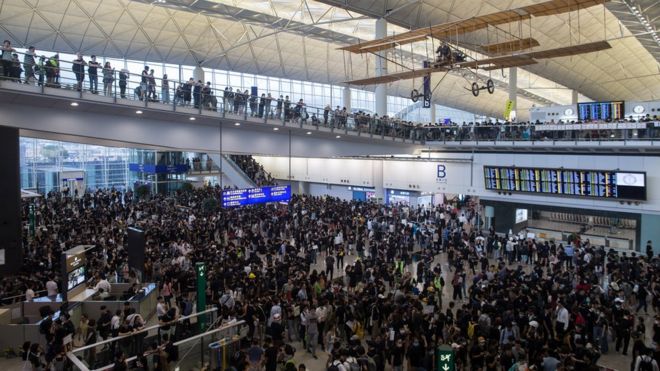
Image copyright EPAImage caption Officials say about 5,000 gathered for the fourth day of protests at the airport
Hong Kong International Airport cancelled all departures on Monday, as thousands of anti-government protesters occupied and caused disruption.
Passengers have been told not to travel to the airport, which is one of the world’s busiest transport hubs.
In a statement, officials blamed “seriously disrupted” operations.
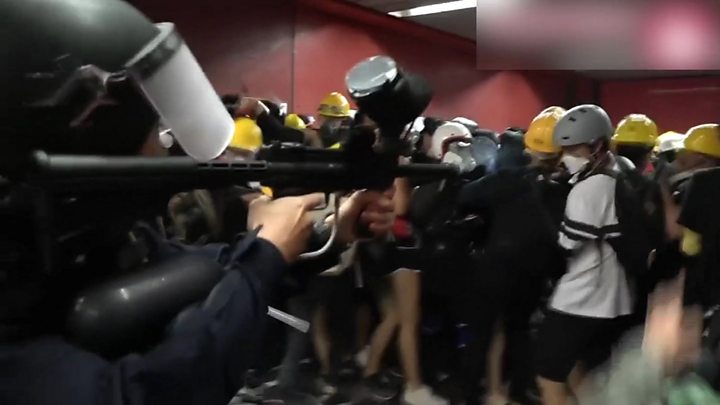
Many of those protesting are critical of the actions of police, who on Sunday were filmed firing tear gas and rubber bullets at close range.
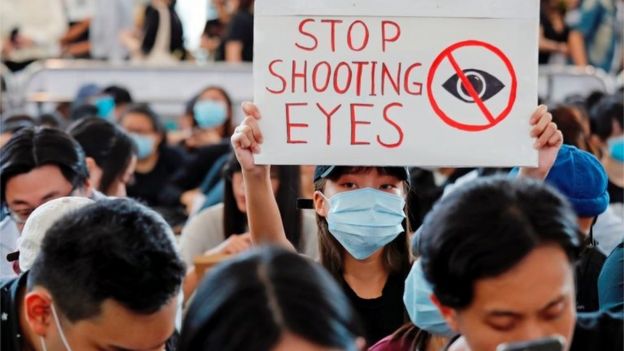
Some protesters wore bandages over their eyes in response to images of a woman bleeding heavily from her eye on Sunday, having reportedly been shot by a police projectile.
In a statement on Monday afternoon, Hong Kong’s Airport Authority said they were cancelling all flights that were not yet checked in.
More than 160 flights scheduled to leave after 18:00 local time (10:00 GMT) will now not depart.
Arrivals already heading into Hong Kong will still be allowed to land, but other scheduled flights have been cancelled.
Officials are now working to reopen the airport by 06:00 on Tuesday, a statement said.
Some passengers expressed annoyance at the disruption. “It’s very frustrating and scary for some people,” one man from Pakistan told the BBC. “We’ll just have to wait for our next flight.”
Helena Morgan, from the UK, said she was set to return to the UK to get her exam results on Thursday. “I’m hoping we get back for them and we’re not on a flight,” she said.
But others were more understanding of the protests. “I was expecting something, given all the news,” one arrival, Gurinda Singh, told Reuters news agency.
As rumours spread that police plan to move in on protesters on Monday evening, thousands opted to leave on foot. There are large backlogs for transport back into the centre, local reports say.
The BBC’s Stephen McDonell, who is at the scene, says the airport has effectively shut down while authorities work out how to deal with the crisis.
Hong Kong’s mass demonstrations and unrest show no sign of abating, more than two months after they were sparked by a controversial extradition bill.
Beijing officials have strongly condemned Sunday’s violence and linked violent protesters to “terrorism”.
Image copyright REUTERSImage caption Many of those who gathered carried signs condemning police conduct
What happened on Sunday?
On Sunday afternoon, a peaceful rally in the city’s Victoria Park led to clashes when protesters moved out of the area and marched along a major road despite a police ban.
There were confrontations in several central districts and police used rubber bullets in an attempt to disperse the demonstrators.
In the bustling central Wan Chai district, petrol bombs and bricks were thrown at police, who responded by charging at protesters.
A number of people, including a police officer, were injured in the clashes.
Videos on social media also showed officers storming enclosed railway stations and firing tear gas.
Footage inside another station showed officers firing what appeared to be rubber bullets at close range and several police officers beating people with batons.
Media caption Violence erupts in HK train stations
Local media outlets reported that suspected undercover police officers had dressed-up as protesters to make surprise arrests.
While protests in the city have turned increasingly violent, there were no reports of arrests during the three previous days of the airport sit-in.
What has the reaction been?
On Monday the Chinese authorities, who have not yet physically intervened to quell the unrest, used their strongest language yet to condemn violent protesters.
“Hong Kong’s radical demonstrators have repeatedly used extremely dangerous tools to attack police officers, which already constitutes a serious violent crime, and also shows the first signs of terrorism emerging,” Yang Guang, a spokesman for the Hong Kong and Macau Affairs Office (HKMAO), said at a press briefing.
“This wantonly tramples on Hong Kong’s rule of law and social order.”
Demonstrations started in June in opposition to a proposed extradition bill, which would have allowed suspected criminals to be sent to mainland China for trial.
Critics said it would undermine Hong Kong’s legal freedoms, and could be used to silence political dissidents.
Although the government has now suspended the bill, demonstrators want it to be fully withdrawn.
Their demands have broadened to include calls for an independent inquiry into alleged police brutality, and an amnesty for all arrested protesters.
Hong Kong is part of China but its citizens have more autonomy than those on the mainland.
It has a free press and judicial independence under the so-called “one country, two systems” approach – freedoms which activists fear are being increasingly eroded.
National outrage sparked when high-profile traveller Li Yaling shares details of incident on social media
Employee on long-term sick leave disrupts flight to Beijing but airline says she is a private traveller
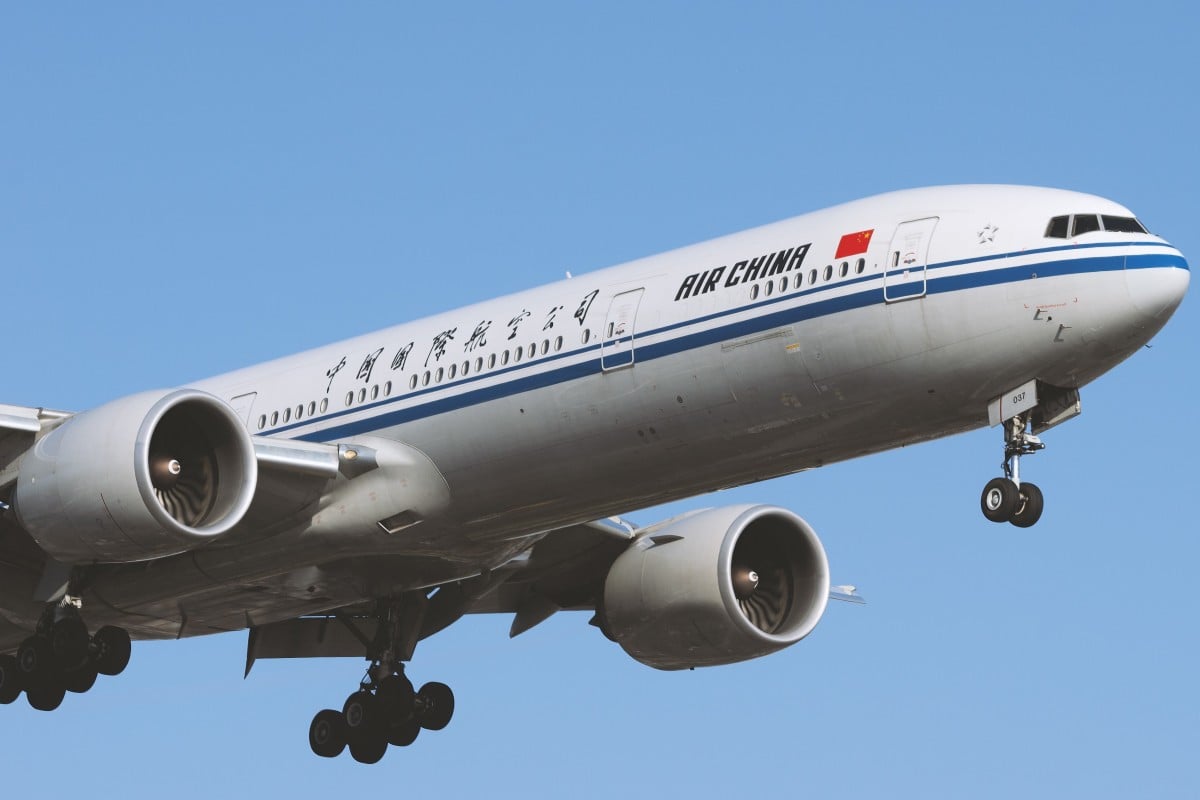
Air China has flown into an internet storm after a flight attendant on long-term sick leave scolded business class passengers. Photo: Shutterstock
National flag carrier Air China has come under fire after an employee made a scene during a flight and accused three business class passengers of attacking her, leading to them being held and questioned for seven hours last Friday after their arrival in Beijing.
Playwright Li Yaling, who was travelling business class on flight CA4107 from Chengdu uploaded a video and lengthy post detailing the incident to her nearly 1.3 million followers on Weibo, China’s Twitter-like microblogging platform.
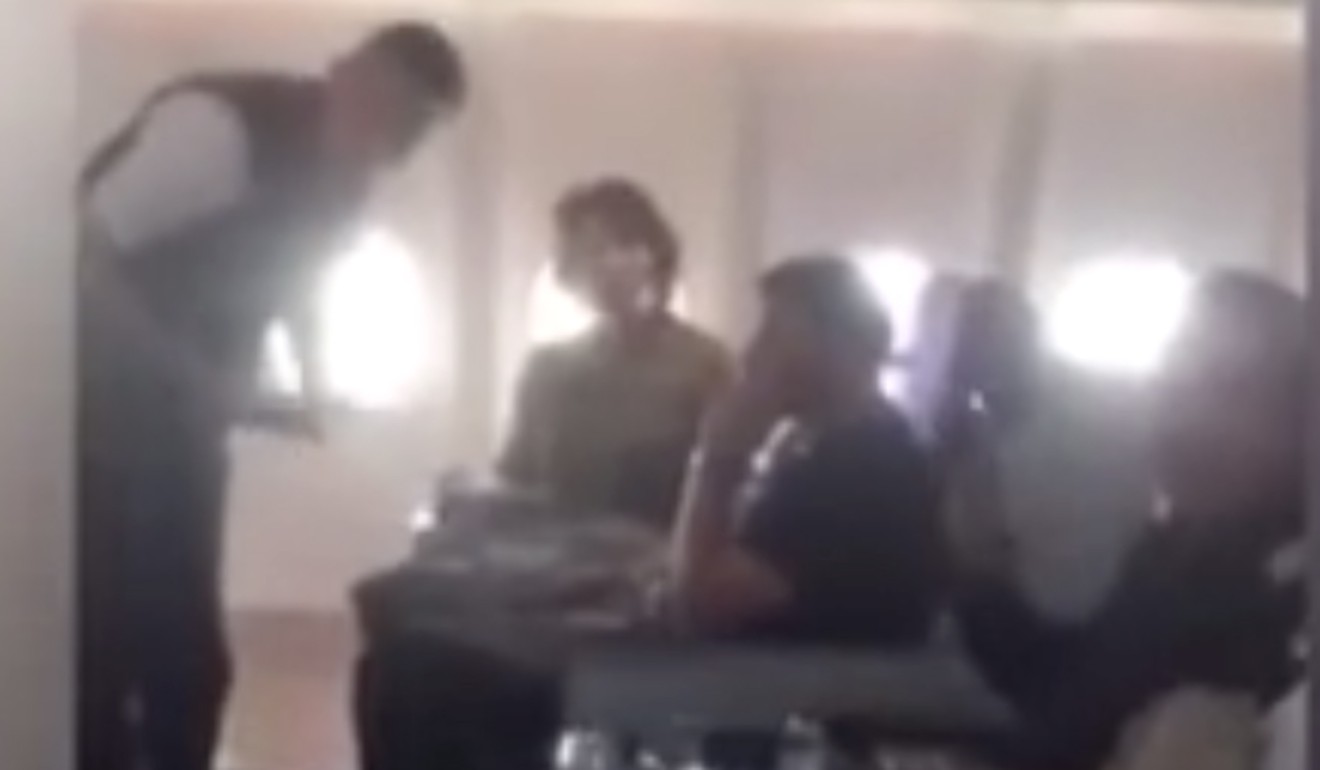
Li’s video showed a female passenger, who claimed to be an Air China supervisor, scolding passengers for using their phones while the plane was on the runway at Chengdu, capital of Sichuan province, southwest China.
The scolding lasted half an hour, according to Li, even after the passengers stopped using their phones and explained they had been switched to flight mode. Air China permits smartphones in flight mode to be used during its flights.
A screenshot of the video filmed during the Air China flight, and later posted to Weibo, of the incident in business class. Photo: Weibo
The woman paced about the cabin as the plane taxied down the runway and continued to make a scene until the flight approached Beijing. She was seen making a call, asking for the police to be notified that the passengers had “attacked” her and “endangered aviation safety” and to come and take them away.
The passengers were stopped by the crew and removed by the police, who took them to the airport police station where they were held for seven hours before being released with a warning, according to Li’s post.
“I want to ask Air China what the position of the Air China supervisor is,” Li wrote on Weibo. “Is she independent or your employee? What legal rights does she have? Has she abused her power, if any?”
Li’s post shocked internet users who reacted with sympathy. Some posted video clips or their own accounts of the same woman making similar false accusations on buses, subway trains and other flights, leading to similar problems for individual passengers, as well as travel delays.
Li later said on Weibo she was contacted by the airline on Saturday afternoon and told the woman was a former flight attendant who had been on sick leave since pouring hot water on a passenger more than 10 years before and had subsequently been diagnosed with bipolar disorder.
Unlucky coin toss lands another Chinese airline passenger in trouble
In a public statement on Monday, Air China said the dispute had involved an employee who was on leave for health reasons and had been on a private trip. The airline said three passengers and four crew members had been taken to the airport police station to help with an investigation into the incident.
Li followed up her Weibo posting on Monday, meeting several senior officials at Air China’s headquarters, where she was told the situation was a dispute between passengers and the airline had fulfilled its responsibilities.
Air China said it could not stop the employee from boarding its flights.
Li said she felt sympathy for mental health patients but not for the woman, who she said had apparently endangered public safety on flights several times. Li also demanded compensation for paying a high price to travel in business class, only to suffer two hours of verbal abuse.
Rush to emergency exit lands Chinese first-time flier in detention
The situation angered many on social media, who felt the airline had not taken enough responsibility for the incident. Some said they would not choose Air China again.
“The incident is not about passengers switching off their phones, it is about how your airline’s employee caused a row in business class,” one Weibo user wrote.
“This is a serious threat to flight order and safety, yet Air China can’t handle it. I will not consider flying with Air China again. Safety comes first after all,” said another.
Online news portal Ifeng.com ran a survey on the incident, with nearly 88 per cent of the 160,000 who took part agreeing that the airline should take responsibility for the incident. A total of 84 per cent said Air China had mishandled the incident and some 58 per cent said they would consider other carriers ahead of Air China in future.
Influential party newspaper People’s Daily also weighed in, criticising the airline for evading the crucial point in its public statement posted to Weibo on Monday night.
“The public does not question the significance of caring for patients with special diseases, but showing humane care does not mean inaction and to maintain the company image does not [mean] blindly protecting its employee,” the newspaper said.
“After all, the travel rights of all passengers and public safety are more important.”
Article 34 of China’s civil aviation rules for domestic transportation of passengers and baggage stipulates mentally ill patients or passengers whose health conditions may endanger themselves or affect the safety of other passengers shall not be carried.
However, in the eyes of the psychiatric profession mental health patients have the same right to fly as anyone else, as long as they are not posing any threat to others.
“The law on mental health protects some basic rights of mental patients and they are entitled to all rights of citizens, as long as they are not in an acute onset of mental illness,” said Ye Minjie vice-president of Kangning Hospital, which is affiliated to Wenzhou Medical University
“We can’t treat them as if they were secondary citizens or deprive them of basic rights just because they have had episodes before,” he said.
BEIJING, July 8 (Xinhua) — China’s high-speed railway (HSR) has registered rapid growth and offered many viable practices for other countries considering HSR investment, according to a World Bank report released Monday.
Key factors enabling the growth include the development of a comprehensive long-term plan and the standardization of designs and procedures, said the report, which summarizes China’s HSR development.
China’s Medium- and Long-Term Railway Plan, which looks up to 15 years ahead, provides a clear framework for the development of the system, according to the World Bank.
Meanwhile, the construction cost of the Chinese HSR network stood at about two-thirds of the cost in other countries, the report said, citing an average of 17 million U. S. dollars to 21 million U. S. dollars per km.
“China has built the largest high-speed rail network in the world. The impacts go well beyond the railway sector and include changed patterns of urban development, increases in tourism, and promotion of regional economic growth,” said Martin Raiser, World Bank director of China.
By the end of 2018, the total railway operation mileage reached 131,000 km, five times higher than 1949, while the high-speed railway exceeded 29,000 km, accounting for more than 60 percent of the world’s total, according to a recent report by the National Bureau of Statistics.
In China, high-speed rail service is competitive with road and air transport for distances of up to about 1,200 km, while fares are about one-fourth the base fares in other countries, which allows HSR trains to attract passengers from all income groups, the report said.
“Large numbers of people are now able to travel more easily and reliably than ever before, and the network has laid the groundwork for future reductions in greenhouse gas emissions,” Raiser said.
GUANGZHOU, Feb. 11 (Xinhua) — China Southern Airlines (China Southern), the country’s largest air carrier, has transported more than 2.1 million passengers during the week-long Spring Festival holiday from Feb. 4 to 10, said the airline Monday.
The airline has provided air services to a total of seven million passengers since the start of this year’s Chinese Lunar New Year travel rush on Jan. 21, according to China Southern.
It represented an eight percent increase comparing with the figure over the same period in 2018. Meanwhile, the airline has also seen ten percent increases of passengers on its regional and international routes.
Guangzhou-based China Southern operates a fleet of about 840 airplanes, ranking the first in Asia and third worldwide. It is China’s largest air carrier with the largest passenger volume and air route network.
Traveling by air has become a major trip mode of Chinese thanks to expanding route networks and continuous rising household income.
A total of 12.59 million air passenger trips were made during the week-long holiday, up 10.6 percent from last year’s holiday, said statistics from Civil Aviation Administration of China (CAAC).
China is now the world’s second-largest civil aviation market. It is expected to become the largest by mid-2020s, according to the latest forecasts by the International Air Transport Association (IATA).


 Rahat Ahmed@dequinix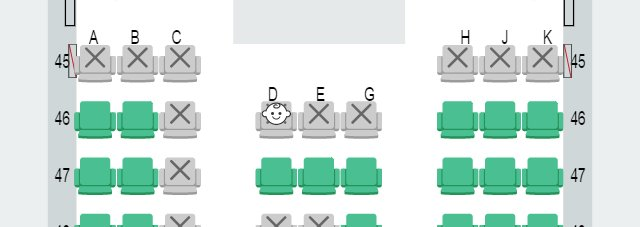

 CHINDIA ALERT: You'll be living in their world, very soon