Archive for ‘peace’

22/12/2019

North Korea threat looms as China, Japan, South Korea leaders meet

BEIJING (Reuters) – The spectre of new confrontation between Pyongyang and Washington hangs over meetings between China, Japan and South Korea this week, with growing risks North Korean actions could end an uneasy detente and upend recent diplomatic efforts.

South Korean President Moon Jae-in and Japanese Prime Minister Shinzo Abe are expected to meet Chinese President Xi Jinping separately on Monday. They will then travel to the southwestern city of Chengdu for a trilateral meeting with Chinese Premier Li Keqiang. Though they are expected to discuss various economic matters, North Korea appears likely to dominate the agenda.

Pyongyang has grown increasingly frustrated that its halt of nuclear and long-range missile tests has not ended the crippling economic sanctions against it. It set a Dec. 31 deadline for the United States to make concessions, but Washington has been unmoved.

Some experts believe North Korea may be readying to test an intercontinental ballistic missile launch soon, which would likely end the 2018 agreement struck by its leader, Kim Jong Un, and U.S. President Donald Trump.

“Safeguarding the stability and peace of the Korean Peninsula and pushing for a political solution to the Korean Peninsula issue are in the interests of China, Japan and South Korea,” Chinese Vice Foreign Minister Luo Zhaohui told reporters on Thursday at a briefing on the trilateral meetings.

U.S. special envoy for North Korea Stephen Biegun met with two senior Chinese diplomats during his two-day visit to Beijing this week, following similar meeting in South Korea and Japan days earlier, as diplomats make last-ditch attempts to prevent new confrontation.

North Korea has not responded to his public call to resume dialogue, however.

“The silence, even after Biegun’s speech in Seoul, makes me concerned,” Jenny Town, managing editor at the North Korea monitoring website 38 North, said on Twitter.

Beijing, jointly with Russia, proposed on Monday that the United Nations Security Council lift some sanctions in what it calls an attempt to break the current deadlock and seeks to build support. But it’s unclear whether Beijing can convince Seoul and Tokyo to break ranks from Washington, which has made its opposition clear and can veto any resolution.

Though South Korea sees China as instrumental in reviving negotiations, it has so far sidestepped questions on whether it supports the new proposal by Beijing and Moscow. Japan, which has historically been a staunch supporter of sanctions against North Korea, has also refrained from commenting on the proposal.

“With the (2020 Tokyo) Olympics coming up, North Korea going wild would pose a problem for Japan,” said Narushige Michishita, professor at Japan’s National Graduate Institute for Policy Studies.

“But bilateral talks with North Korea, for example, will probably be a better approach for Japan than easing UN sanctions.”

Source: Reuters

26/11/2019

China, Japan agree to further improve ties, strengthen people-to-people exchanges

JAPAN-TOKYO-CHINA-WANG YI-SHINZO ABE-MEETING

Japanese Prime Minister Shinzo Abe meets with Chinese State Councilor and Foreign Minister Wang Yi in Tokyo, Japan, Nov. 25, 2019. (Xinhua/Du Xiaoyi)

TOKYO, Nov. 25 (Xinhua) — Japanese Prime Minister Shinzo Abe and Chinese State Councilor and Foreign Minister Wang Yi on Monday agreed that both sides should work together to further improve bilateral ties and strengthen people-to-people exchanges.

Japan and China have witnessed frequent high-level exchanges and positive progress in the improvement of bilateral relations recently, said Abe, adding that the Japanese side is eagerly looking forward to Chinese President Xi Jinping’s state visit next spring and believes that it will be a major opportunity for promoting bilateral relations in the new era.

A stable Japan-China relationship is the cornerstone of peace and prosperity in Asia, and is also crucial to addressing current global challenges. Japan is ready to work with China to usher in a new future of bilateral relations, he said.

Japan welcomes the launch of the high-level consultation mechanism on people-to-people exchanges between the two countries and stands ready to work with China to continuously boost the affinity between the two peoples and properly handle sensitive differences so as to create a favorable atmosphere and conditions for the improvement and development of bilateral relations, he added.

Abe also said he is looking forward to further in-depth communication with Chinese leaders on bilateral ties during his visit to China next month to attend the China-Japan-ROK (Republic of Korea) leaders’ meeting.

Wang, for his part, said that with the political guidance of the two leaders and joint efforts of both sides, China-Japan relations have returned to the right track and have seen a sound momentum of improvement and development. The top leaders of the two countries had a successful meeting in Osaka in June and reached important consensus on building bilateral relations that meet the requirements of the new era.

The China-Japan relations have gone through twists and turns and the present situation has not come easily and should be doubly cherished, Wang said.

The two sides should push for continuous improvement and development of China-Japan relations from a longer-term and broader perspective, he said.

He called on the Japanese side to meet China halfway, take more positive actions, properly manage and handle differences so as to create a favorable atmosphere and conditions for the proposed major political and diplomatic agenda of the two countries.

The improvement and development of China-Japan relations not only conform to the interests of the two countries and peoples but also has great positive significance to regional peace and stability, injecting stability into the current world situation which is full of uncertainty, said Wang.

The Chinese side welcomes Abe to attend the China-Japan-ROK leaders’ meeting in China next month. China is willing to work with Japan to give full play to the role of the high-level consultation mechanism on people-to-people exchanges, usher in a new era of exchanges between our peoples, localities and youth, and create a brighter future for bilateral relations, he said.

Source: Xinhua

28/10/2019

Military World Games of “historic” and “peace” close in Wuhan

(SP)CHINA-WUHAN-7TH MILITARY WORLD GAMES-CLOSING CEREMONY

Xu Qiliang, president of the 2019 Military World Games organizing committee and also vice chairman of China’s Central Military Commission, declares the 7th CISM Military World Games close during the closing ceremony of the Games in Wuhan, capital of central China’s Hubei Province, Oct. 27, 2019. (Xinhua/Xiao Yijiu)

WUHAN, Oct. 27 (Xinhua) — Xu Qiliang, president of the 2019 Military World Games organizing committee, also vice chairman of China’s Central Military Commission, declared the Games close on Sunday in Wuhan, central China, to wrap up the biggest ever “Olympics for the military”.

Chinese Vice Premier Sun Chunlan, also president of the Wuhan Military World Games organizing committee, thinks highly of the organization of the Games and the performances of worldwide athletes.

“We have experienced a successful, wonderful and unforgettable military games in the lastest 10 days. This is a military gala of sharing friendship and safeguarding peace,” said Sun at the closing ceremony.

“This Games have showcased the spirits of the military personnel, which uphold perseverance, challenging limits and striving for better. This Games are full of wonders and achievements and are set to leave China’s marks in its history,” she added.

According to Sun, seven world records had been set and 85 International Military Sports Commission (CISM) affiliated records had been broken here in the tournament, as athletes rated it as a high-level international event, which featured 67 Olympic and world champions.

After 10-day competitions, host China collected 133 golds and 239 medals in total, the first time for a country to grab 100 plus golds. The traditional powerhouse Russia obtained 51 golds and 161 medals in all as an evident runner-up in medal tally, followed by Brazil, the host for 2011 Games, with 21 golds and 88 medals. France, Poland and Germany lined up from fourth to sixth places, all clinching 10 plus golds.

Herve Piccirillo, CISM president, hailed the Games as great success and tagged it with two key words “historic” and “peace” on Friday, lauding its material and spiritual legacy to the host city and the world.

“These are games that will mark the history of military competitions and develop new practices in the future,” said Piccirillo in an interview with Xinhua.

The president picked the word “historic” for its history-making participation of nearly 10,000 military personnel, investment for games organization, mobilization of volunteers and passion from Chinese people.

Explaining the word “peace”, he said, “because the message that is carried by a whole people, because beyond the games, it is all the Chinese people who are spreading this message of solidarity and peace, which corresponds to ‘friendship through sport’, the motto of the CISM.”

The 52-year-old Frenchman repeated his praise on the Games on Sunday at the closing ceremony, saying “the Military World Games leaves Wuhan unparalleled tangible and intangible heritage for the future generations.”

Piccirillo applauded the Athletes’ Village and sports facilities built for the Games. “Athletes’ Village represents the effectiveness of the city government’s effort to balance between urban development and environmental protection,” said he. “The multiple sports venues built in line with highest standards in the world can serve any future international sports event that Wuhan may step up to host.”

It’s the first time all competitions for the Games had been staged in a single city. The size of the host city, as well as its diversified terrain and abundant water resources, made it possible in Wuhan, where 35 sports venues were built or renovated to meet international standards.

A 30-building Village was built to accommodate the athletes and coaches, which is also the first attempt in the Games’ 24-year history.

Piccirillo expressed his sincere thanks to the organizers and volunteers for their contributions and services to the promotion of military sports, commenting “you have completed your jobs excellently.”

“I would like to thank the governments of China, Hubei province, and Wuhan city for enabling us all, valid and disabled, to share the common value of the military under the banner of inclusiveness, equality, universal love and sharing, and this is the greatest success of the event,” said Piccirillo.

“All these will not have been possible without the conscientious efforts of the organizing committee. The volunteers have made our stay in Wuhan better, easier and more convenient.”

Ma Guoqiang, Party secretary of Wuhan city, paid tributes to the participants across the world, saying they have been “writing down a brand-new page in the history of world military sports,” and honored their performances at the event.

“Military athletes from 109 countries have come here and given their full and best plays in the competitions. They have not only demonstrated excellent sports skills, but also showed high morale,” said Ma at the ceremony.

He also praised the athletes with disabilities, noting they have exemplified the military dignity and showcased the power of life with their firm determination and great perseverance.

Ma underlined the theme of “peace” delivered from the Games and the sign of goodwill from China. “Peace is an eternal theme and a shared aspiration of the human society, as well as an unremitting pursuit of the Chinese people,” said Ma.

“This Games, as a sign of goodwill from the Chinese government, the Chinese armed forces, and the Chinese people, convey our yearning and blessing for peace. We hope the Games, like bright sunshine, can dispel the darkness of war and build a bridge of friendship to promote exchanges between civilizations.”

The 2019 Games has attracted the largest number of athletes and presented the most sports in history. Nearly 10,000 soldiers from 109 nations have competed for 329 gold medals in events from athletics, football, swimming, and basketball to parachuting, lifesaving, aeronautical and naval pentathlons.

It’s the first time the Games are open to the public, instead of being confined to barracks. Over 600,000 tickets had been sold, according to the Games executive committee, with men’s basketball, women’s volleyball, swimming and diving in highest demand.

The Games will also leave Wuhan with huge benefits to infrastructure improvements, new subway lines, and environmental upgrades. Over the past three years, the city renovated 1,300 kilometers of its urban roads and saw its metro network reach 330 kilometers in total length. Meanwhile, a total of 360,000 trees were planted.

First held in 1995 in Rome, the Military World Games are a multi-sports event for military personnel organized by the CISM.

Source: Xinhua

01/10/2019

China anniversary: How the country became the world’s ‘economic miracle’

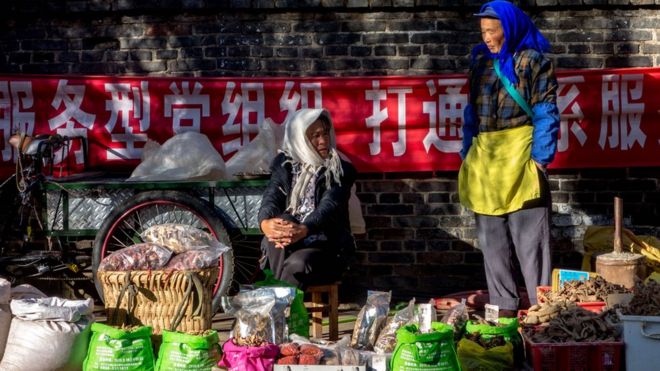
Local women sell produce in the market. Zhongyi market, located at the southern gate of Dayan ancient city, in Lijian, Yunnan Province in ChinaImage copyrightGETTY IMAGES

It took China less than 70 years to emerge from isolation and become one of the world’s greatest economic powers.

As the country celebrates the anniversary of the founding of the People’s Republic of China, we look back on how its transformation spread unprecedented wealth – and deepened inequality – across the Asian giant.

“When the Communist Party came into control of China it was very, very poor,” says DBS chief China economist Chris Leung.

“There were no trading partners, no diplomatic relationships, they were relying on self-sufficiency.”

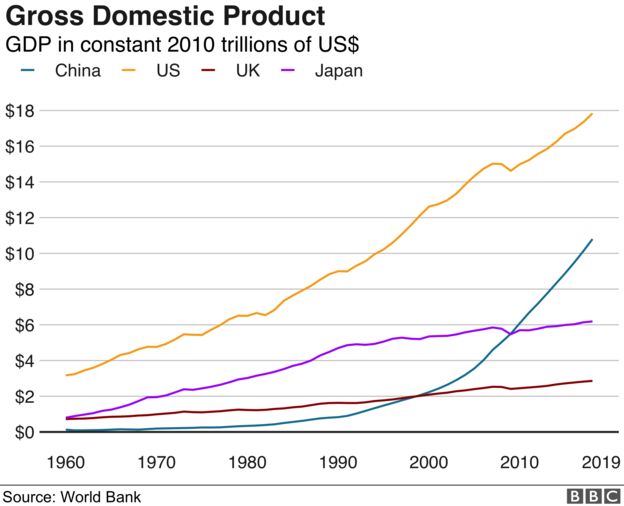
Over the past 40 years, China has introduced a series of landmark market reforms to open up trade routes and investment flows, ultimately pulling hundreds of millions of people out of poverty.

Chart showing gross domestic product of US, China, Japan and the UK

The 1950s had seen one of the biggest human disasters of the 20th Century. The Great Leap Forward was Mao Zedong’s attempt to rapidly industrialise China’s peasant economy, but it failed and 10-40 million people died between 1959-1961 – the most costly famine in human history.

This was followed by the economic disruption of the Cultural Revolution in the 1960s, a campaign which Mao launched to rid the Communist party of his rivals, but which ended up destroying much of the country’s social fabric.

‘Workshop of the world’

Yet after Mao’s death in 1976, reforms spearheaded by Deng Xiaoping began to reshape the economy. Peasants were granted rights to farm their own plots, improving living standards and easing food shortages.

The door was opened to foreign investment as the US and China re-established diplomatic ties in 1979. Eager to take advantage of cheap labour and low rent costs, money poured in.

“From the end of the 1970s onwards we’ve seen what is easily the most impressive economic miracle of any economy in history,” says David Mann, global chief economist at Standard Chartered Bank.

Through the 1990s, China began to clock rapid growth rates and joining the World Trade Organization in 2001 gave it another jolt. Trade barriers and tariffs with other countries were lowered and soon Chinese goods were everywhere.

“It became the workshop of the world,” Mr Mann says.

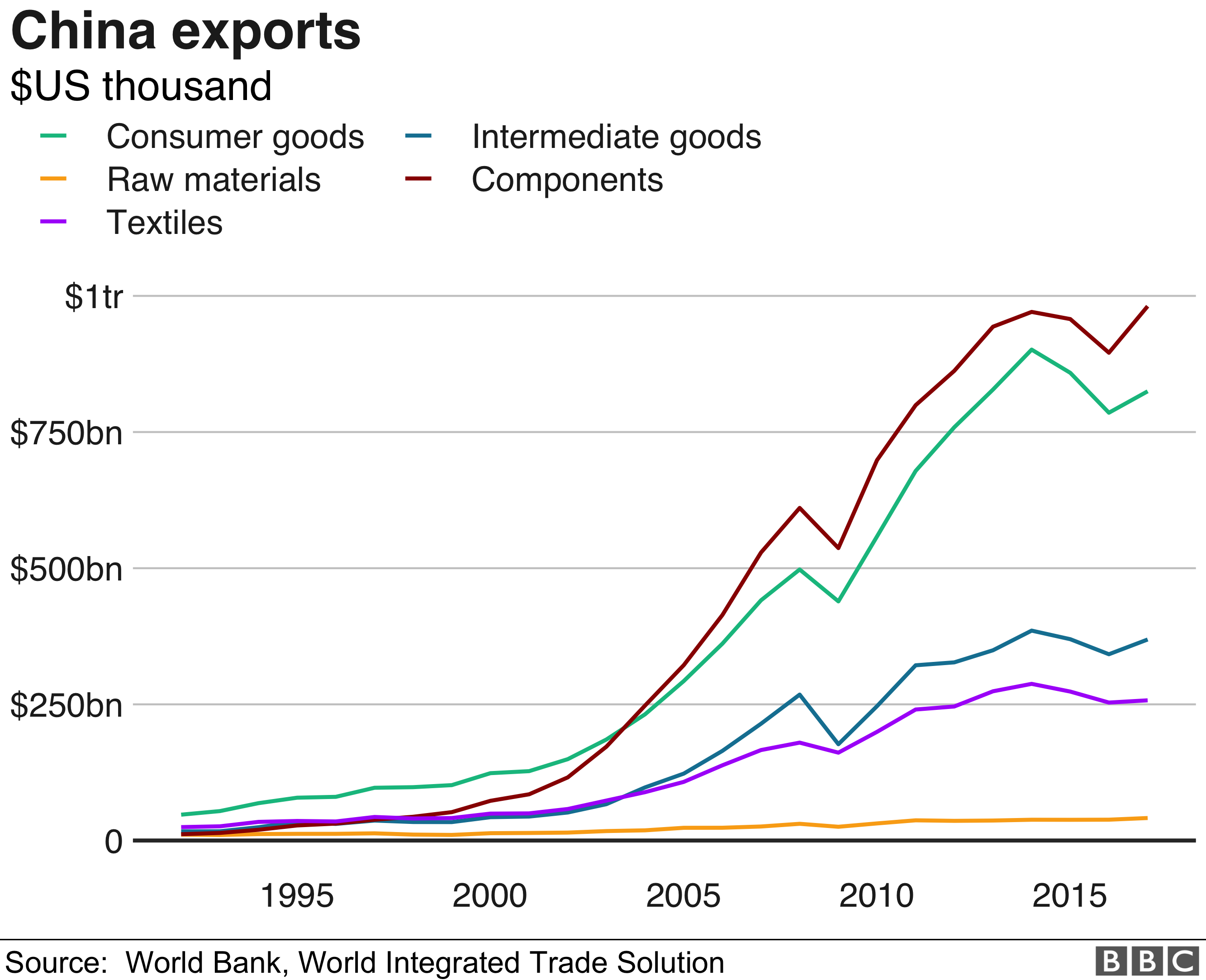
Chart showing China exports

Take these figures from the London School of Economics: in 1978, exports were $10bn (£8.1bn), less than 1% of world trade.

By 1985, they hit $25bn and a little under two decades later exports valued $4.3trn, making China the world’s largest trading nation in goods.

Poverty rates tumble

The economic reforms improved the fortunes of hundreds of millions of Chinese people.

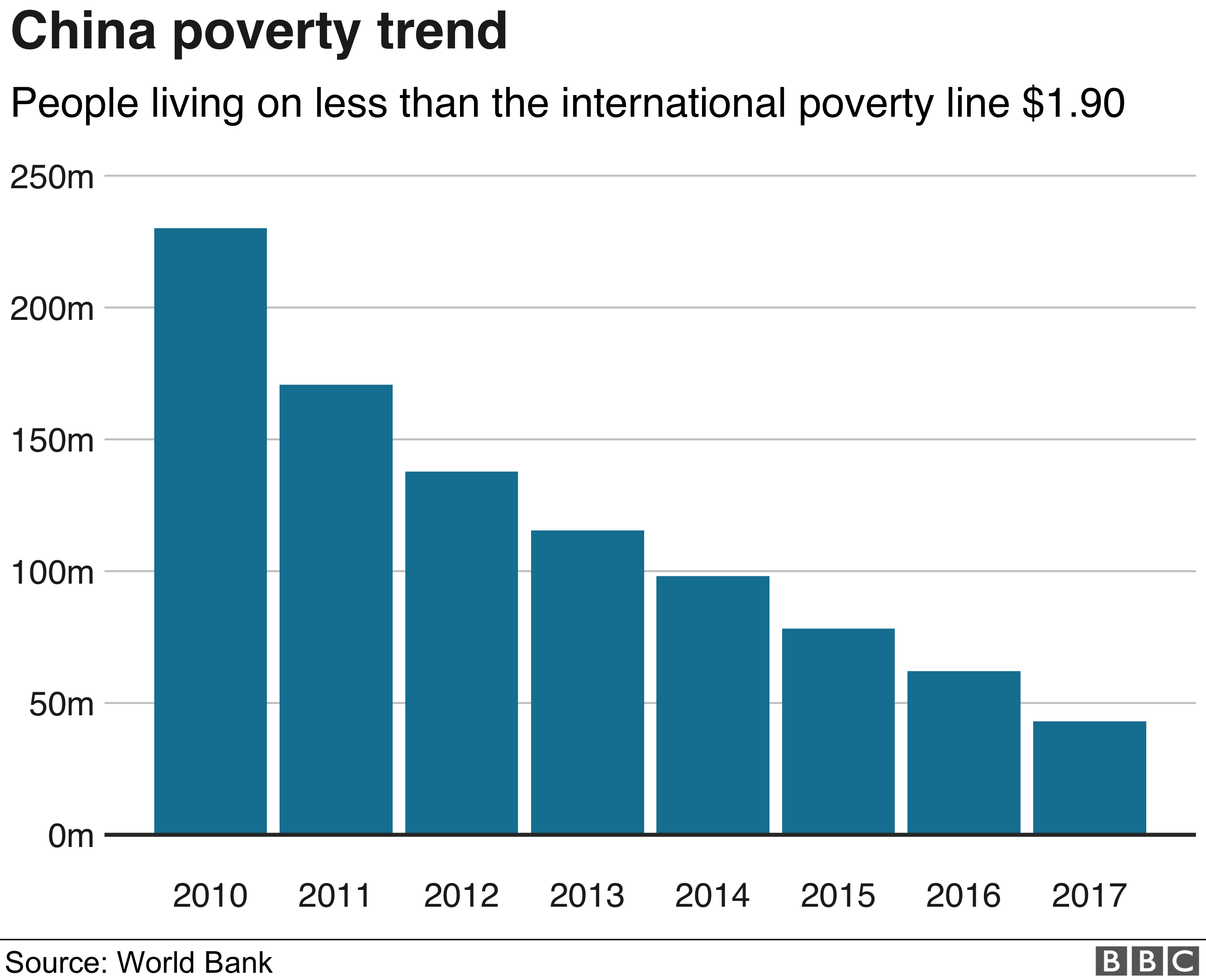
The World Bank says more than 850 million people been lifted out of poverty, and the country is on track to eliminate absolute poverty by 2020.

At the same time, education rates have surged. Standard Chartered projects that by 2030, around 27% of China’s workforce will have a university education – that’s about the same as Germany today.

China poverty rates

Rising inequality

Still, the fruits of economic success haven’t spread evenly across China’s population of 1.3 billion people.

Examples of extreme wealth and a rising middle class exist alongside poor rural communities, and a low skilled, ageing workforce. Inequality has deepened, largely along rural and urban divides.

“The entire economy is not advanced, there’s huge divergences between the different parts,” Mr Mann says.

The World Bank says China’s income per person is still that of a developing country, and less than one quarter of the average of advanced economies.

China’s average annual income is nearly $10,000, according to DBS, compared to around $62,000 in the US.

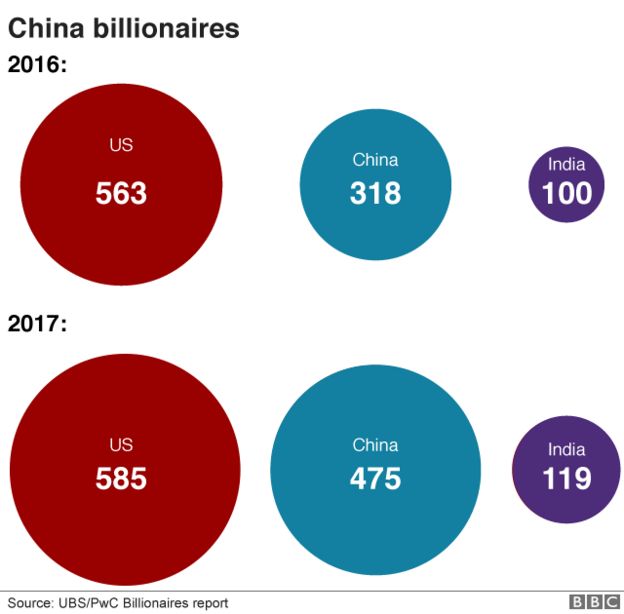
Billionaires in China, the US and India

Slower growth

Now, China is shifting to an era of slower growth.

For years it has pushed to wean its dependence off exports and toward consumption-led growth. New challenges have emerged including softer global demand for its goods and a long-running trade war with the US. The pressures of demographic shifts and an ageing population also cloud the country’s economic outlook.

Still, even if the rate of growth in China eases to between 5% and 6%, the country will still be the most powerful engine of world economic growth.

“At that pace China will still be 35% of global growth, which is the biggest single contributor of any country, three times more important to global growth than the US,” Mr Mann says.

The next economic frontier

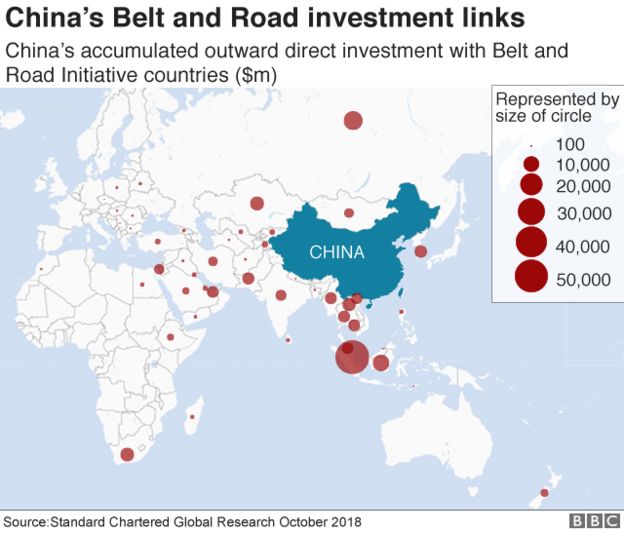
China is also carving out a new front in global economic development. The country’s next chapter in nation-building is unfolding through a wave of funding in the massive global infrastructure project, the Belt and Road Initiative.

Map showing Chinese investment as part of the Belt and Road initiative

The so-called new Silk Road aims to connect almost half the world’s populations and one-fifth of global GDP, setting up trade and investment links that stretch across the world.

Source: The BBC

20/01/2019

China-U.S. relations contribute to world peace, prosperity

SAN FRANCISCO, Jan. 18 (Xinhua) — China-U.S. relations have achieved remarkable development over the past 40 years, delivering huge benefits to the two peoples and making significant contributions to world peace and prosperity, a senior Chinese diplomat said here Friday.

Addressing an event marking the 40th anniversary of the establishment of diplomatic relations between China and the United States, Chinese Consul General Wang Donghua said the older generation of Chinese and U.S. leaders broke the ice of isolation between the two countries “with extraordinary strategic vision and political wisdom” to establish bilateral diplomatic ties.

“The establishment of China-U.S. diplomatic relations has had a huge and profound impact on the development of our bilateral relations and the maintenance of world peace,” Wang said.

San Francisco Mayor London Breed said at the event that the 40 years of China-U.S. relations have been “a time of growing exchanges and understanding.”

“We have realized the great possibilities of cooperation between our two nations, and this anniversary is a chance to remember that we have an enormous stake in each other’s success,” she said.

“In an interconnected world, countries would be more prosperous when we work together as one,” said Breed.

Heidi Kuhn, founder and CEO of Roots of Peace, a California-based humanitarian NGO dedicated to the removal of landmines and rebuilding of war-torn regions, said her family has maintained very close relations with China and the Chinese people for 150 years.

“I look forward to the next 150 years ahead. I’m so proud of the formal diplomatic relations between the United States and China,” Kuhn said.

Johannes Hoech, a San Francisco-based businessman who travels to China two to three times a year, said he has very close relations with China and made many Chinese friends.

“The prospect for the two countries is very positive. There’s a lot of mutual interest. There is a lot of curiosity about each other’s cultures and each other’s backgrounds,” he said.

“Since both countries’ interests are much larger than their differences, I am sure they will find a way to work out a solution to those disputes,” Hoech said.

Source: Xinhua

08/12/2018

China vows to continue support for Myanmar’s peace process in Rakhine

YANGON, Dec. 7 (Xinhua) — China will continue its support for Myanmar government’s process of restoring peace and stability as well as promoting development in western Rakhine state, Chinese Ambassador Hong Liang said on Friday.

Hong made the remarks at a donation ceremony to Myanmar’s Union Enterprise for Humanitarian Assistance, Resettlement and Development (UEHRD).

China encourages the Myanmar government’s efforts on the repatriation process of displaced persons, he said.

Myanmar Minister of Social Welfare, Relief and Resettlement Dr Win Myat Aye thanked the Chinese Embassy for the prompt donation, saying that it will help build houses for the returnees and will also take the lead to bring about more donation from others.

Myanmar formed the UEHRD in Oct. last year for the effective performance of a long-term project of freedom from conflict in Rakhine state.

It also established nine private sector task forces to join the mechanism of UEHRD.

02/12/2018

Kartarpur corridor: A road to peace between India and Pakistan?

  • 29 November 2018
Gurcharan Singh
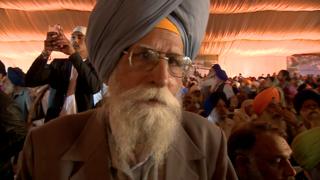
Image captionGurcharan Singh welcomes the opportunity to unite Indians and Pakistanis

Seventy-five-year-old Gurcharan Singh was just a child during Partition in 1947, when his family left their home in the city of Sialkot, in modern day Pakistan, to head to India.

Now on a visit to the Sikh temple in the Pakistani village of Kartarpur, he was delighted that the two countries had agreed to construct a corridor allowing visa-free access to pilgrims from India.

“Since Pakistan was created our community has wanted this,” he told the BBC. “Two families,­ Indians and Pakistanis,­ are meeting again.”

The Gurdwara Darbar Sahib Kartarpur is one of the holiest places in Sikhism. It’s believed to have been built on the site where Guru Nanak, the founder of the religion, died in the 16th Century.

Image captionThe Gurdwara Darbar Sahib Kartarpur, close to the Pakistan-Indian border, is one of the holiest sites in Sikhism

The temple is located around 4km (2.5 miles) from the border with India, but tensions between the neighbouring countries have meant Sikh pilgrims have often found it difficult to visit. Some have had to be content with viewing it through binoculars from India.

The “Kartarpur corridor” will however lead from the Indian border straight to the gurdwara, with the sides fenced off.

The move has been welcomed enthusiastically by the Sikh community, and also represents a rare instance of co-operation between the two countries, which have fought three wars against each other since independence.

Image captionThe ceremony was attended by Sikh children

Relations between India and Pakistan remain strained, but at a ceremony formally starting construction work on the pathway on the Pakistani side of the border, the country’s Prime Minister Imran Khan said: “We will only progress when we free ourselves from the chains of the past”.

A number of Indian politicians were amongst those attending.

Pakistani Foreign Minister Shah Mahmood Qureshi told the BBC the Kartarpur project would help improve the countries’ relationship.

“The more people meet, the more they realise how much in common we have, and what we are missing by not resolving our outstanding issues.” he said.

Formal talks between India and Pakistan have stalled since an attack in 2016, which Indian authorities blamed on Pakistani-backed militants. Pakistan denied the claim.

Prime Minister Khan directly addressed the commonly held view that Pakistan’s powerful military and intelligence services don’t want peace with India, whilst civilian governments generally do.

“My political party, the rest of our political parties, our army, all our institutions are all on one page. We want to move forward,” he said.

Image captionPakistani PM Imran Khan spoke of his hope that the two neighbours can one day be friends

However India’s Foreign Minister, Sushma Swaraj, said the initiative did not mean “bilateral dialogue will start”, adding: “Terror and talks cannot go together. The moment Pakistan stops terrorist activities in India, bilateral dialogue can start.”

Pakistan denies supporting militants targeting Indian forces in Kashmir and in return accuses India of supporting separatist movements within Pakistan.

Following his election victory this summer, Mr Khan announced that for every “one step” India takes on improving relations, Pakistan would take “two”. However, a planned meeting between the countries’ foreign ministers on the sidelines of the United Nations General Assembly in September was cancelled by Indian officials, amidst anger over stamps issued by Pakistan commemorating what they termed Indian atrocities in Kashmir.

Analyst Michael Kugelman, from the Wilson Centre, told the BBC the Kartarpur border crossing was a “significant” development but it would be wrong to suggest that the next step was a peace process.

“It’s a confidence building measure but at the end of the day India and Pakistan are still at loggerheads”.

Image captionSikhs will be celebrating a landmark birthday of their founder next year

Many observers have also predicted that substantial progress on dialogue between the neighbours would have to wait at least until after elections are held in India, next April or May.

Mr Kugelman said: “It’s politically risky for the Indian government, particularly for a Hindu nationalist government like the current one, to extend an olive branch to Pakistan during the height of campaign season.”

The Kartarpur corridor is due to become operational next year, in time for celebrations of the 550th anniversary of the birth of Guru Nanak.

Law of Unintended Consequences

continuously updated blog about China & India

ChiaHou's Book Reviews

continuously updated blog about China & India

What's wrong with the world; and its economy

continuously updated blog about China & India