Chindia Alert: You’ll be Living in their World Very Soon
aims to alert you to the threats and opportunities that China and India present. China and India require serious attention; case of ‘hidden dragon and crouching tiger’.
Without this attention, governments, businesses and, indeed, individuals may find themselves at a great disadvantage sooner rather than later.
The POSTs (front webpages) are mainly 'cuttings' from reliable sources, updated continuously.
The PAGEs (see Tabs, above) attempt to make the information more meaningful by putting some structure to the information we have researched and assembled since 2006.
Image copyright AFP / GETTYImage caption The P4 laboratory (centre) in Wuhan is among a handful around the world cleared to handle viruses that pose a high risk of person-to-person transmission
Chinese state media has accused US Secretary of State Mike Pompeo of lying, after he said there was “enormous evidence” the coronavirus emanated from a laboratory in Wuhan.
Mr Pompeo made the claim on Sunday, without going into specifics.
In an editorial on Tuesday, the hawkish Global Times newspaper said Mr Pompeo was “degenerate”.
The World Health Organization says the US claims are “speculative”, and that it has seen no “specific evidence”.
What did Chinese media say?
Editorials in Chinese state media often given an insight into the direction of government thinking, but there has been no official response to Mr Pompeo’s comments as yet.
“Pompeo aims to kill two birds with one stone by spewing falsehoods,” it said.
“First, he hopes to help Trump win re-election this November…second, Pompeo hates socialist China and, in particular, cannot accept China’s rise.”
Media caption “The Chinese Communist Party has refused to co-operate with world health experts” – Mike Pompeo
The editorial admitted there were “initial problems” in China’s response to the outbreak, but claimed “the overall performance is bright enough to outweigh the flaws”.
It also said it was “conceivable that the virus first contacted humans in other places [than Wuhan]”.
The Global Times is not the only Chinese outlet to take aim at Mr Pompeo and the US.
The People’s Daily said Mr Pompeo had “no evidence”, while a piece on the CCTV site accused US politicians of “nefarious plotting”.
What did Mike Pompeo say?
In an interview with ABC on Sunday, Mr Pompeo said there was “enormous evidence” that the virus had emerged from the Wuhan Institute of Virology.
“Remember, China has a history of infecting the world, and they have a history of running sub-standard laboratories,” he said.
Mr Pompeo – a former director of the Central Intelligence Agency (CIA) – said he did not think the virus was man-made or genetically modified.
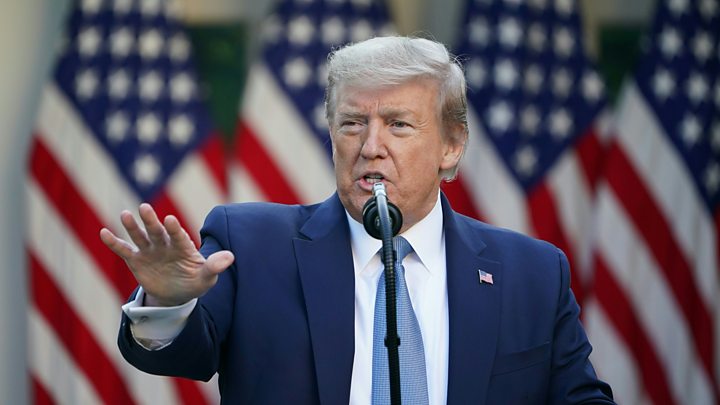
The Wuhan laboratory is known to study coronaviruses in bats. In April, President Trump was asked whether “lax safety protocols” allowed such a virus to escape via an intern and her boyfriend.
Mr Trump did not confirm the theory, but said: “More and more we’re hearing the story.”
Media caption Donald Trump was recently asked if the virus emanated in a laboratory, rather than a market
Last week, he was asked if he had seen evidence that gave him a “high degree of confidence” that the virus emerged in the Wuhan laboratory.
“Yes I have,” he replied – but said he could not go into specifics.
On Monday, World Health Organization emergencies director Michael Ryan said it had received “no data or specific evidence” from the US about the virus origins.
“So from our perspective, this remains speculative,” he said.
Last week, the US intelligence community said it “concurred” that the virus “was not man-made or genetically modified”.
But it said it would “continue to examine” whether the outbreak began via “contract with infected animals, or if it was the result of an an accident at a laboratory in Wuhan”.
Australian Prime Minister Scott Morrison said on Tuesday that the most likely source of the virus was a wildlife market. However he said he would not rule out the theory that it originated in a lab.
“What’s really important is that we have a proper review, an independent review which looks into the sources of these things in a transparent way so we can learn the lessons,” he told reporters.
Meanwhile, Western “intelligence sources” have told several news outlets there is “no evidence” to suggest the virus leaked from a laboratory.
China’s economy shrank for the first time in decades in the first quarter of the year, as the virus forced factories and businesses to close.
The world’s second biggest economy contracted 6.8% according to official data released on Friday.
The financial toll the coronavirus is having on the Chinese economy will be a huge concern to other countries.
China is an economic powerhouse as a major consumer and producer of goods and services.
This is the first time China has seen its economy shrink in the first three months of the year since it started recording quarterly figures in 1992.
“The GDP contraction in January-March will translate into permanent income losses, reflected in bankruptcies across small companies and job losses,” said Yue Su at the Economist Intelligence Unit.
Last year, China saw healthy economic growth of 6.4% in the first quarter, a period when it was locked in a trade war with the US.
In the last two decades, China has seen average economic growth of around 9% a year, although experts have regularly questioned the accuracy of its economic data.
Its economy had ground to a halt during the first three months of the year as it introduced large-scale shutdowns and quarantines to prevent the virus spread in late January.
As a result, economists had expected bleak figures, but the official data comes in slightly worse than expected.
Among other key figures released in Friday’s report:
Factory output was down 1.1% for March as China slowly starts manufacturing again.
Retail sales plummeted 15.8% last month as many of shoppers stayed at home.
Unemployment hit 5.9% in March, slightly better than February’s all-time high of 6.2%.
Analysis: A 6% expansion wiped out
Robin Brant, BBC News, Shanghai
The huge decline shows the profound impact that the virus outbreak, and the government’s draconian reaction to it, had on the world’s second largest economy. It wipes out the 6% expansion in China’s economy recorded in the last set of figures at the end of last year.
Beijing has signalled a significant economic stimulus is on the way as it tries to stabilise its economy and recover. Earlier this week the official mouthpiece of the ruling Communist Party, the People’s Daily, reported it would “expand domestic demand”.
But the slowdown in the rest of the global economy presents a significant problem as exports still play a major role in China’s economy. If it comes this will not be a quick recovery.
On Thursday the International Monetary Fund forecast China’s economy would avoid a recession but grow by just 1.2% this year. Job figures released recently showed the official government unemployment figure had risen sharply, with the number working in companies linked to export trade falling the most.
China has unveiled a range of financial support measures to cushion the impact of the slowdown, but not on the same scale as other major economies.
“We don’t expect large stimulus, given that that remains unpopular in Beijing. Instead, we think policymakers will accept low growth this year, given the prospects for a better 2021,” said Louis Kuijs, an analyst with Oxford Economics.
Since March, China has slowly started letting factories resume production and letting businesses reopen, but this is a gradual process to return to pre-lockdown levels.
Media caption Why does China’s economy matter to you?
China relies heavily on its factories and manufacturing plants for economic growth, and has been dubbed “the world’s factory”.
Stock markets in the region showed mixed reaction to the Chinese economic data, with China’s benchmark Shanghai Composite index up 0.9%.
Image copyright TAOBAO/SINA WEIBOImage caption Taobao confirmed that this was no April Fools joke
An online buyer has won an opportunity to launch a commercial rocket for 40 million yuan ($5.6m; £4.5m) in central China, it’s reported.
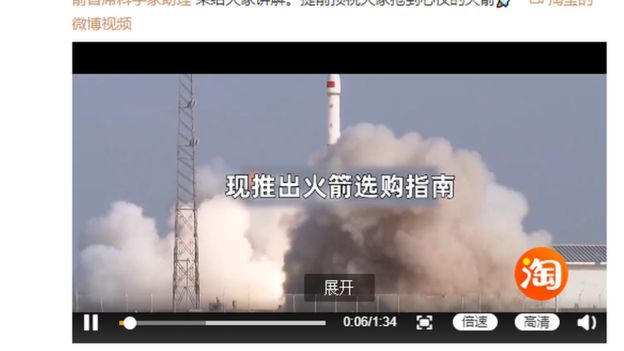
According to the official People’s Daily, popular online shopping platform Taobao live-streamed the sale of a commercial rocket yesterday evening.
The official China Daily said that the rocket was “a small launch vehicle” in the city of Wuhan, Hubei Province, which has already seen eight commercial launches.
Buyers were told that they could paint the body of the rocket and the launch platform, and that they could visit the launch site and control the launch.
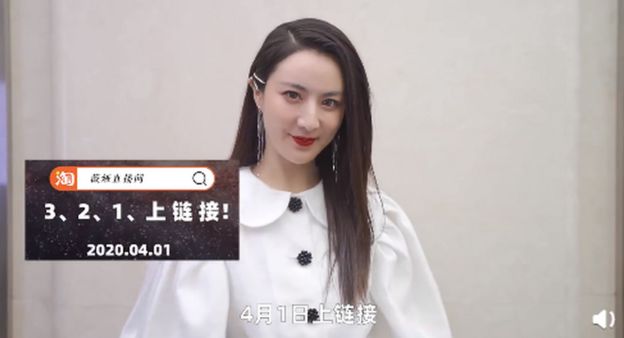
Image copyrightT AOBAO/SINA WEIBOImage caption Celebrity sales anchor Wei Ya has more than seven million Weibo followers
Posters advertising the livestream, headed by celebrity shopping anchor Wei Ya, went viral on Wednesday 1 April, leading many to speculate they were part of an April Fools joke.
But national newspaper Global Times says that Taobao confirmed that “this is for real” in an online post.
It hints that the decision to sell a rocket experience, headed by Chinese entrepreneur Luo Yonghao, followed an earlier online poll where netizens were asked whether they’d rather win a “rocket, a satellite, a partner or a cleaning lady”.
‘How to choose the first rocket in your life?’
China Daily says that this was “the world’s first live broadcast of a rocket sale” and the livestream has attracted considerable attention online.
Media have noted that the livestream of the event, watched by millions, has been an opportunity to re-promote what Wuhan has to offer, since it made international attention as the original epicentre of the Covid-19 virus.
As well as promoting Wuhan’s Aerospace Science and Technology & Rocket Technology, the livestream was also interspersed by footage highlighting the hard-working efforts of medical workers in the city.
The name of the buyer has not been revealed, but this is not the first time that an online buyer has purchased an air vehicle for millions of dollars. In November 2017, two Boeing 747 jets were bought on Taobao in an online auction.
Image copyright TAOBAO/SINA WEIBOImage caption Taobao confirmed shoppers could buy a rocket on their platform
BEIJING, April 28 (Xinhua) — China will hold a gathering to mark the centenary of the May Fourth Movement at 10:30 a.m. on Tuesday at the Great Hall of the People in Beijing.
President Xi Jinping, also general secretary of the Communist Party of China Central Committee and chairman of the Central Military Commission, will attend the event and deliver an important speech.
The event will be broadcast live by China Media Group and on http://www.xinhuanet.com. It will also be rebroadcast simultaneously on major news websites including people.com.cn, cctv.com and china.com.cn as well as on news apps run by People’s Daily, Xinhua News Agency and China Central Television.
BEIJING, April 15 (Xinhua) — The Communist Party of China (CPC) Central Committee has published regulations on the work of leading Party members groups.
The 45-article regulations were updated from a trial version issued in June 2015.
The CPC Central Committee has also issued a circular demanding the implementation of the regulations.
The revisions fully embody the theoretical, practical and institutional innovations in the work of leading Party members groups in recent years, the circular said, adding that the revisions were made in accordance with the new situations, tasks and requirements of their work.
It demanded strict implementation of the regulations to make sure that leading Party members groups uphold General Secretary Xi Jinping’s core status, as well as the authority of the CPC Central Committee and its centralized, unified leadership.
The circular said leading Party members groups should take the implementation of the decisions and deployments of the CPC Central Committee as the prerequisite in carrying out work.
A leading Party members group is a leading body set up by the Party in the leadership of the central and local state organs, people’s organizations, economic and cultural institutions, as well as other non-Party organizations.
The regulations have eight chapters including the general provisions, the establishment, duties and organizational principles of leading Party members groups, as well as the rules of their decision-making and supervision.
In a press release, an official with the General Office of the CPC Central Committee spoke of the importance and necessity of the revised regulations.
The official said the regulations reflect new requirements on Party building in the new era and are key to addressing prominent issues in the work of the leading Party members groups and strengthen the institutional guarantees for their work.
There are over 102,000 leading Party members groups from central to county levels nationwide, the official said.
The regulations will help ensure that the CPC always remains a strong leadership core in the cause of socialism with Chinese characteristics, the official added.
An editorial to be published by the People’s Daily on Tuesday hailed the issuance of the regulations, saying the establishment of leading Party members groups is an arrangement based on Chinese reality and fully demonstrates the unique political, organizational and institutional strength of the Party.
BEIJING, April 8 (Xinhua) — Chinese ambassador to Barbados Yan Xiusheng has called for efforts to promote China-Barbados cooperation to a new stage.
In the article, carried by Monday’s People’s Daily, Yan said the two countries signed a Memorandum of Understanding (MOU) on jointly advancing the Belt and Road Initiative (BRI) in February, making Barbados the first new partner to join the BRI in 2019.
“The friendly and cooperative relations between the two countries have deepened in recent years, showing a good trend of upgrading quality and accelerating speed,” Yan said.
Political mutual trust between the two sides has been strengthened, pragmatic cooperation has been steadily advancing and people-to-people and cultural exchanges have seen many highlights, he explained.
As an important partner of China in the Caribbean, Barbados attaches great importance to international cooperation within the framework of the BRI, the article read.
The signing of the MOU between the two countries has brought new opportunities for further development of bilateral relations and practical cooperation in various fields, Yan noted.
Under the framework of the BRI and guided by the principle of consultation, collaboration and benefit for all, both sides will give full play to their comparative advantages and tap into their potential for cooperation in the fields including shipping, aviation, infrastructure and modern agriculture, he said.
Efforts will be made to achieve high-quality Belt and Road cooperation and push China-Barbados friendship and cooperation into a new stage, said the article.
BEIJING (Reuters) – Saudi Crown Prince Mohammed bin Salman cemented a $10 billion (7.7 billion pounds) deal for a refining and petrochemical complex in China on Friday, meeting Chinese President Xi Jinping who urged joint efforts to counter extremism and terror.
The Saudi delegation, including top executives from state-owned oil company Saudi Aramco, arrived on Thursday on an Asia tour that has already seen the kingdom pledge investment of $20 billion in Pakistan and seek to make additional investments in India’s refining industry.
Saudi Arabia signed 35 economic cooperation agreements with China worth a total of $28 billion at a joint investment forum during the visit, Saudi state news agency SPA said.
“China is a good friend and partner to Saudi Arabia,” President Xi Jinping told the crown prince in front of reporters.
RELATED COVERAGE
Saudi, China sign $28 billion worth of economic accords – SPA
Saudi Aramco to acquire 9 percent of Chinese petrochems project – SPA
“The special nature of our bilateral relationship reflects the efforts you have made,” added Xi, who has made stepping up China’s presence in the Middle East a key foreign policy objective, despite its traditional low-key role there.
The crown prince said Saudi Arabia’s relations with China dated back “a very long time in the past”.
“In the hundreds, even thousands, of years, the interactions between the sides have been friendly. Over such a long period of exchanges with China, we have never experienced any problems with China,” he said.
Crown Prince Mohammed, who has come under fire in the West following the murder of Saudi journalist Jamal Khashoggi at the kingdom’s Istanbul consulate in October, said Saudi Arabia saw great opportunities with China.
“The Silk Road initiative and China’s strategic orientation are very much in line with the kingdom’s Vision 2030,” he said according to SPA, referring to Saudi Arabia’s sweeping economic reform programme.
Trade between the countries increased by 32 percent last year, he said.
China has had to step carefully in relations with Riyadh, since Beijing also has close ties with Saudi Arabia’s regional foe, Iran.
China is also wary of criticism from Muslim countries about its camps in the heavily Muslim far western region of Xinjiang, which the government says are for de-radicalisation purposes and rights groups call internment camps.
Xi told the crown prince the two countries must strengthen international cooperation on de-radicalisation to “prevent the infiltration and spread of extremist thinking”, Chinese state television said.
Saudi Arabia respected and supported China’s right to protect its own security and take counter-terror and de-radicalisation steps, the crown prince told Xi, according to the same report, and was willing to increase cooperation.
Meeting the crown prince earlier on Friday, Chinese Vice Premier Han Zheng said the two countries should enhance exchanges on their experiences in de-radicalisation, China’s official Xinhua news agency said in a separate report.
Chinese state media made no direct mention of Xinjiang in their stories on the crown prince’s meetings.
DEALS SIGNED
Aramco agreed to form a joint venture with Chinese defence conglomerate Norinco to develop a refining and petrochemical complex in the northeastern Chinese city of Panjin, saying the project was worth more than $10 billion.
The partners would form a company called Huajin Aramco Petrochemical Co as part of a project that would include a 300,000-barrels per day (bpd) refinery with a 1.5-million-metric tonnes per year ethylene cracker, Aramco said.
Aramco will supply up to 70 percent of the crude feedstock for the complex, which is expected to start operations in 2024.
The investments could help Saudi Arabia regain its place as the top oil exporter to China, a position Russia has held for the last three years. Saudi Aramco is set to boost market share by signing supply deals with non-state Chinese refiners.
Aramco also signed an agreement to buy a 9 percent stake in Zhejiang Petrochemical, Saudi state news agency SPA said. This formalised a previously announced plan to gain a stake in a 400,000-bpd refinery and petrochemicals complex in Zhoushan, south of Shanghai.
China sees “enormous potential” in Saudi Arabia’s economy and wants more high-tech cooperation, State Councillor Wang Yi, the Chinese government’s top diplomat, said on Thursday.
But China was not seeking to play politics in the Middle East, the widely read state-run tabloid, the Global Times, said in an editorial.
“China won’t be a geopolitical player in the Middle East. It has no enemies and can cooperate with all countries in the region,” said the paper, published by the ruling Communist Party’s official People’s Daily.
“China’s increasing influence in the Middle East comes from pure friendly cooperation. Such a partnership will be welcomed by more countries in the Middle East.”
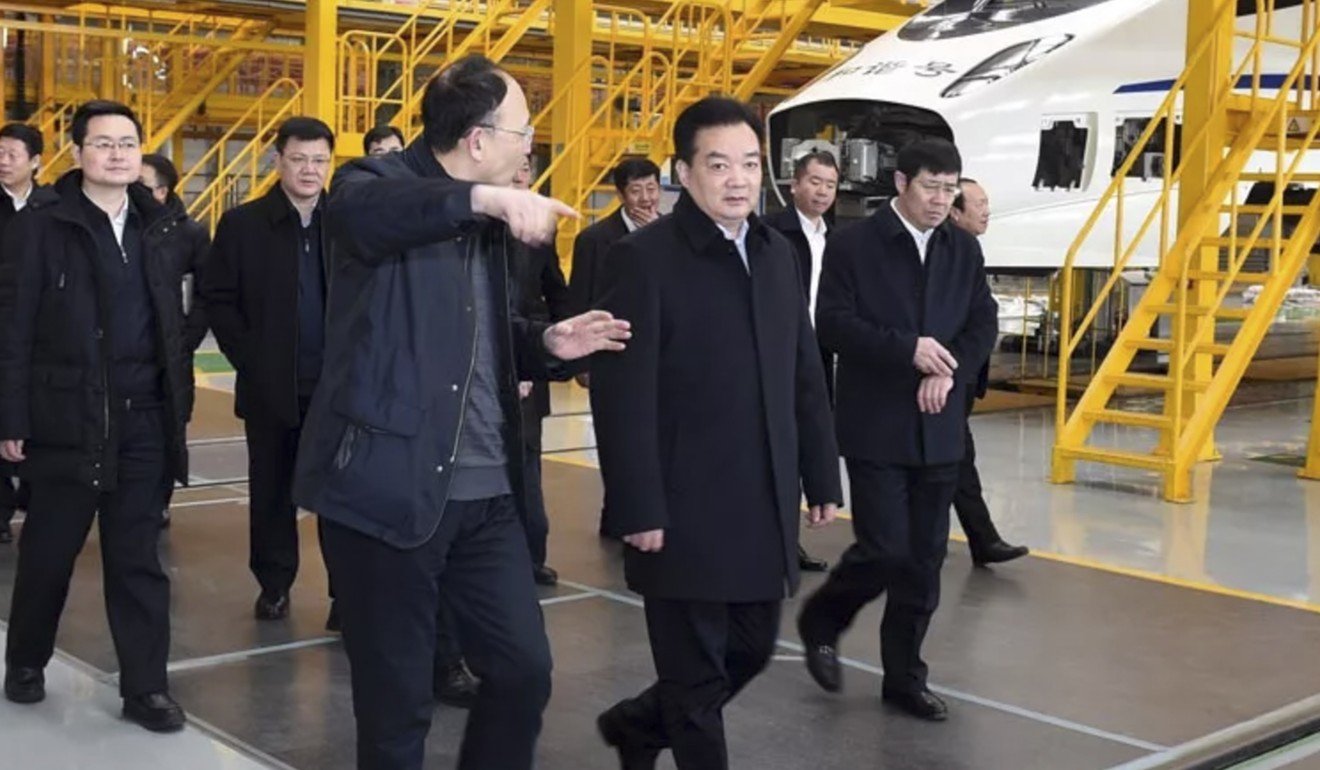
Beijing has sent a trusted senior cadre – with a track record of versatility and economic development – to join the highest decision-making body of China’s highly sensitive Xinjiang Uygur autonomous region.
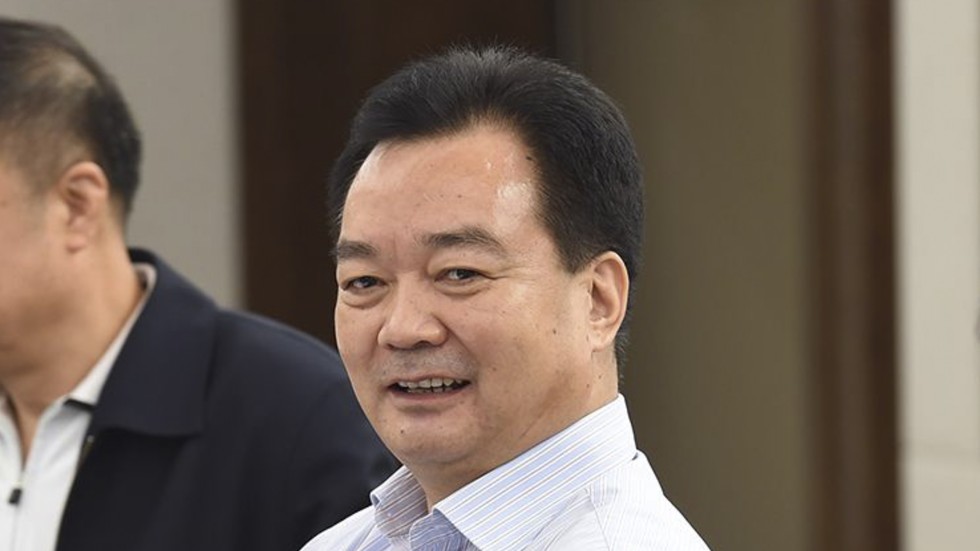
Wang Junzheng, 56, has been appointed to Xinjiang’s 14-member Communist Party standing committee, according to an official statement on Monday. His new role was not specified in the two-paragraph announcement.
Analysts said he was expected to assume a leadership role in the party’s regional political and legal affairs commission – a critical body in the implementation of China’s “stabilising measures” in Xinjiang, which include the controversial “re-education camps” where up to 1 million people from the Muslim ethnic minority group are reportedly being held.
In a move that may have paved the way for such a role for Wang, the incumbent head of Xinjiang’s political and legal affairs commission – Zhu Hailun, 61 – was elected deputy head of Xinjiang’s People’s Congress in January. It is standard practice in China for deputy provincial level cadres to step down and take up such positions on reaching 60.
Dr Alfred Wu, an associate professor at Singapore’s Lee Kuan Yew School of Public Policy, said that while there were other vacancies in both Xinjiang’s political and legal affairs commission and its united front work department, Wong’s legal experience made it likely he would take up the role vacated by Zhu.
A source familiar with Wang told the South China Morning Post he was among a group of cadres who had won the trust of President Xi Jinping.
Wang’s career has been on a fast track of rotation and promotion. He reached vice-provincial level when he was only 49 and, five years later, became an alternate member of the Central Committee – the party’s highest organ of power – at the 19th party congress in October 2017.
He moves to Xinjiang from the northeastern province of Jilin, where he was a member of the provincial party standing committee and party chief of Changchun, the provincial capital.
It was not all smooth sailing for Wang in Jilin, where his career was tainted by last year’s Changchun Changsheng vaccine scandal.
National outrage followed the revelation that one of China’s biggest vaccine makers, Changsheng Bio-tech, had systematically forged data in its production of rabies vaccines and had sold ineffective vaccines for diphtheria, whooping cough and tetanus that were given to hundreds of thousands of babies – some as young as three months old.
Heads rolled. Sackings included Jilin vice-governor Jin Yuhui, who had overseen food and drug regulation; Li Jinxiu, a former Jilin food and drug chief; Changchun mayor Liu Changlong; and Bi Jingquan, deputy director of the State Market Regulatory Administration in Beijing.
In a farewell speech published in People’s Daily on Monday, Wang apparently made a veiled reference to the scandal and admitted some shortcomings.
“Because of my constraints, I could have done better on some issues … and have failed to meet the expectations of the Party and people,” he said.
Alfred Wu said the Xinjiang posting showed Wang’s career had not been tainted by the Changchun vaccine scandal.
“Going to Xinjiang is both an opportunity and a challenge for Wang. If he can prove himself in stabilising Xinjiang, he will go further [in his career],” Wu said.
Xinjiang is Wang’s fourth provincial posting. He began his political career in Yunnan, southwestern China, where he spent nearly two decades working with many ethnic minority groups.
He was the legal chief of Kunming, the provincial capital of Yunnan, from 1988 to 2000 and also served as vice-president of the Yunnan Higher People’s Court from 2005 to 2007.
In 2009 Wang became party chief of Lijiang, a tourist city in Yunnan where the economy thrived under his watch.
“More importantly, he struck a balance between tourism development and environmental conservation and was noticed by the leadership,” a source said.
Wang left Yunnan in 2012 when he was promoted to provincial vice-governor of Hubei in central China. He later became party chief of the city of Xiangyang in Hubei province and was promoted to provincial party standing committee member in 2013.
After three years in Hubei, Wang headed north to Jilin, becoming Changchun party chief in January 2016.
Wang was born in the eastern province of Shandong. He graduated from Shandong University with a bachelor’s degree in socialism studies and a master’s in the same subject from Renmin University in Beijing in the 1980s. He attained his doctorate in management from Tsinghua University in 2006.


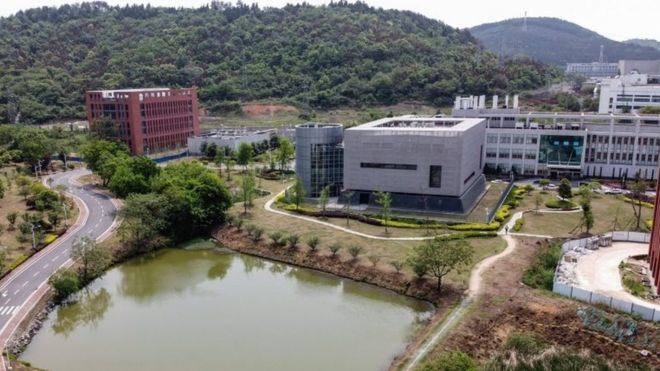 Image copyright AFP / GETTY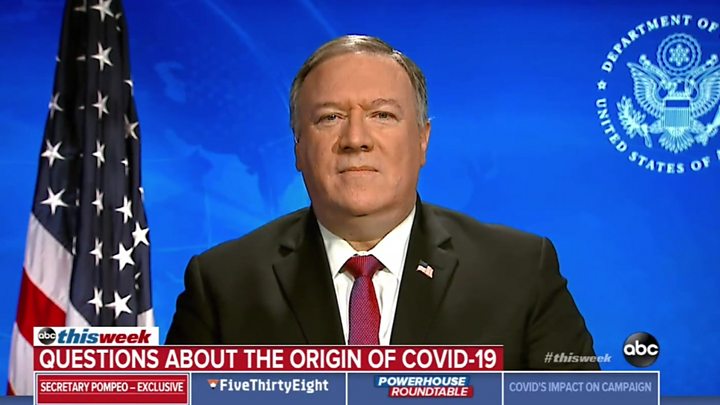



 CHINDIA ALERT: You'll be living in their world, very soon

COMMENTS: 1