Archive for ‘People’s Republic’

24/05/2020

Xi Focus: “What is people first?” Xi points to how China saves lives at all costs

Chinese President Xi Jinping, also general secretary of the Communist Party of China Central Committee and chairman of the Central Military Commission, takes part in a deliberation with his fellow deputies from the delegation of Inner Mongolia Autonomous Region at the third session of the 13th National People’s Congress (NPC) in Beijing, capital of China, May 22, 2020. (Xinhua/Ju Peng)

BEIJING, May 23 (Xinhua) — “What is people first?” Chinese President Xi Jinping asked, before offering his own answer when he was talking with lawmakers at the ongoing national legislative session.

“So many people worked together to save a single patient. This, in essence, embodies doing whatever it takes (to save lives),” he said.

Xi, also general secretary of the Communist Party of China Central Committee and chairman of the Central Military Commission, is a deputy to the 13th National People’s Congress.

During his deliberations with fellow deputies from Inner Mongolia Autonomous Region on Friday, “people” was a keyword.

Xi referred to a story told by another deputy that morning. Luo Jie, from the COVID-19 hard-hit province of Hubei, told reporters at the session how medical workers in his hospital spent 47 days saving an 87-year-old COVID-19 patient.

“About 10 medical workers meticulously took care of the patient for dozens of days, and finally saved the patient’s life,” Xi said. “I am really impressed.”

In the COVID-19 pandemic, health workers around the world got to know the elderly are the most difficult to treat and require the most sophisticated medical resources. China has given every patient equal treatment irrespective of their age or wealth.

Chinese President Xi Jinping, also general secretary of the Communist Party of China Central Committee and chairman of the Central Military Commission, takes part in a deliberation with his fellow deputies from the delegation of Inner Mongolia Autonomous Region at the third session of the 13th National People’s Congress (NPC) in Beijing, capital of China, May 22, 2020. (Xinhua/Huang Jingwen)

In Hubei alone, more than 3,600 COVID-19 patients over the age of 80 have been cured. In the provincial capital Wuhan, seven centenarian patients have been cured.

“We mobilized from around the nation the best doctors, the most advanced equipment and the most needed resources to Hubei and Wuhan, going all out to save lives,” Xi said during the deliberations, adding that the eldest patient cured is 108 years old.

“We are willing to save lives at all costs. No matter how old the patients are and how serious their conditions have become, we never give up,” Xi said.

Xi joined political advisors and lawmakers on Thursday and Friday in paying silent tribute to the lives lost to COVID-19 as the top political advisory body and the national legislature opened their annual sessions.

This year’s government work report said China’s economy posted negative growth in the first quarter of this year, but it was “a price worth paying” to contain COVID-19 as life is invaluable.

“As a developing country with 1.4 billion people, it is only by overcoming enormous difficulties that China has been able to contain COVID-19 in such a short time while also ensuring our people’s basic needs,” the report said.

Epidemic response is a reflection of China’s governing philosophy.

The fundamental goal for the Party to unite and lead the people in revolution, development and reform is “to ensure a better life for them,” Xi said.

The nation’s average life expectancy reached 77 years in 2018, more than double that in 1949, when the people’s republic was founded.

Chinese people are not just living longer but better lives, with more material wealth and broader choices to pursue individual dreams. All rural poor will bid farewell to poverty this year as part of the goal of building a moderately prosperous society in all respects.

The Party’s long-term governance, Xi said, rests on “always maintaining close bond with the people.”

“We must always remain true to the people’s aspiration and work in concert with them through thick and thin,” Xi said.

Source: Xinhua

22/08/2019

Chinese armed police truck convoy rolls into Shenzhen as Hong Kong enters another week of protests

  • State media says presence is part of preparations for major drill, but analyst calls it a ‘psychological warfare tactic’
  • Fears that the armed presence was a show of power to Hong Kong
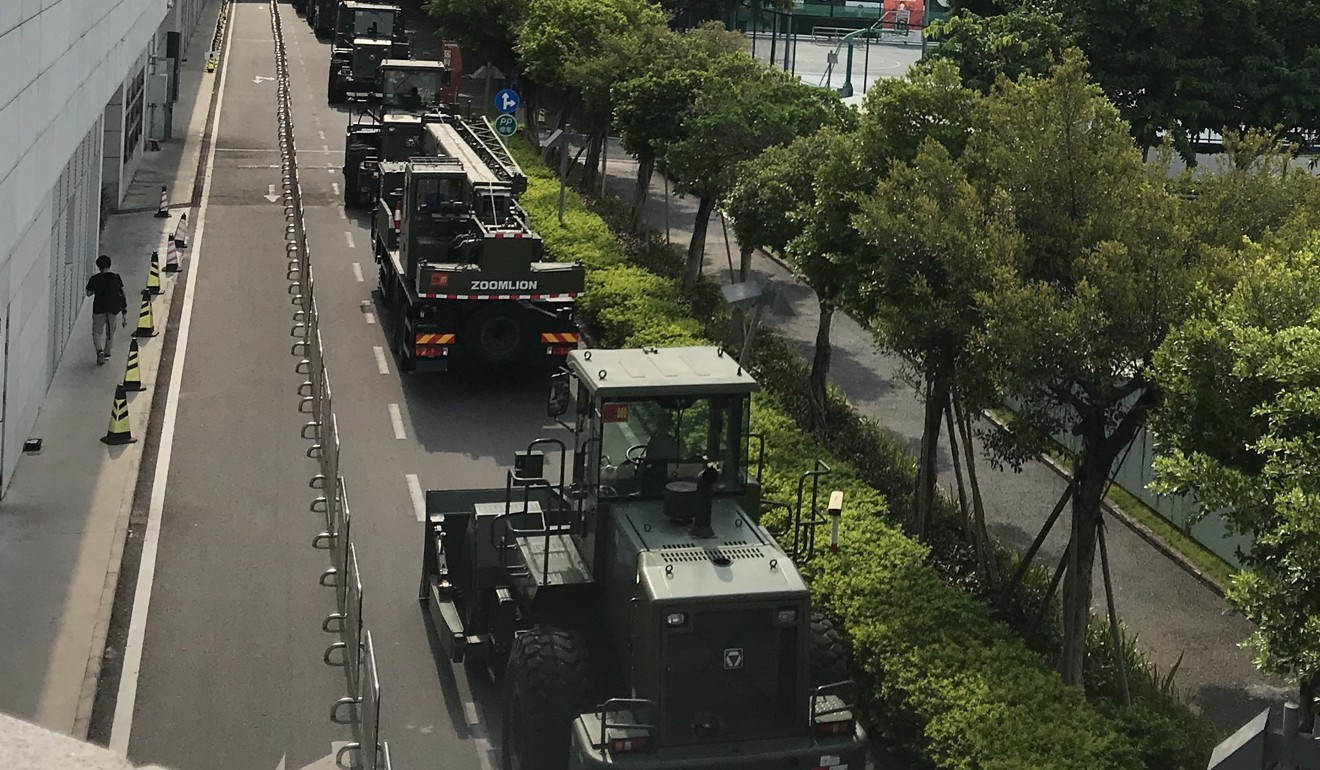
Dozens of trucks line a street next to the entrance of the Shenzhen Bay Sports Centre in Shenzhen on Monday. Photo: SCMP
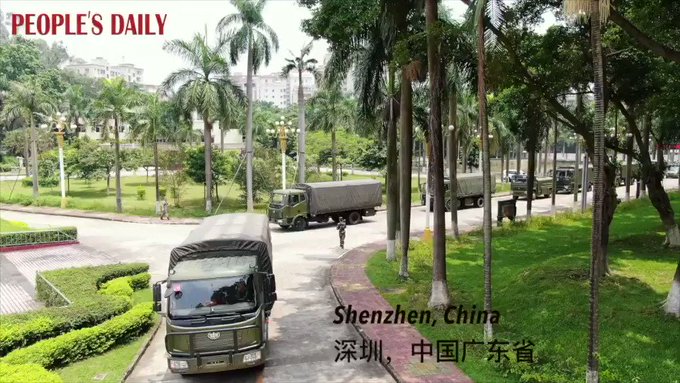
A convoy of armed police trucks has been stationed at a sports centre in a mainland Chinese city bordering Hong Kong, adding to speculation online that Beijing could be preparing to intervene directly in the protests roiling the special administrative region.
But a Beijing-based military expert said the movements were part of regular exercises and not cause for concern.
Footage of the trucks rolling into Shenzhen in the southern province of Guangdong began circulating online on Saturday.

On Monday, Communist Party mouthpiece People’s Daily and Global Times posted videos of the convoy in the city, saying the police were there to prepare for large-scale drills.

Dozens of the trucks as well as excavators lined a pavement next to the entrance of the Shenzhen Bay Sports Centre in Nanshan district on Monday, across the harbour from Hong Kong.

Personnel in camouflage uniforms stood at the entrances of the sports centre, but did not block access to civilians.

Asked whether they were in Shenzhen for a drill and what time they had arrived, the personnel shook their heads and said nothing.

Also on Monday, the Hong Kong and Macau Affairs Office released a stern statement, calling attacks on police “signs of terrorism”.

Online, internet users speculated that the armed presence was a show of power to Hong Kong.

Excavators are among the heavy equipment stationed near the entrance of the Shenzhen Bay Sports Centre on Monday. Photo: SCMP

“They are just waiting for an order before they’ll drive to Hong Kong to calm the riots. We hope the armed forces can enter Hong Kong and beat the hell out of these idiotic youth,” one commenter said on Weibo, China’s Twitter-like social media platform.

Beijing-based military specialist Zhou Chenming said that the armed police were taking part in regular drills and that people should not feel nervous.

“The central government has repeatedly stated it will only interfere if there are large-scale riots and the Hong Kong government has applied voluntarily for support,” Zhou said.

Hong Kong policeman filmed aiming gun at protesters hailed as a hero by Chinese state media

“If the situation does not reach that point, then this is only a deterrence measure, to deter these [small group of people] from stepping over the line.”

Dixon Sing Ming, a political-science professor at the Hong Kong University of Science and Technology, said the move was a “psychological warfare tactic”.

“The drill is part and parcel of a well-coordinated attempt by Beijing to pressure the protesters and the general public to give up their five demands, including the one for universal suffrage immediately,” Sing said.

Hong Kong has been engulfed in protests since early June, at first to oppose the now-shelved extradition bill that would have allowed Hong Kong to send suspects to other jurisdictions, including mainland China.

Chinese police mass 12,000 anti-riot officers in Shenzhen for drill

But protesters now have five demands, including a complete withdrawal of the extradition bill and an independent investigation into the police’s use of force in handling the protests.

As the confrontations have escalated, public opinion in the mainland has grown steadily tougher, with many calling for more stern measures to restore order.

On August 6, 12,000 police officers gathered in Shenzhen for a drill, which included anti-riot measures similar to those seen on the streets of Hong Kong.

Although the police said the drill was part of security preparations for the 70th anniversary of the People’s Republic on October 1, internet users saw it as a show of power and warning to Hong Kong.

Source: SCMP

17/08/2019

‘Risks still too big’ for China to send in troops to quell Hong Kong unrest

  • Chinese government advisers say Beijing has not reached direct intervention point but that could change if the violence continues
  • Military action would trigger international backlash, observers say, as US expresses concern over reported paramilitary movements and ‘erosion of Hong Kong’s autonomy’
Footage of trucks from the paramilitary People’s Armed Police in Shenzhen has circulated online. Photo: Handout
The unrest in Hong Kong does not yet warrant direct intervention by Beijing despite hardening public sentiment and calls for tougher action in mainland China, according to Chinese government advisers.
Shi Yinhong, an international relations expert at Renmin University and an adviser to the State Council – China’s cabinet – said China would risk damaging its ties with the United States and other major foreign powers, upsetting its own development and losing Hong Kong’s special status if it took the matter directly into its hands.
“I don’t think we need to use troops. Hong Kong police will gradually escalate their action and they haven’t exhausted their means,” Shi said, expressing a view shared by other mainland government advisers and academics.
But he warned that if the violence and chaos continued, it “won’t be too far away from reaching that point”.

A US State Department spokeswoman said the United States was “deeply concerned” about reports of paramilitary movements along the Hong Kong border and reiterated a US call for all sides to refrain from violence.

She said it was important for the Hong Kong government to respect “freedoms of speech and peaceful assembly” and for Beijing to adhere to its commitments to allow a high degree of autonomy for Hong Kong.

She said the protests reflected “broad and legitimate concerns about the erosion of Hong Kong’s autonomy”.

“The continued erosion of Hong Kong’s autonomy puts at risk its long-established special status in international affairs,” she said.

It comes after massive anti-government protests at Hong Kong International Airport

brought the city’s air traffic to a halt and triggered a huge backlash on the mainland
, where the public feel they have been wrongly targeted by the increasingly violent protesters. Many demanded the central government take action to end the chaos.
The tension deepened after US President Donald Trump, citing intelligence sources,

tweeted that the Chinese government was moving troops

to the border with Hong Kong. Trump described the situation in the city as “tricky” and called on all sides to remain “calm and safe”.

Footage of trucks from the paramilitary People’s Armed Police rolling into Shenzhen began circulating online on Saturday.
Beijing ‘unlikely to intervene’ in Hong Kong as pressure mounts on police

But Shi and others said direct intervention would be too costly to China and would only be used when all other methods had been exhausted.

“As the trade war with the US goes on, Hong Kong’s importance to our financial system is getting bigger,” Shi said. “If Beijing intervenes with too much assertiveness, the US might revoke the preferential status of Hong Kong.”

He was referring to the US’ 1992 Hong Kong Policy Act which gives the city a special status. In June, American lawmakers introduced a bipartisan bill requiring the US government to examine Hong Kong’s autonomy annually to decide whether to extend the arrangement.

Losing that status could cripple the operations of many businesses based in Hong Kong, said Shen Dingli, a Shanghai-based international affairs expert.

A satellite image appears to show a close-up of Chinese military vehicles at Shenzhen Bay Sports Centre in Shenzhen. Photo: Maxar Technologies

Wang Yong, another specialist on international political economy with Peking University, agreed.

“There would be a lot of opposition from interest groups in the US. Hong Kong is the bridgehead for many multinational corporations and investors from Wall Street to get into the Chinese market,” said Wang, who also teaches at an academy affiliated with China’s Ministry of Foreign Affairs.

“Hong Kong and the Chinese government will need to handle this with extra care, so as not to give any ammunition to hawks in the United States.

“If Hong Kong is not handled properly, it could add tensions to the bilateral ties and ruin any prospect of a trade deal.”

China rejects requests for US warships to visit Hong Kong amid protests Pang Zhongying, an international relations specialist at Ocean University of China in Qingdao, said direct intervention could also damage China’s ties with other countries.

“The whole world is watching. Beijing has exercised restraint for two months and still hasn’t taken any clear action because this is not an easy choice,” said Pang, who is also a member of the Beijing-based Pangoal Institution, a think tank that advises several ministerial offices.

While some observers said Beijing was under political pressure to end the protests in Hong Kong before October 1 – the 70th anniversary of the founding of the People’s Republic, Shi said the central government would not lose patience so easily.

“National Day [on October 1] is an important time, but the Chinese government is not naive to believe there has to be peace under all heaven then,” he said.

“It’s only a bit more than a month from now, we can almost say for sure the trade war will still be on by then and a major turning point in Hong Kong is not likely to happen. But the celebration must go on.”

Source: SCMP

01/03/2019

Chinese navy’s 70th birthday parade set to showcase country’s rising sea power

  • Next month’s nautical spectacle will allow country to show off its most advanced warships to an international audience
  • More than a dozen foreign navies are expected to join in, including the United States

Chinese navy’s 70th birthday parade showcases rising sea power

1 Mar 2019

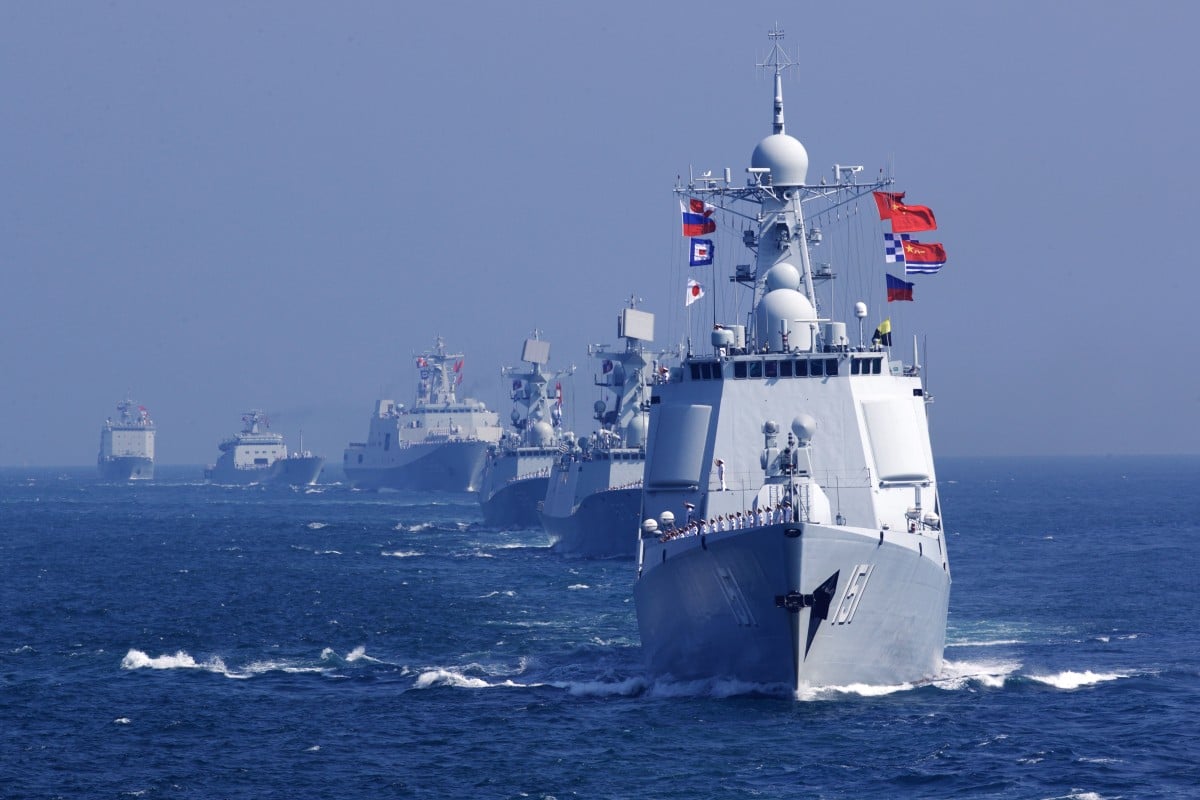
Chinese warships pictured at the end of joint exercise with the Russian navy in 2016. Photo: Xinhua
China will hold a naval parade next month to mark the 70th anniversary of the founding of the People’s Liberation Army Navy and will invite more than a dozen of foreign navies to participate.
The parade will take place on April 23 in the Yellow Sea off the coast of Qingdao in Shandong province, Ren Zhiqiang, a spokesman for the Ministry of National Defence, said on Thursday.
Ren did not provide further details of the parade but military analysts said the exercise would give the navy the opportunity to display its rapidly growing strength and show how that has increased in the past 12 months.

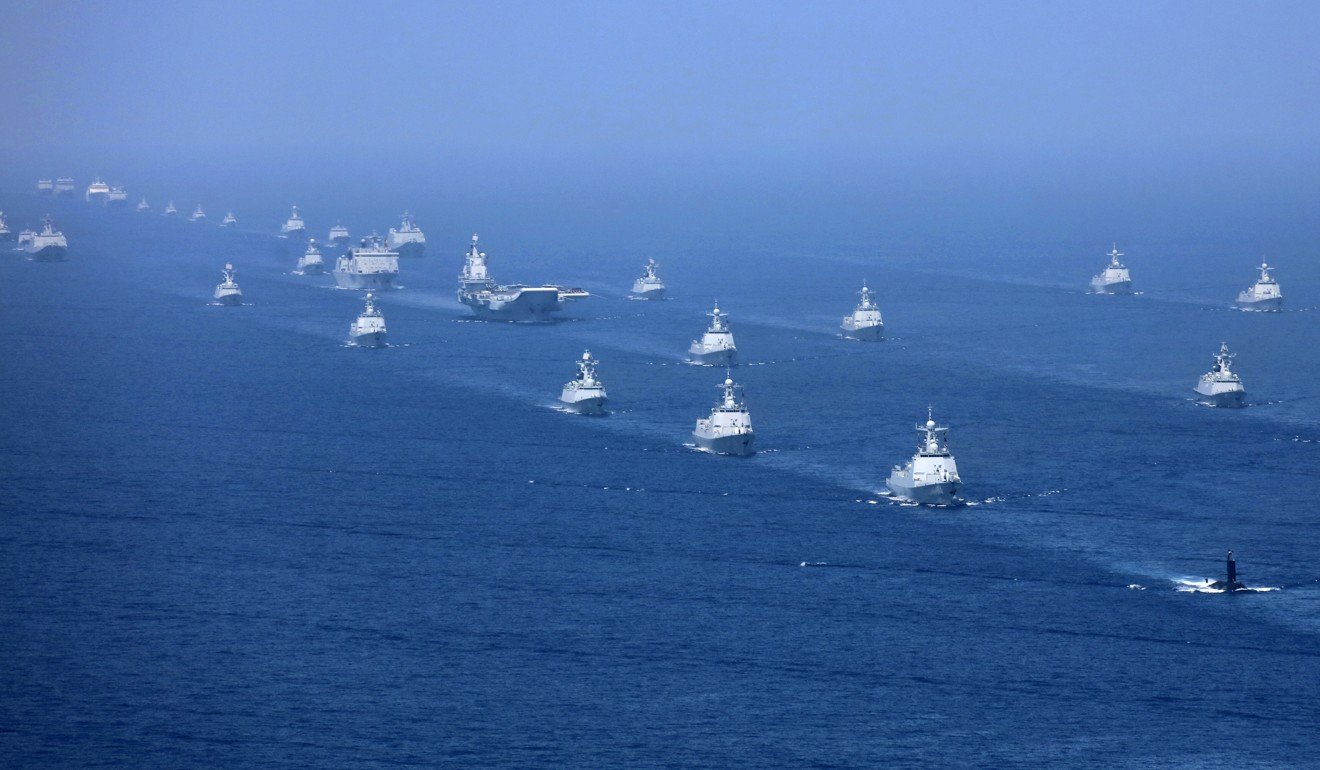
In April last year a naval review in the South China Sea featured a total of 48 vessels and 76 planes, including China’s first aircraft carrier, the Liaoning, its Type 094A and 095 nuclear submarines, 052D guided missile destroyers and J-15 fighter jets.

The experts expect that next month’s event will provide a showcase for several new and more powerful vessels including its home-grown aircraft carrier Type 001A, the Type 055 – Asia’s most powerful destroyer – and several nuclear submarines.

“The fact that China is holding the naval parade just one year after the South China Sea review shows the great importance [the leadership] attaches to the development of China’s maritime interests, the navy and its expansion,” navy expert Li Jie said.

Chinese President Xi Jinping joined the crew on the deck of the cruiser Changsha following last year’s naval review. Photo: Xinhua

China also held a major naval parade in 2009 to mark the navy’s 60th anniversary.

It was smaller in scale than the upcoming extravaganza with 25 PLA vessels and 31 fighter jets taking part.

Fourteen foreign navies sent ships to the 2009 parade, including the USS Fitzgerald from America and the guided-missile cruiser Varyag from Russia. France, Australia, South Korea, India and Pakistan also joined in the event.

More foreign countries are expected to join the party this year as the PLA has become more active internationally and China has sold more warships to foreign navies.

China’s new veterans’ law to be reviewed at National People’s Congress next week

“The parade is more like a birthday party for the PLA Navy and the participation of foreign navies is a matter of diplomatic courtesy with few military implications,” said Yue Gang, a former PLA colonel.

Yue said the US and its allies would attend despite the rising tensions between the two sides.

Since 2015 the US and Chinese navies have engaged in a series of confrontations in the South China Sea as China strengthens its military presence in the region and the US has sought to challenge Beijing’s claims to the waters by conducting what it describes as “freedom of navigation” operations.

“I don’t expect they will send any of the warships that have taken part in such operations [to the parade],” Yue said.

China has greatly expanded its naval capabilities in recent years. Photo: AP

It has been reported that the Japanese Maritime Self-Defence Force has expressed an interest in joining the parade and the Philippines – which has a rival claim to the South China Sea – is planning to send a vessel to the event for the first time.

Li said militaries such as the US and Japan would not want to miss the chance to observe the PLA Navy closely.

“In addition, greater transparency [through the parade] will also help reassure smaller regional partners such as the Philippines that China is a friendly power despite its growing military strength,” he said.

China held its first naval parade in 1957 and April’s display will be the sixth such event.

Sailors also took part in the parade through Tiananmen Square to mark the foundation of the People’s Republic on October 1 1949.

Source: SCMP

Law of Unintended Consequences

continuously updated blog about China & India

ChiaHou's Book Reviews

continuously updated blog about China & India

What's wrong with the world; and its economy

continuously updated blog about China & India