28/04/2020
SHANGHAI (Reuters) – Apple Inc’s (AAPL.O) discounts on the iPhone 11 in China and the release of a new low-price SE model have put the company in a better position than rivals to weather a coronavirus-related plunge in global smartphone demand.
While China, which accounts for roughly 15% of Apple’s revenue, appears to be a rare bright spot, investors will be keen to get a picture of global demand when the Cupertino, California-headquartered company reports second-quarter results on Thursday.
The iPhone maker has shut retail stores in the United States and Europe following the COVID-19 outbreak, and China is the only major market where it has been able to reopen all shops.
Consumer spending is expected to be muted as the pandemic has crippled economies and Apple, the world’s second-most valuable tech company, is better armed with the launch of its new price-conscious iPhone model, analysts said.
“Apple is better positioned than most to experience a rapid recovery in a post COVID world,” Evercore analyst Amit Daryanani said in a research note. “We see demand as pushed out, not canceled.”
He added that the launch of the $399 iPhone SE suggested that Apple’s supply chain was getting back on its feet after weeks of shutdown earlier this year.
Analysts expect Apple to report a 6% drop in revenue and an 11% fall in net income in its fiscal second quarter, according to Refinitiv data.
On the other hand, Chinese brands such as Oppo and Vivo who have steadily moved to offer high-end models to challenge iPhones, stand to lose marketshare as bargain hunters choose Apple.
Earlier this month, several online retailers in China slashed prices of the iPhone 11 by as much as 18% – a tactic Apple has used in the past to boost demand. And while initial social media reaction to the new iPhone SE was muted, analysts said they were seeing a pick up in demand.
The cheaper iPhone SE could tempt iPhone owners to opt for a newer device, something they might have otherwise delayed in a weak economy, said Nicole Peng, who tracks the smartphone sector at research firm Canalys.
“People want to avoid uncertainty in a downturn,” she said. “Having a brand like Apple that can showcase quality and make people less worried about breakdowns or after-sales service can bring in buyers.”
CHEAP IS GOOD
Early data suggests that the Chinese smartphone market is recovering rapidly in the aftermath of the virus, and Apple has emerged relatively unscathed.
Sales of iPhones in China jumped 21% last month from a year earlier and more than three fold from February, government data showed, meaning March-quarter sales in the country were likely to have slipped just 1%.
To be sure, a recovery in Chinese demand won’t offset sales lost in the United States and Europe. And the company is yet to launch a smartphone enabled with 5G wireless technology like those offered by Asian rivals, a disadvantage for Apple so far.
But those same expensive 5G models may not sell well in the current climate of frugality, analysts said.
“If there are no massive subsidies (in China), I doubt there will be many smartphone users who will be eager to upgrade to 5G,” said Linda Sui, who tracks the smartphone sector at research firm Strategy Analytics.
Sui expects iPhone shipments in 2020 to be down 2 percentage points at the most, versus double digit declines at Chinese firms.
Apple also has revenue from its services business to fall back on. It has leveraged its large iPhone customer base to boost services revenue from music, apps, gaming and video.
“Apple’s Services segment should remain resilient in today’s work-from-home environment, thereby demonstrating the durability of Apple’s model,” Cowen analyst Krish Sankar said.
Source: Reuters
Posted in 5G models, 5G wireless technology, accounts, after, analyst, analysts, appears, Apple, Apple Inc’s (AAPL.O), apples, are bright spot, armed, Asian, avoid, back on its feet, better, blow, brand, breakdowns, Buyers, California-headquartered, canceled, cheaper, China, Chinese brands, climate, Company, Consumer spending, coronavirus-related, COVID, COVID-19 outbreak, crippled, Cupertino, current, demand, discounts, downturn, drop, earlier, economies, Europe, Evercore, expected, experience, fall, February, fiscal, fold, following, from, frugality, fter-sales service, global, Government, income, investors, IPhone, iPhone 11, iPhone SE, just, last month, launch, low-price, Major, maker, March, market, marketshare, model, muted, net, new, online retailers, only, Oppo, pandemic, plunge, position, Post, price-conscious, prices, put, quality, quarter, rapid, reaction, recovery, Refinitiv data, release, reopen, reports, research note, results, retail stores, Revenue, rivals, roughly, Sales, SE model, second-quarter, Shanghai, shops, showcase, shut, shutdown, slashed, slipped, smartphone, social media, Strategy Analytics, suggested, Supply chain, tactic, this year, Three, Thursday, to cushion, Uncategorized, uncertainty, United States, Virus, Vivo, weak economy, weather, weeks, World, world’s second-most valuable tech company, worried, year |
Leave a Comment »
10/04/2020
BEIJING (Reuters) – China will promote the sales of export products in domestic markets, as foreign trade faces unprecedented challenges due to the coronavirus pandemic, an assistant commerce minister said on Friday.
As the coronavirus spreads to almost all of China’s trading partners, the world’s second-largest economy is set to reach a grim milestone for full year growth, with the pace of expansion likely to be the slowest since the Cultural Revolution ended in 1976. And, the export sector is facing millions of job losses and factory shutdowns.
“Due to the rapid spread of the epidemic in the world, foreign demand has slumped and the biggest difficulty facing foreign trade companies is the plunge in orders,” said Ren Hongbin, the assistant minister at the Ministry of Commerce.
He said firms across the board have had their orders cancelled or delayed, and new orders are “very hard to sign”.
“The uncertainty about the pandemic has become the biggest uncertainty for foreign trade development.”
Forecasters expect China’s 2020 growth could be nearer the 2.0% mark – the slowest in over 40 years – due to the sweeping impact of the pandemic both at home and overseas. The economy grew 6.1% last year.
China’s overseas shipments fell 17.2% in January-February from the same period a year earlier, marking the steepest fall since February 2019. Imports sank 4% from a year earlier.
Among the government measures to support the sector, China is accelerating efforts to build online trade fairs and guiding exporters to work with e-commerce retailers for sales in domestic markets and coordinating with its trading partners to stabilise supply chains, said Ren.
The Canton Fair, China’s oldest and biggest trade fair due to take place online, will feature live-streaming services for participants, Li Xingqian, another commerce ministry official, told the same briefing. The fair was originally scheduled to begin on April 15, but was postponed due to the coronavirus outbreak.
China is willing to boost trade relations with other countries, including the United States, under the new circumstances, said Ren, adding that Beijing hopes to work together with Washington to promote bilateral trade.
Both countries have been engaged in a near two-year long trade war with tit-for-tat tariffs on each other’s goods, before negotiators called a truce with an interim trade deal in January.
Source: Reuters
Posted in 0, 1, 10, 11, 12, 13, 14, 15, 16, 17, 18, 19, 1976, 2, 20, 21, 22, 23, 24, 25, 26, 27, 28, 29, 3, 30, 31, 4, 5, 6, 7, 8, 9, April, batters, Beijing, bilateral trade, cancelled, Canton Fair, challenges, China, China’s, Commerce minister, companies, coronavirus, coronavirus outbreak, Coronavirus pandemic, Cultural Revolution, delayed, domestic markets, domestically, encourages, epidemic, export goods, export products, export sector, Factory, February, foreign demand, foreign trade, global, imports, interim trade deal, January, job losses, live-streaming services, milestone, millions, Ministry of Commerce, Negotiators, oldest and biggest trade fair, online, orders, overseas shipments, pandemic, plunge, promote, Sales, shutdowns, slumped, spreads, tit-for-tat tariffs, Trade, trade war, trading partners, Uncategorized, uncertainty, United States, unprecedented, Virus, Washington, World, world’s second-largest economy |
Leave a Comment »
29/02/2020
- Purchasing managers’ indexes for both manufacturing and service sectors drop to all-time lows
- Steep falls raise questions over extent of damage epidemic has caused to China’s economy and how long it will take the country to recover
Many Chinese factories have faced a labour shortage as migrants have been unable to return to work because of the coronavirus outbreak. Photo: AFP
The damage caused by the
coronavirus outbreak to China’s US$14 trillion economy could be much worse than Beijing hoped, as official measures for the country’s factory and service activity indicated on Saturday, threatening President Xi Jinping’s vision for 2020 and underscoring his urgent appeal to get production back to normal.
Monthly economic indicators for February sank to all-time lows as the coronavirus halted China’s manufacturing machine and froze activity in the service sector – from retailing to recycling – painting a bleak picture of the world’s second-biggest economy and challenging Beijing’s repeated assurance that the impact would be manageable and short-lived.
Covid-19, the disease caused by the coronavirus – was first reported in Wuhan in December. Since then it has spread to more than 50 countries and more than 85,000 people have been infected. The outbreak has disrupted travel and cargo shipments, and caused stock markets to slump.
China’s official February purchasing managers’ indexes (PMI) for both manufacturing and services, released by the National Bureau of Statistics on Saturday, confirmed fears that China’s economy was in bad shape and fanned speculation that it may even contract in the first quarter.
Larry Hu, chief China economist at Macquarie Capital in Hong Kong, said in a note that Beijing might report negative growth for “the first time since the Cultural Revolution”.
The manufacturing PMI, which measures factory activity, dropped to 35.7 in February – below the previous all-time low of 38.8 set in November 2008 during the global financial crisis – from 50 in January when the impact of the epidemic was not apparent.
A reading below 50 indicates a contraction in activity.
The February PMI figures confirmed fears that China’s economy was in bad shape. Photo: AFP
All of the sub-indexes of the PMI pointed to the difficult situation facing Chinese factories. Output plummeted, new orders vanished, exports and imports stopped, and logistics were badly disrupted. Input prices, which reflects the costs factories must pay, was the only sub-index that remained above 50.
The non-manufacturing PMI – a gauge of sentiment in the services and construction sectors – also dropped, to 29.6 from 54.1 in January. This was also the lowest on record, beating the previous low of 49.7 in November 2011, according to the China Federation of Logistics and Purchasing, which produces the index with the National Bureau of Statistics.
The declines in the February reflect the difficulties businesses are having in bringing production back online due to shortages of labour as well as difficulties receiving supplies or shipping goods to market because of transport restrictions enacted to contain the spread of the virus.
An extended slump would put upwards pressure on unemployment, especially among small, private sector service firms. Beijing, which worries that rising joblessness could cause social unrest, has called on local governments to remove unnecessary restrictions to get businesses back to work.
The employment sub-index in the manufacturing PMI fell to 31.8 in February.
“It is not because factories have stopped hiring migrant workers, it is because the flow of migrant workers to factories has been blocked,” said Hua Changchun, an analyst at brokerage Guotai Junan Securities. “There’s no point talking about resuming production if workers can’t return to their jobs.”
Zhang Qiqun, a researcher with the Development Research Centre of State Council, said in a statement that the major economic indicators for this quarter would see “obvious drops” and China must “be prepared”.
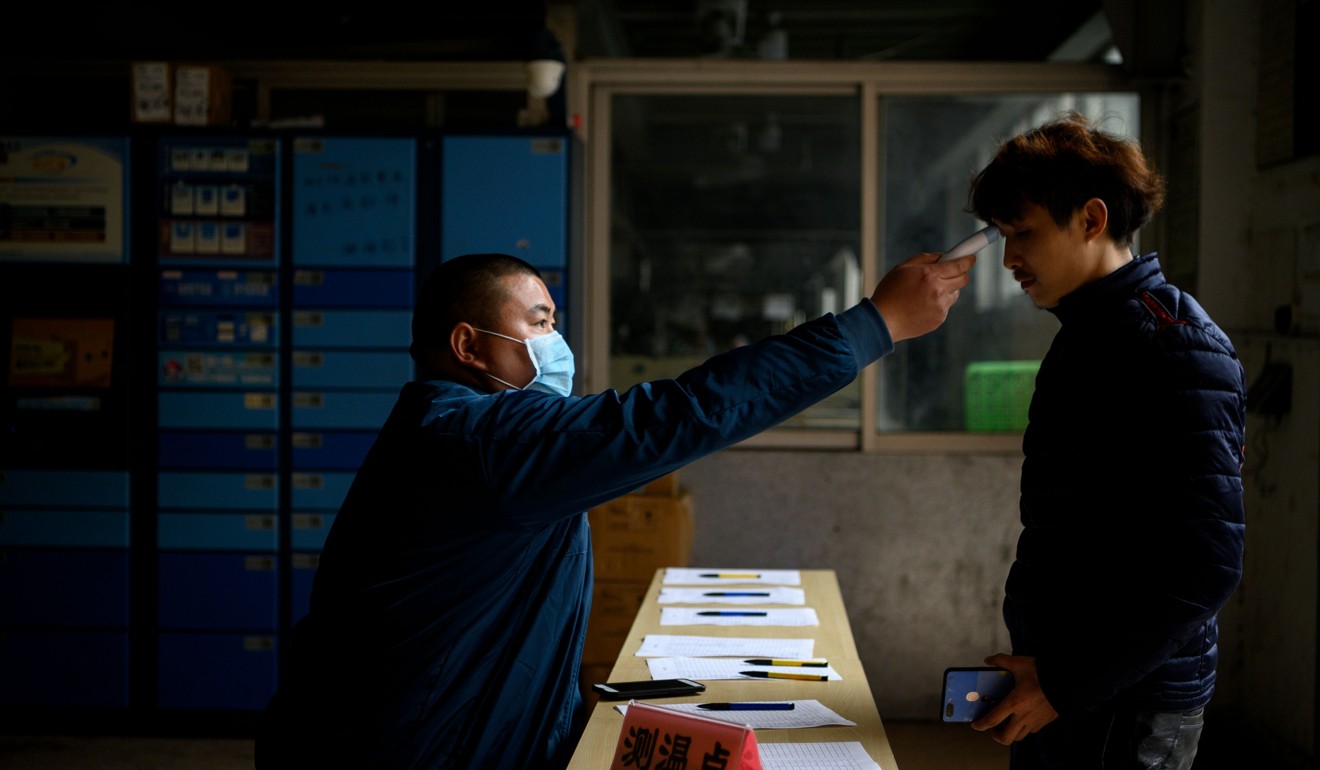
The employment sub-index in the manufacturing PMI fell to 31.8 in February. Photo: AFP
How quickly China can dig itself out of the coronavirus hole is a matter of debate.
According to the PMI survey, about 90 per cent of medium and large-sized manufacturers are expected to resume production in March, meaning about 10 per cent will still be closed four weeks from now.
As for small firms, the industry ministry said this week that two-thirds would still be closed at the end of February.
China’s production difficulties have resulted in economic problems for nations around the world that rely on supply chains that begin or pass through the country. The global spread of the coronavirus will only exacerbate the problem.
Barclays and Nomura forecast China’s first-quarter growth at 2 per cent, while Capital Economics said it would contract in year-on-year terms.
“The sharp drop in China’s manufacturing PMI in February reinforces our view that the normalisation in economic activity will be delayed,” said Xing Zhaopeng, an economist at Australia & New Zealand Banking Group.
“There’s scant chance for a V-shaped rebound – the authorities are using targeted aids more than stimulus to stabilise the economy and that will lead to a gradual bounce.”
The National Bureau of Statistics tried to put a brave face on the data, saying there would be a substantial improvement in March.
“The resumption of work is ramping up and market confidence is steadily recovering,” said Zhao Qinghe, a senior statistician at the NBS.
“Although the novel coronavirus pneumonia epidemic has caused a larger impact on production and operations of Chinese enterprises … currently the epidemic has come under initial containment, and the negative impact on production is gradually weakening.”
Source: SCMP
Posted in Beijing, China Federation of Logistics and Purchasing, China’s economy, coronavirus, cost, COVID-19, Cultural Revolution, Development Research Centre, Hong Kong, larger, manufacturing and service sectors, national bureau of statistics, plunge, purchasing managers’ indexes (PMI), State Council, Uncategorized |
Leave a Comment »



 CHINDIA ALERT: You'll be living in their world, very soon