Archive for ‘PM Modi’

28/12/2018

Collapse in India’s onion prices could leave Modi smarting in election

HIVARGAON/MUJAHIDPUR, India (Reuters) – A spike in the price of onions has led to the ouster of governments in Indian elections in the past. Now, prices of the staple have collapsed, and many impoverished farmers are saying they will make Prime Minister Narendra Modi pay in next year’s general election.

Steep drops in recent weeks in the prices of onions and potatoes, both staple foods for India’s 1.3 billion people, have badly hit the rural economy in large states.

In interviews with dozens of farmers last week, Reuters reporters found resentment welling against Modi’s Hindu nationalist Bharatiya Janata Party (BJP) for not helping support incomes in the countryside, where a majority of the population lives.

“Whatever they do in the coming months, I will vote against the BJP. I won’t repeat the 2014 mistake,” said Madhukar Nagare, an onion grower from Nashik in Maharashtra state, referring to his backing the BJP at the last general election.

In the 1998 state elections, a sharp spike in onion prices led to the fall of the BJP government in the capital New Delhi.

In the 1980 general election, sky-high onion prices helped former Prime Minister Indira Gandhi dislodge a coalition government that had included politicians who later formed the BJP.

In recent weeks, loss-stricken farmers have staged protests, blocked highways and dumped onions on the road after prices plunged to as low as one rupee (1.4 U.S. cents) per kg for a crop that costs about 8 rupees a kg to produce.

But because of large cuts taken by middlemen, consumers have not benefited from the low prices.

In Maharashtra, the top onion producing state, farm prices have fallen 83 percent, dragged down by surplus supplies from the previous season’s crop and lower export orders from the Middle East and Southeast Asia.

And in India’s most populous state of Uttar Pradesh, which was crucial in Modi’s election win in 2014, there is a similar problem with low potato prices.

Maharashtra and Uttar Pradesh are both dominated by rural voters and together send 128 lawmakers to the 545-member lower house of parliament. It means that big losses in these two states could either see Modi lose the next election which is due by May or his party be forced to form a coalition government. Farmers say shortcomings in a government crop support programme, and weak overseas demand have combined to produce the current glut of onions. And as prices have plunged, fertiliser and crop nutrient costs have risen, thanks in part to a weak rupee.

Perhaps most important of all, the BJP came into office in 2014 determined to shift away from subsidies. That may have been fine when crop prices were relatively high but as they crashed it has exposed the party in farm areas.

The prime minister’s office did not respond to a request for comment on this story.

NOT “GOOD DAYS”

Many farmers blame Modi for not fixing a price protection programme which barely covers 7 percent of India’s 263 million farmers, leaving most growers at the mercy of middlemen.

They also criticize him for not setting up more food processing and cold storage facilities, which would allow them to store their crops without having to sell immediately after the harvest.

“Expecting good days, as promised by Modi, we voted for the BJP, but now we are going through the worst phase,” onion farmer Madhav Pawase said, pointing to his rotting crop stocked in a temporary shed in Hivargaon village, about 230 km (140 miles) northeast of Mumbai, India’s financial hub.

“I’ve spent more than 80,000 rupees to produce 15 tonnes of onions from my two acres of land, but I won’t recover more than 3,000 rupees at the current market price,” he said.

Some farmers have decided to let onions rot in the field, saying that harvesting and transporting the produce to wholesale markets would only add to their losses.

A farmer sits on a tractor trolley after auctioning his onions at Lasalgaon market in Nashik in the western state of Maharashtra, India, December 19, 2018. REUTERS/Rajendra Jadhav

The BJP was defeated by the opposition Congress party in three major states in local elections this month because of rural anger, and Modi’s government is under pressure to come up with measures to placate farmers.

Congress wrote off farmers’ loans in the three states which it won and has demanded the federal government do the same across the country.

Although the BJP has so far not commented on the issue of farm loan waivers, Rajiv Kumar, the head of government think-tank NITI Aayog, has said that writing off debt is not the solution for the problems of the farm sector.

Syed Zafar Islam, a spokesman for the BJP, said the government had initiated a number of steps to help farmers get remunerative prices, including a project to electronically provide farmers with real-time market prices and help them directly sell to buyers, eliminating middlemen.

“It’s an ongoing process and the results will not just start reflecting in four years,” he said.

In a sign that the Modi administration is beginning to take the crisis seriously, the government on Friday doubled export incentives for onion farmers to 10 percent.

The move will result in better prices for onions in the domestic market, the government said in a statement.

POTATO PRICES

In Mujahidpur village of Uttar Pradesh, India’s biggest potato growing state, farmers lamented that prices have dropped by 86 percent to 2,500 rupees a tonne.

“I lost my entire investment of 100,000 rupees to grow potatoes on one hectare,” said Gopi Chand, 55, sitting next to bright yellow mustard fields.

He said he and some other farmers in the area had dumped potatoes in favour of growing mustard.

Farmers in the two states also complained of rising operating costs.

Prices of crop nutrient diammonium phosphate, popularly called DAP, have gone up by 400 rupees to 1,450 rupees for a bag of 50 kg, said Babloo Singh in Mujahidpur village. DAP rates have gone up because of higher overseas prices and India’s weaker currency.

“Higher input costs and record low potato prices have left us in deep debt,” said Singh. “The situation would have been different had there been more cold storage facilities and food processing plants in our state.”

The crash in vegetable prices hasn’t helped consumers either thanks to the chain of middlemen.

In Lasalgaon, the country’s largest onion trading hub, most farmers are selling their produce at 2 rupees a kg. But consumers in Mumbai are still shelling out 20 rupees. Between Lasalgaon and Mumbai, a distance of 220 km (135 miles), traders say onions pass through at least four layers of middlemen, adding a hefty margin at every stage.
28/12/2018

Modi’s clampdown on e-commerce in India may not win back votes of small retailers

NEW DELHI (Reuters) – India’s new curbs on e-commerce companies may not be enough to win over small store owners and traders in next year’s general election, with the key voting bloc still seething over what it sees as broken promises by Prime Minister Narendra Modi.

From Feb. 1, e-commerce firms such as Amazon.com and Walmart-owned Flipkart Group will not be able to sell products from companies in which they have an equity interest or form exclusive agreements with sellers.

Intended to prevent predatory pricing and deep discounting, the curbs follow intense lobbying by India’s many millions of small shopkeepers and the middlemen who serve them, particularly after Walmart this year spent $16 billion to acquire Flipkart.

The sector, which includes an estimated 25 million small store owners, largely supported Modi in the 2014 general election. While seeing the new rules as a step in the right direction, many small businesses feel too much damage has been done after Modi went back on promises that he would not allow the entry of foreign companies into the domestic retail sector.

“We clapped and voted for Modi believing in his promises. But what have we got is just a slap on our face,” said Pankaj Revri, president of a furniture market association in central Delhi.

The curbs, announced on Wednesday, surprised foreign e-commerce firms as little had been done by the government despite over three years of lobbying by domestic retailers.

Modi’s Hindu nationalist Bharatiya Janata Party is widely viewed as panicking after losing five state elections this month. The government, which must hold a general election by May, is also expected to come up with new support programs for farmers as their opposition grows due to low crop prices.

An opinion poll by TV channel ABP News this week predicted Modi’s party could fall short of a majority if the opposition forms an effective alliance in the national election.

EARNINGS HALVED

B.C. Bhartia, president of the Confederation of All India Traders, said some small businesses had seen earnings more than halve in the last few years as they struggle to compete with low prices offered by the American-controlled behemoths.

“The last minute policy change is too little and too late,” he said.

In particular, retailers and traders believe Modi turned a blind eye to what they say was the use of policy loopholes by major e-commerce companies to offer heavy discounts that allowed them to seize market share for goods such as electronic items.

Asked about those accusations, Amazon India said in a statement that it had always operated “in compliance with the laws of the land” and that had more than 400,000 small and medium businesses on its marketplace.

Flipkart declined to comment on the specific allegations.

Small Indian businesses have also been bruised by other Modi policies, including a sudden ban on the use of high-value currency notes in late 2016 and the launch of a national sales tax in 2017, both of which raised compliance costs.

Bhartia said if the government was serious about the concerns of small traders, it should prosecute violators of trade rules and appoint an independent regulator to curb malpractice.

FILE PHOTO: The logo of Flipkart is seen on the company’s office in Bengaluru, India, May 9, 2018. REUTERS/Abhishek N. Chinnappa

A government official told reporters on Thursday the administration could consider demands for a regulator in its new e-commerce policy, expected to be released in the coming months.

A September report by PricewaterhouseCoopers estimated online commerce in India would grow 25 percent a year for next five years, hitting $100 billion a year by 2022.

The new curbs could harm those growth prospects and discourage some foreign investors, said investment consultants.

“Sentiment is definitely hurt,” said Harminder Sahni of retail consultant Wazir Advisors, adding that the policy suggested online retail business should only be done by Indians.

Amazon said in its statement it was evaluating the new guidelines to engage as necessary with the government so it could remain true to its vision of “transforming how India buys and sells and generating significant direct and indirect employment.”

Flipkart said the advent of e-commerce had created hundreds of thousands of jobs and “the industry was set to be a major growth driver for the Indian economy and create millions of jobs in the future.”

“It is important that a broad market-driven framework through the right consultative process be put in place in order to drive the industry forward,” it added.

The government boasts of attracting nearly $223 billion foreign investment in the last four years, compared with about $152 billion in the previous four years.

17/12/2018

Narendra Modi: Is hardline Hindu politics failing India’s PM?

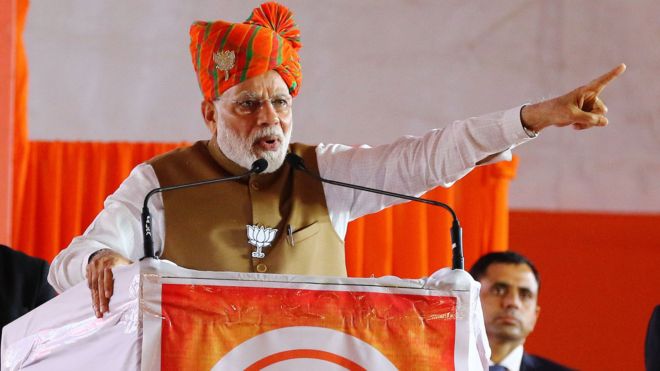
Prime Minister Narendra Modi addressing the election campaign rally ahead the state assembly polls , in Jaipur , Rajasthan, India , Dec 04,2018.Image copyrightGETTY IMAGES

Last week’s electoral losses in five states for India’s ruling party has led to speculation that its agenda of promoting hardline Hindu politics has backfired. The BBC’s Priyanka Pathak reports.

Prime Minister Narendra Modi’s Bharatiya Janata Party (BJP) lost to the main opposition Congress party in the Hindi-speaking heartland states of Madhya Pradesh, Rajasthan and Chhattisgarh, all of which they previously governed. Local parties swept up the other two states – Telangana and Mizoram – putting the BJP in a tough place ahead of general elections next year.

It appears that after winning no less than 13 state elections since coming to power in 2014, the BJP’s seemingly invincible electoral juggernaut is losing steam.

There is a great deal of introspection within and outside the party. And the main question is: has the BJP’s recent pursuit of a hardline Hindu agenda – known locally as Hindutva – backfired? Will a departure from an inclusive, development agenda to a polarising, communal one cost the BJP general election too?

These are legitimate questions because the party deployed the chief minister of the northern state of Uttar Pradesh, Yogi Adityanath, as its star campaigner in the five states that went to polls.

Mr Adityanath is widely considered a controversial figure because of his well-publicised anti-Muslim comments.

He addressed 74 election rallies while Mr Modi, who is usually his party’s star campaigner, addressed just 31.

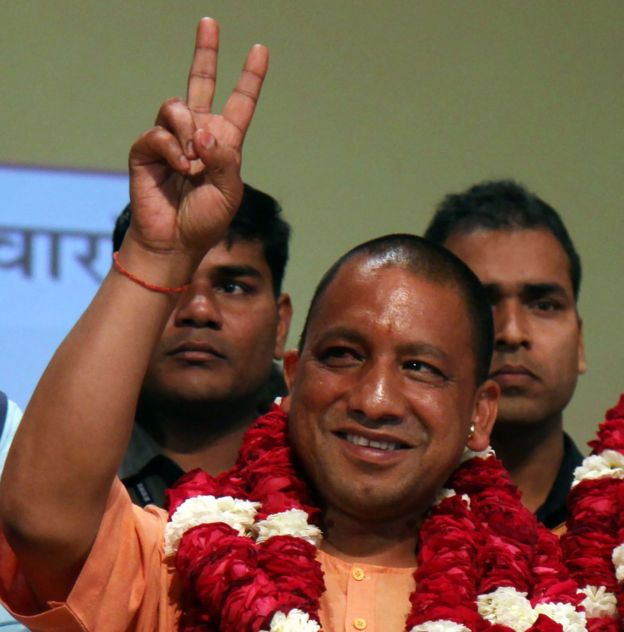
Adityanath victoryImage copyrightAFP
Image captionYogi Adityanath is seen as a “poster child” for a hardline Hindu agenda

Mr Adityanath also spent the past few months courting the Sangh Parivar – a “family” of Hindu nationalist organisations including the Rashtriya Swayamsevak Sangh (RSS), a hardline Hindu organisation with umbilical ties to the BJP.

The Sangh Parivar also includes the Vishwa Hindu Parishad (VHP), which has been at the forefront of a movement demanding the construction of a Hindu temple on the site of a 16th Century mosque that was torn down by Hindu mobs in 1992, provoking widespread riots that left thousands dead.

Hindus believe Ayodhya, situated in Mr Adityanath’s Uttar Pradesh state, is the birthplace of their revered deity Lord Ram, and say an older temple existed at the site before the mosque was constructed.

Mr Adityanath has announced the construction of a giant statue of Ram in the state, and changed the name of the historical city of Allahabad to the more “Hindu” sounding Prayagraj ahead of the forthcoming Ardh Kumbh Mela, one of the world’s largest religious gatherings.

But if Mr Adityanath was hoping to prove to the VHP leadership that he is a more willing pursuer of the Hindutva agenda and, therefore, a potential alternative to Mr Modi, the recent electoral defeats do not advance his case.

Many observers believe that the BJP’s defeats are because the party deviated from the development agenda that swept them to power in 2014. The pursuit of Hindutva has backfired, they say.

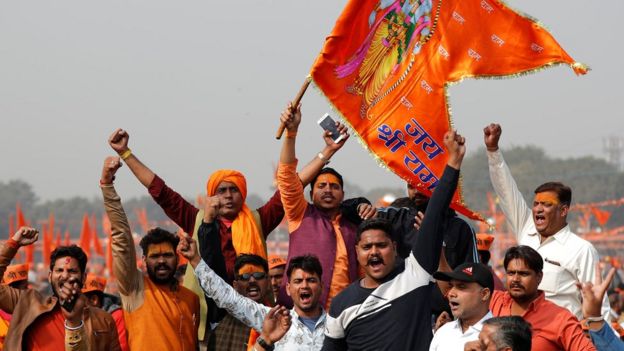
Supporters of the Vishva Hindu Parishad (VHP), a Hindu nationalist organisation, shout religious slogansImage copyrightREUTERS
Image captionHindus believe the disputed religious site of Ayodhya is the birthplace of one of their most revered deities

But some in the Sangh Parivar disagree, insisting that it is actually the opposite that is true. “Just the way people feel disenchanted with the economic policies of the government, the people have also lost faith in this government’s commitment to build the Ram temple. If the VHP and RSS have to come to the street to warn the government about it, what does it tell you? What does it tell the electorate?” one of them said.

Last week, tens of thousands of Hindus gathered in the capital, Delhi, to demand the expedited construction of the temple and criticised the government for failing to do so.

They chanted a striking slogan directly targeting Mr Modi’s stated development-first agenda: “Pehle Ram ko aasan do, phir humko sushasan do (First give Ram a throne, then give us good governance)”.

But it must be noted that while Mr Modi has never openly supported these hardline elements, his silence on issues such as an increasing number of attacks on Muslims over various issues like eating beef – cows are considered sacred in Hinduism and their slaughter is banned in many Indian states – is interpreted as a tacit approval for muscular Hindu politics.

But he now faces pressure to do more.

His government already leads a lacklustre economy. And this renewed pressure to recommit to Hindutva, despite its apparent failure as an electoral agenda, puts Mr Modi’s government in a difficult place.

There is also the fact that the RSS played a vital role in the BJP’s 2014 election victory by mobilising and galvanising voters. They are also credited for Mr Modi’s rise from state chief minister to a national figure. Apart from spearheading a sophisticated online and digital campaign in his favour, cadres also held 600 district-level meetings across the country to make Mr Modi a familiar name among the rural population.

Clearly, they cannot be ignored or offended.

So even as the liberals suggest that Hindutva has backfired and demand that the government refocus on the economy, there are voices within the BJP which are demanding a more strident return to the party’s “core” agenda – including the construction of the Ram temple and renewed focus on efforts to protect cows – to reassure their base that the BJP has not abandoned them.

The less-than-satisfactory economic performance will also make the Hindutva agenda more important, they say.

03/12/2018

Nehru wore rose on his suit, but was ignorant of farmers’ woes: PM Modi

“He (Nehru) used to wear rose and had the knowledge of gardens but did not know about farmers or farming, due to which the community faced hardship,” PM Modi was quoted as saying without naming the first Prime Minister.

Nehru wore rose on his suit, had knowledge of gardening but was ignorant of farmers' woes: PM Modi
PM Modi also stated that Nehru had objections about President Rajendra Prasad’s visit for the consecration of Somnath temple which was destroyed by foreign invaders and ‘renovated’ by Sardar Vallabhbhai Patel. (PTI File photo)

Campaigning for the upcoming assembly elections in Rajasthan, Prime Minister Narendra Modi on Monday resorted to ‘kaamdaar-naamdar’ (worker-dynast) jibe in his attack on Congress party which had earlier questioned his knowledge on Hinduism. The prime minister also invoked the first prime minister Jawahar Lal Nehru while talking about the agrarian distress in the country.

Without naming Nehru, Modi said a leader wore a rose and had knowledge of gardening but didn’t know about farming, which he held as the reason behind farmers’ distress. “He (Nehru) used to wear rose and had the knowledge of gardens but did not know about farmers or farming, due to which the community faced hardship,” PM Modi was quoted as saying by PTI.

He also claimed that Nehru had objections about President Rajendra Prasad’s visit for the consecration of Somnath temple which was destroyed by foreign invaders and ‘renovated’ by Sardar Vallabhbhai Patel.

Modi also stated that he is a petty “kaamdaar” who never made the claim of having complete knowledge of Hinduism, nevertheless, the “naamdaar” has the right to speak. He also asked the Congress party about the source of its expertise on religion. PM Modi has often labelled the Congress president to be a dynast or “naamdaar” on multiple occasions previously.

03/12/2018

PM Modi Creating 2 Indias, One For Ambani, One For Farmers: Rahul Gandhi

PM Modi Creating 2 Indias, One For Ambani, One For Farmers: Rahul Gandhi

Rahul Gandhi has been attacking the Modi government over Rafale jet deal.


NEW DELHI: Congress chief Rahul Gandhi on Monday attacked Prime Minister Narendra Modi over the farmers’ issue, saying he was making “two Hindustans” – one for Anil Ambani and the other for farmers.

He cited a media report which claimed that for 750 kg of onion, a farmer was given Rs. 1040 in Maharashtra.

“Modi-ji is making two Hindustans. One is the Hindustan for Anil Ambani — who without doing anything, without making an airplane, will get the Rafale contract worth Rs. 30,000 crore from Modiji.

“The second is the Hindustan for farmers — whose 750 kg of onion grown after four months of toil will get only Rs. 1040 from Modiji,” the Congress president wrote on Twitter.

The Congress has been attacking the Modi government over issues concerning the farmers, alleging that the government’s policies have left them in distress.

The government has rejected the claims and pointed out the number of steps it has taken for the welfare of farmers.

The Congress and its chief have also launched an offensive on PM Modi and his government, alleging corruption and favouritism in the fighter jet deal for purchase of 36 Rafale aircraft from France’s Dassault Aviation, a charge the government has strongly denied.

Law of Unintended Consequences

continuously updated blog about China & India

ChiaHou's Book Reviews

continuously updated blog about China & India

What's wrong with the world; and its economy

continuously updated blog about China & India