30/05/2020
- Chinese groups calling for more ‘fighting spirit’ are getting the upper hand on those who favour calm and cooperation, government adviser says
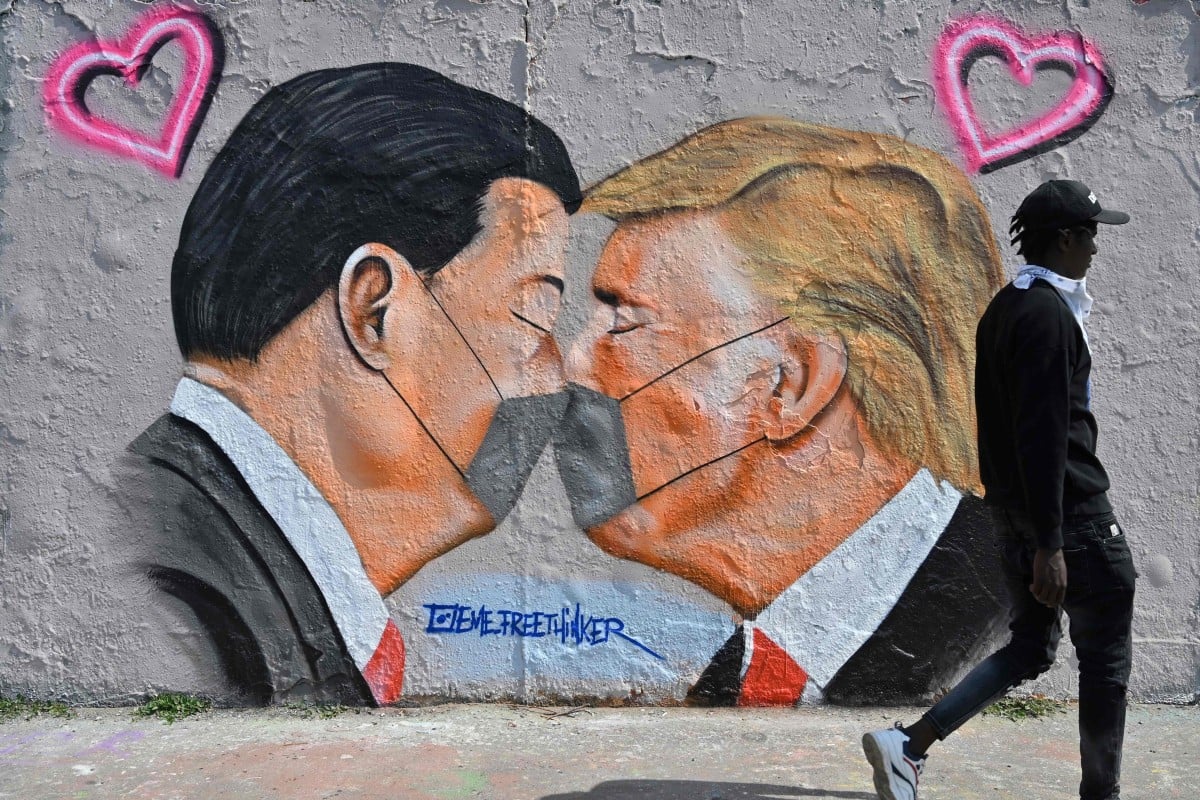
- From Hong Kong to Covid-19, trade to the South China Sea, Beijing and Washington are clashing on a growing number of fronts and in an increasingly aggressive way
Efforts to promote dialogue and cooperation between the US and China are failing, observers say. Photo: AFP
Moderates who favour dialogue and cooperation as a way to resolve China’s disputes with the
United States are losing ground to hardline groups bent on taking the fight to Washington, according to political insiders and observers.
“There are two camps in China,” said a former state official who now serves as a government adviser and asked not to be named.
“One is stressing the combat spirit, the other is trying to relieve tensions. And the former has the upper hand.”
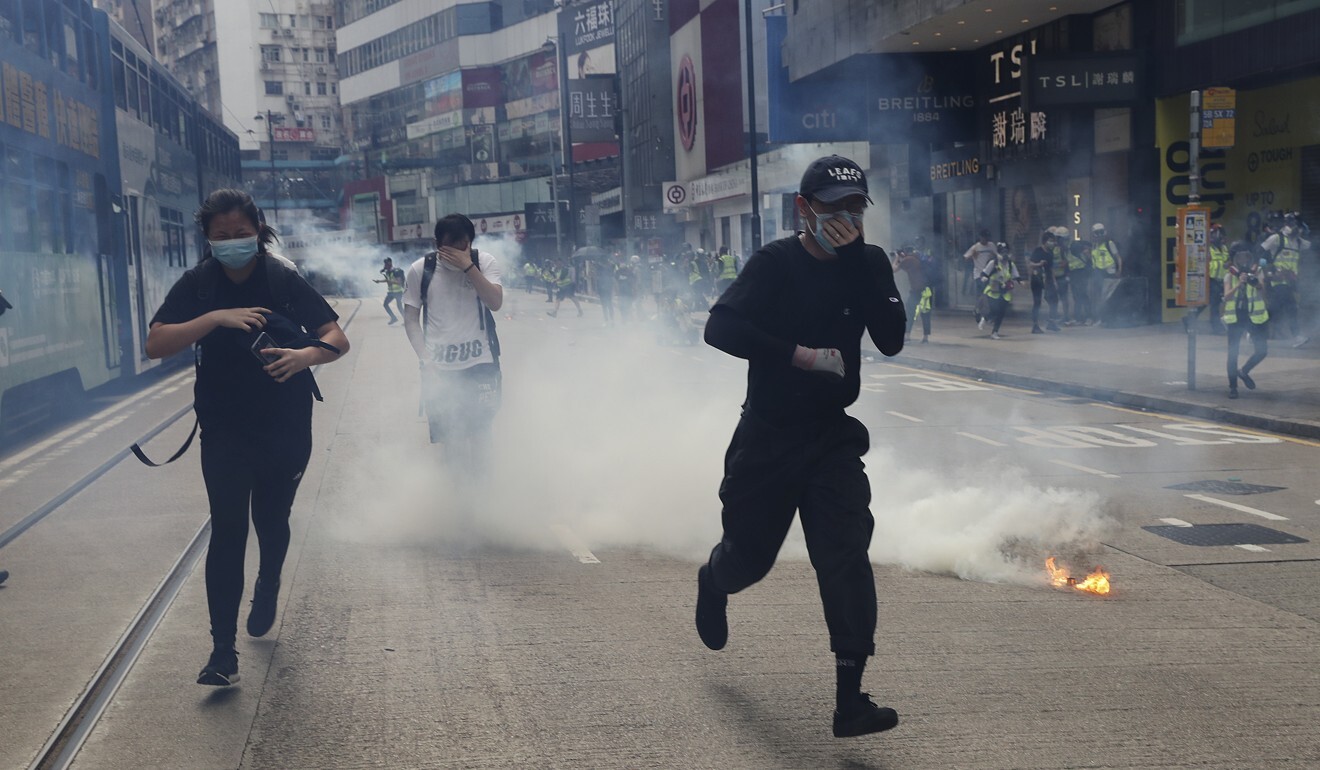
Relations between China and the US are under intense pressure. After Beijing moved to introduce a national security law for Hong Kong, US President Donald Trump said on Friday that Washington would begin eliminating the special policy exemptions it grants the city, as it no longer considers it autonomous from mainland China.
Beijing’s decision to enact a national security law for Hong Kong was met with anger from the US and other Western countries. Photo: Sam Tsang
The two nations have also clashed over trade, Xinjiang, Taiwan and the South China Sea, with the US passing several acts denouncing Beijing and sanctioning Chinese officials.
China has also experienced turbulence in its relations with other countries, including Australia and members of the European Union, mostly related to the Covid-19 pandemic
and Beijing’s efforts to position itself as a leader in the fight against the disease with its policy of “mask diplomacy”.
After Canberra appealed for an independent investigation to be carried out to determine the origins of the coronavirus, Beijing responded by imposing tariffs on imports of Australian barley, showing it is prepared to do more than just trade insults and accusations with its adversaries.
Pang Zhongying, a professor of international relations at Ocean University of China in Qingdao, said there was a worrying trend in China’s relations with other nations.
“We need political and diplomatic means to resolve the challenges we are facing, but … diplomatic methods have become undiplomatic,” he said.
“There are some who believe that problems can be solved through tough gestures, but this will never work. Without diplomacy, problems become confrontations.”
said during his annual press conference on the sidelines of the National People’s Congress last weekend that China and the United States must work together to prevent a new Cold War.
His words were echoed by
Chinese Premier Li Keqiang, who said during a press conference after the closure of the legislative session on Thursday that the many challenges facing the China-US relations could only be resolved through cooperation.
However, the government adviser said there was often quite a chasm between what China’s leaders said and what happened in reality.
“Even though we say we do not want a Cold War, what is happening at the working level seems to be different.” he said. “The implementation of policies is not properly coordinated and often chaotic.”
Tensions between China and the US have been in a poor state since the start of a trade war almost two years ago. After multiple rounds of negotiations, the sides in January signed a phase one deal, but the positivity that created was short-lived.
In February, Beijing expelled three reporters from The Wall Street Journal over an article it deemed racist, while Washington has ramped up its military activity in the South China Sea and Taiwan Strait, and threatened to revoke the visas of Chinese students studying science and technology in the US over concerns they might be engaged in espionage.
Beijing has also used its state media and army of “
Wolf Warrior” diplomats to promote its narrative, though many Chinese scholars and foreign policy advisers have said the latter’s nationalistic fervour has done more harm than good and appealed to Beijing to adopt a more conciliatory tone.
However, Hu Xijin, editor-in-chief of Chinese tabloid Global Times, said China had no option but to stare down the US, which regarded the world’s most populous nation as its main rival.
“Being contained by the US is too high a price for China to pay,” he said. “I think the best thing people can do is forget the old days of China-US ties”.
Jin Canrong, a professor of international relations at Renmin University in Beijing, wrote in a recent newspaper article that Beijing’s actions – notably enacting a national security law for Hong Kong – showed it was uncompromising and ready to stand its ground against the US.
Wu Xinbo, dean of international studies at Fudan University in Shanghai, agreed, saying relations between the two countries were likely to worsen in the run-up to the US presidential election in November and that Beijing should be prepared for a fight.
But Adam Ni, director of China Policy Centre, a think tank in Canberra, said the issue was not that the moderate camp had been sidelined, but rather Beijing’s perception of the US had changed.
“Beijing has woken up to the idea that America’s tough policy on China will continue and it is expecting an escalation of the tensions,” he said.
“The centre of gravity in terms of Beijing’s perception of the US has shifted, in the same way the US perception of China has shifted towards a more negative image”.
Beijing was simply responding in kind to the hardline, assertive manner of the US, he said.
Source: SCMP
Posted in aggressive way, annual, appealed, Australia, Australian, autonomous, ‘fighting spirit, “Wolf Warrior”, barley, Beijing, calm and cooperation, Canberra, chaotic, chasm, China-US relations, China-US ties, Chinese foreign minister Wang Yi, Chinese groups, Chinese premier Li Keqiang, Chinese scholars, Chinese students, Chinese tabloid, clashing, Cold War, conciliatory, confrontations, contained, cooperation, coordinated, coronavirus, COVID-19, Covid-19 pandemic, diplomacy, diplomats, editor-in-chief, Espionage, European Union, favour, foreign policy advisers, Fudan University, Global Times, growing, hardliners, Hong Kong, implementation, increasingly, independent investigation, lose out, main rival, Mainland China, moderate camp, moderates, more harm than good, narrative, National People’s Congress, national security law, November, number of fronts, observers, origins, policies, political insiders, presidential election, press conference, problems, promote, Qingdao, Renmin University, resolved, revoke, science and technology, Shanghai, sidelines, South China Sea, special policy exemptions, studying, Taiwan, Taiwan Strait, tariffs, The Wall Street Journal, think tank, threatened, tone, Trade, two camps, Uncategorized, uncompromising, undiplomatic, United States, upper hand, US President Donald Trump, US-China tensions, Visas, Washington, Western countries, world’s most populous nation, worsen, Xinjiang |
Leave a Comment »
02/05/2020
WINDHOEK, May 1 (Xinhua) — China’s poverty eradication policy and deliberate attempts to improve the lives of the rural population is a model for Namibia and Africa in general to follow in dealing with inequality in society, experts have said.
University of Namibia social and political analyst Ndumbah Kwamwayah said China has laid a strong foundation in dealing with poverty and emancipating its people since the days of Mao Zedong.
“Chinese literature especially the life journey of Chairman Mao is a good benchmark for developing countries that want to find ways of creating equal societies. If you check here in Namibia inequality and rural poverty are there despite our economy being agro-based.
“We need to take a cue from countries like China who have created better societies through improving agriculture production and mechanization through investing heavily in local people,” he said.
According to Kamwayah, China continues to value its agro-based economy as well as investment in rural development.
“China through its leaders in the past and present has come up with strong policies of decentralizing key services and also curbing rural urban drift through developing villages. Chinese literature also strongly captures the aspect of local development.
“In Namibia there are many regions including the Kunene, Zambezi and Kavango which are heavily affected by poverty. These need deliberate policies to be improved,” he said.
Political analyst from University of Namibia, Hoze Riruako said poverty eradication remains one of the biggest challenges confronting Namibia in contemporary times.
“What is more important is not to reproduce the Chinese way of doing things but to pick certain traits that can dent poverty and rural development from them,” he said.
Source: Xinhua
Posted in africa, agriculture production, agro-based, better societies, captures, chairman mao, challenges, China's, Chinese literature, confronting, contemporary, created, creating, dealing with poverty, decentralizing, deliberate attempts, developing, developing countries, economy, emancipating its people, equal societies, eradicate, especially, experts, find ways, good benchmark, improve, improving, inequality, Investing, Kavango, Kunene, leaders, life journey, lives, local people, Mao Zedong, mechanization, model, Namibia, policies, poverty, poverty eradication, poverty eradication policy, rural development, rural population, rural poverty, rural urban drift, social and political analyst, society, strong foundation, Uncategorized, University of Namibia, villages, WINDHOEK, Zambezi |
Leave a Comment »
09/03/2020
BEIJING, March 8 (Xinhua) — China has rolled out a slew of measures to strengthen social assistance for people most in need and fight against poverty, the Ministry of Civil Affairs said Sunday.
A census targeting poor people will be launched to ensure those eligible are covered by the social security system and have access to supportive policies, the ministry said at a teleconference on poverty relief.
Efforts will be intensified to support disadvantaged groups, including the elderly, the disabled and minors who are incapable of working, have no source of income, and have no others to rely on for support, it said.
The ministry also stressed encouraging social organizations to participate in poverty relief and accelerating the implementation of charity projects to combat poverty.
Targeted assistance will be provided for areas of extreme poverty, said the ministry, calling for more relief projects, financial support and personnel training for these regions.
Source: Xinhua
Posted in against, Census, China, fight, issues, Ministry of Civil Affairs, new, policies, poverty, Uncategorized |
Leave a Comment »
26/04/2019
BEIJING, April 26 (Xinhua) — The China-proposed Belt and Road Initiative (BRI) facilitates the compliance with the UN 2030 Agenda for Sustainable Development and the realization of the 17 Sustainable Development Goals in Latin America, said a senior official of a UN body based in Latin America.
Mario Cimoli, deputy executive secretary of the Economic Commission for Latin America and the caribbean (ECLAC), made the remarks in an interview with Xinhua.
Also as chief of the division of production, productivity and management of ECLAC, Cimoli has arrived in Beijing to participate in the second Belt and Road Forum for International Cooperation on April 25-27.
So far, 18 Latin American countries have signed the Memorandum of Understanding on jointly building the Belt and Road cooperation with China.
“The countries in Latin America view China as a fundamental actor,” he said. “The fact that 18 Latin American countries have joined the Belt and Road Initiative means that these countries think that China is necessary and China is also aware of the importance of dialogue. It’s a historical process.”
In his opinion, the BRI makes “greater integration, greater multilateralism and more dialogue” possible and “does good to Latin America.”
He said that both the 2030 Agenda and the BRI seek sustainable development and reduction of inequality and poverty, without contradicting with the proper model of each country.
“Given that the growth rates of Latin America will not be very high for the next few years, a rational process of cooperation such as the Belt and Road will surely help the region and allow each country to seek and improve their model of development and growth,” the ECLAC official said.
The BRI is a much more horizontal dialogue, a platform, in that sense that it is a process that helps and allows a much more positive coexistence despite current global tensions, he said.
In the dialogue with China, Latin America can demonstrate the importance of being an integrated area of trade, policies, and infrastructures in order to trade better with Asia, he said.
Cimoli also affirmed that the incorporation of new technologies in Latin America is a course under discussion, and dialogue with China can accelerate and improve the process.
Cimoli said his one observation of his ongoing China trip is the extensive use of electronic commerce among ordinary people.
He said when he went out to buy something, he found almost everyone use e-payments.
The way in which technologies immerge into the daily life of Chinese citizens is an example and would be a valuable contribution of China to the world and especially to Latin America, Cimoli said.
“The example of China shows the role that a state should play to trigger the technological development. In this dialogue with China, Latin America surely has to learn from the pragmatism of China,” he said.
The ECLAC official mentioned that China invests over 2 percent of its GDP in science and technology, while the average investment of Latin American countries in the field is between 0.4 and 0.5 percent of its GDP, plus, it appears to be swaying instead of stable state policies.
“There is a lot of cooperation to be done, much experience to be shared and much a platform for dialogue like the Belt and Road Initiative could do,” said Cimoli.
Source: Xinhua
Posted in Belt and Road (B&R), Belt and Road Initiative (BRI), chief of the division of production, productivity and management of ECLAC, China alert, deputy executive secretary, ECLAC official, Economic Commission for Latin America and the caribbean (ECLAC), horizontal dialogue, infrastructures, Latin America, Mario Cimoli, Memorandum of Understanding (MOU), policies, Sustainable development, Trade, UN 2030 agenda, Uncategorized |
Leave a Comment »
06/03/2019
BEIJING, March 5 (Xinhua) — China will lower its defense budget growth rate to 7.5 percent in 2019, from last year’s 8.1 percent, according to a draft budget report submitted to the annual session of the National People’s Congress (NPC) Tuesday.
The 2019 defense budget will be 1.19 trillion yuan (about 177.61 billion U.S. dollars), figures from the report show.
The rate marks the fourth straight year for the budgeted growth rate remaining single digit, following five consecutive years of double-digit increases.
China’s budgeted defense spending growth rate stood at 8.1 percent in 2018, 7 percent in 2017, and 7.6 percent in 2016.
“The Chinese government has always paid attention to controlling the scale of defense expenditure,” said He Lei, former deputy head of the Academy of Military Sciences.
Describing China’s defense budget increase as reasonable and appropriate, Zhang Yesui, spokesperson for the legislative session, said the rise aimed to “meet the country’s demand in safeguarding national security and military reform with Chinese characteristics.”
“China’s limited defense spending, which is for safeguarding its national sovereignty, security and territorial integrity, poses no threat to any other country,” Zhang said at a press conference Monday.
The expenditure has been mainly used for advancing defense and military reforms, supporting military training and diverse tasks, modernizing weapons and equipment, and improving welfare of service personnel, according to He, who is also a deputy to the NPC.
“The defense budget increase is appropriate against the backdrop of profound changes in the country’s overall strength, its security environment, and the global strategic situation,” He said.
China’s defense budget takes up a fairly small share of its GDP and national fiscal expenditure compared with other major countries, said He, noting that its military spending per capita and per soldier was also very low.
While the national defense spending in a number of major developed countries accounts for more than 2 percent of their GDP, the ratio was only about 1.3 percent for China in 2018.
The United States has increased its national defense expenditure for the fiscal year 2019 to 716 billion dollars, about four times the budget of China, the world’s second largest economy.
China’s military spending per capita is only about one-nineteenth of that of the United States.
“When it comes to whether a country poses a threat to other countries, the key is not that country’s national strength and armed forces, but the policies it adopts,” said Chen Zhou, research fellow with the Academy of Military Sciences.
“China has always been following the path of peaceful development and firmly adheres to a defense policy that is defensive in nature,” Chen said, noting that China’s development would not pose a threat to any other country.
He Lei highlighted China’s role in providing public security goods for the international community, saying the Chinese military had actively participated in UN peacekeeping missions, maintained security of marine passages, and engaged in international rescue and security cooperation.
“The growth in China’s defense spending is the growth of forces for world peace,” he noted.
Source: Xinhua
Posted in Academy of Military Sciences, armed forces, Chen Zhou, China alert, Chinese Characteristics, country's overall strength, defense budget, deputy to the NPC, GDP, global strategic situation, growth, He Lei, international community, international rescue and security cooperation, lower, military reform, national fiscal expenditure, National People's Congress (NPC), National security, peaceful development, policies, public security goods, research fellow, security environment, security of marine passages, spokesperson for the legislative session, UN peacekeeping missions, Uncategorized, world peace, Zhang Yesui |
Leave a Comment »



 CHINDIA ALERT: You'll be living in their world, very soon