

 Image copyright REUTERS
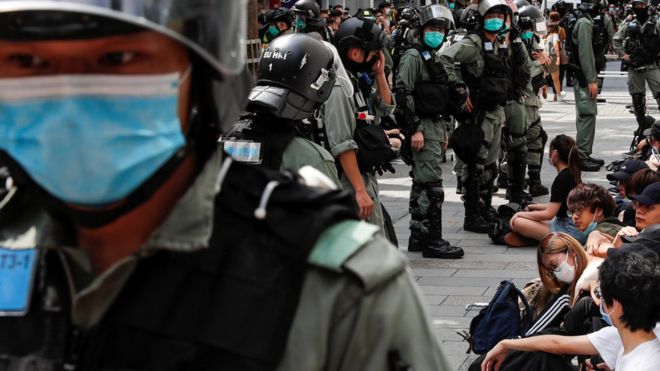
China is facing mounting criticism over a planned security law for Hong Kong which would make it a crime to undermine Beijing’s authority in the territory.
The UK and US said at a private session of the UN Security Council that the law would curtail the city’s freedoms.
China, which blocked a formal meeting, warned them to “stop interfering”.
Hong Kong’s autonomy is guaranteed by the 1997 agreement under which it was returned to China from the UK.
It enjoys some freedoms – of the press and association – unseen in mainland China.
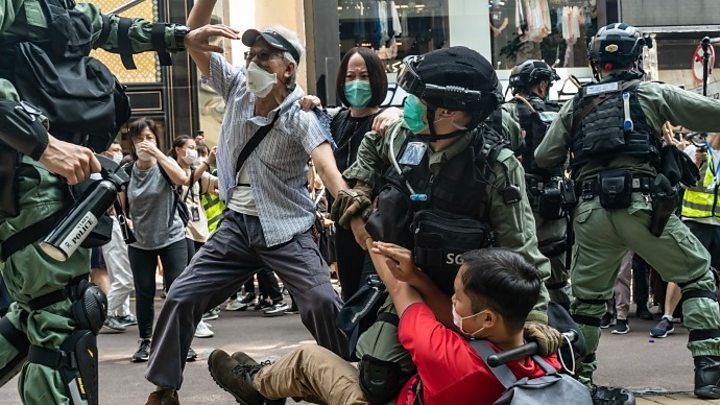
But there are fears the proposed law – which has sparked a wave of anti-mainland protests – could end Hong Kong’s unique status.
This week, Britain said that if China went forward with the law, it could offer British National (Overseas) passport holders a path to UK citizenship.
There are 350,000 BNO passport holders in Hong Kong who currently have the right to visit the UK for up to six months without a visa.
On Friday, the UK Home Office confirmed the new rights could be given to up to three million people with BNO status – as long as they applied for and were granted a passport.
China says all BNO passport holders are Chinese nationals, and if the UK changes this practice, it would violate international law.
Australia, Canada and the EU have also criticised the security law and its implications for Hong Kong.
Taiwan’s parliament has backed a plan to offer sanctuary to people who want to flee Hong Kong, but China – which considers Taiwan to be part of its own territory – has warned the island not to get involved.
On Friday, Chinese Foreign Ministry spokesperson Zhao Lijian urged other countries to stop interfering in the matter.
“We will take necessary measures to resolutely counter the wrong acts of external forces interfering in Hong Kong affairs”, he said.
What might the US do?
On Wednesday, US Secretary of State Mike Pompeo told Congress that Hong Kong no longer merited special treatment under US law, potentially paving the way for it to be stripped of trading privileges such as lower tariffs than mainland China.
US media reports that President Trump is considering a range of sanctions. These could include strong measures such as stripping Hong Kong of its trading privileges or milder options such as restricting visas and freezing the assets of Chinese officials.
He is expected to make an announcement later on Friday.
The EU has warned that imposing sanctions would not solve the crisis.
“Our relationship with China is based on mutual respect and trust… but this decision calls this into question and I think that we have to raise the issue in our continued dialogue with China”, EU High Representative for Foreign Affairs Josep Borrell said after talks with foreign ministers on Friday.
Hong Kong’s justice secretary Teresa Cheng told the BBC’s Chinese service that any threat of sanctions was unacceptable.
“Are the sanctions being imposed with a view to coerce another state to change their policy…? Any such sanctions are not going to benefit anyone”.
What is the law about?
China’s parliament has backed the security legislation, which would make it a crime to undermine Beijing’s authority in Hong Kong.
The resolution – which now passes to China’s senior leadership – could also see China installing its own security agencies in the region for the first time.
Full details about exactly what behaviour will be outlawed under the new security law are not yet clear. It is due to be enacted before September.
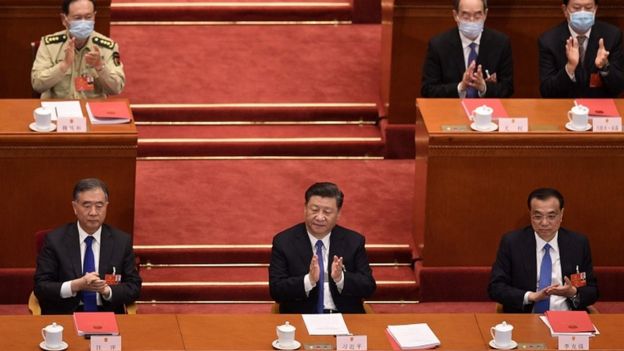 Image copyright AFP
However, it is expected to criminalise:
- secession – breaking away from China
- subversion – undermining the power or authority of the central government
- terrorism – using violence or intimidation against people
- activities by foreign forces that interfere in Hong Kong
Experts say they fear the law could see people punished for criticising Beijing – as happens in mainland China. For example, Nobel Laureate Liu Xiaobo was jailed for 11 years for subversion after he co-authored a document calling for political reform.
China’s foreign ministry in Hong Kong described US criticism of the new draft law as “utterly imperious, unreasonable and shameless”.
Source: The BBC

 CHINDIA ALERT: You'll be living in their world, very soon