Archive for ‘political turmoil’

12/06/2019

How Tiananmen crackdown left a deep scar on China’s military psyche

  • Many of those involved feel profound ‘guilt and shame’ over the lives lost in Beijing 30 years ago, according to two former PLA officers
  • Move to tone down language used to describe movement – as ‘political turmoil’ rather than a ‘counter-revolutionary rebellion’ – came from army
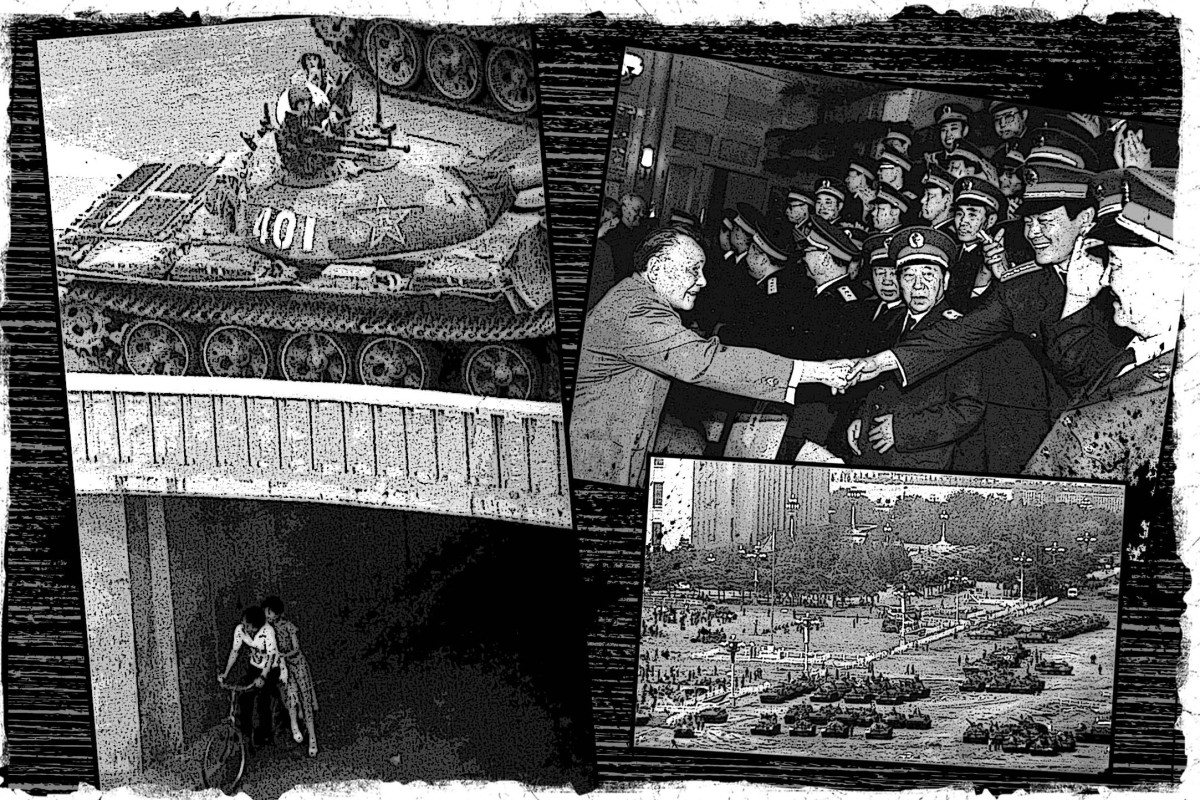
The brutal military crackdown on peaceful protesters in Beijing 30 years ago might have saved the Communist Party’s rule, but it has since become a cross to bear for the People’s Liberation Army.

Today, the world’s largest fighting force is still haunted by the 

Tiananmen Square

tragedy in 1989, despite efforts to rebuild its image. After the bloodshed, it was the military that suggested the pro-democracy student movement be referred to not as a “counter-revolutionary rebellion” but as a time of “political turmoil”, two former PLA officers told the South China Morning Post.

They said the move to tone down the language around the crackdown reflected the anxiety and shame felt by many rank-and-file officers over a fateful decision that has tainted the military’s reputation and legacy.

Up to that point, the PLA had been widely respected by the Chinese public. Even during the turbulent decade of the Cultural Revolution from 1966, the military was largely uninvolved. Rather, it was instrumental in bringing an end to the chaos and setting China on the path of reform and opening up.

The crackdown in 1989 was unprecedented for the PLA and dealt a crippling blow to its reputation and morale – and the question over the legitimacy of the decision to send in the tanks and open fire on the protesters remains.

“[I believe] the Tiananmen crackdown will be revisited one day – it’s just a matter of time. The ultimate responsibility will fall to those military leaders who directly implemented the decision,” a retired researcher with the PLA’s Academy of Military Science, who requested anonymity, told the Post.

PLA soldiers with automatic weapons eat ice creams as protesters plead with them to leave Tiananmen Square on June 3, 1989. Photo: Reuters

Throughout history and across cultures, following orders has been a fundamental principle of military service. But the absence of a written order on the mission from the commander in chief – late paramount leader Deng Xiaoping – puts its legality in doubt.

It is estimated that hundreds, or perhaps more than 1,000, civilians were killed during the crackdown that began on the night of June 3 and continued until the morning.

“No matter whether it is one or 10,000 people killed, it’s still wrong to shoot at unarmed civilians,” said a retired PLA officer who served in the army’s political department and also declined to be named. “But [the troops] had to do this dirty job because the party’s rule was in danger.”

According to the former military researcher, many commanders involved in the crackdown questioned the decision to use force to quell the protests, particularly since they had only been given a verbal order from above and never saw a written instruction from Deng, who was chairman of the Central Military Commission (CMC).
This was further complicated by the fact that Zhao Ziyang, the party’s general secretary at the time, openly opposed a military crackdown. Without the support and approval of the party’s chief, the operation violated the long-held principle of “the party commanding the gun”.
Even then CMC vice-chairman Yang Shangkun and Xu Qinxian, commander of the 38th Army Corps that had been sent to Beijing, had qualms about carrying out the verbal order, according to the former researcher.
It is not known how many troops were sent in to crush the protests, but the number could be as high as 200,000, according to a book by US-based scholar Wu Renhua.
Soldiers patrol Changan Avenue in Beijing on June 4, 1989. Photo: Jeff Widener/AP

The retired PLA political officer said the instruction to commanders was to “clear out Tiananmen Square by June 4 – and whoever stands in our way is an enemy of the state”.

“Most officers and soldiers were only trained to use heavy weapons like machine guns and tanks. They didn’t even know there were things like rubber bullets, tear gas or other kinds of non-lethal weapons for crowd control,” said the former officer.

“To meet the deadline to clean up the square, some commanders asked their troops to shoot into the air to scare away the crowds – that was the only thing they could think of doing,” he said.

But although they started off firing into the air, ricocheting bullets hit many protesters as they fled and in the chaos and bloodshed, inexperienced troops panicked and started firing into the crowd, according to the former officer.

The army’s clean image was destroyed overnight, and in the minds of many, renmin zidibing – the army of our sons – became the feared and reviled tool of a killing regime.

It also left a psychological scar on the military, which is reflected in the effort to tone down the narrative around the crackdown.

The former researcher said the push to use “political turmoil” instead of the more provocative “counter-revolutionary rebellion” to describe the movement first appeared in a military academy reference book, the Chinese Military Encyclopaedia, in 1997. He said it was proposed by military advisers who believed it could help soften attitudes towards the crackdown.
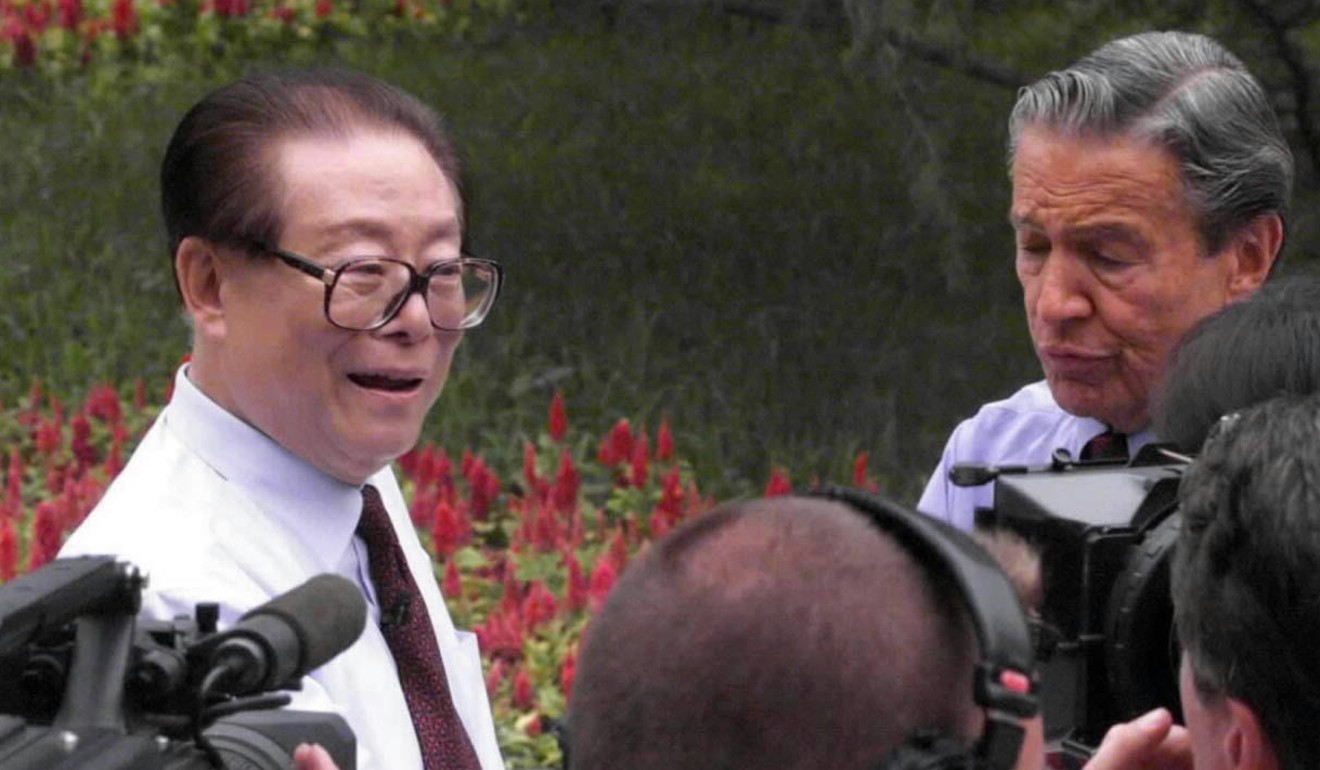
Then president Jiang Zemin with American journalist Mike Wallace during an interview in 2000. Photo: Xinhua

Former president Jiang Zemin spoke of the “political turmoil” in 1989 during an interview with American journalist Mike Wallace in 2000, and the wording has since been widely used by state media.

Meanwhile, the suppression of the protesters also prompted calls for a separation of the army and the party, so the PLA would be a “national” force rather than a political one.

But after 

a decade of debate

, the idea was squashed by the top leadership in 2007, on the eve of the PLA’s 80th anniversary. It was labelled as a plot by hostile Western forces to topple communist rule in China and is now a taboo subject.

“But despite banning discussion of military nationalisation, the calls from within the PLA to rehabilitate the military and for a review of what happened with the student movement have never stopped,” the former PLA political officer said.
“Many senior military officers believe the students weren’t attempting to overthrow communist rule – they were just asking for a better political system. That’s why calling it a counter-revolutionary rebellion is wrong.”
Curious Beijing residents gather to look at the military hardware in Tiananmen Square on June 7, 1989. Photo: AP
On Sunday, days ahead of the 30th anniversary, Defence Minister General Wei Fenghe

defended the Tiananmen crackdown

, telling a regional defence forum that putting an end to the “political turbulence” had been the “correct policy”.
“Throughout the 30 years, China under the Communist Party has undergone many changes – do you think the government was wrong with the handling of June Fourth?
There was a conclusion to that incident. The government was decisive in stopping the turbulence,” Wei said at the Shangri-La Dialogue in Singapore.
But according to the former PLA researcher, military top brass involved in the crackdown still felt profound “guilt and shame” over the lives lost.
“None of those people in the PLA would feel a sense of honour for participating in the crackdown,” he said. “Instead they harbour a deep feeling of shame.”
Source: SCMP
19/02/2019

Viewpoint: Should Britain apologise for Amritsar massacre?

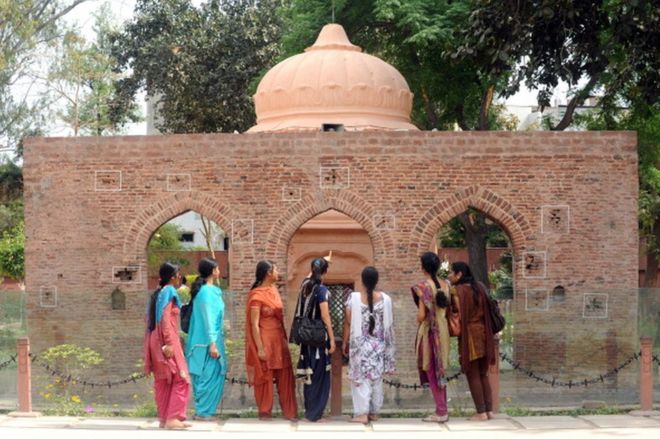
Indian visitors look at the bullet ridden wall at the historical site of the Jallianwala Bagh massacre in Amritsar on April 12, 2011Image copyrightAFP
Image captionVisitors can inspect a bullet-ridden wall at the site of the massacre

Hundreds of Indians attending a public meeting were shot dead by British troops in the northern Indian city of Amritsar in 1919. Historian Kim Wagner sifts fact from fiction as the UK House of Lords prepares to debate the massacre, including if Britain should apologise.

On 13 April 1919, Sergeant WJ Anderson witnessed first-hand the brutal massacre of hundreds of Indian civilians at Jallianwala Bagh, a public garden in Amritsar city.

“When fire was opened the whole crowd seemed to sink to the ground, a whole flutter of white garments, with however a spreading out towards the main gateway, and some individuals could be seen climbing the high wall,” Anderson later recalled.

“There was little movement, except for the climbers. The gateway would soon be jammed. I saw no sign of a rush towards the troops.”

He had served as the bodyguard of Brigadier General RH Dyer, who had rushed to Amritsar a few days earlier to quell what he believed to be a major uprising.

The crowd of more than 20,000 people, however, were not armed rebels. They were local residents and villagers from the surrounding countryside who had come to listen to political speeches or simply to spend a few hours in the gardens.

It was also the day of the Baisakhi festival, which marked the anniversary of the creation of the Khalsa, or Sikh community, and annually attracted thousands of visitors and pilgrims.

The crowd comprised Hindus, Muslims and Sikhs. Most were men and young boys, including some infants; only a few women were present.

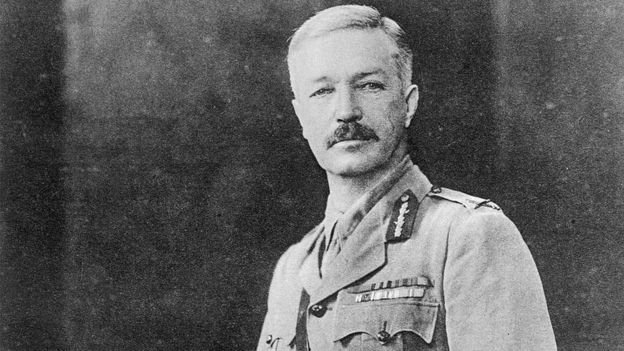
British Brigadier General R.E.H. DyerImage copyrightGETTY IMAGES
Image captionBrigadier General Dyer rushed to Amritsar to quell what he believed to be a major uprising

When Gen Dyer ordered his troops to cease firing, Jallianwala Bagh resembled a battlefield strewn with corpses. Between 500 and 600 people were killed, and probably three times as many wounded. The exact numbers will never be known for certain but the official death count, reached months later, was just 379.

In recent years, much of the public debate has focused on calls for a formal British apology – the demand has been led by, among others, Indian politician and author Shashi Tharoor.

Queen Elizabeth II visited the memorial at Jallianwala Bagh in 1997 and then Prime Minister David Cameron visited in 2013 – both showed their respect yet carefully avoided making an actual apology.

In December 2017, the Mayor of London, Sadiq Khan, nevertheless urged the British government to make just such a gesture during his own visit to Amritsar.

“I am clear that the government should now apologise, especially as we reach the centenary of the massacre. This is about properly acknowledging what happened here and giving the people of Amritsar and India the closure they need through a formal apology,” he said.

ritish Prime Minister David Cameron (C) along with Punjab State Chief Minister Parkash Singh Badal (2L), and Shiromani Gurdwara Parbandhak Committee (SGPC) President Avtar Singh Makkar (2R) visit the Sikh Shrine Golden temple in Amritsar on February 20, 2013Image copyrightAFP
Image captionOn his 2013 visit, Cameron avoided making an actual apology but said the massacre was “deeply shameful”

Exactly what happened at Jallianwala Bagh, however, remains unclear, and a century later, the actual circumstances of the massacre are still shrouded in myth and misconceptions.

There are, for instance, people, often with a nostalgic attachment to the Empire, who still insist that Gen Dyer only opened fire as a final resort when the crowd ignored his warning to disperse – even though the general himself was quite clear that he gave no such warning.

Similarly, the idea that the shooting was necessary and prevented much worse violence conveniently ignores the fact that Indian riots in April 1919 were in each and every case precipitated by British actions.

Factual inaccuracies are also to be found at the Jallianwala Bagh memorial today. Among other things, a sign claims that 120 bodies of the victims of the massacre were recovered from what has become known as the Martyrs’ Well. It’s believed that many people jumped into the well to escape the bullets.

But there is no evidence for this story, which appears to be based on a mix-up with the infamous well at Kanpur city, where the bodies of British women and children were disposed after a massacre in 1857.

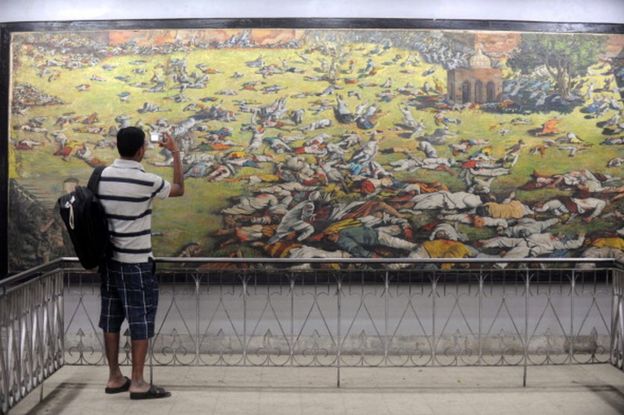
Visual depictions of the Jallianwala Bagh massacre also show machine guns being used, when the historical record is quite clear that the shooting was carried out by 50 Gurkha and Baluchi troops armed with rifles.

Gen Dyer also did not orchestrate the massacre, and deliberately trap the crowd inside the gardens, as some popular accounts have it.

An Indian man takes a photograph of a painting depicting the Jallianwala Bagh massacre in Amritsar on April 12, 2011. The Amritsar massacre, also known as the Jallianwala Bagh Massacre, took place on April 13, 1919 when British Indian Army soldiers on the direct orders of their British officers opened fire on an unarmed gathering killing at least 379 men, women and children, according to official records. AFP PHOTO /NARINDER NANU (Photo credit should read NARINDER NANU/AFP/Getty Images)Image copyrightGETTY IMAGES
Image captionThe crowd were not armed rebels but local residents and villagers

In fact, it was British panic and misreading of the political turmoil in India that was at the root of the violence.

While Indian nationalists were looking forward to political reforms and greater self-determination after the end of World War One, the British were still haunted by the spectre of the 1857 “mutiny”, an uprising that is often referred to as India’s first war of independence.

So, when riots broke out in Amritsar on 10 April – and five Europeans and dozens of Indians were killed – the authorities responded with immediate and indiscriminate force. Three days later, Gen Dyer entered what he mistakenly perceived to be a war zone.

Where popular depictions show a peaceful crowd of locals quietly listening to a political speech, Gen Dyer instead perceived a defiant and murderous mob, which had only days before run rampant through Amritsar. When he ordered his troops to open fire, it was an act of fear, spurred on by a disastrously flawed threat assessment.

None of this exonerates Gen Dyer or detracts from the sheer brutality of the massacre – nor does it justify the subsequent torture and humiliation of Indians under martial law. The indisputable violence of the Jallianwala Bagh massacre hardly requires any embellishment. Nevertheless, facts matter if we are to pay our respect to those who died rather than simply perpetuate politically convenient fiction. And to understand is not the same as to condone.

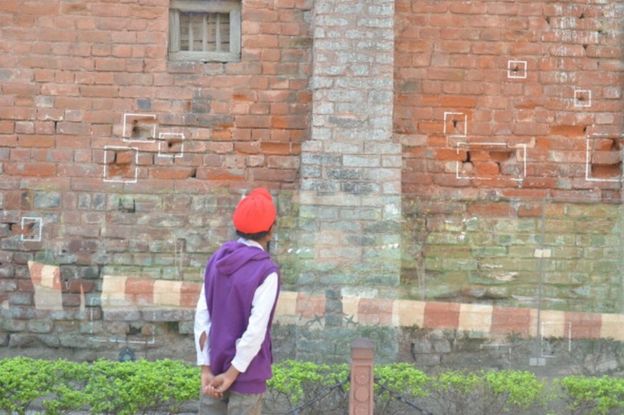
A visitor looking at the bullet marks on a wall on the eve of 95th anniversary of the massacre at Jallianwala Bagh on 12 April 2014 in Amritsar.Image copyrightGETTY IMAGES
Image captionThere are bullet marks on a wall in the garden

Apologies and centenaries, which are essentially about the present rather than the past, are rarely conducive to an honest and nuanced reckoning with history.

An apology from a British government in the throes of Brexit, at the moment, seems highly unlikely. It it indeed doubtful whether an official acknowledgement of the massacre would be construed as more than an act of political expediency.

The question thus remains whether an apology without a genuine understanding of the past can ever provide the “closure” that so many seek.

Source: The BBC

Law of Unintended Consequences

continuously updated blog about China & India

ChiaHou's Book Reviews

continuously updated blog about China & India

What's wrong with the world; and its economy

continuously updated blog about China & India