Archive for ‘10 year leadership change’

01/11/2016

For China’s Leaders, Age Cap Is but a Moving Number – China Real Time Report – WSJ

The past three turnovers in the inner circle of China’s Communist Party leadership have come with an age guideline for retirement: Those 67 years old or younger could stay; those 68 or older had to go.
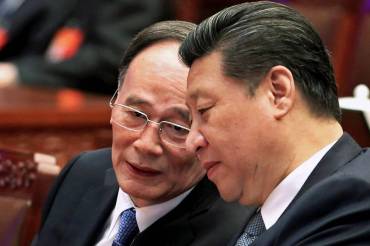
Now, comments from a senior party functionary are adding fuel to speculation that President Xi Jinping may break with the norm at a once-every-five-years party congress late next year.Speaking to reporters Monday, Deng Maosheng, a director at the party’s Central Policy Research Office, dismissed the qishang baxia (“seven up, eight down”) retirement convention as a “popular saying” that “isn’t trustworthy.”

“The strict boundaries of ‘seven up, eight down’ don’t exist,” said Mr. Deng, whose office is headed by one of Mr. Xi’s top policy advisers. Rather, he said, retirement rules are “flexible” and subject to revision as circumstances require.

His comments were the most public expression to date of what some party insiders have been saying privately for months. The age norm is a burden to Mr. Xi as he works to sideline rivals and hold on to allies in the next leadership lineup in the party’s Politburo and its standing committee, the inner sanctum of Chinese political power.

Political observers say one of those allies is 68-year-old Wang Qishan, who has directed the president’s withering crackdown on graft and, increasingly, political disloyalty. Under the qishang baxia norm, Mr. Wang is among five members of the Politburo Standing Committee, which currently numbers seven, due to retire at the next party congress.Party insiders have also speculated that the 63-year-old Mr. Xi may try to defy another recent convention, by not promoting a potential successor to the Standing Committee next year. That could set him up to remain in power after the expiration in 2022 of his second—and by recent custom, final—term. He would be 69 by then.Mr. Deng’s comments send “a clear signal that Xi will be a ‘rule modifier’ rather than a strict rule follower,” said Jude Blanchette, a Beijing-based researcher who is writing a book on Mao Zedong’s legacy. The rules are merely norms, and not well settled, he said.

As for the age norm, China politics experts say it was introduced by Jiang Zemin, then the outgoing party chief, to push a rival into retirement at the 2002 congress. According to Mr. Blanchette, that episode showed that Chinese leaders have “readjusted” malleable party norms “to fit political exigencies.”Or, as Mr. Deng put it in a news briefing in Beijing, the “strict organizational procedures and sufficient democratic processes” used in selecting top party leaders are “subject to adjustments in accordance with practical conditions.”

Mr. Xi’s growing clout may represent just such a practical condition. A top-level party conclave last week designated him as the party leadership’s “core,” an arcane title that political observers say signified his pre-eminent status. It was previously applied to Mao Zedong, Deng Xiaoping and Mr. Jiang but not Mr. Xi’s predecessor, Hu Jintao.

At Monday’s briefing, Mr. Deng of the party’s policy research office said the designation reflects Mr. Xi’s unanimous support within the party and broad public acclaim, but doesn’t threaten a return of a Mao-style “cult of personality”—which the party has explicitly banned—or contradict the party’s principles of collective leadership. Rather, the title was necessary to help the party and the country overcome new economic and political challenges, he said.

Mr. Hu, according to Mr. Deng, repeatedly declined to be designated as a “core” leader.“That time had its own circumstances,” he said. “The present has its own needs.”

Source: For China’s Leaders, Age Cap Is but a Moving Number – China Real Time Report – WSJ

08/09/2013

A Chinese power struggle: Hunting tigers

The Economist: “A DRIVE against corruption? Or a political purge? Or a bit of both? Outside China, not many people noticed the dismissal of Jiang Jiemin, the minister overseeing China’s powerful state-owned enterprises (SOEs). His charge—“serious violations of discipline”—is party-speak for corruption. Officials at CNPC, a state-run oil giant which Mr Jiang used to run, have also been charged. But in Beijing it fits a pattern. It follows on from the trial of Bo Xilai, the princeling who ran the huge region of Chongqing and was a notable rival of Xi Jinping, China’s president. Mr Xi now seems to be gunning for an even bigger beast: Zhou Yongkang, Mr Jiang’s mentor, an ally of Mr Bo’s, and until last year the head of internal security whom Mr Bo once hoped to replace.

Mr Xi vows to fight corrupt officials large and small—“tigers” and “flies” as he puts it. He has certainly made as much or more noise about graft as his predecessors. If Mr Zhou is pursued for corruption, it will break an unwritten rule that the standing committee should not go after its own members, past or present. And there are good reasons for Mr Xi to stamp out corruption. He knows that ill-gotten wealth is, to many ordinary people, the chief mark against the party. It also undermines the state’s economic power.

But this corruption drive is also open to another interpretation. To begin with, the tigers being rounded up are Mr Xi’s enemies. Mr Bo had hoped to use Chongqing as the springboard to the Politburo’s standing committee. The verdict on Mr Bo, expected any day, is a foregone conclusion. His sentence will be decided at the highest levels of the Communist Party, and it can only be harsh. Party politics, as seen by its players, is an all-or-nothing game, and the stakes are even higher when family prestige and fortunes are at stake.

Mr Xi is also open to the charge of being selective about leaving other tigers untouched. His own family’s fortune, piggy-banking off Mr Xi’s career, runs into hundreds of millions of dollars. Even as Mr Xi rails against corruption, he has overseen a crackdown on reformers calling, among other things, for the assets of senior cadres to be disclosed. And although the party makes much of how Mr Bo’s trial is the rule of law at work, many of the moves against Mr Bo, Mr Jiang and Mr Zhou appear to be taking place in a parallel and obscure system of detention for party members known as shuanggui.

Now set out your stall, Mr Xi

So China is entering a crucial period. The optimistic interpretation of all this is that Mr Xi is not just consolidating his own power but also restoring political unity. This will free him to push ahead with the deep but difficult economic reforms that he has promised and that China so badly needs if growth is not to stumble; it would also allow him to drive harder against corruption. The SOEs are bound to be part of both campaigns.

The test will come at a party plenum in November. There, Mr Xi should make it clear that even his friends are not above the law. A register of official interests would be laudable, and a few trials of people from Mr Xi’s own camp would send a message. He should also tie his campaign against graft to economic liberalisation: break up the various boondoggles and monopolies, and there will be far fewer chances for theft. It is still not clear whether Mr Xi’s “Chinese Dream” is a commitment to reform or maintaining the status quo. For China’s sake, it had better be reform.

via A Chinese power struggle: Hunting tigers | The Economist.

See also:

26/08/2013

China’s Bloggers Rally Around Bo Xilai

BusinessWeek: “Official China has been touting it as a breakthrough for government transparency. But has the decision to live blog the five-day trial of Bo Xilai, which closed Monday, backfired? That’s a relevant question as a flood of support for the charismatic former high-flying princeling has erupted on China’s Internet.

Former Chinese politician Bo Xilai speaks in a court room at Jinan Intermediate People's Court in Jinan, eastern China's Shandong province, on Aug. 25

China posted portions of the five days of court proceedings in Jinan, Shandong Province, on Sina Weibo (SINA), China’s largest microblogging site. Chinese checking out the trial online got to see an unusually spirited defense put up by the 64-year-old Bo, the former head of China’s southwestern megalopolis Chongqing who almost made it into the top echelons of the Chinese leadership.

The decision to show the trial online demonstrates an admirable new candor, according to state-run media. “The public hearing and the Weibo broadcasts reflect the transparency and openness of the country’s rule of law,” said a commentary on the website of China’s official party mouthpiece, the People’s Daily, on Aug. 22.

STORY: Can Bo Xilai Be China’s Comeback Kid?

But that’s not the takeaway for everyone. Instead, many on the Web have written of a newfound admiration for Bo, who has been charged with bribery, embezzlement, and abuse of power (the verdict—likely harsh—will come later, at a time still unspecified),and who fell from official grace last year after a murder perpetrated by his wife came to light.

“I’ve changed my view of him! He is much more gentlemanly than those with power and he really does know the law,” said one tweet by blogger He Jiangbing on Sina Weibo, translated by blog Tea Leaf Nation, which monitors China’s Internet. “This man has remarkable logic, eloquence and memory. As someone who likes smart people, for a moment I almost forgot about his avarice, evilness and ruthlessness,” wrote another microblogger, also on Sina Weibo.

While the decision to tweet key parts of the trial has indeed surprised many, others are less impressed. “The selective postings can only show selective openness and selective justice, and cannot be said to represent the truth,” said Liu Wanqiang, a Guangxi-based journalist, reported the BBC on its website on Aug. 22.

VIDEO: Can Bo Xilai’s Trial Change China’s Government?

In contrast, way back in 1976, the trial of Mao’s widow Jiang Qing, a member of the so-called Gang of Four, was shown live on television for all to view. While few Chinese then had their own TV sets, much of the population gathered communally around televisions to watch and discuss the live proceedings.

Beijing over the past week has launched a crackdown on spreading rumors on the Internet, which some fear will be used to squelch online free speech. Already authorities have announced arrests, including the detention of a muckraking journalist for “criminal fabrication and dissemination of rumors online,” reported the official English language China Daily on Aug. 26. Interestingly, little effort appears to have been made so far to scrub the Internet of the pro-Bo commentary.

“China is a country that respects and protects free speech, but people should also bear in mind that greater online freedom is guaranteed by greater responsibility,” stated the official Xinhua News Agency in a piece calling for greater efforts to police the Web on Aug. 21. “People should maintain moral principles and denounce any activities that harm the reputation and interests of others so as to stop the Internet from decaying into a land of abusive language and rumors.””

via China’s Bloggers Rally Around Bo Xilai – Businessweek.

24/08/2013

China’s Rotational Ruler Model

International Policy Digest: “The only system that can be described as similar to the Chinese “once-in-a-decade transition of power” practice in the 21st century is Plato’s rotational ruler model proposed in The Republic— “those who have come through all our practical and intellectual tests with distinction must be brought to their final trial…and when their turn comes they will, in rotation…do their duty as Rulers…when they have brought up successors like themselves to take their place as Guardians, they will depart…” A comparison shows that three common features and two pragmatic variations can be found between the Chinese system and Plato’s ideal. And this system, if well institutionalized, can achieve an advantage that democracy can produce—regular and peaceful handover of authority.

Before coming to power, Hu Jintao, Xi Jinping and many other Politburo members had gone through certain types of party school training programs and been posted in rotation among several local administrative and/or functional ministerial positions as a sort of on-the-job training. Although the Chinese curriculum is not exactly the same as Plato’s mathematics (10 years), dialectic (5 years) and the post-dialectic “military or other office” apprenticeship (15 years), the fundamental principle is the same, namely, that only purposively trained for statecraft people can become rulers of the state.

The second common feature is that the rulers lead the state “in rotation” which in modern terms means “tenure”. In China, as imposed by Deng Xiaoping and subsequently stipulated in the constitution and certain administrative directives, there is a maximum limit of ten years (two terms of five years each) for an officer to hold a particular position. It has been a national anticipation that when the tenure comes to the end, the rulers in Beijing have to step down and retire. Hu Jintao’s complete retirement from both the state presidency and chairmanship of the party’s Central Military Commission in 2012 indicates that the practice has been institutionalized.

One of the main duties of the rulers is to bring up, assess and select their successors. Here is the third common feature between the Chinese system and Plato’s ideal. The selection of rulers is in no doubt arbitrary but there have been some signs of institutionalization in place. Firstly, it is supposed to be on merit. It has been generally expected that the selected rulers should have good track record in heading at least two provincial governments. Secondly, age is a strict requirement for consideration. Thirdly, like Plato’s “final trial,” the two leading candidates have to serve five years in the Politburo for final assessment before formal assumption of the top posts of state president and premier respectively. So far, authority has been handed over to the persons without kinship to their predecessors. It seems meritocracy is working.

The arrangement that potential rulers are openly recruited in China can be deemed as the first pragmatic variation from Plato’s ideal. While Plato proposes a caste system for his “Guardian herd,” Chinese Communist Party membership is open to all citizens. It provides socio-political upward mobility opportunity to the general public, which is in line with the functional purpose of the two thousand years long Chinese tradition of civil service examination system. The satisfaction of the national aspiration for socio-political mobility through open and fair competition is a key factor for social stability, and even legitimacy.

Nevertheless, the second pragmatic variation from the Platonic model that the Chinese rulers are allowed to hold private property and have family has become the source of rampant corruption. Plato, who understood the weakness of human greed, explicitly prohibited his ideal rulers from having private property and family. Unfortunately, it is impractical and unrealistic. Therefore, it will be a great challenge for Xi Jinping to strike a balance between private property ownership and the declaration of his assets so as to put corruption under control.

The present political succession system in China can be viewed as a pragmatic and experimental implementation of Plato’s ideal in a large scale that it has been institutionalized as a huge human resources management system for public administration, political training as well as selection of helmsmen as rulers.”

via China’s Rotational Ruler Model — International Policy Digest.

26/06/2013

Chinese Leader Xi Jinping’s Rare Scolding of Top Communist Party Leaders

WSJ: “After telling the lower ranks of the Communist Party to shape up and make a clean break from past practice, Chinese leader Xi Jinping has taken aim at a new target:  the Party leadership itself.

And he’s done so with authority and openness from the highest pulpit of politics in China–the Politburo, the very place where the senior leaders sit and make policy.

In a speech at the conclusion of a three-day special meeting that was covered across Party media and took up nearly half of the evening newscast on Tuesday evening, Xi proclaimed that senior members of the Party needed “to play an exemplary role,” and that they had to be “broad-minded enough to reject any selfishness…to adhere to self-respect, self-examination and self-admonition” in their work (in Chinese).

It’s extremely rare for Politburo proceedings to be spoken of in such detail and openness.  And it’s unprecedented in modern times for the Party boss to start taking swings at his colleagues at the top by so directly reminding them of their responsibilities—a move that suggests he might be planning something even stronger soon.

Having just admonished lower-level cadres in a salvo last week, some observers might think that Xi is simply putting on a show here. After all, it’s difficult to demand improvement in the work-styles of the rank and file without at least paying lip-service to the idea that those at the top could stand to do a little better themselves.

But the tone of Xi’s comments and the play they’ve received in the state media suggest this is far more than just rhetorical window dressing.  It wasn’t enough for high officials to “strictly abide by party discipline and act in strict accordance with policies and procedures,” Xi said. Those at the top must also “strictly manage their relatives and their staff and refrain from abuse of power.”

“The sole pursuit” of senior members of the Party, Xi insisted, should be tied to “the Party’s cause and interests” – in other words, “to seek benefits for the Chinese people as a whole.”

Whether it’s misuse of official license plates or the high-end looting of state assets (in Chinese), Xi knows that corruption is not always confined to lower-level cadres.

Xi was careful to concede that there have been some positive developments in the ways by which the Politburo and other Party bodies operate, such as “improvements in research and reporting.”  Meetings have been shortened and presentations streamlined, “enhancing the majority of party members’ and cadres’ sense of purpose, as well as the view of the masses” towards the Party leadership, he noted.

But it’s clearly morality at the top — not the way that decisions are made — that concerns Xi and his allies the most.   As Xi’s speech noted, “as long as Politburo comrades always and everywhere set an example, they can continue to call the shots, for that will have a strong demonstration effect, and the Party will be very powerful.”

via Chinese Leader Xi Jinping’s Rare Scolding of Top Communist Party Leaders – China Real Time Report – WSJ.

15/03/2013

* China confirms Li Keqiang as premier

BBC: “China’s leaders have named Li Keqiang premier, placing him at the helm of the world’s second-largest economy.

Mr Li, who already holds the number two spot in the Communist Party, takes over from Wen Jiabao.

Mr Li was elected for a five-year term but, like his predecessor, would be expected to spend a decade in office.

On Thursday, Xi Jinping was confirmed by legislators as the new president, completing the transition of power from Hu Jintao.

Li Keqiang’s widely-signalled elevation was confirmed by 3,000 legislators at the National People’s Congress, the annual parliament session, in Beijing. He received 2,940 votes to three, with six abstentions.

From humble beginnings, Li Keqiang has risen high in politics, but his career has not been without controversy. During the mid-1990s a scandal of stunning proportions devastated many rural communities in Henan. Thousands of farmers and their families contracted HIV after receiving contaminated blood transfusions. Most infections in the government-backed blood-selling scheme happened before Li Keqiang became the province’s party boss. But he was widely criticised for silencing those speaking out.

Many villagers still travel to Beijing every year to protest about the issue. One demonstrator told the BBC she hoped Li Keqiang would pay more attention, saying she had still not received any compensation. But others have seen a different side to the politician. One gay-rights activist told the BBC that Li Keqiang was very “easy-going” during a recent meeting. “He didn’t act at all like a government official,” said Kong Lingkun. “During the discussion he wanted everyone’s opinion and he encouraged us to speak freely.”

China’s new premier likes to project an image that he’s modern, sophisticated and ready to listen. But he has also shown he can be ruthless when the party’s reputation is at risk.

As premier, he will oversee a large portfolio of domestic affairs, managing economic challenges, environmental woes and China’s urbanisation drive.

The appointments seal the shift from one generation of leaders to the next. A raft of vice-premiers and state councillors will be named on Saturday, before the NPC closes on Sunday.

Mr Li, 57, who is seen as close to outgoing leader Hu Jintao, speaks fluent English and has a PhD in economics.

He has called for a more streamlined government, eliminating some ministries while boosting the size of others.

The son of a local official in Anhui province, he became China’s youngest provincial governor when he was tasked to run Henan.

But his time there was marked by a scandal involving the spread of HIV through contaminated blood.

Mr Li is expected to end the NPC with a press conference on Sunday, given by Wen Jiabao in the past.

via BBC News – China confirms Li Keqiang as premier.

14/03/2013

* Xi Jinping named president of China

BBC: “Leaders in Beijing have confirmed Xi Jinping as president, completing China’s 10-yearly transition of power.

Mr Xi, appointed to the Communist Party’s top post in November, replaces Hu Jintao, who is stepping down.

Some 3,000 deputies to the National People’s Congress, the annual parliament session, took part in the vote at the Great Hall of the People.

The new premier – widely expected to be Li Keqiang – is scheduled to be named on Friday, replacing Wen Jiabao.

While votes are held for the posts, they are largely ceremonial and the results very rarely a surprise.

Mr Xi, who bowed to the delegates after his name was announced but made no formal remarks, was elected by 2,952 votes to one, with three abstentions.

He was named general secretary of the Communist Party on 8 November and also given the leadership of the top military body, the Central Military Commission.

China’s parliament engaged in a political ceremony that involved all the hallmarks of a real election: a ballot box, long lines of delegates queuing to vote, and a televised announcement of a winner. However, no-one was surprised to hear the results: with a whopping 99.86% of the vote, Xi Jinping was anointed President of the People’s Republic of China and Chairman of the People’s Liberation Army.

In November, Mr Xi was elevated to the top spot in China’s Communist Party. However, he did not become the country’s official head of state until his candidacy was approved by China’s parliament.

According to China’s constitution, almost 3,000 NPC delegates are allowed to “elect” candidates for the state’s top positions. However, in practice, delegates merely endorse the names put forward by the party.

Perhaps the only interesting result of the election is that Mr Xi did not receive 100% of the ballot. One person voted against him and three people abstained. The result leaves some in China to wonder: perhaps, in an act of modesty, Mr Xi voted against himself.

This vote, handing him the role of head of state, was the final stage in the transition of power to him and his team, the slimmed-down, seven-member Standing Committee.

The largely symbolic role of vice-president went to Li Yuanchao, seen as a close ally of Mr Hu and a possible reformist.

The 61-year-old, who is not a member of the Standing Committee, has in the past called for reforms to the way the Communist Party promotes officials and consults the public on policies.”

via BBC News – Xi Jinping named president of China.

04/03/2013

* Reforms and Restructuring at the Chinese NPC Session: Managing Expectations

China Policy Institute: “This year’s Lianghui, the National People’s Congress (NPC) and People’s Political Consultative Conference (PPCC), is important in the sense that a new government will be “sworn in”.

npcd

Following last November’s Party Congress, the Premier-in-waiting will be confirmed at the NPC session. He will take up his position together with a whole new cabinet—following the forming of a new Central Committee of the Party, ministers are expected to be reappointed as well, with a five year term ahead.

But the more critical question is what policy initiatives will the new government press ahead in order to show that it is the right government for the country. The new Party leadership emerged out of the last November’s Party Congress carries a strong mandate of “reform”. Now that the honeymoon effect between the new leadership team and the country is starting to fade away, citizens are watching carefully what the leadership indeed has to offer in terms of real actions.

Before the Party’s Congress, there was already indication that the new leadership team would take structural reforms quite seriously. There was indication that Xi Jinping was already commissioning reform proposals throughout the last 1-2 years. Li Keqiang, to be confirmed as Premier at this Lianghui, was also quick to signal that he was a reform guy and his government will take concrete reform measures. But it will be too early to expect the leadership team to roll out a comprehensive reform plan at this Lianghui. Between the conclusion of November’s Party Congress and this Lianghui, there was simply not enough time to forge a consensus among the Party elite.

The main preoccupation of the last three months have been lining up the provincial leaders and working out the political appointments of state agencies, which will be unveiled at the end of the NPC session. In fact, the Party Plenum (the second of this new Central Committee) that closed last night (28 Feb 2013) explicitly said in its communique that it had agreed on the political appointment list for state agencies. It did not give explicit promises of reform policies that are soon to come.”

via China Policy Institute Blog » Reforms and Restructuring at the NPC Session: Managing Expectations.

01/03/2013

* From builders to managers: educating China’s leadership

Reuters: “Sun Zhengcai earned his PhD from China Agricultural University in 1997, experimenting with different fertilizers for crop rotation in northern China, according to his doctoral thesis.

Sun Zhengcai, then party chief of Jilin province attends a meeting held on the sidelines of the 18th National Congress of the CPC, in Beijing, in this November 9, 2012 file photo. Sun earned his PhD from China Agricultural University in 1997, experimenting with different fertilizers for crop rotation in northern China, according to his doctoral thesis. Sun represents one of the more far reaching changes in Chinese politics. Highly educated leaders in a broad range of disciplines are rising to the top of the ruling Communist Party, according to data from Connected China, a Reuters database application that tracks the connections and careers of China's leaders. REUTERS-China Daily-Files

For the world’s biggest grain grower and consumer, this type of research is crucial for improving yields. But it was an unlikely qualification for political leadership in China where engineers have traditionally held many of the top posts.

Sun represents one of the more far reaching changes in Chinese politics. Highly educated leaders in a broad range of disciplines are rising to the top of the ruling Communist Party, according to data from Connected China, a Reuters database application that tracks the connections and careers of China’s leaders.

Sun, 49, who joined the Politburo at November’s Communist Party Congress, is one of five PhD holders in a body in which all 25 members have at least a junior college education.

Some education experts explain the rise of this more highly educated leadership class as a product of the increasing complexity of China’s economy and society.

It also reflects an evolution in the Party. A generation of revolutionary soldiers gave way to technocratic engineers who guided the following period of industrialization. The engineers are now handing over to leaders better qualified to run the world’s second-biggest economy.

“As the society matures, it is always beneficial to have a leadership with diverse backgrounds,” said Gong Peng, a Professor at Tsinghua University’s Center for Earth System Science. “They bring different thinking and skills to the administration.”

The data from Connected China shows far more Politburo members now hold PhDs and graduate degrees than earlier leadership generations.

It also shows that education is not necessarily the only path to power: loyalties forged during political posts in the provinces, and family ties to former leaders also matter a great deal.

DR XI AND DR LI

The other PhD holders in the current Politburo are party leader and incoming President Xi Jinping, who studied China’s rural markets at Tsinghua University. Li Keqiang, expected to become Premier after the National People’s Congress in March, has a PhD in economics from Peking University. Liu Yandong studied China’s political development at Jilin University, and fellow Politburo member Li Yuanchao explored socialist art and culture in his thesis at the Central Party School.

The current Politburo also features nine members with masters degrees and three with other higher degrees. That stands in stark contrast with members of the 14th Politburo formed in 1992. Only Hu Jintao and Wen Jiabao, who became China’s top leadership duo a decade later, had graduate degrees in that group.

The change in the breadth of education has also been dramatic. Ten years ago, 15 of the 20 college-educated members of the Politburo were trained in engineering or the physical sciences. At the very top of China’s hierarchy, engineers were even more heavily represented.

In the nine-member Politburo Standing Committee appointed in 2002, eight members of the party’s top decision-making body were engineers and one was a geologist. Of these, four were engineering graduates of Tsinghua.

The current Politburo has only four engineers. They are outnumbered by colleagues with training in economics, finance and business management. It also shows a sharp increase in members educated in law, humanities and social sciences. The seven-member Standing Committee has only two engineers; Xi Jinping, who has an undergraduate degree in chemical engineering and Yu Zhengsheng who worked in missile guidance.

For some Chinese educators, the presence of fewer engineers at the top is a welcome development after decades in which technocratic leaders, often Soviet trained, dominated decision-making in Beijing.

“Engineers who do not learn about management may not be good managers and eventually good administrators,” says Tsinghua’s Gong. “I think it will improve the governing quality in China.”

WORLDY LEADERS

In the early 1980s, then paramount leader Deng Xiaoping directed the party to foster a generation of better educated cadres who could accelerate China’s market reforms.

China’s subsequent rise as a major trading nation and growing military power is also increasing pressure on the party to select better educated and more worldly leaders, political analysts and education experts say.

“Because the country is changing and the world is changing, it requires a more sophisticated understanding of the issues,” says Yu Maochun, an expert on Chinese politics and a professor at the Annapolis, Maryland-based United States Naval Academy.

Some experts question whether academic qualifications are as important as loyalty and family ties in a political system where many senior leaders, including Xi Jinping, are “princelings”, children of senior party veterans.”

via Analysis: From builders to managers: educating China’s leadership | Reuters.

Tags:
09/02/2013

* Mysterious China blogger comes out

SCMP: “For weeks, a mysterious microblog has been lifting a veil from around China’s new leader, Xi Jinping, with candid snapshots from his travels that defy the typically stiff and staged images of the leadership presented in state media.

Xi Jinping 习近平

Xi Jinping 习近平 (Photo credit: Wikipedia)

Ordinary Chinese, foreign reporters and even China’s own state media have speculated over who or what might be behind the blog – ostensibly registered to a female tech school graduate. Is Xi’s own team surreptitiously trying to humanise the leader in the guise of citizen journalism? Is this a crusader’s attempt to bring China’s leaders down a notch and send them a message?

It turns out it’s the brainchild of a male college dropout and migrant worker, Zhang Hongming, who said in an exclusive interview that he is both a genuine fan of China’s new leader and intent on making him more accessible to the country’s people.

“It is just me. It’s completely an individual act,” said Zhang, who started the “Fan Club of Learning From Xi” on China’s Twitter-like Sina Weibo on November 21 with a simple thought: Like other foreign leaders in these times, Chinese leaders should have an online following.

Zhang said he initially wanted to keep a low profile, but now wants to come forward to end the rampant speculation about his identity and intentions.

The account shares photos gathered from citizen volunteers and local reports throughout the country of Xi on his visits out in the field – and the candid images aren’t always flattering. There are shots of him visiting a vegetable market, serving food to the elderly, looking sideways. One shows him napping in a van.

The microblog even tracked Xi’s recent trip to Gansu province step by step, beating state media in reporting Xi’s activities. National broadcaster CCTV complained on its own microblog: “What happened? The Study Xi Fan Club is quicker and closer to him than us.”

The unexpected popularity of the microblog speaks to the Chinese public’s demand to humanize their typically aloof leaders.

“Our leaders used to appear to be out of reach for the masses. They always appeared to be mysterious. Now the public can feel closer to their leader with timely and transparent information,” Zhang said. “Xi is a national leader, but take his official title away, he’s an ordinary person.””

via Mysterious China blogger comes out | South China Morning Post.

Law of Unintended Consequences

continuously updated blog about China & India

ChiaHou's Book Reviews

continuously updated blog about China & India

What's wrong with the world; and its economy

continuously updated blog about China & India