Archive for ‘Diplomacy’

22/08/2014

As China becomes, again, the world’s largest economy, it wants the respect it enjoyed in centuries past. But it does not know how to achieve or deserve it

Extract from long article – well worth reading in full.  CHINA’S FUTURE | The Economist.

MATTHEW BOULTON, James Watt’s partner in the development of the steam engine and one of the 18th century’s greatest industrialists, was in no doubt about the importance of Britain’s first embassy to the court of the Chinese emperor. “I conceive”, he wrote to James Cobb, secretary of the East India Company, “the present occasion to be the most favourable that ever occurred for the introduction of our manufactures into the most extensive market in the world.”

description of the image

In light of this great opportunity, he argued, George Macartney’s 1793 mission to Beijing should take a “very extensive selection of specimens of all the articles we make both for ornament and use.” By displaying such a selection to the emperor, court and people, Macartney’s embassy would learn what the Chinese wanted. Boulton’s Birmingham factories, along with those of his friends in other industries, would then set about producing those desiderata in unheard-of bulk, to everybody’s benefit.

That is not how things turned out. The emperor accepted Macartney’s gifts, and quite liked some of them—a model of the Royal Sovereign, a first-rate man o’ war, seemed particularly to catch his fancy—but understood the whole transaction as one of tribute, not trade. The court saw a visit from the representatives of King George as something similar in kind to the opportunities the emperor’s Ministry of Rituals provided for envoys from Korea and Vietnam to express their respect and devotion to the Ruler of All Under Heaven. (Dealings with the less sophisticated foreigners from inner Asia were the responsibility of the Office of Barbarian Affairs.)

“We have never valued ingenious articles, nor do we have the slightest need of your country’s manufactures”

The emperor was thus having none of Macartney’s scandalous suggestion that the Son of Heaven and King George should be perceived as equals. He professed himself happy that Britain’s tribute, though admittedly commonplace, should have come from supplicants so far away. But he did not see it as the beginning of a new trading relationship: “We have never valued ingenious articles, nor do we have the slightest need of your country’s manufactures…Curios and the boasted ingenuity of their devices I prize not.” Macartney’s request that more ports in China be opened to trade (the East India Company was limited to Guangzhou, then known as Canton) and that a warehouse be set up in Beijing itself was flatly refused. China at that time did not reject the outside world, as Japan did. It was engaged with barbarians on all fronts. It just failed to see that they had very much to offer.

In retrospect, a more active interest in extramural matters might have been advisable. China was unaware that an economic, technological and cultural revolution was taking place in Europe and being felt throughout the rest of the world. The subsequent rise of colonialist capitalism would prove the greatest challenge it would ever face. The Chinese empire Macartney visited had been (a few periods of collapse and invasion notwithstanding) the planet’s most populous political entity and richest economy for most of two millennia. In the following two centuries all of that would be reversed. China would be semi-colonised, humiliated, pauperised and torn by civil war and revolution.

Now, though, the country has become what Macartney was looking for: a relatively open market that very much wants to trade. To appropriate Boulton, the past two decades have seen the most favourable conditions that have ever occurred for the introduction of China’s manufactures into the most extensive markets in the world. That has brought China remarkable prosperity. In terms of purchasing power it is poised to retake its place as the biggest economy in the world. Still home to hundreds of millions mired in poverty, it is also a 21st-century nation of Norman Foster airports and shining solar farms. It has rolled a rover across the face of the moon, and it hopes to send people to follow it.

And now it is a nation that wants some things very much. In general, it knows what these things are. At home its people want continued growth, its leaders the stability that growth can buy. On the international stage people and Communist Party want a new deference and the influence that befits their nation’s stature. Thus China wants the current dispensation to stay the same—it wants the conditions that have helped it grow to endure—but at the same time it wants it turned into something else.

Finessing this need for things to change yet stay the same would be a tricky task in any circumstances. It is made harder by the fact that China’s Leninist leadership is already managing a huge contradiction between change and stasis at home as it tries to keep its grip on a society which has transformed itself socially almost as fast as it has grown economically. And it is made more dangerous by the fact that China is steeped in a belligerent form of nationalism and ruled over by men who respond to every perceived threat and slight with disproportionate self-assertion.

via CHINA’S FUTURE | The Economist.

06/08/2014

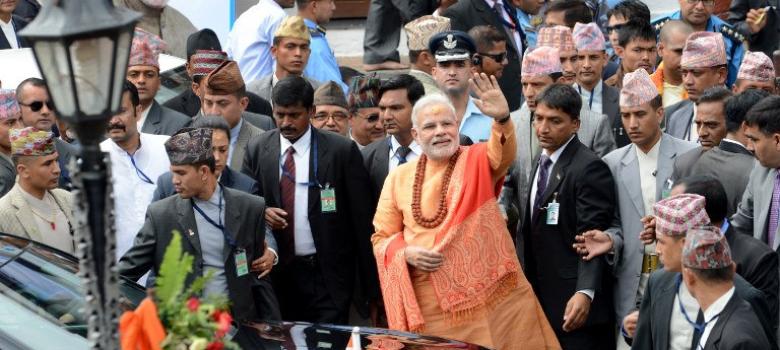
Why Modi’s reference to Buddha’s birthplace was among the highest points of his Nepal visit

Nepal has long been irked by the common misconception that Buddha was from India, even though his accepted birthplace, Lumbini, is across the border.

The Nepalese are so outraged about the Indian appropriation of Buddha, some cable operators blocked Zee TV in the country last year for misidentifying the Enlightened One‘s birthplace.  To correct the record, the country has issued special Rs 100 currency notes proclaiming, “Lumbini: The Birthplace of Lord Buddha.” The controversy has even led a musician named Dhiraj Rai to record an overwrought pop song on the subject.

So for many residents of the mountain-kingdom, the highest point of Indian Prime Minister Narendra Modi‘s two-day state visit to their country came during his address to parliament on Sunday, when he referred to Nepal as “the birthplace of Lord Buddha”.

Though the Indian prime minister’s speech to lawmakers included the announcement of a $1 billion line of credit to Nepal and suggested how energy cooperation could be enhanced, the country’s Telegraph Weekly reported the address under the headline, “Indian PM Modi admits Lord Buddha was born in Nepal.”

The Khatmandu Post added more details. “Nepali lawmakers gave a thunderous applause when he mentioned that Buddha was born in Nepal – an issue that rouses deep passion in the country when various quarters of India claim that the former was born in India,” it wrote. “He uttered the word Buddha five times.”

Many Nepalese Twitter users expressed their delight at Modi’s statement.

via Scroll.in – News. Politics. Culture..

15/07/2014

In First Meeting, Modi and Xi Discuss Decades-Long Border Disputes – India Real Time – WSJ

In their first one-on-one meeting, Chinese President Xi Jinping and Indian Prime Minister Narendra Modi spoke about finding a resolution to the long-standing boundary dispute between the Asian neighbors, a goal that has eluded the two countries for decades.

In talks lasting 80 minutes, Mr. Modi told Mr. Xi that “it is necessary to resolve the boundary question,” Syed Akbaruddin, a spokesman for India’s foreign ministry, said in a televised interview after the meeting in Brazil on the sidelines of a summit of BRICS countries. Pending that, Mr. Modi said, “peace and tranquility need to be maintained on the border,” according to Mr. Akbaruddin.

Mr. Xi called for “negotiated solutions” to the dispute at an early date, China’s official Xinhua News Agency reported. He also said the two countries “should join hands in setting global rules so as to raise the voice of developing countries,” Xinhua said.

China has reached out to the new Indian administration, led by Mr. Modi, at a time when its ties with other Asian countries including Japan and the Philippines have soured over territorial disputes. The Chinese foreign minister visited New Delhi last month, and Beijing’s premier was the first foreign leader to talk to Mr. Modi after his swearing-in as prime minister earlier this year, following national elections.

Ties between India and China have long been characterized by mistrust, and the sentiment appears to linger. More than seven in 10 Indians are concerned that territorial disputes between China and its neighbors will lead to military conflict, according a Pew Research Center survey published Monday.

Nearly half of all Indians think China’s growing economy is a bad thing for their country, and only 31% of Indians had a favorable view of China, the survey showed. By comparison, 55% of Indians had a favorable view of the U.S. and 43% had a favorable view of Japan.

Tensions between India and China boiled over into a brief war in 1962, following which China gained control of a 14,600-square-mile territory known as Aksai Chin. China claims another 35,000 square miles in Arunachal Pradesh, a state in India’s northeast. Relations worsened last year when India alleged that Chinese troops had crossed into Indian-held territory in the Himalayan region of Ladakh, triggering a weekslong standoff.

On the campaign trail during national elections earlier this year, Mr. Modi promised to be tough on security issues. In a speech in February he warned China against having an “expansionist mindset.” In Mr. Modi’s first few weeks in office, his government has taken steps to boost infrastructure and connectivity on the Chinese border.

Mr. Modi’s China policy remains unclear, as does his ability and willingness to negotiate a border settlement, a process that has gone on for three decades. Special representatives appointed to work out a solution have so far held 17 rounds of talks.

The two countries signed an agreement last October aimed at easing hostilities on the disputed and ill-defined border, known as the Line of Actual Control, including commitments to ensure that patrols don’t escalate into military confrontations. But the agreement failed to impress security analysts in India, who said it was little more than a statement of intentions.

India is also worried about China’s growing influence in South Asia where New Delhi sees itself as the regional power. Mr. Modi has moved to revitalize India’s neighborhood ties, inviting South Asian leaders to his swearing-in and choosing Bhutan for his first foreign visit.  The government is also pushing to close India’s $40 billion trade deficit with China.

via In First Meeting, Modi and Xi Discuss Decades-Long Border Disputes – India Real Time – WSJ.

17/06/2014

Top China diplomat to visit Vietnam in possible thaw over oil rig | Reuters

China’s top diplomat will visit Vietnam on Wednesday in a sign the two countries want to ease tensions over China’s deployment of an oil rig in the disputed South China Sea, but experts said there were many obstacles to healing the ruptured relationship.

Map of the South China Sea

Map of the South China Sea (Photo credit: Wikipedia)

The visit by State Councilor Yang Jiechi, who outranks the foreign minister, will be the highest level direct contact between Beijing and Hanoi since a Chinese state oil company parked the rig in waters claimed by both countries on May 2. Yang would attend an annual meeting on bilateral cooperation, Chinese Foreign Ministry spokeswoman Hua Chunying told a regular briefing. Vietnamese officials said Yang would meet Prime Minister Nguyen Tan Dung as well as the head of the country’s ruling communist party. “We hope that Vietnam keeps its eye on the broader picture, meets China halfway and appropriately resolves the present situation,” Hua said, without directly mentioning the rig. Vietnam’s Foreign Ministry spokesman Le Hai Binh said the rig would be discussed. Ties between the two neighbours have been largely frozen since early May, with both sides constantly accusing the other of inflaming the situation. Dozens of Vietnamese and Chinese coastguard and fishing vessels have repeatedly squared off around the rig, resulting in a number of collisions. via Top China diplomat to visit Vietnam in possible thaw over oil rig | Reuters.

13/06/2014

Japan denies brush with Chinese planes, demands China withdraws footage | Reuters

I sincerely hope China and Japan are NOT sleep walking into a major war.

“Japan on Friday denied Beijing’s claims that its Self-Defence Force planes came “dangerously close” to Chinese aircraft in an incident over the East China Sea on Wednesday, demanding China takes down the footage allegedly showing the incident.

A Chinese SU-27 fighter flies over the East China Sea, in this handout photo taken May 24, 2014 and released by the Defense Ministry of Japan May 25, 2014. REUTERS/Defense Ministry of Japan/Handout via Reuters

The tit-for-tat accusations and denials are part of a long-running territorial dispute between Asia’s largest economies. They follow a similar incident on May 24, when Japan said Chinese aircraft came within a few dozen metres of its warplanes. China, where bitter memories of Japan’s wartime militarism run deep, lays claim to Japanese-administered islets in the East China Sea, known as Senkaku in Japan and Diaoyu in China. China declared its air defence zone covering most of the East China Sea last year despite protests by Japan and the United States.

On Thursday, China said two Japanese F-15 planes followed a Chinese Tu-154 aircraft and came as close as 30 metres, “seriously affecting China’s flight safety”. It posted a video allegedly showing that incident on the defence ministry website.

“We believe there is no truth in China’s assertions that Japanese fighter planes came within 30 meters of a Chinese plane and severely affected the flight’s safety,” Japanese Chief Cabinet Secretary Yoshihide Suga told reporters.

“The planes (in the video) are different,” he said in response to a reporter’s question about the rationale behind Japan’s assertion, adding Japan lodged a protest late on Thursday and demanded that Beijing take down the footage.

China responded by calling on Tokyo to “immediately stop all its provocative words and acts”.”

via Japan denies brush with Chinese planes, demands China withdraws footage | Reuters.

13/06/2014

Does China Care About its International Image? | The Diplomat

China’s global image faces challenges — but if asked to choose between its national interests and preserving its national image, China would choose the former

Does China Care About its International Image?

A recent poll conducted by the BBC World Service shows that China’s international image is not that great around the world. Although this year China’s international image is equally divided (42 percent vs. 42 percent) between those who think China’s influence is positive and those who think it is negative, China’s image in Japan and South Korea (two of China’s most important Asian neighbors) is quite negative. In South Korea, only 32 percent of South Koreans have positive perceptions of China whereas 56 percent of them hold a negative perception of China. In Japan the picture is ugly as only 3 percent (a record low) of Japanese hold positive views of China whereas 73 percent view China as a negative influence in Asia.

However, China’s image in Africa and Latin America is quite positive. All three African countries surveyed have very high levels of positive views of China, with 85 percent in Nigeria, 67 percent in Ghana, and 65 percent in Kenya. Of all four Latin American countries surveyed, only Mexico has more negative views than positive views of China (40 percent vs 33 percent); the other three countries are mostly positive about China (Peru 54 percent vs. 24 percent; Brazil 52 percent vs. 29 percent; Argentina 45 percent vs. 20 percent). Another interesting finding about China’s international image is that most advanced countries hold negative views of China, with the U.K. (49 percent vs. 46 percent) and Australia (47 percent vs. 44 percent) being exceptions. Especially puzzling is Germany, which only has a 10 percent positive view of China against 76 percent negative views of China. This might not be surprising as most advanced countries happen to be democracies and they are often quite critical of China’s lack of democracy and human rights problems.

A natural question that one might ask is “does China care about its international image?” Due to China’s recent assertive actions (here and here) in East China Sea and South China Sea, it might seem like China is not worried about its image among its Asian neighbors. But it is inconsistent with China’s efforts in recent years to enhance its soft power and build a positive national image around the world. Thus, the puzzle is this: if China does care about its international image, why would China behave in a way that hurts its own national image? This is a legitimate question given some evidence showing that many in Asia now see China as a big bully.

There are three possible explanations for the seeming inconsistency between China’s national image campaigns and its recent assertive behavior. First, it could be that China does not genuinely embrace the idea of national image or soft power. According to realist logic which is dominant in China, what really matters in international politics is material power; also, soft power often is a byproduct of material power. Thus, the Chinese leadership might have accepted the idea “it is better to be feared than loved” in international politics. If indeed this is the reasoning behind China’s foreign policy in recent years, then it is not surprising at all that China feels little need to promote its national image.

The second reason could be that China does care about its national image but the problem is that China is inexperienced or even clumsy in promoting its national image. Indeed, in recent years China has put in lots of resources into its ‘public diplomacy’ which has generated mixed results. Just think about how much money Beijing spent on the Beijing Olympics 2008 to promote China’s positive image. It is abundantly clear that Beijing does want to present a positive and peaceful national image to the international community. Nonetheless, it could well be that officials in China who are in charge of promoting national image are incompetent or there is no coordination between different ministries and actors such as the Foreign Affairs ministry and the military. For example, the Ministry of Foreign Affairs finally released a position paper on the 981 oil rig crisis after a month had passed. Although this is helpful, one wonders why China could not have done it earlier. Now the damage is already done. Also, China has maintained that Vietnamese vessels have rammed Chinese vessels more than 1,400 times, but it would be much more convincing if China could release videos showing how the Vietnamese vessels rammed Chinese ships. There are many other examples like this one, suggesting that China’s public diplomacy needs to be more skillful and sophisticated if it is going to win international public opinion.

Finally, China’s neglect of its national image could be explained by a rational choice strategy that puts national interests in front of national image. Thus, China does care about its national image, but it cares more about national sovereignty and territorial integrity. When forced to choose between sovereignty and national image, China will choose sovereignty — and any other country would do the same. As Xi Jinping said earlier this year, China will never sacrifice its core national interests, regardless of the circumstances. Viewed from this perspective, national image becomes secondary compared to territorial integrity.

via Does China Care About its International Image? | The Diplomat.

11/06/2014

Nawaz hopes to resolve unsettled matters with Modi – Pakistan – DAWN.COM

In a letter written to Indian premier Narendra Modi on Wednesday, Prime Minister Nawaz Sharif said he looked forward to working him in harmony to resolve all unsettled matters in the interest of the two nations.

Prime Minister Nawaz Sharif (L) and Indian premier Narendra Modi (R). — File photo

The premier also expressed satisfaction over his visit to India.

“I have returned satisfied with meaningful exchange of thoughts over regional issues and matters of mutual interest,” Sharif said.

“Million of people living in poverty in both countries deserve our foremost attention and their future is integrated with our common economic destiny,” Sharif said.

The premier further said that prosperity could be brought to both nations with concerted efforts.

He also said that he hoped that mutual endeavours by both countries would brighten their futures.

Sharif was invited to Prime Minister Modi’s swearing-in ceremony after the Bharatiya Janata Party (BJP) emerged victorious in the general elections held in the world’s largest democracy during the course of two months. The invitation was accepted after a series of consultations that the premier held with his close aides.

Sharif had also phoned Modi to congratulate him on his party’s win in the elections.

via Nawaz hopes to resolve unsettled matters with Modi – Pakistan – DAWN.COM.

11/06/2014

China Tries to Woo India’s Prime Minister Narendra Modi – Businessweek

China is courting Narendra Modi. The Indian leader became prime minister last month after his Hindu nationalist party won a landslide victory, and in his campaign he promised to take a tougher stand toward China. India says China occupies 38,000 square kilometers (about 15,000 square miles) of its territory in the northern state of Jammu and Kashmir. China says no, India is the guilty party because 90,000 sq. km. of land in the Indian state of Arunachal Pradesh are actually Chinese.

China Tries to Woo India's Prime Minister Narendra Modi

China made progress toward settling the dispute under Modi’s predecessor, the Congress Party’s Manmohan Singh. Following Congress’s humiliating defeat in the elections, the Chinese need to work harder to prevent relations from deteriorating anew.  Hence the glowing words from Foreign Minister Wang Yi on Monday in New Delhi. “China-India cooperation is like a massive buried treasure waiting to be discovered,” he said, telling reporters the two sides are close to a deal on the border. “We are prepared to reach a final settlement,” said Wang.

Any deal would provide a much-needed diplomatic victory for China. With Chinese and Vietnamese ships ramming one another in the South China Sea and Chinese and Japanese planes confronting each other in the skies over the East China Sea, the Chinese government has enough territorial disputes threatening to escalate into full-blown crises. Yesterday, China appealed to United Nations Secretary-General Ban Ki-moon regarding what the Chinese called “Vietnam’s provocation” against a Chinese company’s offshore oil rig. China wants “to tell the international community the truth and set straight their understanding on the issue,” deputy permanent representative Wang Min said.

via China Tries to Woo India’s Prime Minister Narendra Modi – Businessweek.

10/06/2014

China Takes Dispute With Vietnam to UN – ABC News

China took its dispute with Vietnam over its deployment of an oil rig in contested waters to the United Nations on Monday, accusing Hanoi of infringing on its sovereignty and illegally disrupting a Chinese company’s drilling operation.

Oil Rig

China’s deputy ambassador Wang Min sent a “position paper” on the rig’s operation in the South China Sea to Secretary-General Ban Ki-moon on Monday and asked the U.N. chief to circulate it to the 193 members of the General Assembly.

China sent the rig into disputed waters on May 1, provoking a confrontation with Vietnamese ships, complaints from Hanoi, and street protests that turned into bloody anti-Chinese riots. Hundreds of factories were damaged and China said in the paper that four Chinese citizens were “brutally killed” and over 300 injured.

The oil platform is located about 32 kilometers (20 miles) from the China-controlled Paracel Islands, which Vietnam also claims, and 278 kilometers (173 miles) from the coast of Vietnam.

According to the paper, the state-run China National Offshore Oil Corporation has been conducting seismic operations and well site surveys in the area for the past 10 years and the drilling operation “is a continuation of the routine process of explorations and falls well within China’s sovereignty and jurisdiction.”

China accused Vietnam of “illegally and forcefully” disrupting the rig’s operation by sending armed ships and ramming Chinese vessels.

“Vietnam also sent frogmen and other underwater agents to the area, and dropped large numbers of obstacles, including fishing nets and floating objects, in the waters,” it said.

The paper said Vietnam’s actions violated China’s sovereignty, posed “grave threats” to Chinese personnel on the rig and violated international laws including the U.N. Convention on the Law of the Sea.

It cited numerous references to back its claims that the islands “are an inherent part of China’s territory, over which there is no dispute.”

via China Takes Dispute With Vietnam to UN – ABC News.

Enhanced by Zemanta
10/06/2014

Indian PM Modi meets with Chinese FM – Xinhua | English.news.cn

Indian Prime Minister Narendra Modi Monday met here with visiting Chinese Foreign Minister Wang Yi, the special envoy of Chinese President Xi Jinping.

INDIA-NEW DELHI-PM-CHINA-WANG YI-MEETING

During the meeting, Wang conveyed greetings and messages from President Xi and Chinese Premier Li Keqiang to Prime Minister Modi.

The Chinese president said in his message that he believes India will obtain greater development and progress under the leadership of Prime Minister Modi.

The Chinese president said that as two important forces in the process of multi-polarization of the world, China and India share far more common interests than differences and that the two countries are long-term strategic cooperative partners rather than adversaries.

The Chinese president pointed out that the dreams of both China and India to build a strong nation and to upgrade the living standards of their people have a lot of commonalities and the two countries should make an in-depth convergence of their development strategy, support each other with their respective strengths, build a close development partnership, and hold hands to realize peaceful development, cooperative development, and inclusive development, in order to benefit their people and enhance peace, stability and prosperity of Asia and the whole world.

Prime Minister Modi said that the important message from President Xi Jinping has given a clear guidance for developing bilateral relations.

Modi said he highly appreciates the achievements in the field of development made by China and personally cherishes a friendly feeling toward China.

Modi said India’s new government is willing to join China to give a clear signal to the world that the two countries are dedicated to common development.

He suggested that the two countries maintain exchange of high- level visits, consolidate strategic trust, and use each other’s strengths to deepen cooperation in the fields of infrastructure, manufacturing, and IT industry.

Modi also said that India and China should develop their resources of two ancient civilizations to enhance cooperation and increase exchanges in humanity.

On the boundary issue, he said the two countries should commonly maintain peace and tranquility on the border areas in order to provide guarantees to the development of bilateral relations.

Foreign Minister Wang said that China and India are now standing at a new historical starting point of developing their relations and in the meantime are faced with important opportunities of their own development.

He said that China is ready to realize convergence with India in the fields of development theories and ideas, exchange and learn from each other in practice and theories of governance.

Wang said China is also willing to realize convergence of development strategies with India and let the “Look East” policy of India meet and confluence with China’s acceleration of opening its western regions.

The two countries should also use their respective strong points to support and supplement each other in their respective development, he said.

Wang said as the two ancient civilizations, China and India should join each other to make new contributions to human civilization and progress. He also suggested that the two countries properly control and manage their boundary problem to seek a mutually acceptable, fair and reasonable solution to the boundary issue.

via Indian PM Modi meets with Chinese FM – Xinhua | English.news.cn.

Enhanced by Zemanta
Law of Unintended Consequences

continuously updated blog about China & India

ChiaHou's Book Reviews

continuously updated blog about China & India

What's wrong with the world; and its economy

continuously updated blog about China & India