Archive for ‘Dissident’

26/05/2020

China’s Hong Kong garrison ‘ready to safeguard national security’ in the city

  • PLA commander says new law will help to crack down on separatist and foreign forces in ‘two sessions’ interview
  • Military has ‘determination, confidence and ability’ to safeguard national security interests and Hong Kong prosperity
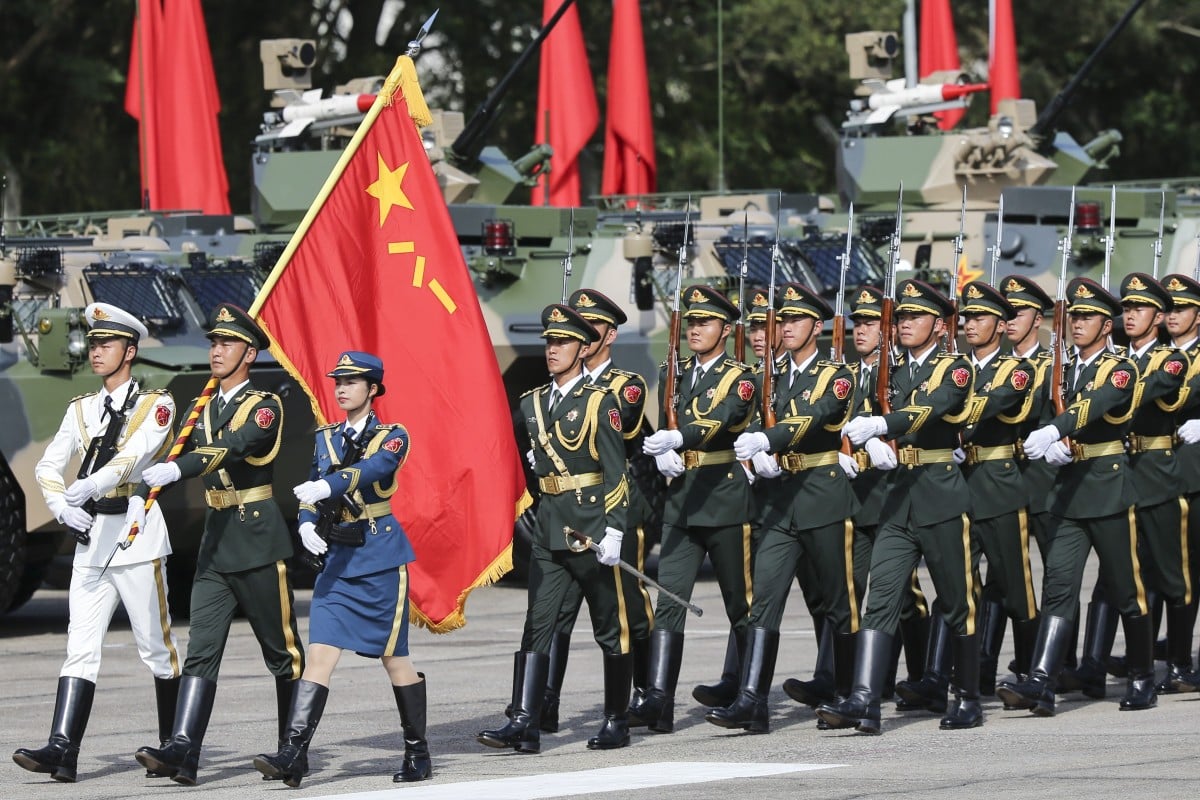
China’s People’s Liberation Army has said its Hong Kong garrison will “resolutely” safeguard national security and sovereignty. Photo: Sam Tsang
The People’s Liberation Army has said the Chinese military will “resolutely” safeguard China’s national security and sovereignty, in its first statement since Beijing announced plans to impose a sweeping national security law in Hong Kong.
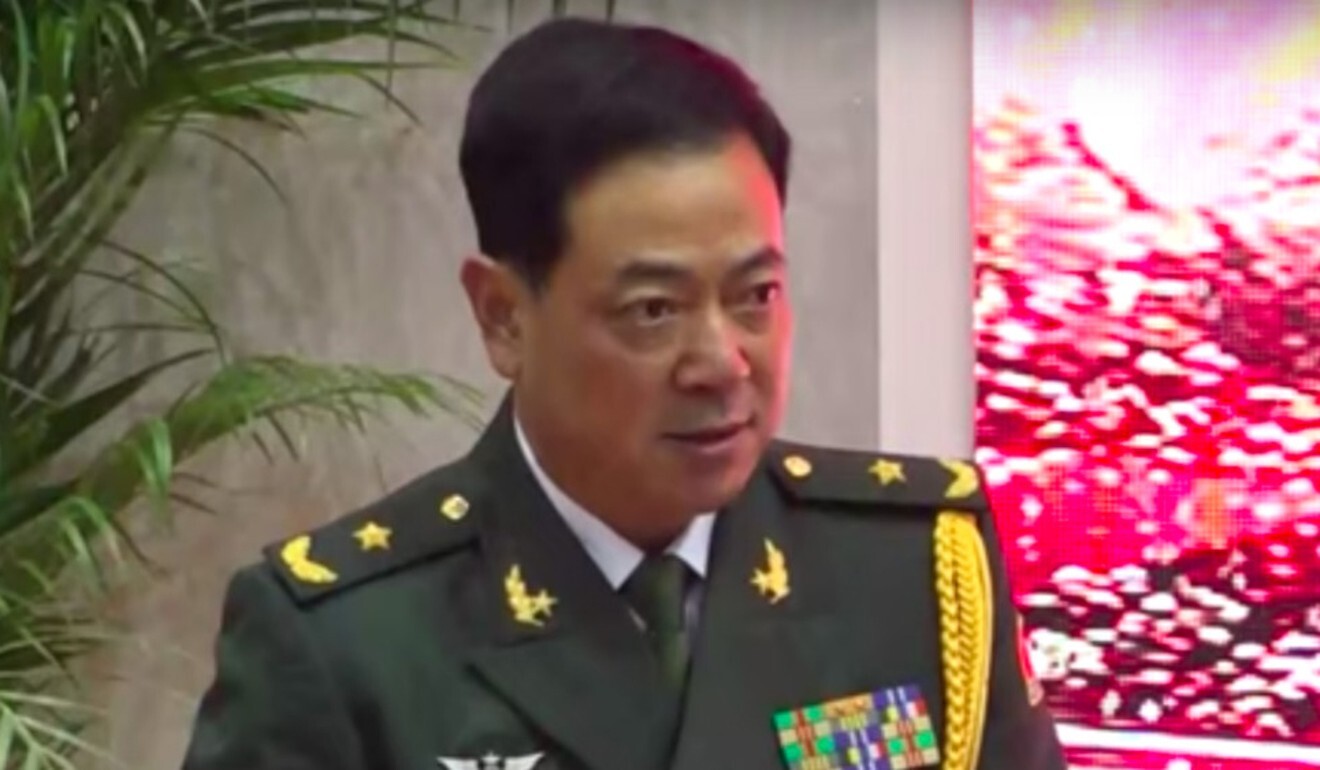
Chen Daoxiang, commander of the PLA’s Hong Kong garrison, said it would “act with firm resolve to implement the central government’s decision and plans” as well as continuing to implement the “one country, two systems” policy in the city.
How China is drafting a new Hong Kong national security law at the National People’s Congress
Speaking on the sidelines of China’s annual parliamentary meetings, also known as the

“two sessions”

, Chen told state broadcaster CCTV that the new law would help to crack down on separatist and foreign forces aiming to undermine China’s national unity.

“[The garrison] will implement, according to law, various tasks delegated by the party and the people, and has the determination, confidence and ability to safeguard national security and development interest as well as Hong Kong’s continuing prosperity,” he said.

Commander of the PLA Hong Kong garrison Chen Daoxiang. Photo: Weibo
The proposal to impose a national security law in Hong Kong – which will give Beijing more direct control over the city – was introduced by China’s legislature on Friday. Beijing has blamed foreign forces for inciting last year’s months-long protests in Hong Kong, sparked by opposition to a separate and now-withdrawn extradition bill, and described the unrest as a grave threat to national security.

Separately, CCTV reported that a group of top military officials said in a session on Tuesday that there was a “great urgency” for Beijing to impose the law in a bid to address the “new risks and challenges” in governing the city.

The officials, who included Central Military Commission vice-chairmen Xu Qiliang and Zhang Youxia, said the plan was a “very timely, necessary and important” step to prevent and punish efforts to undermine China’s national sovereignty and security.

They reiterated the PLA’s commitment to opposing intervention from foreign forces in Hong Kong as well as maintaining China’s national unity and territorial integrity.

“Hong Kong affairs are purely China’s internal affairs. We resolutely oppose efforts by any foreign country, organisation and individual in interfering with Hong Kong affairs, and will resolutely guard against and contain any attempts by external forces in … engaging any separatist, subversion and infiltration activities,” they said, according to CCTV.

The planned national security law has drawn strong condemnation from the US government, with Secretary of State Mike Pompeo calling it a “death knell” for the territory’s relative autonomy. White House national security adviser Robert O’Brien said on Sunday that the US government would likely impose sanctions on China if Beijing went ahead with the plan.

Source: SCMP

22/05/2020

Chinese government drops references to ‘peaceful’ reunification with Taiwan

  • The rhetoric towards the self-ruled island has hardened in Premier Li Keqiang’s annual work report
  • Beijing regards Taiwan as one of its core national interests and says it ‘resolutely opposes’ any separatist activity
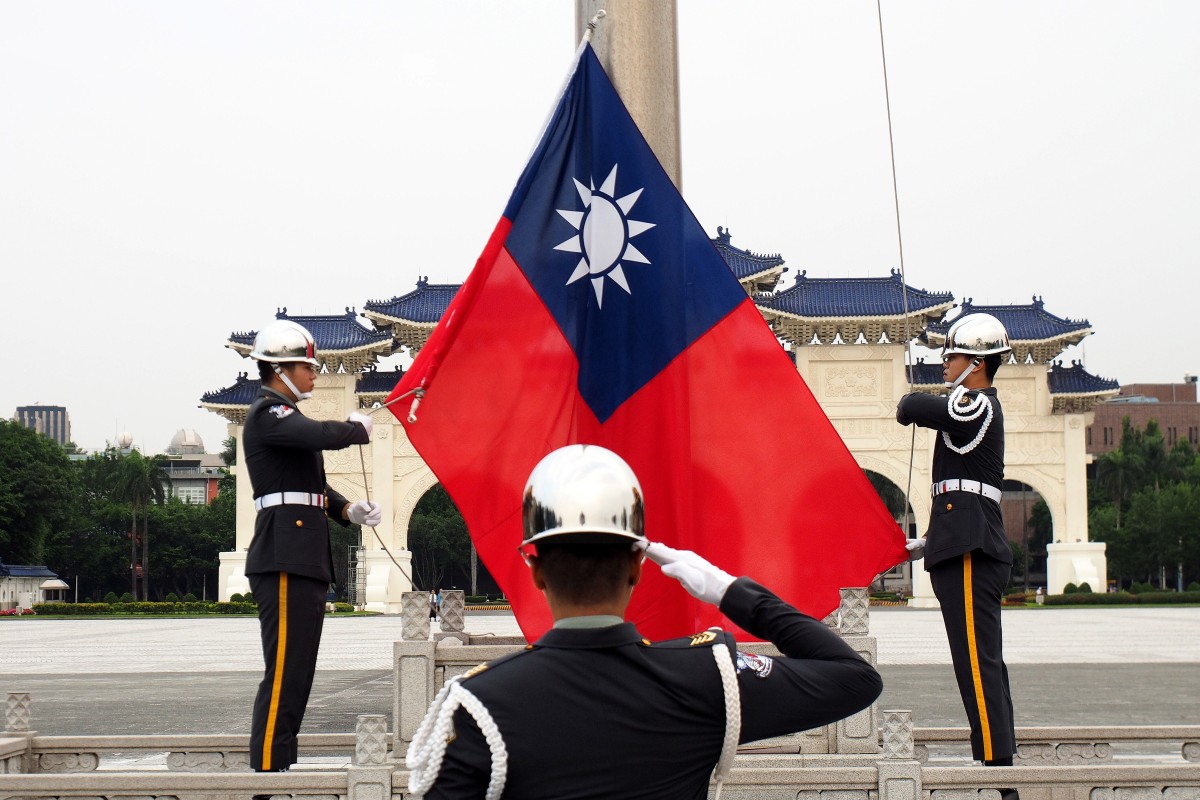
Beijing regards reunification with Taiwan as one of its core interests. Photo: EPA-EFE

Beijing has hardened its rhetoric towards Taiwan, removing references to “peaceful reunification”, in the government’s annual work report.

Observers said the change reflected the stronger stance Beijing would adopt in tackling the Taiwan issue, which it regards as one of its key national interests.

The past six work reports since President Xi Jinping took power in 2013 stressed peaceful reunification and the 1992 consensus – under which both sides tacitly agree there is only one China, but have different interpretations on what this means.

But the latest report from Premier Li Keqiang took a different tone, saying: “We will adhere to the major principles and policies on work related to Taiwan and resolutely oppose and deter any separatist activities seeking ‘Taiwan independence’.”

US to sell US$180 million worth of submarine-launched torpedoes to Taiwan

21 May 2020

“We will improve institutional arrangements, policies, and measures to encourage exchanges and cooperation between the two sides of the Taiwan Strait, further cross-strait integrated development, and protect the well-being of our compatriots in Taiwan,” the report said.

“We will encourage them to join us in opposing ‘Taiwan independence’ and promoting China’s reunification.

“With these efforts, we can surely create a beautiful future for the rejuvenation of the Chinese nation,” it said, dropping a clause that described the process as “peaceful”.

The 1992 consensus allows leeway for both parties to negotiate an agreement, but President Tsai Ing-wen has said the island would never accept it as the basis for cross-strait relations.

Taiwan’s Mainland Affairs Council said on Friday that the “one country, two systems” framework, touted by Beijing as a political basis for unification, had harmed cross-strait relations. It called for the two sides to work together to resolve their differences.

Tang Shao-cheng, an international relations specialist at Taiwan’s National Chengchi University, said the change in wording and tone of the Taiwan section of the work report could be seen as a warning to Tsai’s independence-leaning Democratic Progressive Party (DPP).

“Not mentioning ‘peace’ suggests Beijing is considering unification both by peaceful means and by force,” Tang said.

President Xi Jinping and Premier Li Keqiang at the National People’s Congress opening session on Friday. Photo: Kyodo
Derek Grossman, an analyst from US-based think tank Rand Corporation, said Beijing would continue to put pressure on the island using diplomatic, military, economic and psychological means.

“Beijing will continue to send military aircraft near the island … [it] could decide to end the Economic Cooperation Framework Agreement which has remained active in spite of Tsai’s election in 2016; Beijing could steal one or more diplomatic partners from Taipei. I would expect these types of actions to be on the table,” Grossman said.

How would mainland China attack Taiwan? A video outlines one scenario

22 May 2020

Sun Yun, director of the China programme at the Stimson Centre think tank in the US, said Beijing faced a dilemma on whether to continue economic integration with Taiwan because that had not had the political effect it wanted.

“The obstacles to unification are not economic, but political. Taiwan is unwilling to pursue unification with an authoritarian mainland. To solve that issue, presumably the mainland could pursue political reform. But in reality, the Chinese Communist Party is unwilling,” she said.

“If the economic and political approach doesn’t work, what’s left is the military approach. But with US intervention, the mainland will not prevail.”

Beijing recently warned Washington it would respond after US Secretary of State

Mike Pompeo congratulated Tsai on her second term of office

, and demanded that the US stop selling arms to the island.

Joshua Eisenman, a professor from the University of Notre Dame in Indiana, said Beijing was running out of countermeasures, since its actions had only hardened attitudes on the island and enhanced the sense of Taiwanese identity.
“As I see it, all that remains is for the [Chinese Communist Party[ to sit down and talk to the DPP without preconditions and establish a modus vivendi for cross-strait relations,” he said.
Source: SCMP
03/04/2020

Taiwan talks WHO role with U.S., China denounces ‘manipulation’

TAIPEI/BEIJING (Reuters) – Taiwan and the United States this week discussed how to get “closer coordination” between the island and the World Health Organization (WHO) during the coronavirus outbreak, drawing a rebuke from China for “political manipulation” of the epidemic.

Taiwan’s is excluded from the WHO due to diplomatic pressure from China, which considers it merely a wayward province with no right to the trappings of state.

Its omission has become a major source of anger for the Taiwan, which says it has been unable to get first hand information from the WHO, putting lives on the island in danger for the sake of politics. Both the WHO and China say Taiwan has been given the help it needs.

The U.S. State Department said on Thursday senior officials from the United States and Taiwan on Tuesday held a “virtual forum on expanding Taiwan’s participation on the global stage”, with particular focus on the WHO and how to share Taiwan’s successful model of fighting the coronavirus.

“Participants also discussed ongoing efforts to reinstate Taiwan’s observer status at the World Health Assembly, as well as other avenues for closer coordination between Taiwan and the World Health Organization,” it said.

The World Health Assembly is the WHO’s decision-making body.

Taiwan attended it as an observer from 2009-2016 when Taipei-Beijing relations warmed, but China blocked further participation after the election of Taiwan President Tsai Ing-wen, who China views as a separatist, charges she denies.

Taiwan’s Foreign Ministry expressed thanks to the United States on Friday for its “continued taking of concrete actions to support Taiwan’s participation in the WHO and other international organisations”.

In Beijing, Chinese Foreign Ministry spokeswoman Hua Chunying said the United States and Taiwan were both well aware that members of the WHO must be sovereign states, and accused Taiwan of seeking political capital from the outbreak.

“We hope they will not attempt to use this epidemic to engage in political manipulation,” she told a daily news briefing.

U.S. President Donald Trump signed a new law last month requiring increased support for Taiwan’s international role. China threatened unspecified retaliation in response.

Like most countries the United States has only unofficial ties with the island, but is its strongest backer on the world stage.

Taiwan has been far more successful than many of its neighbours keeping the virus in check thanks to early and stringent steps to control its spread. It has reported 348 cases and five deaths to date.

In its latest measure, Health Minister Chen Shih-chung said on Friday people who don’t wear face masks on public transport would face fines of up to T$15,000 (nearly $500).

($1 = 30.2040 Taiwan dollars)

Source: Reuters

21/02/2019

India withdraws security for Kashmir separatist leaders

NEW DELHI (Reuters) – India’s Jammu and Kashmir state withdrew the security details for 18 separatist leaders and 155 other opposition figures on Wednesday after an Islamist suicide bomber killed 40 paramilitary troopers last week.

The restive mountain state is currently administered by India’s federal government after Prime Minister Narendra Modi’s Bharatiya Janata Party walked out a coalition with a major Kashmiri party.

The separatist leaders had been allocated security personnel to protect them from militants after they entered talks with the federal government.

In a statement, the Jammu and Kashmir state government said it “felt that providing security to these separatist leaders is a wastage of scarce state resources which could be better utilized elsewhere”.

Besides the separatist leaders, the security of 155 political figures and activists – some from mainstream opposition parties – was also withdrawn, the statement said.

“Through this (step), over 1,000 police personnel and over 100 vehicles are freed to do regular police work,” it said.

Both India and Pakistan lay claim to Kashmir and have twice gone to war over it since independence from Britain in 1947. India accuses Pakistan of fomenting decades of sporadic insurgency in its only Muslim-majority state.

Pakistan denies that, saying it only offers political support to the Kashmiri people.

Source: Reuters

14/02/2019

Sweden replaces China envoy in furore over dissident bookseller

STOCKHOLM (Reuters) – Sweden said on Thursday it had replaced its ambassador to China after her “incorrect” handling of unauthorized meetings intended to help free dissident bookseller Gui Minhai.

The Hong Kong-based, Swedish publisher of books critical of China’s communist leaders was abducted in Thailand in 2015 and later appeared in custody in mainland China.

His daughter Angela Gui said this week she had met ambassador Anna Lindstedt and two businessmen in Stockholm in January, where she was advised to keep quiet about her father’s case while negotiations were proceeding.

Sweden’s Foreign Ministry said that was not an official meeting, and Lindstedt had now returned to Sweden with an interim envoy sent to Beijing during an inquiry.

“Neither the Foreign Ministry nor the Foreign Minister were informed until after the event,” ministry spokesman Rasmus Eljanskog said in an emailed statement.

“As a consequence of the incorrect manner in which the said meetings were handled, we are now conducting an internal investigation.”

Gui, 54, became a Swedish citizen after studying there in the 1980s. After the abduction, he was released in October 2017, but his whereabouts were unclear until January last year when his daughter said he was seized by Chinese agents on a Beijing-bound train in the presence of Swedish diplomats.

China later confirmed it had detained him again.

In her blog, Angela Gui said Lindstedt invited her to Stockholm to meet two businessmen who could help secure her father’s release.

“OUTRAGEOUS SCANDAL”

“The businessman said, ‘you care about Anna (Lindstedt), right? If you keep talking to the media it’ll damage her career. You don’t want her to come to any harm, do you?’”, she said in the post on blog portal Medium.

“In order for this to happen (negotiations), I was told I needed to be quiet. I wasn’t to tell anyone about this, or say anything publicly about the case,” she added.

“I’m not going to be quiet in exchange for … an arbitrary promise that my father ‘might’ be released. Threats, verbal abuse, bribes, or flattery won’t change that.”

China’s Foreign Ministry declined comment, with spokeswoman Hua Chunying saying she knew nothing about Gui’s latest situation. On its website, China’s embassy in Stockholm said it had not authorized anyone to “engage” with Gui’s daughter.

“The Chinese side handles the Gui Minhai case in accordance with law and legal procedure,” it said.

Gui’s original abduction – along with four others in the Hong Kong book trade – fed worries about interference from Beijing despite guarantees of wide-ranging freedoms for the former British colony which returned to Chinese rule in 1997.

The four others have since returned to Hong Kong. The United States and European Union have urged Gui’s release.

Sweden said it was continuing to seek Gui’s freedom, as Lindstedt faced scathing criticism for what the leader of Sweden’s Left Party called an “outrageous scandal”.

“A Swedish ambassador has done the bidding of a dictatorship and tried to silence the daughter of a Swedish political prisoner in China,” Jonas Sjostedt told local TV.

“I don’t think we have seen a worse scandal in Swedish foreign administration for decades.”

Lindstedt could not immediately be reached for comment.

Source: Reuters

17/09/2016

The plateau, unpacified | The Economist

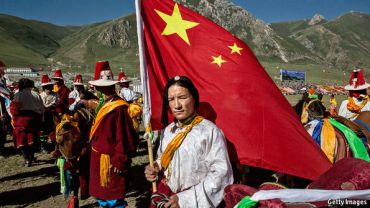
AN ELDERLY woman with long, grey plaits, wearing a traditional Tibetan apron of wool in colourful stripes, has spent her day weaving thread outside her home near the southern end of Qinghai Lake, high on the Tibetan plateau. She is among hundreds of thousands of Tibetan nomads who have been forced by the government in recent years to settle in newly built villages. She now lives in one of them with her extended family and two goats. Every few months one of her sons, a red-robed monk, visits from his monastery, a place so cut off from the world that he has never heard of Donald Trump. Her grandson, a 23-year-old with slick hair and a turquoise rain jacket, is more clued in. He is training to be a motorcycle mechanic in a nearby town. Theirs is a disorienting world of social transformation, sometimes resented, sometimes welcome.Chinese and foreigners alike have long been fascinated by Tibet, romanticising its impoverished vastness as a haven of spirituality and tranquillity. Its brand of Buddhism is alluring to many Chinese—even, it is rumoured, to Peng Liyuan, the wife of China’s president, Xi Jinping. Many Tibetans, however, see their world differently. It has been shattered by China’s campaign to crush separatism and eradicate support for the Dalai Lama, their spiritual leader who fled to India after an uprising in 1959. The economic transformation of the rest of China and its cities’ brash modernity are seductive, but frustratingly elusive.

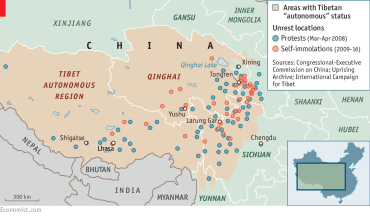
The story of political repression in Tibet is a familiar one. The Dalai Lama accuses China’s government of “cultural genocide”, a fear echoed by a tour guide in Qinghai, one of five provinces across which most of the country’s 6m Tibetans are scattered (the others are Gansu, Sichuan, Yunnan and the Tibet Autonomous Region, or TAR—see map). “We know what happened to the Jews,” he says. “We are fighting for our existence.” Less commonly told is the despair felt by many young Tibetans who feel shut out of China’s boom. They are victims of Tibet’s remote and forbidding topography as well as of racial prejudice and the party’s anti-separatist zeal. They often cannot migrate to coastal factories, and few factories will come to them. Even fluent Mandarin speakers rarely find jobs outside their region.
Yet Tibetans are not cut off from the rapidly evolving culture of the rest of China, where more than 90% of the population is ethnic Han. Mayong Gasong Qiuding, a 26-year-old hotel worker in Yushu in southern Qinghai, listens to Mandarin, Tibetan and Western pop music in tandem. He can rattle off official slogans but can recite only short Tibetan prayers. His greatest wish, he says, is to go to the Maldives to see the sea. Tibetan women in Qinghai use skin-whitening products, following a widespread fashion among their Han counterparts; a teenager roller-skates anticlockwise around a Buddhist stupa, ignoring a cultural taboo. Young nomads frustrate their elders by forsaking locally-made black, yak-hair tents for cheaper, lighter canvas ones produced in far-off factories.

Han migration, encouraged by a splurge of spending on infrastructure, is hastening such change. Although Tibetans still make up 90% of the permanent population of the TAR, its capital Lhasa is now 22% Han, compared with 17% in 2000. Many Tibetans resent the influx. Yet they are far more likely to marry Han Chinese than are members of some of China’s other ethnic groups. Around 10% of Tibetan households have at least one member who is non-Tibetan, according to a census in 2010. That compares with 1% of households among Uighurs, another ethnic minority whose members often chafe at rule by a Han-dominated government.

Core features of Tibetan culture are in flux. Monasteries, which long ago played a central role in Tibetan society, are losing whatever influence China has allowed them to retain. In recent years, some have been shut or ordered to reduce their populations (monks and nuns have often been at the forefront of separatist unrest). In July buildings at Larung Gar in Sichuan, a sprawling centre of Tibetan Buddhist learning, were destroyed and thousands of monks and nuns evicted. Three nuns have reportedly committed suicide since. Of the more than 140 Tibetans who have set fire to themselves since 2011 in protest against Chinese rule, many were spurred to do so by repressive measures at their own monastery or nunnery.

Cloistered life is threatened by social change, too. Families often used to send their second son to a monastery, a good source of schooling. Now all children receive nine years of free education. “The young think there are better things to do,” says a monk at Rongwo monastery in Tongren, a town in Qinghai, who spends his days “praying, teaching [and] cleaning”. New recruits often come from poorly educated rural families.

Mind your language

In the TAR (which is closed to foreign journalists most of the time), the Tibetan language is under particular threat. Even nursery schools often teach entirely in Mandarin. A generation is now graduating from universities there who barely speak Tibetan. Some people have been arrested for continuing to teach in the language. In April last year Gonpo Tenzin, a singer, was sentenced to three-and-a-half years in prison for his album, “No New Year for Tibet”, encouraging Tibetans to preserve their language and culture.

In some areas outside the TAR, however, the government is less hostile to Tibetan. Since the early 2000s, in much of Qinghai, the number of secondary schools that teach in Tibetan has risen, according to research there by Adrian Zenz of the European School of Culture and Theology at Korntal, Germany. The range of degrees taught in Tibetan has expanded too. Unlike elsewhere, someone who has studied mainly in Tibetan can still get a good job in Qinghai. A third of all government roles advertised there between 2011 and 2015 required the language. Despite this, many parents and students chose to be taught in Mandarin anyway, Mr Zenz found. They thought it would improve job prospects.
Karma chameleon

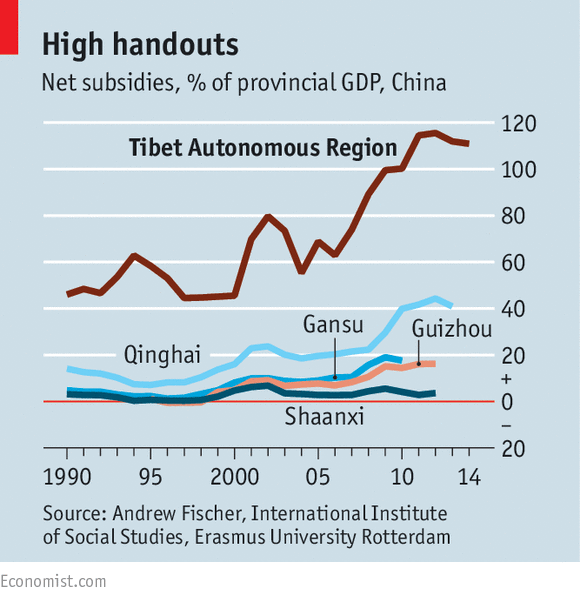
But work can be difficult to get, despite years of huge government aid that has helped to boost growth. Government subsidies for the TAR amounted to 111% of GDP in 2014 (see chart), according to Andrew Fischer of Erasmus University Rotterdam. Eleven airports serve Qinghai and the TAR—they will have three more by 2020. A 156-mile train line from Lhasa (population 560,000) to Shigatse (population 120,000), which was completed in 2014, cost 13.3 billion yuan ($2.16 billion). A second track to Lhasa is being laid from Sichuan, priced at 105 billion yuan.

Better infrastructure has fuelled a tourism boom—domestic visitors to the TAR increased fivefold between 2007 and 2015—but most income flows to travel agents elsewhere. Tourists stay in Han-run hotels and largely eat in non-Tibetan restaurants (KFC opened its first Lhasa branch in March). Tibetan resentment at exclusion from tourism- and construction-related jobs was a big cause of rioting in Lhasa in 2008 that sparked plateau-wide protests. Other big money-spinners—hydropower and the extraction of minerals and timber—are controlled by state-owned firms that employ relatively few Tibetans. The Chinese name for Tibet, Xizang, means “western treasure house”. But Tibetans have little share in its spoils. The rehousing of nomads has helped provide some with building jobs, but has also brought suffering: those relocated sometimes find it harder to make a living from herding.

In most other parts of China, villages have been rapidly emptying as people flock to work in cities. In the country as a whole, the agricultural population dropped from 65% to 48% as a share of the total between 2000 and 2010. On the plateau it fell only slightly, from 87% to 83%. It is hard for Tibetans to migrate to places where there are more opportunities. Police and employers treat them as potential troublemakers. In 2010 only about 1% of Tibetans had settled outside the plateau, says Ma Rong of Peking University. They cannot move abroad either. In 2012 Tibetans in the TAR had to surrender their passports (to prevent them joining the Dalai Lama); in parts of Qinghai officials went house-to-house confiscating them.

Karma chameleon

For university graduates, the prospects are somewhat better. There are few prospects for secure work in private firms on the plateau. But to help them, the government has been on a hiring spree since 2011. Almost all educated Tibetans now work for the state. A government job is a pretty good one: salaries have been rising fast. Few Tibetans see such work as traitorous to their cause or culture. But the government may not be able to keep providing enough jobs for graduates, especially if a slowdown in China’s economy, which is crimping demand for commodities, has a knock-on effect on the plateau.

Many of the problems faced by Tibetans are common in traditional pastoral cultures as they modernise. But those of Tibetans are compounded by repression. They are only likely to increase when the Dalai Lama, now 81, dies. The central government will try to rig the selection of his successor, and no doubt persecute Tibetans who publicly object.

In private, officials say they are playing a waiting game: they expect the “Tibetan problem” to be more easily solved when he is gone. They are deluding themselves. They ignore his impact as a voice of moderation: he does not demand outright independence and he condemns violence. Tibetan culture may be under duress, but adoration of the Dalai Lama shows no sign of diminishing. Poverty, alienation and the loss of a beloved figurehead may prove an incendiary cocktail.

Source: The plateau, unpacified | The Economist

26/08/2016

The Economist explains: Why Kashmir is erupting again | The Economist

TODAY marks the 48th consecutive day of protests in Jammu & Kashmir, India’s only Muslim-majority state. Young Kashmiri men have been on the streets calling for independence from India and throwing stones at security forces. Indian security forces have responded with tear gas and shotguns that fire small-bore pellets instead of buckshot.

A strict curfew has also been imposed across the Kashmir valley, which includes Srinagar, the region’s largest city. So far, 66 civilians and two police officers have been killed in the violence. Why are Kashmiris protesting?

The region has been disputed since the partition of India and Pakistan in 1947. Both sides claim the territory and have fought three wars over it. Kashmir has been living under India’s Armed Forces (Special Powers) Act, which gives special powers to the army, since the eruption in 1990 of an armed insurgency that was covertly supported by Pakistan. Some 40,000 people have been killed since. Even in the relatively peaceful past decade, unrest has flared up, most notably in the summers of 2008 and 2010. The current protests started on July 9th after Indian security forces killed Burhan Wani, a young and charismatic Islamist militant. Resentment had been building for months. Kashmiris worried when Narendra Modi’s Hindu-nationalist Bharatiya Janata Party (BJP) came to power in 2014 that his national government would make life difficult for Muslims. At state elections later that year, the local Peoples Democratic Party formed a coalition with the BJP, leaving them feeling betrayed. Wani’s killing has mobilised a generation that had grown up under what it sees as an illegitimate Indian occupation.

The result has been a seven-week cycle of violent protests and retaliatory action by the police and paramilitary forces. Their supposedly non-lethal pellets have blinded dozens and injured hundreds. Shops and businesses have remained closed since the protests started, either under curfew orders or because of calls for strikes from separatist leaders. Many Kashmiris have not left their homes for weeks. Few expect the situation to improve any time soon, despite soothing words this week from Mr Modi and a visit to the region by India’s home minister.An obstacle to any lasting solution is India’s insistence on seeing Kashmir through the prism of its rivalry with Pakistan. The Indian government’s immediate reaction to this summer’s unrest was to accuse its neighbour of meddling. In fact, Wani was a home-grown insurgent; the young men on the streets are locals. Unemployment is widespread and economic opportunities are few. The state was also promised special status, guaranteeing autonomy, in India’s constitution. And many Kashmiris now want more: a survey in 2010 by Chatham House, a think-tank, found overwhelming support for independence. Kashmiris are at best ambivalent about their attachment to India. Until the government recognises their demands, the anger is unlikely to dissipate.

Source: The Economist explains: Why Kashmir is erupting again | The Economist

25/06/2015

At least 18 dead in attack in China’s Xinjiang: Radio Free Asia | Reuters

At least 18 people are dead after ethnic Uighurs attacked police with knives and bombs at a traffic checkpoint in China’s western Xinjiang region, Radio Free Asia reported on Wednesday.

The attack occurred on Monday in a district of the southern city of Kashgar, where tensions between Muslim Uighurs that call the region home and the majority Han Chinese have led to bloodshed in recent years.

Suspects killed several police officers with knives and bombs after speeding through a traffic checkpoint in a car in Kashgar’s Tahtakoruk district, U.S.-based Radio Free Asia said, citing Turghun Memet, an officer at a nearby police station.

Armed police responded to the attack and killed 15 suspects “designated as terrorists,” Radio Free Asia cited Memet as saying.

An SVG map of China with the Xinjiang autonomo...

An SVG map of China with the Xinjiang autonomous region highlighted Legend: Image:China map legend.png The orange area is Aksai Chin, a part of Xinjiang which is claimed by India. (Photo credit: Wikipedia)

The attack comes at the beginning of the Muslim holy month of Ramadan, a sensitive time in Xinjiang after an uptick in attacks over the past three years in which hundreds have died, blamed by Beijing on Islamist militants.

Repeated calls to the Xinjiang government news office were not answered. Such incidents are frequently reported in overseas media but not confirmed by the Chinese government until days later, if ever.

Exiled Uighur groups and human rights activists say repressive government policies in Xinjiang, including controls on Islam and on Uighur culture, have provoked unrest, a claim that Beijing denies.

via At least 18 dead in attack in China’s Xinjiang: Radio Free Asia | Reuters.

18/06/2015

China steps up controls in unruly Xinjiang as Ramadan approaches | Reuters

Some local governments in China’s unruly far western region of Xinjiang are stepping up controls on the Islamic faith followed by the Uighur people ahead of Ramadan, including making officials swear they will not fast.

An SVG map of China with the Xinjiang autonomo...

An SVG map of China with the Xinjiang autonomous region highlighted Legend: Image:China map legend.png The orange area is Aksai Chin, a part of Xinjiang which is claimed by India. (Photo credit: Wikipedia)

The holy month, which begins this week, is a sensitive time in Xinjiang following an uptick in deadly attacks blamed by Beijing on Islamist militants over the past three years in which hundreds have died.

In recent days, state media and government websites in Xinjiang have published stories and official notices demanding that party members, civil servants, students and teachers in particular do not to observe Ramadan, something that happened last year too.

In Jinghe county near the Kazakh border, food safety officials decided last week that they would “guide and encourage” halal restaurants to stay open as normal during Ramadan, the government said on its website.

Those that do stay open would get fewer visits from food safety inspectors, it added.

Muslims worldwide observe Ramadan, during which many abstain from eating and drinking during daylight hours.

Other government institutions have given similar instructions.

via China steps up controls in unruly Xinjiang as Ramadan approaches | Reuters.

15/12/2014

About 300 Chinese said fighting alongside Islamic State in Middle East | Reuters

About 300 Chinese people are fighting alongside the Islamic State in Iraq and Syria, a Chinese state-run newspaper said on Monday, a rare tally that is likely to fuel worry in China that militants pose a threat to security.

China has expressed concern about the rise of Islamic State in the Middle East, nervous about the effect it could have on its Xinjiang region. But it has also shown no sign of wanting to join U.S. efforts to use military force against the group.

Chinese members of the East Turkestan Islamic Movement (ETIM) are traveling to Syria via Turkey to join the Islamic State, also known as IS, the Global Times, a tabloid run by China’s ruling Communist Party’s official newspaper, the People’s Daily, said.

“According to information from various sources, including security officers from Iraq’s Kurdish region, Syria and Lebanon, around 300 Chinese extremists are fighting with IS in Iraq and Syria,” the Global Times reported.

via About 300 Chinese said fighting alongside Islamic State in Middle East | Reuters.

Law of Unintended Consequences

continuously updated blog about China & India

ChiaHou's Book Reviews

continuously updated blog about China & India

What's wrong with the world; and its economy

continuously updated blog about China & India